Olga Spessivtseva, graduate of the St Petersburg Theatre School, famed interpreter of Giselle, star of Serge Diaghilev’s ill-fated 1921 London production of The Sleeping Princess, and legendary ballerina of the Paris Opera in the 1920s, was contracted to come to Australia in 1934 as principal dancer with the Dandré-Levitoff Russian Ballet. Spessivtseva, or Spessiva as she was officially known on the tour, joined the company in Singapore, along with her companion (the retired American businessman Leonard G. Braun), her dancing partner Anatole Vilzak and others who were to join the company. Following the Singapore season, in which she did not perform, she travelled with the company through Java, where she did dance, and on to Australia where the company was to fulfil engagements in Brisbane, Sydney, Melbourne and eventually Perth.
The Australian component of the tour has generated a good deal of interest as a result of the fact that Spessivtseva left the tour in an apparent state of mental distress following the Sydney season, which ran from 27 October to 28 November 1934. Exactly what happened to Spessivtseva is unclear and although her performances were, on most occasions, reviewed more than favourably by the press, most other accounts present a story of wildly eccentric and delusional offstage behaviour on her part. Anton Dolin, for example, in his biography of Spessivtseva, The Sleeping Ballerina, records that she complained she was being spied upon and that she was in terrible danger from unknown forces, that on one occasion she was found wandering on a deserted highway miles from town and so on.
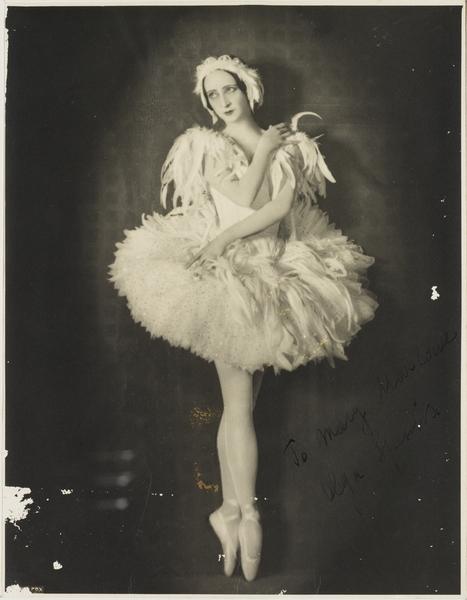
The official story as given to Australian newspapers was that Spessivtseva sprained her ankle. Melbourne’s Argus newspaper reported on 1 December 1934, the day the Melbourne season was to begin:
‘A week before the end of the Sydney season the company suffered a severe loss when the first ballerina, Olga Spessiva, sprained her ankle. Mme Spessiva is resting in Sydney and may not be able to appear again for several weeks.’
However, Harcourt Algeranoff, who also danced with the company on this tour and whose letters to his mother provide a wealth of information about the company, has a slightly different version of events. Writing from Melbourne on 2 December 1934 his inside information is that Spessivtseva had already left for Europe:
We’ve had rather a blow as Spessiva is ill and although it is no known publicly, she’s sailed for Europe. She has promised to rejoin us some months hence when she is better.’
Dolin, however, gives a quite different account of Spessivtseva’s movements. He maintains that Spessivtseva was sent to recuperate in the Blue Mountains west of Sydney for some weeks after her last performance in Sydney. Although no evidence for the Blue Mountains story, other than Dolin’s account, has yet come to light it does have a certain plausible aspect to it. In his unpublished work ‘For Olga Spessivtzeva. A memoir of loving’ Dale Fern suggests that what has not been fully recognised is that Spessivtseva was physically frail during her dancing career. He writes:
‘What was consistently overlooked, by managers and dancers alike, in 1916 [her appearances with Diaghilev’s Ballets Russes in the United States], in 1921 [her performances in Diaghilev’s Sleeping Princess], and in 1934 [her tour with the Dandré-Levitoff company], was Olga’s frail constitution, her delicate physical condition. She was not well. Tuberculosis visited her regularly.’
In the late 1800s and early 1900s, the crisp mountain air found in the Blue Mountains was promoted to Sydneysiders as a kind of health tonic for many ailments including, according to Blue Mountains Park historical information, tuberculosis, asthma, bronchitis, malaria, stress, anaemia, and heart troubles. In the early part of the twentieth century, the small town of Wentworth Falls in the heart of the Blue Mountains was the site of two very well known institutions — the Queen Victoria Home and Bodington Sanatorium — both of which cared for patients with tuberculosis. In addition, the Hydro-Majestic Hotel, located higher into the mountains at the village of Medlow Bath, was built by Mark Foy of the wealthy Australian retail family as a ‘hydropathic sanatorium’. Unlike the Wentworth Falls institutions, where conditions appear to have been spartan and somewhat unpleasant according to the patients who have reported on life there, the Hydro-Majestic and its surrounds were a prestigious and socially desirable health retreat and its guests often included those prominent in the arts. The kinds of treatments available were listed in one promotional booklet. They included electric water and massage, electric light bath, vibration massage, general vibration massage, local hot air, local general massage, and various medicated baths.
It is conceivable that Spessivtseva, if indeed she did go to the Blue Mountains, may have gone to the Hydro-Majestic. But if Algeranoff was correct, Spessivtseva had no time to recuperate in the Blue Mountains or anywhere else before boarding a ship. However, ships’ passenger lists from Sydney that include her name, or that of her companion Leonard G. Braun, that might confirm such a departure remain to be located.
With regard to the official account of a sprained ankle, it was more than likely simply a story concocted by company management to explain to Melbourne audiences the fact that Spessivtseva was not performing there as previously advertised. Her name appeared as star attraction in Melbourne advertisements up until 28 November. By 29 November all reference to stars had been removed and by 30 November it was Natasha Bojkovich whose name was being promoted in Melbourne.
Nevertheless, just exactly what happened remains a mystery at this point. Spessivtseva’s name continued to be listed in newspaper advertisements for the last Sydney shows but there is a curious absence of reviews of the last program in the Sydney season and the last mention of her name in a performance seems to have occurred in The Sydney Morning Herald on 19 November when her performance in Raymonda was thought to be ‘cold’. In a review of the new program that opened on 24 November, the weekly newspaper Truth reported:
‘Owing to a slight indisposition, Spessiva did not dance. Her place was taken by Natasha Bojkovich, second ballerina of the company … The management announced that Spessiva will appear as usual tomorrow.’
Whether she appeared at all during the last week is questionable. Edward Pask in his Enter the colonies, dancing writes that she danced on the last night of the Sydney season but he quotes as his source ‘an [unidentified] observer at that performance’. Dolin also maintains that she performed on the last evening in Sydney. But neither gives any sound documentary reference to support his claim and it has to be assumed that neither attended performances in that last week to see for himself since Dolin was not in Australia at the time and Pask had not been born. As a counter report to Pask’s and Dolin’s comments, Valerie Lawson notes in an article in Brolga in December 2000 an unidentified, undated press clipping in a privately-held scrapbook that states:
‘[Spessiva] strained her ankle during the third week of the Sydney season and was ordered a brief rest by her doctor. She struggled on bravely for a few performances but was obliged to retire from the cast during the final week of the season.’
This report does, however, sound a little like an elaboration of the explanatory story given to Melbourne audiences. But as 1935 began, a further reference to Spessivtseva appeared in The Sydney Morning Herald as part of a summary of the previous year’s theatrical highlights. It supports Algeranoff’s account that Spessivtseva returned to Europe and alludes to her ill health:
‘Spessiva, who had been billed as the leader of the company, danced at every performance at first; but made only brief appearances, and, as time passed it became apparent that she was ill at ease. Still she danced brilliantly in “Carnival” and dropped out of the cast only when she strained an ankle. Since then, it has been revealed that she was in ill-health during the whole of the Sydney season; and now she has had to return to Europe leaving Natasha Bojkovich as a highly-efficient substitute leader in Melbourne.’
The story of Spessivtseva in Australia continues to remain something of an unsolved mystery. Until further evidence emerges, her activities during and immediately after the Sydney season continue to raise questions.
© Michelle Potter, 25 August 2010
Note: My substantial article on the Dandré-Levitoff Russian Ballet tour to South Africa, Singapore, Java, Australia, Ceylon, India and Egypt during 1934 and 1935 is currently being considered for publication by Dance Research (Edinburgh University Press).
Update 5 December 2013: The article mentioned above was published in Dance Research, 29:1, Summer 2011. See also the tag Olga Spessivtseva for further posts and ongoing comments.
September 26, 2010
Dear Dr. Potter:
I read with interest your article about the Dandre-Levitoff Ballet tour in Australia in 1934-35. It was not the first time that Olga Spessivtseva prematurely left an ongoing tour midway. In October, 1916 she arrived in New York to go on the cross-country 52-city American tour of the Ballet Russe with Nijinsky. Olga was to dance only four times a week. With her mother Jusdtyna as chaperone Olga was given her own private accomodations on the train. Yet the grueling, relentless tour of one-night stands across America proved too punishing for Olga’s frail, delicate health. After New Year’s Day, 1917 she left the tour in San Francisco and returned by train to New York. She sailed back to St. Petersburg, just in time to witness the start of the Russian Revolution.
There is evidence to support your contention that Olga left Australia in early 1935 to return to Europe. US immigration records show that Olga
boarded the S/S Europa on March 30, 1935 in Cherbourg, France, arriving in New York on April 4, 1935. A copy of the passenger list can be obtained on: http://www.ancestry.com keyword: Olga Spessivtzewa.
I am reconstructing step-by-step the two American tours of Diaghilev’s Ballet Russe in 1916-1917. Any archival material, especially vintage photographs or ephemera, would be welcomed to enhance this American dance history project.
In the mutual pursuit to support all the performing arts through research and scholarship, I look forward to a positive response!
Best regards,
B
Dance historian
Thank you for this very interesting comment and for adding extra information to my search to understand what happened to Olga in Australia. The published material to date gives us so little sound documentary evidence with which to piece the story together, and what’s more most of it seems to be based on gossip or emotional involvement.
The sea journey from Australia to Europe took about 6 weeks and my ongoing task is to find exactly when and on what ship she left Australia, and from what port.
Should any material surface during my investigations that might be of interest to your project I would be more than happy to share it with you.
Dear Dr Potter
What fabulous research you have done on Olga. I have been researching her on and off since 1991. I am now compiling my information for a video essay for educational purposes and am very keen to something cleared up. I wonder if you and Boris Fedoff can help me?
Did Olga leave the USA Ballet Russe 1916-17 tour before the Company visited Charlie Chaplin at his studio or did she go and meet him. In Judith Mackrell’s book about Lydia Lopokova, Bloomsbury Ballerina, on page 101, a photo shows the Company with Chaplin and though it no-one other than Chaplin and Lopokova are identified I think Olga is front row 2nd in from left. The photo is dated as 1916. On page 115 Mackrell states that the Company visited Chaplin’s studio after Christmas – so essentially that must be between the 26th Dec and 30 Dec. Boris in your correspondance with Dr Potter here on this link – you say Olga left after New Years Day – so that means she must have been there. Dale Fern’s article about Olga in Dance Magazine 1960 says that in her later years she spoke of many things repeatly, one of them being Chaplin. I summise that she must have met Chaplin on that visit but information I gained from Jane Pritchard some years back indicated not. Can you help me with this please?
Thank you Suzanne for your comment. I looked at the photograph in Judith Mackrell’s book and it is hard to say if Spessivtseva is there. I am so used to photographs of her in costume, so often looking sad, that I was a bit taken aback by the smiling photo. My research has been focused essentially on her Australian journey and I know little about her activities in the US. I will make sure that I alert Boris to your comment and hope that he can help.
Thank you for your reply. Yes, I too have found it hard to identify her as a smile is so unexpected from her, however in the large group photo of her with the Dandre-Levitoff company where she is smiling straight to camera http://www.flickr.com/photos/statelibraryofnsw/4462991533/ you can see the definite similarities with the Chaplin photograph.
Tying in with what Boris says in his post of 26 September 2010, Gennady Smakov’s in his book The Great Russian Dancers (1984, p154) says “At the beginning of 1917, Spessivtseva returned to Petrograd..” So, as the photo was dated as between Christmas 1916 and new years day 1917, she must have been there – though of course not necessarily in the photo.
I look forward to hearing from Boris.
Many thanks for your help.
Suzanne
Suzanne, My attempts to contact Boris Fedoff through the details he left with his previous posts have failed I’m afraid. I have had ‘undeliverable’ notices from the ‘postmaster’. I can just hope now that Boris finds your comments through a search engine.
Re the photo link you sent, I have used two photos from the same Sam Hood shoot in my Dance Research article on the Dandre-Levitoff tours to South Africa and beyond (Summer 2011 issue), although in them Olga does not have the very bright smile captured in your image. But there are similarities, you are right, and your other evidence seems to confirm that she was there.
I hope we hear from Boris in due course.
Hi Michelle
I’m still on the Olga trail – she’s now the subject of my MA that I’m studying in London. I read that you went to the Library in Paris – I am considering going there. Would you happen to have a contact name/email and do you know if her diaries are there or in Russia?
Many thanks
Suzanne
Hi Suzanne
I had a very rushed time in Paris then (always do unfortunately) and a whole day was spent getting a permit to use the library at the Palais Garnier. That library is now part of the Bibliothèque nationale and I assumed (wrongly) that I could get a permit at the library in the Palais Garnier. But in fact I had to go elsewhere and by the time I found out where, got there, and went through the process, which involved a kind of interview in French, a whole day was gone! There seems to be a lot of Spessivtseva material in the Palais Garnier and the staff were exceedingly helpful once I got there. But I had a very specific focus and didn’t have time to delve into things that didn’t have a major bearing on her contract with Dandré. So I’m afraid I am not much help to you, other than offering encouragement to you to go. Much easier for you to get there than for me and I am sure you will find useful information. I found a few items on the BnF online catalogue, which is why I decided to go, but, once there, there seemed to be many other catalogues that weren’t online. I don’t have a name for you to contact I’m afraid – it was all whatever happened on the day.
Sorry I can’t be more helpful…but do go. It will be worth it I am sure.
Michelle
Thank you so much for being so incredibly helpful. I will definitely go and will endeavour to get the permits etc sorted out in advance. I’ll let you know how it goes.
Once again – thanks for being so encouraging.
Suzanne
Is the theory that Spessivtzeva was found in 1934 wandering in an Australian town outside SYDNEY not substantiated?
I have not been able to find any reliable documentation to substantiate that story. But, of course, that doesn’t mean it didn’t happen. It is clear to me from the research I did into Spessivtseva’s Australian sojourn that ‘management’ (that is Victor Dandré for the most part) did its level best to cover up what was happening and certainly someone wandering around in an agitated state was not good publicity. The ‘outside Sydney’ is interesting too and I wonder whether the Blue Mountains is too far Away to be ‘outside Sydney’. If she did go the the Blue Mountains to recover after her last performance, and I think that probably did happen, she could well have been wandering there. But it’s all surmise at the moment.
Thanks for you query.