Triple Bill: Lister/Weir/Horsman. Queensland Ballet

27 June 2025. The Playhouse, Queensland Performing Arts Centre, Brisbane

Queensland Ballet’s Triple Bill left me with mixed feelings. The opening work was Jack Lister’s Gemini, which in program notes is described as ‘A subterranean gathering harnessing both the earthly and the divine. A new world where myth and matter amass.’ To me it was an effort to bring to the fore the procedure of Gesamtkunstwerk where all the various elements that make up a show are given a strong presence and inform each other in some way. Musically we heard Dvorak’s Symphony No. 9 as a reimagined score by Louis Frere-Harvey. Lighting was interesting, although not hugely to my liking as it constantly cut out the movement created by the dancers. But music and lighting certainly had a strong presence.

A moment from Jack Lister’s Gemini. Queensland Ballet 2025. Photo: © David Kelly

But for me the choreography was an unimpressive addition to the whole. For some of the time there was no movement, just bodies standing in various groupings. When there was movement it was quite abrupt and geometric in look. At times it looked animalistic and at others it reminded me of a kind of calisthenics. It was all something of a disappointment.

The absolute standout was the second work on the program, Natalie Weir’s 4Seasons, a creation that was filled with fluid movement and curving shapes. There were some truly beautiful pas de deux sections—as we have come to expect from Weir. Some were quite acrobatic but always balletically acrobatic and I loved watching for how the male dancers held the females as they proceeded through the pas de deux. There were some spectacular solos too, especially from Ivan Surodeev as Summer and Joshua Ostermann as Winter (pictured below right).

It was also fulfilling to watch Weir’s use of the performing space throughout 4Seasons. Often a line of dancers across the space, or stretched vertically through the space, would break up with movements that flowed along those lines and seemingly reflected on interconnections between those engaged in a journey through life.

4Seasons was danced to Antonio Vivaldi’s The Four Seasons, with some sections recomposed by Max Richter. Its costumes were designed by Bruce McKinven and lighting came from Matthew Marshall.

The evening closed with Greg Horsman’s A Rhapsody in Motion. This is the third time I have watched Horsman’s Rhapsody and every time I have seen something new. On this occasion I was taken aback (pleasantly) by parts of the opening section in which Horsman explores a dancer’s engagement with the barre, that object with which every ballet dancer’s class begins and which Horsman sees ‘a seemingly simple tool that represents years of discipline and dedication’. I loved those moments when the dancers found an occasion to use the barre in ways that don’t usually happen. (I don’t remember a class where I was held upside down at the barre!)

Using the barre in unusual ways in Greg Horsman’s A Rhapsody in Motion. Photo: © David Kelly

I also enjoyed immensely the movement from barre to eventual performance complete with changed costumes (Zoe Griffiths) and with some exciting dancing from across the cast. A Rhapsody in Motion is a fast-paced production that opens new areas of interest at each viewing.

Queensland Ballet continues to go from strength to strength with displays of remarkable dancing.

Michelle Potter, 28 June 2025

Featured image: Libby-Rose Niederer in a moment from Greg Horsman’s Rhapsody in Motion. Queensland Ballet, 2025. Photo: © David Kelly

Libby-Rose Niederer in a moment from her 'Arohanui'

60 dancers: 60 stories. Queensland Ballet. Week 1

Art must prevail

In something of a pioneering move, Queensland Ballet has set up a project called 60 dancers: 60 stories to manage the COVID-19 situation. It is in part a fund raising move and a field requesting donations is present at various stages—and why not? The arts have been badly hit in more ways than one and 60 dancers: 60 stories is Queensland Ballet’s pledge to its dancers and other personnel to keep working as hard as possible to keep everyone employed for as long as possible—’to keep the magic alive’.

But the project also has a strong creative underpinning. In the company’s 60th year, Queensland Ballet has asked its 60 dancers to choreograph and film a short dance work (most are between 2 and 3 minutes) to screen to audiences. Each day in the month of June, two of these creations are being released via the company’s website. Week one has just finished and the variety, in terms of choreography, approach to the theme of love, filming techniques, use of music, pretty much everything, has been astonishing. ‘Art must prevail’ is part of the introductory text. And so it must, and does with this project.

I have truly enjoyed watching every one of the 14 works screened in the first week, although one work really stood out for me—Libby-Rose Niederer’s Arohanui. Niederer is a New Zealander by birth and initial training and joined Queensland Ballet in 2017 as a Jette Parker Young Artist. She is currently a Company Artist. In her introductory text to Arohanui she writes:

Aroha is Maori for ‘love’ and Arohanui loosely translates to ‘big love’ meaning beyond that for a person or community. This word describes how I feel towards nature, especially the wild beauty of my homeland Aotearoa. It reminds me to live life in gratefulness and with amazement for the natural world which brings me love and joy.

Arohanui takes place outdoors (as you might expect from Niederehr’s comments)—in a beautiful fern-filled forest, which you can see in the featured image to this post; on an isolated beach; in the entrance/exit to a large rock-cave; and amazingly on a stony stretch between land and water. Niederer’s performance is magic from the moment we see her unfold her leg to the side while using the trunk of a tree as a barre. Her body just flows along with the Puccini music she has chosen and every step is filled with joy and beauty.

I also enjoyed the camera work in Prelude danced by Lucy Green and Sam Packer to music composed and played by Peter Wilson. There were some lovely camera angles and fade-in/fade-out moments.
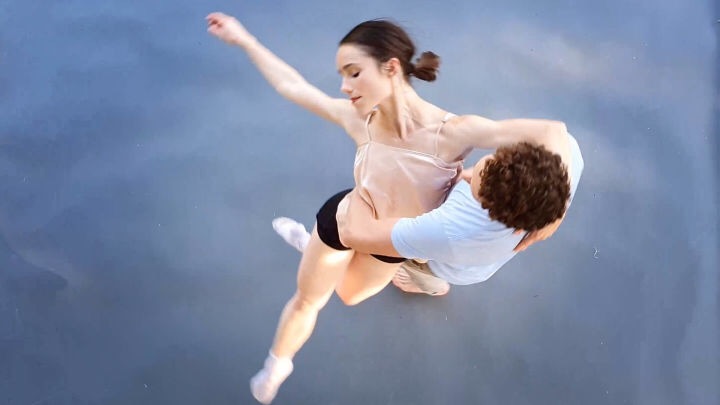
Lucy Green and Sam Packer in a moment from Prelude

Then there was a sophisticated piece, Caricias, from Yanela Piñera and Camilo Ramos and a rather jaunty work, En-counter, from Kohei Iwamoto and Isabella Swietlicki. But these are simply my preferences and I take nothing away from the artists of Queensland Ballet who have given so much.

If you log in to the website to watch, don’t miss the quite fascinating item I love to turn, which is inspired by Li Cunxin’s pirouette coaching classes. It begins with a dancer showing a very carefully prepared and executed single pirouette. Then follows a variety of turns, multiple turns, from several dancers finishing with Li demonstrating his ‘Unvingtuple’. But don’t switch off before you have read the concluding credits.
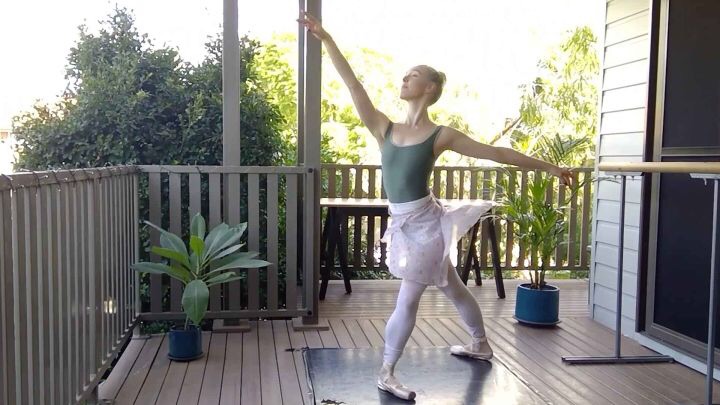
A moment from I love to turn

I’m looking forward to next week’s surprises. The link to ‘60 dancers: 60 stories’ is here.

Michelle Potter, 7 June 2020

Featured image: Libby-Rose Niederer in a moment from Arohanui
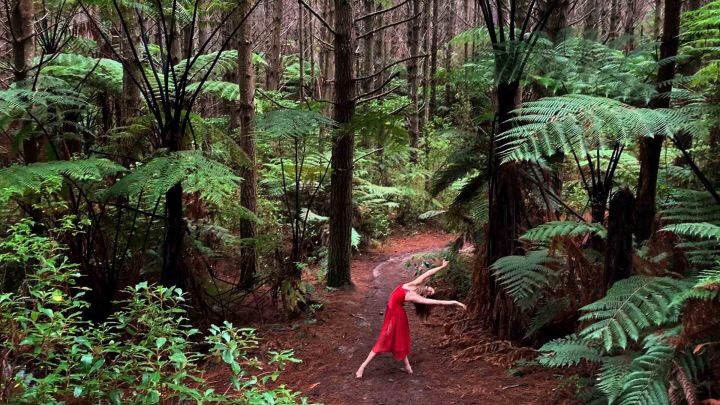
Libby-Rose Niederer in a moment from her 'Arohanui'