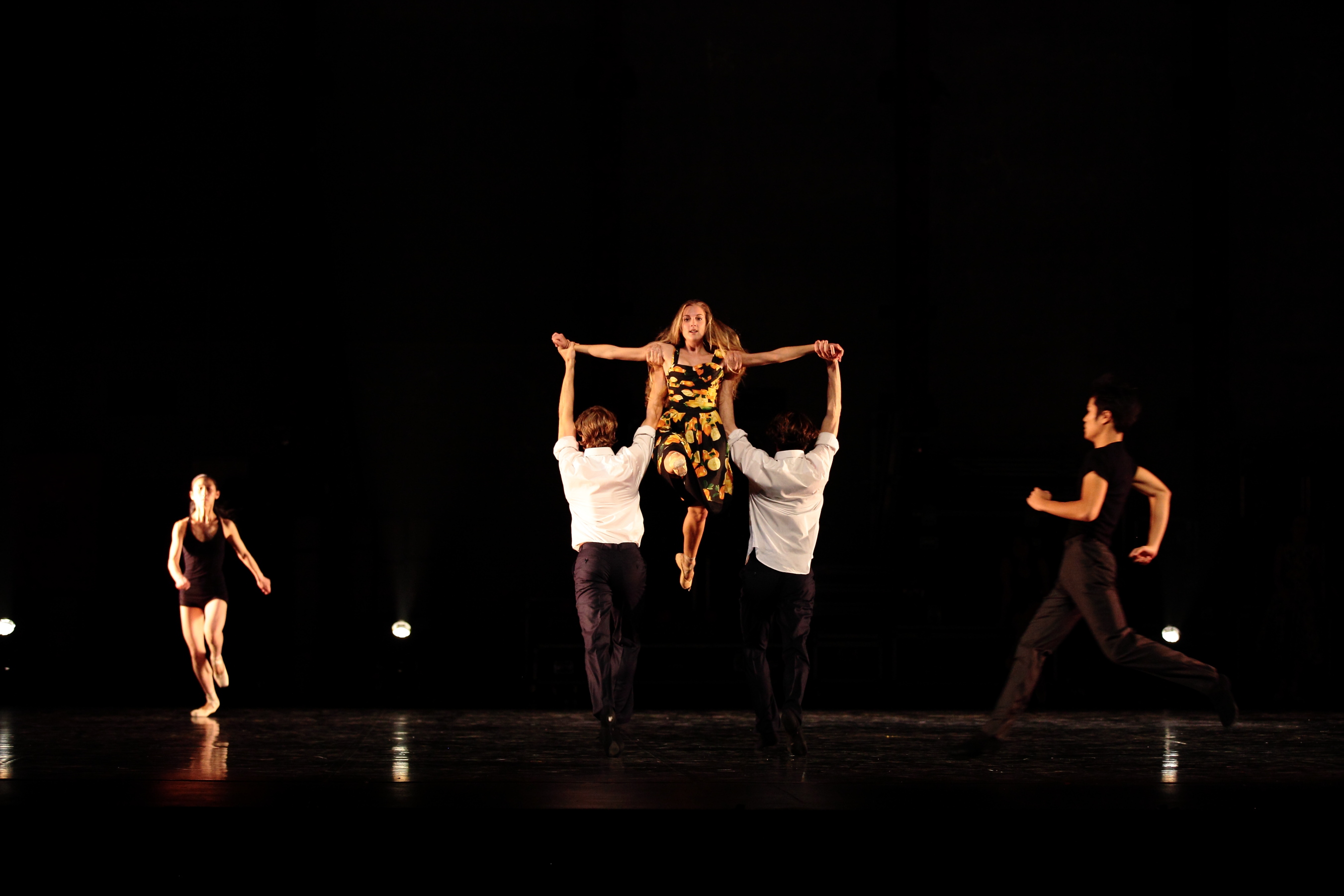
GEMS. L.A. Dance Project

7 September, 2025 (matinee). The Playhouse, Queensland Performing Arts Centre, Brisbane Festival

Brisbane Festival media announcements for Benjamin Millepied’s Gems have frequently stressed that Gems, a work in three parts, reflects George Balanchine’s Jewels, also a three part work. It is an interesting, but perhaps confusing comment. Millepied of course danced with New York City Ballet (NYCB) and I was lucky enough to see him perform with NYCB in Jewels in 2010. Then I was impressed with his dancing in ‘Rubies’, the second section of Jewels. I referred to him in my review as ‘a boisterous Benjamin Millepied’.

Had the media not been so insistent that Millepied’s Gems reflected Balanchine’s Jewels I doubt I would have thought of making a connection. But Gems was not only a work in three parts but was made in collaboration with Van Cleef and Arpels, an upmarket and creative jewellery organisation. Charles Arpels, a co-founder of the company, was in part responsible for the development of Balanchine’s Jewels, so a connection of sorts is not beyond the realms of possibility..

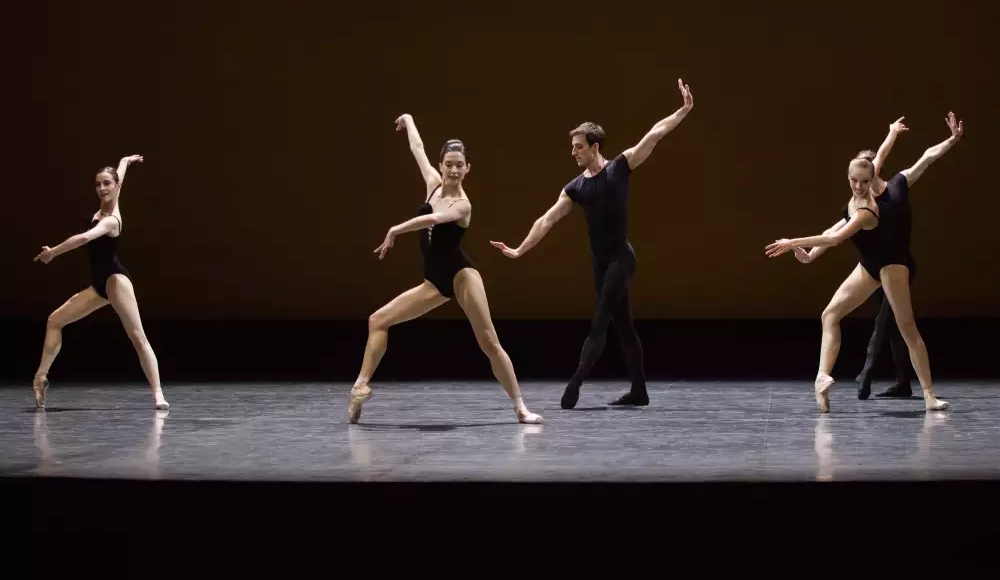
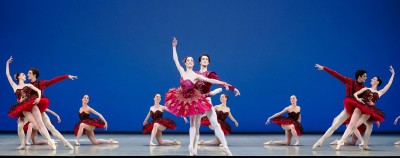
The standout section for me was the second item, ‘Hearts and Arrows’, which Millepied made in 2014. Performed to a selection of music by Philip Glass, with arresting costumes of black tops of various designs with black and white skirts or shorts for the dancers, it showed Millepied’s beautifully constructed choreography that pushed the boundaries of classical dance into a contemporary mode of groupings and poses.

A moment in the section ‘Hearts and Arrows’ from Gems. Photographer not identified.

I was staggered by the brilliant dancing of one of the dancers (unknown to me by name but the tallest of the eight dancers who made up the company on this occasion). The pirouettes, tours en l’air and other airborne steps on view were so well placed and perfectly executed. Just spectacular.

The least arresting section for me was the first item on the program, ‘Reflections’ originally made in 2013 and performed to music by David Lang. It was danced in front of a bright red backcloth with the word STAY emblazoned in white across it, and on a red floorcloth with white writing on it that was hard to see from close up (I was sitting in row F of the stalls). One really needed to be seated upstairs in a gallery seat to look down on the wording.

It was not easy to focus on the choreography when the words seemed to take over (visual concept by Barbara Kruger). The writing on the floorcloth was something about ‘thinking of you’ and program notes say the section concerned ‘presence and absence, desire and memory’. But it would have had more effect I think had the so-called visual concept not pushed the choreography into the background. In addition the costumes were not as theatrical as I would have expected. Those track pants (not seen in the header image but very obvious in Brisbane) were not attractive.

The final section, ‘On the Other Side’, was also performed to a score from Philip Glass and took place in front of backcloth showing an art work by Mark Bradford.

A moment in the section ‘On the Other Side’ from Gems. Photographer not identified.


Program notes say this section traced ‘the bonds between individuals and the quiet strength of collective experience’. It was perhaps a trifle long but it showed Millepied again working with classically trained bodies and making complex groupings, and often focussing on very moving moments of stillness.

A breathtaking moment occurred (more than once too), for example, when one of the dancers took a pose with upper body and head bent back but with one arm stretching forward. The pose was held for several seconds before the dancer folded her body into another pose. Simplicity perfected.

The true highlight of Gems, however, was the exceptional dancing of all eight dancers throughout the three sections. There was quite a bit of ‘grounded’ work, which was something that Balanchine avoided but which is commonplace in contemporary dance. But what stood out was the way the bodies of all eight dancers were managed by Millepied in ways that did to a certain extent recall a Balanchine choreographic mode, but that had been manipulated in quite complex ways to create a new, contemporary look.

Shortly after Balanchine’s Jewels was first presented in New York in 1967 a journalist wrote, ‘Though there’s no important meaning in the fact that Jewels is the “first abstract three-act ballet”, there’s lots of good copy in the phrase.’* I suspect that comparisons between Gems and Jewels is also ‘good copy’, but is perhaps just an unecessary comparison.

The three sections of Gems were put together for the first time for the Brisbane Festival. The work had much to offer in opening up a look at how dance can absorb much, and how in the hands of an exceptional choreographer can be developed into a particularly different mode of expression.

Michelle Potter, 8 September 2025

Featured image: A moment from ‘Reflections’ the first section of Benjamin Millepied’s Gems.


All images used in this review come from internet sources and are not necessarily from the Brisbane performances.

*See the section on Jewels in The International Dictionary of Ballet (Detroit: St James Press, 1993). Volume 1: A-K, p. 721.

I attended Gems as a member of the general public. My ticket cost $120.

Dance diary. May 2017

  • Canberra dance: funding news

In the dire funding situation affecting dance artists across the country, it was a thrill to hear from Liz Lea that her third science show for schools, Reef UP!, has been funded by the Queensland Government under their Engaging Science Grant Program.

Lea, ever resourceful when it comes to collaborating and seeking funding, has previously presented science-oriented shows called Flying Facts and Star Struck in collaboration with the Queensland Music Festival. She received an ACT seed grant last year to begin research on Reef UP! Discussing Lea’s plans for her children’s shows I wrote last year:

Flying Facts began from a seeding grant Lea received to develop a show, eventually named InFlight, which examined Australian aviation history using materials in the National Library and the National Film and Sound Archive. During the research period, Questacon [the National Science and Technology Centre] asked Lea if a science component could be incorporated. InFlight went ahead as planned but a children’s show looking at how planes and birds fly, Flying Facts, also emerged and scored considerable success. The other children’s show, Star Struck, grew from work Lea did with astronomers and scientists from Mount Stromlo Observatory. It explores the astronomy of the northern and southern constellations and now Lea is exploring the possibility of a new collaboration with Mount Stromlo incorporating dancers from Australia and Singapore. And, fascinated by David Attenborough’s work on the fate of the Great Barrier Reef, Lea is working on a new educational show with characters called Manta, Ray, Slinky the Shark and the like. She has a small grant to undertake further research for this show in Queensland.*

Reef UP! will have an opening season in October in Canberra before touring into regional schools across Queensland and will feature, in addition to Lea, Liesl Zink and Michael Smith.

Liz Lea in a moment from 'Star Struck'. Photo © Sam Rutledge
Liz Lea in a moment from Star Struck. Photo: © Sam Rutledge

In addition to Lea’s funding success, Alison Plevey and Australian Dance Party have received an ACT seed grant to work on a proposed show, Mine!, to premiere (further funding permitting) in August.

  • Zahira Madeleine Bullock (1927–2017)

I was saddened to hear of the death at the age of 90 of Zahira Madeleine Bullock, one of the standout figures in Canberra’s GOLD group. Her appearance in shows by the GOLDs will certainly be missed. I always enjoyed the way her dancing was incorporated into GOLD productions, and how she was assisted along the way by others in the group. She was also founder of Dances of Universal Peace in Australia.

Portrait of Zahira Madeleine Bullock. Photo © Lorna Sim

The video clip at below shows some moments from her dancing career with the GOLDs. Her opening remark on the clip— ‘I think it’s rubbish that dance is only for the young’—will live on forever.

  • Hannah O’Neill

Fans of Hannah O’Neill may be interested in watching the following short film, Ascension made by by Jacob Sutton in 2015, showing O’Neill and Germain Louvet dancing inside and outside the Palais Garnier. [Update: Link no longer available]

The venues used by Sutton in his film can be seen as well in the film Relève (Reset), which documents the first months of Benjamin Millepied’s directorship of Paris Opera Ballet. In particular, there are scenes in Relève that have been shot on the roof of the Palais Garnier, where O’Neill and Louvet execute that very beautiful (but somewhat terrifying) lift with O’Neill being carried along the edge of the roof in a grand jeté pose.

Michelle Potter, 31 May 2017

Featured image: Liz Lea in a moment from Star Struck. Photo: © Sam Rutledge

* Read the full article at this link.

Artists of Paris Opera Ballet in 'Herman Schmerman'. Photo: © Ann Ray/Opera national de Paris

Merce Cunningham and William Forsythe. Paris Opera Ballet

22 April, 2017, Palais Garnier, Paris

Recently The Times (London) carried a short article entitled ‘Learn language while you wait for web page to load’. It concerned newly developed apps that ‘test you on vocabulary in idle moments, such as when you are connecting to a network or waiting for an instant message.’*  The timing of the article was serendipitous. It came to my attention as I was about to see Paris Opera Ballet’s triple bill, Merce Cunningham and William Forsythe. It seemed like it was an update to what Merce Cunningham was interested to explore with his Walkaround Time (1968), the first work on the POB program. I set off for the theatre with even more anticipation than usual. Cunningham truly was ahead of his time I mused.

The title Walkaround Time, according to Cunningham, comes from computer language. ‘You feed the computer information then you have to wait while it digests.’** Cunningham mentions, however, that it isn’t clear whether it is the computer or the user who is doing the walking around, although for him it is clearly the people!
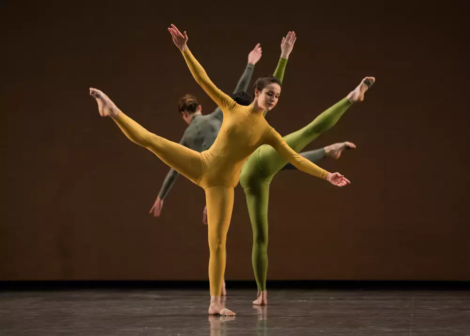
Artists of Paris Opera Ballet in Walkaround Time, 2017. Photo: Ann Ray/Opéra national de Paris

The dancers of POB handled the Cunningham choreography beautifully—staging was by ex-Cunningham dancers Jennifer Goggans and Meg Harper. I admired especially the dancer who took the role originally danced by Carolyn Brown. Many of the artists appearing in this program (at least at the performance I saw) were not high enough up in the POB hierarchy to warrant a photo in the printed program, so I don’t know who she was. In any case, she was exceptional in her ability to display the balance and stillness this role requires at times, but also showed a beautiful fullness to her dancing when moving was part of the choreography. But all the dancers I saw, with their finely honed bodies and inbuilt understanding of shape and space, brought a wonderful quality to the work, showing as they did the clarity of Cunningham’s deceptively simple choreography.

Jasper Johns’ set, which referred to Marcel Duchamp’s dada-ist Large Glass, and David Behrman’s score …for nearly an hour…, set the work firmly within the Cunningham collaborative tradition, highlighting the independence of the collaborative elements. Watching Walkaround Time was a truly evocative and quite exciting experience.

The first of the two works by William Forsythe that made up the rest of the program was Trio. It had some conceptual similarities to the Cunningham piece, even though Forsythe, unlike Cunningham, works within the vocabulary of classical ballet. Trio was a kind of slapstick piece, reminding me a little of something from Cirque du soleil. The dancers came forward pointing out different parts of their body in between dancing and engaging in a kind of rough and tumble physical contact. But, with its stop-start musical accompaniment (a Quartet by Beethoven), and with several sections of dancing being executed in silence, the link back to Cunningham was uncanny.

Herman Schmerman, consists of two parts (made at different times in the 1990s)—a pas de cinq followed by a pas de deux. It probably was the work that showed the dancers of Paris Opera Ballet at their balletic best. The pas de cinq, fast-paced and showy, gave them the opportunity to display speed, intricate beaten work and extended limbs. I especially enjoyed the dancing of Chun Wing Lam. He moved brilliantly, using every part of his body. He twisted, turned, bent all ways, moved so smoothly and fluidly, and looked as though he was having the best time. Wonderful to watch.

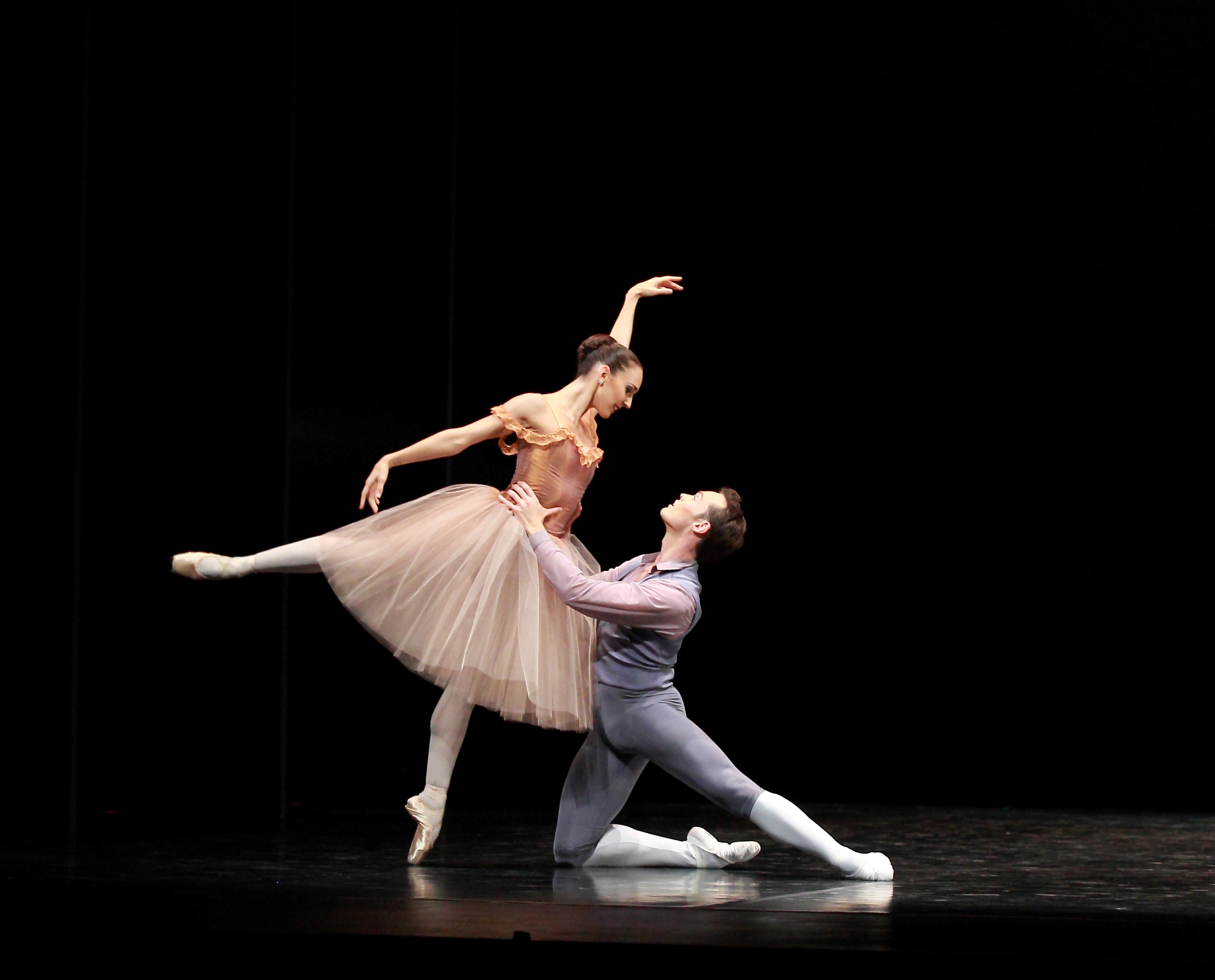
The pas de deux, danced by Aurélia Bellett and Aurélien Houette, was a little unusual. In its vocabulary, it had Forsythe’s signature elements of extended limbs, off-centre poses, startling lifts, and the like, scattered throughout the piece. But the communication between the two dancers was not what one might have expected. They were sometimes off-hand with each other, and sometimes they seemed to be in teasing mode. They were a little cheeky and often amusing in the way they related to each other. A bit like life really.

Both the pas de cinq and pas de deux had delightful and surprising endings. As the pas de cinq came to an end, all five dancers disappeared behind a low barrier that stretched across the back of the stage. The accompanying lighting, by Tanji Rühl and Forsythe, was gorgeous and was enhanced by the appearance of two large orange/yellow circles of light on the backcloth as the dancers popped their heads up over the barrier. In a similarly surprising and delightful way, towards the end of the pas de deux both the woman and the man added short, yellow, pleated skirts over their black, close-fitting costumes (costume design by Gianni Versace and Forsythe) and continued the dance with skirts swinging jauntily.

Merce Cunningham and William Forsythe was an inspired program. It was through the vision of Benjamin Millepied, now no longer dance director of POB, that these three works entered the repertoire. Together they made up a program that clearly showed what dance can accomplish in the hands of two exceptional intellects and two inquiring choreographic minds.

Michelle Potter, 24 April 2017

Featured image: Artists of Paris Opera Ballet in Herman Schmerman, 2017. Photo: © Ann Ray/Opéra national de Paris
* The Times (London), 22 April 2017, p. 5
** Quoted in the app Merce Cunningham 65 Years
Dance diary. October 2015

  • The return of Ochres

Bangarra Dance Theatre has a special program coming up at the end of November—a brief revival of Ochres at Carriageworks in Sydney beginning on 27 November.

Tara Gower in a study for 'Ochres'. Bangarra Dance Theatre, 2015. Photo: © Edward Mulvihill
Tara Gower in study for Ochres. Bangarra Dance Theatre, 2015. Photo: © Edward Mulvihill

Ochres was one of Bangarra’s earliest works and is still regarded as a milestone in the company’s history. Co-choreographed by Stephen Page and Bernadette Walong, it was first performed in Sydney in 1994. In 1995 it came to Canberra as part of the National Festival of Australian Theatre, the brainchild of Robyn Archer and for a few years one of the highlights of the theatre scene in Canberra. Anyone who was lucky enough to see Ochres back then in its first years will never, I am sure, forget Djakapurra Munyarryun smearing his body with yellow ochre as the work began.

Looking back through my archive, I discovered a review I had written for Muse, a monthly arts magazine produced in Canberra and initially edited by Helen Musa (Muse—like the Festival—is now, sadly, defunct). Re-reading the review I found I had speculated in 1995 on how Bangarra would develop in future years, especially in regard to the growth of a recognisable Bangarra style and vocabulary. Well that has certainly happened and it will be interesting to look back on Ochres as an early work in which Page and Walong were testing ways of doing just that—setting Bangarra on a journey to discover a contemporary, indigenous dance style.

  • Hannah O’Neill

One of my favourite French dance sites, Danses avec la plume, recently posted some news about Hannah O’Neill and the up-and-coming competitive examinations for promotion within the Paris Opera Ballet. Female dancers will face the jury on 3 November. O’Neill’s name has been suggested on a number of occasions for promotion into one of two positions as principal dancer. One author suggests O’Neill is an Etoile in the making and the future of the company! (Une promotion d’Hannah O’Neill me plairait beaucoup aussi. C’est une danseuse brillante, une future Étoile, elle est l’avenir de la troupe.)

The word is too that Benjamin Millepied, now directing Paris Opera Ballet, would have liked to have dispensed with this ingrained competitive system of promotion, but the dancers voted that it remain.

See this link for what is currently ‘trending’ regarding the promotions, and follow this this link to see an image of O’Neill (taken by Isabelle Aubert) with Pierre Lacotte after a performance of Lacotte’s production of Paquita. [UPDATE: Link to Paquita image no longer available}

  • All the things: QL2 Dance

As an annual event on its performance calendar, QL2 Dance produces a short program of dance for its young and less experienced dancers, aged from 8 to 17. This year the program, All the Things, included choreography by Ruth Osborne, Jamie Winbank, Alison Plevey and Joshua Lowe with perhaps the most interesting moments coming from Plevey’s ‘girly’ piece about shopping, ‘Material Matters’, and Joshua Lowe’s male-oriented ‘I Need’ about ‘needing’ technological devices in one’s life. It was an entertaining, if somewhat sexist juxtaposition of ideas in these two pieces, which had been strategically placed side by side in the program.

Scene from 'All the Things'. QL2 Dance, 2015. Photo: Lorna Sim
Scene from All the Things. QL2 Dance, 2015. Photo: © Lorna Sim

But the great thing about this annual event is the experience it gives these young dancers. James Batchelor (independent), Daniel Riley (Bangarra Dance Theatre) and Sam Young-Wright (Sydney Dance Company) are just three current professionals who had early dance experiences with Quantum Leap.

  • New book from photographer Lois Greenfield

One of the most pleasurable experiences I had while working in New York between 2006 and 2008 was visiting the studio of dance photographer Lois Greenfield. I was there to buy a collection of her images for the Jerome Robbins Dance Division. She is about to launch a new book. See this link for details.

  • Press for October

‘Lording it in high-tech high jinks.’ Review of Michael Flatley’s Lord of the Dance: Dangerous GamesThe Canberra Times, 9 October 2015, ‘Times 2’ pp. 6–7. Online version.

‘Sizzling and simply sensational.’ Review of Natalie Weir’s Carmen Sweet for Expressions Dance Company. The Canberra Times, 13 October 2015, ‘Times 2’ p. 6. Online version.

‘Dancing our way next year.’ Preview of dance in Canberra in 2016. The Canberra Times, 26 October 2015, ‘Times  2’ p. 6. Online version.

‘Listless on the Lake.’ Review of Swan Lake by the Russian National Ballet Theatre. The Canberra Times, 31 October 2015, ARTS, p. 20. Online version .

Michelle Potter, 31 October 2015

Le palais de cristal & Daphnis et Chloé. Paris Opera Ballet

Watching dance on the big screen has many pleasures. Perhaps the biggest joy these days is being able to see, so soon after a premiere, works presented by major companies from the other side of the world. The recent screening in Australia of a filmed performance from the Paris Opera Ballet is a case in point. Filmed just days after the opening at the Opéra Bastille, this program brought together Le palais de cristal from George Balanchine and Daphnis et Chloé, a new work from Benjamin Millepied, shortly to take over at POB from Brigitte Lefèvre.

Le palais de cristal opened the program. Made by Balanchine in 1947 especially for POB, it is better known around the world in a revised form as Symphony in C. One of the aspects of the filming that I especially liked was that the recording was often made from a position high up in the theatre. As a result the precise and very formal patterns Balanchine created for Le palais de cristal were easily appreciated. But we were also given many occasions to see the dancers as if we were  sitting in the best seats in the house. The closer shots provided a good view of the costumes, newly designed by Christian Lacroix. Some have seen them as overly decorative. I thought they suited the work and I was especially fascinated by the tutus for the corps de ballet. They seemed to have a hoop-like addition to the skirt that gave them a kind of puff-ball look.

But of course the highlight was the dancing. It is always amazing to see the precision of the dancers of the Paris Opera Ballet. Never a foot wrong! One dancer from amongst the soloists stood out. Not knowing the dancers as much as I would like I don’t know her name but she was, I think, of Japanese extraction. What appealed to me was the way she stepped forward into the space in front of her, generously, and the way her movements seemed to have an ongoing existence. A lift of the arm didn’t finish at the finger tips but looked as though it continued through space. Beautiful.

Paris Opera Ballet, 'Le palais de cristal'. Photo: © Agathe Poupeney
Amandine Albisson, Matthieu Ganio and dancers of the Paris Opera Ballet in Le palais de cristal, 1st movement. Photo: © Agathe Poupeney

Daphnis et Chloé had a certain fascination, given that I remain an admirer of Graeme Murphy and his works made for Sydney Dance Company made over a thirty year period between the mid 1970s and the early 2000s. Murphy’s Daphnis and Chloe, made in 1980 and designed by Kristian Fredrikson, could not have been further apart from that of Millepied. But I have no wish to make a comparison, just a comment on what a different take it was, visually, choreographically and in terms of portrayal of the narrative.

I found Millepied’s work hard to follow. The choreography certainly flowed and there were some lovely moments of mass movement from the corps. But the storyline wasn’t really conveyed strongly. It was something of a cross between a story ballet and an abstraction, but in the end neither. The standout dancer was François Alu as Bryaxis. Millepied gave him a solo full of spectacular jumps and turns and he rose to the occasion.

Daniel Buren’s large, brightly coloured shapes that descended from the flies and then withdrew back upwards were beautiful in themselves but they didn’t help with understanding the story. In the interview Buren gave to Mme Lefèvre prior to the start of the performance he talked about voids and the idea of occupying space. He is a conceptual artist but the concept he was aiming for with his design to my mind didn’t help the ballet. And why, at the conclusion of the ballet, were the dancers’ costumes transformed into colour from the white they were throughout the rest of the work? At the same time, Buren’s shapes were removed only to reappear a little later for a curtain call. The whole thing escaped me. I wondered whether, for this work, I would have been more satisfied had I been in the theatre watching live.

Despite my problems with Daphnis et Chloé, it is always a huge pleasure watching Paris Opera Ballet performances. The practice of filming live and then transmitting around the world is a great initiative. May it continue.

Michelle Potter, 30 July 2014

Some thoughts on Giselle and the Paris Opera Ballet

Interesting news from Paris is that Benjamin Millepied will take up the position of Director of Dance at the Paris Opera Ballet following the retirement of Brigitte Lefèvre in 2014. Millepied, dancer and choreographer whose performing career has included a significant stretch of time with New York City Ballet where he rose from corps dancer to principal, is perhaps best known to a wider public for his work with Natalie Portman on the movie Black Swan. Millepied’s stage choreography was most recently seen in the southern hemisphere in 2012 in the Royal New Zealand Ballet season of NYC. RNZB staged Millepied’s 2005 work 28 variations on a theme by Paganini.  

Meanwhile, the Paris Opera Ballet, a company with a long and illustrious heritage, opens its Sydney season of Giselle at the Capitol Theatre tomorrow. It has been a while since a full production of Giselle has been danced in Australia, and this is a perfect opportunity to see it performed by the company whose forebears danced it at its world premiere.

Giselle first took to the stage in Paris in 1841 at the theatre of the Paris Opera. The ballet was developed by a first-rate team of European creatives. Its libretto was written by poet and critic Théophile Gautier and dramatist Jules-Henri Vernoy de Saint-Georges and was based on a story by the German writer Heinrich Heine. Its music was composed by Adolphe Adam and its choreography created by Jean Coralli and Jules Perrot. On opening night the role of Giselle was danced by Italian ballerina Carlotta Grisi and her performance that night established her as a major star.

Since that opening performance Giselle has hardly been out of the ballet repertoire making it one of the most enduring of all the classics. It has undergone various changes over time, as happens with all works in the performing arts, but essentially it remains the story of a young peasant girl, Giselle, who falls for Albrecht, a nobleman in disguise. She has her heart broken and dies when it becomes clear that Albrecht is engaged to a noblewoman, Bathilde. Giselle returns in spirit form—as a Wili, that is a spirit of a betrothed girl who has died before her wedding night. Led by their queen, Myrthe, the Wilis are intent on pursuing to their death all men who enter the forest at night. It falls to Giselle to save a grieving Albrecht from this fate.

But like all works of art that have endured over centuries, Giselle takes place in a complex world. We encounter many differences of life-style—peasants appear alongside noblemen; and different realms of nature—a fertile countryside where a bountiful grape harvest is celebrated in Act I contrasts with a forest graveyard and the chill of night in Act II. In the Paris Opera Ballet production flower symbolism also plays a significant role. White flowers appear in both acts. They are daisies and field flowers in Act I. Giselle’s peasant admirer, the gamekeeper Hilarion, leaves a bouquet of white daisies outside Giselle’s cottage rather than the dead rabbit or bird he leaves in productions by many other companies. A single daisy also hints that all is not well when Giselle and Albrecht engage in the ‘he loves me, he loves me not’ game with daisy petals.

In Act II Hilarion returns with daisies for Giselle’s grave but the flowers of Act II include lilies, white roses and flowering myrtle, powerful symbols of love, immortality, purity, and in the case of myrtle used for centuries in bridal bouquets. The Queen of the Wilis, Myrthe, carries a branch of flowering myrtle as her sceptre; Albrecht enters with an armful of lilies for Giselle’s grave; Giselle pleads with Myrthe to spare Albrecht and a handful of white roses tumble from her arms and fall at Myrthe’s feet. The forces of nature are powerful throughout.

Giselle also presents us with a number of conundrums. Where or who is Giselle’s father for example? We only meet her mother, Berthe, who in Act I superstitiously tells the story of the Wilis and provides a foretaste of what will occur in Act II. Could the father be the Duke of Courland, who in Act I arrives with his hunting party and is served with refreshments by Berthe? In the Paris Opera Ballet production (at least on its current video manifestation) he takes a particular interest in Giselle, cupping her chin in his hands and looking into her eyes. He seems quite familiar with Berthe as well. And why did Giselle die? Was it of a broken heart? Was it from all the dancing in which we see her engage in Act I, just as Berthe prophesied? Or did she inherit a weak constitution? And how does she die? Does she stab herself with Albrecht’s sword, which Hilarion uses to expose Albrecht’s real identity? And what of Albrecht? Does he really love Giselle? Or is he living a lie and wreaking havoc on the life of a young peasant girl as he plays at being a peasant himself? Marie-Antoinette and her fake rustic village at Versailles come to mind.

The dancing itself in this Paris Opera Ballet production is almost flawless in a technical sense. In addition, the dancers, male and female, have an elegance and a perfection in the way they carry themselves that not only reflects their impeccable training but somehow also seems to reflect their royal heritage. The Paris Opera Ballet can trace its lineage back to 1661, when the French monarch Louis XIV, the Sun King, established the Académie royale de danse. Louis XIV was an enthusiastic and accomplished dancer himself. His familiar name, the Sun King, is reputed to date from his appearance as Apollo, god of the sun, in one of the sequences in Les Ballets de la nuit in 1653. He was just 14 at the time and was dressed in a costume replete with golden rays that fanned out around him as we imagine the rays of the sun radiate from a golden orb. Legend also has it that he had such slim and elegant ankles that he loved to pose with his heel pushed forward to show the royal ankles in all their glory. Ballet technique, the story goes, has been characterised by a ‘turn out’ of the feet and legs ever since.

There is so much to ponder on as the story of Giselle unfolds. I am filled with anticipation!

Giselle, Paris Opera Ballet, Capitol Theatre, Sydney, January 29–February 9

© Michelle Potter, 28 January 2013

Postscript (29 January 2013): Shame about the misspelling of Laurent Hilaire’s name in The Sydney Morning Herald‘s article (p. 7) this morning. Not a good advertisement  for Australian media on the morning of the Paris Opera Ballet’s opening. And, although the same article also notes that Millepied has no official ties with the Paris company, Millepied has made a work for the company, his Amoveo (2006).

NYC. Royal New Zealand Ballet

22 March 2012, St James Theate, Wellington

The first program by new artistic director of Royal New Zealand Ballet, Ethan Stiefel, opened in Wellington on 22 March. After a regional tour that began in Auckland in February the program, NYC: three short works from the Big Apple, had clearly worked itself into a very smooth operation by the time it reached Wellington. We saw a diverse, exuberant and beautifully danced show.

28 variations on a theme by Paganini
Antonia Hewitt and Brendan Bradshaw in 28 Variations on a theme by Paganini, 2012. Photo: © Evan Li. Courtesy Royal New Zealand Ballet

The program opened with 28 variations on a theme by Paganini, a work by Benjamin Millepied made originally in 2005. Danced to a piano score by Brahms, the choreography is as varied as the music. Under a single chandelier, and against a black background, five elegantly dressed couples whirl and swirl across the stage. Sometimes they dance in canon, often they execute fabulous lifts and move with unexpected changes of direction. They engage in a luscious performance of the classical vocabulary and occasionally there are subtle undercurrents that suggest relationships between them. I especially enjoyed the dancing of Bronte Kelly whose pleasure in being in this very dancerly work was patently clear.

There were, however, a few moments when for me the choreography was jarring. At one point Gillian Murphy entered walking on pointe, stiff-legged and looking a little like a dancer-doll who had suddenly stepped off a music box. Not even Murphy’s strong onstage presence and expressive face could save this section from looking out of place.

Scene from 'Final dress'
Dancers of the Royal New Zealand Ballet in Final dress, 2012. Photo: © Evan Li. Courtesy Royal New Zealand Ballet

Taking the middle spot on the program was Larry Keigwin’s Final dress, created especially for the Royal New Zealand Ballet and danced to a fast-paced score for violin, cello, clarinet and electric piano by Adam Crystal. On a stage stripped right back to basics, this work is full-on dancing from beginning to end. Mixing contemporary movement with more classical steps, the dancers explore the adrenalin rush associated with getting a show onstage. They run, throw themselves at each other and exude constant energy. I didn’t read into it what the program note told me it was about, ‘the boundaries between the public and the private, and the territories we guard’, but Final dress deservedly got a loud and enthusiastic reception as it came to an end.

Closing the evening was a performance of the vintage Balanchine work Who cares? set to a Hershey Kay arrangement of songs by George Gershwin. This is sassy Balanchine in his Hollywood/Broadway mode and to a certain extent it is a little outdated in terms of the dance style and era it references: it is four decades old, compared with later works in a similar vein such as Twyla Tharp’s Nine Sinatra Songs (made a mere two decades ago). But that aside, the dancers of the Royal New Zealand Ballet did themselves proud. Gillian Murphy and Paul Mathews danced an as smooth as silk pas de deux and the two other soloists, Abigail Boyle and Lucy Green, shone like Hollywood stars. I also admired the lovely-limbed dancer, Maree White, who took the middle spot in the line-up of the five chorus ladies.

A small grumble about the printed program: why didn’t it contain costume design credits? There wasn’t much to worry about with sets as there weren’t really any to fuss about, other than the New York skyline (minus the Chrysler Building) for Who cares? But the costume designers did deserve a billing, even if some costumes were apparently hired from New York-based ballet companies. Someone must have designed them. And why were there no captions for photos in the program? For those who are not regulars at Royal New Zealand Ballet performances it would have been nice if the dancers in some lovely photographs had been identified. But NYC was a wonderful start for Stiefel’s directorship and the prospect of more is definitely something to anticipate.

Michelle Potter, 23 March 2012

Dance diary. September 2011

  • Publication news

In September The Canberra Times published my preview of the Australian Ballet’s 2012 season, a review of the recent book The Ballets Russes in Australia and Beyond under the title ‘Dancing round a few home truths’, and my review of Graeme Murphy’s new take on Romeo and Juliet. Romeo and Juliet has certainly sparked some discussion and the amount of traffic that the extended review has generated over this website has been quite astonishing. It has more than quadrupled the previous record of visits to any one post. The suggestion that this Romeo and Juliet is just not a profound work has been made, not only in published comments but also in other communications to me. But whatever we think, it appears to be selling remarkably well and it will be interesting to see what Sydney audiences make of it when it opens there in December.

Editing and design began in September on an article of mine to be published in the December issue of The National Library Magazine. This article looks at the ballet designs of Arthur Boyd for Robert Helpmann’s Elektra, and those of Sidney Nolan for Kenneth MacMillan’s Rite of Spring. Both ballets were given their premieres by the Royal Ballet in London in the early 1960s. We’ve never seen the MacMillan Rite of Spring here in Australia, but Elektra was staged by the Australian Ballet in 1966 when there were some interesting changes to Boyd’s designs, which in fact had already undergone changes before they even made it to the Covent Garden stage.

joseph-janusaitis
Joseph Janusaitis in make-up for Elektra, the Australian Ballet, 1966. Photo by Walter Stringer. National Library of Australia
  • Nijinsky’s costume for Le Dieu bleu

While the Romeo and Juliet post has attracted instant interest, the post from late last year on Nijinsky’s costume for the Blue God quietly continues to generate visits. I was recently contacted by author Denise Heywood, whose book Cambodian dance: celebration of the gods was published in 2008 in Bangkok by River Books. The book is an interesting examination of the history of Cambodian dance and reproduces some remarkable photographs from across many decades. Denise suggests in her recent communication with me that it is not just the costume has links to the Khmer culture, as I suggested in the post, but the choreography for the ballet Le Dieu bleu must surely also have been influenced by Khmer dance, especially the ‘slow, statuesque movements’.

  • The Royal New Zealand Ballet

The Royal New Zealand Ballet has just announced its 2012 season, its first full year under the directorship of Ethan Stiefel. Stiefel will begin the year in February with a very American program entitled NYC, ‘New Young Classic’ (although the other meaning of that acronym is in there too). NYC will feature works by Larry Keigwin, Benjamin Millepied and George Balanchine. Keigwin has a big following in New York and he will create a new work on the dancers of RNZB. Millepied is now probably best known for his contribution to The Black Swan, but he has been making dances for several years for a range of high profile companies including New York City Ballet, American Ballet Theatre and the Paris Opera Ballet. RNZB will dance Millepied’s 28 Variations on a Theme by Paganini (2005).  The program will also include Who Cares?, Balanchine’s popular and beautifully polished work set to songs by George Gershwin.

Later in the year RNZB will restage its production of Christopher Hampson’s Cinderella and in November Gillian Murphy will take the lead role in a new staging of Giselle to be co-produced by Stiefel and that exceptional interpreter of the role of Albrecht, Johann Kobborg.

tonia-looker-2012-giselle-h-photo-ross-brown1
Tonia Looker in a study for Giselle 2012. Photo: © Ross Brown. Courtesy Royal New Zealand Ballet
  • Memory lane

Canberra is currently in the middle of Floriade, its annual celebration of spring (although the weather is decidedly cold). I have never forgotten a remarkable Floriade, the only one I have ever attended I have to admit, back in 1990. The Meryl Tankard Company was then Canberra’s resident dance company and Tankard staged Court of Flora outdoors against the backdrop of Commonwealth Gardens.

Inspired by the engravings in J. J. Grandville’s book, Les Fleurs animées first published in 1847, Court of Flora was given eleven performances in October 1990. Its spectacular costumes, designed by Sydney-based couturier Anthony Phillips, drew sighs of delight from audiences. So too did the ability of Tankard’s dancers to pose decoratively behind bushes and around trees while at the same time investing the flowers that they represented with clearly discernible human qualities, as indeed Grandville had done with his illustrations. In particular, an impish Paige Gordon as Thistle and an elegant Carmela Care as Rose still remain in the mind’s eye.

  • The Little Mermaid

I continue to be confounded by Rex Reid’s Little Mermaid, the version he made for Laurel Martyn’s Victorian Ballet Company in 1967. All sources seem to indicate that it opened as part of a mixed bill on 1 September 1967, but reviews seem to have appeared in Melbourne papers on the same day, 1 September. There is probably a simple explanation—perhaps there was a preview before 1 September to which reviewers were invited? But if anyone was there and can assure me that it did open on 1 September, despite reviews appearing on the same day, I would be thrilled to hear.

  • Site news

Traffic across the site during September increased by over 20% compared with August, due largely to the exceptional interest in Romeo and Juliet. The review attracted a large number of visits, more than any other post in the two year history of the site. Not surprisingly visits from Melbourne topped the list. Other Australian cities generating significant numbers of visits during September were, in order, Sydney, Canberra, Brisbane and Adelaide.

Some small updates will be made to the site in the next few weeks. On the home page I am having a link to the full tag cloud inserted under the list of top 20 tags. This will facilitate searching from the home page.

I am also having two new sub-pages added to the Resource page. One will be for National Library of Australia articles and will allow me to separate articles written for National Library of Australia News/The National Library Magazine from other online publications. The second will be for articles written for theatre programs.

Michelle Potter, 1 October 2011

Jewels. New York City Ballet

27 February 2010, David H. Koch Theater, Lincoln Center, New York

What a pleasure and a luxury it is to those whose home is not New York to see the full length Jewels. Made by Balanchine in 1967, each of its three distinct sections—’Emeralds’, ‘Rubies’ and ‘Diamonds’—is set to music by three different composers, Fauré for ‘Emeralds’, Stravinsky for ‘Rubies’ and Tschaikovsky for ‘Diamonds’. Many have suggested that Jewels is also in homage to three different countries—’Emeralds’ to France, ‘Rubies’ to Balanchine’s adopted homeland, America, and ‘Diamonds’ to Russia. But in the end, Jewels is an evening of delicious and diverse dancing.

‘Emeralds’ is at once moody and mysterious, romantic and sombre, and sometimes like a whisper in a forest glade. ‘Rubies’ is all sass and neon. ‘Diamonds’ is pure and clean, a dance in an arctic cave filled with cool yet intricate ice carvings.

The structure of ‘Emeralds’ calls for two leading couples. On this occasion Abi Stafford and Jared Angle were a gracious couple, transcendent in their pas de deux, while Sara Mearns and Jonathan Stafford showed breathtaking expressiveness and expansiveness of movement. Robert Fairchild was impressive as the male member of the pas de trois of soloists, showing his courteous partnering without losing his own strong presence.

‘Rubies’ showcased a pert and prancey Janie Taylor and a boisterous Benjamin Millepied. They were more than ably supported by Savannah Lowrey and a strong corps de ballet whipping off the clean, fast footwork, flicking wrists and eye catching head movements of this section.

The big disappointment, however, came with ‘Diamonds’. There were some uplifting moments—a polonaise for the corps de ballet that was just joyous Balanchine, for example. But Wendy Whelan and Philip Neal lacked attack in their pas de deux and so the brilliance and strength that should characterise this act was lost. And Whelan seemed hugely uncomfortable in her 1960s style ‘powder puff’ tutu.

New York City Ballet’s Jewels could well do with a redesign in my opinion. While choreographically it remains as modern as today, as the French ballerina Aurélie Dupont has remarked, both Karinska’s costumes and Peter Harvey’s scenery for New York City Ballet are fussy and look outmoded. Christian Lacroix and Brigitte Lefèvre have made the Paris Opera Ballet’s staging of Jewels a cut above that of New York City Ballet. Lacroix’s scenery verges on the minimalist and his costumes, while they recall those of Karinska, have a more contemporary feel (especially the tutus for ‘Diamonds’), which to my mind allows the choreography to maximise its ‘as modern as today’ image.

Michelle Potter, 13 March 2010