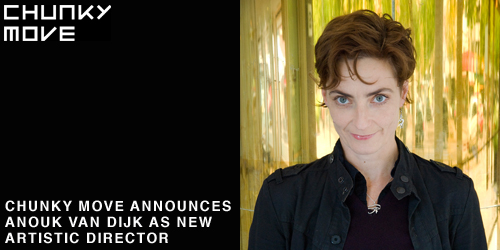
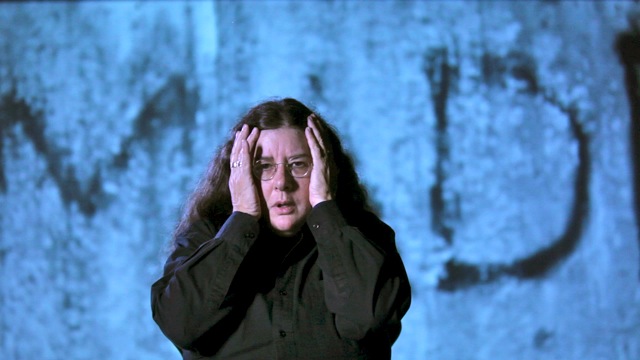
The Board of Chunky Move today announced that Anouk van Dijk will take over as Artistic Director following Gideon Obarzanek’s departure at the end of 2011.
Photo by Silvia Sztankovits
Anouk van Dijk is an internationally acclaimed choreographer, whose work has toured extensively throughout her home country of The Netherlands, and far beyond throughout Europe, North America, Asia and Australia. Her appointment builds on Chunky Move’s commitment to supporting the creation of dance that surprises and delights. Anouk’s work attracts broad audiences through an approach which is daring, innovative and unpredictable in both its form and context.
Anouk van Dijk began her career as a dancer, and for almost a decade was lead soloist with the Rotterdam Dance Group and Amanda Miller’s Pretty Ugly Dance Company. In 1998 she formed her own company, anoukvandijk dc creating work both distinctive and unpredictable which has toured the globe attracting broad audiences and critical acclaim. Her enthusiasm for collaboration with individual artists and companies has delivered vital and exciting co-productions – she is currently premiering the site specific, outdoor work MENSCH on the island of Terschelling (Netherlands), which then relocates (and reincarnates) to the sheds of the former Dutch Dock and Shipbuilding Company in Amsterdam. This follows the presentation of TRUST (a co-production between anoukvandijk dc and Schaubühne Berlin with regular creative collaborator, writer and director Falk Richter) which opened the 2011 Festival Transamerique in May after performing at the Perth International Festival of the Arts in February. Anouk’s work STAU performed in Australia at the Adelaide Festival of Arts and Sydney Opera House in 2006.
Anouk van Dijk will commence her hand-over part time from January 2012, relocating to Melbourne in June 2012 when she will assume the full time role of CEO and Artistic Director.
Bolero, by that remarkable duo Meryl Tankard and Régis Lansac, will have another European outing in April 2012. It will appear on a triple bill program by the Lyon Opera Ballet along with works by William Forsythe and Jiří Kylián. Is there any other Australian choreographer whose work can, over and over again, stand alongside those who are considered by most to be choreographic giants?
Bolero shows off Tankard’s capacity to create a vision of an ever-changing body in movement. It grows from earlier experiments with shadow play, which can be traced at least back to works made in Canberra—works such as Banshee and Nuti.
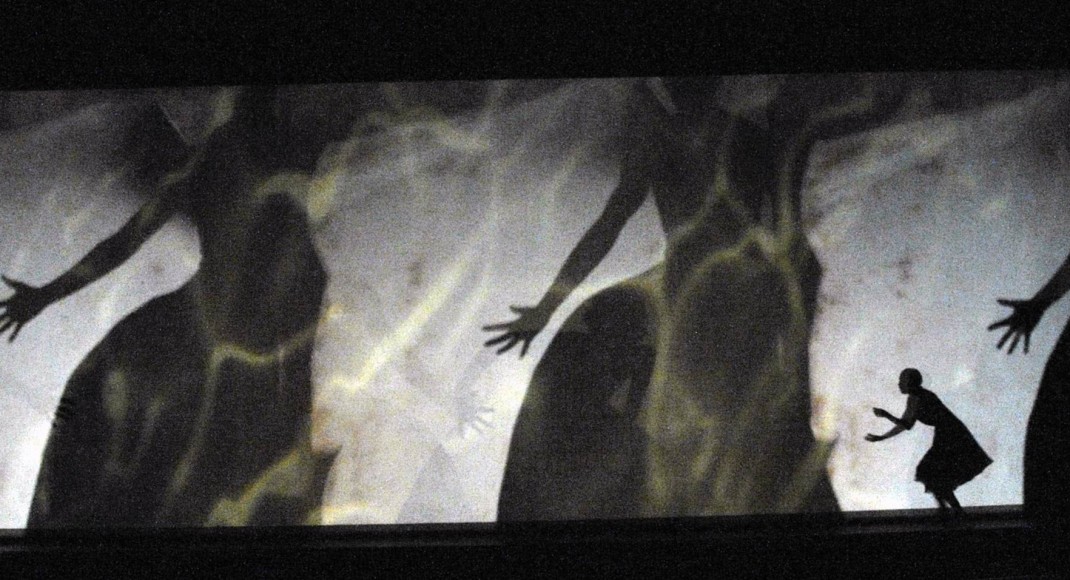
Bolero was first staged on commission from the Lyon Opera Ballet in 1998 shortly after Tankard had been dismissed as artistic director of Australian Dance Theatre. Its opening scene recalls a Javanese shadow play. Shadows in profile, delicately costumed in bell-shaped skirts with fretted designs are images of real dancers who are hidden behind a screen. As these dancers move across the stage space, they hold their arms in a way that casts two dimensional shapes onto the screen. They move jerkily through images of shadowy columns and disappear behind what appears to be the narrowest of slits between two architectural columns. They then re-emerge from this slim, vertical strip of light, and pursue their crossing of the space.
However, as the work proceeds—and it is performed entirely as a shadow play—the feeling of artificiality disappears. A feeling that this is a real world emerges, even though the audience is still involved in watching bodies behaving in mysterious ways. At one stage a man and a woman engage in a romantic interlude that changes emotional direction and ends with her being pushed to the ground. As she falls to the ground the floor swallows her up. The shadow of her body simply disappears from view. Further into the piece a Spanish dancer is joined by a headless woman and they dance alongside each other.
Set to the driving rhythms of Ravel’s Bolero, the dance gathers momentum along with the music. As both music and dance move to an inevitable climax, shadowy figures change size and shape and position. Some scurry across the space, some move with relentless slowness. There are multiple manifestations of the one figure. Frenzy and control. It is a technical tour de force for Lansac and a work in which the collaboration between Tankard and Lansac reaches a high point. The work was restaged in 2003 in Sweden by the GöteborgsOperans Balett but has never been seen in full in Australia.
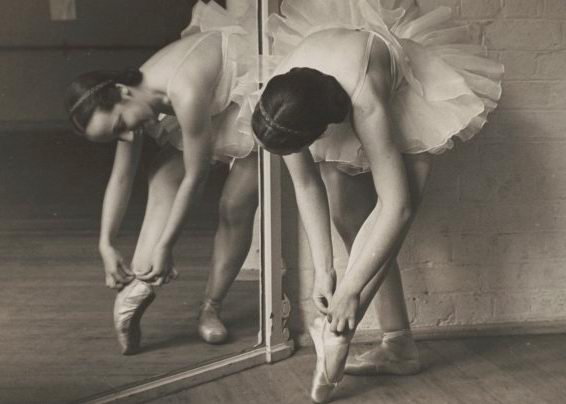
Rachel Cameron Parker, dancer and dance teacher who has died in London just a few weeks short of her 87th birthday, worked all her life to maintain the classical basis of ballet.
On a trip to Australia in 1976 Cameron told oral historian Hazel de Berg:
‘I want the pure classical basis of the ballet to continue. I want it to continue in England, the whole of Europe, America, and Australia, so that we can extend and continue to build on this basis. I feel that out of 200 pupils maybe only one will grasp the real significance of this basic work. But out of 200 or 300, one person is enough for it to be handed down to future generations. I don’t want it to be lost.’
Cameron was born in Brisbane but spent her early childhood in Townsville in northern Queensland before moving to Sydney aged about 5 or 6. In Sydney she began dancing lessons with Muriel Sievers who had studied in London with Phyllis Bedells and who taught the syllabus of the Royal Academy of Dancing, as it was then called. It was with Sievers that Cameron first began teaching as Sievers quickly had her helping teach the youngest classes on Saturday morning. Sievers also insisted that Cameron take piano lessons and also lent her Tamara Karsavina’s book Theatre Street.
In the early 1940s Cameron danced with the Borovansky Australian Ballet Company, which later became the professional Borovansky Ballet and then with the Kirsova Ballet in Sydney, a company led by former star of the Monte Carlo Russian Ballet, Hélène Kirsova. There were also opportunities for Cameron to develop her teaching skills in Kirsova’s school, which was firmly grounded in what Kirsova referred to as the ‘Russian method’.
Cameron was given major roles in a number of Kirsova’s works including Revolution of the Umbrellas, Faust, A Dream…and a Fairy Tale, Harlequin, and Hansel and Gretel. She has recalled that her happiest days as a dancer were with Kirsova:
‘She was a woman who tried to mould her company in the Diaghilev tradition where music, the scenery, the dancers became part of one whole, and there it was I think that the true beginnings of Australian ballet lie.’
Moving to England with her husband Keith Parker, Cameron danced in Song of Norway and in a company directed by Molly Lake. She also studied in Paris with former stars of the Russian Imperial Ballet, Lubov Egorova and Olga Preobrajenska, and with many notable English teachers including Anna Northcote.
By her own admission one of the most exciting periods of her life came when she was asked to demonstrate for two great teachers and former ballerinas—Lydia Sokolova and Tamara Karsavina. With Karsavina she also developed a teaching syllabus for the Royal Academy of Dance.
‘Sokolova was absolutely marvellous,’ Cameron once recalled. ‘She was not content with near being good enough, it had to be exact or else.’
Of Karasavina, she has recalled: ‘I found for the first time that what I had always dreamed of was true, and that’s why, now, I am such a stickler for perfection of technique.’
Cameron was guest teacher for many companies around the world including the Australian Ballet. In December 2010 she was awarded the Queen Elizabeth II Coronation Award for a lifetime of services to dance. Rachel Cameron is survived by her brother Alister and nieces Alison, Fiona and Christine.
Rachel Cameron Parker: born 27 March 1924, died 6 March 2011
Michelle Potter, 13 April 2011
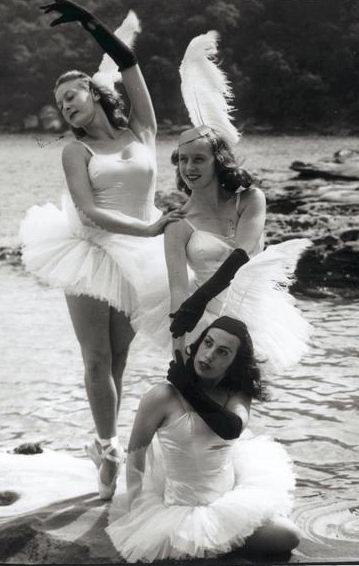
Postscript: One of the images of Cameron that has fascinated me, as much for its 1940s glamour as anything else, is that of her with her colleagues from the Kirsova Ballet, Peggy Sager and Strelsa Heckelman, posing outdoors at Taylor’s Bay close to Kirsova’s home on the northern shores of Sydney Harbour.
Added 28 April 2011: Maina Gielgud studied with Rachel Cameron at various points in her life and they remained close friends until the end of Rachel’s life. Maina shared this recollection:
Memories of Rachel from when she gave me private lessons when I was nine years old: Passionate, outspoken, knowledgeable. I believe she was an excellent dancer with lots of personality and mammoth technique.
I always remember her coming to see me in Newcastle (UK) performing Swan Lake with Festival Ballet. I thought I was dancing quite well (for once!)—she said nothing, but wrote me a long letter which quite disillusioned me, but certainly made me rethink what I was up to and how I went about my work and my dancing…
She knew I knew that she only bothered because she thought I was worth it…
The New York Times published an article this morning by Roslyn Sulcas, whose critical writing from New York and Europe, is always thought-provoking and intellectually probing. The article summarises recent events relating to the future of the Royal Ballet of Flanders, the company led by Australian Kathy Bennetts. The ongoing saga of the company is worth following. Here is a link to the Sulcas article.
Bennetts was an unsuccessful candidate for the current directorship of the Australian Ballet. Speculation on what might have been is tempting, but it is probably more productive to hope that Bennetts’ passion continues unabated in the present situation, and that the Royal Ballet of Flanders continues to flourish under her uncompromising approach.
The ticket said ‘Darcey and Rafael in conversation’. The menu cover said ‘Dance—collaboration, creativity and choreography’. A tall order? This luncheon event associated with the National Gallery of Australia’s current exhibition Ballets Russes: the art of costume featured former Royal Ballet star Darcey Bussell, now living with her family in Sydney, and Rafael Bonachela, artistic director of the revamped Sydney Dance Company. So what happened?
Well, about 200 people gathered in Gandel Hall, the Gallery’s new-ish public event space. Seated at round tables accommodating nine or ten people per table, we started with a main course, a most acceptable meal given that it clearly needed to be prepared in advance. Then, as dessert was brought in, Darcey and Rafael, made their way to the stage and, seated in armchairs, began to talk about dance. So far fairly predictable. Things began to get interesting as dance became the focus.
Some footage was shown. We saw the amazing Ms Bussell, with those incredibly articulate arms and legs not to mention face and entire body, in excerpts from Christopher Wheeldon’s Tryst, which Australian audiences were lucky enough to see when Ross Stretton brought the Royal Ballet to Australia in 2001, then in parts of the Black Swan pas de deux from Swan Lake Act III, and finally in the last pas de deux from Manon. Footage of Bonachela’s recent works followed, including segments from We Unfold and 6 Breaths.
The conversation centred for a while on the similarities between classical and contemporary dance in terms of the athleticism required by dancers whatever style they are performing, and on the nature of collaboration. Bonachela stressed his aesthetic of commissioning artistic collaborators to produce new work and outlined the importance of moving the art form forward through the creation of new work. Bussell introduced a certain degree of humour as she recounted the trials of rehearsal and the pitfalls (and pleasures) of performance. They both showed a beautifully human side of themselves.
But perhaps the most interesting moments came when the floor was opened up to questions. For me there were three particularly provocative questions. The first concerned narrative in contemporary dance. Did it exist? And was its lack (or apparent lack outside of ballet) what differentiated contemporary dance from ballet? Bonachela’s answer was beautifully phrased. ‘I believe’, he said ‘that the body has a narrative and I am interested in finding it through my choreography. I want to engage with the audience in an emotional way. I am interested in ideas and think the body is a strong communicative tool.’ He did add however, tongue in cheek, that perhaps he would wake up tomorrow and want to make a narrative work!
The second question of particular interest to me concerned the Australian Ballet and its now apparently entrenched decision not to perform in Canberra. How, asked the audience member posing the question, do we continue to engage with ballet when the flagship company denies Canberra audiences the opportunity to see Australian Ballet performances other than by spending large amounts of money to travel out of Canberra? Bussell rightly outlined the various problems associated with touring especially by major companies. But because she may not be aware of the situation, she didn’t mention the Australian Ballet’s apparent problems with the size and nature of the Canberra Theatre’s stage, nor its perceived issues with the Canberra Symphony Orchestra. But she did say that in the end it is up to us, the people of Canberra, to make it known that we do constitute an audience for ballet and that we want to see performances by the main company, not only those of the Dancers Company or specially contrived one-off events. Well, I’m not sure that any movement from the people would have the slightest effect.
And the third question of particular interest to me concerned the difference in physicality between the dancers of the Ballets Russes era and those of today. It is clear from watching old footage from the 1930s that the dancers who came to Australia between 1936 and 1940 were different in musculature, in technique and in the performance values they brought to the stage. But probably the luncheon conversation was not the forum in which to elaborate on the various changes we see in the way dancers look and perform today. The responses petered out a little. Another occasion perhaps?
The National Gallery of Australia has provided some inspiring events associated with its Ballet Russes exhibition. This was one of them. May there be more events where an audience feels free to ask and comment in the way it did at this event.
The British-Australian choreographer and dancer Liz Lea recently presented a show at the National Gallery of Australia in which she managed, with singular success, to rework her popular piece 120 Birds, staged at the Edinburgh Fringe in 2010, from a work for a small company into a one-woman show.
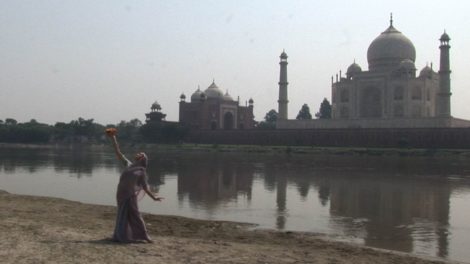
But the irrepressible Lea has another project in the pipeline—a documentary made with Kuwaiti director, Talal Al-Muhanna, and Indian cinematographer, Lakshya Katari. Lea has had an ongoing fascination with dance makers who toured to far flung destinations in the early part of the twentieth century, including Ruth St Denis and Anna Pavlova, and the documentary, entitled On the trail of Ruth St Denis, follows the journey of St Denis across India. The crew visited the locations in which St Denis performed including the cities of Amritsar, Agra, Kanpur, Lucknow, Varanasi, Kolkuta and Mumbai.
Lea acts as the on-screen presenter for the documentary and also performs some of the ‘Oriental’ dances that made St Denis famous in her day.
The film is currently being cut in the United Kingdom by editor Krishna Francis and has music by Nick Parkin. Further information (published earlier) is available. See e-press from India.
Michelle Potter, 6 March 2011
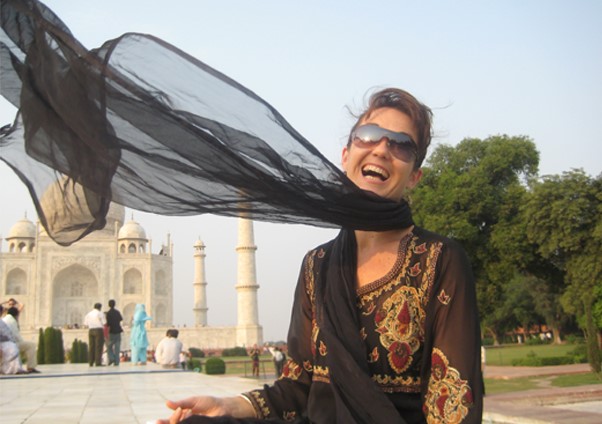
Featured image: Liz Lea in front of the Taj Mahal. Photographer not idfentified.
Meryl Tankard reports that her first short documentary film, MAD, has been selected for showing at the 17th World of Women: WOW Film Festival.
MAD focuses on madness and schizophrenia, explored by poet and writer Sandy Jeffs, who has lived with schizophrenia and all its moods for 34 years. It features music by Elena Kats-Chernin and vocals by Mara Kiek both of whom have collaborated with Tankard on numerous previous occasions. Lyrics are by Sandy Jeffs. Jeffs was a featured writer at the 2010 Melbourne Writers Festival. She has published five books of poetry.
Sandy Jeffs in Meryl Tankard’s short documentary, MAD
Tankard says she is thrilled that her first documentary has been chosen to be screened at the Festival. She says:
‘I hope this documentary will give viewers a glimpse inside the schizophrenic mind. I have been inspired by Sandy’s works and by Sandy herself, in particular the way she deals with her inner voices and the way she articulates her feelings about her illness.’
MAD will be screened on 9 March 2011 at the Dendy Opera House Quay cinema.
As the Victoria and Albert Museum’s Diaghilev exhibition is being taken down, its curator, Jane Pritchard, has made the startling discovery that there appears to be film footage of Diaghilev’s Ballets Russes in performance. And we have always thought that no such footage exists! She reports on this remarkable discovery in her latest blog post—’I eat my words’, where you can also view the footage via the website of British Pathé.
Michelle Potter, 27 January 2011
UPDATE 16 June 2020: The footage and blog post is no longer available via the link above. But the footage (lasting just 30 seconds) of a section from Les Sylphides, filmed in Montreux, Switzerland, in 1928, is below.
In an astonishing coup, the Royal New Zealand Ballet has just announced that Ethan Stiefel, currently principal dancer with American Ballet Theatre and dean of the School of Dance at the University of North Carolina School of the Arts, will be its next artistic director, taking up the position in the second half of 2011. Stiefel will be joined by Gillian Murphy, his partner in life and also a principal with ABT.
Stiefel’s comments on his appointment are: ‘I am enormously appreciative and enthusiastic about having been appointed the next Artistic Director of the Royal New Zealand Ballet. Becoming RNZB’s Artistic Director provides me with an exceptional opportunity to professionally and personally evolve and to contribute to the art form I truly love. It is very encouraging to see how much the company has already achieved, the potential it possesses and how the nation embraces its national ballet company. I look forward to building on the company’s fine reputation, while seeking to be a fresh, innovative and inspiring new leader for the RNZB in any way I can. Both myself and my partner in life; American Ballet Theatre Principal Dancer, Gillian Murphy, are ready for this new chapter in our lives and wholeheartedly make a commitment to the new adventures and prospects it holds. Finally, I also look forward to connecting with my relatives living in New Zealand today and, being a sports enthusiast with Kiwi blood, I’m also looking forward to supporting the All Blacks!’
I can see that ‘crossing the ditch’ will become more common for Australian dance folk. One of my fondest memories of living in New York between 2006 and 2008 was seeing an ABT production of La Bayadère in which Stiefel danced Solor, Murphy Gamzatti and Diana Vishneva Nikiya.
Inspired by a comment on my August 2010 post regarding Olga Spessivtseva in Australia, I went back to that amazing National Library of Australia resource, Trove, and began looking again for passenger lists around the end of 1934 that might contain the names Olga Spessiva or Leonard G Braun.
It appears that Spessivtseva and Braun left Sydney on board the London-bound R. M. S Orama, a ship of the Orient line, on 22 December 1934. A passenger list including both names appears in The Sydney Morning Herald for that day. The ship passed through Fremantle on 31 December and news of Spessivtseva’s departure was reported in The West Australian on 1 January 1935 in a brief article headed ‘A famous dancer. Olga Spessiva leaves Australia’. In that article the story of the injured leg surfaces again with the reporter noting that her withdrawal from the company was the result of ‘An injury to her left leg, occasioned through over-work’. The article also reports that Spessivtseva was anxious to return to Australia ‘with the object of establishing a school of instruction and of producing ballet with entirely Australian casts’!
What makes this information particularly interesting, however, is that there was almost a full month between the last Sydney performance by the Dandré-Levitoff company on 28 November and the sailing date of 22 December. What did Spessivtseva and Braun do during that time? It appears on the one hand that the Blue Mountains story discussed in a previous post may indeed have a grain of truth, and also that Algeranoff’s information about Spessivtseva having already left by 2 December, also discussed previously, is wrong. Do we assume that there was an effort to cover-up what appears to have been more than an injured leg not only to the press but even to other members of the company?
Michelle Potter, 27 September 2010
With many thanks to Boris Fedoff for spurring me on to keep looking. Read his comment about Spessivtseva and her early departure from a US tour. And here is the full tag archive relating to Spessivtseva and the Dandré-Levitoff Russian Ballet tour to Australia.