The Nutcracker. The Australian Ballet (2010)

There was a time when Christmas in Sydney without a production of The Nutcracker was unimaginable. The ballet attracts a festive audience, there is no doubt about it. So it is hardly a surprise that the Australian Ballet’s staging of Peter Wright’s Nutcracker as its final offering for the 2010 Sydney season was a total sell-out.

This Nutcracker does not strive too hard for psychological explanations or modernisations and the production has a clear and very welcome logic to it. Nothing happens in the transformation scene, when the Christmas tree grows, mice (rats I think in this production?) emerge and engage in a fight in which they are ultimately the losers, and Clara’s Christmas gift of a nutcracker doll turns into a handsome prince, which is not prefigured in some way in the party scene. The second act too has more logic than usual. Clara’s involvement with the dances is a welcome addition, as is her transformation—she is an aspiring dancer in this production—into the Sugar Plum Fairy. While the ballet still of course requires suspension of belief, there is a coherence that is unusual in a staging that does not diverge markedly from the traditional storyline.

The production was also pleasing from a technical point of view. And by this I mean that for once there were no loud bangs and crashes from backstage as scenery was moved in and out. I have winced more than once throughout the 2010 season at noises off stage that were never meant to be heard in the auditorium.

There was also some great dancing, and what a treat that is! A total standout was Madeleine Eastoe as the Sugar Plum Fairy. She was technically assured, her feet sparkled and there was such a delicious flow of movement in her torso as her spine stretched upwards through to her beautifully poised head. She gave such light and shade to the choreography with some unexpected changes of pace in her movements. She was every inch the ballerina—commanding but never overbearingly so. And what a magnificent, beautifully placed and perfectly executed diagonal of fouettés at the beginning of the coda!

As for her partner, Yosvani Ramos, he was sadly encumbered by a jacket in a startling shade of lolly pink—very unbecoming I thought. And to make matters worse the neckline seemed quite stiff and much too high for him. It made him look as though he had an incredibly short neck—not good when he is not the tallest of dancers in the first place. It quite detracted from some really nice dancing on his part.

Reiko Hombo danced the role of Clara and acquitted herself well showing absolute engagement with the role. Leanne Stojmenov as the Rose Fairy could scarcely put a foot wrong. The choreography here demands a dancer with a strong sense of classical order and in such situations Stojmenov always displays a natural ability and an exceptional level of expertise. Daniel Gaudiello had a small role in the first act as Drosselmeyer’s assistant. With his ability to realise a character, his powerful presence on stage and his technical prowess, especially when it comes to beaten steps and steps of elevation, Gaudiello turned this role into something exceptional and quite idiosyncratic. There were also fine performances from Andrew Killian as Drosselmeyer and Tzu-Chao Chou as the Jack-in-the-Box

There were moments when I found the costume and set design by John F. Macfarlane overbearing and fussy. Apart from wishing that the Prince’s pink jacket was not quite so inelegant, I also craved a little more subtlety in the set for Act II, which suffered in my opinion from a surfeit of colourful motifs including two different kinds of very large flowers, a stylised (anthropomorphised) sun and a bunch of swirly ribbons. But this Nutcracker is a Christmas treat to delight young and old alike and closed the Australian Ballet’s 2010 season on a high note.

Michelle Potter, 12 December 2010
Edge of Night. The Australian Ballet

This last triple bill of the Australian Ballet’s 2010 season was an opportunity to revisit two ballets created by resident choreographer Stephen Baynes and to ponder on the emergence of a new force in Australian choreography, Tim Harbour.

Edge of Night, which gave the program its name, was first seen in 1997. What especially stood out for me from this 2010 viewing was the visual strength of the work. Michael Pearce’s set and costumes and Stephen Wickham’s lighting evoked just the right atmosphere of nostalgia, longing and sad (and perhaps not so sad) memories. A real sense of collaboration was evident and Pearce in particular deserves many accolades for bringing a quality of surrealism to the design, which suggested the role of the subconscious in our most nostalgic encounters. Pianist Stuart Macklin added to the mood with his expressive playing of the seven Rachmaninov Preludes to which Edge of Night is set.

Kirsty Martin was elegant in the leading female role and the partnership with Robert Curran as the man in her past was as smooth as silk. But Martin played the part a little coldly for my liking missing the opportunity to develop an emotional connection with the audience. The stand-out performer was Laura Tong as the girl on the swing. She did connect with us and the youthfulness and the ‘breath of spring’ quality to her dancing was a joy.

Harbour’s new work, Halcyon, had a strong narrative line and suffered from being pretty much incomprehensible unless one knew intimately the Greek myth concerning the wind goddess Halcyon’s doomed love affair, and its consequences, with the mortal Ceyx. The ballet needed surtitles! However, if one ignored the narrative and watched from a purely visual and theatrical point of view—and I’m ignoring for the moment the implications of that idea—there was much to admire. Harbour’s choreography was brimming with ideas and I was especially taken by the fact that he had managed to imbue the choreography with the look of ancient Greek sculpture while also giving it a real contemporary edge. Stage concept and lighting was by the Melbourne-based lighting and design company, Bluebottle, and their designers made effective use of backlighting to create two worlds of action by at times turning what initially looked like a backcloth into a scrim. The work looked fabulous and the dancers looked beautifully rehearsed and absorbed in executing the choreography for maximum effect. But oh … that need for surtitles!

The closing work on the program, Baynes’ Molto Vivace, is a crowd pleaser, and to my mind an exercise in silliness, danced to a compilation of works by Handel. It was first seen in 2003. Dourly I have to say that I have never been a fan of this work but I laughed my way through it unable to do anything else when the woman behind me was almost hysterical with laughter from opening to closing moment. Laughter breeds laughter.

Leanne Stojmenov danced the leading role of the Lady but again like Martin in Edge of Night I found her performance beautifully rendered but a little cold. In the glorious central pas de deux with its exquisite lifts and soft, sighing movements, which for me is the raison d’être of this work, she looked perfect in an Alice in Wonderland kind of way. But thoughts of Simone Goldsmith, who created the role in 2003 and whose extreme vulnerability gave to the pas de deux a deep humanity, were hard to erase from my mind.

Michelle Potter, 28 November 2010

Out of context—for Pina. Les Ballets C de la B

Alain Platel founded Les Ballets C de la B (Les Ballets contemporains de la Belgique) in Ghent in 1984 and since then he has always taken rather large risks in creating work for the company. Out of context—for Pina is no exception.

The work begins slowly. We sit in our seats looking for a time at a bare, sparsely lit stage. We listen to the beginnings of a soundscape of animal-like sounds. Eventually, one by one, nine dancers stand up from seats in the auditorium, move to the stage, take their places upstage with their backs to us and begin to strip down to their underwear. They wrap themselves in orange blankets and turn to confront us before beginning to interact with each other. In these initial stages the interaction is minimal. The dancers nuzzle each other gently, sniff and rub against each other. They are a little like dogs greeting each other, sniffing out territory.

The work gathers pace from here with the dancers shedding their blankets to perform and returning to their folds when lesser activity is required of them. At one stage there is a kind of disco sequence when the dancers attempt to sing snatches of popular songs although their language carries a kind of speech impediment and their movements are marked by odd twitches and tics recalling physical disability.

Platel was previously a teacher for people with motor disabilities and throughout the piece his choreography explores some kind of dichotomy between apparently dysfunctional movement and a kind of transcendental power of the human body in motion. This is nowhere more apparent than in the closing solo by a male performer whom I was unable to identify (there was no program). Dragging two full-length microphone stands with him, one in each hand, this dancer seemed on occasions to have a disability, both physical in his slightly uncoordinated movements, and otherwise as he stared out at us at the end of the solo. Yet at other times he seemed more like an Olympic athlete with a javelin in each hand.

The strongest performer overall to my mind was, however, a woman who looked a little like Frida Kahlo and who I imagine was Rosalba Torres Guerrero (similar problem with identification—no program and I relied on advertising material to guess). She had a commanding presence that showed itself in every movement, large or small. She was especially remarkable in her duets with male members of the cast, which often bordered on the erotic and which involved complex partnering, and in a scene in which she lay on the ground wrapped in her orange blanket and reacted with diverse facial movements to the appearance of an opera singer (who was not one of the dancers but who appeared from the auditorium at one stage during the performance).

As for the work’s relationship to Pina Bausch, whose name appears in the title, Platel has remarked in an interview for the Canadian newspaper The Globe and Mail:

‘Pina died during the creation process, so I added on the dedication. I’d known her for 30 years and admired that special way she used dancers, transforming them into personalities. She also established the practice that any movement or thought could be used in dance.’

I would argue that there were choreographers in the United States working with the concept that anything could be dance well before Bausch. However, the notion of ‘anything’ is likely to be more expressionistic and emotionally confronting in choreography made in Europe than in a society like that of the United States, where a veil is often drawn over the less pleasant aspects of human behaviour (99% of the time the toilet is euphemistically referred to as the bathroom for example). The ‘anything’ vocabulary created for Out of context is confronting, but like that of Bausch demands that one have an opinion.

Michelle Potter, 16 November 2010

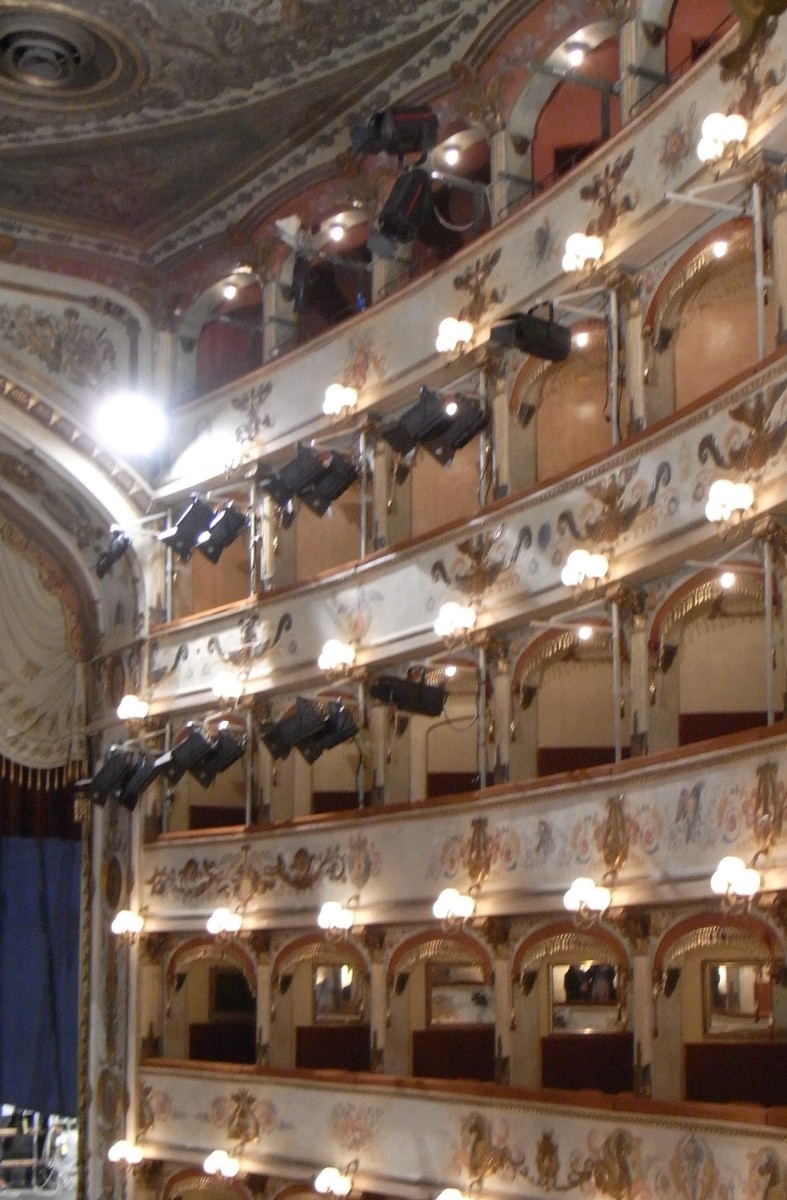
Postscript: The performance I saw took place in the beautiful old Teatro comunale di Ferrara. The construction of this theatre, whose auditorium is horseshoe shaped in the tradition of many old European opera houses, began in 1773 and much of its original decoration remains.

Teatro comunale di Ferrara

Mirrors and Scrims. Marcia B Siegel

Marcia Siegel’s recently published collection of reviews and essays, Mirrors and Scrims: the life and afterlife of ballet, is a real stunner. Such collections are usually useful to dip into to find a contemporary opinion when researching a particular work, choreographer or era. Mirrors and Scrims is, of course, useful in this way. But it also offers so much more. Siegel’s writing is perceptive, lucid, coherent and honest. It also often pushes the reader to investigate or question further his or her own assumptions about dance. What a delight that is in this twenty-first century when much of the readily available dance writing is little more than a regurgitation of a puffed-up media release.

On an obvious level, Siegel has an enviable capacity to describe what she sees on stage in terms that can easily be visualised by the reader. Take her description of the second movement of Balanchine’s Mozart Violin Concerto for example. Siegel writes:

‘In this movement, essentially a long adagio pas de deux, the corps is always present, sometimes as witness, posing in lines and semicircles around the principal couple, and sometimes, strangely, forming little sub-groups that seem engaged in their own private colloquies. Then, toward the end, the women become almost an abstraction, coming forward in a straight line so that they discreetly mask the solo man and woman just as she’s fallen into his embrace.’

This is deceptively simple writing. On the one hand it gives us a clear, straightforward idea of the formal structure of this movement of the work. But on the other, it also subtly gives an insight into an emotional underpinning with just an apposite word or two, judiciously placed.

At the same time, Siegel’s writing has the capacity to analyse a work within its wider cultural and historical context. Take for example her discussion of the revival of Balanchine’s Cotillon by Tulsa Ballet. She writes:

‘The ballet is a clear choreographic bridge between the lush, narrative Diaghilev era ballets and the neoclassical austerity of the latter-day Balanchine. It does, however, represent a strain of romanticism and fantasy that the choreographer kept to the end of his life.’

The whole discussion of the Cotillon revival is a fascinating read, as are Siegel’s discussions of other revivals from the Diaghilev era, a subject that is clearly of great interest to her.

Siegel has also worked through many philosophical issues as they relate to dance writing and reviewing. She takes a clear, personal stand. Right from the beginning she states:

‘I see myself as both a demystifyer and a validator, sometimes an interpreter, but not a judge.’ She fearlessly carries through with this stance. In an analysis of the position of the much-admired critic Arlene Croce (as understood from her reviews), Siegel writes:

‘I think a critic has to take even mavericks and crackpots at their word. In not doing so, Arlene Croce places herself above the artists. She implies she knows better than they do what’s right for dance. To my mind, that’s the one thing a critic isn’t allowed’.

The essay in which this comment occurs, ‘Balanchine and beyond’, is full of points for further discussion and development in those situations (I wish they occurred more frequently) where those who love dance come together to discuss dance and how to look at it. Reading ‘Balanchine and beyond’, I couldn’t help thinking of the concept of intentional fallacy, the idea (probably unfashionable at the present time) that what an artist intends is not a standard by which to measure a work. Intentional fallacy veers onto a slightly different pathway from Siegel’s discussion of the need ‘to take mavericks and crackpots at their word’ but it is nevertheless a related and equally as interesting issue.

Mirrors and Scrims covers close to three decades of Siegel’s writing in publications that include Ballet Review, Boston Phoenix, Christian Science Monitor, Dance Now, Dance on Camera Journal, Hudson Review, Village Voice and Washington Post Book World. And although the excerpts I have quoted above all relate to Balanchine in some way, the writing in this collection covers the work of many choreographers. It also covers many genres of dance and analyses many formats in which dance reaches an audience, including dance on film and books about dance.

Siegel notes in her introduction that she has organised the entries around themes of authenticity and change. To give further shape to the collection she has grouped her selections into seven sections. Each section reads well as a variation on a theme making the book a satisfying, and often an edifying journey rather than simply a chronological one as often happens with such collections of essays. And as with all collections of this nature, some pieces and some themes will touch a individual nerve in a special way. I particularly admired Siegel’s obituary for the critic Edwin Denby, ‘Edwin Denby, 1903-1983’—a moving and personal tribute, which includes the following comment:

‘He knew long before I did that dancing is like living, and that the better we can perceive the ordinary specialness in living, the better we’ll see the out-of-the-ordinary specialness of dancing.’

I also relished reading an essay called ‘Reclaiming the ordinary’. It deals with PASTForward, a program staged by Baryshnikov’s White Oak Dance Project that revived some of the works from the Judson era in American dance. At one point Siegel writes:

‘Judson made the acceptable dance vocabulary immensely bigger by reducing the stimulus: with almost nothing to look at, there’s suddenly so much more.’

Marcia Siegel knows dance and is not afraid to call it the way it is. Mirrors and Scrims deservedly won the 2010 Selma Jeanne Cohen Memorial Prize.

Michelle Potter, 7 November 2010

Marcia B. Siegel, Mirrors and Scrims: the life and afterlife of ballet, Wesleyan University Press, 2010
416 pp; 27 illustrations
ISBN 978-0-8195-6875-5 (cloth) USD85.00
ISBN 978-0-8195-6926-4 (paperback) USD27.95

La Valse; Invitus, Invitam; Winter Dreams; Theme and Variations. The Royal Ballet

15-30 October 2010. Royal Opera House, London

Frederick Ashton’s La Valse—what a swirlingly beautiful opening to the Royal Ballet’s recent mixed bill program. Ashton’s choreography seemed slightly idiosyncratic with its unexpected shifts in épaulement, swift lifts of the arms, quick bends of the body and a range of nuanced movement. Yet it was perfectly attuned to the changes of colour and rhythm in the Ravel score. In addition, the Royal Ballet dancers performed with such aplomb and brilliant attack not to mention a beautiful classical technique based, as it should be, on turned-out, centred movement.

The two works that followed were both exceptional distillations of involved narratives. Kim Brandstrup’s new work, Invitus, Invitam (Against his will, against her will) essentially compressed Racine’s play Bérénice into three pas de deux, while Kenneth MacMillan’s Winter Dreams distilled Chekov’s work The Three Sisters into one dramatic act.

In Racine’s version of part of Suetonius’ history of the Roman emperors, Titus is forced by the senate to send Bérénice, his mistress, away, against her will and against his will. In Brandstrup’s work we see three encounters between Titus and Bérénice: in the first Bérénice is aware that Titus has a concern that he is not speaking openly about; in the second Bérénice knows what is to happen and is devastated, as is Titus; and in the third they part in mutual sorrow. Leanne Benjamin is perfectly cast as Bérénice. All her maturity as an artist comes to the fore as the inevitable parting approaches. Edward Watson is her partner and he too captures the sense of impending drama.

Choreographically Brandstrup’s three pas de deux draw the two protagonists together and at the same time separate them from each other. Both Benjamin and Watson gave exceptional performances, strong yet tremulous with emotion. Benjamin’s dancing was faultless and her portrayal of the role was vulnerable in the extreme. Richard Hudson was responsible for the costumes and minimal setting, so in empathy with the distillation of the story. His screens and scrims and his use of computerised writing and sketches, which appeared sporadically on the screens, added just the right sense of location. The contemporary score by Thomas Adès was based on the work of Couperin and again was empathetic to Brandstrup’s overall conception. Invitus, Invitam was intensely moving and certainly deserves further performances.

Winter Dreams was led by Sarah Lamb as Masha and Thiago Soares as Vershinin with minor principal roles being taken by Mara Galeazzi as Olga and Roberta Marquez as Irina. Together they provided a strong performance of this bleak story.

The closing work on this generous program, the pièce de resistance in my mind, was Balanchine’s Theme and Variations. I was not at the opening night’s performance when, I am told, Tamara Rojo and Sergei Polunin took the leading roles and when Alicia Alonso, creator of the ballerina role for Ballet Theater in 1947, was in the audience. But I was more than happy to see a radiant Marianela Nuñez partnered by a dashing Nehemiah Kish dancing with all stops out in this ferociously demanding work. From the opening moments when the ballerina and her partner present themselves to us, to that wonderful moment as the work comes to a close when grands battements merge into high-kicks, this is a work to be savoured for the remarkable display of the classical technique that it is. And again the entire complement of dancers showed what an outstanding company the Royal is at the moment.

I could, however, have done without Peter Farmer’s set for Theme, which to my mind suffers from a surfeit of draperies. Simplicity is all that is needed as a foil to Balanchine’s intricate weaving of bodies across the stage. But what a pleasure it was to see such beautifully trained bodies dancing with such a secure sense of classicism.

Michelle Potter, 27 October 2010

Trisha Brown Dance Company at the Tate Modern

What is it about Trisha Brown’s 1976 work Line Up (Spanish Dance) that is so enticing? Is it the brevity—it can’t last  more than two minutes or so? Is it the Bob Dylan song (Early Morning Rain) that accompanies it? Is it the apparent simplicity of the choreography as the cast lines up equidistant from each other and one by one moves towards the person in front to create a mini-train of tightly bunched-up bodies. Is it the inevitability of it all as the wall looms closer and we know what the outcome has to be? Is it the sexy, hip-swaying walk with which the dancers proceed towards the wall in front of them? Whatever it is, it was there as the Trisha Brown Dance Company performed this work at London’s Tate Modern as part of the UK’s Dance Umbrella 2010.

The Trisha Brown event at the Tate Modern began on the bridge that crosses the vast Turbine Hall, which is the first encounter many visitors have with Tate Modern’s spaces. On the bridge four dancers, Tamara Riewe, Leah Morrison, Laurel Tentindo and Elena Demyanenko, performed Group Primary Accumulation a Brown work from 1970. While one’s own mind is allowed to wander and to speculate on many things as one watches, there is no room for the dancers’ minds to wander as, lying on the floor for the duration of the piece, they perform a sequence of movements that grows in complexity as the moves are repeated and added to with each repeat. The dancers’ level of concentration is more than admirable and the effect quite mesmerising.

Group Primary Accumulation was followed by Leaning Duets (1970) in which three groups of two dancers made their way down the sloping entry space of the Turbine Hall. With hands joined, inside arms extended tautly and sides of the inside foot pushed against that of the partner, each pair of dancers walked a step at a time down the slope, each testing the extent to which he (or she) could lean to the side without losing balance. It was especially interesting to see, a little later in the Tate’s film tribute to Brown, such duets being performed in 1970 in what appeared to be the streets of downtown Manhattan. Then the duets took place in a much more relaxed and casual environment and amongst curious and bemused passers-by.

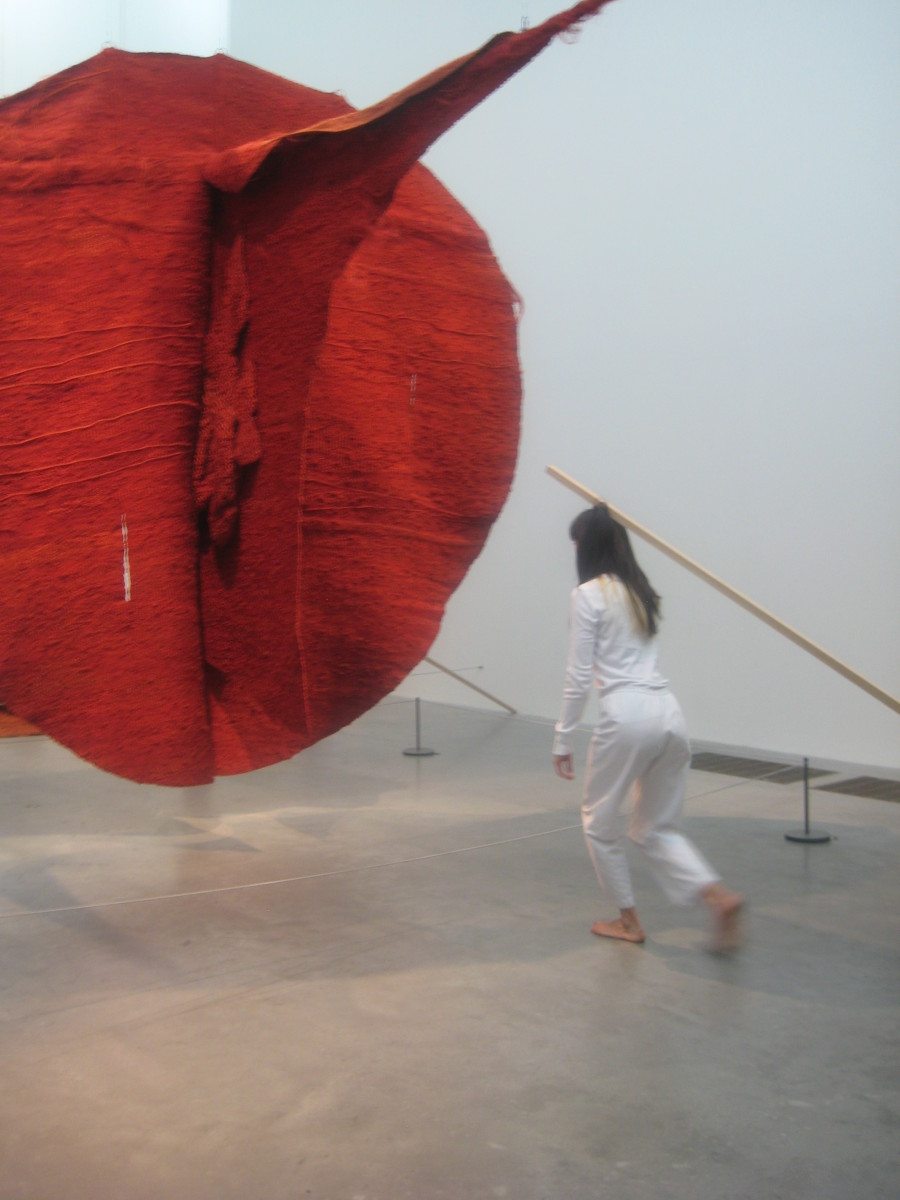
Tamara Riewe in Sticks, Trisha Brown Dance Company. Art work: Abakan Red (1969) by Magdalena Abakanowic

From the Turbine Hall the dancers moved to various of the Tate’s gallery spaces and danced amongst the art works, making art amongst art. Here the program comprised another accumulation work, another version of the leaning duets, Line Up and two different versions of Sticks (1973). Sticks requires the performers secure one end of a long stick against a wall or to anchor it it some other way, balance the other end on a part of their body and then undertake a series of simple moves such as kneeling or lying down, all the while keeping the stick balanced. One version was performed by three dancers in three separate gallery spaces No dancer could see another and the dance unfolded with the performers indicating the stage they had reached by calling out to the others across the galleries. The dance concluded when the third dancer called ‘Done’.

For those who were not New York City residents in the 1960s and 1970s the Tate Modern event was an  exceptional opportunity to see the early work of one of the twentieth century’s most significant dance pioneers. The works shown at the Tate represented on the one hand Brown’s interest in process and problem solving and on the other her attempts to redefine what constitutes dance and to blur the boundaries of dance and installation art. While nothing can ever replicate the original works performed in streets, on roof tops, down the side of buildings and the like, it was a rare privilege to see a twenty-first century manifestation of this early work by the current Trisha Brown Dance Company in London’s most impressive contemporary art space.

Michelle Potter, 23 October 2010

Diaghilev and the Golden Age of the Ballets Russes. Victoria & Albert Museum

The Victoria & Albert Museum, London, has an enviable collection of theatrical costumes from the Diaghilev era, many of which (or is it all of which?) are displayed in the museum’s current, celebratory exhibition Diaghilev and the Golden Age of the Ballets Russes. There are some real gems to be seen. I was especially attracted by a costume worn by Tamara Karsavina as Zobeide in Schéhérazade. Not the more familiar Zobeide costume of harem pants and bodice but a soft, deep purple dress with painted gold designs scattered over the skirt and a top decorated with golden braid. Designed by Bakst, it was apparently worn only briefly before the more familiar costume became popular.

Also quite fascinating was a costume worn by a child performer in Le Dieu bleu, a golden costume of pants and top with a tall headdress reminiscent in shape of those worn by Thai and Cambodian dancers (although far less complex in decoration). While we are used to seeing the costume worn by the Blue God himself, costumes for the ancillary characters, in this case a ‘Little God’, are less common.

Some of the costumes are displayed with quite dizzying effect. For example, some ten or twelve costumes from the famous (or infamous) Nijinsky/Stravinsky/Roerich Rite of Spring are arranged on a tiered framework and are grouped into men’s and women’s costumes. The display gives a very clear view of the range of patterns and colours used by Roerich in designing the work. It is truly an embarrassment of riches.

I also loved the two appearances of Lydia Sokolova on film. One snippet is a two minute silent film made in 1922 called Dancing grace: novel studies of Lydia Sokolova the famous dancer. By today’s technical standards Sokolova’s turn out is pretty much non existent and she rarely points her feet, but as she executes a cabriole followed by an assemblé her sense of movement throughout the whole body is breathtakingly expansive. In another piece of footage Sokolova is wonderfully eccentric as she exclaims over one of the costumes she once wore, which was going under the hammer at the Sotheby’s auction of 1968. Clearly an outstanding dancer and a great lady.

The moment of greatest impact for me, however, came as I turned a corner into a new room to be confronted by the magnificent backcloth by Natalia Goncharova for the final scene of The Firebird. The huge and imposing cloth representing a Russian walled city, inspired we are told by frescoes by Andrea Mantegna, is familiar from many images in books. But to see it in real life is a remarkable experience. It is hung diagonally across the space of a quite small gallery. Above a brick wall that stretches horizontally across the bottom one eighth or so of the cloth, Russian buildings are piled vertically on top of each other, stretching upwards to a patch of deep blue sky. It’s a brilliant piece of work by Goncharova, impressively constructed with its horizontal lower and upper sections anchoring the towering verticality of the block of buildings. In terms of colour it is equally impressive with the golden onion domes of the Russian towers set off against patches of rich, red on the building walls.

Stravinsky’s Firebird music fills the space and the other walls show shadowy images of the Firebird, in this case Begoña Cao of the English National Ballet, dancing against a changing background of fire, original programs, images of Karsavina as the first Firebird, the musical score and a range of other images. Subsidiary material relating to The Firebird is shown on the walls of the previous gallery and includes a squared up design for the cloth and various versions of the design. All together it makes for a wonderful gallery-going experience.

The morning I was there the place was packed with people, all of whom had their favourite items as I did I am sure. And therein lies the rub. Diaghilev and the Golden Age of the Ballets Russes is a hugely ambitious show, perhaps overly ambitious. I couldn’t see the point of some items on display. Was there really any need to display a perfume bottle that once held the Guerlain perfume thought to be the favourite scent of Diaghilev? And there was the usual selection of devotional items—Diaghilev’s top hat and opera glasses and an assortment of pointe shoes worn by various Ballets Russes stars. But what was the argument at the heart of the show? In the end it became nothing more than a huge cabinet of curiosities, which is perhaps fitting given its location in a museum named after two giants of the Victorian age, when such cabinets were all the rage.

Michelle Potter, 21 October 2010

Australia Dances. Alan Brissenden and Keith Glennon

Some who log on to this site have asked about Alan Brissenden’s and Keith Glennon’s recently published book Australia Dances: creating Australian dance 1945–1965. With the kind permission of The Canberra Times, who published my overview of the book on 2 August 2010, I am posting a PDF of that review. While I was extremely fortunate to have been allocated a whole page for my comments there is always much more to say than is possible in a  review. I would be more than happy to publish any comments on Australia Dances from readers of this site.

Australia Dances review

Michelle Potter, 1 October 2010

Wrong Skin. Chooky Dancers. Spring Dance 2010 (3)

2-12 September 2010. Sydney Opera House, 

Wrong Skin, performed by the indigenous company Chooky Dancers, is really a play with dance sequences included. Its narrative line concerns traditional law, in particular as it relates to kinship and marriage in indigenous society, and the difficulties of adhering to tradition in the face of an encroaching Western world with quite different values. It might even be called a version of Romeo and Juliet, or an indigenous West Side Story.

The story is not spoken in English but in an Aboriginal language spoken by the Yolngu people of Elcho Island off north east Arnhem Land where the Chooky Dancers have their home. As the story begins the words of the protagonists are translated into English and the translation projected onto a screen. The audience learns that in Yolngu culture marriage between people of opposite moieties—the Yirridja and Dhuwa moieties—is forbidden as being between people of the ‘wrong skin’. And the inevitable has happened. Two young lovers find themselves in the category of ‘wrong skin’. After this initial explanation to English-only speakers, there is no more translation and it is a credit to the strength of the show and its direction that we don’t need further translations. The storyline is perfectly easy to follow and understand.

The dance sequences range from a reference to Zorba the Greek Yolngu style, a piece of choreography that became a worldwide hit via YouTube in 2007, to a take on that iconic Hollywood movie Singing in the Rain complete with clips from the movie and a traditional rain dance that merges into a dance sequence in contemporary mode complete with umbrellas. The dance is high energy, youthfully raw, and powerful in its capacity to carry a message. It is also sometimes funny, although not perfect in its attempts at comedy. At times I felt the humour was overdone when less might have been more.

The work is not without modern day political implications either. The footage that is projected as backcloth often shows appalling living conditions endured by some Elcho Island inhabitants. And on one occasion we are shown on one of the television monitors that dot the stage an excerpt from one of former prime minister John Howard’s less than acceptable speeches on indigenous issues. But again it is a credit to the direction of the show that there is a great balance between politics and the telling of the main story in words, music and dance.

I loved this show. At last a group of dancers has used a technique that the music world has been using for some time now. We had a mashup from a dance group and got a derivative new work, as we should from a mashup, which was also provocative and entertaining.

Open the link for an Opera House interview with the director of Wrong Skin, Nigel Jamieson. *(See note below)

Michelle Potter, 18 September 2010

* Postscript, May 2011: Sadly the interview mentioned above is no longer available online from the Sydney Opera House site and I have removed the broken link. The original version of Zorba by the Chooky Dancers is still going strong on YouTube.

Complexions Contemporary Ballet

16–18 September 2010. The Playhouse, Canberra Theatre Centre

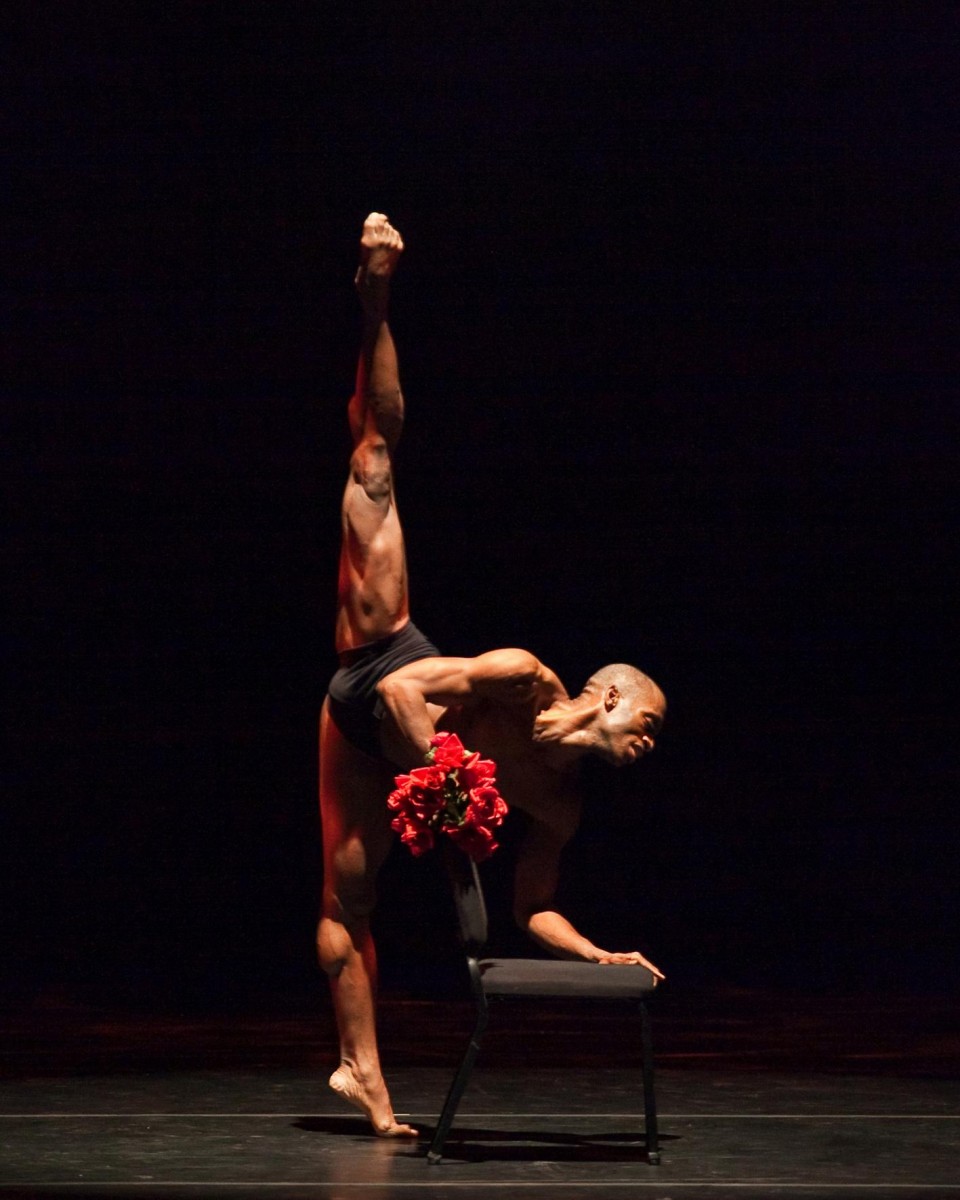
One work saved (just) the Canberra program by Complexions Contemporary Ballet: Moonlight, a very brief solo for Desmond Richardson, co-artistic director of this New York-based company, and also its leading dancer. Richardson has a Mr Universe body with fabulously defined musculature and extraordinary flexibility. He used it to advantage in this solo.

Desmond Richardson in Moonlight. Photo: © Sharen Bradford.

The work was not, however, listed in the printed program, even though it appeared to be a generic program for the whole Australian season, so I had to Google post-performance to discover that apparently Moonlight is part of a 25 minute ballet called FRAMES, made in 1992 by Dwight Rhoden, the other co-artistic director and main choreographer for Complexions. Rhoden also wrote the music, a song whose words were difficult to discern because the music was so loud (all through the evening) and sounded distorted from where I was sitting. I gathered though that Moonlight is about the demise of a relationship. But watching Richardson move was enough without wondering what the chair and bunch of roses, which were used as props, meant.

The other works on the program suffered, in my opinion, from choreography that contained a surfeit of arabesques, big jumps, dramatic poses and other steps designed to show off a particular kind of technique without any feeling for what happens between such steps, or for the need to balance showiness with subtlety or punchy-ness with smoothness. I felt often that the steps were fighting the dancers and as a result few of them seemed to ‘own’ the choreography in a physical sense.

The most disappointing for me was On Holiday, a work for four couples danced to songs made famous by Billie Holiday. I guess in my mind I was thinking of Twyla Tharp’s Nine Sinatra Songs, a beautiful series of dances for seven couples and a benchmark for this kind of format of dancing to popular songs. But On Holiday had none of the sophistication and emotional impact that marks the Tharp work and nothing else to make it stand proudly alongside Nine Sinatra Songs or even Paul Taylor’s Company B danced to songs from the Andrew Sisters.

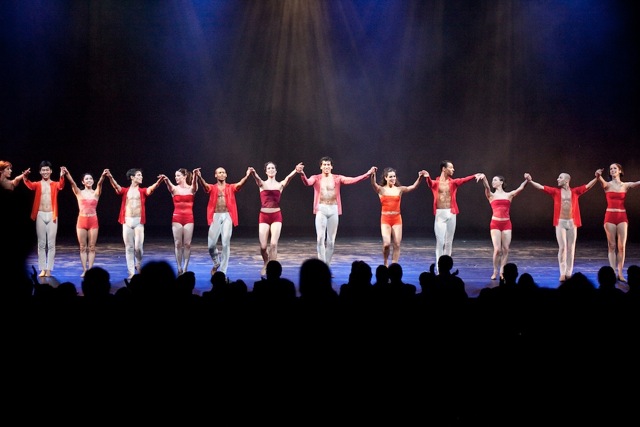
The audience responded with gusto to the last work on the program, Rise, with its strong rhythmic base from music by the Irish rock group U2. Other works on the program were Moon over Jupiter danced by the full company to music by Rachmaninov and Moody Booty Blues danced by two women and three men to blues music by Roy Buchanan.

Curtain call for Rise. Complexions Contemporary Ballet. Photo: © Sharen Bradford.

And to return to the printed program, casting was given for some of the works and was set out according to specific dates. But those dates all seemed to be in October and referred, therefore, only to the Sydney season. So what about Canberra and Perth audiences? For them there was (or will be in the case of  Perth) no way of knowing which dancers were performing specific works. At $20 the program is very poor value. Some kind of (free) cast sheet for the night would have been helpful.

Michelle Potter, 16 September 2010