Madame Butterfly. The Australian Ballet

What impressed me most about this revival of Stanton Welch’s 1995 work Madame Butterfly was Welch’s ability to create a strong, dramatic effect by the simple, yet strategic placement of characters on the stage. It was especially, but not exclusively, noticeable towards the end of the work when Pinkerton returns to Nagasaki with is American wife Kate. It is then, with Sharpless, Suzuki, Butterfly and Sorrow also onstage, that the drama of what has occurred is fully realised. While various of the characters are the centre of attention at particular points during the unfolding of this part of the saga, the placement of the characters across the stage, and their attention—demanding stillness when the action is not especially focused on them—is powerfully moving. The girlish scenes between Butterfly and Suzuki are also memorable. Again it is often the placement of the two onstage in relation to the rest of the action that gives the scenes their strength, although the recurring motif of wiping away each other’s tears is also a strong device.

But despite the above, I find it hard to see a major artistic reason to justify the revival of Madame Butterfly. I can of course see that it attracts an audience and so can only imagine that the artistic team sees money as the main reason for staging a production. But no one looked comfortable in those shuffling ‘Japanese’ walking movements, heel leading in so obvious a manner. And how illogical it seems when shuffling and obsequious bowing are followed by full-on contemporary ballet, as in that long and demanding wedding night pas de deux for example. And how can one shuffle to the top of a flight of steps and then extend a beautifully arched foot, clad in a pointe shoe, and descend the stairs in balletic style. It looked just silly to me.

Madeleine Eastoe danced brilliantly as Butterfly. What a secure, fluid technique she has now. But she lacked the vulnerability needed for the role and quite honestly, with that soaringly beautiful technique, she is just not cut out to be a fifteen year old Japanese Geisha sublimating herself to a man the likes of Pinkerton. Juliet (about the same age) yes, but Butterfly—not in my opinion. But then again, maybe it’s the double-edged choreography that’s the problem?

The strongest performances to my mind came from Daniel Gaudiello as Sharpless and Reiko Hombo as Suzuki. Gaudiello had the advantage of playing a European character (the US Consul in Nagasaki) and so was not burdened by the fake Japanese movements. But that aside, his performance was impressive for the manner in which he created a distinctive character, often not so much through dancing but though small mannerisms such as the twist of a cuff or a slight movement of the head, all of which indicated a certain awkwardness at the situations in which he found himself.

Hombo as Suzuki was perfectly cast. She was ever attentive to Butterfly, sad when Butterfly was sad, happy and excited when Butterfly felt those emotions. Technically pretty much flawless too. A great job.

Sheree da Costa also gave a strong performance in the cameo role of Butterfly’s mother. But how I wish the Australian Ballet would delve into its extensive repertoire and give us some programming that is truly stimulating and forward looking. As the recent (traditional) production of Swan Lake by the English National Ballet showed, ballet isn’t dead. But sometimes it seems like it is.

Michelle Potter, 19 April 2011
Shared Frequencies. Sydney Dance Company

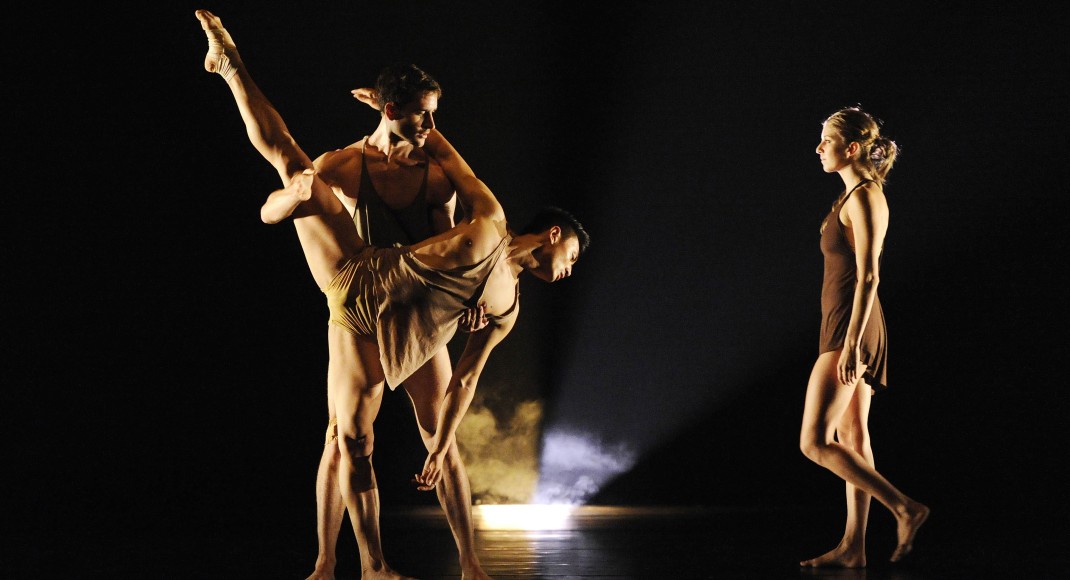
This latest program from Sydney Dance Company featured two works: Raw models by Italian-born choreographer Jacopo Godani and LANDforms by Sydney Dance Company’s artistic director, Rafael Bonachela.

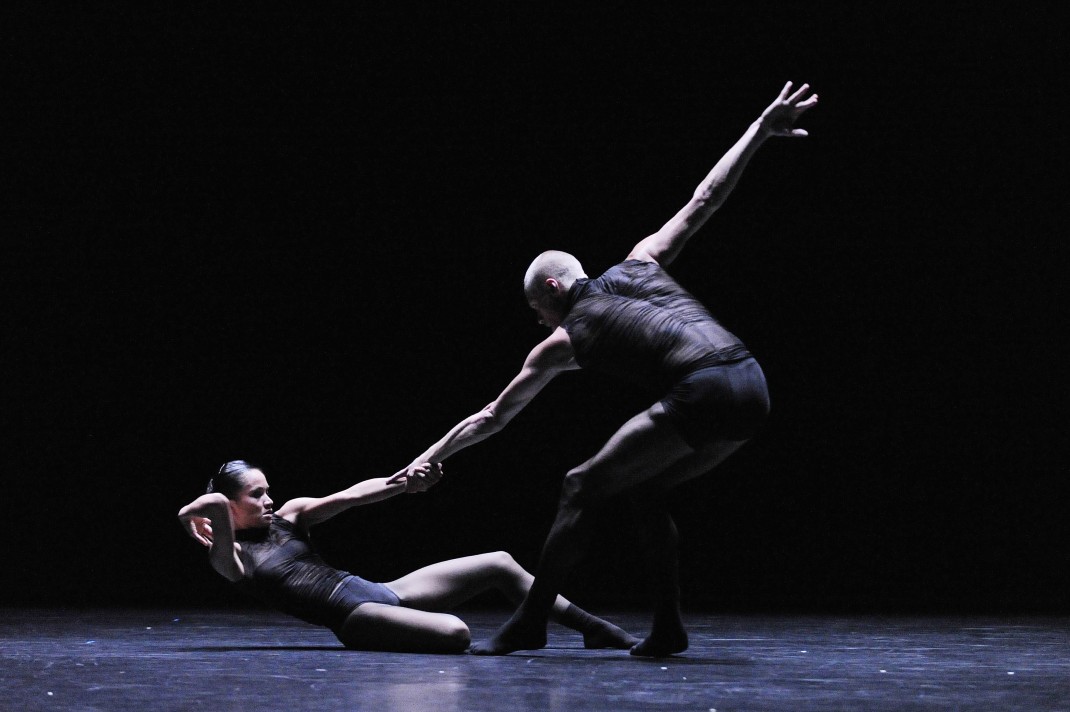
Andrew Crawford & Charmene Yap in ‘Raw models’. Courtesy Sydney Dance Company

Raw models opened the program and I have to admit that I read the choreographer’s note before the curtain went up. Bad move probably because it was a decidedly alienating note and smacked to me of meaningless, intellectual jargon. The dancing, however, was not alienating, although it would have to be described as intense or perhaps severe.

The stage was set as a black box: two black side screens and a black backdrop/screen. The dancers were dressed minimally in black lycra-style short shorts and transparent tops. They wore what I think were skin-tight, soft leather ankle boots. This footwear was interesting because the lighting (by Godani) was such that most of the time it was hard to tell until curtain call time whether the black shadows at foot/ankle level were just shadows on bare feet and legs or whether the dancers were wearing some kind of footwear. Sometimes, as a result of the lighting, the dancers looked as though they had no feet, or that their legs ended in some kind of malformation. This reminded me of  a Francis Bacon painting where bodies are distorted and contorted, not completely beyond recognition but enough to make one wonder.

In terms of choreography, Godani had the dancers moving as if they were jointless. Their arms in particular rippled and undulated, but at such a speed that at times they became blurred. Bacon and his distorted bodies again slipped into my mind. Most of the movement was performed with the dancers bunched tightly together so not only did the bodies look distorted they seemed not able to separate themselves from each other. But the work was very slick, very shiny, although despite the coupling of bodies throughout to me it looked a-sexual.

Production photographs from Raw models are interesting. They show off the dancers and the costumes beautifully but give no idea really of what the piece looked like as a moving canvas of bodies. While this is the case most of the time with dance, it seems even more of an issue with Raw models given the effects on the eye that Godani’s work has. Nothing like being there in the end.

Raw models was performed to a commissioned electronic score by Ulrich Mueller and Siegfried Roessert of the German experimental group 48nord, which added to the bleakness of the work (and again to my feeling that Bacon was overseeing its unfolding).

After all the gloom and blackness, Bonachela’s LANDforms seemed like it came from another planet. It opened with a solo by Juliette Barton whose dancing and understanding of Bonachela’s movement style just gets better and better. Bathed in a warm golden light (lighting by Mark Dyson) she moved through Bonachela’s flowing, intricate choreographic phrases as if she were born to do so.

Bonachela has spoken elsewhere about the development of this work with composer Ezio Bosso, and about its genesis in ideas about the weather and the landscape. But what struck me more than anything was the manner in which Bonachela had structured this work. I loved the variety and dynamics of the patterns he developed throughoout. There were times when the pace was serene, others when it was more frenetic. And in the most frenetic section of all bodies hurtled across the stage space from all directions. Here the athletic Chen Wen was a standout as he threw himself into one leap and turn after another. The second section, composed entirely of duets, was also particularly impressive. Here we saw some duets for two men, some for two women and some for a man and woman. Each had a different expressive quality and gained yet another texture if it were the only duet on stage or if it were just one among several happening at the same time.

Bosso’s luscious score for piano, violin, cello and voice was played live in the pit with Bosso directing from the piano. Towards the end Katie Noonan slipped in to add her distinctive voice to the piano trio.

Sydney Dance Company is looking brilliant and its repertoire, whether bleak or passionate, is receiving great audience response. Cheering, whistling, stamping, and the drumming of heels greet the fall of the curtain.

Michelle Potter, 10 April 2011

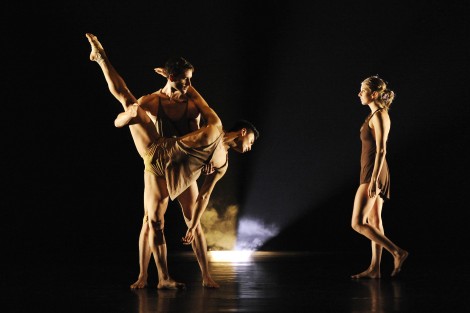
Featured image: Juliette Barton, Chen Wen and Richard Cilli in LANDforms. Courtesy Sydney Dance Company

Dance portraits by E. O. Hoppé

The name E. O. Hoppé is familiar to anyone who has put in any time researching the history of the Ballets Russes under Serge Diaghilev. Hoppé, who was born in Germany but who spent much of his professional life in England, secured the exclusive right to photograph the Diaghilev dancers when they first came to London in 1911. Some of these photographs are well known in Australia and are currently on display in the National Gallery of Australia’s exhibition, Ballets Russes: the art of costume—the well-known image of Tamara Karsavina and Adolph Bolm in Firebird, for example. But a current exhibition at the National Portrait Gallery in London, Hoppé portraits: society, studio & street, has on show some exceptional dance portraits that are not quite as well known.

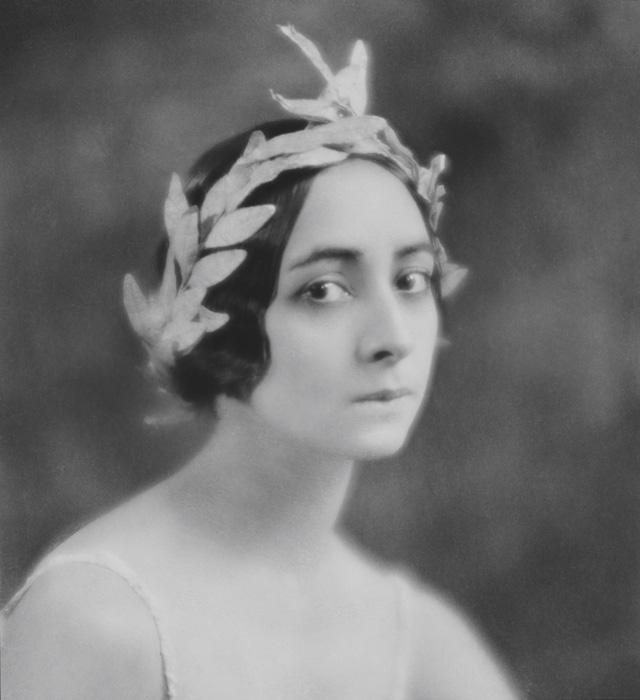
E. O. Hoppé, Olga Spessivtseva as Aurora in The Sleeping Princess, 1921. Courtesy National Portrait Gallery, London

Given my recent research into the 1934-1935 tour by the Dandré-Levitoff Russian Ballet and Olga Spessivtseva‘s role in it, I was especially interested in a portrait of Spessivtseva as Aurora in The Sleeping Princess. It was taken by Hoppé in 1921, the year of the premiere of Diaghilev’s ill-fated production of that ballet. Spessivtseva does not face the camera full on and her subdued eyes are turned to the front with a gaze that asks us to consider her as someone quite fragile. Her pale lips seem almost cold and the overall effect is haunting. Is it because we know that Spessivtseva would suffer some kind of mental illness that we read the portrait in this way? Or did Hoppé capture the essence of this enigmatic woman?

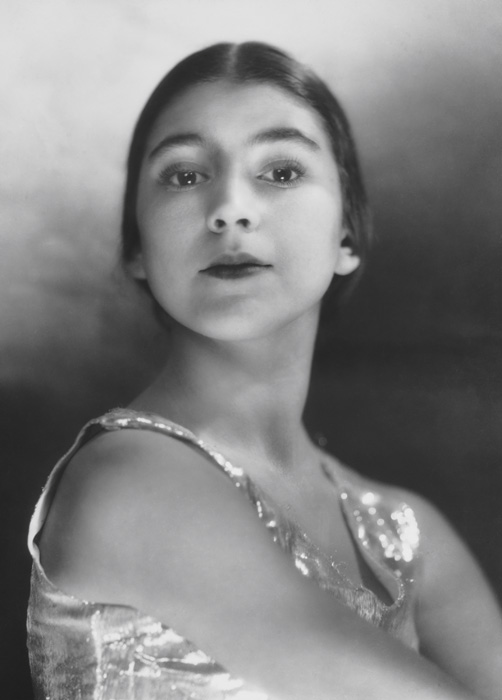
E. O. Hoppé, Portrait of Margot Fonteyn, 1935. Courtesy National Portrait Gallery, London

By contrast, a magnificent portrait of a young Margot Fonteyn taken in 1935 (she would have been 16) shows her looking straight at us. With lustrous eyes and full, red lips she is sensuous and confident, even slightly haughty,  and definitely ready to take on the world. Again Hoppé appears to have had a remarkable eye for capturing the essence of his sitter.

There are a number of other fascinating dance portraits in this exhibition including a great shot of Martha Graham with Ted Shawn in a tango-style pose taken in 1922 just as Graham was completing her study at the Denishawn school before joining the Greenwich Village Follies. And of course many of the Russian Ballet shots are on show. All are reproduced in the exhibition book, along with many non-dance portraits and a collection of remarkable documentary studies of day-to-day life in Britain between the wars.

Michelle Potter, 4 April 2011

Hoppé portraits: society, studio & street runs until 30 May 2011 at the National Portrait Gallery, St Martin’s Place, London.

Exhibition book: Hoppé portraits: society, studio & street (London: National Portrait Gallery, 2011) ISBN 978 85514 4217

Swan Lake. English National Ballet (2011)

The English National Ballet has just concluded a season of Swan Lake that can only be described as a triumph. As much as I admire, and love watching Graeme Murphy’s production of Swan Lake, and this is the Swan Lake Australians now see regularly, there remains deep down a craving for the traditional version, and this is just what ENB delivered.

ENB’s current Swan Lake is choreographed by Derek Deane. This season gave us not his probably better known in-the-round version seen in Australia some years ago, but a glorious, dramaturgically strong, proscenium version that moved from palace to lakeside and back again capturing attention from the moment the curtain rose until it fell.

A beautifully rehearsed and coached corps de ballet danced to perfection in the white acts, moving as one and conjuring up a sense of another world. The dancers were just as impressive as courtiers, always aware of the underlying narrative, never standing around uncertain of how to behave. From a more technical point of view, the corps demonstrated in particular just how expressive the upper body can be when actually used. Such fluidity above the waist seems a little rare to me these days.

As well as dancing brilliantly, the soloists and principals brought to the stage quite outstanding skills of characterisation. This was a production where Rothbart was a significant character (not always the case) and the relationship of Rothbart, Odette and Siegfried to each other was powerfully realised to the extent that I sat on the edge of my seat agog as the final act unfolded. This last act, which so often disintegrates into nothing more than a pretty finale, had great dramatic intensity as Odette struggled against the opposing forces that Rothbart and Siegfried represented.

I saw two casts and was most affected by the cast led by Vadim Muntagirov as Siegfried. Muntagirov, still a very young artist, dances with so much care for the details of ballet technique. He moves with elegance, he executes jumps with the lightness and grace of a panther, and his turns and tours en l’air are beautifully placed and yet exude bravura. In his solo in Act I where he ponders his predicament as a young man, who has been told he must marry but who yearns for something he can’t quite yet articulate, he displayed his refined line and his ability to show emotion through technique.

Muntagirov partnered a very secure Daria Klimentova as Odette/Odile—fragile as Odette, cunning and ultimately triumphant as Odile. Rothbart was danced with flair by Fabian Reimair. Others who stood out to me included Shiori Kase in the Act I pas de quatre at both performances I saw, and Esteban Berlanga who acquitted himself well as Siegfried in the second cast partnering Erina Takahashi.

Apart from having the pleasure of watching some really good technical dancing, and seeing a company so well rehearsed and coached, the greatest joy was seeing a performance that gave full reign to Swan Lake’s brooding Gothic character. Peter Farmer’s design helped but nothing can take the place of intelligent staging. Many bouquets to ENB. Is ballet dead? Certainly not at English National Ballet.

Michelle Potter, 3 April 2011

Legacy program. Merce Cunningham Dance Company

In the final year of its legacy program, the Merce Cunningham Dance Company has just completed a season at the Joyce Theater in New York showing CRWDSPCR (1993), Quartet (1982) and Antic Meet (1958). This program not only spanned three decades of Merce Cunningham’s creative output, but it represented three major strands in his creative process.

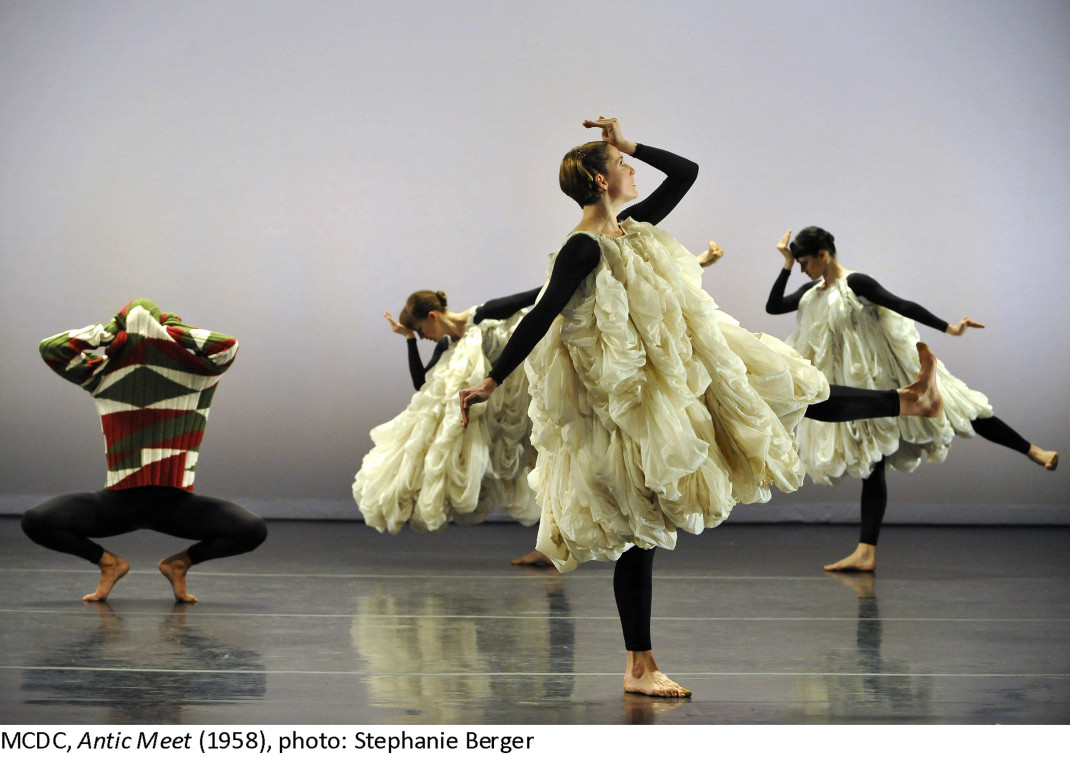
The program moved backwards in time, although this was probably not a wise programming decision. Antic Meet, which closed the program, did not have the strength to bring the evening to a conclusion on a high note. It was, however, totally fascinating as representative of work from the early Cunningham period when money was short, the company was small and collaboration between three artistic giants—Cunningham, John Cage and Robert Rauschenberg—was a highlight of the company’s work. A series of slight unrelated moments for six dancers (four women and two men), Antic Meet is vaudeville, theatre of the absurd and a dada event rolled into one with the strength of the piece coming from the visual and musical accompaniments and the juxtaposition of sections rather than from the choreography itself.

Rauschenberg’s costumes, consisting of various additions to basic black tights and a black leotard, are an eclectic mix of  ‘found’ items.

In one section the four women wear dresses originally fashioned from government surplus parachutes. The women are joined by a male dancer wearing a four-armed neckless sweater (made originally by Cunningham) and the sweater in fact becomes the dancer as it is swung, twisted, stretched and struggled with by the live dancer underneath its eccentric construction.

Others of Rauschenberg’s costumes include a fur coat (originally racoon), a long Victorian-style nightdress (both found by Rauschenberg in thrift shops), and some remarkably contemporary-looking black T-shirts with a plastic hoop inserted around the hemline—a little like very short, misplaced tutus. Along with a chair strapped to a dancer’s back, an assortment of props including a door on wheels that leads nowhere, and the accompaniment of John Cage’s Concert for Piano and Orchestra played live at the Joyce by five distinguished musicians, the whole is light heartedly bizarre.

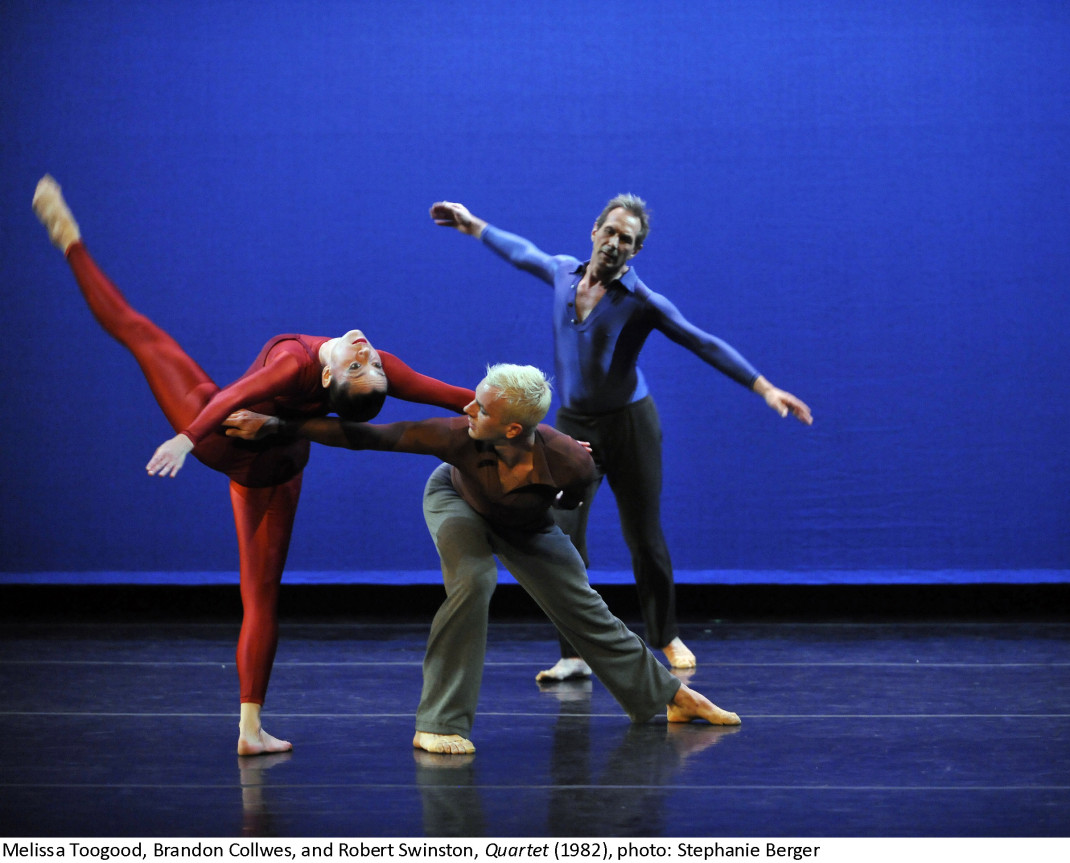
The middle piece, Quartet, is the most powerful of the three works on the program and represents Cunningham’s engagement with electronic music and with two major collaborators from the 1970s and onwards, designer Mark Lancaster and composer David Tudor. Although called Quartet, it was made for five dancers, a quartet who perform Cunningham’s signature choreography of off-balance poses, asymmetrical partnering and fast turns, and a fifth dancer who remains separated from the four and whose choreography is composed of twisted, sudden movements especially of the arms, largely made while standing on the spot. This fifth dancer was originally Cunningham and the work was created as arthritis was beginning to take its toll on Cunningham’s body. In the Joyce season the role was danced by the company’s current director of choreography, Robert Swinston. It is tempting to suggest that Swinston was posing as Cunningham. But he isn’t Cunningham and what Swinston was able to suggest was that Quartet is a work about belonging and not belonging.

With the dancers dressed simply by Lancaster in functional dance wear in luscious colours of olive, brown and burnished reds and blues, Quartet was performed to Tudor’s electronic score Sextet for Seven, played live by Takehisa Kosugi, the company’s current music director. Despite the theme of alienation and the somewhat chilling sound of the score, described as ‘six homogenous voices and one wandering voice’, Quartet is not a depressing work. In fact it seemed to me to be a very peaceful work as if in Cunningham’s mind the concept of outsider had been resolved.

The opening piece on the program, CRWDSPCR, is perhaps best summed up by a member of the audience who sprang to her feet as the work finished and shouted ‘Bit of work!!’ It is indeed a ‘bit of work’. It begins with its full complement of thirteen dancers on stage and for the twenty-five minutes or so that the dance lasts, apart from one slow solo section, the dancers weave themselves cross the space to John King’s electronic score, blues ’99. The energy is frenetic as the dancers manoeuvre past each other like the crowds at Grand Central Station, gathering momentum as they proceed. Pronounced either Crowd spacer, or Crowds pacer, a double edged notion that gives a clue to the nature of the work, CRWDSPCR is a little like ordered chaos but brilliantly designed choreographically and as brilliantly executed. The excitement it generated in the audience suggests that it would perhaps have been better placed at the end of the program.

CRWDSPCR represents Cunningham’s early but ongoing interest in using computer technology as a choreographic tool and he created it using the software program LifeForms (now DanceForms). It is costumed by Mark Lancaster in tights and leotards in fourteen blocks of colour to echo the software program. King’s score was again played live by King and Kosugi.

What a pleasure it was to see this this outstanding company in works from across the repertoire with music played live by such remarkable musicians. It was clear reinforcement of the vital role Cunningham, his company as it existed across many decades, and the astonishing collaborators with whom he worked, have made to the world’s dance culture.

Michelle Potter, 27 March 2011

Snow on the mesa. Martha Graham Dance Company

24 March 2011. The Rose Theatre, New York

The 2011 New York revival of Snow on the mesa, subtitled Portrait of Martha, began in a highly theatrical manner. Three stuffed wolf heads lay on the stage floor. Three women clad in black hooded cloaks appeared at various intervals. Dramatic colours, often a brilliant blue, washed the backcloth. A single hand belonging to one of the mysterious figures was lit briefly to glow starkly in the darkness. A soundscape of rain, wolves howling, thunder and lightning broke the silence. Towards the end of this section, the first of twelve that made up the total piece, the women each picked up a stuffed head and wore it as a glove. They exited as mysteriously as they had appeared.

This opening had all the hallmarks of the best of Robert Wilson, who choreographed and designed the work for the Martha Graham Dance Company in 1995. We saw in particular his dramatic use of space in the strategic placement of the wolf heads on the floor and the mysterious arrival of the women at separate moments; we saw and heard how brilliantly he can juxtapose elements of sound and light against objects and people to set up an atmosphere; and we saw his capacity to create allusions and resonances, all surreally personal to the audience. The opening made me think of Cathy and Heathcliff on the Yorkshire moors in Wuthering Heights. Perhaps, however, those more familiar with the work of Martha Graham could see allusions to Graham or her work since this portrait of Martha was meant to evoke Graham’s creative journey.

But after this first scene, ‘The wolf wife’, the work fell apart somewhat. Can Robert Wilson seriously be considered a choreographer? I suspect not. The third section entitled ‘Navaho Rug’ was a case in point. The sole dancer looked to me a little like a golliwog or one of those Christmas Nutcracker dolls with a string that when pulled makes the dolls’ arms and legs move in a jerky fashion. It also went on for an inordinate length of time and as a result could not escape from being  unnecessarily repetitious.

Another section, which I only realised after looking back at the program must have been the section entitled ‘Very young Kachina clowns’, was a reference to a character within the Hopi tradition who engages in exaggerated behaviour. And exaggerated is the word to describe the choreography of this section. All that face-pulling simply made good dancers look silly. Similarly when the company appeared onstage all wearing long Methuselah beards (and I mean seriously long—they almost swept the floor) in the section entitled ‘Very old: ghost walkers’, I had to wonder why any choreographer would want to dress such beautiful dancers as the very elegant Katherine Crockett in such a get-up.

Apart from Crockett, the other dancer who stood out was the Chinese-born Xiaochuan Xie whose dancing in ‘Shaker interior’ with Tadej Brdnik was as minimally beautiful as the white bench that was the only item of decoration in this section. It was a travesty to have this dancer wearing one of those hideous Methuselah beards later in the piece.

We knew the work had reached its conclusion when the snow began to fall from the flies, although there were sections before this scene that seemed (wishful thinking?) like a finale. People had left before the snow of course. But then it wouldn’t be a Robert Wilson piece without a restless audience.

Michelle Potter, 24 March 2011

For images that underscore the dramatic visual look of Snow on the mesa open this link. It also gives another account and a link to yet another.

Not entirely herself. Vicky Schick

20 March 2011. The Kitchen, New York

Vicky Schick’s newest work, Not entirely herself, is a beautifully lyrical and sensuous dance piece for a trio of young women, along with Schick herself, and another veteran performer, Neil Greenberg.

Performed in the black box space of the Kitchen in downtown Manhattan, Not entirely herself began with three dancers, Marilyn Maywald, Jimena Paz and Maggie Thom, working on a small, square platform raised slightly off the floor. As they posed, alone and together on this platform, linking and separating their bodies in a variety of ways, they set the scene for what might be considered the theme of Schick’s work: how we connect (or don’t connect) with each other. These groupings continued throughout the piece, sometimes on the platform, sometimes elsewhere in the performing space, and became a little like a photograph album with the changing nature of the groupings reflecting the changing pattern of friendships over time.

In between, passages of dancing showed Schick’s choreographic interest in small, detailed movement set alongside flowing sections of luxuriant dancing. I especially admired Marilyn Maywald who was able to imbue the simplest of movements, such as the twist of a wrist or the placement of a foot on the ground, with dancerly sensibility, and whose body sang with a feeling of abandonment as she moved through the free-flowing sections.

This trio section, the longer of the two that made up the hour-long work, was followed by a duet for Schick and Greenberg. It seemed like a statement of closure on what had gone before. Here was a couple familiar with each other’s character, able to move together, joke together, be together without concern that the relationship might flounder. And what a star performer Neil Greenberg is. His Cunningham-esque ability to isolate movement in specific parts of the body, whether hips, hands, head or any other part of his anatomy, is formidable. He must be one of the most articulate and kinetically intelligent dancers to grace the contemporary dance scene. Not only that, he has charisma in bucket loads.

The work was designed by Schick’s long-term collaborator Barbara Kilpatrick. I particularly enjoyed the contrast Kilpatrick set up between the three young women in their rather trendy outfits, which included a Sergeant Pepper style jacket, various see-through items and a kind of island sarong, and the more functionally useful outfits worn by Schick and Greenberg. Costuming highlighted beautifully the differences of personal relationships suggested in each section. Lighting was by Chloe Brown and the work was performed to an original score and sound design by Elise Kermani.

Arriving from the far-flung Antipodes without a ticket to this sold-out show I decided to take my chances with that peculiarly New York custom—the wait list. I was in luck and am grateful to whomever decided not to pick up their reserved tickets!

Michelle Potter, 21 March 2011

Food Chain. Gavin Webber and Grayson Millwood (Animal Farm Collective)

Seymour Centre, Sydney Festival 2011

I didn’t see roadkill or lawn, the previous works by Gavin Webber and Grayson Millwood shown in Australia in recent years. So I have no way of knowing how Food Chain, presented at the Sydney Festival 2011, fits in with their developing (or developed?) aesthetic. I have to say that if those previous works were like Food Chain I find it difficult to understand their apparent success.

Food Chain was episodic—not surprising given the experience of Webber and Millwood, which includes working with Meryl Tankard Australian Dance Theatre and in various situations in Germany. Billed as ‘a David Attenborough documentary in reverse’, it purported to examine the idea of animals experimenting on humans and on how much ‘animal’ was apparent in human beings. Men in bear suits changing into business suits. A woman wearing a bear head backwards or on the end of her leg. A conversation with a line-up of stuffed animals. A game of shadow play of a fairly simplistic nature that morphed into shadowy allusions to bestiality. Crude references to sexual smell. For me Food Chain just lacked any kind of sophistication of thought. Even those polar bear advertisements for Bundaberg rum we used to see on commercial television with some frequency had more to offer in my opinion.

For me Food Chain also lacked any kind of sophisticated movement. With no-one identified as choreographer perhaps this is not surprising. Take the closing scene when the cast spent some time slowly descending a large tree trunk that made up the major part of the set. Each performer would make it, eventually, to the floor and disappear only to return at the top of the trunk and make another descent. It seemed to last an age. The work was also punctuated with the spoken word. Some lines were just inaudible. Not all dancers have the ability or training to speak on stage. Very frustrating.

In the end it was difficult to understand exactly what Webber and Millwood were trying to say other than something on the most superficial of levels. I thought Food Chain was way down the chain of where dance is in the twenty-first century. At least the tickets were only $30.

Michelle Potter, 2 February 2011

Entity. Random Dance

28 January 2011, Sydney Theatre, Walsh Bay. Sydney Festival, 2011

Wayne McGregor’s Entity, performed by his company Random Dance as part of the 2011 Sydney Festival, begins and ends with black and white footage of a greyhound in motion. It may be or be based on the work of the nineteenth-century, British-American photographer Eadweard Muybridge, a pioneer of the physics of animal locution. It certainly recalls the work of Muybridge. To me this visual clue is of far greater import and carries much more interest for the viewer than any amount of philosophical discussion of McGregor’s research project ‘Choreography and cognition’ and his work with neuroscientists, as fascinating as those and other aspects of McGregor’s career are.

Entity shows the remarkable ability of the human body to move, bend, twist, flex, soar and travel. Like the greyhound the dancers are sleek. Their limbs extend and reach outwards. Their bodies are stretched long and lean. They use their muscles efficiently. They move with intention. In their black briefs and white T-tops, dispensed with towards the end to reveal black bra tops on the women and for the men a bare upper body, they hover on the edge of classical movement before morphing into strange new shapes. They twist and contort their bodies with one recurring motif being an arched spine with backside pushed out, the antithesis of the classically stretched spine with the head balanced perfectly at the top. Bodies are in constant dialogue with each other and the movement screams out its edginess.

Danced to a score by Joby Talbot followed by another from Jon Hopkins, the work is set in an enclosed space consisting of three light coloured, translucent screens, one at each side and one at the back of the stage area. Designed by Patrick Burnier they can be manipulated by a (viewable) mechanical system and lit when required. When lit (design by Lucy Carter) their internal structure is further revealed. During the second part of the work the screens rise above the dancers and are enhanced by video projections. From my position towards the back of the circle of the Sydney Theatre it was not entirely clear what the projections were other than they seemed to be various formulae. Part of the choreographer’s fascination with mathematical and engineering principles?

But in the end Entity is about McGregor’s choreography and about his attitude to how the body can move in this present day and age. It makes me long to see more of McGregor’s work, especially when danced by intensively trained ballet dancers. There are some great scenes of McGregor rehearsing Genus, his work for the Paris Opera Ballet, along with brief excerpts from the work in performance in the recent film La danse. While Random Dance performed superbly in Sydney, there is something additional in the way the dancers of the Paris Opera Ballet perform. There is a certain security in the way they move, an inherent understanding of the body, something deeply intuitive about movement, that allows McGregor’s classical references to be offset in a particular way. The mix of the classical and the restive tension of today becomes heightened and makes us see both and all more clearly.

Although this is a little simplistic, McGregor reminds me of Merce Cunningham, George Balanchine and William Forsythe rolled into one. He’s a formalist. He dispenses with fussy costumes and decorative sets. And he has a remarkable intellectual curiosity. It makes for unusual and ultimately satisfying dance, which in its essence is purely McGregor.

Michelle Potter, 31 January 2011

My bicycle loves you. Legs on the Wall

Program notes for My bicycle loves you, the 2011 Sydney Festival production from Legs on the Wall, promote the show as a day in the life of seven characters inhabiting the same apartment building. They also explain that the show features archival footage sourced from the National Film and Sound Archive, rare footage dating to the early twentieth century as used by the Corrick family of vaudeville entertainers.

The footage is fascinating and is a mix of travelogue, chase, and fantasy scenes, with some trick photography and early use of tinted film. It has been beautifully manipulated for the show by video artist Mic Gruchy. Whether projected onto screens—sometimes large, sometimes small—used as shadow play, or mixed with contemporary footage of the artists of Legs on the Wall, it rarely loses its fascination.

But as on so many occasions when footage or projections of some kind are used as an integral part of a theatre performance, especially one where movement is the central mode of expression, the movement becomes a secondary partner. Without an exceptional collaborative aesthetic at work, the visual imagery always dominates. And this is what happened in My bicycle loves you. It was only when the very skilful artists of Legs on the Wall were performing against a static backdrop (which was not often) did they command the attention they deserve.

The eclectic movement style of Legs on the Wall, dubbed ‘physical theatre’, often appears to me to lack focus at the best of times. The mind tends to wander and wonder whether the mixture of circus acrobatics, street dance, stunts and other varieties of dancing and movement, is able to convey a narrative, even a surreal or episodic one. It is worse when something else takes the attention away from the physicality on display. Bouquets, however, to the four musicians in the pit, especially for their five minute or so jam at the end of the show.

Michelle Potter, 19 January 2011