Alexei Ratmansky. ‘The real thing’

12–13 November 2011, City Center, New York

When I wrote unaffectionately about Alexei Ratmansky’s 2009 work for the Australian Ballet, a new version of the 1933 Massine ballet Scuola di ballo, I received some feedback from friend and colleague David Vaughan. David wrote that he wished I could see work made by Ratmansky for New York City Ballet and American Ballet Theatre. ‘I am sure you would realize’, he wrote ‘that he is the real thing’.

It has been interesting, too, over the two years since I wrote that review to hear comments from dancers and others who worked with Ratmansky on that Australian production. They all found it a huge pleasure and had nothing but praise for Ratmansky. But nothing changes my opinion of his Scuola di ballo, and I had nothing to go on other than what I saw on stage, which is as it should be for any reviewer.

However, I now believe that David was right, at least in the wider scheme of things. I recently had the good fortune to see two performances of Ratmansky’s Seven Sonatas during American Ballet Theatre’s recent Fall season at City Center, New York.

Seven Sonatas, also first made in 2009, is danced to keyboard sonatas by Domencio Scarlatti. The work is for three couples who engage with each other in a variety of combinations. They dance with and for each other. At the heart of the work, and centrally in the structure, are three pas de deux. The first and the longest had a note of anguish to it. Maria Riccetto and Blaine Hoven, in the first cast I saw, danced an intense and emotive pas de deux. Was this couple breaking apart? The woman seemed to be wanting to end the relationship as she extended her body away from the man. But it was never clear cut and Ratmansky’s gift to us was to leave us wondering.

The second pas de deux was also the shortest. It was full of unabashed pleasure, in life, dancing and partnership. Of the two casts I saw Xiomara Reyes and Herman Cornejo best managed the spectacular choreography with its sudden changes of direction and its difficult turns. The third was a teasing game in which Julie Kent and Alexandre Hammoudi excelled. I loved Kent’s expressions, both facial and bodily, as she played with Hammoudi’s emotions, leading him on all the time. At one stage he was left alone briefly to dance a solo hoping Kent was watching from the wings. And she no doubt was as she re-entered the game to bring it to a satisfying conclusion with a leap into his arms.

Before and after these pas de deux we were treated to such lyrical movement in which the arms and upper body played a major role. Sometimes the arms and hands seemed very natural—clasped in front or behind the body, although clearly choreographed to be that way. Other times, rather than the palms facing each other in classical mode, the arms were held with the palms facing outwards and the arms opened as if pushing the air away. Sometimes the arm and hand movements were just totally surprising. At one stage Julie Kent executed a set of turns with arms in fifth position. But a closer look revealed that her fists were clenched and her wrists crossed. But diversity and surprise were features across every aspect of the work, especially in the way steps were combined and conceived as part of the work’s structure.

This work also presented every one of the six dancers as individuals. Individuality extended beyond the choreography even to the women’s hairstyles—beautifully braided in some cases but always drawn well off the face showing the elegance of the neck. And mention should be made of Holly Hynes’ costumes. The women wore soft white dresses, reaching well below the knee and with bodices decorated with pinkish brown trimmings, each slightly different. The men were costumed in white tights and short white jackets, again each slightly different in cut and trimming.

Seven Sonatas is a ballet for all. If you want to see a delicious work, which is also somehow very calming, then this is it. You don’t have to work hard to be given a special experience. But if you want more then it’s all there too. It could be watched multiple times and would always keep giving. But perhaps best of all, Ratmansky has made a work that speaks of, and asks questions about life and love through movement. I can think of nothing better or more admirable.

Michelle Potter, 15 November 2011

And to the Australian Ballet: give us the real thing please!
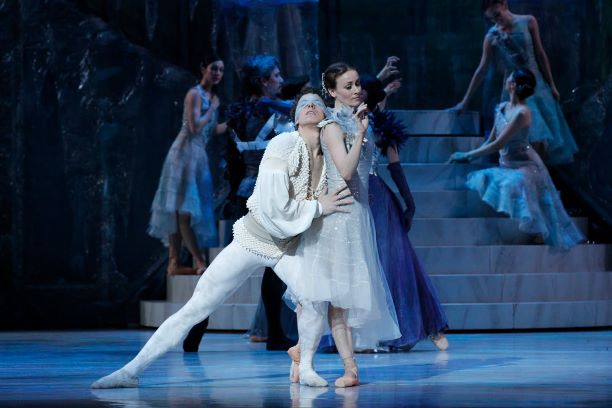
Romeo and Juliet. The Australian Ballet (2011)

This is an expanded version of my review first published in The Canberra Times, 17 September 2011, p. 30 under the title ‘Fluid postmodern take on a classic’.

13 September 2011, State Theatre, Victorian Arts Centre, Melbourne

In an interview published in the September issue of the Qantas inflight magazine, choreographer Graeme Murphy said of his new production of Romeo and Juliet for the Australian Ballet that we should ‘bring a lifeboat’. Well he had a point because this production, which had its world premiere in Melbourne on 13 September, is a very fluid one indeed. It opens in a town setting, which could be Verona at the time Shakespeare’s Romeo and Juliet is set. But over the course of the evening the location and the era change wildly. We see the marriage of Romeo and Juliet in Japan, the killing of Tybalt and Mercutio in India and the mourning of Juliet in a harsh, blood red desert setting. The characters ride bikes in one scene. Romeo, Mercutio and Benvolio find themselves in a row boat in another. And more.

Graeme Murphy’s Romeo and Juliet is quintessentially postmodern. It has moments of humour and irony. It is filled with allusions to all kinds of cultural objects and issues—devotees of the Hare Krishna movement even make an appearance. Murphy also references himself and his work through some choreographic moments that look back to the vintage days of Sydney Dance Company. The scene in which Juliet receives a potion to induce a death-like sleep, when six black clad figures support Juliet in expansive swooping and flying movements, is just one example of this glance back at previous choreography.

Murphy also incorporates fabric into the choreography and the production overall. And while on this occasion his costume designer, Akira Isogawa, may well have had a strong input into how fabric has been used, Murphy has been playing with lengths of cloth and curtains of fabric throughout his choreographic career. One of the most dramatic uses of fabric in Romeo and Juliet occurs when a bolt of scarlet silk, initially resting amongst other rolls of fabric on the side of the stage in the Indian market place, unwinds and streams across the stage as the Capulets and the Montagues engage in their bloody feud.

This Romeo and Juliet is a collage of ideas playfully deconstructed and the remarkable thing is that it works. Everyone knows the story and Murphy has assumed this familiarity with the plot and has pursued a vision for a work that is like no other that the Australian Ballet has ever presented.

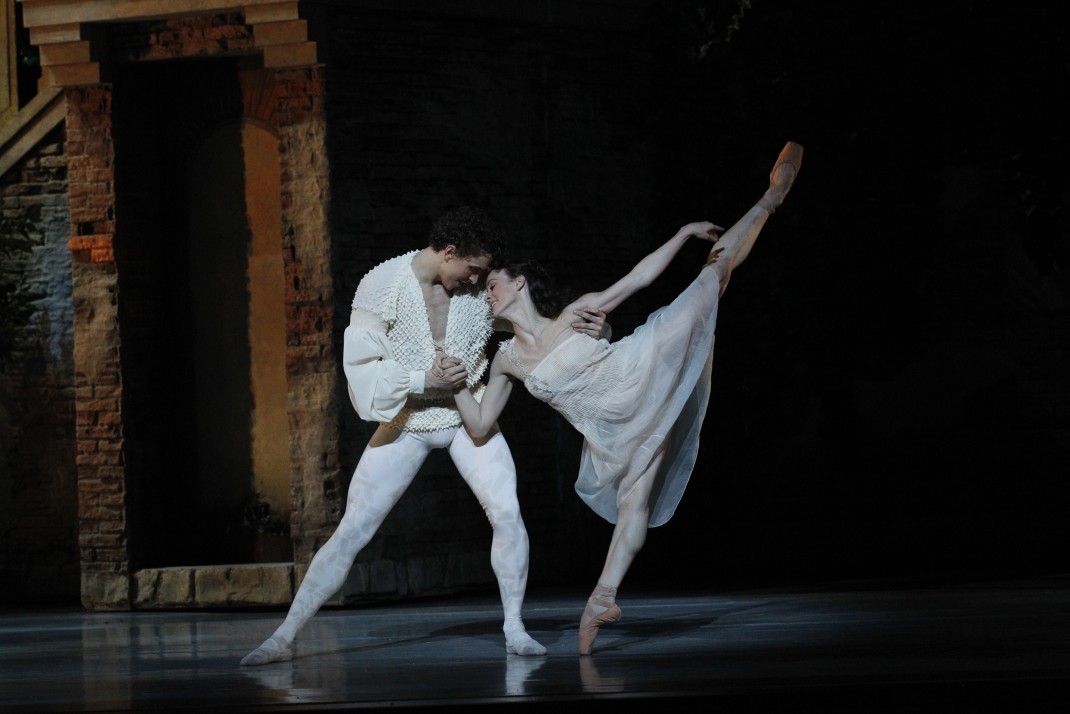
On opening night Madeleine Eastoe and Kevin Jackson as Juliet and Romeo led us on this journey of love and death. Eastoe in particular danced with joy, passion, despair, every emotion that the story requires. Her opening dance, with its quick footwork and fluid upper body movement, filled us with pleasure and anticipation.

Madeleine Eastoe and Kevin Jackson in Romeo and Juliet, 2011. Photo: © Jeff Busby. Courtesy of the Australian Ballet

Daniel Gaudiello continued to impress as Mercutio and moved, as his name in this ballet implies, like quicksilver, darting here and there, unpredictable and always impassioned in defence of his friends. Juliet’s nurse, usually played as a somewhat plump and bumbling if kind-hearted older woman, was intelligently performed by Elizabeth Hill and became (thankfully) a much less pantomimic role. A character introduced by Murphy—Death, the Prince of Darkness—provided a through line for the meandering locations and times. Death picks up bodies, which he places in a wooden cart (rather like the carts that carried the French to the guillotine in 1789—another reference). Or sometimes he just hovers menacingly in the background. It’s not a big dancing role but one that requires a very strong presence. It was very ably performed on opening night by Adam Bull.

In addition to Akira Isogawa, the collaborative team on this production included Murphy’s creative associate, Janet Vernon, set designer Gerard Manion, and Damien Cooper who lit the show. From among literally hundreds of costumes created by Isogawa, I especially liked the beautifully cut, high-collared black coat for Death and the pale olive, very simple costume for Juliet’s nurse. I was amused by the costume for Paris, which seemed to have a kind of gold ‘breast-plate’ of muscles. Paris is rarely portrayed in a sympathetic way and this addition to his costume suggested an inherent vanity. Manion’s strongest contribution was a visually arresting painted front cloth comprising a huge bunch of gold, pink and blood red lilies from which the deepest colours drained to grey as the cloth rose at the beginning of the work.

This Romeo and Juliet may not appeal to everyone, especially those who like their ballet to be more in a modernist vein, that is somewhat coherent in form. Did I miss the John Cranko version of Romeo and Juliet, which has been in the Australian Ballet’s repertoire for decades? Yes, a little, but in the same way as I occasionally yearn to see a traditional Swan Lake, rather than Murphy’s newer production. It’s part of the balletic legacy and we need to be reminded occasionally that we have a heritage.

But Murphy’s approach in 2011 raises many issues that are discussed across other art forms and it is refreshing to see this occurring in ballet, an art form that is so often seen as a little dowdy. Of course such issues include the notion that postmodernism is dead so we have to wonder whether this Romeo and Juliet is already outdated? But whatever one might think, it is a production worth seeing.

Michelle Potter, 19 September 2011

Featured image: Madeleine Eastoe and Kevin Jackson in Romeo and Juliet, 2011. Photo: © Jeff Busby. Courtesy of the Australian Ballet

UPDATE, 11 December 2011: Romeo and Juliet. A second look

Spring Dance 2011 (2). Monumental

Ros Warby’s Monumental has been around since 2006 but I had not seen it for one reason or another. So it was more than irritating to arrive at its showing during Spring Dance to be told that there was no program sheet. ‘Oh, it’s the last performance’, I was told. Well this is the digital age when it doesn’t take long to print off a few more copies. And there were only two performances and I was at the second, so it seems slack that such a small number of shows could not be catered for in the first place. Besides, it is offensive to the artists involved when the audience doesn’t have the opportunity of reading who did the lighting, who made the costumes, who composed the music and so forth.

But to the show! Monumental, a solo work, focused on two generic figures—a swan and a soldier. I’m not sure they had any relationship to each other but certainly as each took the stage we were reminded of the fragility and perhaps the futility of the human condition and experience. The swan, which may or may not have been Odette from Swan Lake or the dying swan of Anna Pavlova fame, twitched and fluttered nervously. Warby’s headdress of a white skull cap/swimming gear looked incongruous with her white tutu but went well with her bare feet. Then the swan began to share the stage with footage of birds and of Warby herself. A beautiful blend of the living and the mechanical began to emerge and more resonances began to surface in one’s mind.

The soldier, dressed in a black jumpsuit and a headdress that recalled that worn by the Siren in the Ballets Russes production of The Prodigal Son, was a little less successful, although Warby demonstrated her versatility as a dancer, changing from the twitching anxiety of the swan to a precise, neat way of covering space—dare I say a militaristic way of moving? The Lone Ranger allusion (‘Hi, yo silver. Away’) as the soldier became a horse was again a complex layering of meaning especially as the footage changed from marching feet in a harsh environment to balletic feet, and as the soldier/horse became a black swan.

Warby’s Monumental is a strong work but not easily ‘understood’. It is emotional to a certain extent and juxtaposes ideas as non sequiturs. So it fits in a way with the Spring Dance focus on the expressionist legacy of Pina Bausch. But Warby has quite a cerebral, even dry approach to her creative practice that seems to me to be the antithesis of the Bauschian approach. Nevertheless, Monumental is a work worth watching and pondering over.

However, I do wish that Warby would avoid including obvious balletic language as part of her choreography. No matter how much one’s early ballet training may be ‘imprinted’ on the body (it’s on mine too!) one reaches a stage where turning pirouettes in a circle no longer looks the way it should. Without daily and intensive ballet classes and ongoing use of the ballet technique in a professional way, no dancer can do justice to the intrinsic qualities of the balletic vocabulary. The body seems like a slightly out of tune musical instrument, the steps suffer and we are faced with an unintended (I think) denigration of the vocabulary.

After the show I was able to confirm that the footage and lighting were the work of Margie Medlin and the cello score was by Helen Mountfort. Medlin and Mountfort are Warby’s regular collaborators but not everyone in the audience would have known that without a program sheet.

Michelle Potter, 10 September 2011

Spring Dance 2011 (1). Pina: a celebration

Pina Bausch died quite suddenly in 2009. It was a shock to most in the dance world and was the occasion for an outpouring of recollections and writing of various kinds. Sydney’s Spring Dance program, now in its third year, made its contribution with almost its entire program devoted in some way or another to the legacy of Bausch. A major highlight was Pina: a celebration, two days of talks and films hosted by journalist and broadcaster Caroline Baum.

In terms of format, Pina: a celebration comprised three sessions, ‘Keys to your soul’, ‘Pina’s children’ and ‘Muscle memory’. Each was held in the Playhouse at the Sydney Opera House and began with a conversation between Baum and her invited guests. On each occasion the conversation was followed by a film screening.

Although a major focus of the event was, to my mind anyway, on setting Bausch and her work within an Australian context, Bausch was absolutely central to the occasion and eclipsed most other aspects of the event. One of the unexpected highlights was a small snippet of footage shot in 1982 by Scott Hicks for a documentary on the 1982 Adelaide Festival at which Bausch and her company appeared. How warm and friendly Bausch seemed. And how cunningly she avoided the issue of how to describe her works by telling instead an amusing story about Alfred Hitchcock.

We saw Bausch again almost forty years later in  ‘Dancing Dreams’, a documentary made in 2010 by Anne Linsel and Rainer Hoffmann on the creation of a new version of Kontakthof, a work Bausch first made in 1978 and which was seen in Australia in Adelaide in 1982.  

In this new production Bausch used teenagers over the age of fourteen as her entire cast. Bausch watched rehearsals for this show we would occasionally see a smile break out on her now lined but always expressive face. There was again a sense of warmth and tenderness from the woman who was once accused of being a ‘theatre terrorist’ and making works that were the ‘raw pulp of abuse’.

The other two films were Pina Bausch made, again by Anne Linsel, in 2006, and Life in Movement made in 2010 by Bryan Mason and Sophie Hyde on the work of Tanja Liedtke. While both offered much insight, and Life in Movement in particular is an important addition to our knowledge of Liedtke’s creativity, both were at times a little subjective making them seem a tad too long. Not so with Dancing Dreams where the spoken words were forthright and honest, where the cast was able to be self critical and the young people able to analyse the role they were playing in the creative process, not to mention the effect that process was having on them. It was very refreshing,

In the conversations with Baum, three of the five guests were Australians whose work had been influenced in one way or another by Bausch: Michael Whaites, Kate Champion and Shaun Parker. What instantly stood out was the sense of objectivity they were able to bring out in their comments and answers to Baum’s questions. After the reverential tone of Bausch’s dancers in the Linsel film Pina Bausch, it was invigorating to hear something a little more down to earth. Whaites in particular, the only one of the three who had worked in close proximity to Bausch, spoke of the need to maintain just a little distance in dealing with life in Bausch’s Tanztheater Wuppertal. And on another Australian note, Dancing Dreams afforded us the pleasure of watching Jo Ann Endicott, an Australian dancer who has been with Bausch since 1973, in her role as co-rehearsal director (along with Bénédicte Billiet) for the new production of Kontakthof.

Alain Platel and Lutz Förster were Baum’s other guests. Both were in Sydney for performances of Platel’s Out of context: for Pina, which I wrote about last year and in which Förster was a performer.*

An unexpected (for me) addition to the program was a brief public conversation with photographer William Yang, whose images of two Bausch works, Kontakthof and 1980, taken at the 1982 Adelaide Festival were on view in the foyer. Yang, who admitted he was not really a great dance-goer, likened Bausch to Chekhov. ‘She understands the human condition’, he said.

Michelle Potter, 10 September 2011

*Platel was a guest on ‘Mornings with Margaret’ on 31 August 2011. His interview is available as a podcast. (update: Podcast no longer available)

.

Pina. A film by Wim Wenders

Pina, shot in 3-D and directed by the acclaimed German artist Wim Wenders, has been touted by many as showing the way forward in terms of filming dance, giving back to dance the physicality that it apparently loses in regular filming. But I’m not sure that many of the reviewers who have hailed it as a breakthrough have actually sat in a theatre and watched a performance by Pina Bausch’s company, or any other dance company for that matter.

For me the most interesting review to date has been by Australian playwright and commentator Louis Nowra. Writing in the August edition of The Monthly, Nowra astutely says, amongst other things, that the scenes shot out of doors are ‘[drained] of their claustrophobic power’, and that ‘the uterine universe that Bausch created onstage is dissipated’. His concluding statement is: ‘For all its 3-D marvels, the film finally doesn’t do her work justice’. And it doesn’t.

Pina is not really a documentary. Nor is it really a dance film. It sits uneasily between the two. It shows sequences from four major Bausch works, Rite of Spring, Café Mueller, Kontakthof and Vollmond, in most cases danced by the current company. It contains some archival footage, although not as much as one might have hoped to see. It contains solos performed outdoors in locations around Wuppertal, the German city where the company, led by Pina Bausch and now since Bausch’s death in 2009 by Dominique Mercy and Robert Stürm, has resided for almost four decades. It shows Bausch’s current dancers talking about their experiences with the company and their thoughts about what it was like working with Bausch.

Company dancers now, as they have been across the history of the company, are great movers. No doubting that. They are also articulate about their experiences and their emotional involvement in the act of working with Bausch. But what horrors are perpetrated by the 3-D technology! The scenic space in which the dancers perform is often far too deep and distorts the dancers. They often look far too small and far too thin. They don’t inhabit the space as living human beings but as kinds of puppet figures. We also, especially in footage of Rite of Spring, get some hideous close-up images (3-D close-up) of faces—images that we never see in performance, and that we are really never meant to see. Distance in the theatre has a place.

Also having a place in the theatre and often missing in Pina is the intimate contact between performers that develops in the enclosed space of a theatre stage. In the deep 3-D recesses, dancers seem to be separated or disengaged from each other, from the props and indeed from the performing space itself, not to mention from the viewer—and I don’t consider having a face thrust straight into mine courtesy of 3-D an engagement with the viewer. How much more engaging is the archival footage (not filmed in 3-D) of Bausch herself performing in Café Mueller where we see her interacting with the space around her body, her personal space, as all great dancers are able to do, rather than seeing her placed within a technological extension of space.

Going back to Louis Nowra, he is absolutely right that the very inward looking, almost narcissistic approach that seems necessary for the creation of a work by Pina Bausch is lost when the works (or parts of them) are placed out of doors. In fact for me the most interesting part of the footage shot out of doors was seeing the Schwebebahn, Wuppertal’s suspended monorail system that, as far as I am aware, is a somewhat over-engineered rail system that has never been replicated elsewhere.

Worse than that, as far as I am concerned, is that the works lose their inherent, dancerly theatricality when shot in 3-D.

Michelle Potter, 20 August 2011

Belong. Bangarra Dance Theatre

Bangarra Dance Theatre has always made dance that links back to the heritage of two groups of indigenous Australians: the Aboriginal communities of mainland Australia and the communities of the Torres Strait Islands. Belong, the company’s latest work, is no exception. Each of the two works that comprise the program, About choreographed by Elma Kris, and ID choreographed by the company’s artistic director Stephen Page, represents one of those streams of indigenous heritage. And, while the overall focus of the program is on the question of indigenous identity, the two works couldn’t be more different.

About opens with Kris, shrouded in a cloud of white mist, taking the role of a storyteller. She appears at the beginning of each section of the work and introduces us in turn to the four winds of the Torres Strait on which the work centres. Through Kris’ flowing choreography we encounter ‘Zey’, the cool south wind, ‘Kuki’, the powerful northwest wind, ‘Naygay’, the calm and gentle north wind, and ‘Sager’ the gusty, dominant southeast wind. Each has its particular energy, which is conveyed choreographically, through changing emphasis on male or female dancers, and through the way in which each wind is envisaged through colour and costuming.

About is without political overtones. Even as the Sager wind spirits confront each other as powerful forces, the work remains concerned with moods and a changing sense of spirit and movement. ID on the other hand is an emotive and often confronting work. Examining what it means to be an indigenous person in the 21st century, Page has structured his work as a series of episodes each commenting on some aspect of urban Aboriginal life. An indigenous man being tortured by prison guards is tough viewing and David Page’s music, interwoven with text, is unrelenting and adds an extra layer to a harsh and uncompromising work. The work does, however, contain some less politically challenging sections to balance the harshness. One uses a collection of hollowed out objects like tree trunks, or even slit gongs, and evocative lighting by Matt Cox to set the scene for some dancing that conveys more a passion for life and one’s culture than issues of social injustice.

I have long been an admirer of the strong and distinctive visual ‘look’ of a Bangarra production, which was established early in Bangarra’s performance history by the design team of Peter England (sets) and Jennifer Irwin (costumes). It is being carried forward now by others including, for Belong, Jacob Nash (sets) and Emma Howell (costumes). Stylistically and in the way both costumes and set occupy space there is more than a passing nod to the England/Irwin collaboration. But I greatly admired Nash’s backcloth (or was it a projection?) in About for the sections ‘Nagay’ and ‘Sager’. Streamer-like, the black and white image wound and swirled its way upwards across the backcloth at times looking like snake skin, at times like ancient bark, and at times like a meticulously executed linocut. Like the wind, and with the help of Matt Cox’s lighting, it appeared to be a changeable and unpredictable entity.

But if the ‘look’ is same, same but different, Bangarra dancers have moved ahead in leaps and bounds. Now with older role models and mentors, and perhaps with improved or more access to training, the current company is dancing very well indeed. Stand out performances came from Daniel Riley McKinley as the Initiate in ID and Kris and Waagenga Blanco as the Wind Spirits in the Sager section of About. Kris and Blanco in particular had a powerful connection between them as they danced, which many classical dancers might (or should) envy, and Blanco’s ability to fill the space around him with movement was exceptional.

Michelle Potter, 13 August 2011

International Gala 2011. Queensland Ballet

Asaf Messerer’s brief pas de deux, Spring Waters, was first seen in Australia around five decades ago when the Bolshoi Ballet visited the country. Then it was the most technically exciting pas de deux most people had ever seen. Now those high lifts with the man using just one arm to hold his partner aloft, and the sight of a female dancer throwing herself through the air into the arms of her partner, are not so rare. But Spring Waters remains a delight and its inclusion on the Queensland Ballet’s 2011 International Gala was something of a treat. Despite having to perform it to what sounded like an ancient recording, two of the guests artists who joined the dancers of Queensland Ballet for the gala, Ambra Vallo and Tyrone Singleton from Birmingham Royal Ballet, danced it with just the right sense of youthfulness and joy.

Vallo and Singleton also danced the pas de deux from Frederick Ashton’s Two Pigeons. This charming yet elegant pas de deux was a reminder that choreographers whose voice is distinctive are rare and precious. It was a joy to watch Ashton’s placement of the two dancers in relation to each other, often in unexpected but always harmonious juxtapositions.

Other works on the program were not so well served by international performers, or by their choreographers. Two very youthful dancers from Singapore Dance Theatre made a brave effort with the final pas de deux from The Sleeping Beauty. Kenya Nakamura as the Prince was inflexible in the upper body and very nervous. It meant that his performance was stilted and wooden. His partner, Tomoko Takahashi, had a lovely smile and was technically capable of executing the steps, but her performance suffered from inadequate partnering.

Two dancers from Berlin’s Staatsballett, Krasina Pavlova and Rainer Krenstetter, each had a solo on the program, although Krenstetter’s solo, Barocco by Renato Zanella, was little more than a series of poses. They also danced together in Grand pas classique, choreographed by Victor Gsovsky. Their performance in this pas de deux with variations in the traditional manner needed much more vivacity than we were given. I think both dancers needed to be reminded that dance happens with the human body and thus is inherently sexy (if not necessarily overtly sexual), especially if it is a pas de deux. There was little engagement between Krenstretter and Pavlova in Grand pas classique, and little engagement with the audience other than an occasional, unwarranted look of triumph on completion of certain steps. A great disappointment.

Probably the most interesting, and certainly the most anticipated work on the program was Nils Christe’s Short Dialogues, a new work for three couples. Set to music by Philip Glass, Christe’s choreography is ‘of the moment’. Bodies wrap around bodies and stretch into seemingly impossible positions, Visually it is often hard to disentangle one body from another. The work was expertly performed by Clare Morehen and Keian Langdon, Meng Ningning and Hao Bin formerly of the National Ballet of China but now dancing with Queensland Ballet, and Rachael Walsh and Christian Tátchev. And while the choreography and its performance were impressive, what made this work really stand out for me was the lighting design by David Walters. It gave the work an almost liquid quality: Short Dialogues seemed to pass before our eyes like an unexpected breeze—here one minute, gone the next.

At this International Gala the strongest performers were rarely the international guests but rather the dancers of Queensland Ballet. Apart from the execution of Christe’s slick, contemporary choreography, they also showed their theatricality in François Klaus’ Overture and Finale. His choreography for the opening and closing sequences of the gala had overtones of a contemporary commedia dell’arte and the dancers responded in a manner that was beautifully playful and slightly humorous. Noelene Hill’s pert red and orange costumes, including the cheeky frill on the women’s costume and the equally cheeky short shorts that were part of the men’s outfit, were perfect in carrying through the style.

The dancers carried their ability to move between diverse choreographic styles into Rosetta Cook’s homage to the tango, Hall of Flame, a work dedicated to former artistic director of Queensland Ballet, Harold Collins, who died just a week before the gala. I especially admired Kathleen Doody in Hall of Flame. She gave a cool, sophisticated reading of her character in a slightly over-long work that required cameo performances from each dancer.

Galas are always touch and go events. Unless the performers and the choreography are exceptional, and this was not always the case with this gala, such occasions are inevitably beset with problems of uneven quality and interest, as was the case.

Michelle Potter, 8 August 2011

Rain (Anne Teresa de Keersmaeker). Paris Opera Ballet

Most publicity related to the recent Paris Opera Ballet season of Anne Teresa de Keersmaeker’s Rain comments that the Belgian choreographer thought long and hard about having her work enter the repertoire of the Paris Opera Ballet. Would she or would she not agree to Brigitte Lefèvre’s request? Her vocabulary is just so different from that at the heart of the Paris Opera Ballet.

Reading these comments I thought about Merce Cunningham’s exquisite Summerspace entering the repertoire of New York City Ballet in 1966 and recalled that some Cunningham dancers say they sat in the theatre on opening night and cried as they watched it. I have never seen de Keersmaeker’s own company dancers perform Rain so I have no idea whether what I saw by the astonishing dancers of the Paris Opera Ballet would have induced tears in others. However, I know what reactions it elicited in me. Probably for the first time in my dance going career I felt that there was a real and palpable cross fertilisation between music and dance and that the design also contributed in its own way, all components advancing for me the simple idea of there being detail in detail.

Rain is danced to a score by Steve Reich, Music for eighteen musicians, pour ensemble avec voix, written in 1976, and the activity in the pit (and I had a seat close enough to have an excellent view of the musicians) was almost as good as what was happening on stage. The musicians of Ensemble Ictus and Synergy Vocals worked relentlessly to produce the sound just as the dancers worked relentlessly to put the choreography before us. Some, like the violinist, played pretty much constantly for the entire 70 minute piece, others occasionally changed positions in the pit or moved to play a different instrument. It looked as choreographed as the dance it accompanied.

From a dance point of view the work was full of the runs and falls, the off-centre leaning, the kicks of the legs, the pivots that we might expect of de Keersmaeker’s brand of dance. But the whole was beautifully arranged. Take the off-centre leans. They featured early in the piece but were picked up again towards the end of the work and repeated with arms lifted high rather than by the side. Devices of this kind featured throughout and gave the work a strong and logically organised internal structure within a seemingly random array of  individualistic dance moves. The ten dancers, three men and seven women, demonstrated the innate ability that the Paris Opera Ballet dancers have to articulate movement in different parts of the body. Just as every note of music and every small change could be heard clearly, every minute change of movement had the essential clarity needed to make de Keersmaeker’s choreography detailed rather than seemingly repetitive

Danced within a large semi-circle of suspended ropes designed and lit by Jan Versweyveld, the work began and finished theatrically with the dancers appearing first and last to us as shadows behind the rope circle. At times throughout the piece they moved to the front of the stage and smiled out to us, inviting us to share what seemed to be a joyous experience.

Costumes by Dries van Noten were made of light fabric initially in honey shades. They moved freely and consisted of simple skirts and tops or shift-style dresses for the women and pants and shirts for then men. Like the music and the choreography they too underwent small changes. A light honey brown skirt was changed to a rose one; a pale T shirt became a fuschia coloured one; a light dress became magenta; until at the end all changes had changed again back to the honey shades of the beginning.

It was done without fuss and without excess. And it was simply beautiful.

Michelle Potter, 11 June 2011

Ballo della regina, Live fire exercise, DGV. The Royal Ballet

10 May 2011, Royal Opera House, Covent Garden

Every time I visit London and am lucky enough to see a performance by the Royal Ballet I am bowled over. The recent mixed bill of Balanchine’s Ballo della regina, Wayne McGregor’s brand-new Live fire exercise and Christopher Wheeldon’s DGV (Danse à grande vitesse) simply reinforced my view that the Royal is at a high point in its career—so many dancers of star quality or star potential, a coaching team that appears to work on developing a clear understanding of what lies behind each work and great programming.

Balanchine’s Ballo della regina opened this program. On the night I went, leading roles were danced by Lauren Cuthbertson and Sergei Polunin. It was especially rewarding to see Cuthbertson take command of a role so closely associated with that great American ballerina Merrill Ashley, who created the leading female role in 1978. On stage Ashley always looked as American as apple pie, you might say, with her glowingly healthy face, her forthright (and fabulous) technique, and a kind of no holds barred, no nonsense approach. Cuthbertson, however, had a different approach. Ashley showed the steps, and how she showed them. Cuthbertson, with a lighter frame than Ashley, seemed to emphasis not so much individual moments but an overall fluidity. This is not to say that her dancing lacked highlights. Her ability to alter direction suddenly and to move with unexpected changes of speed was a real delight. And there was not a moment when she faltered. It was a great performance.

As for Polunin he had nothing to live up to as Robert Weiss, who partnered Ashley in 1978, never in my opinion really made the role his own. Polunin knocked me for six with his ability to cover space—the extension of the front leg in movements like grands jetés en avant was like an arrow speeding forward on a perfect course. And then there was the clarity of his beats and the perfection of his turns.

Four soloists—Melissa Hamilton stood out in particular—and a beautifully rehearsed corps de ballet made this Ballo a special treat.

Wayne McGregor’s Live fire exercise, made in collaboration with artist John Gerrard, on the surface could hardly have been more different. The starting point was a US army exercise in the Djibouti desert, a detonation designed to prepare troops for the physical effects of the mortar rounds or road side bombings they may encounter. A screen occupied a large part of the upstage area. On it was a projection of a desert scene and over time we saw the arrival of trucks and other machinery, a blast and the subsequent plume of fire and its smoky aftermath. In front of this video installation three men and three women performed McGregor’s demanding, highly physical choreography. In the background Michael Tippet’s Fantasia concertante on a theme of Corelli provided, almost as a juxtaposition, a kind of pastoral accompaniment.

McGregor’s choreography in Live fire exercise, showed his signature extensions with the dancers’ legs pushed high into positions that destroy the usual line of classical ballet, along with his approach to partnering with its emphasis on curved, twisted and folded bodies, and with his use of extreme falls. At one point Sarah Lamb performed a promenade in attitude on a bent supporting leg. She was supported in this by Eric Underwood who, once the circle of the promenade had been completed, swiftly lifted her and with a swirl threw her through the air. She travelled through the air, looking light as a feather with a perfectly held body, into the arms of another dancer. For me this moment put McGregor in a new light and his ability to use the classical vocabulary, and then to manipulate it became clear.

Overall, and almost unbelievably, the choreography seemed quite calm and considered. Throughout the piece single dancers occasionally stood quietly beside the video installation. They were lit so as to appear shadowy, isolated human beings figures against the plume of fire or smoke. They drew our attention from the choreography back to the footage and also served to remind us of the content of this footage and its underlying political message. Live fire exercise is the most personal of the works of McGregor that I have seen to date

In addition to Lamb and Underwood the cast comprised Cuthbertson, Polunin, Akane Takada, Federico Bonelli and Ricardo Cervera.

Closing the evening, Wheeldon’s DGV was something of a letdown. DGV is set to a score by Michael Nyman, MGV (Musique à grande vitesse), and draws inspiration from the idea of a journey with the French very fast train (TGV) the source of both Nyman’s and Wheeldon’s title. The work is essentially a series of four pas de deux with a corps to ballet of another eighteen dancers who often also work in pairs. It shows Wheeldon’s exceptional ability to create mesmerisng duets and his capacity to move large groups of people around the stage to create strong visual imagery. It was beautifully danced, especially by the corps and without a perfect corps the patterns falls apart, which they certainly didn’t on this occasion.

But I found the work a little repetitive and somewhat soporific. Maybe it was simply that it came after the McGregor with its underlying message of the politics of war? McGregor pushes his audience, Wheeldon doesn’t, or didn’t with DGV. Nevertheless DGV completed a wonderfully diverse and fabulously performed evening of dance.

Michelle Potter, 27 May 2011

British Liaisons. The Australian Ballet

14 May 2011, Opera Theatre, Sydney Opera House

This triple bill program, designed to highlight the strong links between British ballet and the growth of ballet in Australia, produced some moments that were absolute show stoppers.

None of those show stopping moments came, however, in Checkmate. Choreographed in 1937 by Dame Ninette de Valois as a battle between love and death played out on a chessboard, it opened the program. While for the most part it was adequately danced, it lacked any sustained suspense, which pretty much made a mockery of the whole thing. There is no doubt that Checkmate is an old fashioned work, highly stylised in its narrative and choreography. But some stronger characterisation, especially from Lucinda Dunn as the Black Queen, the seductress who ultimately brings about the downfall of the Red King, would have helped to make the work more enticing and anchored it in some kind of reality. Only Amy Harris as the Red Queen made anything of her role, a relatively minor one too, as she ushered in the Red King with kindness and concern. But without any strength of purpose from the other characters, Colin Peasley as the Red King had an uphill battle to make anything of his very important part.

But Christopher Wheeldon’s After the Rain, programmed as the middle piece, made up for the disappointments of Checkmate. The first section was strongly danced by Lana Jones, Amy Harris and Miwako Kubota partnered by Adam Bull, Andrew Killian and Brett Simon respectively. But it was the second section, the seductively beautiful pas de deux danced by Jones and Bull, that was the show stopper. Jones in particular captured the inner calm of this duet— ‘at the still point, there the dance is’ wrote T. S Eliot. Not only was Jones able capture the elusive quality of stillness and repose even as she moved or was moved by her partner, but with each lift one could only gasp at the curving line of her body as it cut through space until it reached the high point of the movement . There  it settled into its final, classically perfect shape. Bull partnered her with care and the tenderness that befits the emotional underpinning of the duet, but nothing could match the star quality of Jones.

Jones appeared again as the leading dancer in the first movement of Kenneth MacMillan’s Concerto, which closed the program. Here she showed another side of her technique, her clear, precise footwork and her ability to turn—especially her ability to turn as she executed a faultless series of chaîné turns across the stage from one downstage corner to the other. She also imbued her dancing in this movement with a beautifully pert quality bringing the audience into her ambit with smiling eyes and a sparkle to her every move. It made me long to see her dance the lead in Balanchine’s Rubies.

Concerto needed, however, a little more precision of technique from the corps de ballet to do justice to MacMillan’s spatial arrangements, which any straggly lines instantly destroy. And they were destroyed on more than one occasion. Juliet Burnett, however, made a strong impression with a beautifully controlled performance in the pas de deux that comprises the second movement. She was partnered by Andrew Killian who almost stole the limelight from her with his deliciously unexpected changes of expression and mood.

Company pianist Stuart Macklin deserves accolades too for his solo piano performances, first in Arvo Pärt’s Spiegel im Spiegel to which the pas de deux in After the Rain is performed, and then as soloist in the Shostakovich second piano concerto to which Concerto is danced.

At last, a few moments of excitement from an Australian Ballet performance. Oh that there could be more!

Michelle Potter, 16 May 2011