Infinity. A second look

14 April 2012 (matinee), Opera Theatre, Sydney Opera House

A second look at the Australian Ballet’s triple bill program, Infinity, at a recent Saturday matinee in Sydney produced some new highlights, but largely reinforced my thoughts following my first viewing on opening night in Melbourne.

As a new highlight, it was especially pleasurable to see that the shocking conflict between orchestra and the spoken narrative in There’s definitely a prince involved had been solved. It made a huge difference to one’s understanding of choreographer Gideon Obarzanek’s approach to the piece when one could actually hear what the performers were saying. The narrative is much wittier than was apparent on opening night when clarity and audibility were pretty much non-existent and when it seemed more like a fight between the orchestra and the spoken word than anything else.

In addition, the printed handout now included a credit to Tom Lingwood, whose name was missing from the handout on opening night but whose costumes from Swan Lake and Night Shadow were used for Prince (with extra costumes by Alexi Freeman). I suspect there needs to be someone doing a better job at proof reading of Australian Ballet publications, from major books down to nightly cast sheets.

Kristina Chan and Sara Black gave strong performances in Prince. Chan is a powerful dancer and her contemporary skills were especially evident in the ‘Drone 2’ section of Prince (although I’m not sure what the ‘Drone’ sections were meant to achieve). Black stood out on this occasion mostly for her confident delivery of the spoken text. And as before I admired Madeleine Eastoe and continue to yearn to see her in a Swan Lake that will give full expression to her glorious classical technique.
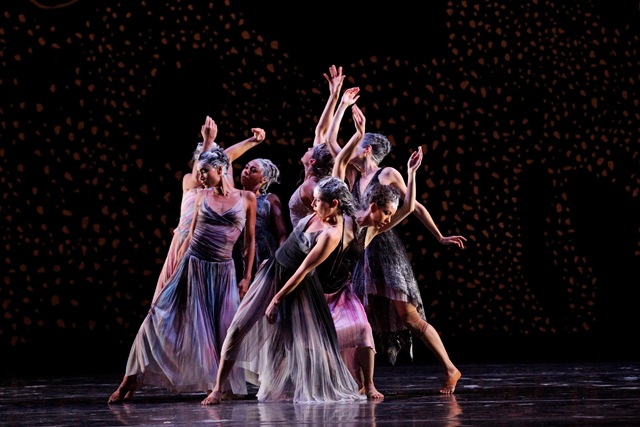
Warumuk-in the dark night. Photo by Jeff Busby
Artists of the Australian Ballet and Bangarra Dance Theatre as ‘The seven sisters’ in Warumuk—in the dark night, 2012. Photo: © Jeff Busby. Courtesy the Australian Ballet

In Stephen Page’s Warumuk—in the dark night, Jennifer Irwin’s costumes remain a highlight as does Vivienne Wong’s performance as the Evening Star. But it remains just a pretty work, evocative and atmospheric.

There is no doubt in my mind that the major piece on the Infinity program is Graeme Murphy’s The narrative of nothing. Halaina Hills and Amy Harris danced the female leads on this occasion but I was especially impressed by Benedicte Bemet, in her first year with the company, who danced securely and serenely in a duet with Jarryd Madden. An injured Andrew Killian was replaced by Andrew Wright but it was Adam Bull again who stole the show amongst the male performers. I admired the intensity with which he approached Murphy’s choreography with its quirky and demanding partnering and its detailed and often unexpected movements. And looking back to my original post and its comments, I don’t think I interpreted the work differently despite now knowing that the score by Brett Dean referred to the Black Saturday bushfires of 2009. I continue to think that the work stands alone as an abstract piece and needs no context of bushfires or anything else of a specific narrative/contextual nature.

In fact, what I found most striking on this second viewing of Infinity was the choreographic power of The narrative of nothing. While we can look at this work as ‘vintage Murphy’ in so many ways, when seen alongside the other works that comprise Infinity the depth of Murphy’s choreographic invention, his devotion to making dance that speaks to the audience about the nature of dance, his ongoing explorations into the art of collaboration with the performers he chooses and with his creative team, is astonishing. While I love Infinity as a whole, especially for its admirable pushing of the boundaries of what the Australian Ballet stands for, Murphy stands out as the choreographer with the most to offer. He gave the dancers something to dance, something with guts, and he gave the audience something abstract, something in which they could immerse themselves in a way that only dance can offer.

Michelle Potter, 15 April 2012.
NYC. Royal New Zealand Ballet

22 March 2012, St James Theate, Wellington

The first program by new artistic director of Royal New Zealand Ballet, Ethan Stiefel, opened in Wellington on 22 March. After a regional tour that began in Auckland in February the program, NYC: three short works from the Big Apple, had clearly worked itself into a very smooth operation by the time it reached Wellington. We saw a diverse, exuberant and beautifully danced show.

28 variations on a theme by Paganini
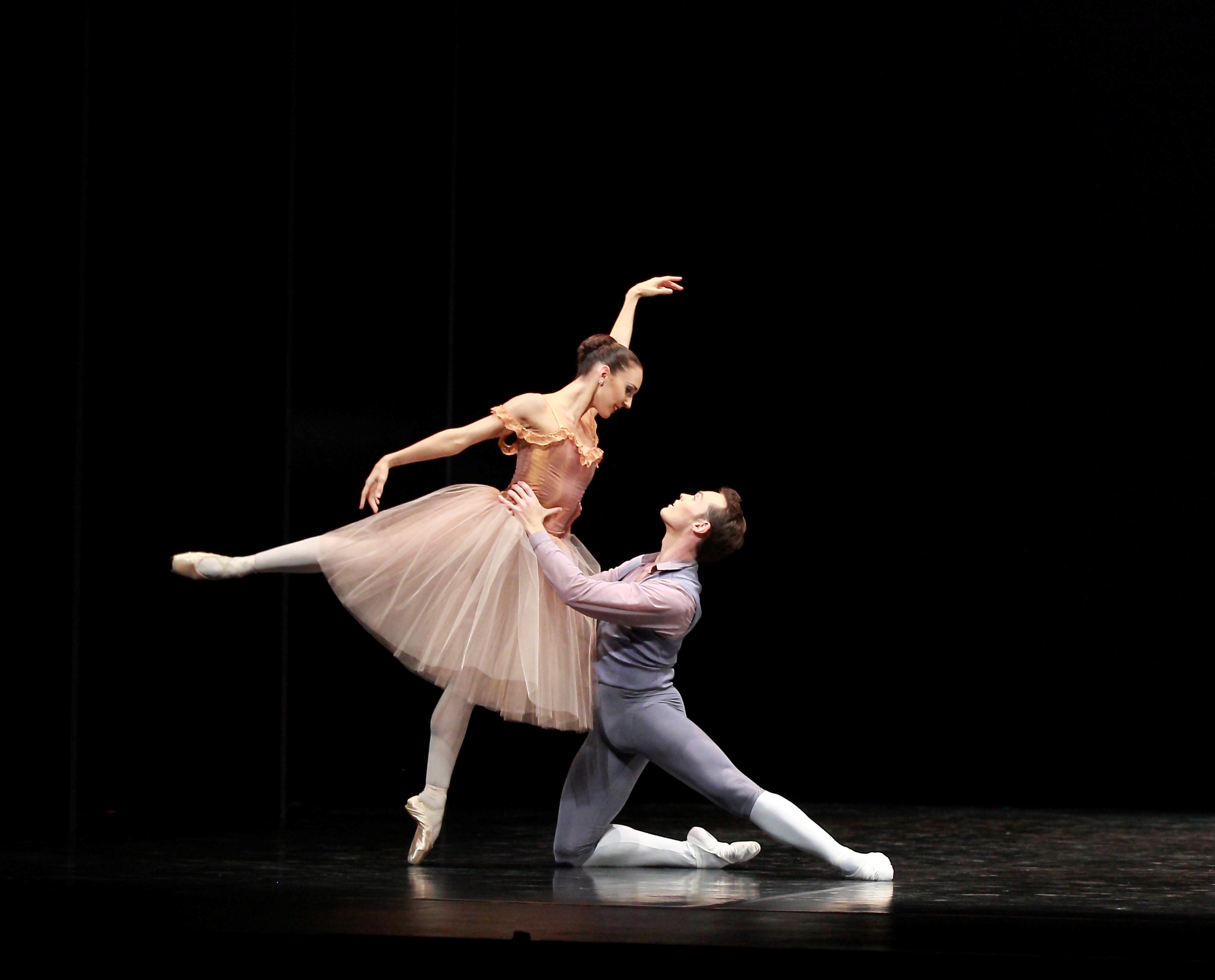
Antonia Hewitt and Brendan Bradshaw in 28 Variations on a theme by Paganini, 2012. Photo: © Evan Li. Courtesy Royal New Zealand Ballet

The program opened with 28 variations on a theme by Paganini, a work by Benjamin Millepied made originally in 2005. Danced to a piano score by Brahms, the choreography is as varied as the music. Under a single chandelier, and against a black background, five elegantly dressed couples whirl and swirl across the stage. Sometimes they dance in canon, often they execute fabulous lifts and move with unexpected changes of direction. They engage in a luscious performance of the classical vocabulary and occasionally there are subtle undercurrents that suggest relationships between them. I especially enjoyed the dancing of Bronte Kelly whose pleasure in being in this very dancerly work was patently clear.

There were, however, a few moments when for me the choreography was jarring. At one point Gillian Murphy entered walking on pointe, stiff-legged and looking a little like a dancer-doll who had suddenly stepped off a music box. Not even Murphy’s strong onstage presence and expressive face could save this section from looking out of place.

Scene from 'Final dress'
Dancers of the Royal New Zealand Ballet in Final dress, 2012. Photo: © Evan Li. Courtesy Royal New Zealand Ballet

Taking the middle spot on the program was Larry Keigwin’s Final dress, created especially for the Royal New Zealand Ballet and danced to a fast-paced score for violin, cello, clarinet and electric piano by Adam Crystal. On a stage stripped right back to basics, this work is full-on dancing from beginning to end. Mixing contemporary movement with more classical steps, the dancers explore the adrenalin rush associated with getting a show onstage. They run, throw themselves at each other and exude constant energy. I didn’t read into it what the program note told me it was about, ‘the boundaries between the public and the private, and the territories we guard’, but Final dress deservedly got a loud and enthusiastic reception as it came to an end.

Closing the evening was a performance of the vintage Balanchine work Who cares? set to a Hershey Kay arrangement of songs by George Gershwin. This is sassy Balanchine in his Hollywood/Broadway mode and to a certain extent it is a little outdated in terms of the dance style and era it references: it is four decades old, compared with later works in a similar vein such as Twyla Tharp’s Nine Sinatra Songs (made a mere two decades ago). But that aside, the dancers of the Royal New Zealand Ballet did themselves proud. Gillian Murphy and Paul Mathews danced an as smooth as silk pas de deux and the two other soloists, Abigail Boyle and Lucy Green, shone like Hollywood stars. I also admired the lovely-limbed dancer, Maree White, who took the middle spot in the line-up of the five chorus ladies.

A small grumble about the printed program: why didn’t it contain costume design credits? There wasn’t much to worry about with sets as there weren’t really any to fuss about, other than the New York skyline (minus the Chrysler Building) for Who cares? But the costume designers did deserve a billing, even if some costumes were apparently hired from New York-based ballet companies. Someone must have designed them. And why were there no captions for photos in the program? For those who are not regulars at Royal New Zealand Ballet performances it would have been nice if the dancers in some lovely photographs had been identified. But NYC was a wonderful start for Stiefel’s directorship and the prospect of more is definitely something to anticipate.

Michelle Potter, 23 March 2012

Telstra Ballet in the Park. The Australian Ballet in Canberra

This is an expanded version of a review written for The Canberra Times. The original review is no longer available online.

Autumn in Canberra is usually the best of seasons. March 2012 has, however, been marked by excessive rain and a performance was touch and go on 16 March when the Australian Ballet arrived bringing its Telstra Ballet in the Park Gala to the city. But the company had not performed in Canberra for several years so people came in droves to Commonwealth Park for the performance, which was scheduled as part of the annual Canberra Festival. Dressed in rainwear, they sat under their umbrellas, picnicking regardless, and waiting. About five minutes before the show was due to start, the rain stopped, the umbrellas went down and the very large audience was treated to a series of ballet bonbons showcasing some of the company’s top dancers.

Lana Jones and Daniel Gaudiello, dashingly costumed in red, black and gold, opened the evening with Petal Miller-Ashmole’s pas de deux, La Favorita. Both Jones and Gaudiello have strong, sure techniques―those double fouettés from Jones were stunning―and cover the stage majestically with their movements. It was a joy to watch them dance together. They also both have great onstage personalities and what made this item the stand-out of the evening for me was their ability to project those personalities off the stage and into the audience. We weren’t seated in a space enclosed by walls and a roof and the extent of the ‘auditorium’ was vast, so being able to project in such a situation was some feat and not achieved to the same extent by others during the evening.

Another highlight was Rachel Rawlins and Ty King-Wall dancing the pas de deux from Giselle Act II. Rawlins is such a mature artist and captured beautifully the ethereal qualities of Giselle, as she danced to keep her one true love alive until dawn. Rawlins looks as though the balletic vocabulary is such a part of her very being that it is completely effortless, even during those demanding moments in Giselle’s variation where she travels backwards, upstage, executing a series of fast beats and relevés. King-Wall partnered her elegantly and his variation showed off his own fine beaten steps and elevation.

I was also impressed by Juliet Burnett and Andrew Killian who danced the pas de deux from Nutcracker. Burnett was poised and controlled in one of the most classical of pas de deux. Her adagio movements unfolded with an elegance and calm sense of control and she allowed us to see the structure of every développé, every arabesque. Killian was a suitably caring cavalier and danced his solos with great style.

We also saw the rising star of the company, Chengwu Guo, in two items, the pas de deux from Don Quixote and Le Corsaire. While Chengwu’s turns and jumps were spectacular, I missed the sexuality that more mature performers are able to bring to these works. There were strong flourishes every so often from Chengwu but there was a kind of restraint in the upper body rather than what I think the roles demand, the appearance of throwing caution to the wind in a display of unbridled passion. Chengwu partnered Reiko Hombo in Don Quixote and Miwako Kubota in Corsaire.

Also on the program was the Act III pas de trois from Graeme Murphy’s Swan Lake with Amber Scott, Adam Bull and Amy Harris. It was especially interesting to see Murphy’s contemporary choreography on a program that consisted of works in an older classical style. The Murphy style stood up beautifully although this pas de trois generally suffered from being seen out of the context of the complete ballet and without the set, which on reflection adds a brooding quality to the unfolding drama of this particular moment in the work.

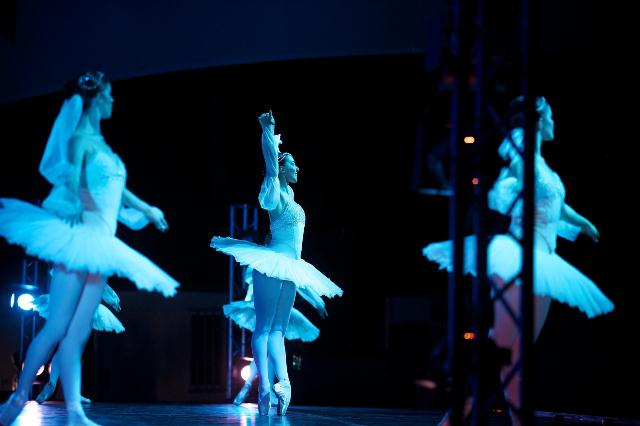
Artists of the Australian Ballet. Telstra Ballet in the Park
Artists of the Australian Ballet in an excerpt from ‘The Kingdom of the Shades’ from La Bayadère, 2012. Photo: William Hall. Courtesy the Australian Ballet

Completing the program were the pas de deux from Stephen Baynes’ Molto Vivace, smoothly danced by Amber Scott and Adam Bull, and excerpts from La Baydère where Lana Jones and Daniel Gaudiello returned as Nikiya and Solor and in which the three variations were danced by Hombo, Harris and Dimity Azoury.

Canberra region audiences used to see the Australian Ballet once a year but a decision, an unpopular one in the eyes of audiences, was made some years ago now to remove Canberra from the touring schedule. The size of the audience for the Telstra event, which took place in less than ideal weather conditions, seems to me to be a clear signal to the Australian Ballet that it is time to return to the national capital on a more regular basis. The announcement that Garry Stewart and an unnamed collaborative team will make a new work for Canberra’s centenary in 2013 is a start.

Michelle Potter, 20 March 2012

Infinity. The Australian Ballet

This is an expanded version of a review written for The Canberra Times.

24 February 2012, State Theatre, Victorian Arts Centre, Melbourne

Infinity, the Australian Ballet’s first program in its 50th anniversary year, is a diverse and sometimes challenging evening of dance. But most of all it is thrilling experience to see the Australian Ballet putting itself out on a limb with three brand new works from three Australian choreographers: Graeme Murphy, Gideon Obarzanek and Stephen Page. All three works are danced to new scores by Australian composers and all three have new Australian designs. Definitely something to celebrate.

The show opens with the new work from Murphy, The narrative of nothing.  To tell the truth, while there is a perfectly good explanation from Murphy for why this title was chosen—there’s no obvious narrative but the work may still be telling the audience something, I’d much rather dispense with titles that sound smart (with all due respects to Murphy). Untitled works just as well for me!

Murphy’s choreography often had a primeval feel as bodies twisted and curled around others. There were powerful performances from Lana Jones and Adam Bull, and I especially admired the sequence where Jones was partnered by several men who alternated between holding her aloft and letting her fall from side to side. Vintage Murphy really but Jones’ ability to hold her body in a perfect curve as she fell was breathtaking.

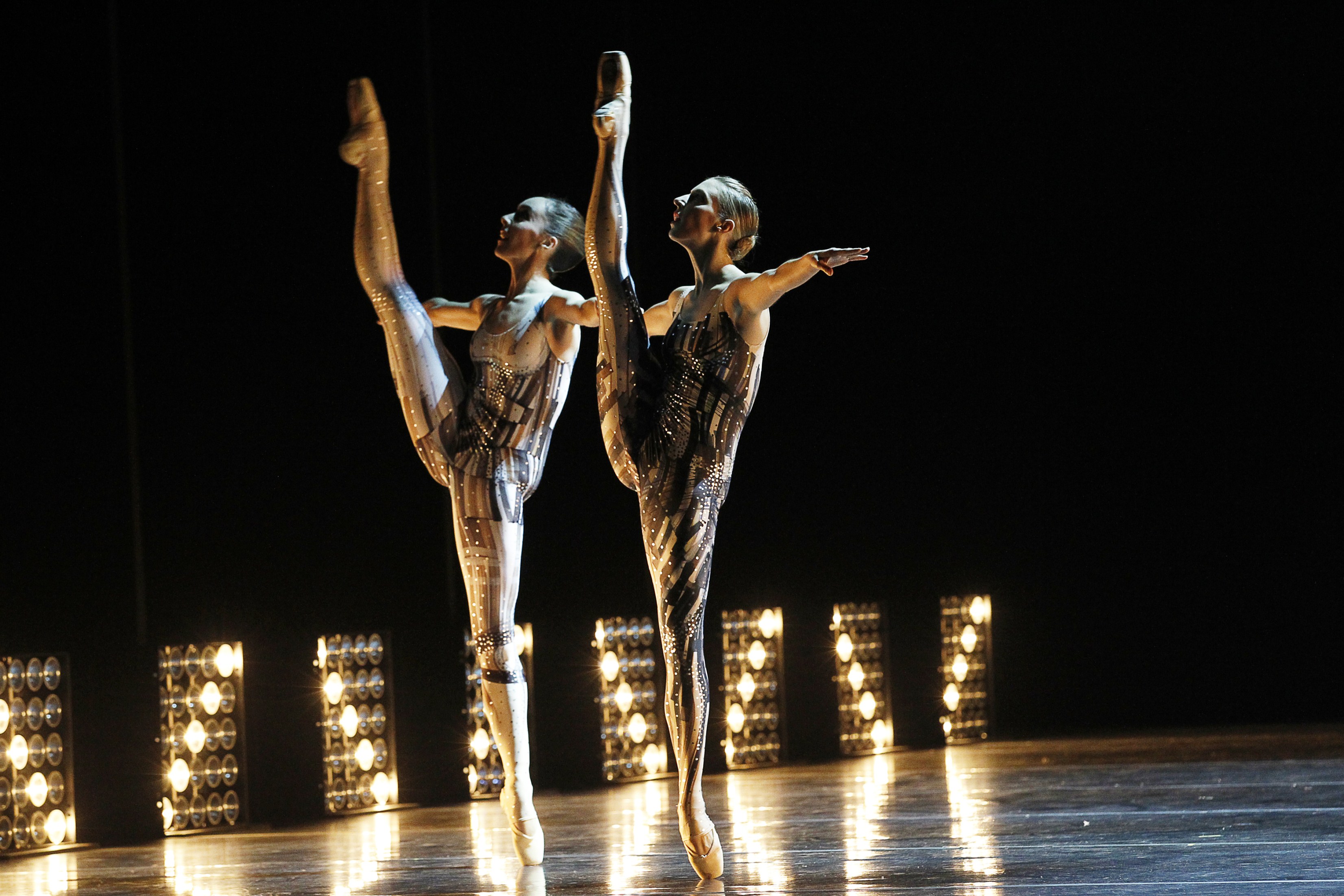
Lana Jones and Amy Harris The narrative of nothing PhotoJeff Busby
Lana Jones (right) and Amy Harris, The narrative of nothing, 2012. Photo Jeff Busby. Courtesy the Australian Ballet

The supporting dancers deserve praise for their technical strength as they attacked the demanding choreography. Murphy has moved a step beyond his usual (always interesting) vocabulary and made a work that, in somewhat of a contradiction, asks the dancers to move with a kind of aggressive lyricism.

I didn’t read the program notes prior to watching this work so wasn’t aware in advance that the commissioned score, Fire Music by Brett Dean, was in response to the Victorian ‘Black Saturday’ bushfires of 2009. With the knowledge of what was behind Dean’s score, fire in some respects becomes the non-narrative. But the works stands without this knowledge and in fact I was pleased that I didn’t know in advance. The score sounded quite elemental—the thunder sheets certainly helped there—and, with some instruments positioned outside the pit, the sound was enveloping.

Jennifer Irwin’s body hugging costumes were decorated individually with black patterns, often swirling organically, and with what looked like silver studs or tiny mirrors. Depending on the lighting (by Damien Cooper) they changed from looking a little punk, to glowing in the dark, to looking slinky, and much more. Cooper’s design was uncompromising—a solo by Adam Bull performed pretty much on the spot in a strong downlight was another highlight. The design also included an onstage use of lighting rigs not normally on view to the audience, another technique that has often featured in works by Murphy. With the inclusion of a minimalist black space as a setting The narrative of nothing became an example of the very best of contemporary collaborative enterprises. It also looks back to some of Murphy’s strongest abstract works made for Sydney Dance Company—Piano sonata comes straight to mind.

Obarzanek’s piece also had a strange, or at least not very catchy title, There’s definitely a prince involved.  It referred to his process of generating ideas and vocabulary for the work by asking a range of people about what they thought constitutes a ballet, and his subsequent deconstruction of the ballet Swan Lake. The work can be read on a number of levels. On the most simplistic it tells the story of Swan Lake, using the dancers as narrators, and focuses on the illogicality of the story. It relies on the dancers’ deadpan delivery of the text to raise laughter from the audience, and the various dancers who take on the role of narrator throughout the piece are more than adept. Unfortunately, even though they used a microphone, their voices were often inaudible above the crashing sounds of the orchestra playing Stefan Gregory’s fragmentation of Tchaikovsky’s familiar Swan Lake music.

On another level the work rips apart the traditional choreography of Swan Lake, and amusingly so, especially in the section based on the dance of the four little swans. It helps but is not essential if the audience is familiar with the traditional steps.

On yet another level the work can be seen as a comment on art asking the question of whether Swan Lake is indeed a work of art. Obarzanek has an acutely inquiring mind and his ability to force us to reconsider what we as a ballet audience might take for granted is powerful and actually quite respectful.

There’s definitely a prince involved uses dancers of the Australian Ballet augmented by dancers from Obarzanek’s company, Chunky Move. Australian Ballet principal Madeleine Eastoe showed her versatility as a performer and slotted beautifully into the varying demands associated with the role of a deconstructed Odette, the female lead. The few moments of classical movement—a fabulous grand jeté across the stage, and her ‘dying swan’ poses—did however make me yearn to see her dance a ‘real’ Swan Lake. Deconstruction is fine, entertaining and thought provoking, but the classic version transcends it all and it is that strength really that allows Obarzanek’s deconstruction to work so well.

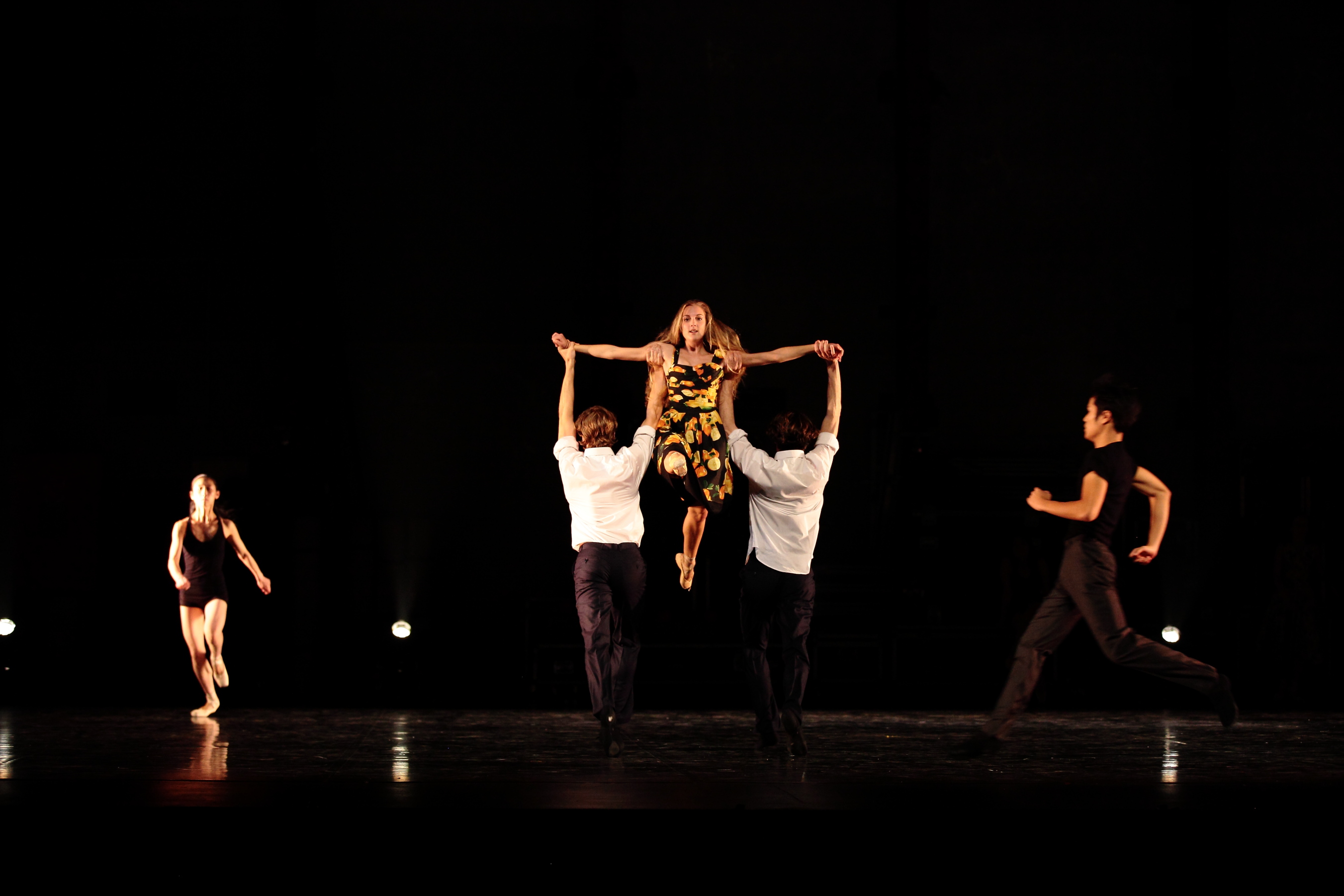
Madeleine Eastoe as Odette and Artists of the Australian Ballet, There's definitely a prince involved, 2012 Photo Jeff Busby Courtesy the Australian Ballet
Madeleine Eastoe as Odette with artists of the Australian Ballet and Chunky Move, There’s definitely a prince involved, 2012. Photo Jeff Busby. Courtesy the Australian Ballet

The program closes with Page’s Warumuk—in the dark light with Bangarra Dance Theatre joining forces with the Australian Ballet. With its new score from David Page it presents an exploration of the myths associated with the night sky.

The Bangarra dancers performed with their usual, beautifully rehearsed ensemble work with particularly striking performances from Elma Kris and Waangenga Blanco representing Full Moon. Vivienne Wong, stunningly dressed by Jennifer Irwin in a lacy black outfit cut with a long ‘tail’ at the back, stood out as the Evening Star. For me Wong was the sole Australian Ballet dancer who was able to transcend her balletic training and blend into the Bangarra way of moving. This was a real feat as Bangarra has now consolidated its own very distinctive style and company dancers are performing with added assurance and expertise.

The one disappointment for me was Jacob Nash’s set design. To me it looked a little too much like a previous Bangarra commission, his set designs for ‘About’, part of the Belong program of 2011.

This program is the Australian Ballet in an extreme mood. I have nothing but praise for the courage of the company in taking on, and succeeding in a program that far surpasses anything they have done in recent years. It makes the company look at last as though it is a company with a desire to move ballet into the future.

Michelle Potter, 27 February 2012

Postscript: The Canberra Times review appeared on 17 March 2012. It is no longer available online.

Anatomy of an Afternoon. Martin del Amo

14 January 2012, Playhouse, Sydney Opera House, Sydney Festival 2012

The one certainty that emerges from Martin del Amo’s latest work, Anatomy of an Afternoon, is that Paul White, the solo performer in the piece, is a very versatile dancer. Some aspects of his dancing remain constant no matter what the choreography―his muscular strength, his control over every small or large movement and the seamless fluidity with which he links steps, for example. They were clearly on show in this Sydney Festival production.

Anatomy of an Afternoon, however, required that White behave like an animal, or various animals to be exact, and to achieve the best outcome he apparently spent some time at the zoo observing animal behaviour. Well a variety of animal characteristics were certainly in evidence. From the point of view of White’s movement capabilities, mesmerising were those sections when his movements resembled those of a monkey. At one stage, with his back to the audience, his body over folded over, his head twisted to look out at the audience and the palms of his hands on the floor he appeared to be jointless as he loped from side to side in this seemingly impossible position on all fours.

But to tell the truth if I want to see a monkey I’d rather go to the zoo. And I certainly could have done without the moment when White exposed his buttocks to the audience, spread the cheeks apart and put one hand into the crevice that was thus revealed, drew the hand out and moved it towards his nose. Again, if I have burning desire to see such actions, the zoo is a better proposition. White is capable of more than this and deserves, in my opinion, superior choreography (even though he is jointly credited with the choreography on this occasion).

Anatomy of an Afternoon is explained in program notes as an investigation of ‘how the practical exploration of an extant choreography would affect [del Amo] as a choreographer creating original work’. Del Amo chose Vaslav Nijinsky’s 1912 creation Afternoon of a Faun as his ‘extant choreography’. However, attempts to draw parallels between the two works are futile I think. In fact all that Anatomy of an Afternoon does, to its own detriment, is show just what a coherent work Afternoon of a Faun was. The outrage of Parisian audiences and critics when Faun made its first appearance in Paris and when, in the closing moments, its interpreter, Nijinsky, sank onto a scarf in a moment of erotic pleasure, was I think more to do with the morals of the time than anything else. But despite the outrage and shock, Nijinsky’s erotic act was actually the culmination of the Faun’s previous flirtatious activities with the seven nymphs who completed the cast of characters in Faun. The Faun had taken the scarf from the nymph to whom he was most attracted. The erotic culmination to the work was not a gratuitous action.

Unlike the audiences of Paris in the 1920s, today’s audiences are pretty much unshockable and a different set of freedoms is in play. But I believe that today’s most watchable dance works have a certain coherence which, in its randomness of action and its various gratuitous events, Anatomy of an Afternoon lacked. I did, however, enjoy the original score by Mark Bradshaw. It had the languid quality of a summer’s day.

Michelle Potter, 15 January 2012

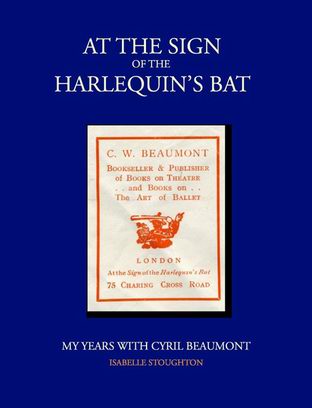
At the Sign of the Harlequin’s Bat. Isabelle Stoughton

Dance Books: Harlequin’s Bat cover

Last June I received a query about a particular photo of Olga Spessivtseva. An exchange of emails resulted and it transpired that the enquirer was the son of Isabelle Stoughton, whose recollections of working for publisher and writer Cyril Beaumont were published by Dance Books late in 2011 under the title At the Sign of the Harlequin’s Bat: My Years with Cyril Beaumont. I don’t think we really resolved the issue of the photo but the correspondence gave reading the book an added interest.

What is immediately attractive about this book is that it doesn’t pretend to be something that it’s not. It is simply a book of recollections randomly gathered together. It is written in quite a lively manner and it is easy to keep reading from beginning to end (and it’s not a long read), and easy to imagine or visualise the situations described. Having said that I have to add that it is a little uncritical, which is a bit annoying occasionally, but then that’s part of it not pretending to be something that it’s not. Isabelle Stoughton was fond of her employer and proud of his knowledge and expertise, and this comes through quite clearly.

Stoughton went to work for Cyril Beaumont in the 1950s and stayed until her marriage later that decade. It was a time when behaviour was more strictly codified than it is today. She says of her leaving to get married that in the 1950s married women only stayed on at work after marriage if either they were in financial need or had a profession. She was in neither category. There were conventions to be observed. There were also certain behaviours that were not mentioned except in enigmatic or ambiguous terms. So Beaumont’s friend (and Stoughton’s too), Montie Morris, was described by Stoughton’s mother as ‘Not a marrying man’. The book becomes to a certain extent a rather quaint reminder of 1950s rules of social behaviour.

But there are some interesting sections about the dance and dancers of the period as well. So many people with names that are iconic today passed through the doors of Beaumont’s bookstore at 75 Charing Cross Road, London. So many became close friends. I especially enjoyed the letter sent by Beaumont to Stoughton from Edinburgh in 1955 describing performances by the Royal Danish Ballet, including Ashton’s Romeo and Juliet, and the company’s excursion on Sunday ‘through wonderful Sylphide country’. And there is plenty of gossip and stories of ruffled feathers (or worse). The more things change …

But in the end what the book does is bring Beaumont to life. Most of us know him only from afar as the author of books that are still referred to today. He was at performances that have become legendary or saw first hand works that have long departed from today’s repertoire. He was able to analyse and recall brilliantly. In Stoughton’s book, which is definitely not a biography, the man behind the writing is there with all his idiosyncrasies, his habits, his working processes (highly unusual in most respects) and his eccentric pronunciations. And despite her uncritical approach I think Stoughton manages to show us a man that perhaps we all wish we could have met.

It’s a lovely holiday read.

Michelle Potter, 3 January 2012

Isabelle Stoughton, At the Sign of the Harlequin’s Bat: My Years with Cyril Beaumont (Alton: Dance Books, 2011)
Paperback, 104 pp. ISBN 978-1-85273-150-2

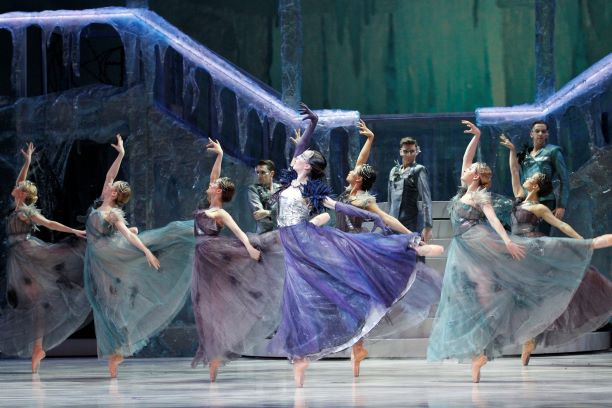
George Balanchine’s Nutcracker. New York City Ballet on film

New York does December in its own inimitable way and one annual and memorable event is a season of George Balanchine’s Nutcracker performed at Lincoln Center by New York City Ballet. This year, however, you didn’t have to be in New York to see the production. It was filmed live on 13 December and relayed in a high definition cinema broadcast across the United States. Just before Christmas it was screened in movie houses in Britain, Austria, Spain, Portugal and Australia.

While we all know that there’s nothing like being there, I loved the way this Nutcracker was so carefully filmed, especially Act I. I even liked the way the camera selected close-ups and never felt I was missing out on the action by having a close-up cut into the full stage view. I mostly liked the views shot from a side box too, especially in the Snowflakes scene where a high view accentuated the enclosed space of the snow-covered forest without taking anything away from the dancing. From a filmic point of view, Act II was probably less successful. But I suspect that this had something to do with Rouben Ter-Arutunian’s somewhat overwrought set of sweets and candies. Its visual complexities detract from the dancing at the best of times and, when seen on screen, the limitations of the two dimensionality of the medium are accentuated. However, I never once wished it had been shot in 3D!

One aspect of Balanchine’s version that I find especially enjoyable is the way in which children are incorporated into the production and the way the adult performers never treat them as anything but an integral part of the narrative. In Act I the children dance with the adults as well as with each other and have roles as soldiers, while in Act II they have their own roles as angels and as the children of Mother Ginger. In Act II they dance in the opening section and in the coda with all the panache of their adult counterparts. The coda in particular is quite fast but they are in there, totally unfazed and dancing beautifully.

The roles of Fritz and Marie, or Clara as we more commonly know her counterpart in Australia, are also children’s roles, rather than roles for smaller company members as often happens. The children from the School of American Ballet, who fill all the children’s roles, are professionals-in-training and it is hard to fault the way they conduct themselves on stage. In the role of Fritz, Maximilian Brooking Lendegger was captivatingly naughty and almost stole the show from the rather more placid and appropriately well-mannered Colby Clark as the princely child hero and nephew of Herr Drosselmeier. Marie was danced by a very composed Fiona Brennan. I was also mesmerised by a dark- haired child aged about eight, the youngest (or at least smallest in height) of the Polichinelles who emerge from Mother Ginger’s skirt in Act II. She grabbed my attention immediately with her innate understanding of how to use the space around her to achieve maximum effect from her movements.

Of the adult performers Megan Fairchild danced the role of the Sugar Plum Fairy and was partnered by Joaquin De Luz: lovely techniques both of them but on this occasion not much of the radiance that should accompany these roles. They are after all the roles of a prima ballerina and a premier danseur. The standout performers among the adults were Teresa Reichlen as a glamorously slinky Coffee, Tiler Peck as the leading Marzipan (in a tutu that I found clumsy and unattractive though) and Ashley Bouder as Dewdrop, the leading dancer in the Waltz of the Flowers. Bouder’s technical skills were electrifying. In Act I Adam Hendrickson gave a strong performance as Herr Drosselmeier. He captured every bit of the fantasy and mystery of this character.

The film was introduced by Kelly Ripa, who hosts a popular television series in the United States, and she also hosted several backstage interviews during the intermission. They included some interviews with excited child performers and a discussion of some of the technical tricks asociated with the production – the Christmas tree that grows during the transformation scene, for example. They were all interesting, even fascinating at times, but I could easily have done without some of Ripa’s comments. They were no doubt meant to appeal but often dumbed down what was happening.

Years ago now the American dance writer Edwin Denby remarked of Balanchine’s take on Nutcracker: ‘It’s Balanchine’s Oklahoma!’ This particular production, with sets by Ter-Arutunian and costumes by Karinska, dates back to 1964 and it is indeed a very American production, right down to its flying, reindeer-drawn sleigh that carries Marie and her Prince across the stage in the closing scene. At Christmas its glitz, even when it’s a little over the top and even when Ripa behaves a little too ingenuously, is irresistible.’

Michelle Potter, 27 December 2011

Romeo and Juliet (2011). A second look

10 December 2011, Opera Theatre, Sydney Opera House

Graeme Murphy’s Romeo and Juliet for the Australian Ballet continues to generate discussion and mixed reviews, and I recently took a second look at it at a Sydney mid-season matinee performance. It is impossible to ignore the dominance of the scenic elements and the challenges of the constantly changing times and locations, and why should we ignore them anyway as they are an intrinsic part of the collaboration and choreographic plan. So I still like to see this Romeo and Juliet as a postmodern work, despite all the problematic issues that the term ‘postmodern’ generates. Postmodernism, at least in areas of the visual arts, allows a collage of non-sequiturs and apparently frivolous allusions, which gives a pastiche we can either love or hate, but not ignore.

On this viewing, the sometimes overbearing scenic elements, and the episodic nature of the changes of time and location, did not startle to the same extent as they did that first time. On any second or subsequent viewing, whatever the work, one naturally notices different things. During the opening scene, set in what my ever-entertaining companion at these matiness thought looked like a scene from Dungeons and Dragons, it was Murphy’s attention to detail in his handling of the minor characters that attracted my attention. At the side of the main action and above it on the ‘bridge’, groups of bedraggled-looking townsfolk engaged in their own comments on the feuding being carried out centre stage. Murphy has always been a dab hand at this kind of background action—no standing round twiddling thumbs and admiring dresses. His works are choreographed down to the last detail.

The ball scene contains one of the best-known sections of the Prokofiev score, a section I will never be able to call anything other than ‘the cushion dance’. My approach to this scene will forever be coloured by my very first viewing of a ballet with the name Romeo and Juliet when, as a child, I saw a film of the Bolshoi Ballet with Galina Ulanova as Juliet. Well there were no cushions for the male guests to toss onto the floor in Murphy’s version of the magnificent ‘cushion dance’, but there was some startling and bold choreography. I especially admired the dramatic swirl of movement as the male guests held their partners, who leant back precariously as they were turned in a tight circle and who, with knees bent and feet together, jabbed the floor aggressively with their pointe shoes.

Akira Isogawa’s wedding dress for Juliet in the Japanese-inspired scene also caught my eye. Although it is pretty much impossible to learn much about the construction and detail of individual costumes from a seat in the auditorium, this dress seemed to be beautifully made from delicately patterned silk, or synthetic silken-look fabric. But it was the shoulder feature that surprised me. The straps that held the dress together over the shoulders were wide and crossed over just as they joined the bodice rather than in the middle of the of the upper back. It was a simple and almost unnoticeable touch, and perhaps not of major significance in the overall scheme of the ballet, but so elegant.

I was lucky enough to see Juliet Burnett in the leading role on this second viewing. She handled Murphy’s ever-changing and ever-challenging choreography as if she were born to dance his steps. She was bubbling with youth as she ran across the stage on pointe in the opening sequence. She soared through lifts in Murphy’s pas de deux and in those scenes in which the black-garbed holy men transported her across the stage. Her expressive arms gave a joyous quality to those moments where her young love for Romeo needed to be shown. But those arms also conjured up something entirely different, something leaden and full of fear when, for example, she reached out in an attempt to pick up the bottle of poison from her bed. It was this quality of being able to express emotion so well through the body, and not just through facial expression, that made her performance so exhilarating. But perhaps most of all it was a thrill to watch her portray the character of Juliet and to maintain that characterisation across the entire ballet, despite the changes of time and location. A stellar performance from Burnett who was partnered by Rudy Hawkes as Romeo.

Of the other cast members, Josef Brown made a welcome return to the ballet stage as Lord Capulet with Ingrid Gow as his Lady Capulet. Brown played Lord Capulet with a calm yet imposing presence. His handling of Juliet in the scenes with Paris rarely showed anger but rather some kind of fatherly determination. It allowed Murphy’s choreography, which in these scenes contains conflict within it, to shine through.

Michelle Potter, 11 December 2011

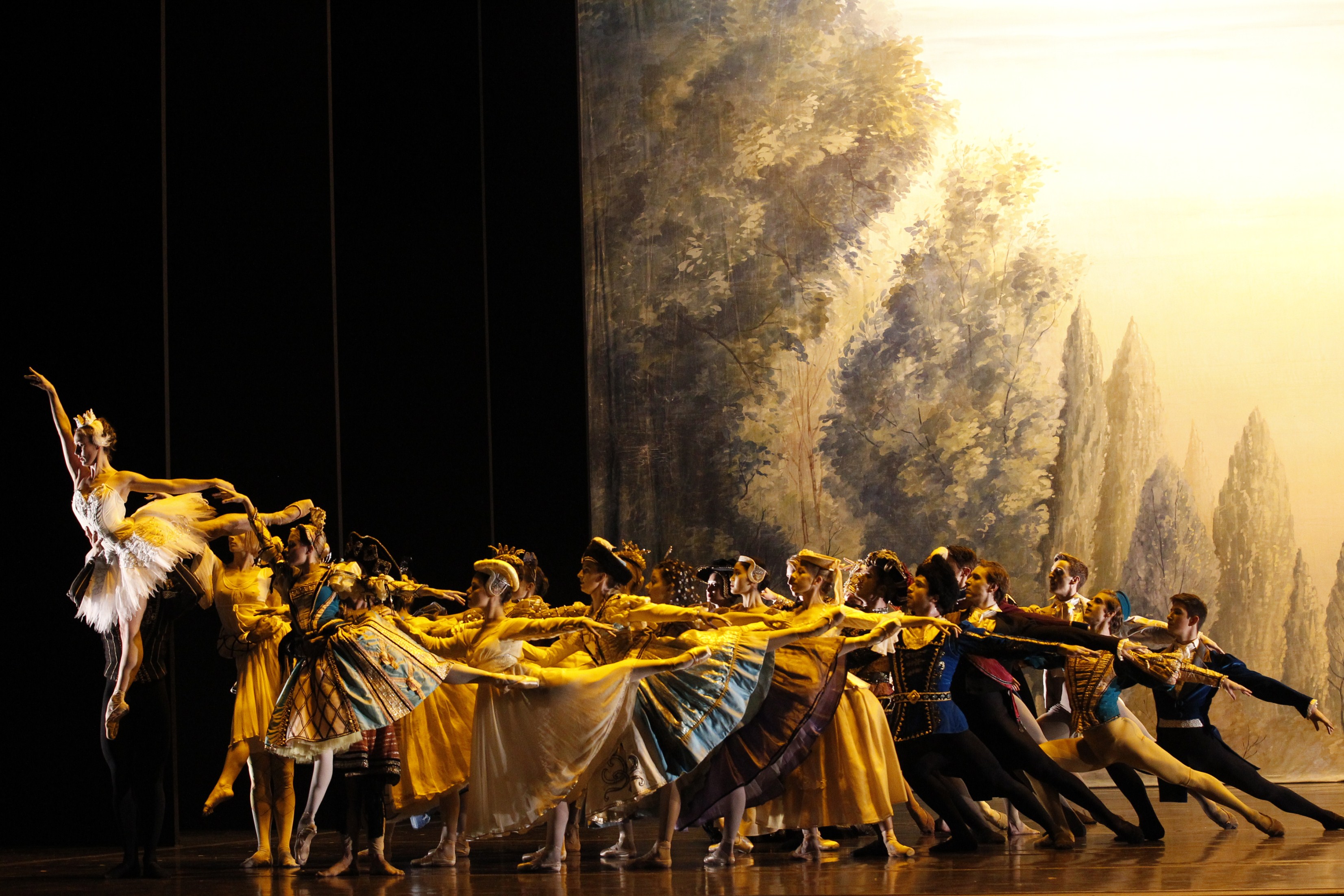
Featured image: Artists of the Australian Ballet in Romeo and Juliet, 2011. Photo: © Jeff Busby. Courtesy of the Australian Ballet

Artists of the Australian Ballet in 'Romeo and Juliet', 2011. Photo: Jeff Busby

Here is the link to my original post and comments on this production of Romeo and Juliet.

UPDATE, 12 December 2011: I have just reread more carefully the original post written after opening night in Melbourne in September. In it I wrote: ‘Manion’s strongest contribution [Gerard Manion was the set designer for this work] was a visually arresting painted front cloth comprising a huge bunch of gold, pink and blood red lilies from which the deepest colours drained to grey as the cloth rose at the beginning of the work’. Well this was not part of the Sydney production! Why not? I have no idea, but it was a sad omission in my opinion.

The Merry Widow. The Australian Ballet (2011)

19 November 2011, Opera Theatre, Sydney Opera House

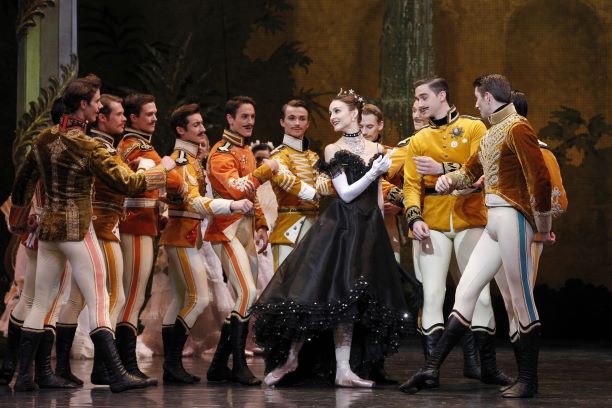
Ronald Hynd’s Merry Widow has never been my favourite ballet. I dislike its nature as balletic operetta, with emphasis on the ‘etta’, and its stock comic characters and its silly story line with people hiding in and escaping from pavilions and so forth. And as I took my seat at the Sydney Opera House my companion said, from the perspective of someone whose parents were brought up in 1920s and 1930s Vienna, that she wasn’t looking forward to ‘Viennese schmaltz’, referring in particular to the Franz Lehar music. So I was surprised and delighted to discover that I actually enjoyed the performance (and so did my companion).

Much credit for the way the production sped along goes to the corps de ballet, who were dancing beautifully, and as an ensemble, which doesn’t always happen these days. The Pontevedrian dancers in Act II, especially the men, were outstanding and it was an absolute delight to see everyone engaging with the action even when standing on the sidelines at balls, soirees, and other occasions.

Madeleine Eastoe was delicious as Valencienne. She danced pretty much faultlessly, and what an expressive back she has, which was very much on show in Desmond Heeley’s ball gowns with their deeply cut backs. She gave the role such warmth and charm as she flashed her eyes at a dashing Camille (Andrew Killian), or showed attentiveness to her aged husband Baron Zeta (Colin Peasley).

Colin Peasley’s performance as Baron Zeta had some truly poignant moments. In particular I was moved by his resignation at the close of the ballet to the fact that Valencienne is in love with Camille. It made me wish that he didn’t always have to dance the comic roles—those where his knees always give way when he tries to dance! He has a bit more to offer I think.

On a downside, however, I was disappointed by the performance of Jin Yao, guest artist from the Hong Kong Ballet, as Hanna Glawari. She has beautifully long limbs and carries herself with elegance and her final pas de deux with Count Danilo (Brett Simon) was charming and flowed smoothly. But in general I thought her portrayal of Hanna lacked any warmth. Just a glimmer of what might have been came at the end of the show as she took her curtain call. A little too late unfortunately! Nor was there much strength of characterisation in the scene where Hanna and Danilo realise they are sweethearts from some years earlier and that important scene (important to the storyline) fell a little flat.

I was also disappointed with Matthew Donnelly’s portrayal of Njegus. Donnelly doesn’t seem to have a stage presence that is strong enough to sustain such roles. Or perhaps he needs better coaching or a role model to learn from. His apparent grooming to take on cameo roles of this kind just isn’t working at the moment.

All in all, despite some reservations, which also included for me some jarring aspects in the design, especially in relation to choice of colours, this production of The Merry Widow was a pleasurable experience. Perhaps thanks are due to John Meehan who was guest repetiteur for this production?

Michelle Potter, 20 November 2011

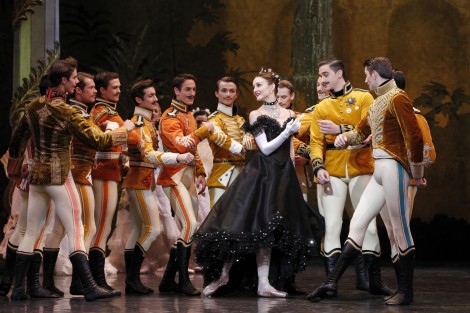
Featured image: Artists of the Australian Ballet in The Merry Widow, 2011. Photo: © Jeff Busby. Courtesy of the Australian Ballet

American Ballet Theatre. Fall season 2011

12–13 November 2011, City Center, New York

New York City’s newly refurbished City Center theatre was the venue for American Ballet Theatre’s Fall season, a program of nine, one-act works by contemporary choreographers presented over a short period of a few days. Just three of those works, Alexei Ratmansky’s Seven Sonatas, Demis Volpi’s Private Light and The Garden of Villandry choreographed by Martha Clarke, Robby Barnett and Felix Blaska, were accompanied by live music. This music was played on stage in each case: a grand piano for Seven Sonatas, four guitars played alternately by one musician for Private Light and a piano trio for The Garden of Villandry. The remaining works were performed to taped music.

The highlight for me was Ratmansky’s Seven Sonatas, about which I have written separately. But I was also pleased to see Merce Cunningham’s Duets, originally made in 1980. In this work for six couples Cunningham’s inventiveness was patently clear, especially in the complex partnering that was an essential feature of the work. But there were also moments when his choreography showed its modernist qualities, movement stripped back to essentials with an emphasis on clear shapes filling the space around the body, and with a strong sense of focus and line, albeit often set off centre. There were jarring moments, however, when the dancers seemed unable to detach themselves from a balletic need to project emotion through the face and via bodily embellishments to the choreography. Paloma Herrera, for example, dancing the second duet with Eric Tamm looked a little too much like a swan queen at one stage as she nestled into her partner’s shoulder and wrapped an arm around him at hip level. As beautiful as she looked, it was not quite Cunningham.

Paul Taylor had two works in the season, the classic Company B, always enjoyable, and a new work choreographed in 2011 called Black Tuesday. This latter work, danced to songs from the era of the Great Depression, provided a great showcase for some of the company’s soloists. Misty Copeland for example danced with verve and panache from beginning to end and especially in a solo, ‘The boulevard of broken dreams’, while Gemma Bond gave a gutsy, crowd-pleasing performance in her solo ‘I went hunting and the big bad wolf was dead’. Santo Loquasto dressed the dancers for Black Tuesday in brown, black and grey outfits in 1930s style with an eye catching assortment of fabrics and patterns and a range of accessories: hats, caps, stockings, gaiters, suspenders and the like. While perhaps not world-shattering choreographically with its mix of musical comedy routines and 1930s jitterbug-style movements, it was a fun work, well structured and full of interest from start to finish.

Twyla Tharp had three works on the program. Sadly I missed Sinatra Suite on this occasion but caught two performances of In the Upper Room and one of a duet entitled Known by Heart (‘Junk’) Duet. In the Upper Room was something of a disappointment. I have seen it danced better in Australia and it was unfortunate that the first cast I saw seemed not to be able to last the distance let alone look as though they were dancing together in the same ballet. In the end the remarkable Herman Cornejo looked quite idiosyncratic without a strong backup from his colleagues.

The second performance was, however, distinguished by a spectacular performance from Paloma Herrera as the main pointe girl. She had such assertiveness, such control of those slow turns, and such powerful technique as she handled slides into splits followed by a lift from the floor into a fish dive pose, or when hurling her body through space to be caught in some astonishing position. Misty Copeland danced strongly as the third sneaker girl (a role I can’t help but identify with the former Australian Ballet dancer Katie Ripley). Sascha Radetsky, Blaine Hoven and Patrick Ogle showed how they had lasted the distance when they came on for their curtain calls and each reprised a step from the work.

Known by Heart was new to me. Dating to 1998 and danced to selections from Donald Knaack’s Junk Music, it was performed by an ebullient Gillian Murphy partnered by Blaine Hoven. Basically the work is a variation on the traditional format of the pas de deux with duet, variations and coda, and the scene was set with an explosive opening as a diagonal shaft of light highlighted a generous grand jete from Murphy, who was supported by a finger tip hold from Hoven. There followed a battery of fast paced movements. Murphy at times even seemed to be tap dancing on pointe. Both Murphy and Hoven stylishly carried off the mixed nature of the choreography—a bit of ballroom, a bit of musical comedy, a bit of classical while all the time maintaining a somewhat cheeky partnership.

The Garden of Villandry, a work made in 1979 was very pretty but was without a huge amount of depth, although it was beautifully expressive of the Schubert Trio No 1 in B Flat, Opus 99 to which it was danced. I admired the lilting movements of bodies and the intertwining of arms throughout. As a kind of Edwardian love triangle it was understated and lingeringly melancholic as two men vied for the attentions of one woman. It was given a pleasant performance by a lovely Veronika Part partnered by Roddy Doble and Gennadi Saveliev.

I was least impressed by the Volpi work, Private Light, especially the sections where the choreography seemed to be more classically oriented. Then the dancers seemed almost to be engaging in centre practice and centre practice with little choreographic interest. And there was a lot of lining up and breaking out of line, huddling together and kissing in the dark. Volpi seemed too to be unable to choreograph for the arms, which were often left hanging unimaginatively at the dancer’s side. But one dancer, Simone Messmer, stood out for her beautifully articulated body and her ability to use her chest to project emotion. It was  a shame that the lighting was so dark that it was almost impossible to see her until the lights were raised for curtain calls. Perhaps the darkness was the source of the title?

It is always a pleasure to see a strong company performing a range of works that challenge the dancers stylistically. And is an equal pleasure to be challenged oneself by such a range of contemporary choreography as ABT presented in this short season.

Michelle Potter, 17 November 2011