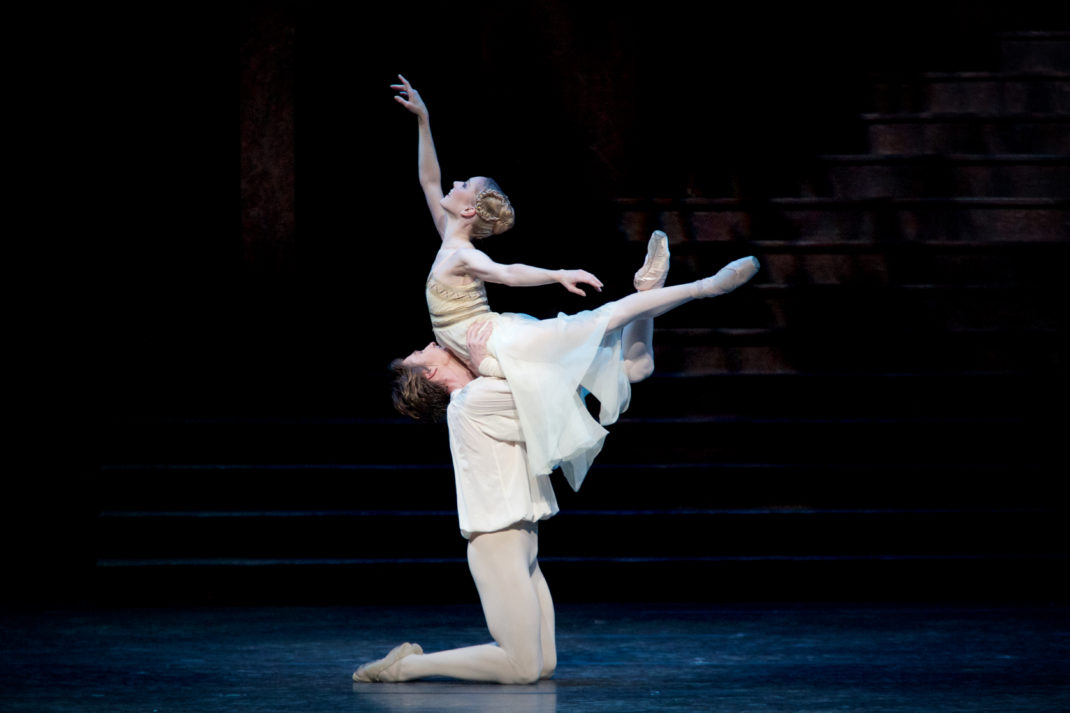
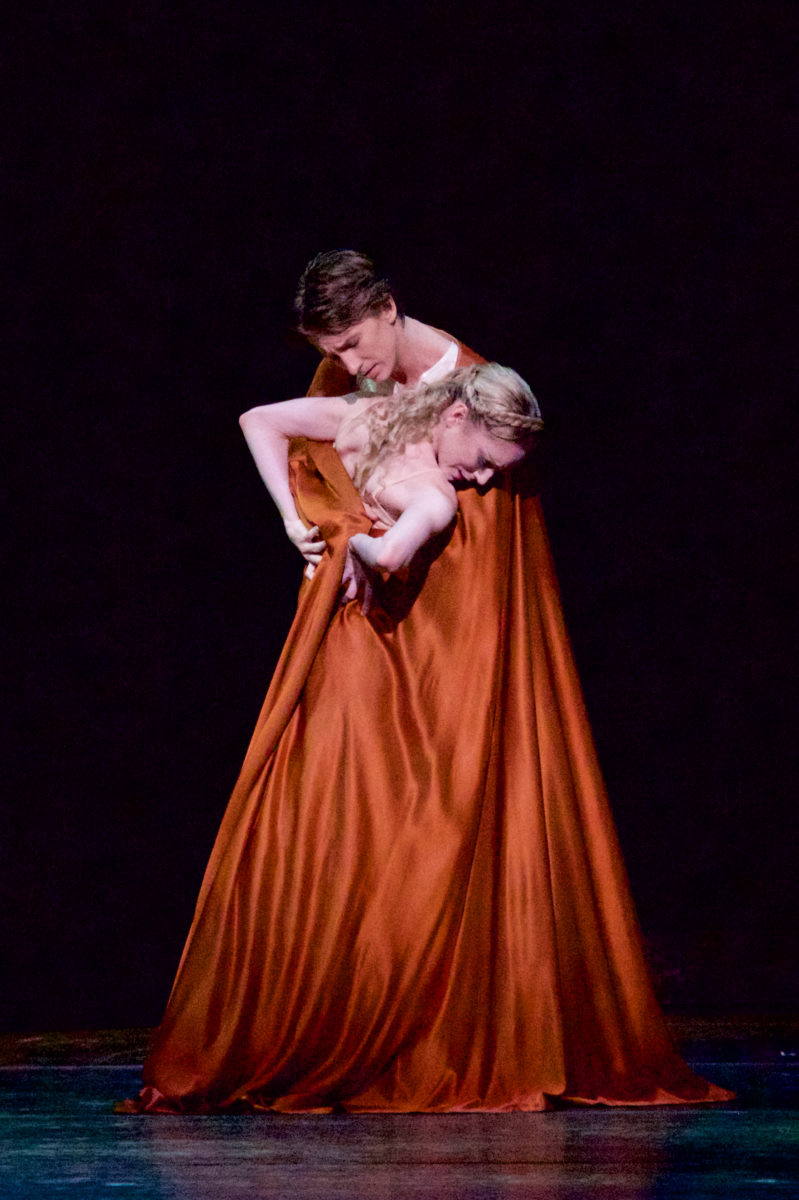
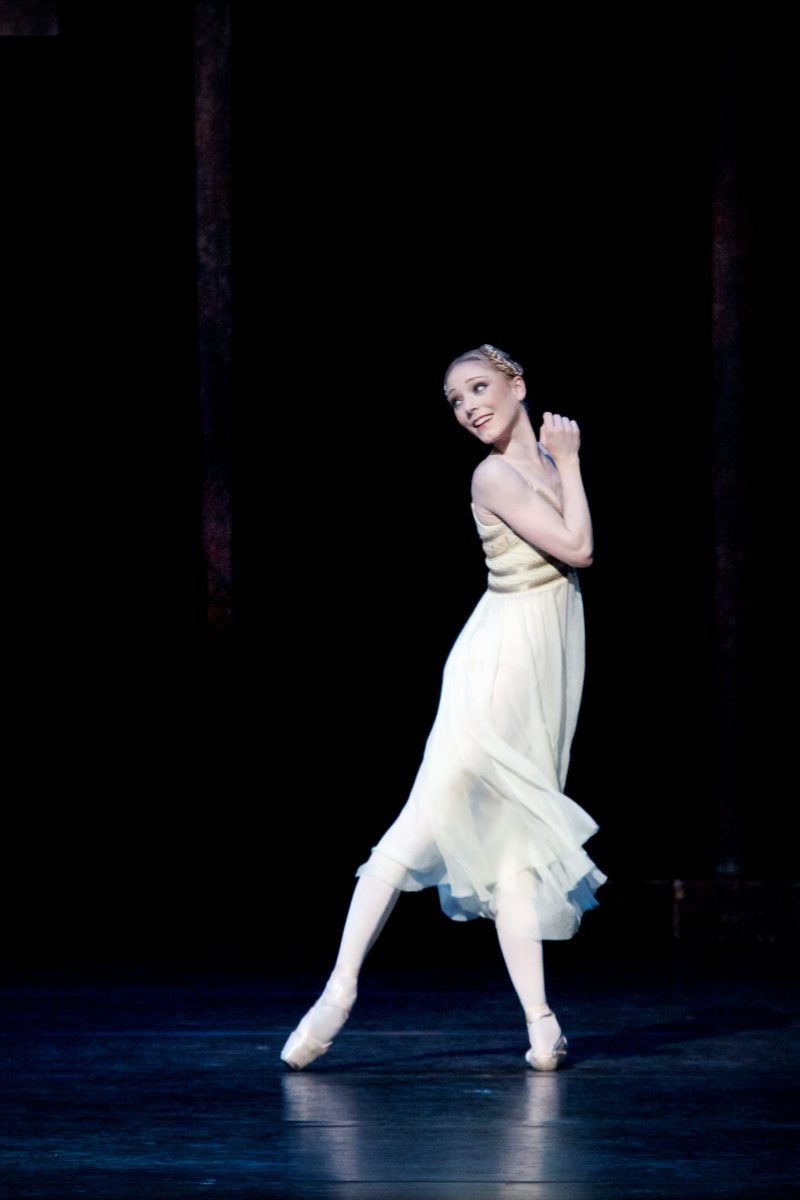
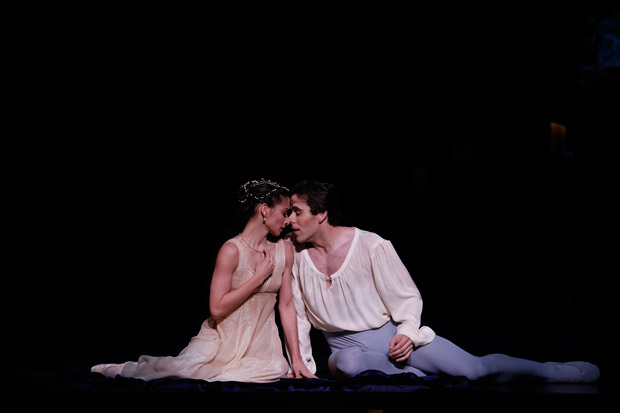
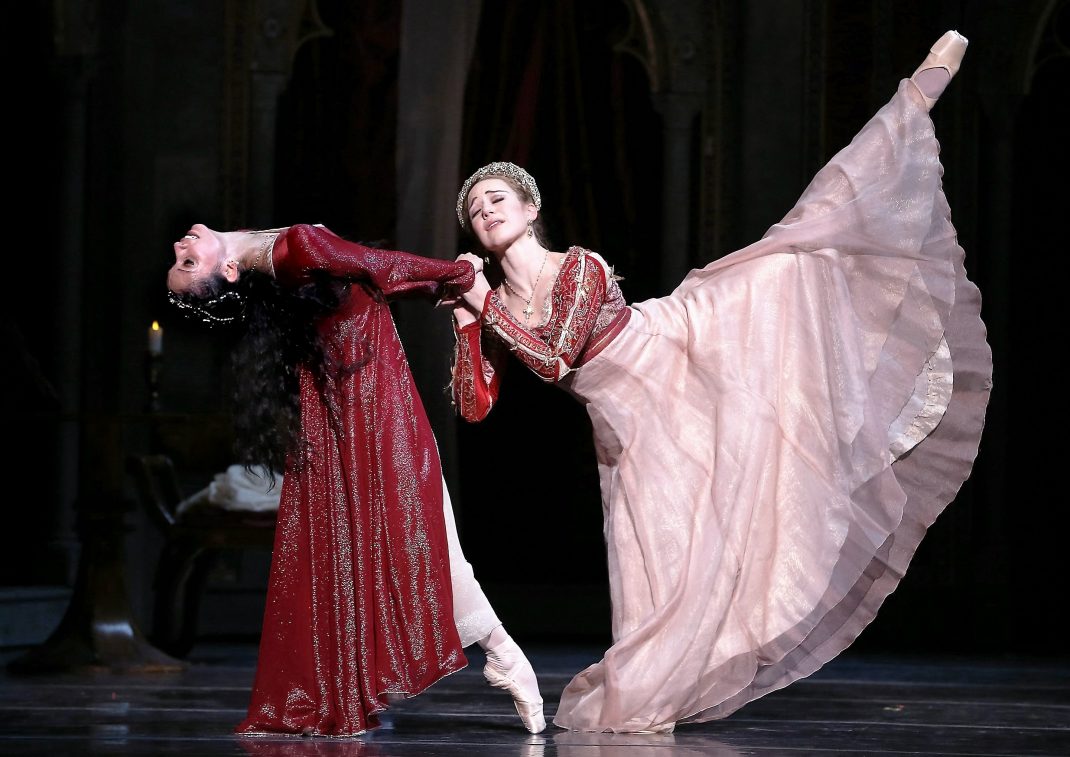
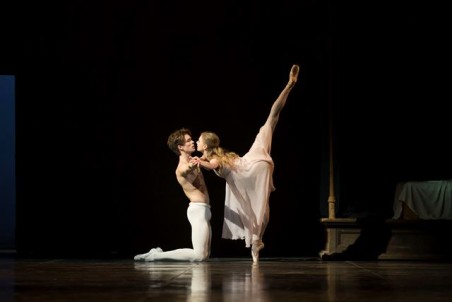
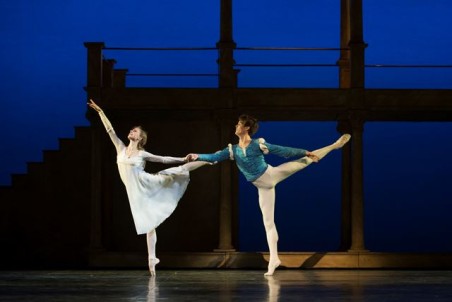
10 December 2022 (matinee). Joan Sutherland Theatre, Sydney Opera House
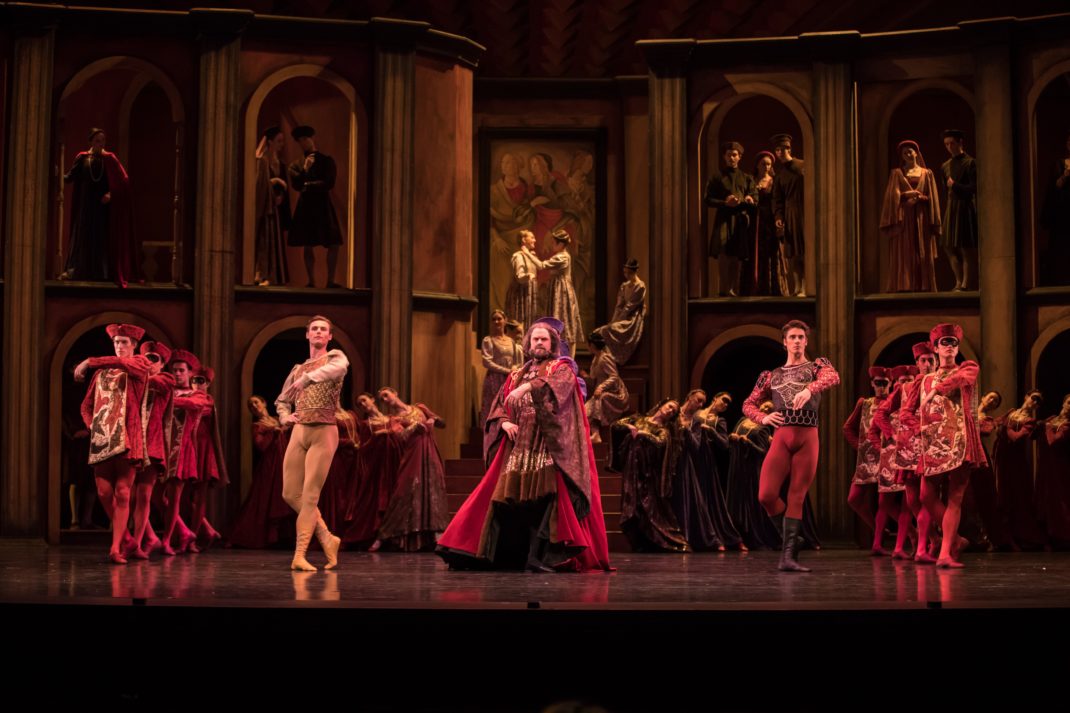
Choreography: John Cranko Design: Jürgen Rose Lighting: Jon Buswell Composer: Sergei Prokofiev
It is hard to believe that it is around 20 years since John Cranko’s Romeo and Juliet was last performed by the Australian Ballet. Since then the production of Romeo and Juliet that the Australian Ballet has shown on numerous occasions has been by Graeme Murphy. Apart from the Murphy production, in the 20 years prior to the current production of Cranko’s work, I have seen Kenneth MacMillan’s Romeo and Juliet, danced by the Royal Ballet and by Queensland Ballet, as well as productions by Stanton Welch for Houston Ballet, Sasha Waltz for the Paris Opera Ballet, John Neumeier’s production danced by the Royal Danish Ballet, a condensed version with the title R & J by Natalie Weir for Expressions Dance Company, and a reimagined production of the story, called Unravel, by a Canberra-based pre-professional company. So, rather than do a regular review I am simply noting some high points from the performance I saw just recently from the Australian Ballet.
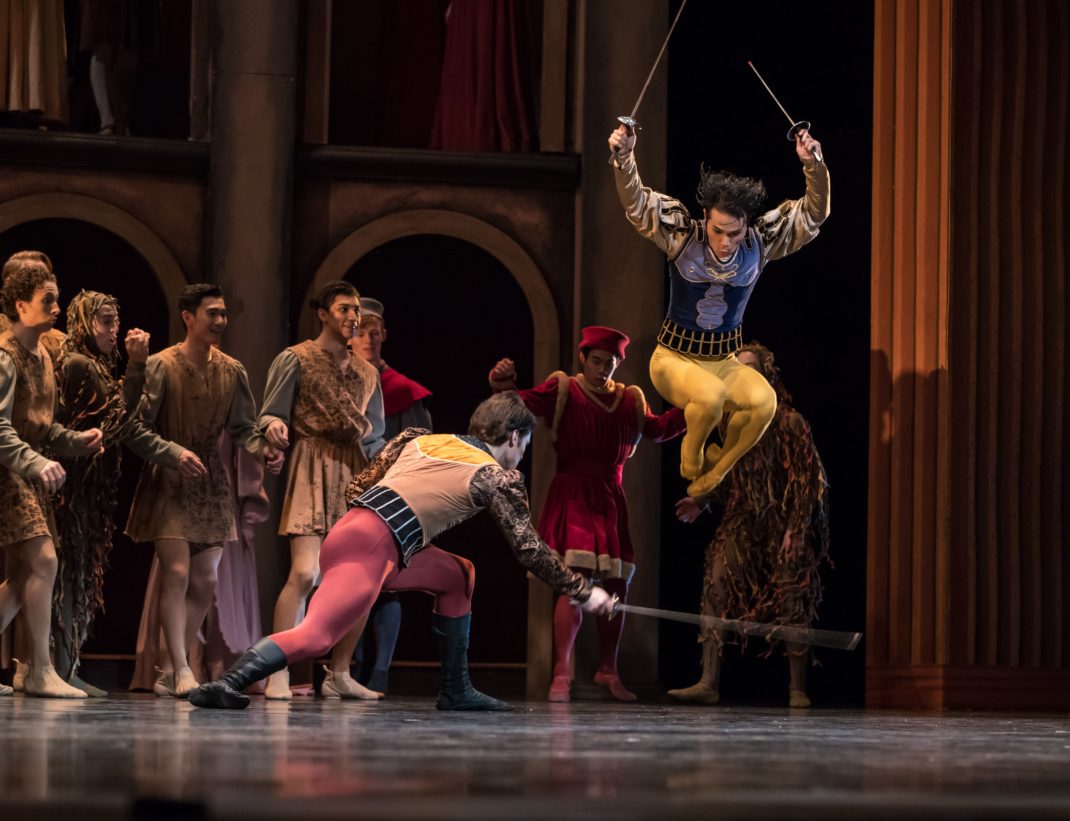
Tybalt I had the good fortune to see Joseph Romancewicz in the role of Tybalt, kinsman of the Capulet family. I have enjoyed watching Romancewicz for some time now and I thought his performance as Tybalt demonstrated a well thought through characterisation. He was cold and unrelenting in his dislike for the Montagues. He never fell out of character and his sword fight with Mercutio and then his death at the hands of Romeo were dramatic and powerful.
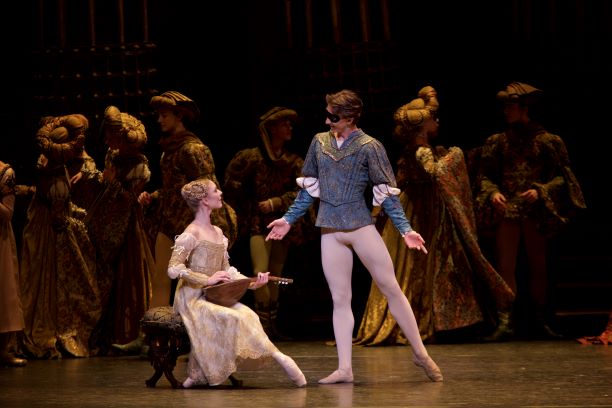
The ball scene (Act I, scene 4) The largely-black costumes by Jürgen Rose for the guests at the Capulet ball were spectacular, as was the choreography and the dancing of it. I especially loved the moments when the men fell to their knees, on cushions they had dropped to the floor, and made a kind of reverence to their lady partners.
The music The well-known music by Sergei Prokofiev, with the orchestra under the baton of the new Australian Ballet conductor Jonathan Lo, sounded just brilliant. Filled with such a diversity of thematic material and so much emotion, it was used to great effect by Cranko.
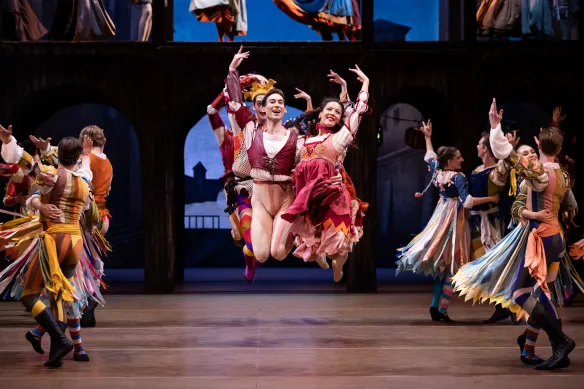
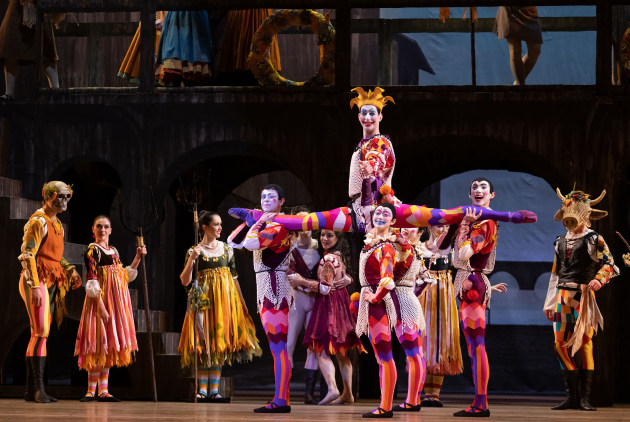
The carnival scene in the marketplace of Verona (Act II, scene 1) Although I found the costuming for this scene a little overly decorative, the dancing was exciting to watch: I especially enjoyed the acrobatic moments by a quartet of very flexible performers. But all the dancers were full of the excitement of the moment, until the joy was interrupted by the demands of Tybalt.
The progression of the storyline The storyline moved along quickly and without a hitch. Every scene made its point clearly, never lingering over non-essential matters. The one exception, perhaps, was the dance of the bridesmaids (Act III, scene 3) which choreographically seemed to be a little uninspiring to me and continued for too long.
***************************
Apart from the dance for the bridesmaids, there were other aspects of the work that didn’t appeal, which I think related more to the dancers I saw than to the work itself. Apart from Romancewicz, the only other dancer who made my eyes light up was Lucien Xu as Benvolio, who often is an easy-to-ignore character. But not this time.
As a final comment, I have to say that Cranko’s Romeo and Juliet, which concludes the Australian Ballet’s 2022 season, is a master work really. It had, thankfully, so much more to offer than the previous program, Instruments of Dance.
Michelle Potter 12 December 2022
For reviews of other productions of Romeo and Juliet, and some stories relating to the work, see this link.
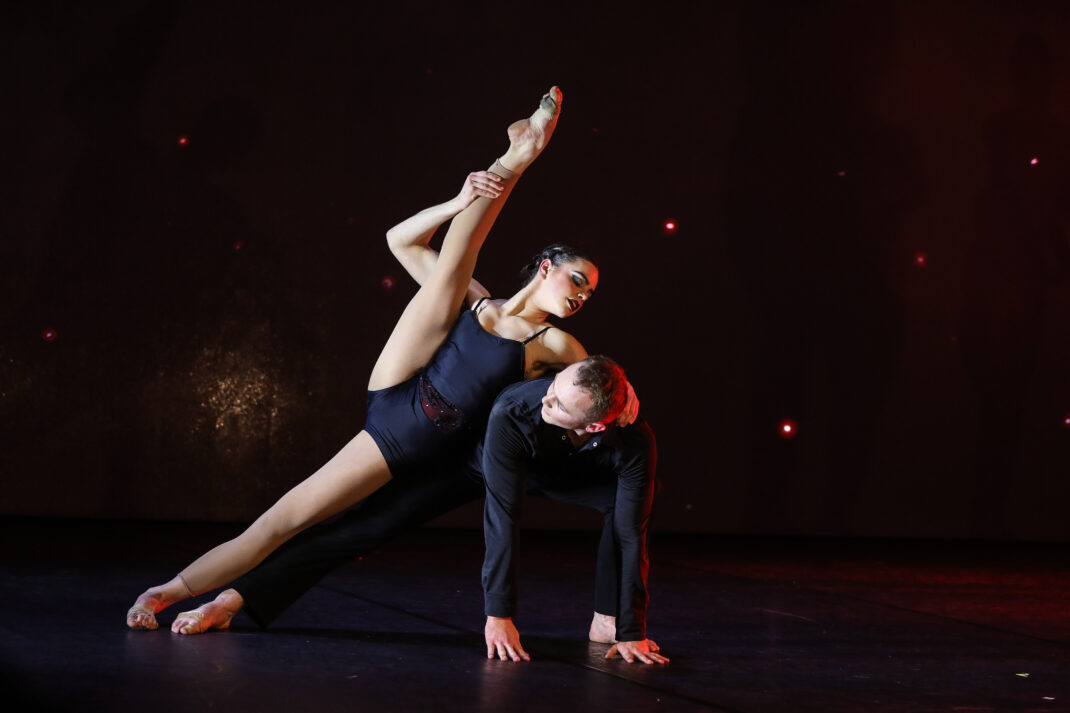
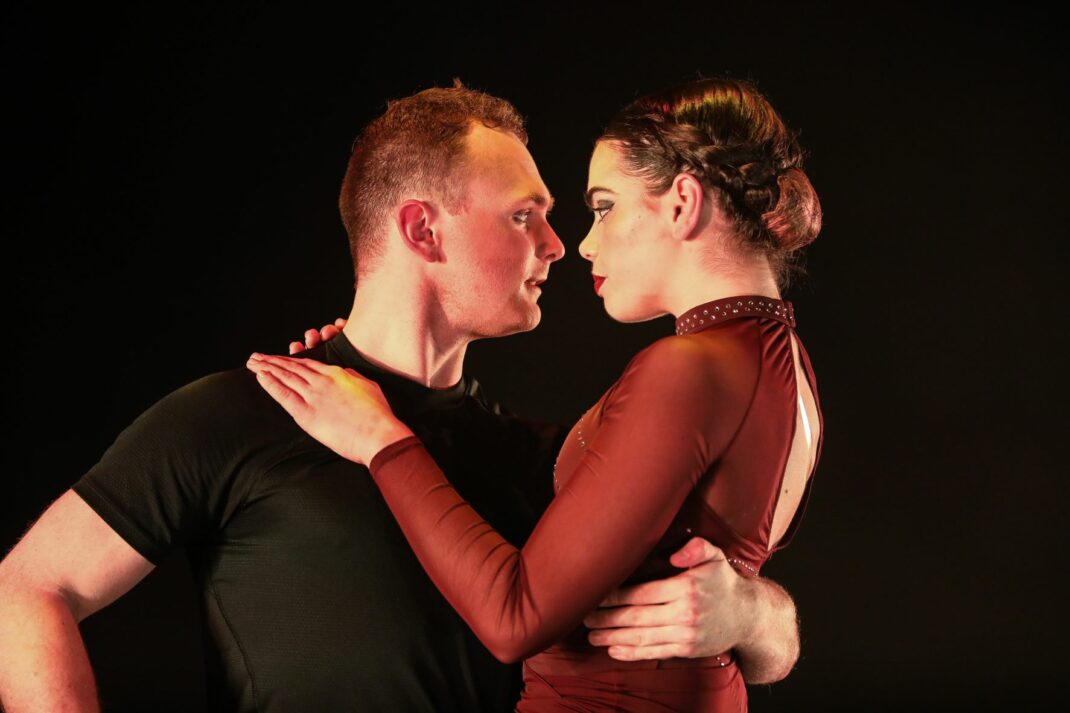
‘Two households both alike in dignity …’ So goes the opening line of Shakespeare’s Romeo and Juliet, referring as it does to the Montagues and the Capulets, two families whose life, and their longstanding feud with each other, unfold in the play. There’s not much dignity, however, between the Montagues and the Capulets as they are portrayed in Unravel, the latest work from Canberra’s Training Ground company. But there is a lot of aggression both in gesture and facial expression and in the choreography. The Montagues are a family of ‘corporate tycoons’ and the Capulets are ‘common delinquents’, and their behaviour reflects these lifestyles.
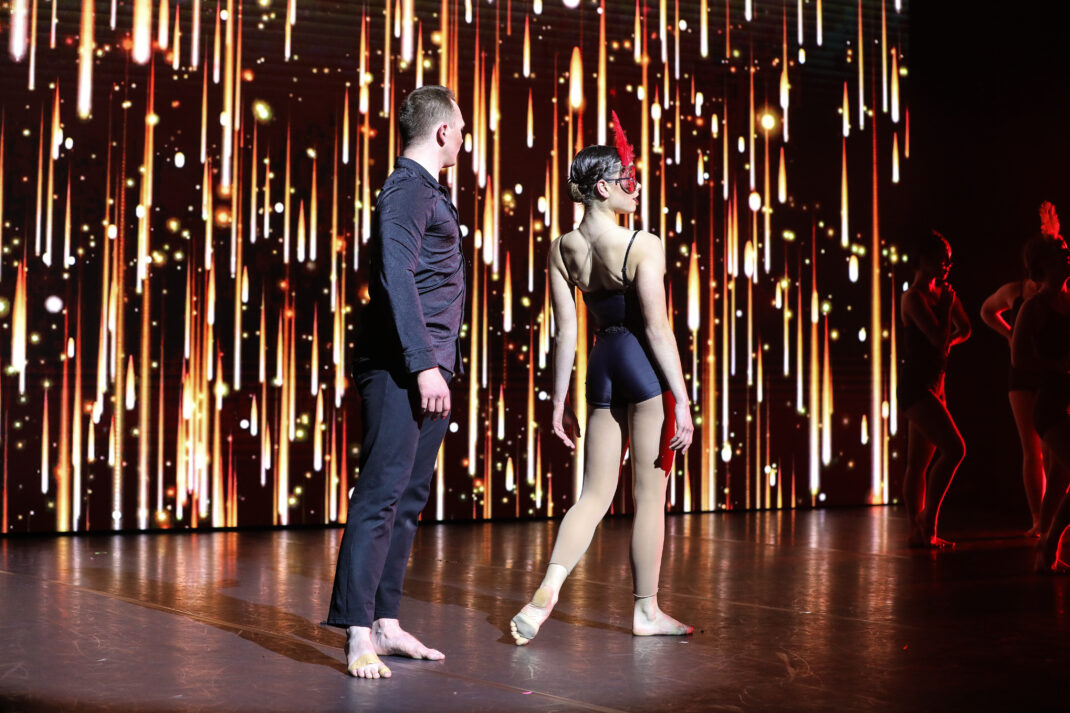
This is clearly not the Romeo and Juliet that Shakespeare created but an imagining (or unravelling) by Bonnie Neate and Suzi Piani, Training Ground’s directors. In addition to moving the story into the present (a world of tycoons and delinquents?), Paris, normally a male character seeking marriage to Juliet, is a woman, danced with suitable overkill by Hollie Teer, soon to be betrothed (she hopes) to Romeo. The significant scene of the ball where Romeo first encounters Juliet is a ‘Montague Masquerade Ball’ rather than one held by the Capulets. There is no priest to marry the couple and to dispense a potion. And Juliet eventually commits suicide in her bathtub (unable to manage the feuding situation, which remains from Shakespeare, and the interference by Paris?).
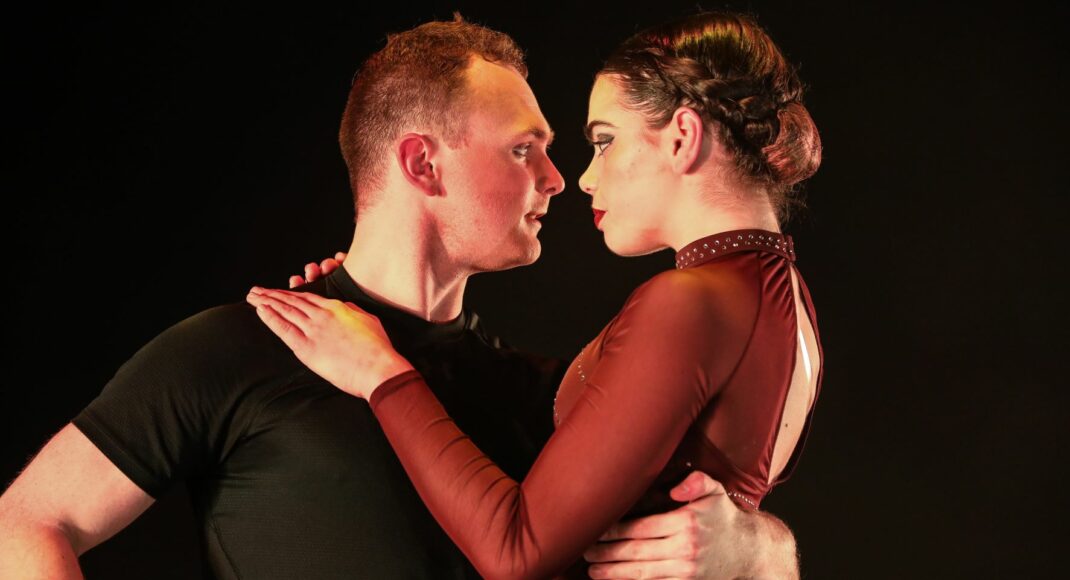
Choreographically there were moments to remember, especially some of the groupings of dancers—I especially remember an undulating line of dancers towards the end—and the whole was beautifully rehearsed and strongly performed. But there is no doubt in my mind that the duets between Romeo and Juliet were the highlights. Ali Mayes (Juliet) has exceptional fluidity, and extraordinary line in all her movements as a result of her beautifully proportioned limbs. Her duets with Joshua Walsh (Romeo) were choreographed to exploit that line and her ability to move her body to fill the space around her.
Film by Cowboy Hat Films was nicely incorporated on several occasions. Footage set the scene to explain the nature of two households, for example. The Montagues at one point appear in a modern office setting (Canberra’s Brindabella Business Park perhaps) where they are directed to work by Mrs Montague, a role performed with appropriate belligerence by Imogen Addison, while the Capulets are seen making their way along an alley filled with rubbish bins, detritus and graffiti (no doubt one of many in Canberra’s Civic Centre). Less confrontational but nevertheless especially powerful, was the watery footage that followed Juliet’s suicide.
The aspect of the production that I found the least satisfying was its episodic nature. Of course there are many episodes in the R & J story that need to be shown whatever the context, but it was annoying when one episode finished and another started without some kind of linking mechanism. It was often too abrupt. A similar situation arose with the changes to the music. One musical excerpt would stop suddenly, there would be silence, and then another, quite different in mood, would start. Similarly with some of the footage and the very bright (overbright I think) lighting of some scenes.
But despite these gripes, the work was well produced and performed and moved Canberra dance in a new and unusual direction. The Training Ground is an initiative of Neate and Piani to give performance opportunities to pre-professional and advanced contemporary dancers in the ACT and surrounding regions.
Ausdance ACT has welcomed the beginning of Dance Week with an opening event held at Gorman Arts Centre, Canberra, on International Dance Day, 29 April.
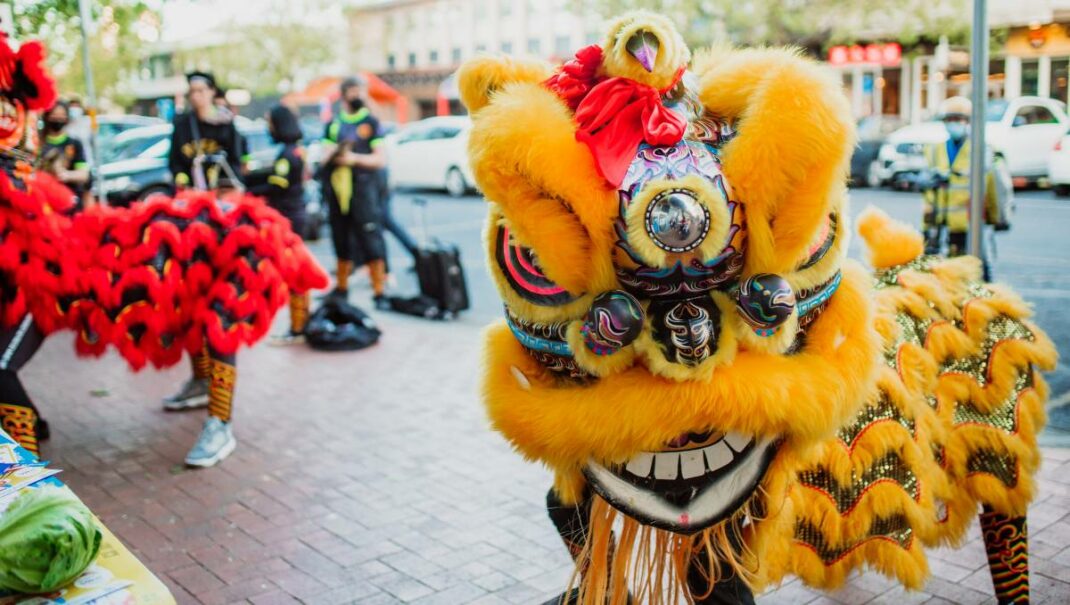
Following this celebratory opening, the ACT organisation has programmed a varied selection of events over the week until 8 May. The program reflects the current focus in the ACT on community dance and dance for people with varying skills and interests throughout that community. There is a strong focus in the 2022 program on classes to try and workshops to experience. One of the most fascinating to my mind happens on 1 May and is the Chinese Tiger and Lion Dance Workshop—not something that is offered often! See the full program at this link.
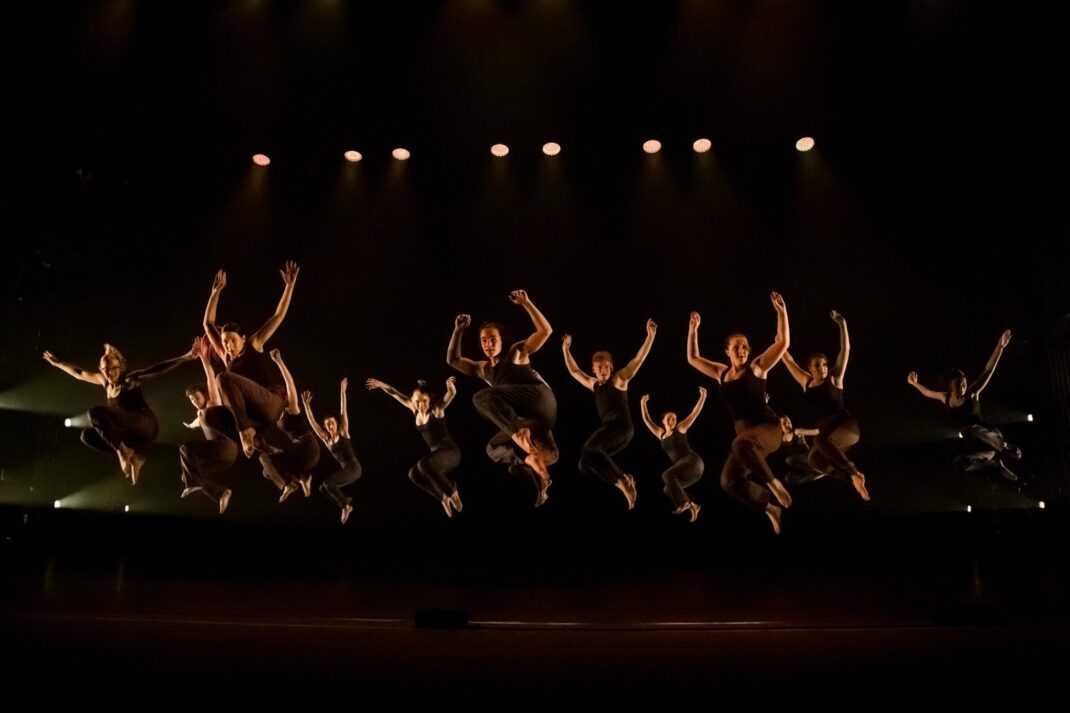
In addition, QL2 Dance launched, also on 29 April, a 12 minute film, Unavoidable casualty. This film examines ways in which young dancers might express how they have felt and managed difficult, even traumatic events they have experienced, or seen others experience. Unavoidable casualty is available to watch until 8 May at this link. Watch to the end to see a beautiful finishing section in which some of the dancers are introduced one by one. Choreography is by Stephen Gow and Ruth Osborne.
In 2019 I was in New York briefly for the celebration of 75 years of the Dance Division of the New York Public Library. As part of the event I was asked to talk about the acquisitions I especially remember from my time as curator there. It brought back memories of a rather amazing visit I made to a gallery in downtown Manhattan in 2007.
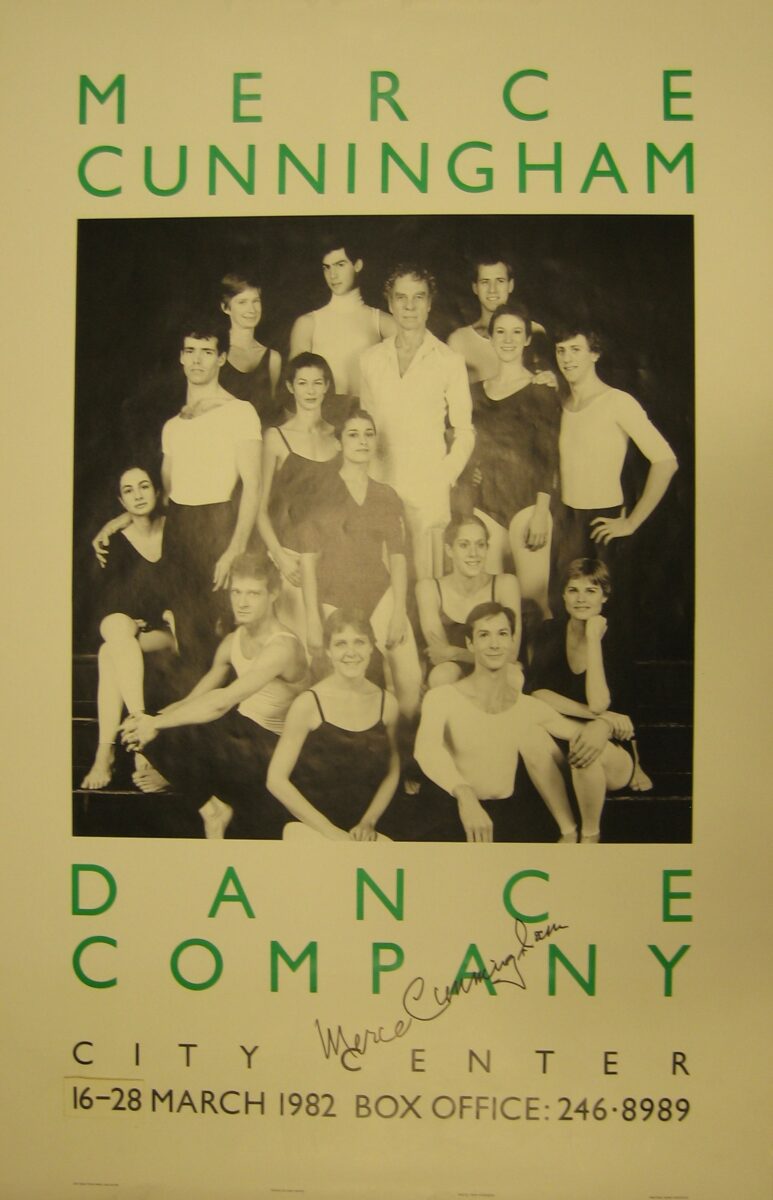
A small but significant collection of posters from the 1960s to the 1980s for performances by the Merce Cunningham Dance Company was being prepared for sale in the gallery. They were the work of some of those truly exceptional artists who collaborated with MCDC during those decades: Frank Stella, Robert Rauschenberg, Morris Graves, Jasper Johns and others. The suggestion came that I should go down to this gallery and see if there was any material I would like for the Dance Division. So off I went. There I was met by Julian Lethbridge, himself a fine artist. Julian introduced me to the gentleman who was hanging the show. There he was up a ladder in his jeans. ‘Oh Michelle,’ Julian said. ‘I’d like you to meet Jasper Johns.’ Only in New York, I thought to myself.
But apart from the shock that the man up the ladder in jeans was Jasper Johns, the material was amazing and every poster was signed by Merce. And the escapade was also an example of the philanthropic generosity that keeps the Dance Division running. The items I selected were bought for the Division by Anne Bass and were appropriately hung in the Division’s 2007 exhibition INVENTION Merce Cunningham and collaborators.
I was reminded of this acquisition and the meeting I had with Jasper Johns when just recently I noticed, via Google Analytics, that views of the obituary on this website, which I wrote for Anne in 2020, had been steadily rising (around the second anniversary of her death).
Anna Karenina
Anna Karenina live (as opposed to the streamed version) left me a little underwhelmed, so I decided not to do a full review but simply to make a few comments. Despite the so-called ’rave reviews’ that have appeared in various places, I found it interesting but not a great production, despite some exceptional design and projections, and some fine dancing. It was highly episodic, which is hardly surprising given the length and depth of the book on which it was based. But for me that episodic nature meant that there was no strong through line to the production. My mind flicked back to Graeme Murphy’s Romeo and Juliet. It was also episodic in nature as it skipped from place to place, era to era. But one of its great strengths was the addition to the work of the symbolic figure of Death, powerfully performed by Adam Bull. Death constantly hovered in the background and drew the episodes together.
Apart from the problem of the work’s episodic nature, I still find it hard to understand why the ending, which followed Anna’s suicide, was so, so long and featured (and ended with) two secondary characters, Kitty and Levin. Wasn’t the ballet about Anna Karenina?
A new Swan Lake?
As part of a Mothers’ Day promotional email, I discovered that the Australian Ballet is planning a new production of Swan Lake for 2023! I was a little surprised I have to say but will wait to hear more before further comments.
Michelle Potter, 30 April 2022
Featured image: Poster for Ausdance ACT Dance Week 2022
28 August 2019. Lyric Theatre, Queensland Performing Arts Centre, Brisbane
With its production of Sir Kenneth MacMillan’s Romeo and Juliet, Queensland Ballet once again displayed its constantly growing position as one of Australia’s leading dance companies. This Romeo and Juliet, for which the premiere dates back over 50 years to 1965, was first performed by Queensland Ballet in 2014 when the cast included several international guest artists. In 2019 the cast was home grown. The night really belonged, however, to Mia Heathcote as Juliet and Patricio Revé as Romeo. Both were promoted onstage at the conclusion of the performance.
The Heathcote/Revé partnership was an engaging one throughout. They shone in the several pas de deux on which the MacMillan production centres, and both provided us with believable interpretations of the characters they represented. Mia Heathcote’s confidence onstage and her ability to maintain her characterisation (and technique) throughout what is a long ballet with many changes of location, not to mention changes of emotional mood, was admirable. Revé clearly has many talents, although I suspect he probably needs a little more time before he has the stage presence that will match his technique.
I loved the group scenes in this production, all of which were imbued with great energy and so much interaction between all those on stage. Particularly impressive was the Capulet Ball, led magnificently by Steven Heathcote, guesting on this occasion from the Australian Ballet. There was just a touch of pride in the way he held his chest and turned his head that told us he was in charge. He maintained that dominance, a calm but obvious dominance, throughout, whether he was dismissing Tybalt’s attempts to remove Romeo from the ballroom, or demanding later that Juliet marry Paris. The ball scene was also distinguished by MacMillan’s beautiful choreographic approach in which the guests all danced with a slight tilt to the body. So appropriate to the era in which the ballet takes place.
The several fight scenes, staged by Gary Harris, were dramatic and spirited and, in the earliest of those scenes, the whole stage was abuzz with fiery action. The death of Mercutio at the hands of Tybalt was equally as dramatic with Kohei Iwamoto performing strongly throughout as Mercutio.
I was entranced too by a dancer (unnamed) playing the part of a disabled old man in the market place. Mostly he was high up on a kind of balcony that surrounded the market square but he was so involved with what was happening below that it was often hard to take one’s eyes away from him to watch the main action.
What confused me slightly (and probably only because I had not so long ago seen London’s Royal Ballet perform the MacMillan Romeo and Juliet) were the designs used by Queensland Ballet. I was, I have to admit, expecting the Georgiadis designs, which I admired greatly) but it turned out that Queensland Ballet has what Li Cunxin calls the ‘touring’ designs, which were rented from a company in Uruguay and are by Paul Andrews. For me they couldn’t match those of Georgiadis, although I admired Juliet’s bedroom with its red/orange drapes and its religious icon/prayer point in one corner. The costumes for the musicians who accompany the wedding procession in the market place were also impressive. They spun out beautifully during turning movements.
All in all though, another wonderful show from Queensland Ballet.
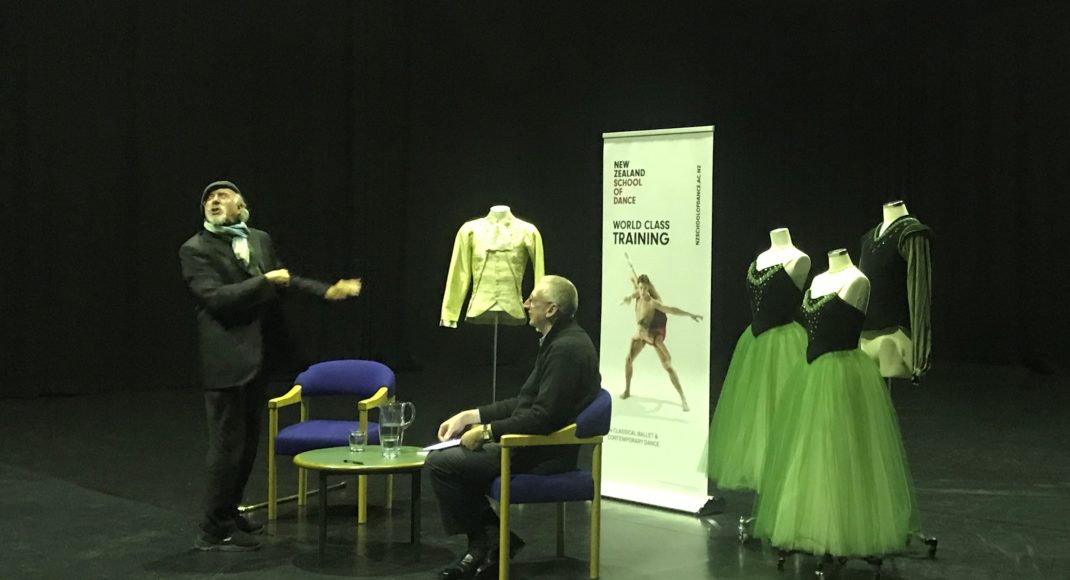
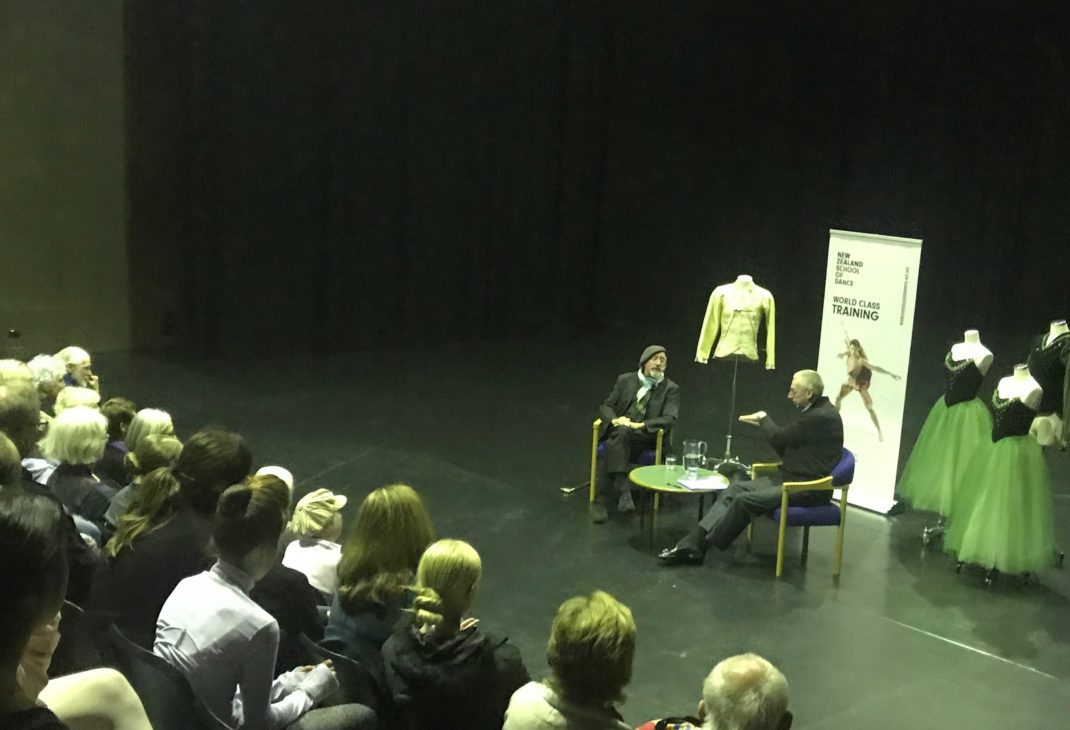
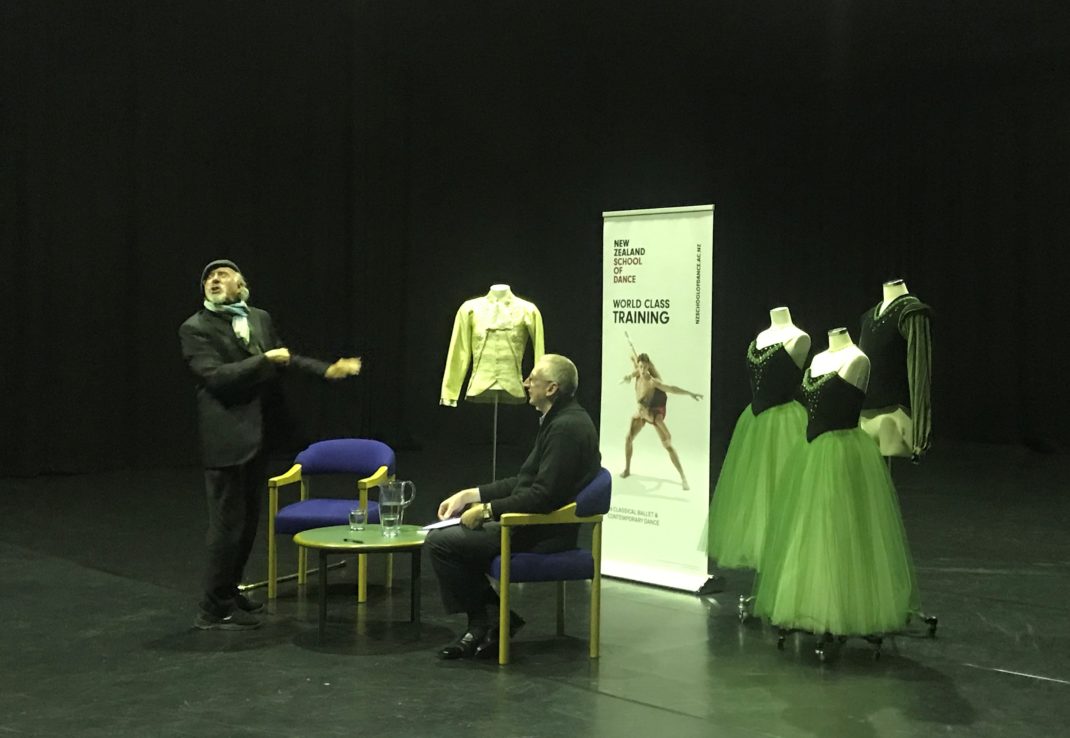
An armchair conversation with Sir Jon Trimmer was the brainchild of Garry Trinder, Director of New Zealand School of Dance. It was held in the theatre at Te Whaea, mid-week of the school’s winter intensive national seminar, so that many young students, parents and teachers could attend. It was also open to the public and a large contingent of Friends and friends, colleagues, admirers, teachers and audience-goers took the chance to express publicly their appreciation of, and thanks for, this dancer’s phenomenal career. It was twilight hour, so a poignant echo that, on innumerable performance nights across the past six decades, warm-up, make-up, dress-up, curtain-up would have been taking place at around the same time. In reviving the memories and pleasures of those performances, the conversation summoned many ghosts, all of them good. No bad ghosts arrived. Love was in the air.
The names of the main players in his early story include: Jonty’s parents and siblings who danced and sang their way around the family home; Pamela Lowe, his older sister whose dance school in Petone he attended; Poul Gnatt who arrived in 1953 like a lightning bolt from afar and established a ballet company on zero resources yet with the highest of aspirations; Russell Kerr, a quiet genius of ballet, music and theatre arts who succeeded him as Artistic Director of the company in 1962, contributing to its growing international recognition; Alexander Grant, our legendary character dancer expatriate; Peggy van Praagh who offered support during the early years of her directorate of The Australian Ballet—including an enterprising initiative whereby several dancers had three-month exchange residencies between the two companies. Jacqui and Jon Trimmer were later invited to dance with The Australian Ballet on an international tour with guest artists Margot Fonteyn and Rudolf Nureyev, and entertaining tales were told of those times.
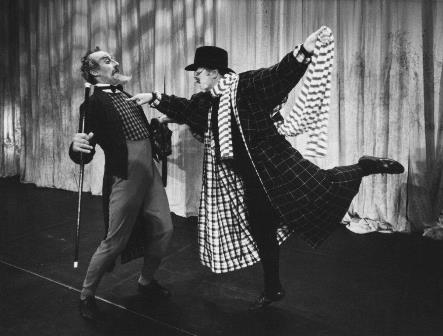
Harry Haythorne, a subsequent director of New Zealand Ballet, was another Australasian success story. He and Jonty were obviously great mates (‘We both knew all the hit songs and numbers from vaudeville and music-hall era—had a ball outdoing each other’). There’s no better illustration of that rapport than their twin roles in A Servant of Two Masters, Gray Veredon’s classic commission with inspired design by Kristian Fredrikson. The Film Archive’s copy of that commedia dell’ arte ballet is still worth viewing for the dazzling line-up of its stellar cast—Trimmer and Haythorne, Kerry-Anne Gilberd, Cathy Goss, Karin Wakefield, Lee Patrice, Eric Languet, Warren Douglas, Kilian O’Callaghan. The earlier romp, TheRagtime Dance Company to Scott Joplin, was another of Veredon’s and Fredrikson’s hits. Bernard Hourseau’s Carmina Burana and Ashley Killar’s choreographies No Exit and Dark Waves also gave Jon some of his strongest roles. Many of the heritage works of the Company’s repertoire exist only in memory, but are no less real for that, and a number of them could do with re-visiting.
Sir Jon Trimmer (left) as Pantalone and Harry Haythorne as Dr Lombardi in Gray Veredon’s A Servant of Two Masters. Royal New Zealand Ballet, 1989. Photographer not known
Christopher Hampson’s Romeo & Juliet, and Cinderella, Stanton Welch’s Madame Butterfly, Liam Scarlett’s Midsummer Night’s Dream are further impeccable works that secured RNZB’s reputation for full-length choreographies, combining all the power that dancing, music and design can offer. If asked to name one indelible image of Jon Trimmer on stage, I’d probably first lodge a conscientious objection—What, only one?’ but then describe his power as the Duke of Verona in R&J. He strode in, on a high, elevated back platform, glared down first at the Montagues, then at the Capulets—at everyone stunned by the horror of what had played out, then again at both houses —turned and strode off. His demand that warring end and a truce be declared, delivered in so few gestures, carried all the power of Shakespeare’s tragedy. The timing and the minimalism of those few moments on stage, said it all.
We should tell our
grandchildren what we saw. Find the music, tell them the story, show them
photos, keep the dress-ups box at hand, take them to a matinee, suggest they
draw and write afterwards what they saw, maybe send a postcard to their
favourite dancer. Who knows where it might lead, but it can only be a good
place.
The clearly
important international parts of Jon’s career, with Sadler’s Wells Ballet, and
Royal Danish Ballet, were referenced, (‘It certainly helped in Denmark to have
Poul Gnatt’s mantle on my shoulders. He was still vividly remembered by
everyone there—and clearly had been one of their top dancers’) but it is
overwhelmingly apparent that the Trimmers’ commitment and loyalty to the Royal
New Zealand Ballet has shaped their lives, and that of so many younger dancers and
colleagues here whose artistry they have helped to develop. For that we say
Thank You.
Garry asked: ‘When did it first occur to you that the recreation and pleasure you took in dancing as a boy could become your life work, your career?’ Jon replied: ‘Well, you know I’m not sure I can say. I just kept on doing what I loved.’
Garry Trinder (right) asks a question of Sir Jon Trimmer. New Zealand School of Dance, Wellington, 2019.
‘What he loved’ included Poul’s pedigree productions of Bournonville ballets—La Sylphide and Napoli; the talisman Prismatic Variations, Russell’s Prince Igor, Petrouchka, Swan Lake, Giselle, Coppélia, Christmas Carol, Peter Pan; interesting new work with Russell Kerr in an interlude at Auckland Dance Centre; plus 100 more… Servant, Ragtime Dance Company, La Fille mal Gardée, Cinderella, Romeo & Juliet … who’s counting and where do we stop? Clearly this is significant repertoire that earned the Company an international recognition and reputation, as well as its royal charter.
The sagas of
company politics, funding and management highs and lows over the years were
referred to in the briefest of terms, as also the devastating challenge of the
fire that destroyed almost all the company’s resources in 1967. The abiding
impression one gains is of the resilience and determination to somehow hold on
to the reins—with Poul Gnatt, Beatrice Ashton, Richard Campion, Russell Kerr
and the Trimmers as the heroes in those early battles.
Young dancers listening will have taken on board Jon’s words about the importance of breathing while moving—to shape and sustain an arabesque, to support a jump, to control a pirouette … ‘oh and the music of course, that helps enormously.’
Another tip, this one he had from Russell Kerr—’Go and sit outside a café, watch people as they walk by. Study their gait, their timing, how they hold their body. That will tell you much about their character which you can then put into your performance, make it lifelike.’
Jon: ‘I stopped dancing princes at a certain age but went on to old men, old women and witches. Look, it’s been just wonderful to work with all those talented people.’ Jon, one could guess it’s been just as wonderful for them, as it has been for us too.
A friend in the audience commented later—’One
thing that struck me was his presence when speaking. When Trinder was
talking Jonty seemed like just a genial old man, but as soon as he started to
speak you couldn’t take your eyes, or attention, away from him.’ That magnetic presence
and practice of paying attention has also worked in the opposite direction and been
a way of life for Jon for years. He has watched countless RNZB rehearsals and
performances with the most attentive eye, and always found a way of gently
encouraging younger dancers, suggesting a tip to a colleague as to how the smallest shift in
physics of limbs or expression of eyes or face might enhance their performance. Such
generosity in the competitive world of ballet arts is rare, but makes the man worth his
weight in gold.
There are more stories to be found in
Jon’s recently published memoir, Why
Dance?and details of the
Company productions are listed in the three published histories of the
RNZBallet—at 25, 50 and at 60 years.
Jon has also
explored pottery and painting as further means of expression. He is a legendary
gardener —and, one senses, a deeply happy man Of course he’s not stupid and
wants a much better world for dancers, but the knowledge that he has used his
own given talents to the maximum has allowed him to remain positive throughout
a career that has seen some tortured ups and downs of politics and make-overs
during the decades (every ballet company knows them). His humour is quick but
never biting, always gentle with wry amusement, a rich sense of irony, patience
in waiting for time to resolve troubles of the political variety, and
truckloads of performance memories.
Also apparent is a
deep and genuine love of his country—’Oh it was wonderful to travel through the
whole countryside as we toured everywhere in the early days—we saw so much, and
made so many wonderful friends as billets. We’re still friends.’
Bill
Sheat, a pillar in many areas of the arts community in New Zealand, says: ‘During
my long term as Chairman of the Board of RNZB I was lucky enough to see Jon T.
perform countless times. Whenever he made his first appearance there would be a
wave of whispered delight as the audience recognised him. It was a mixture of
love, ownership and appreciation.’
Tuesday evening was a sweetheart affair—no notes, no microphones, no bullshit, no self-aggrandisement, no lecturing, no breathless promotions, no shouting and whistling, just an ocean of smiling faces and sustained, warm applause that is echoing yet, and holding history. There is no future without the past.
So what did Jonty
do? He joined in the applause of course.
Jennifer Shennan, 12 July 2019
Featured image: Sir Jon Trimmer (left) makes a point during his conversation with Garry Trinder. New Zealand School of Dance, Wellington, 2019
Please consider supporting the Australian Cultural Fund project to raise money to have hi-res images made for a book on the career of designer Kristian Fredrikson, which is heading towards publication. See the project, which closes on 30 July 2019, at this link.[Update 1 August 2019: Project closed]
c. 1590—Shakespeare sets Romeo & Juliet in c.1390 Verona (and
the town is happy to remember that still). Poetry tells the drama of youth,
rivalry between the gangs Montague and Capulet, loyalties demanded, much street
fighting, boy and girl in love affair doomed from the start. Sword fights,
authorities not coping, fatal mistakes in timing of survival strategies.
Deaths, actors exit, curtain down.
1957—Jerome Robbins, director/choreographer,
Leonard Bernstein, composer, Stephen Sondheim, lyricist, and Arthur Laurents,
book, set West Side Story in upper
west Manhattan (though the area has since been somewhat gentrified). Dance
tells the drama of youth, rivalry between the gangs Jets and Sharks, loyalties
demanded, much street dancing, boy and girl in love affair doomed from the
start. Fist and knife fights, authorities not coping, fatal mistakes in timing
of survival strategies. Deaths, actors exit, curtain down.
2019—Australian production opens in
Wellington. Seasoned musical director/conductor, Donald Chan, holds brilliantly
taut reins on a spirited performance from
the Australian cast and local Orchestra Wellington musicians.
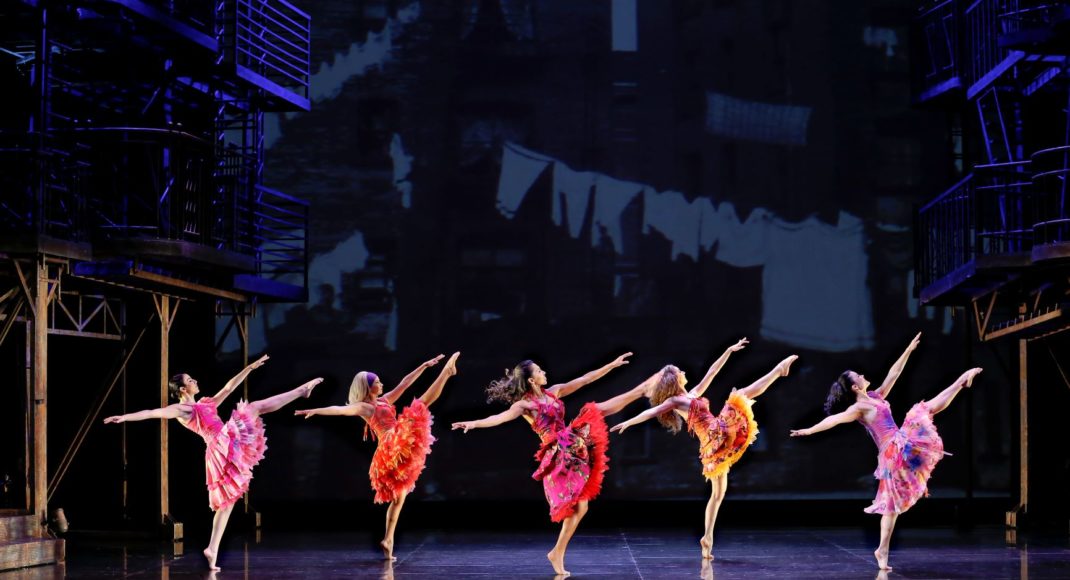
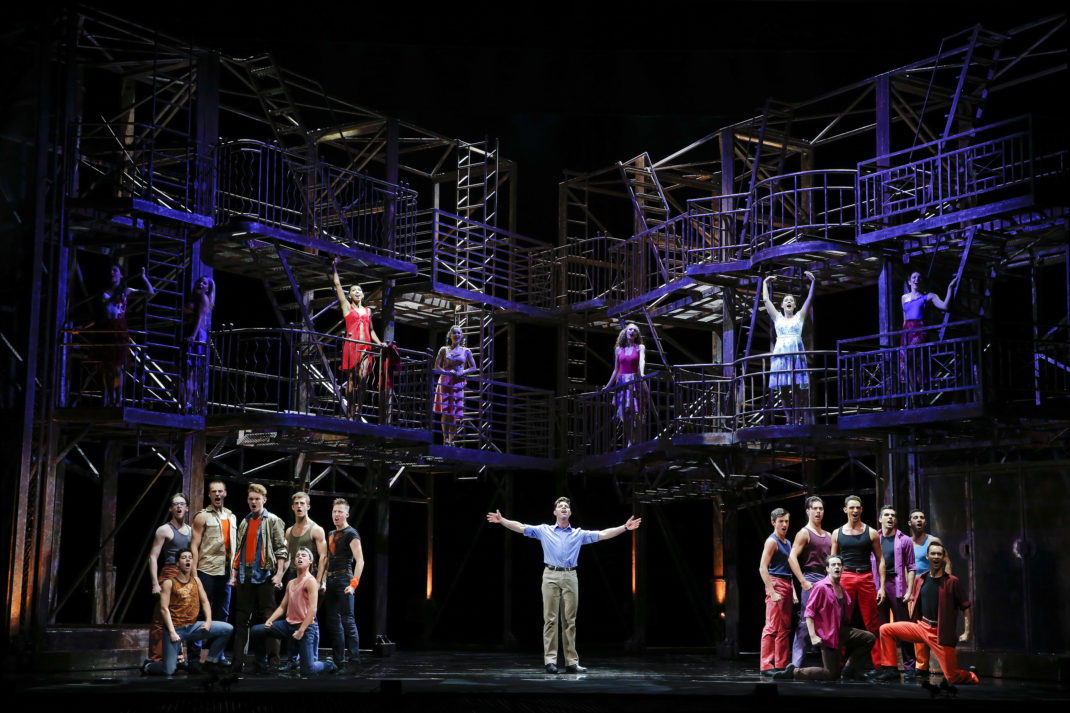
Complex stage sets of towering buildings and balconies are moved seamlessly throughout the performance, so there is a further team out the back performing a dance we don’t see.
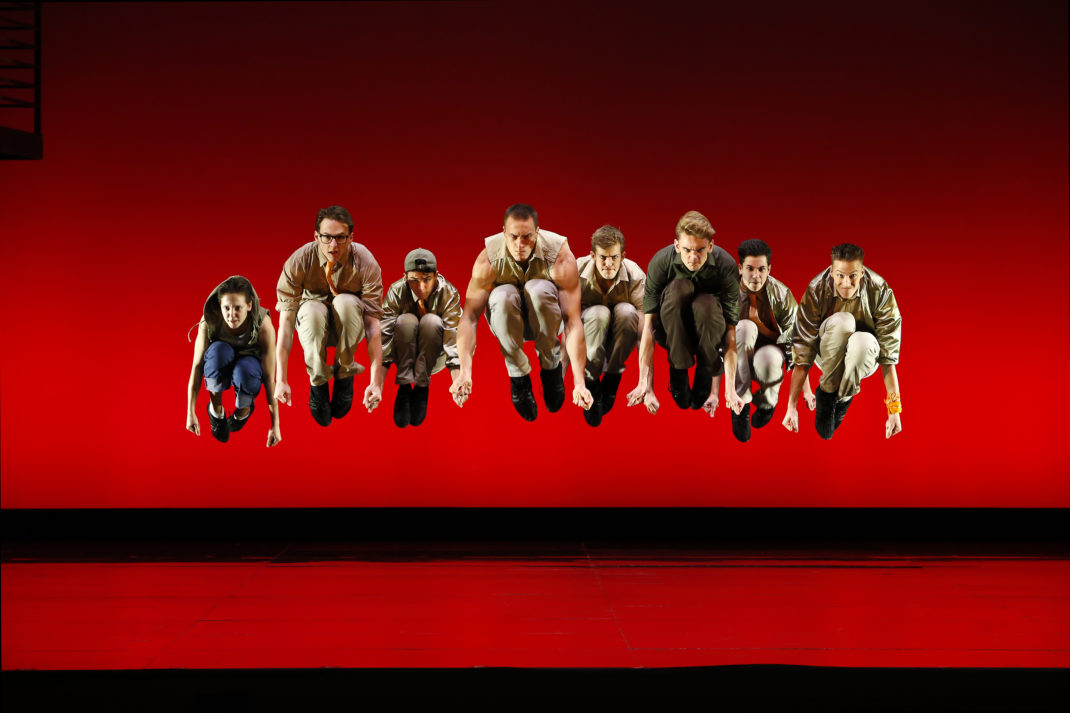
There is little spoken dialogue in the show but in a short sequence, two junior members of the Jets confess their fear of the imminent arrival of cops to investigate murder. The pathos struck in their brief confession of individual human emotion makes striking contrast with the kind of confident bravura so readily summoned for group display in the gangs’ dances and songs throughout the show. Of those the romping standouts are I like to be in America and Gee, Officer Krupke.
The ballet sequence near the end, to Somewhere (perhaps too well-lit for the
dream scenario it implies?) sits in marked contrast to the rest of the dancing,
and we only hear but do not see the vocalist for that number. (I would have welcomed the singer to stand in
a royal corner box and thus to seem to sing on the audience’s behalf).
West
Side Story rocketed to fame on Broadway as a big,
big musical, and was soon translated to
a movie that became known worldwide. (Do you know anyone who didn’t see it?)
Steven Spielberg is preparing a new movie version, this one to be set in Harlem,
so that’s moving to 131st Street, filming to start about now.
Rita Moreno, unforgettable as Anita, the
leading lady of the Sharks, won an Oscar for her performance in the original
movie. She will play in the Spielberg film, a re-worked version of the
character Doc, the shop-owner where Tony (aka Romeo) works.
In the cast we saw here, Doc, the only voice of reason, though no-one would listen until too late, was impeccably played by Ritchie Singer. In the sizzling role of Anita, Chloe Zuel was the knockout member of a large cast where everyone acquitted themselves with verve and commitment. Not a beat was missed throughout. Donald Chan saw to that.
(Makes you want to watch the movie again.
Maybe after that I’ll listen to Prokofiev’s Romeo
& Juliet score?)
New Zealand apparently holds the dubious
title of the per capita world record for the number of gangs and patched
members. Territories are guarded, loyalties demanded, external authority
rejected. From the occasional reports of events and encounters between them,
one might imagine they also know personal storylines not too removed from the
above. How we are is who we are.
West Side Story comes from classic stock. Dance followers may be interested, and perhaps surprised, to learn that Belgian choreographer Anne Teresa de Keersmaeker, hitherto renowned for avant garde dance theatre, is also at work on a Broadway revival of West Side Story with entirely new choreography, production date 2020. Clearly it’s a work for our time, and for many times.
4 May 2019 (matinee). Royal Opera House, Covent Garden, London
It is always exceptional to see a work by a choreographer who is not the familiar one from one’s previous experiences of that work. Having seen John Cranko’s production of Romeo and Juliet countless times, as performed by the Australian Ballet, along with several versions by other choreographers, the Royal Ballet’s production of Kenneth MacMillan’s version of the Shakespearian tragedy was indeed an exceptional experience. I was lucky too, I think, to have seen Sarah Lamb and Vadim Muntagirov in the leading roles. While I thought Lamb’s interpretation was a little too child-like, I was fascinated by the changing emotions displayed by Muntagirov. In addition, the partnership between Lamb and Muntagirov was very secure technically and, as a result, MacMillan’s often swirling, curving, diving lifts were realised beautifully.
The MacMillan version of Romeo and Juliet received its premiere in 1965. It is a gutsy production from the beginning when the market place of the opening scene buzzes with activity and is filled with people who seem so real (and was that a side of a dead cow being carried through the crowd on the way to the market?). The sense of the real continues through to the middle scenes when Mercutio and then Tybalt die from sword wounds and do so in such a dramatically convincing fashion, and on to the end where Romeo’s and Juliet’s death scenes leave us emotionally exhausted.
Then, Nicholas Georgiadis’ sets have little of the romantic to them. The Capulets live in a fortress, as we see when the guests arrive for the Capulet ball. And, as Jann Parry tells us in her program notes, the inclusion of a fortress looks back to the Franco Zeffirelli theatre production, made for the Old Vic in 1960-61, when Zeffirelli had the Capulets live in such a structure as protection from enemies and in order to preserve their family treasures. Then the crypt in which the Capulets place the apparently dead Juliet is spectacular with its huge stone sculptures and its flights of dark stairs of stone. The production has a kind of rawness to it and just speeds along.
Muntagirov danced superbly showing off his spectacularly light and seemingly effortless jumps; his wonderfully controlled turns, including some in attitude devant as well as attitude derrière, along with some great manèges with various showy steps. But what I especially admired about his Romeo was the way he made his emotions so visible. A highlight was when he watched a wedding parade enter the market place (to the accompaniment of mandolins) in the early moments of Act II. As he stood downstage, almost motionless, we could read that he was thinking that he and Juliet could and should follow that very example. Another was his undisguised anger at what Tybalt had done to Mercutio, and his determination to avenge the death of his friend.
Sarah Lamb is not my favourite Juliet I’m afraid. I know Juliet is a mere 13 or 14 years old but, within the MacMillan structure, I would have preferred a more feisty Juliet. But with her beautifully proportioned limbs and sound technique she danced superbly and was a joy to watch from that point of view
I enjoyed Thomas Whitehead’s commanding presence as Tybalt, especially in the scenes in the market place where his dislike of Romeo was constantly visible, and in the ball scene where his carriage of the upper body marked him as being a proud and aristocratic Capulet. And incidentally, the corps danced beautifully in the ball scene as they tilted their bodies slightly back from the waist upwards in a show of historical deportment. Other dancers to admire especially were Marcelino Sambé as a vibrant Mercutio, Téo Dubreuil as a constantly concerned Benvolio, and Christina Arestis as a very haughty Lady Montague who clearly could not bear the Capulet family.
This production was highly engaging and I love to ponder its character beside the others that I have seen—those of Cranko, Graeme Murphy, John Neumeier, Stanton Welch, and the two versions that take particular liberties for one reason or another—those of Sasha Waltz and Natalie Weir. (I have no review on this site of the Cranko production. It has been a while since the Australian Ballet showed it).
30 June 2016, State Theatre, Victorian Arts Centre, Melbourne
My review of Stanton Welch’s spectacular Romeo and Juliet for Houston Ballet is now available on DanceTabs at this link. In relation to the DanceTabs review, below is an image of Karina Gonzalez as Juliet and Jessica Collado as Lady Capulet showing the ‘exclamation mark’ arabesque I mention in the review.
While in the review I didn’t go into much detail about the children who appeared in the work (courtesy of the Australian Ballet School), I am am curious to know the name of the fair-haired boy who led the Blind Man’s Buff game, and who appeared whenever children were required. He had such charisma for someone so young.
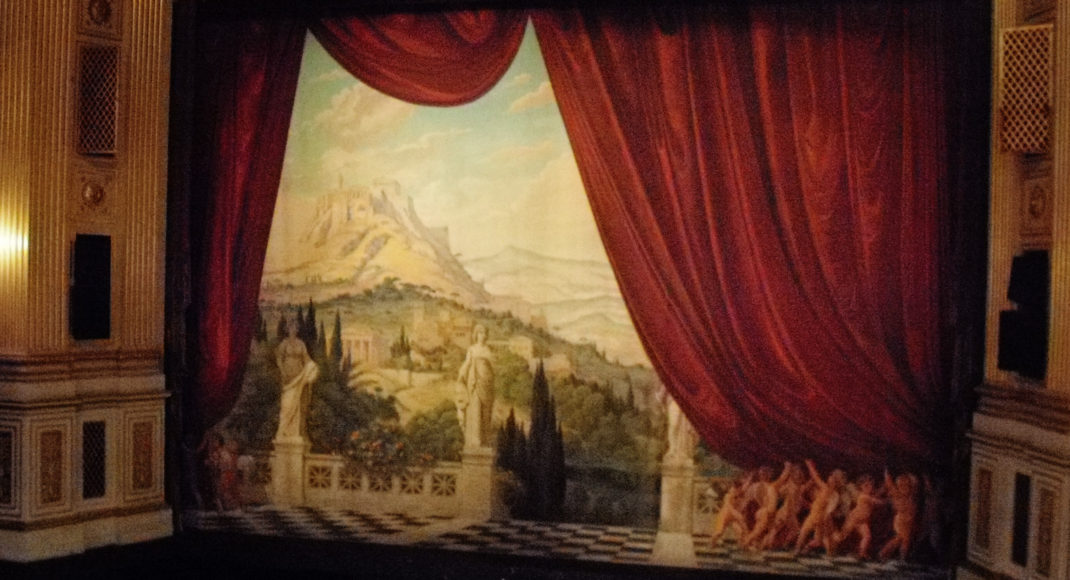
What a pleasure it was to be sitting in the auditorium of Copenhagen’s beautiful, old Royal Theatre waiting for the curtain to go up on a production of Romeo and Juliet—John Neumeier’s version too, which I had never seen: such a sense of anticipation not just because for me it was a different production, but also because it was about ten years since I last saw the Royal Danish Ballet. What a sense of occasion too because just as it was time for curtain up Queen Margrethe II of Denmark, a true balletomane, appeared in the Royal Box and the audience rose as one to welcome her.
But to the show …
The Neumeier Romeo and Juliet is said to have been partly inspired by John Cranko’s production, so well known to Australian audiences during the period of Maina Gielgud’s directorship of the Australian Ballet. And yes, there is a spectre of Cranko somewhere there. But on the other hand, Neumeier’s production is quite distinctive. Choreographically it is absolutely fascinating, especially in the way it contrasts the movements of the elders of the Capulet and Montague families and those of the younger folk across the social strata. Both groups are given what I can only say are beautifully eccentric movements, especially for the arms and upper body. The elders often use a highly formalised vocabulary, while the young people have a freedom that sometimes verges on the wild. Gorgeous. And how beautifully did the dancers of the Royal Danish Ballet respond to this vocabulary!
Ida Praetorius as Juliet was completely entrancing. She showed off a stellar technique—the highlight for me came when she was refusing the attentions of Paris and at one point, in desperation, tossed off an amazing, perfect double turn in arabesque with arms flung upwards and body slightly tilted. But not only did she dance with such perfection, her characterisation of Juliet was brilliant. She played the role as it was written—she was a thirteen year old. She often seemed slightly awkward of limb, she often made her youth clear by seeming not to know how to behave in every situation, and her nervousness and vulnerability were clear, especially when she executed that wonderful stumble on the last few stairs as she entered the ballroom for the Capulet ball. But throughout, her youthful, slightly crazy love for Romeo was always obvious.
As Romeo, Andreas Kaas was as ardent and dramatic in love as one could hope. His enthusiasm and desire for Juliet showed in his every movement. He rushed to her. He could scarcely hold back his longing for her. Kaas and Praetorius, together, made the two characters come alive in a way I have never seen before. It seems like a partnership made in heaven from both a dancerly and dramatic point of view.
Another stand-out performance came from Sebastian Haynes as Mercutio, dashing and charismatic as a character, thrilling as a dancer. His death scene was powerfully moving and made more so by the feisty way Romeo took on Tybalt after the stabbing. I also admired Susanne Grinder as Lady Capulet. She moved with such strength and such elegance, sweeping her way through Neumeier’s formal choreography and wearing her bright orange gown with style and aplomb—a true aristocrat. And I have never taken all that much notice of the entourage that enters the square to try to restore some peace to the conflicts between the Capulets and the Montagues. But in this production Poul-Erik Hesselkilde was a towering presence as the Prince of Verona. Mostly he stood still, centre stage, but he was so in command of the role that his power spread across the stage and out into the auditorium.
There were so many magical moments, too, inserted by Neumeier to make more sense of the story. The potion that the friar gives to Juliet, for example, we know is not a deadly poison but Neumeier introduces a group of street performers who, in a commedia dell’arte manner, mime the effect the liquid will have. Juliet and the friar stand motionless, in a kind of freeze frame, in the act of giving and receiving the vial.
As is usual in Royal Danish Ballet performances, the presence of children in the crowd scenes was always noticeable. I loved the way the adult dancers in the corps de ballet interacted with them, shielding them from fight scenes, making sure they hurried off during the more gruesome moments. And as for the corps, I loved that they looked as though dancing was their life and not just their job.
Costumes and sets were by Jürgen Rose, also responsible for the design of the Cranko production. But his work for Neumeier had a very different feel and was often unusual in the way Neumeier’s choreography was unusual. His striking red wedding dress with white turban for Juliet was quite startling, for example, and the church for the wedding, which was created as plain brown flats slid beautifully and noiselessly into place, had all the simplicity of a Cistercian abbey church. Nothing was overdone but everything contributed beautifully and economically to the unfolding story.
This Romeo and Juliet was such a striking production, so beautifully danced by the entire company and musically thrilling—it just took my breath away. The evening sped by and it was by far the most exciting and captivating performance I have seen for years, anywhere in the world.