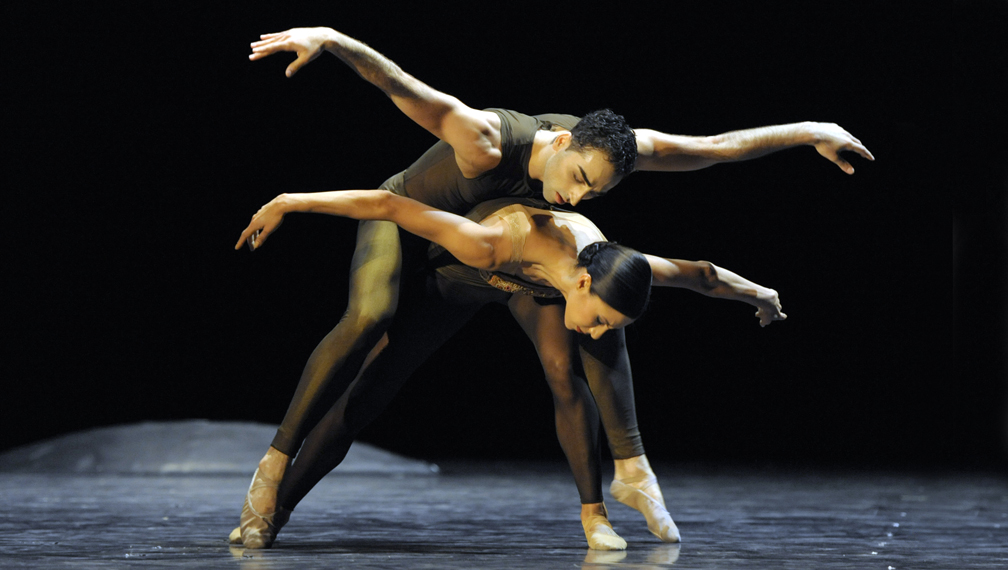
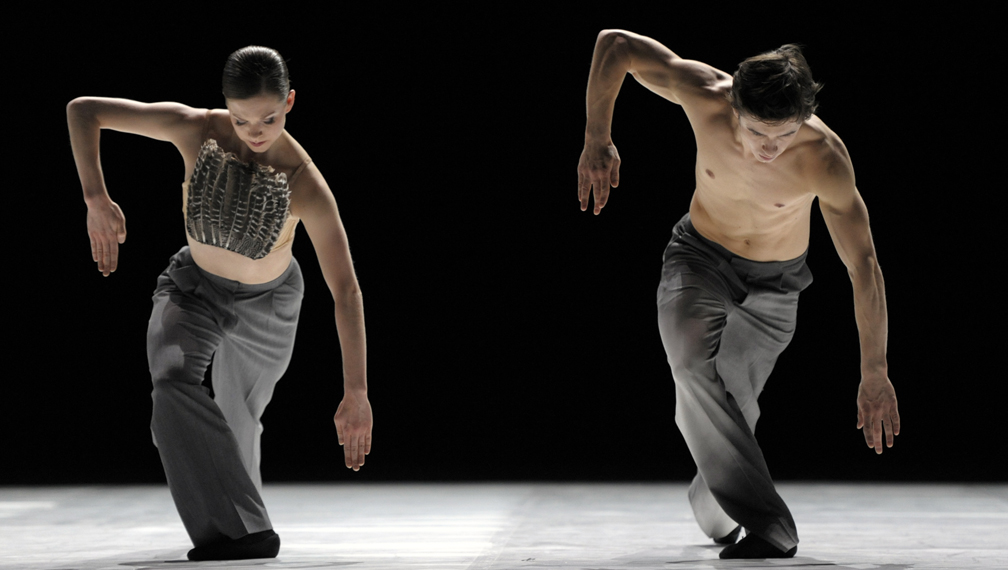
Anna Karenina. Eifman Ballet

15 August 2012, Capitol Theatre, Sydney

There is a lot to admire in Boris Eifman’s balletic interpretation of Leo Tolstoy’s novel, Anna Karenina. It is definitely not that Eifman covers all the complexities of the plot in his narrative but that, having chosen to reduce the storyline to a love triangle between the influential statesman Alexey Karenin (Oleg Markov); Anna (Nina Zmievets), his wife; and Alexey Vronsky (Oleg Gabyshev), cavalry officer and Anna’s lover; he presents a theatrically powerful distillation of the emotional heart of the novel.

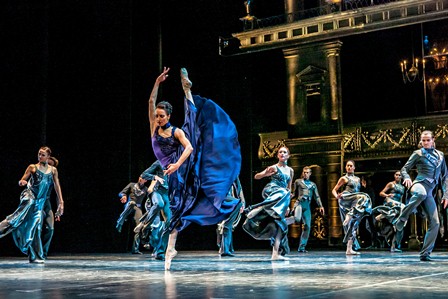
Eifman emphasises individual incidents and single moments in the narrative and this approach is supported by a lighting design from Gleb Filshnitsky who uses strong spotlighting to direct the audience’s focus. I admired the quite minimal designs of the costumes by Slava Okunev with their reduced colour palette, largely of slate grey, black and white, and the multi-functioning black and gold setting by Zinovy Margolin with its architectural and historical allusions. They also supported Eifman’s vision. Alongside the three principals in this production, the corps de ballet becomes a kind of chorus filling roles as socialites, visitors to Venice, and eventually as the train that kills Anna.
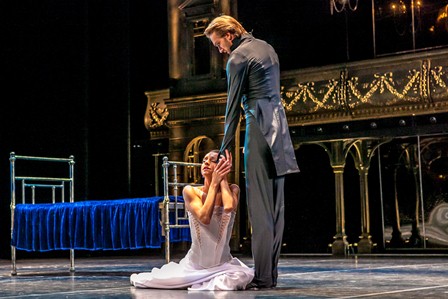
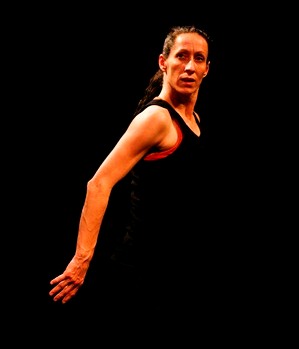
Nina Zmievets and Oleg Markov in a scene from Anna Karenina, Eifman Ballet, 2012. Photo: © Cynthia Sciberras

Eifman’s choreography is an odd mixture of classical and contemporary movement. There is the temptation to think of Martha Graham, perhaps even Nacho Duato at times, and also musical comedy routines. But it is more a case of it being Eifman’s own brand of eccentric movement where bodies are twisted and contorted and thrown around dramatically. I am not particularly a fan of Eifman’s ‘flash-bang’ choreographic style, although the dancers clearly relished what they were dancing and that in itself is something to admire. For a while I didn’t notice that the women were on pointe, so focused was the choreography on flinging the body from one extraordinary shape and position to another. But once I started looking more closely I disliked the way the women used (or didn’t use) their feet. Pointe shoes look ghastly if the foot isn’t working strongly inside them and often it wasn’t, which totally destroyed the line of the leg in my opinion.
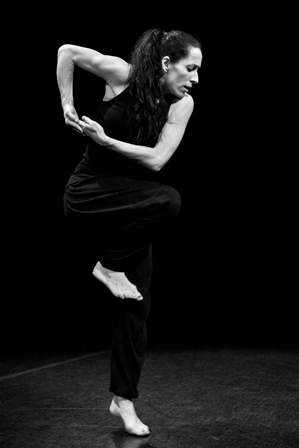
Scene from Anna Karenina, Eifman Ballet, 2012. Photo: © Cynthia Sciberras

What I really didn’t like was the Tchaikovsky mash-up to which the work was set musically. In particular, there were some musical selections that are so closely identified with other ballets as to detract from what Eifman was trying to achieve. The scene in Venice where Anna and Vronsky have fled, for example, was danced to music that is used for that wonderful Polonaise in the finale of Balanchine’s Theme and Variations. No matter how elegant those black and gold Venetian carnival costumes were, it was all but impossible not to wish one was seeing Theme and Variations instead of Anna Karenina. Similarly, the ballet opened with the music that opens Balanchine’s Serenade, and again it is hard to not visualise that ballet rather than watch what is unfolding on stage in Anna Karenina.

I think it’s worth looking at Judith Flanders’ summation of Eifman Ballet as posted on theartsdesk.com not so long ago. She wrote, ‘Boris Eifman has always divided the critics. Western audiences tend to respond the way they do to car crashes: they are appalled, but find it hard to look away. Russians, meanwhile, virtually stand on their seats and scream for more.’ There is also an interesting comment posted at the end of the Flanders’ piece!

I wasn’t appalled, there was too much to think about and plenty to admire, but to my eyes Eifman’s way of presenting ballet is definitely eccentric. Having said that, perhaps we need a few more eccentricities here in Australia?

Michelle Potter, 17 August 2012
Seeking Biloela. Liz Lea

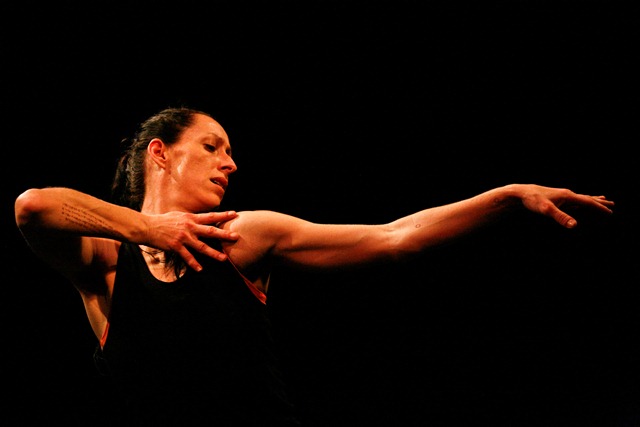
Dance and science came together in Canberra recently at a CSIRO Discovery Centre open day. Liz Lea, working with dancer Tammi Gissell, showed Seeking Biloela, a work in progress based on research into the red-tailed black cockatoo, which Lea has been undertaking while choreographer-in-residence at the Discovery Centre.

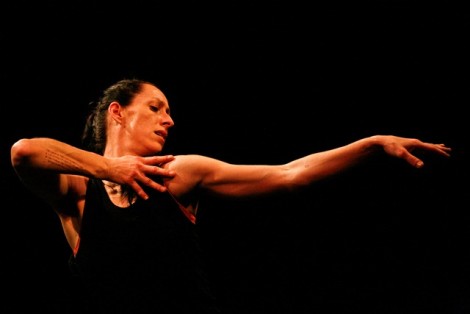
Tammi Gissell in rehearsal for Seeking Biloela, 2012. Photo: © Lorna Sim

‘Biloela’ is an aboriginal word (exact language not specified) for black cockatoo and Lea’s work at the moment is truly a ‘seeking’ for the way her work will ultimately develop. Will it focus on ecological issues (some sub-species of the black cockatoo are endangered); indigenous stories (the bird is believed in some areas to be a harbinger of rain); white colonial activities (the nineteenth-century name for Cockatoo Island in Sydney Harbour was Biloela); the bird’s qualities as expressed in poetry about it; or something else?

Gissell, a descendant of the Muruwari nation of north-western New South Wales, is an exceptional dancer. Every part of her beautifully-honed body is expressive and she is extraordinarily flexible in moving between vocabularies. She was equally at home demonstrating and discussing indigenous movement language as she was using Lea’s particular brand of contemporary Western choreography with its occasional allusions to Indian dance. Gissell also provided some insights into the transmission of indigenous knowledge as she discussed stories about the black cockatoo as told to her by her grandmother.

Tammi Gissell in rehearsal for Seeking Biloela, 2012. Photo: © Lorna Sim

At CSIRO Lea is working with former CSIRO chief research scientist Dr Denis Saunders and researchers from CSIRO’s Sustainable Ecosystems area. Her residency with CSIRO came about as a result of a children’s show she created in 2011 about the science of flight, which was shown at Questacon, the National Science and Technology Centre in Canberra, during National Science Week.

Michelle Potter, 13 August 2012

Featured image: Tammi Gissell in rehearsal for Seeking Biloela, 2012. Photo: © Lorna Sim

On stage alone. Claudia Gitelman and Barbara Palfy (eds)

I clearly remember the first live performance I saw when the concept of ‘solo dancer’ made a strong impact on me. In the 1980s some time Susanne Linke made a tour of Australia. I remember two works in particular: one, whose name I don’t recall, involved Linke moving slowly and agonisingly across the stage following a strip of bright, white light on the floor. The other was the well-known Im Bade wannen in which Linke danced with, in and around a bath tub. The show was a revelation.

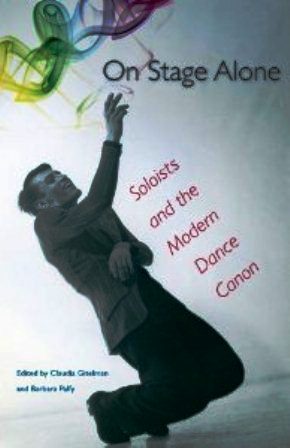
On stage alone, cover

A recent book, On stage alone: soloists and the modern dance canon, recalled my Linke experience and reminded me of the many other solo dancers whose work I have encountered since. After reading the book I was also reminded of the many solo performers whose work I haven’t yet encountered!On stage alone: soloists and the modern dance canon is a collection of essays in which the solo dancer, male and female, is considered for the role he or she may play in shaping culture. Even though there are many acclaimed solo performers who do not appear in the book, to its credit On stage alone is broad in its scope. As Claudia Gitelman notes in her introduction, the book ‘presents an international roster of male and female soloists who worked from the late nineteenth century into the twenty first, and who offer arguments about what it means to be modern’.

We encounter some of the better-known, older exponents of the form. Julie Malnig gives an account of Maud Allan’s exploits, for example, and concludes that ‘In an age of clashing, if not confused, visions of women, Allan’s solo performances marked her as an icon of a newly expressive mode of female sexuality’. And with his usual strong theoretical insight, Ramsay Burt expounds on Vaslav Nijinsky and Mary Wigman and considers the challenging and uncomfortable nature of solo performances given by these two dancers in 1919. ‘Their solos enacted a modernist critique of dominant ideologies of freedom and individuality and, by so doing, stressed a fracture in the symbolic order’, he writes.

But there are also a number of chapters on more recent dancers whose main form of expression is the solo: a chapter on Daniel Nagrin by Deborah Jowitt, for example. Jowitt’s writing has an immediacy that is missing from some of the other essays. She has such a practised eye when it comes to analysing performance and she enables the reader to visualise Nagrin’s dancerly qualities:  ‘…his lightest steps were precise in the way they struck the floor, brushed it, or skittered over it. He managed his strength like a tiger, able to move from stillness into an explosion of energy’. Jowitt also strategically places Nagrin within the wider context of modern dance in America, especially within the context of society’s attitudes to the male dancer.

I enjoyed Janice Ross’ essay on Ann Carlson, whose dances with animals I have never seen. Ross made me hanker to do so. Carlson’s performances with a cow or a kitten or a goldfish in a bowl, generate a range of gender and identity issues and contain a wealth of ‘hidden narratives’. Ross examines four works in detail and concludes that Carlson’s solos with animals ‘are tender but compelling reminders of how the act of performing fractures but also reunites us, affording the solitary dancer the possibility of never really dancing alone’.

Other solo performers whose work is highlighted in On stage alone include the Japanese-American Michio Ito, the Brazilian Eros Volúsia and a number of solo artists working in Central Europe in the early part of the twentieth century, including Mata Hari, Olga Desmond and Niddy Impekoven.

The authors address a range of theoretical issues, to which Gitelman alludes briefly in her introduction: gender identity, the notion of the modern body, national and racial differences and others and the book groups essays according to the overarching theoretical and research approach of each. But what I missed in the book was a chapter on the art of solo performance itself, if such an analysis is possible in one chapter. Gitelman’s introduction sums up the content of the book, but it is not an analysis of the form. Nevertheless, On stage alone is a welcome addition to dance literature and opens up the field for further investigation.

Michelle Potter, 3 August 2012

Claudia Gitelman and Barbara Palfy (eds), On stage alone: soloists and the modern dance canon (Gainseville, FL: University Press of Florida, 2012)
Hardback, 213 pp. ISBN 978-0-8130-4025-7

RRP: USD 39.95. Available through many online sites.

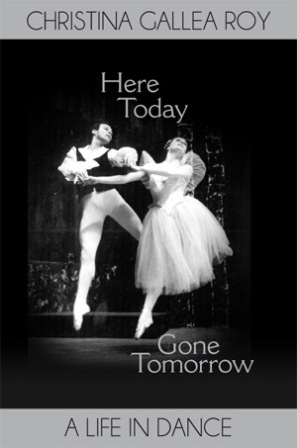
Here today, gone tomorrow. Christina Gallea Roy

My copy of Christina Gallea Roy’s book Here today, gone tomorrow has an inscription on the fly leaf that reads in part ‘Here is the rest of the story!’ I first had contact with Gallea when she donated to the National Library in Canberra a collection of material relating to her early career as a dancer with Walter Gore’s and Paul Hinton’s company, Australian Theatre Ballet. And there is indeed a whole lot more to the story.

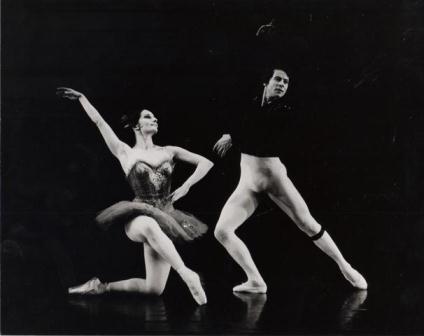
Christina Gallea and Alexander Roy came from very different dance backgrounds. She was Sydney girl and studied at the Frances Scully School of Dancing; her first professional engagement was as a dancer with the Gore/Hinton Australian Theatre Ballet in 1955. He came from Magdeburg and danced with the ballet company at the Komische Oper in East Berlin. They met as members of American Festival Ballet, with which they toured Europe, and married in the 1960s. Their dance training and early careers are discussed briefly in the opening sections of the book. These sections set the scene for an account of the more than thirty years they spent leading an independent ballet company, International Ballet Caravan,* later Alexander Roy London Ballet Theatre.

Christina Gallea and Alexander Roy in the grand pas de deux from Don Quixote. Photo: © Jenny Walton

Those early sections of the book provide glimpses of some of the teachers and choreographers with whom they worked. From an Australian perspective, Gallea’s ongoing friendship and working relationship with Gore and Hinton have resulted in some insightful comments on these two artists. In addition to their work in 1955 with Australian Theatre Ballet, Gore and Hinton were in Australia with Ballet Rambert in the 1940s. However, very little has been written about their contribution to Australian dance so Gallea’s comments are more than welcome. But from a wider perspective Gallea also brings to life many others in the dance world who were working in London and Paris in the 1960s including teachers Audrey De Vos and Nora Kiss (Madame Nora), choreographer Léonide Massine and dancer and teacher Rosella Hightower.

The bulk of the book though records their life on the road travelling up and down England, across Europe, in Asia and through the Americas. It is an astonishing and absorbing story and full of marvellous, often hilarious anecdotes. Their repertoire was broad and largely original. Much of it was choreographed by Roy. Towards the end of the book Gallea writes: ‘We had given ourselves an outlet for almost unhindered creation, sometimes experimentation, and in doing this formed our own very individual style’. Their determination and their dedication to working independently seemed to know no bounds.

But what I found so arresting about the book was Gallea’s strong visual sensibility and her capacity to translate that sensibility into words. There’s her description of Paris in the 1960s: the cafes, the metro, the pissoirs, the clochards, the smells of ‘garlic, red wine and body odour’, the apartments with their unusual bathroom facilities. And her writing about food, as in her description of a meal taken in the Auvergne region of France ‘…boeuf en daube, made with the rich dark meat of the Camargue cattle which had marinated for a day in the equally rich and dark wine of the Languedoc…’. There are some evocative accounts of outdoor performances around the world and descriptions of theatres in various locations—in Quito, Ecuador, for example, where the auditorium held 4,000 people and sat in Gallea’s eyes ‘somewhere between a baroque cathedral and a 1930s movie palace’. And of course there are many stories about difficulties with accommodation, venues, transport, lighting rigs, contracts, collecting payment and so on.

This is not an academic book. Its subtitle is ‘A life in dance’ and that’s exactly what the book is about—a life spent dancing with all its problems and pleasures. Gallea writes as a kind of summary, ‘It had been an extraordinary adventure, foolhardy, no doubt, and if the workload had often been unbearable, the rewards had been many.’ It is so easy to live that adventure vicariously through the pages of this book. I haven’t enjoyed a dance book so much for a long time.

Michelle Potter, 12 July 2012

Christina Gallea Roy, Here today, gone tomorrow: a life in dance  (Sussex: Book Guild Publishing, 2012)
Hardback, 338 pp. ISBN 978-1-84624-690-6

RRP £17.99. Available through many online sites.

*There is a kind of Australian bonus in the accounts of International Ballet Caravan. Graeme Murphy and Janet Vernon performed with the company briefly in the 1970s. Here today, gone tomorrow thus provides background for the early years of the Murphy/Vernon story.

Romeo and Juliet on screen

I finally managed to see the recording of Graeme Murphy’s Romeo and Juliet made by the SBS subscription channel Stvdio and recorded on 21 September 2011 at a live performance in Melbourne. Posts relating to this work continue to attract visitors to this site and it was interesting to notice that the number of visitors accessing the site from Adelaide rose dramatically when the work was shown there recently. Adelaide visits continue to remain high and the Romeo and Juliet posts continue to be the most accessed posts overall. Whatever opinions of the work might be out there, there is little doubt that it has inspired incredible interest amongst the dance community.

I was especially pleased to have the opportunity of watching the ballet close up through the Stvdio recording and also to have the opportunity to rewind certain sections that were especially powerful, or that attracted me for a particular reason.

It was rewarding, for example, to be able to watch several times Madeleine Eastoe’s stunning entrance into her bedroom early on in the work. There she is running on pointe so fast that her feet start to look blurred. And those lovely over-the-head claps as she jumps in the air, and those little piqué steps backwards, create such joyous, light as a feather dancing.

The recording made judicious use of a small number of close ups in this early section, which highlighted Elizabeth Hill’s beautiful portrayal of Juliet’s nurse. Hill watches her charge with such a caring look as Juliet tries her ball gown against her young and blossoming figure, and the rapport between them is clearly shown on their faces. Then eventually, off Juliet runs again, jumping onto a chair that happens to be in her way before she springs onto her bed. It’s wonderful choreography and wonderful acting and an absolute delight to watch again.

I also loved the serenity of the wedding scene and watching the Murphy touches unfold: the journey to the site of the wedding with Juliet walking across the shoulders of a group of black clad holy men; the duet with the monk that uses the feet as a point of contact between the two; and the playful role the train of Juliet’s wedding dress plays in her duet with Romeo during the ceremony. Murphy’s signature is there in full force!

In addition, I really took pleasure watching Adam Bull as Death and still think this role is one of the strong points of the production. Not only does the role act as a powerful through-line, it also acts as an element of dramatic irony. We know what is going to happen right from the beginning when Death picks up a bunch of lilies, a symbol of both purity and death and a recurring motif throughout the work, from the ground in the piazza as the piece opens.

But the scene I thought had the most dramatic power was Juliet’s visit the monk to seek a solution when it seemed that marriage to Paris was her ultimate fate. Murphy makes this a much more significant scene in the ballet than did Cranko in the version that we have been watching in Australia since the 1970s. In the Murphy production the story is told with choreographic and force and through powerful gestures, and we see Murphy using another of his signatures: Juliet is transported through to the country of the holy man held aloft by several black clad figures who carry her through the air in a display of expansive soaring movements.

The conclusion to this scene occurs when Death enters Juliet’s bedroom and stands behind her to slip on her nightdress, and also in the following, shuddering trio when Death places himself between Juliet and Romeo. Again we know there is no hope.

On a less positive note, the final desert scene is not my favourite part of the ballet and a close up look did nothing to make it look better. As one comment has indicated on the original post, Lady Capulet did look decidedly out of place in her high fashion gear, as beautiful as it was, stumbling around with high heels in hand.

In general, though, I thought this recording was beautifully and sensitively made. The more I look at this Romeo and Juliet the more interesting it becomes and the more I wonder about the difficulty we face with the ‘shock of the new’ when we watch a new dance production, in all its fleeting beauty, for the first time.

Michelle Potter, 24 June 2012

Here are links to the first post, and the second.

Let’s dance. Various Australian companies

16 June 2012, State Theatre, Victorian Arts Centre, Melbourne

Let’s dance is the program that the Australian Ballet commissioned to cover the time while the main company was busy ‘taking Manhattan’. It is, on the surface, a commendable venture giving subscription audiences the opportunity to see the array of dance styles being created and performed across Australia—there’s more to dance than the Australian Ballet. But as a program I am not sure that it worked as well as we might have hoped. It turned out to be a bit of a mish-mash and there was also some choreography that I found lamentable. Perhaps the program needed some overarching curatorial plan to give it at least some thread of cohesion?

What follows is not so much a review as a series of thoughts on various aspects of the show.

  • Choreography

I really liked Natalie Weir’s choreography for Don’t made on Expressions Dance Company. Weir’s particular strength, I think, lies in her skills in working on partnerships, whether for two people or more. For Weir a body held upside down has as much value as one held the right way up and what results has always taken the eye, slowly and calmly, in new directions. It’s a shame, I think, that the Australian Ballet has never restaged Weir’s Dark Lullaby, which is definitely worth another look. Too close to Ross Stretton perhaps?

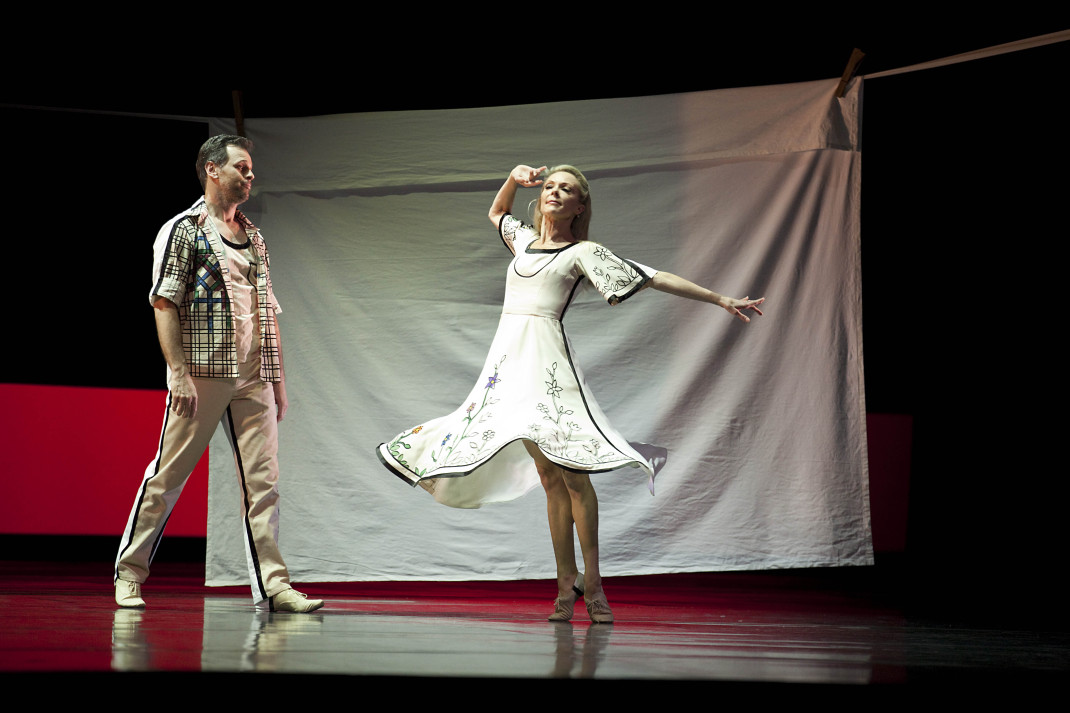
Tim Harbour’s choreography for Sweedeedee was another highlight, not because it was hugely innovative but because he found a way to make two older dancers (‘stars’ is a better word probably for Justine Summers and Steven Heathcote), and two emerging younger dancers (Mia Heathcote and Lennox Niven from the Australian Ballet School) appear together and look as though they all belonged in the work. It was simple, clear movement that told the homey, folksy story well.

Steven Heathcote and Justine Summers in Tim Harbour’s Sweedeedee, 2012. Photo: © Lynette Wills. Courtesy the Australian Ballet

I honestly could have done without Dance North’s Fugue, which was choreographed by Raewyn Hill and which I thought looked like nothing more than a clump of limping dancers engaged in the same moves over and over again. If you read the program notes there is a reason behind the choreography looking the way it did as the work reflects, apparently, a 16th century European ‘dancing plague’. But it was certainly not to my taste, neither aesthetically nor theatrically (despite the Sass & Bide costumes).

  • Dancers

I love watching Sydney Dance Company’s dancers, on this program dancing an excerpt from Rafael Bonachela’s recent work, 2 one another. His dancers have such clean lines in their movements. Nothing is murky or foggy, each tiny aspect of a movement is clear. Chen Wen particularly stood out for me in this program, although he often does. I love so many technical things about how he dances, especially the way his legs, so straight, stretch into infinity, and the way that, when he tilts the body forward, he maintains the strength of his back as he does so.

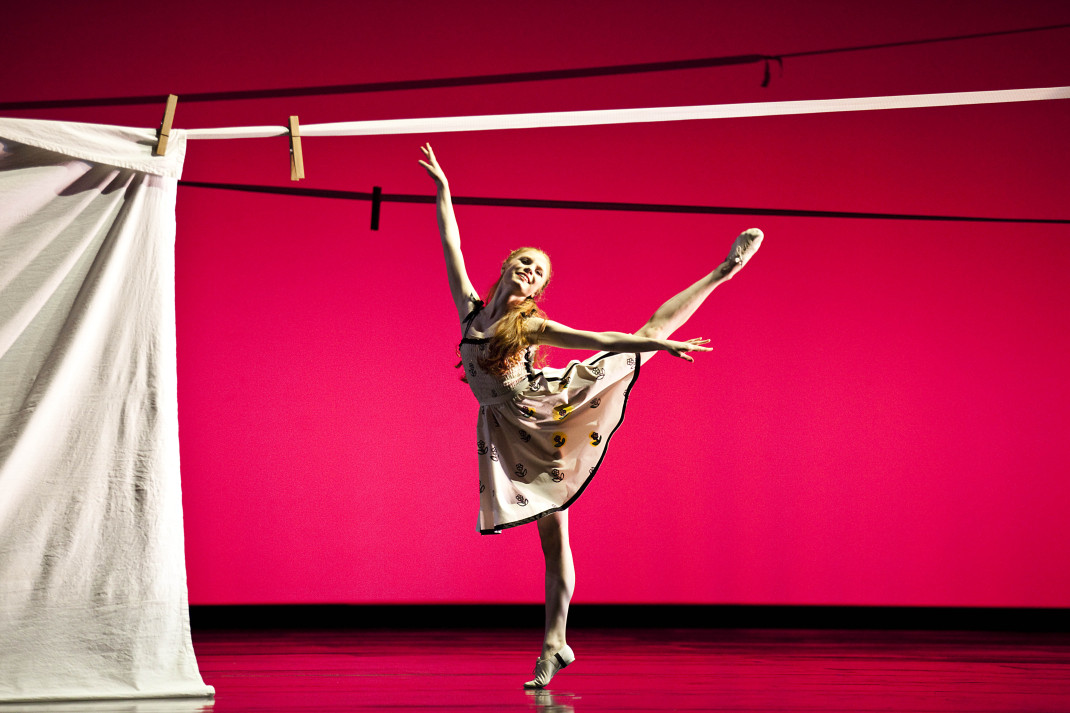
As for Mia Heathcote who played the Girl in Harbour’s Sweedeedee, if things go well for her as I hope they do, she has all the makings of a future star. It has been a long time since a dancer has given me goose bumps, but this member of the Heathcote family did before she had even danced a step. I look forward to following her career.

Mia Heathcote in Tim Harbour’s Sweedeedee, 2012. Photo: © Lynette Wills. Courtesy the Australian Ballet
  • Design

The designer whose work I most admired was Lexi George whose simple, white costumes, patterned with black designs, for Sweedeedee were so appropriate for the piece. Their simplicity belied their elegance. I also liked Bill Haycock’s black and white dresses for the women in Don’t with their variations in length, fitting and general style. Again Natalie Weir is moving in a well-considered direction with her ongoing commissioning of Haycock.

As for lighting I enjoyed Benjamin Cisterne’s designs for both 2 one another and Sweedeedee. Like much else that I liked about this show, his lighting designs were spare and clear. I especially admired the changing, neon-style, vertical columns of light that accompanied the Bonachela piece. Very smart and modernistic and in keeping with Bonachela’s choreography.

  • Appeal

Two works had appeal that invited little analysis: Ivan Cavallari’s Ombra leggera danced by two artists from West Australian Ballet, and Francois Klaus’ excerpt from Cloudland, danced by two artists from Queensland Ballet. Both were charming, if light pieces and were nicely executed.

  • What else?

Tasdance contributed a short film, Momentary, with choreography by Anna Smith, and Australian Dance Theatre was represented by an excerpt from Garry Stewart’s Be your self. Neither really fitted well into the program. Which goes back to my original comment: the program needed a curator. This is not to say that the works had no merit. Stewart, as ever, gave something that required intellectual as much as dancerly input and his dancers, like those of Sydney Dance Company, have extraordinary physical capacity. But Stewart, to his credit I have to say, is out on his own really and looks best by himself.

Michelle Potter, 17 June 2012

Duato Forsythe Goecke. Staatsballett Berlin

02 June 2012, Staatsoper im Schiller Theater, Berlin

This program, a triple bill by two choreographers with a strong body of work to their name, and one whose work I hadn’t previously seen, promised much but delivered little.

Dancers of the Staatsballett in ‘Arcangelo’. Photo Bettina Stöss

The evening opened with Nacho Duato’s Arcangelo, a meditation, the program told us, on heaven and hell. Made in 2000, Arcangelo is set to music by of the Baroque period by Arcangelo Corelli and Alessdandro Scarlatti. Choreographically and visually it had many of the touches that characterise others of Duato’s works—the turned up feet; the deep pliés in second position; the bird-like outstretched arms, often with palms facing down; the intricate partnering that produces unusual and striking shapes as bodies combine; and the mysterious appearance and disappearance of dancers through the black backcloth. And as with every Duato work, Arcangelo was beautifully and evocatively lit, this time by Brad Fields.

But for Duato’s works to fully achieve the sublime qualities that make them the admirable works of art that they are, they need to be performed differently from what I saw. To tell the truth I didn’t feel an intense emotional connection between the dancers as they contemplated their state of being. And I thoroughly disliked the way the exits through those back curtains were so obvious—the opening tended to be flung apart and as a result the exit was not the seamless one I have come to expect. I had never seen Arcangelo before and wanted to like it but in the end I just felt flat, even after the conclusion when two dancers ascend to heaven pulled up by a length of black cloth.

In the middle of this triple bill was William Forsythe’s Hermann Schmerman, first performed in 1992 and set to music by Thom Willems. Again all the choreographic hallmarks of a Forsythe work were there—the outrageously difficult moves and combinations as Forsythe explores what the body can do within the classical medium. But it never seemed that the dancers had a strong enough classical technique—especially the right amount of ‘turn-out’—to make the choreography look like an experiment with movement vocabulary. Looking at still images of the dancers this doesn’t seem as if it should be the case, but onstage, where it matters, the look was wrong in my opinion. Perhaps it was the dancers’ apparent concentration on showy effects? The one dancer whose work I really enjoyed was Federico Spallitta who danced the pas de deux with Nadja Saidakova. His solo variation was sinuous and liquid and a delight to watch.

The final work, entitled And the sky on that cloudy old day, was by Marco Goecke currently resident choreographer with Stuttgart Ballet. Goecke says his inspiration was the music that accompanied the work—John Adams’ Guide to strange places, itself inspired by a book invoking the landscape of Provence in southern France. But the relationship between these thoughts by Goecke and the choreography remained unclear throughout the work.

Choreographically And the sky… appeared to deny the body as a total means of expression with pretty much all the movement concentrated in the arms and hands. The dancers were extraordinarily skilful in executing these movements, some of which were very fast to the extent that the arms and hands often became blurred. There was very little partnering although there was a good deal of placing the nine dancers (four women and five men) in patterns and groups. They used some interesting props, including fans made from feathers, which they occasionally used to hide their faces. But the point of it all was lost on me I’m afraid.

Dancers of the Staatsballett Berlin in Marco Goecke’s And the sky on that cloudy old day. Photo Bettina Stöss. Courtesy Staatsballett media site

The director (intendant) of this company is Vladimir Malakhov, whose dancing I have previously admired. In fact what I had seen of him before partly inspired me to book a ticket to see the show. He danced in both Arcangelo and And the sky… I prefer to remember him, however, as the stunning classical dancer I saw some years ago in New York.

Michelle Potter, 3 June 2012

Roméo et Juliette. Paris Opera Ballet

20 May 2012, Opera Bastille, Paris

Sasha Waltz’s production of Roméo et Juliette, originally made for the Paris Opera Ballet in 2007, is about as far from other danced interpretations of those ‘star-cross’d lovers’ that I can imagine. In program notes for the 2012 staging Waltz herself said that the only production with which she was familiar was that of Maurice Béjart but that she never thinks about other productions when making a work. She simply draws on herself for inspiration. Whether this is possible or not is a matter of contention but, from the point of view of an audience member, it is close to impossible not to situate a work with the title Romeo and Juliet within the context of one’s previous experiences in the theatre.

In her production, Waltz reduced the named characters to three: Romeo, Juliet and Friar Laurence. She then focused on the links between love and death and the redemptive power of the death of Romeo and Juliet for their feuding families. She maintains that her work is not a narrative work but an emotional one. Yet the chorus sings a narrative. Not only that, it is more than tempting to interpret the roles taken by some of the dancers—those without specified roles—as other characters in the story (and the ballets) we all know. And there is very clearly a ballroom scene (more a party in this case) that is quite literal with dancers (women in tutus, men in shiny suits) miming eating, drinking and other party-going activities. So, for me, the question of is there or isn’t there a narrative was never really resolved.

That said, Waltz’s Roméo et Juliette was a breathtaking, highly theatrical production in many ways. Set to the Symphonie dramatique of Hector Berlioz, it employed three soloists and the chorus of the opera company―mezzo-soprano Stéphanie d’Oustrac was outstanding―as well as twenty-two dancers from the ballet company, including on the night I went two étoiles, Aurélie Dupont as Juliet and Hervé Moreau as Romeo. It was the Paris Opera machine at its best, utilising its stars from both the opera and ballet companies to produce a collaborative work of magnificent proportions.

The work was quite spare visually, and effectively so, with the set attributed to Pia Maier Schriever, Thomas Schenk and Sasha Waltz. It appeared to be two large white quadrilateral-shaped platforms, one placed on top of the other but with the top one overlapping the bottom one in some sections. But as the work progressed the top platform was pulled upwards and it was eventually apparent that the two platforms were hinged and they opened into a single, huge quadrilateral platform. The dance action largely took place on these platforms in their various stages of unfolding. Occasionally the singers appeared there too, but mostly they performed at the side of the set. Costumes, by Bernd Skodzig, for singers and dancers were for the most part black or white and emphasised Waltz’s focus on a duality between life and death.

But in many other ways the work was a huge disappointment. While there were some beautifully fluid groupings of dancers, and times when the wide sweep of the body through space was exciting to watch, I found Waltz’s choreography repetitive and often unbecoming with its frequent karate-style movements and its angularity. The pas de deux between Dupont and Moreau was perhaps a highlight. But to tell the truth, while it was flawlessly executed by two exceptional dancers, the choreography seemed cold to me and only rarely allowed Dupont and Moreau to show their humanity and their vulnerability.

Scenically and musically this Roméo et Juliette was spectacular. As ever the dancers of the Paris Opera Ballet were also a joy to watch. But so much of the way the show was conceived and choreographed did not support the exceptional qualities of the dancers and singers and production personnel. In the end it seemed like an evening of missed opportunities and mixed messages.

Michelle Potter, 22 May 2012

Onegin. The Australian Ballet

12 May 2012, Opera Theatre, Sydney Opera House

John Cranko, choreographer of Onegin, had the ability—a rare one—to distill a complex story so that it could be told in dance without losing its inherent dramatic logic. The current production by the Australian Ballet, a revival of a work that was first danced by the company in 1976, simply speeds along and it is all but impossible not to be caught up in the unfolding drama.

At the performance I saw, the stand-out dancers by a long way were Lana Jones as Olga, sister of Tatiana, and Ty King-Wall, friend of Onegin and fiancé of Olga. Apart from their ability to bring their characters to life, they danced so well together that it was possible to see really clearly why Cranko was such an outstanding choreographer. Every nuance of movement was defined—the sweep and curve of each lift through the air, for example, or the surprising and quite exquisite way in which Cranko occasionally sets a playful contrast of direction into a sequence that we expect will go another way. I found it quite thrilling to see classical choreography being so beautifully exposed for everything that makes ballet such a breathtaking art form.

In the leading roles of Tatiana and Onegin, Rachel Rawlins and Rudy Hawkes couldn’t quite match the strength and panache of Jones and King-Wall. Rawlins has all the technique and all the maturity to make the role of Tatiana her own, and to follow in the footsteps of some of the Australian Ballet’s stellar interpreters of this role (and there have been several over the years). But on this occasion she seemed not to make a strong enough contrast between the young Tatiana, scorned by Onegin for her naiveté, and the mature and elegant princess she has become as the ballet draws to a close. As a result Onegin’s feeling that he made a mistake in initially scorning her is not able to be fully explored and a good deal of the dramatic intent of their last meeting is lost.

The corps de ballet was a delight throughout, dancing with the grace and charm that befitted the roles they had guests at balls and parties. I wished however, that the older guests at Tatiana’s birthday celebration had not gone so over the top with being elderly. I have never been a fan of the pantomime-style of dancing that is so often given to characters that are supposed to be of a certain age. It never seems to serve a useful purpose, especially in a ballet like Onegin. It simply becomes an unnecessary parody of one class of people. It does, however, seem to be required in ballet, although I’m not sure why.

This revival of a twentieth-century classic, with its refurbished costumes and its sets borrowed from Sweden and Denmark (design by Jurgen Rose) is a welcome addition to the Australian Ballet’s 50th anniversary program.

Michelle Potter, 14 May 2012

Me right now. Quantum Leap

09 May 2012, Playhouse, Canberra Theatre Centre

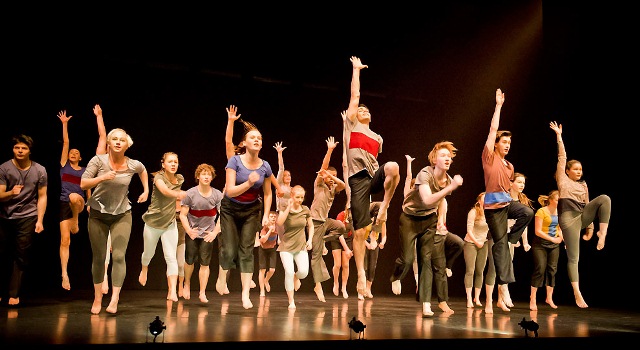
Often the beautifully choreographed ‘curtain calls’ (there is rarely a curtain) in Quantum Leap productions are the most revealing aspect of this youth company’s capabilities. It is then that the dancers relax somewhat and their joy in moving, and their intensity and commitment to the show, is wonderfully clear. Unfortunately with Me Right Now, which centred on ‘the state of being young’, I thought the curtain calls were the best part of the show.

There was a lot of spoken narrative in the first section, ‘You can’t perform a U-turn’, choreographed by Lina Limosani. Too much in my opinion. I’d rather see these young people expressing their ideas with a vocabulary of movement rather than words. And, while I understand the reason for the choreographic structure of the work being pretty much limited to having the dancers move across the stage in a straight line, Prompt to OP, it meant that overall the work lacked variety and subtlety. In fact, it became a little tiresome after a while.

Jade Dewi Tyas-Tungall’s ‘All to-get-her’ suffered a similar fate I think. Its title (remove the hyphens and run the words together) gives a clue to the reason for a choreographic structure that emphasised a certain kind of unity. But the constant crossing of the stage by lines of female dancers gave little visual variety and my interest flagged.

Matt Cornell’s ‘I do I will…’  showed what is a huge strength of the Quantum Leap endeavour—its ability to attract young boys to dance. I am also always impressed by the production values that Ruth Osborne and her team instill into every performance. And I always enjoy the way each section of the show blends seamlessly with the next. But for me Me Right Now lacked the kind of choreography that stops the mind wandering out of the theatre.

Michelle Potter. 13 May 2012

Featured image: Dancers of Quantum Leap in Me Right Now. Photo: © Chris Canham. Courtesy QL2 Dance