Glory Box. Finucane & Smith

This morning The Canberra Times published my review of Finucane & Smith’s burlesque extravaganza, Glory Box. As the review is not available online I am posting a slightly revised version here. I have to admit to being taken unawares at what the show had to offer. Some items were better than others; I found some superficial. But then on reflection that’s not surprising—much of what burlesque parodies is superficial or at least only titillating. As a whole, however, the show was a more than interesting night out.

28 November 2012, The Street Theatre, Canberra

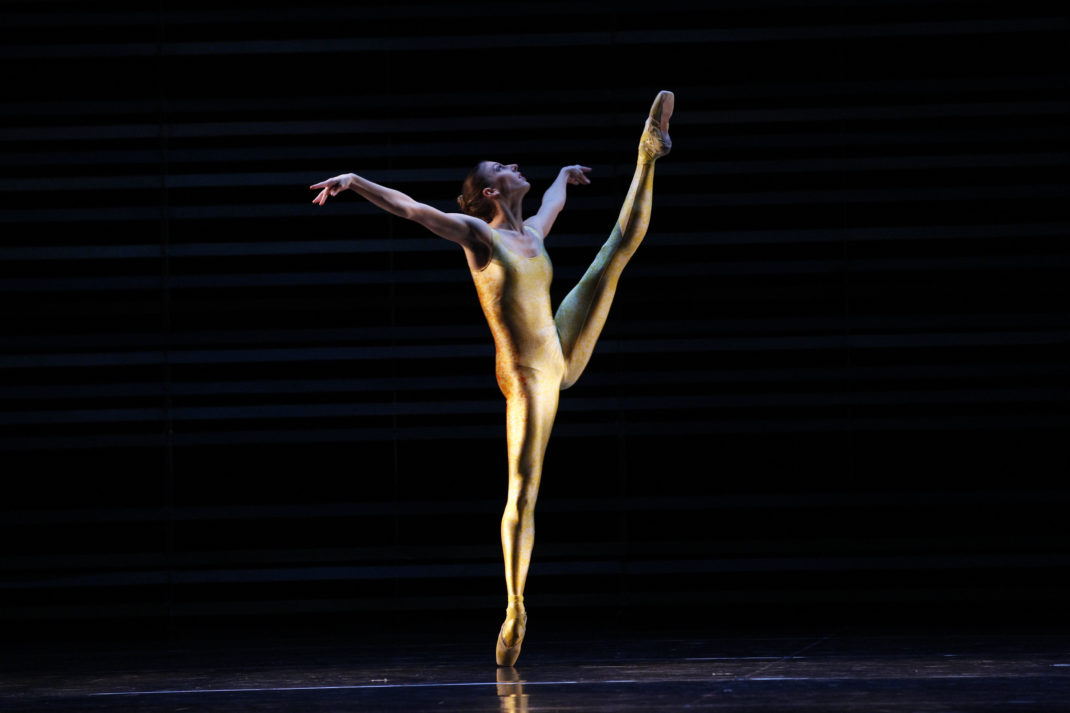
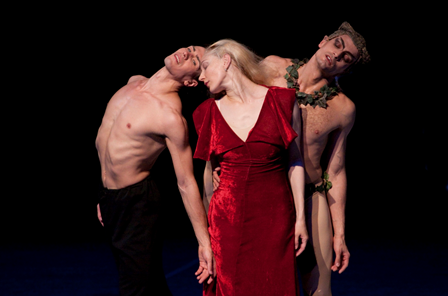
From Pina Bausch to the Rocky Horror Show, from Mardi Gras to Butoh, Bollywood to the Lido, Glory Box has it all. Erotic, brash, exhibitionist, scandalous perhaps and definitely loud (earplugs needed sometimes), it throws its subversive message out to the audience from a stage space decorated with a myriad of Chinese red paper lanterns and set up to resemble a nightclub.

The show opened with the most overtly and superficially sexual offerings, a ‘male strip’ called Romeo with a surprise ending, Strawberry with the performer offering selected members of the audience a mouth to mouth strawberry, which she first extracted from close to her bosom (and elsewhere), and Everyone wins a prize when Paul Cordeiro, the sole male member of the five person troupe, gyrated around the stage and threw stuffed animals, unpinned from his briefs, into the auditorium. But from there it picked up theatrically and became less sexually blatant but more powerful, without losing any of its confronting features.

I was impressed with Anna Lumb and her circus acts, especially her trapeze sequence, hard enough as it is without it being done in the highest of stiletto heels, and her hula-hoop act (how many did she have in the end); and with Maude Davey who gave a powerful performance in Glory wearing nothing but a headdress of antlers and a bleeding heart. I was fascinated by Holly Durant’s Salome, which began reminding me of experiments made at the Folies Bergere in the early years of the twentieth century with lighting and swathes of fabric—Loïe Fuller’s activities for example—but which ended as a reference to the famous/infamous ‘Dance of the Seven Veils’.

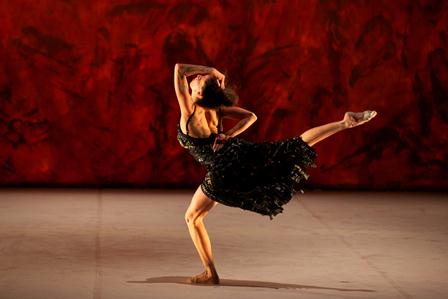
My personal favourite though was Miss Finucane’s Collaboration with the National Gallery of Victoria (Get Wet for Art) spoken, acted, danced, expressed by Moira Finucane to Prince’s Purple Rain. Eat your heart out followers and admirers of Pina Bausch. Here was German expressionist angst rendered sardonic. Finucane left the stage sodden, her flimsy, ankle-length dress clinging to her body. Unbelievably and irresistibly Bauschian. Finucane is a very strong performer who, once onstage, is impossible to ignore and her text about gallery visiting was entertainingly mocking while being delivered with the utmost seriousness.
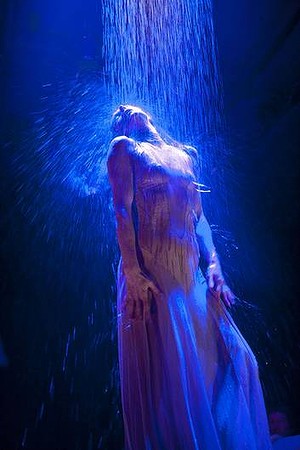
Moira Finucane in ‘Get wet for art’

A handful of people left during the first half and another handful did not return after interval. I’m not sure if they were affronted by the full frontal nudity, the full-on sound, or something else. But it was a shame really because the show is much more than the sum of its individual parts and the second half probably contained the strongest moments. Definitely not for the faint-hearted, but certainly an unexpectedly fulfilling evening that was ultimately surprising in its underlying powerful and emotive comment on sexuality, society and theatrical modes of expression. In any case it was worth everything to see the Street Theatre alive during the finale with a dancing ovation from the audience.

Michelle Potter, 30 November 2012
Icons. A second look

17 November 2012 (matinee), Joan Sutherland Theatre, Sydney Opera House

A second viewing of Icons, the Australian Ballet’s triple bill tribute to 50 years of choreographic exploration by the company, confirmed much of what I thought from my previous viewing.  In particular I think it was a mistake to revive The Display. Despite well danced performances by Rachel Rawlins as the Female, Brett Simon as the Leader and Ty King-Wall as the Outsider the work overall looks old-hat. The kind of behaviour on show in the ballet was perhaps an accurate view of male/female relations in Australia in 1964 but it doesn’t have the shock value it had 48 years ago—times change. And while Katharine Hepburn might have been turned on by lyrebirds, I’m not sure any of the Australian Ballet dancers are, or even pretended to be. What’s more much of Robert Helpmann’s choreography looks a little like that from a musical (and not such a good one at that), while Sidney Nolan’s set, so evocative in its day, lost much of its appeal on the tiny stage of the Joan Sutherland Theatre, especially from J row in the stalls. Memory is a funny thing of course but I also seem to remember the lighting and general visual ambience being softer, hazier and thus more affecting. But I may be living in my dreams! In any case the revival has been a huge disappointment.

Gemini on the other hand still looks fabulous and its choreography was given great treatment by Leanne Stojmenov, Juliet Burnett, Andrew Wright and Kevin Jackson. While I was attracted by the opening night cast in Melbourne by their cool, technical reading of the work, not to mention their spectacular energy, the cast I saw in Sydney brought a whole new element to it. Not to say that there was not also a strength of technique with this cast—there was—it was beautifully danced by all four. A duet between Stojmenov and Jackson (who seems to get better and better every time I see him) was remarkably powerful with its dramatic lines and enfolding of bodies one with the other; and Burnett has an unusual mixture of fragility and strength that brought a new quality to the work. But there was a hint of the sinister, or at least something disquieting or provocative, and more than a hint of emotion in the performance from this cast. For me this Gemini had a feeling of humanity about it, as well as being a ballet about contemporary technique.

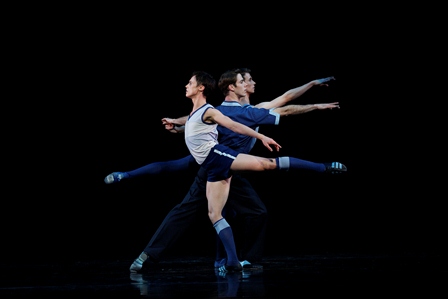
As for Beyond Twelve, well my companion said as we stood up to leave: ‘Graeme Murphy makes ballet for adults!’ With all its slapstick humour, its phallic references, its comments on youthful immaturity, and its poking fun at Australian society it is still an immensely moving ballet. And the trio between the Beyond Twelve, Beyond Eighteen and Beyond Thirty remains one of Murphy’s most heart-warming choreographic accomplishments, as does the beautifully staged ending full of resignation, or is it wistfulness, or is it just time to move forward?

Jack Hersee, Rudy Hawkes and Calvin Hannaford in Beyond Twelve. The Australian Ballet.  Photo: © Jeff Busby

Michelle Potter, 20 November 2012

Here is the link to my earlier post.

Lana Jones and Kevin Jackson dance Balanchine

George Balanchine’s Tschaikovsky pas de deux was the absolute highlight of the Australian Ballet’s 50th anniversary gala, at least as far as I saw on the televised version of the event. Tschaikovsky pas de deux, made in 1960 for Violette Verdy and Conrad Ludlow, has all the nuances of movement of which Balanchine was capable in his choreography and requires considerable technical expertise. Lana Jones and Kevin Jackson made it their own. Jackson is to be congratulated too for stepping into a role that was to be danced by one of the best male dancers around today, David Hallberg, who for some reason that I haven’t yet learnt did not appear.

In terms of the partnership, I loved the way Jones and Jackson interacted. Their initial meeting was gracious and they seemed to linger over each movement so as to enjoy the full pleasure of being in each other’s company. They developed the engagement with each other often in quite subtle ways—a gentle lean, a thrust of the hips or a bend from the waist, for example, or a hand held out to the other, and eye contact all along the way. Jones had such fluidity in the upper body and both were in such command of their movements that they often seemed to be dancing in slow motion. In the early part of the pas de deux Jones’ double swing of the leg going through a fifth position between swings was just gorgeous. Their musical phrasing was breathtaking.  And what a beautiful ending to the pas de deux—that slow, sustained unfolding from arabesque to fish dive. And how they shone in the coda when picking up that fish dive again but beginning it not from arabesque but with Jones flinging herself through the air into Jackson’s arms. Delicious.

Both executed their variations with great attack. Jones stepped into everything as if she had all the space in the world. Turns, beaten steps, that little gargouillade from Jones, Jackson’s grands pirouettes, they all were so pleasurable to watch. Jones often reminded me of that great Balanchine ballerina Merrill Ashley. While Ballo della regina is perhaps not Balanchine’s most thought provoking ballet, it was made on Ashley and Jones could look just as brilliant in it as Ashley did. Perhaps at another gala?

Jones and Jackson were rehearsed in this pas de deux by Eve Lawson. Lawson is now a ballet mistress and repetiteur with the Australian Ballet but comes from a strong Balanchine background. Amongst other things, she worked with Edward Villella at Miami City Ballet (a company with a strong Balanchine repertoire, thanks to Villella) and has worked as a repetiteur for the George Balanchine Trust. While she had great material to coach in Jones and Jackson she appears to have brought out the very best in these two dancers and given them a real understanding of how to dance Balanchine. I can’t help wondering too whether her influence isn’t apparent elsewhere in the company? Unfortunately I didn’t see the gala onstage but the television screening gave me the impression that the Australian Ballet, especially the corps de ballet, is looking better than it has for years. Anyway it augurs well for next year’s Four Temperaments.

Bouquets all round!

Michelle Potter, 16 November 2012

Images? Unfortunately the Balanchine Trust did not give the Australian Ballet permission to photograph this part of the gala so I cannot include any images. Such a shame and incredibly annoying too.

Swan Lake. The Royal Ballet

17 October 2012, Royal Opera House, Covent Garden

The Royal Ballet’s current production of Swan Lake is that of Anthony Dowell. It first went on show in 1987 after Dowell had engaged in a period of extensive research into the Petipa/Ivanov version of 1895. Australian audiences saw it in 2002 when the Royal Ballet, then under the direction of Ross Stretton, toured to various Australian cities. I admired it then. I thought it was danced beautifully (Darcey Bussell and Jonathan Cope were in the lead), and I loved the way the characters had been developed so each had a real presence in the production. Now I’m not so sure. Two Australian productions since then, one by Graeme Murphy and the most recent by Stephen Baynes, have had an effect.

This Royal Ballet production is set in fin-de-siècle Russia and so much about the production now seems overwrought, from the gilded excesses of Yolanda Sonnabend’s sets to the drunken excesses of Siegfried’s entourage. Act I seems to go on and on with much merrymaking and ‘let’s dance’ gestures.  Act II begins with more drunken activities before the swans appear and this act is also distinguished by the addition of several young student dancers from the Royal Ballet School, who are part of Odette’s entourage. This addition apparently harks back to the 1895 version, although I don’t remember that they made it to Australia in 2002! Anyway, they looked beautifully schooled and did their job more than nicely but I’m not sure they added anything of significance to the ballet. Act III has that lovely Tarantella choreographed by Frederick Ashton—certainly an interpolation to the 1895 version (as was David Bintley’s Act I Waltz). Von Rothbart’s two attendant dwarfs also made their presence felt in Act III.

Apart from the mime in which Odette dramatically tells Siegfried that she is about to die because he has betrayed her, Act IV was comfortingly familiar—if slightly kitsch—as Odette and then Siegfried threw themselves into the lake and reappeared sailing heavenwards in a ‘swan vehicle’. But despite what Dowell may have discovered about the 1895 choreography for Act IV, to me those arrangements of swans standing more like wilis or sylphs around Odette and Siegfried, and the emphasis on storytelling through mime, made me long for our own Australian versions where in Act IV the literal storyline gives way to a more abstracted and choreographically-inspired scene.

The big attraction for me, however, was the prospect of seeing Steven McRae dance the role of Siegfried. Technically he could scarcely be faulted. His tours en l’air for example began and finished in a beautifully tight fifth and a lovely deep demi-plié—such soft and pliant landings. His bearing from his first entrance onwards was regal and set him apart from the rest of the characters. His reading of the role was intelligent. At pretty much every point in his dealings with Odette, the Princess (his mother), his friends, von Rothbart and so on his approach was clearly expressed. Nothing was indistinct. Yet I wished that he had been a little more adventurous, and had thrown himself into the steps with greater gusto even if it meant his execution was a little less perfect. It was all too careful.

McRae partnered Roberta Marquez as Odette/Odile. I’m not sure that Marquez is well suited to the role of Odette as her dancing in Acts II and  IV had very little of the softness of arms and body that I associate with those acts. Odile suited her better although she struggled somewhat with some of the technical demands. Oh how I’d love to see someone handle with brilliance those double attitude turns at the beginning of Odile’s variation. Marquez simply went for a single.

I was impressed with the performance of Genesia Rosato as the Princess, Siegfried’s mother. She was a strong lady and demanding of her son. Her presence on stage was indeed commanding, even as she collapsed in a faint at the end of Act III. She had to make us look at her (and I did) and not the billowing red and white smoke that filled the stage as Odile and company departed in triumph. Others whose dancing stood out for me were Tara Bhavnani and Nathalie Harrison as the two leading swans. Both are tall, statuesque women with fluid backs and arms, which they used to the fullest advantage.

This production was not my ideal Swan Lake.  It is always interesting to speculate on what the ‘real’ Swan Lake was like but quite honestly I don’t think anyone will ever know and dance is an art form that is constantly being reinvented. The performance made me look forward more than ever to another look at the Baynes/Colman Swan Lake.

Michelle Potter, 20 October 2012

FAR. Random Dance

11 October 2012, Northern Stage, Newcastle-upon-Tyne

Wayne McGregor’s works are always accompanied by intellectually demanding notes and explanations. FAR is no exception. Made originally in 2010, it is according to McGregor inspired by a study of the Enlightenment by English academic Roy Porter entitled Flesh in the Age of Reason (from which comes, as an acronym, the name of McGregor’s work).

However, I am a fan of the now probably outmoded concept of ‘intentional fallacy’ whereby the artist’s intention is not a standard for judging the success or failure of a work. While it is always interesting to read what the artist believes is the intention of, or forms the inspiration for a work, the work has to stand on its own and must be open to the necessarily varied interpretations of the audience.

FAR begins with a duet, which can only be described as a passionate, if somewhat acrobatic, exploration of the boundaries of what the body can do in dance. The couple, a man and a woman, are attended by four black-clad figures holding flaming torches. These figures vanish quietly and almost imperceptibly one by one throughout the duet. The dancers perform to an 18th century aria, Sposa son disprezzata (‘I am wife and I am scorned’) by Gemininao Giacomelli and sung by Cecilia Bartoli, and the whole is extraordinarily emotional.

But this lush opening gives way to the hard edge of the 21st century as a growling electronic score by Ben Frost takes over and the flicker of torches is replaced by LED lighting (design by Lucy Carter) in the form of five rows of tiny tubes projecting from a rectangular, white board, which occupies much of the back section of the stage. The choreography too seems to lose its fluidity and becomes more angular, and full of flicking hands and very busy bodies.

Occasionally one might read a narrative line into some sections. There are moments when the dancers seem to engage in an argument for example as they push each other around. Occasionally too the ensemble of ten dancers moves as one and this comes as something of a shock to the eye after the seemingly random structuring of bodies on stage. A duet for two men is a highlight, as is a brief moment when two dancers crouch low together on the stage holding a difficult pose on half pointe.

The work closes with another strong duet for a man and a woman in which the woman’s body in particular is often stretched taut, as if to balance the rippling bodies that we have seen in abundance throughout the work. In the final moments the man lowers the woman to the floor, leaves her lying there and walks off.

Some may have seen in this work a connection between body and soul, which was at the heart of Porter’s investigations into the 18th century mode of thinking and behaving. I didn’t think about it as I watched the show. More than anything, seeing McGregor’s tangled yet clearly articulated choreographic moves is a treat, especially when performed by the athletic dancers who make up Random Dance. It was a pleasure to see Anthony Whitely again too, now dancing with Random Dance after his stint with Sydney Dance Company.

The closing duet from FAR

Michelle Potter, 14 October 2012

Run for it, Workwithinwork, 5 tangos. Scottish Ballet

05 October 2012, Theatre Royal, Glasgow

Scottish Ballet’s triple bill of works by Martin Lawrance, William Forsythe and Hans van Manen was designed, according to artistic director Christopher Hampson, to show choreography across three generations. To my mind, however, the evening showed more that choreography sometimes looks dated and that for it to have a powerful effect it needs something more than extreme physicality.

The evening opened with Lawrance’s Run for it, performed to John Adams’ Son of Chamber Symphony. It was made originally for Dance GB, a program associated with the London Olympics, although I’m not sure whether Olympic references in Run for it were specific or merely general (as a result of the athletic performances by the dancers). This was my first encounter with the choreography of Lawrance and, while his ability to create energetic, highly physical movement was absolutely evident, I’m not sure he has yet established an individual choreographic voice that makes his brand of movement vocabulary distinctive. To me it seemed like a series of random movements lacking focus.

In many respects the Olympic references came through more clearly in the design. The set by recent Turner Prize winner Martin Boyce recalled ancient Greece, home of the Olympics. A Grecian-style, fluted column set slightly off centre-stage was topped by a conglomeration of geometric shapes spreading across the upper space a little like a cloud. Yumiko Takeshima’s close fitting costumes, looking like an outfit one might wear to the gym, emphasised the sleek and athletic bodies of the dancers.

Eve Mutso, Owen Thorpe and dancers in Martin Lawrance’s Run for it. Scottish Ballet, 2012. Photo: ©Andrew Ross

Closing the program was Hans van Manen’s 1970s piece 5 tangos to music by Astor Piazzolla. This mixture of ballet and tango moves was well performed by the dancers of Scottish Ballet, who wore their red and black costumes with panache. The men in particular moved as an ensemble with admirable ease. Sadly, I don’t think the choreography gave the dancers the opportunity to move with the passion I associate with the tango, although they made the best of what they were given to dance. For me the piece showed how choreography has changed over the past 30 or so years. The carefully arranged moves and patterns of 5 tangos seemed overly structured and, with an emphasis on canon forms, repeats and so forth, the whole seemed too obvious and almost predictable.

The pièce de résistance was the middle work on the program, William Forsythe’s Workwithinwork set to Luciano Berio’s Duetti per due violini. While the off-kilter moves, extended limbs thrashing through the air, and the highly physical partnering we associate with Forsythe were all there, this work began with the dancers looking as though they were in comic mode. Repeatedly they looked almost as if they were poking fun at classical poses and in general fooling around. But by the close of the work, largely a series of duets and trios, all seemed to come together in a cohesive whole and, as the curtain came down, we were left with wisps of movement being traced in the air by the dancers to remind us of what had gone before. It was a mesmerising work with many levels of meaning. One viewing simply made me long to see it again.

Daniel Davidson and Luciana Ravizzi in William Forsythe’s Workwithinwork. Scottish Ballet, 2012. Photo: Andrew Ross

This program was my first encounter with the work of Glasgow-based Scottish Ballet. Not knowing any of the dancers, I am sorry not to be able to comment on individual performances. Christopher Hampson has been artistic director of Scottish Ballet for a very short time, since August 2012. His personable nature was evident in his onstage introduction to this program, which must have been that of previous director, Ashley Page.  It will be interesting to see how Scottish Ballet develops under Hampson’s leadership. He has some excellent dancers to work with.

Michelle Potter, 9 October 2012

Swan Lake. The Australian Ballet (2012)

18 September 2012, State Theatre, Victorian Arts Centre, Melbourne

Stephen Baynes wanted his new Swan Lake for the Australian Ballet to reflect, as he put it in his notes, the ‘deeply Romantic aesthetic’ of Tchaikovsky’s score. A singularly musical choreographer, Baynes has succeeded in creating some absorbing, and often romantic in the wider sense of that word, choreographic moments. They come in particular in Act I with Baynes’ overall treatment of this act; in his newly conceived opening section of Act II when Siegfried first encounters Odette; and in an inserted pas de deux for Odette and Siegfried in Act IV.

In Act I Baynes’ choreography is beautifully paced. It fills out every note of the music, brings a real freshness to the dances and makes this opening act full of human interest. Ty King-Wall, Lana Jones and Dana Stephensen as Benno, the Countess and the Duchess respectively danced a thrilling pas de trois (or was it a pas de cinq since two other men joined King-Wall at one stage?). The meeting between Siegfried and Odette was a meeting between two human beings rather than a prince and a frightened swan protecting her brood and the choreography sank and rose in sighing movements. The inserted pas de deux too was Baynes at his best and is just what the last act needs, a final intimate encounter between Odette and Siegfried.

There was a new energy in the corps de ballet too. Perhaps it is a new production that has generated a precision in the work of the corps that I haven’t seen recently? Perhaps it is that the company has a new ballet mistress and repetiteur in Eve Lawson? Whatever the reason, it is a treat to see the dancers moving together so well.

(l–r) Reiko Hombo, Jessica Fyfe, Eloise Fryer and Jade Wood in Stephen Baynes’ Swan Lake. The Australian Ballet, 2012. Photo: © Jeff Busby

Most of Act II, however, is classical (in the Ivanov manner) as Baynes has kept a lot of the choreography from older productions so as to keep this famous white act recognisably traditional. Amber Scott as Odette seems on the surface to be perfectly suited to the role. Her body is proportioned in true classical ballerina style and her technique is clean and centred. But Act II seemed to me to exude a particular coldness. I’m not sure whether the lack of passion was a result of Baynes and Ivanov (or ‘after’ Ivanov) being mixed together, or whether Scott and her Siegfried, Adam Bull, just weren’t reacting to each other in an emotional sense. There was just one moment in the pas de deux when Scott moved from supported arabesque to attitude and her foot seemed to caress Bull’s back as the leg bent into attitude and wrapped around Bull. But it was gone in a flash and it was the only time I thought there was an emotional connection between them. There were, however, lovely performances from the four little swans and from the leading swans, danced by Juliet Burnett and Amy Harris.

Act III had a little more emotional power and Bull finally seemed to overcome his depression, which admittedly was what we were intended to see as his mood, as he declared his love for Odile. Rothbart, played by Brett Simon sporting carrot-coloured hair, was a surprise arriving as he did with a retinue of Spanish dancers, and a Russian dancer and four Cossacks. His personality was further established as he sat on the throne next to the Queen (Lisa Bolte), engaging her in conversation. But again the recognisable pas de deux and variations from what we know as the traditional version seemed to me to intrude.

There is much else to say about this new production—the development of the role of Benno and others in Act I; the importance of Siegfried; the designs; the projections of a swan/menacing figure (Rothbart?); the funeral with which the work begins and much more, which I hope to consider in future posts. I wondered whether the work would have benefitted from having a dramaturge work with Baynes and designer Hugh Colman as there were times when I wondered who was who and what was happening—Rothbart’s lifting of a limp Siegfried from the lake as, in the final moments, Rothbart sailed by standing resplendent in a mechanical swan was a surprise as there was no previous indication that I saw that Siegfried had thrown himself in the lake. But it needs more than one viewing to be able to give an informed account and in depth critical analysis. At the moment I feel that leaving some traditional choreography was a mistake and that this Swan Lake would have worked better for me had it all been Baynes.

Michelle Potter, 20 September 2012

UPDATE: Swan Lake: a second look is at this link.

Tara Gower in 'Terrain'. Photo Greg Barrett

Terrain. Bangarra Dance Theatre

13 September 2012, Canberra Theatre

This is an expanded version of my review of Terrain published in The Canberra Times, 15 September 2012, under the title ‘Dancing into luscious terrain’.

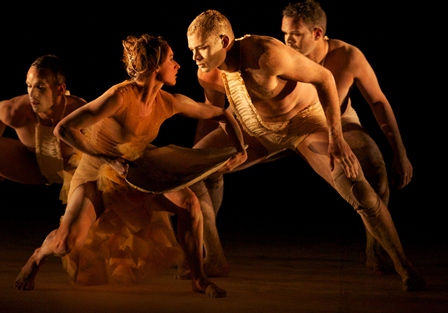
Bangarra Dance Theatre’s Terrain is a mesmerising work in nine short parts. Billed as a hymn to country, it evokes the changing landscape of Lake Eyre while at the same time reflecting on the relationship of indigenous Australians to their land. Its power emerges at every level—choreographically, visually and musically and through some exceptionally fine performances by the dancers as well.

Yolande Brown and Travis de Vries in Terrain, Bangarra Dance Theatre, 2012. Photo: © Greg Barrett

Terrain is the work of choreographer Frances Rings and her dance making has many touches that mark her choreography as unusual and distinctive. She groups people together tightly at times and then suddenly a single body is thrust upwards and extends out of the complexity of it all. She often works on bodies that are positioned upside down so the legs and feet are the main focus. Sometimes the choreography jerks and bobs as in the section called ‘Spinifex’; at other times it flows smoothly and this is the quality we see in the final section ‘Deluge’. Occasionally a political stance draws out movement of a more forceful kind as in ‘Shields’ in which issues of land rights and recognition of indigenous people determine the choreographic style. The work has the stamp of Bangarra in the grounded quality of its movement: bodies rarely attempt to defy gravity. But it has the stamp of Rings in its delicacy and intricacy of movement.

The standout section for me was ‘Reflect’ in which Rings brought to life the meeting of earth and sky at the horizon. With its muted colour scheme of earthy green and brown, and consisting simply of a solo for Deborah Brown followed by a duet between Brown and Leonard Mickelo, it had a simplicity and purity to it. It called up a mysterious place where two worlds converge. ‘Spinifex’ was also bewitching as an ensemble of female dancers pranced and twisted across the stage in choreography that was inspired by the trees around Lake Eyre. My eye was also often drawn to Waangenga Blanco in several sections. He dances with such a fluid upper body and his movement streams out to his fingertips. His dancing was especially strong in the finale, ‘Deluge’, when water and hence life began to flow into Lake Eyre.

The work of Bangarra has always been distinguished by a strong visual aesthetic. For Terrain set designer Jacob Nash began with a bright, white stage that was gradually filled with changing colours and light. His major contribution was a series of abstract back cloths and each was a distinctive work of art in its own right. They ranged from a strong red and black cloth with a central focus of a circular black and white motif for ‘Scar’, to the soft green and brown impressionistic cloth against which ‘Reflect’ was danced. All the cloths were enhanced by the lighting design of Karen Norris, and indeed her lighting was a major design element in the first three sections.

Jennifer Irwin’s costumes were quite stunning. Diverse in their cut and in their sculptural qualities, they were beautifully textured and designed so that light playing on them could change their appearance completely. The women’s skirts for ‘Spinifex’, for example, often looked like lace as bodies swirled into a patch of light. A feathered, tight fitting, short bolero style jacket was alluring in ‘Salt’ and the flowing, lightly patterned skirts for men and women in ‘Deluge’ captured beautifully the feel of water.

Terrain was danced to an original score by David Page. It was lush and romantic at times, sparse and even harsh at other times. It flowed along with the choreography and vice versa.

Terrain is a wonderfully integrated work in which people, politics and country are delicately balanced. The spirit of a constantly changing Lake Eyre courses through the entire piece and the work secures Bangarra’s position as a treasure on the Australian dance landscape.

Michelle Potter, 15 September 2012

Featured image: Tara Gower in ‘Scar’ from Terrain, Bangarra Dance Theatre, 2012. Photo: © Greg Barrett

Tara Gower in 'Terrain'. Photo Greg Barrett

Icons. The Australian Ballet

30 August 2012, State Theatre, Victorian Arts Centre, Melbourne

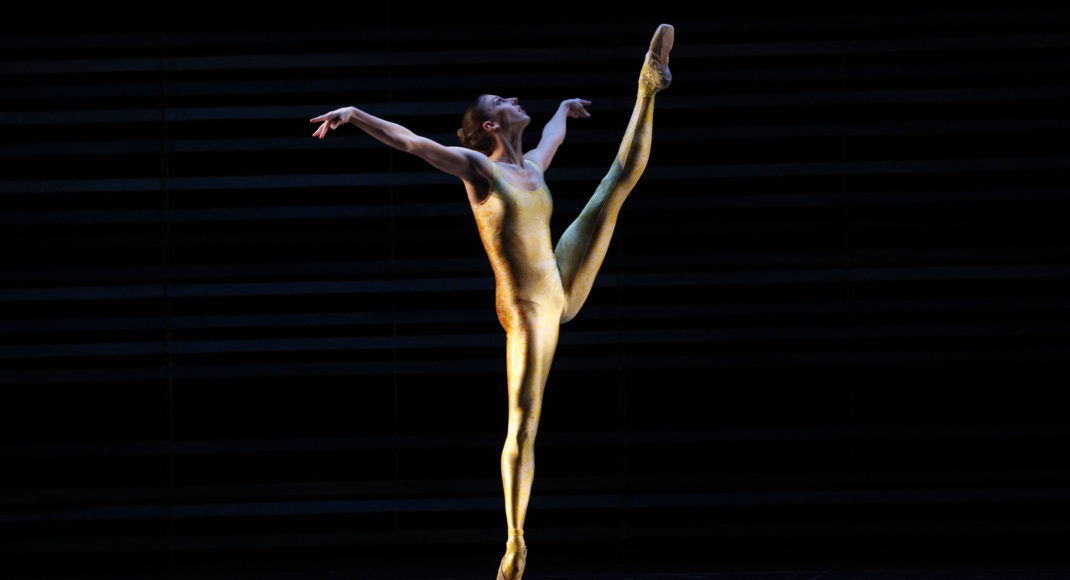
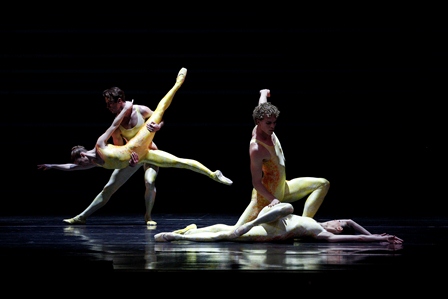
The Australian Ballet’s Icons program is a truly exciting triple bill. Every work has particular interest historically and, while one really doesn’t measure up, two of the three are thrilling to watch. The absolute standout in terms of dancing is the middle work on the program, Gemini, Glen Tetley’s work made on the Australian Ballet in 1973. It was danced on opening night by Lana Jones, Amber Scott, Adam Bull and Rudy Hawkes, with Jones in particular performing as if there were no tomorrow.

Lana Jones and Rudy Hawkes (rear) and Adam Bull and Amber Scott (foreground) in Gemini. The Australian Ballet, 2012. Photo: © Jeff Busby

Against a modernist set of coloured horizontal slats by Nadine Baylis, Gemini unfolds as a series duets and solos embodying powerful, dynamic movement. Of the women, Jones is cool but bold, assertive, a powerhouse of energy. Her manège of grands jetés with arms stretched heavenwards in an open fifth position (à la Isadora in La Marseillaise) was breathtaking. Scott is more elusive, sinuous and deliciously sensuous. Of the men, Bull had that little extra movement in the chest and pelvis—in the torso I guess—that drew the eye towards him whenever the men were onstage. Hawkes’ performance lacked the same zing but was nevertheless a pleasure to watch. When Tetley was in Australia in 2003 to stage Voluntaries he told me that creating Gemini had made him love the energy of Australian dancers. I think he would have been thrilled with the electrifying way in which Jones, Scott, Bull and Hawkes performed.

Closing the evening was Graeme Murphy’s evocative Beyond Twelve, a work first shown in 1980 and a real bottler of an Australian ballet showing all Murphy’s theatricality, humour and unique choreographic hand. Beyond Twelve tells the story of a boy’s transition from football-playing youth to adolescent dancer and finally on to mature artist facing the uncertainties of life beyond dance. Brett Chynoweth, Calvin Hannaford and Andrew Killian took the three main male roles of Beyond Twelve, Beyond Eighteen and Beyond Thirty and their trio in which we see their lives intertwining was a real highlight. Showing the passage of time in a choreographic sense is one of Murphy’s great strengths and this trio is no exception. Brooke Lockett, a coryphée with the company, danced the role of First Love and played it with just the right feeling of delight in the pleasures of youth.

Beyond Twelve is an immensely moving work (as well as being full of wit and humour) and nothing captures that feeling more than when, as the ballet closes, we see the mature dancer joined momentarily by his first love. And just as it looks like they will remain together, a figure in evening dress appears in the background and the girl moves away to join the other man, her Escort. Murphy’s sense of theatricality is brilliant here, partly in his placement of the three characters on the stage, but also in the instant realisation the moment generates that life is full of changes.

Despite its historical interest, the big disappointment of the evening was The Display, Robert Helpmann’s 1964 production based on his and Katharine Hepburn’s sighting of the mating dance of the lyrebird. The Display opened the program and perhaps it was inevitable that a work so entrenched in Australian culture of the 1960s would never translate well into the twenty-first century. But I didn’t think it would be quite so problematic. Nothing to me looked like an Australian picnic in the bush. The girls, so pretty with their Renoir hairstyles and pink dresses, could have been peasants in Giselle—and incidentally, Sidney Nolan, whose designs were ‘refurbished’ for the occasion, wanted the girls’ dresses to be the colour of ‘dog biscuits’, which certainly wasn’t the case with this production. In addition, the boys looked like princes as they pointed their feet, stretched their legs, and stayed so thoroughly within their classical ballet heritage. I’m not sure that, when playing footy, drinking beer and punching people up, men look like that.

Kevin Jackson as the Outsider missed the point, I think, that this character was meant to be so culturally different from the rest of the men. A red shirt and blue trousers aren’t enough to show that he was meant to be an Italian in Australia in the 1960s, a time of significant European migration. Australians had scarcely heard of coffee then let alone of European attitudes to women. The role needs a different physicality as well as costume to get the point across and Jackson didn’t seem to me to be much different from the rest of the men. But then perhaps that was a result of the other men behaving as if they were dancing a nineteenth-century ballet.

The saving grace was Madeleine Eastoe as the Female. She made Helpmann’s choreography look quite respectable despite a series of fouettés that Helpmann suddenly dropped into it all for no apparent reason. And she managed to get across the sense of sexual arousal that needs to be apparent as, at the conclusion of the ballet, the Outsider leaves her after his attempted rape and the Male (the lyrebird) comes forward to cover her with his tail feathers.

It was interesting to see Barry Kitcher, Bryan Lawrence and Garth Welch from the 1964 cast of Display come onstage to take a bow during the curtain calls. They were joined by Julie da Costa who danced the Female in a later 1980s production. There was no note in the program to say that they had been involved in coaching the dancers. The Display certainly needed some good coaching to make it work.

Musically the program was extraordinarily diverse. Malcolm Williamson’s score for The Display remains as beautiful as ever with its quivering, bush sounds, and was perhaps the highlight of that ballet on this occasion; Tetley’s choice of Hans Werne Henze’s Symphony No. 3 for Gemini was inspired with music and choreography so well attuned; and Maurice Ravel’s Piano Concerto in G major, whose movements had been reordered by Murphy to fit the storyline of Beyond Twelve, was played with customary elegance by Stuart Macklin.

Despite The Display having major problems, I thought this was a good triple bill. In my mind it sits within the spirit of the best of triple bills where there is a bit of everything, including the ‘serious’ work in the middle and the ‘feel good’ work to go home with.

Michelle Potter, 1 September 2012

Featured image: Lana Jones in Gemini. The Australian Ballet, 2012. Photo: © Jeff Busby

Postscript: Looking back at a review of Beyond Twelve that I wrote for Dance Australia way back in 1994 (with David McAllister, Steven Woodgate, Greg Horsman and Vicki Attard in the leading roles), I mentioned that Horsman danced the role of Beyond Twenty-Five, rather than calling it Beyond Thirty. I’m not sure when the name change happened, but it is interesting to speculate that times have changed in (almost) twenty years and perhaps thirty is now the new twenty-five? Unless I got it wrong in 1994?

Update: Here are my comments after another look at the program in Sydney.

Nijinsky. Hamburg Ballet

26 August 2012, Playhouse, Queensland Performing Arts Centre, Brisbane

John Neumeier’s Nijinsky is an unusual work and defies easy categorisation. It is neither an abstract nor a narrative work. It’s more like a series of pictures that unfold throughout the work, building to a huge climax in the second part. Those pictures represent random events in the life of Vaslav Nijinsky and are really a series of flashbacks presented to reflect his diagnosed schizophrenic condition. They begin as he prepares to give his final dance performance—a Red Cross benefit show at the Hotel Suvretta in Saint-Moritz, Switzerland.* Neumeier uses this flashback technique to explore many different facets of Nijinsky’s life. We encounter him as a brother and a son, a dancer, a lover, a choreographer, a husband, and we are given impressions of the emotional states that accompany those roles in his life. Not only are these flashbacks random pictures, they also push us headlong into a maelstrom as they combine together, out of historical and any logical sequence and in a surreal fashion. Neumeier calls it a ‘biography of the soul’.

Alexandre Riabko, Anna Polikarpova and Otto Bubenicek in Nijinsky, Hamburg Ballet. Photo: © Holger Badekow

There are some thrilling moments of dancing. The trio between Nijinsky’s wife, Romola (Anna Polikarpova), Nijinsky (Alexandre Riabko) and Nijinsky as the seductive Faun (Otto Bubenicek), in which Neumeier explores facets of love and desire and life and art, is one such moment. The trio between Diaghilev, Nijinsky and another young dancer, where we see the destructive power of Diaghilev, is another. But for me the most powerful moments come in the second part of the work, when Nijinsky feels attacked from all sides—his schizophrenia is a reality, the Great War begins, his brother Stanislaw dies, Massine takes his place in Diaghilev’s life and activities and Romola has a liaison with his doctor. The pressure is relentless and we can feel it in so many ways. We see it when Nijinsky stands on a chair shouting out counts, as history tells us he did when his dancers struggled with Stravinsky’s music for Rite of Spring. We see it in the figure of Petrouchka (Lloyd Riggins), pale, wan and squashed emotionally as the drama continues around him. There is a remarkable performance from Aleix Martinez as Stanislaw, the brother, who dies as figures in military dress throw themselves about the stage. And how horrifying are those raucous moments when the dancers, still dressed as figures at war, humiliate Nijinsky as he struggles to cope with his world.

I wonder, however, how easy it was for the audience to understand on occasions who was who and what was happening. It does make a difference to one’s perception of the overall work to know something of Nijinsky’s choreography, and that of his sister Bronislava. There were many times when poses (albeit very well-known poses), from Jeux and Les noces for example, set the work in a particular context. Similarly costumes and props often gave significant clues. Nijinsky is clearly one of those ‘giving’ works that means more each time one sees it; but then not everyone has those opportunities. Neumeier knows his subject well and in fact has a large personal collection of Nijinsky memorabilia and other documentation.** But does he expect the audience to have the same in depth knowledge? Does it matter that not everyone has the same understanding of Nijinsky’s world?

Nijinsky had the audience on its feet at the end of its first performance in Brisbane. It is rare, I believe, for an Australian audience to rise as one and give a standing ovation and I can remember only one other occasion in Australia when I have thought that I was witnessing, and was part of, a ‘real’ standing ovation rather than one that’s a bit like a reverse fall of dominoes—if you want to see the curtain calls you have to stand up because the person in front is blocking your view. Nijinsky is sometimes hard to follow. I was confused at times and it wasn’t my first viewing.*** But the quality of the production, especially its visual strength, some fine performances, and the absolutely compelling manner in which the work surges forward and then concludes by returning to its beginnings in the Hotel Suvretta, generates in the audience an equally compelling desire to stand up and cheer. I did.

Michelle Potter, 28 August 2012

NOTES

*Ramsay Burt has an interesting essay ‘Alone into the world: reflections on solos from 1919 by Vaslav Nijinsky and Mary Wigman’ in the recent publication On stage alone, which I reviewed earlier this month. Burt looks, amongst other things, at the Suvretta performance in the context of Nijinsky’s philosophical opposition to war.

**John Neumeier has an extended essay on his collection and his fascination with Nijinsky in the catalogue that accompanied the major exhibition Nijinsky (1889–1950) at the Musée d’Orsay in Paris in 2000–2001. The catalogue also contains images and information about many of the Nijinsky items owned by Neumeier. See Martine Kahane, Nijinsky 1889–1950 (Paris: Réunion des musées nationaux, 2000).

***Nijinsky had its premiere in Hamburg in 2000. I was  lucky enough to catch it in 2002 when Hamburg Ballet was guesting in Paris. Looking back at that 2002 program it was interesting to see that some roles were, in 2012, still being danced by those who performed them in 2002.