Scotch Symphony, Within the Golden Hour, From Foreign Lands. San Francisco Ballet

09 March 2013 (matinee), War Memorial Opera House, San Francisco

What a glorious program Helgi Tomasson put together as Program 3 in San Francisco Ballet’s current repertory season. With works by George Balanchine, Christopher Wheeldon and Alexei Ratmansky, to me it said the 20th century had a great choreographer in Balanchine but look where the 21st century is heading with Wheeldon and Ratmansky.

This triple bill program opened with Balanchine’s Scotch Symphony, a work dating back to 1952. It was more than ably led on this occasion by principals Yuan Yuan Tan and Davit Karapetyan, she in particular combining a crisp technique with an elusive element to her dancing and thus perfectly fitting the role. Scotch Symphony shows the delight Balanchine took in making references to other dance styles and techniques and blending them with the technical strengths of his classically trained dancers and with his own characteristic choreographic patterns. In this case the precise footwork of Highland dancing sat side by side with the floating, beyond-this-world feeling of the Romantic movement in ballet. But always obvious were those unexpected Balanchine groupings and his use of the shapes and spaces thus made to develop new groupings.

The corps de ballet shone throughout, especially the men and especially Diego Cruz and Lonnie Weeks in their leading roles in the corps. They gave their roles real personality and one of them knocked me for six with a fabulous saut de basque with arms in 5th in which the lift to 5th was at least as exciting as the saut de basque. The one jarring area to my mind was the backcloth, a dark grey shadow of a castle structure by Broadway designer Arnold Abramson. To me it captured little of an elusive and blended world that the ballet itself presents.

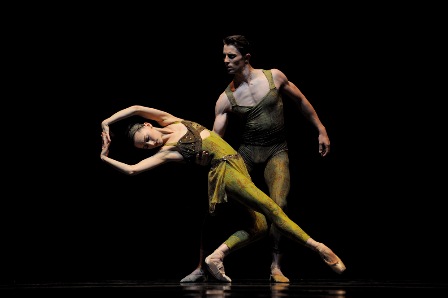
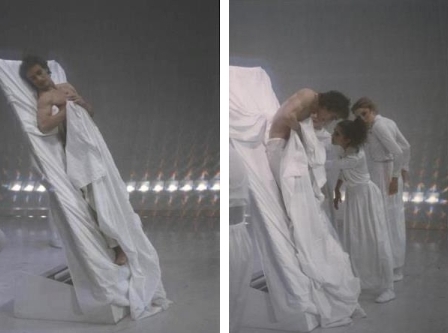
In the middle of the program was Christopher Wheeldon’s Within the Golden Hour, made for San Francisco Ballet in 2008. It is a series of interludes, seemingly unrelated, beginning and ending with sequences for the full cast. In between the beginning and the ending we see a quirky waltz for for a couple, which is picked up almost as it ends by several other couples; a fast and technically demanding duet for two men filled with turns and beats; a pas de deux that scarcely moves through space, a quartet of ladies performing at first as shadows; and a second pas deux that does move around the stage a little more.

Wheeldon’s choreography in Within the Golden Hour mixes ballet technique with all kinds of other styles from ballroom to his own take on contemporary dance. This work was by far the most popular with the audience, who gave it a standing ovation at the matinee I attended. I enjoyed its changing momentum and its quirkiness, but it isn’t a great work.

From Foreign Lands was specially commissioned by San Francisco Ballet from Alexei Ratmansky and had its world premiere on 1 March 2013. The performance I saw was just the ninth show and there were still a few moments when the dancers looked a little unsteady. But what a lovely work it is, exciting to watch, often surprising, often funny, and even redolent at times of those ubiquitous visits we used to have decades ago from groups performing ethnic dances from their homeland. Those tours showed us dancers happily competing with each other to jump higher, turn faster, execute the most difficult steps, and ultimately to win their lady-love.

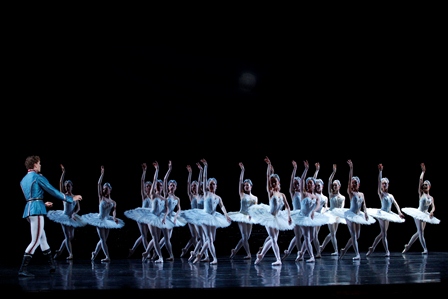
Made up of six parts, ‘Russian’, ‘Italian’, ‘German’, Spanish’, ‘Polish’ and ‘Hungarian’, From Foreign Lands is performed to an 1884 score by German composer and pianist Morris Moszkowski. The ballet, however, begins in silence with a brief introductory section for the full ensemble of twelve dancers. It suggests to us that dancing is to be the order if the day. But apart from that it is an opportunity to see the charming, tiered, older style tutus (finishing just above the knee) designed by Colleen Atwood. Then follow the six sections, which choreographically are largely quartets, or a variation on the quartet.
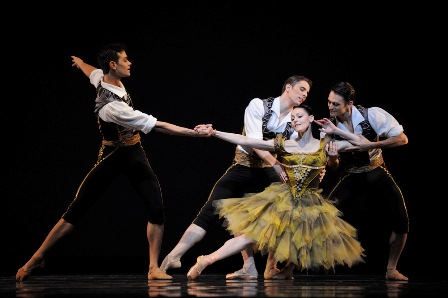
San Francisco Ballet in ‘German’  from Alexei Ratmansky’s From Foreign Lands. Photo: © Erik Tomasson, 2013. Courtesy San Francisco Ballet
Ratmansky’s choreography in this work contains some quite unexpected movement. He drops a supported cartwheel into ‘Spanish’, for example; elsewhere two men perform a simple jump on sequential beats so that they look like pistons going up and down; and occasionally the dancers face each other and dance mirror images. And all this alongside some glorious, ‘straightforward’ classical technique. I found ‘German’ one of the most interesting of the six sections, despite the fact that program notes suggest that it is ‘over-the-top romanticism’. As a quartet for three men and one woman it had a different feel from other combinations and I loved its lushness and the smooth and flowing dancing of Jennifer Stahl.

All in all a wonderfully uplifting program!

Michelle Potter, 10 March 2013

Featured image: San Francisco Ballet in ‘German’ from Alexei Ratmansky’s From Foreign Lands. Photo: © Erik Tomasson, 2013. Courtesy San Francisco Ballet
Within the Golden Hour

Morning Star. Mirramu Dance Company

1 March 2013, James O Fairfax Theatre, National Gallery of Australia, Canberra

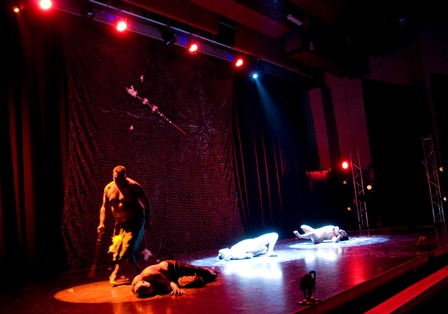
Morning Star is the result of two years of research and choreographic development between Elizabeth Dalman and her Mirramu Dance Company based in Bungendore, New South Wales, and communities in Arnhem Land. The work is based on a sacred songline of the Yolngu people that deals with birth, life, death and rebirth. The cast of Morning Star consisted of indigenous and non-indigenous artists and the production was assisted by several cultural consultants, including the custodian of the traditional Morning Star story, Banula Marika, and didgeridoo player, Nalkuma Burarrwanga.

What made the show especially memorable, and indeed to my mind quite remarkable, was the way in which dances associated with the traditional songline were juxtaposed with contemporary versions of the same aspect of the story. So we saw, amongst other similar components of the production, a traditional spirit dance celebrating the rising of the morning star followed immediately by a contemporary spirit dance enhanced by powerful Western-style theatrical lighting and choreographed using contemporary dance vocabulary.

A particular highlight for me was a contemporary brolga dance, which in the spirit of the show followed ‘Mulung, Mulung’, a traditional brolga dance. Performed by Jade Dewi Tyas Tunggal, a particularly powerful and captivating dancer, the undulating movement of the contemporary choreography expertly captured the notion of a dancing bird. The costume, designed and made by Peta Strachan, was exceptional: a long white, feathery gown with an extended ‘tail’, it was enhanced by a red flower placed on the breast area, which recalled the red plumage the brolga displays around its head.

But I also especially liked watching Albert David who danced strongly throughout and who had a duet with Miranda Wheen towards the end of the show that displayed both his and her technical strengths and strong stage presence. It was a delight too to see Janet and Djakapurra Munyarryun back onstage, in fact often commanding the stage.

I always feel slightly alarmed, however, at the prospect of non-indigenous dancers performing traditional indigenous movement and most of the traditionally-focused sections included non-indigenous dancers working alongside indigenous artists. But to their credit the non-indigenous dancers in Morning Star only occasionally looked out of place. I did find the section called ‘Kinship’ a little jarring though. In it each dancer came forward to explain his or her indigenous heritage or links, including those dancers without an indigenous background who had been adopted into a clan by an indigenous ‘brother’ or ‘mother’ and so on. I’m not sure it was necessary and program notes convey such matters much better I think. The commitment to the project shone through in movement and breaking that feeling with wordy explanations achieved little.

Morning Star was performed in the difficult space of the James O Fairfax Theatre. Its stage has little depth and little wing space and often requires dancers who perform there to radically transform their floor patterns to accommodate the space. But this show fitted beautifully and there were moments when the ambience, helped by a score from Airi Ingram that included the occasional crying child, transported the audience to an imaginary outdoor gathering place.

Morning Star is a beautifully honest show made with love and commitment.

Michelle Potter, 4 March 2013

Featured image: (l–r) Djakapurra Munyarryun, Albert David, Miranda Wheen and Jade Dewi Tyas Tunggal in ‘Contemporary Spirit Dance’ from Morning Star. Photo: © 2013 Barbie Robinson

Living Treasure. Graeme Murphy and Janet Vernon. John Ellison Davies

Living Treasure is a brief memoir: brief but appealing in its thoughtful discussion of the early directorial careers of Graeme Murphy and Janet Vernon. Author John Ellison Davies, former critic for the now defunct newspapers Nation Review and The National Times, focuses on the last years of the 1970s and remarks it was a time ‘when most of their adventure lay ahead of them’.

But prior to his discussion of the works of the late 1970s, Davies reproduces the press release issued in mid-2006 when Murphy and Vernon resigned from Sydney Dance Company. He comments: ‘It was a bombshell of pride, anger, and hope for the future’, and for us it is more than salutary to reread that press release almost seven years later. Especially striking is that Murphy and Vernon mention their ‘sadness’ as they watch dance entering what they call ‘a less dynamic phase’.

Davies goes on to give an abbreviated account of the careers of Murphy and Vernon immediately before they took up the reins of the Dance Company of N.S.W, which just a short time later became Sydney Dance Company. He concludes by publishing three of his reviews written between 1978 and 1979. One concerns Poppy, another Rumours and the third the 1979 Signature Season.

Graeme Murphy as Jean Cocteau in Poppy, 1980. Sydney Dance Company. Photos: Walter Stringer. Courtesy National Library of Australia

For those of us who were lucky enough (and are old enough) to have seen the earliest Murphy/Vernon productions it is a treat to read such graphic, analytically absorbing accounts of them from Davies’ pen. And the reviews are well chosen, not only because they refer to significant works by Murphy but because they show us Murphy’s ability to work with diverse subject matter—the themes of Poppy and Rumours, for example, are worlds apart. For those who didn’t see these early shows, Davies makes it easy to visualise what they were like.

Janet Vernon as Mme Cocteau in Poppy, 1980. Sydney Dance Company. Photo: Walter Stringer. Courtesy National Library of Australia

The publication is unillustrated (I’m sure for very good reasons associated with the difficulties of self-publishing) so I have reproduced a few images from Poppy, taken from a 1980 production, in this post and have attempted to choose images that illustrate some of Davies’ descriptive passages. His analysis of Murphy’s treatment of Cocteau and his opium addiction is especially interesting.

As an aside, an oral history interview recorded with Murphy by Hazel de Berg in 1981 expands upon the years covered in Living Treasure, and on Rumours and Poppy in particular. An edited version of this interview was published in 1994 in the first issue of the journal Brolga: an Australian journal about dance. This article is not available in the online version of Brolga but it is worth hunting out in libraries that subscribed to the journal in print form. The introduction to the edited interview is at this link.

Living Treasure was published by Amazon in 2012 as an e-book for Kindle. I believe it can also be downloaded onto other devices. It’s well worth it, despite the brevity of the publication. It is food for thought too on the issue brought up in the 2006 press release of dance being less dynamic (and indeed by extension the issue of dance writing in a world where newspapers seem to have less and less substantial comment, especially about the arts, and fewer and fewer informed writers, especially about dance).

Michelle Potter, 28 February 2013

Tatiana Leskova: a ballerina at large. Suzana Braga

Suzana Braga’s biography of Tatiana Leskova was first published in Brazilian Portuguese as Uma bailarina solta no mundo in 2005. It went into a second edition and in late 2012 was translated into English by Donald Scrimgeour with the title Tatiana Leskova: a ballerina at large. A translation augured well for Leskova’s English-speaking admirers, and for those who were more than aware of her background as a Ballets Russes dancer in the 1940s. It is, however, an unsatisfying book from many points of view.

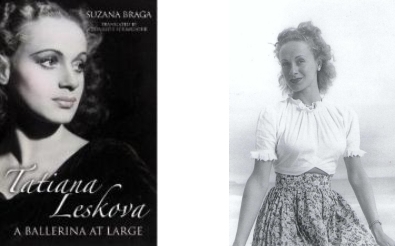
(left) book cover; (right) portrait of Tatiana Leskova in Brazil, 1942

Perhaps the most annoying aspect of the book from my point of view is that Braga doesn’t seem to have decided on a method of telling the story. She knows the Leskova story well having being connected with her subject as a student and then as a professional dancer, and much of the book is quite intimate in approach. But at times Braga stands back and is a distant narrator with expressions like ‘So let us move on …’, or she refers to Leskova in a kind of anonymous way as ‘the young dancer’ or ‘the ballerina’. And she never really decides whether to call the subject of her biography Tatiana, Tatiana Leskova or Leskova and changes constantly between these three names and her selection of anonymous expressions. Other names get an annoying initial rather than a full first name—A. Calder, for example, who from the context I assume is the American artist/sculptor Alexander Calder. Why not pay him the courtesy of a proper identification? And too many infelicitous English phrases keep popping up at the hands of the translator: ‘[he] landed up falling in love with her’; ‘She had made her international bed and could perfectly well have lied down in it’. It all becomes a little irritating.

Looking beyond these irritations, the book probably needs to be read as a piece of oral history in written form. It is based on an extensive interview program and covers Leskova’s life from its earliest stages to the present. There are many quotes from Leskova herself and many reveal her feisty spirit:

I am a perfectionist, always thinking I can do better. I am demanding and have therefore been much criticised and even feared but I don’t do things out of malice but rather because I want, even demand, that they be better.

And on Leskova’s feisty spirit, I met her in the 1990s in New York when she kindly lent me a videorecording of her staging of Les Presages for the Dutch National Ballet. She asked me, when I had finished with it, to pass it on to the Dance Division of the New York Public Library, which I did. But several months later I received a strongly worded message from her questioning why I hadn’t passed the recording on as she had asked. Well it transpired that the recording had been sitting on someone’s desk in the Library and Leskova had not been acknowledged (nor had I). It all sorted itself out and everyone was apologetic but in retrospect her message was a clear example of her strong-willed approach to life and dance.

Many familiar names crop up through the book including those of dancers who performed with the Ballets Russes in Australia and then found themselves in South America in the 1940s—Anna Volkova and Igor Schwezoff in particular have important roles in the story. The discussion is, however, more often than not personal rather than relating to professional careers. Marcia Haydée also makes a guest appearance in a chapter entitled ‘With Marcia Haydée, a Certain Unease’ in which some difficulties that grew from a remark made by Leskova are discussed. And there are interesting thoughts about Nureyev, Massine and a host of other personalities from Leskova’s life.

I found the chapter on Leskova’s restaging of Les Presages and Choreartium, entitled ‘Doors Open’, the most interesting section of the book. It contains selected reviews of various of Leskova’s restagings and I particularly enjoyed Jack Anderson’s comment: ‘Choreartium is a vast mural in motion that makes much recent choreography look puny’. Food for thought I think. The chapter is, however, somewhat uncritical. Everything was a huge success! I didn’t see Leskova’s Presages mounted for the Australian Ballet in 2008, but Leskova told me that she was unhappy in Australia, for a number of reasons. So I would welcome comments on that staging from those who saw it.

Leskova is a larger than life personality and this book reveals the woman behind that personality. I wish, however, that the book had a stronger authorial voice.

Suzana Braga, Tatiana Leskova: a ballerina at large, trans. Donald E Scrimgeour (London: Quartet Books Ltd, 2012)
Paperback, 312 pp. ISBN 978 0 7043 7276 4
RRP £18.00. Available through online sites.

Michelle Potter, 16 February 2013

Giselle. Paris Opera Ballet (2013)

29 January 2013, Capitol Theatre, Sydney

The Paris Opera Ballet’s production of Giselle is breathtaking, poetic and immensely moving. It is steeped in the two nineteenth century traditions from which it emerged: ballet-pantomime and romanticism. And it is danced by artists whose technical expertise is a benchmark for today.

The production is so clear in its story-telling. The dancers appear to live rather than act out their parts and the evening just sweeps along. Giselle, danced by Dorothée Gilbert, draws us into her peasant world and shares her inconsolable sorrow at being betrayed in Act I, and in Act II she almost seems to melt away at times so fragile and vaporous is her reading of her role as a Wili. Her mimed tears as she tells us how much she had loved Albrecht simply melt the heart.

But, while it is clear, the production is also subtle, beautifully so. Nothing screams out, everything is harmonious as the story moves to an inevitable conclusion.

As for the dancing, well there’s just nothing like the Paris Opera Ballet. The corps de ballet is so beautifully rehearsed and they danced to perfection in both acts; Mathieu Ganio as Albrecht performed the most exquisite series of entrechats in Act II; Marie-Agnès Gillot was a commanding Myrthe and the Act I Peasant pas de deux, danced by Mélanie Hurel and Emmanuel Thibault, was joyously captivating.

But although there were some (or many) outstanding moments of performance, the evening was about the entire company. What makes this company so outstanding is the way in which the dancers perform in the classical mode. Every movement is a complete one. The dancers are able to take a bend of the body, a circular movement, a lift of the arms, anything really, and one can see where the movements starts, how it moves along its trajectory and how it finishes and moves into the next movement. This kind of dancing, so smooth and fluid, so sweeping, having such clarity, is rare and it is such a huge pleasure to see.

The Sydney Lyric Orchestra, consisting of musicians drawn together from a variety of organisations and directed by concertmaster Adrian Keating, was conducted by Belgian, Koen Kessels. The music never intrudes but is always clearly and strongly present, moving the story along. Perfect. It also presents a new perspective on Adolphe Adam’s music, reinstating some of the passages that have long been removed from the score as a result of the ballet having been whittled away over the decades from its original ballet-pantomime intentions. And the cello solo in Act II was as moving as the dance it accompanied.

Much has been made of this production being the ‘most authentic’ production of Giselle, and I began this review by mentioning the two traditions from which the first Giselle emerged. It is true that the ballet-pantomime tradition has been given a focus to a certain extent with the mime scenes, such as Giselle’s mother Berthe, danced by Amélie Lamoureux, telling in an extended way the story of the Wilis and prophesying the death of Giselle; the insertion of the men playing dice in the forest as Act II begins; and so on. The romanticism is well and truly there in the qualities the Paris Opera Ballet brings to Act II—that feeling, explored through technical means as much as anything else, of the Wilis drifting in and out of a real world and a world beyond the real.

But I have seen both these traditions explored in several other productions of Giselle—that of Sylvie Guillem for the Finnish National Ballet, the Royal Ballet’s production where the Act I mime is extensive, and even parts of Peggy van Praagh’s production for the Australian Ballet. So for me it is not so much a ‘return to authenticity’ that marks this production as remarkable, as interesting as this is. It is the skill and beauty of the dancers of the Paris Opera Ballet, who are transcendent artists, and the direction of the company that understands that the classical technique can accomplish so much when exploited to its limits and used as an expressive vocabulary.

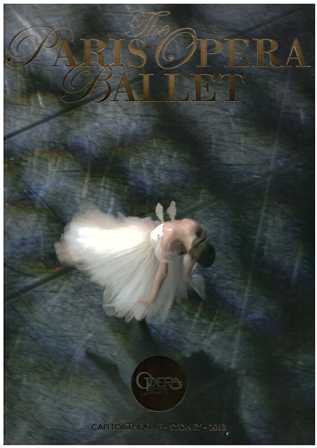
As a side issue, I admired the program cover for Giselle, reproduced below.

It captures so much of the essence of Act II, the fragility of the world of the Wili and the overwhelming presence of the forces of nature and the night. And, best of all, it isn’t a fashion shot that has nothing to do with what happens in the ballet. The cover photo is by © Jacques Moatti.

Michelle Potter, 30 January 2013

Update (3 February 2013): I have it on reliable authority that the sublime cello solo was, on opening night, played by Peter Morrison.

Ballets Russes. The National Library’s finding aid

I was interested, but also filled with despair, to see that the National Library has updated another of its important online dance resources—the finding aid to the Ballets Russes programs for the three Australian tours by Colonel de Basil’s companies. I was interested because the original finding aid needed an update. Since the text was prepared some 10 years or so ago by Australian Collections’ librarian Richard Stone, new information has been unearthed, especially in relation to the dancers who toured with the company. This new material clearly needed to be added. I was also filled with despair, however, because it seems that once again an update to an existing dance resource now offers less than what was offered in the original version.

The original finding aid contained Stone’s text and digitised images of the entire National Library collection of programs and cast sheets for all three tours, along with some interesting advertising flyers for the tours. This digitisation project was carried out in 2005 with funding from the Australian Research Council as part of the Ballets Russes project. Some gaps existed where the Library did not hold programs or cast sheets, but the gaps were small as the Library’s holdings of de Basil company programs are extensive. Now in this update just a tiny portion of that material is being made accessible to the public as an online resource. I am at a loss to know why and wonder whether the Library intends to go back and attach the rest of the digitised material to the new finding aid? The full digitised material was an amazing resource making it possible to discover with ease who danced what and when, anywhere and at any time.

The updated finding aid also includes additional material that may cause confusion. An attempt is made to document the performances after the Original Ballet Russe left Australia in 1940 using a small collection of material from the Papers of Valrene Tweedie, also part of the National Library’s dance resources. While it is only to be expected that this documentation is, at this stage, far from complete, the problem is that many of Tweedie’s programs are not for performances by the Original Ballet Russe. The later part of the tour listings in the finding aid are for the company led by Sergei Denham, usually known as the One and Only Ballet Russe, which Tweedie joined in 1946, and for Cuban companies with which Tweedie was involved. The listing from 1940 onwards is really a reflection of the career of Valrene Tweedie rather than of the history of the Original Ballet Russe. This is not made clear in the updated finding aid. And incidentally, Valrene Tweedie was not the only Australian-born dancer to appear with the Original Ballet Russe in the United States and Cuba, as the text states. Melbourne-born Lydia Kuprina (Couprina) (Phillida Cooper) danced with the Original Ballet Russe in Australia in 1940 and also in the United States and Cuba at least until 1942.

It is unfortunate that the National Library’s dance material continues to be updated in a way that compromises that material. Let’s hope that at least the entire collection of digitised programs will eventually find its way into the updated finding aid.

Michelle Potter, 21 January 2013


Ballet and Fashion. National Gallery of Victoria

Ballet and fashion, an exhibition curated by Roger Leong as a joint venture between the National Gallery of Victoria and the Australian Ballet, is a mini-feast for the eyes. It is a small exhibition with just twenty-one costumes, several headdresses, a face-mask, and seven designs on paper. But the material gives an enticing glimpse of how designers whose work has been primarily in the field of fashion have collaborated in the production of dance.

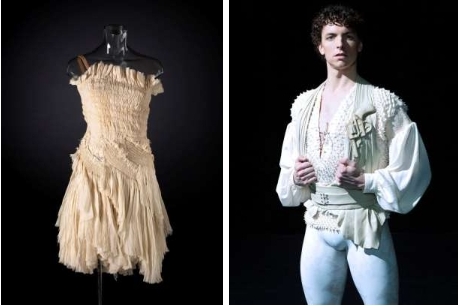
Akira ISOGAWA (designer): left,  Dress (2005) for Grand, choreographed by Graeme Murphy, Sydney Dance Company, 2005. Arts Centre Melbourne, Performing Arts. Photo: National Gallery of Victoria, Melbourne; right, Kevin Jackson in costume for Romeo (2011), Romeo & Juliet, choreographed by Graeme Murphy, The Australian Ballet, 2011. The Australian Ballet Collection, Melbourne. Photos: © Georges Antoni

The show is complemented by a compilation of footage showing extracts from five works: Romeo and Juliet (Graeme Murphy), 2 Lips and Dancers in Space (Robert Wilson/Makram Hamdam), Divergence (Stanton Welch), Aviary (Phillip Adams) and Tutu Parade (Adrian Burnett). The latter was part of another ‘tutu initiative’ that culminated in Tutu: designing for dance, an exhibition shown at the Ian Potter Centre, National Gallery of Victoria in 2004–2005. The footage is an excellent addition giving the viewer the opportunity to see how (or if) some of the costumes we see in display cases move (or don’t) with the body. It is good quality footage too and shown on a large screen.

The exquisite, detailed work of Akira Isogawa is represented in the first room with three costumes from Graeme Murphy’s Romeo and Juliet. But the surprise is the inclusion of two dresses from Grand, Murphy’s deeply moving work made in 2005 in memory of his mother. The dresses from Grand are beautiful to look at close-up, which of course we don’t get the opportunity to do when we see them onstage. Delicate, intricately decorated, ruched and layered, gently coloured and made from ivory-coloured fabric, with one of them showing touches of gold decoration, they highlight the detail and care Isogawa puts into his work.

Another of Isogawa’s techniques that is hardly noticeable from the auditorium but that is a delight to see close-up is his use of delicately patterned fabric. The skirt of Lady Capulet’s dress for Act I scene iii in Romeo and Juliet, for example, has an overlay patterned with a feather design. Romeo’s tights are also patterned. And it is interesting to see close-up Isogawa’s use of Japanese techniques of manipulating fabric on the sleeves of Lady Capulet’s shrug and Romeo’s doublet. And I must admit I didn’t notice while watching the work onstage that Romeo carried a built-in pistol on his chest.

I was also taken by two black ‘bird’ costumes: Giles Deacon’s black tutu commissioned in 2010 by Harper’s Bazaar on the occasion of the sixtieth anniversary of English National Ballet, and a costume from Act I of Aviary a recent work by Phillip Adams. The Deacon tutu, with its traditional shape and with small clumps of ostrich feathers placed delicately on the outer rim of the skirt, has a bodice of skin-coloured fabric on which is stitched a heart-shaped front of lace and beads. While it was initially made as a kind of pièce d’occasion, it was worn in a performance of the Black Swan pas de deux from Swan Lake by dancers of English National Ballet. It is a beautifully elegant version of the traditional tutu and its style stands in contrast to the modern variation on the tutu made by Toni Maticevski for Aviary. The Maticevski garment is less traditional in shape, rather more cabaret-esque with its pannier-like sides of strikingly large ostrich feathers, and with tulle and silk georgette fabric draped at front and back. Its accompanying millinery by Richard Nylon is eye-catching to say the least.

Remarkable to look at are three costumes by Viktor & Rolf for a Netherlands Dance Theatre production, 2 Lips and Dancers in Space, directed by Robert Wilson for the NDT III arm of the company. I especially enjoyed a black and gold costume that consisted of various extravagant additions to a basic, long-sleeved, black unitard-style garment. Gold metal crowns projected from the thigh and hip sections of the unitard, and gold cones (dunce caps?) with gold fabric falling from the peak of the cone sat on the shoulders and projected from the genital region. Gold fabric of various kinds—lamé, silk, satin—were wrapped and draped on various parts of the costume. The theatricality of the whole had the look of the Baroque era or perhaps Carnivale in Venice. Or perhaps Dada-esqe is a better word to describe the items, especially when one watches an extract from the work in the compilation of footage.

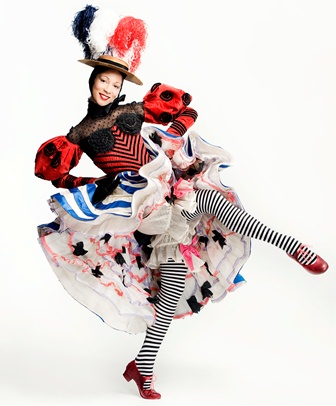
While I have singled out just a few of the costumes on display, every one of them has something of interest, either intrinsically, comparatively or in relation to the footage. Some are well-known to dance-goers in Australia: Vanessa Leyonhjelm’s ‘industrial’ tutu for Stanton Welch’s Divergence, Collette Dinnigan’s finely designed tutu with black lace and beading over a peach-coloured silk skirt and Easton Pearson’s African-inspired tutu, the latter two having been seen in the earlier tutu exhibition. Others are not so well-known: Rei Kawakubo’s astonishing costumes with their large protuberances for Merce Cunningham’s Scenario, Christian Lacroix’s colourful, multi-patterned, mixed fabric costumes for a 1980s revival of Gaîté parisienne by American Ballet Theatre, and others by Ralph Rucci and Valentino. And then of course there are the astonishing hooped burqas with flashing blue lights that are part of 2 Lips and Dancers in Space.

Christian LACROIX (designer): Costume for the Lead Can Can Dancer (1988), Gâité Parisienne, choreographed by Léonide Massine, staged by Lorca Massine, American Ballet Theatre, 1988. Costume worn by Robyn Hendricks. American Ballet Theatre Collection, New York. Photo: Jo Duck, makeup courtesy Napoleon Perdis. © Christian Lacroix

The exhibition is a very nicely curated show and well worth seeing. It is accompanied by a useful booklet, Ballet and fashion, by Roger Leong, which contains the information on the wall captions and extra information, especially about the designers. Some seating in the gallery displaying the footage would be a bonus.

Ballet and fashion: National Gallery of Victoria, Melbourne. 3 November 2012–19 May 2013

Michelle Potter, 17 January 2013

The Merce app

David Vaughan’s Merce Cunningham. Fifty Years was published in New York by Aperture in 1997. It was described on the title page as a ‘chronicle and commentary’, which it is, containing as it does a chronological account of Cunningham’s career from its beginnings until 1994. In 2012, Aperture and the Cunningham Dance Foundation released an updated version of the book for iPad. The app contains the material in the original book and continues Vaughan’s chronicle and commentary in the same kind of format. It takes the reader from 1994 until Cunningham’s death in 2009 and on a little further until the end of the Legacy Tour in 2011.

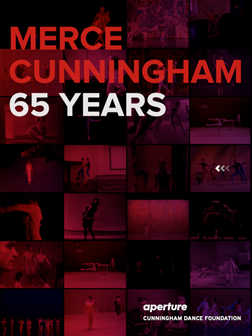
Screenshot from Merce Cunningham: 65 years (Aperture and Cunningham Dance Foundation, 2012). Designer Didier Garcia, Developer Larson Associates

But of course as an app Merce Cunningham: 65 years is able to offer a range of enticing audio-visual items. They include extracts from a number of Cunningham dances, including some black and white archival material and some extracts from documentaries; excerpts from a series of filmed interviews with Cunningham conducted by David Vaughan; excerpts from a filmed series called Mondays with Merce, in which Cunningham recalls anecdotes and events from the past; and something I really enjoyed, Cunningham reading his seminal essay of 1952, Space, time and dance.

Sadly, but for good reasons no doubt, the moving image excerpts are all too brief. One of the most interesting items, however, is an excerpt, only recently discovered, from Martha Graham’s 1940 work Every soul is a circus featuring Cunningham, Graham and Eric Hawkins. Cunningham, then not much more than twenty, enters and dances a short solo. He jumps and prances, changes direction suddenly, sinks to the floor. He is as light as a feather and moves like quicksilver. It’s a remarkable view of Cunningham the young dancer.

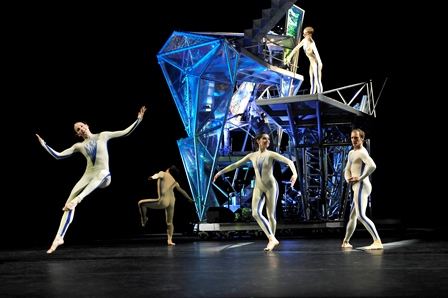
Nearly Ninety, 2009. Brooklyn Academy of Music Opera House, 16 April 2009. From Merce Cunningham: 65 years (Aperture and Cunningham Dance Foundation, 2012). Photo © Stephanie Berger

The photographs in this app are breathtaking. I was especially moved by some of the more recent ones, with which I am not so familiar. What they dois show fabulously trained, articulate bodies. Reading Cunningham’s essays reproduced in this app, listening to him in interviews and reading his thoughts throughout, all his beliefs about dancing are there to see on the bodies of his dancers. Similarly, looking at the short extracts of film footage, the same understanding of how the body positions itself and moves in time and space is absolutely apparent. Look, for example, at Cédric Andrieux in an extract from Suite for five or Holley Farmer in Loose time.

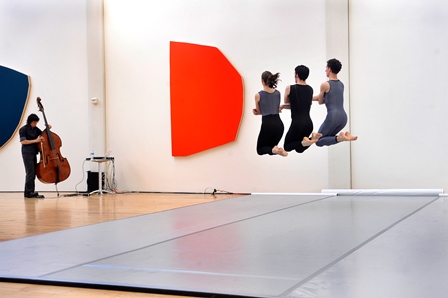
There are also some fabulous photographs from the Beacon Events series, taken during residencies at Dia: Beacon, a gallery space in Beacon a small city not far from Manhattan where Cunningham choreographed a series of site-specific events responding to the art on display.

Beacon Events, 2007-2009. Dia Art Foundation, Beacon, NY. From Merce Cunningham: 65 years (Aperture and Cunningham Dance Foundation, 2012). Photo © Stephanie Berger

In addition, this app has a wonderful bibliography (expanded from the original book); a list of works; an extensive gallery of images; a small gallery of Cunningham’s drawings; another small gallery of pages from his journals; and several of Cunningham’s essays of which the 1994 How to cook a macrobiotic meal in a hotel room is an absolute delight. The app is also a remarkable record of how Cunningham never stopped investigating the new, and never stopped collaborating with others who also worked to discover new ways of making art, right up until the end.

I had some minor issues when I first starting using this app with navigation, which sometimes is a right to left swipe and sometimes an upwards movement. But that was soon over and the navigation is quite logical given that the app is quite large. The audio-visual material is embedded in the app so once downloaded no active internet connection is required. Merce Cunningham: 65 years is a remarkable initiative. It is available through the iTunes store, is available for iPad only and is worth every cent of the $15 or so that it costs.

All images reproduced with permission and courtesy of Aperture.

Michelle Potter, 13 January 2013

UPDATE AUGUST 2020: Unfortunately the app has not been updated so that it can be used with today’s technology. This is a shame because the audio visual content was just wonderful,


Sacre—The Rite of Spring. Raimund Hoghe

5 January 2013, Carriageworks, Eveleigh (Sydney), Sydney Festival 2013

The year 2013 is the centenary of the first performance of Stravinsky’s Rite of Spring, which Vaslav Nijinsky choreographed for Serge Diaghilev’s Ballets Russes and which received a riotous reception on its opening night. The story of that night has passed into legend and, as Raimund Hoghe’s Sacre began, a voice-over recounted that tale. We were not told whose words they were but I have assumed they were those of Stravinsky recalling the evening.

But Hoghe’s production is about as far removed from what we have come to know as Sacre as you could imagine, and since 1913 countless choreographers have tried their hand at making their own version. First, the music for Hoghe’s production was a two piano score, played live. While this was pleasurable to listen to, it was an odd experience because orchestral colour is a large part of what makes those other danced versions of Sacre that audiences have seen over the years so powerful, so full of tension, so theatrical, so dramatic—the Joffrey reconstruction, the Pina Bausch version, Maurice Béjart’s production as danced by Tokyo Ballet, Stephen Page’s Rites and Meryl Tankard’s Oracle are the ones I have seen onstage.

Secondly, the work was choreographically extremely limited. Danced by Hoghe, who is small, middle-aged and has a deformed spine, and the much younger, athletic Lorenzo De Brabandere, it consisted of the two dancers balancing against each other, running (De Brabandere sometimes full pelt, Hoghe usually with jerky, stilted movements reflecting his disability), facing each other and looking hard into each other’s eyes, and performing similarly uncomplicated, often repeated movements. No drama or tension there either.

Raimund Hoghe and Lorenzo de Brabandere in Sacre. The Rite of Spring, Sydney 2013. Photo: © Rosa-Frank.com

Perhaps the clue to this work comes in the final moment when the voice-over returns (and this time we were told the words are those of Stravinsky). Stravinsky recalls that when writing the work he was not constrained by any theory and he further recalls that a neighbour remembered that while he, Stravinsky, was writing a young boy used to stand outside, listening. The boy kept saying ‘That’s wrong’. Stravinsky’s answer was ‘Wrong for him’.

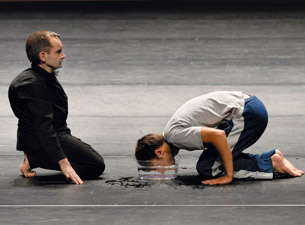
It is Hoghe’s right to produce a Sacre that has nothing of what we have come to expect. No-one expected Nijinsky’s choreography either. But what I found most interesting as I sat watching this show was Hoghe’s body in performance. It was intriguing to see how his disability affected his centre of balance, or how he compensated physically for the lack of a centred spine as he performed the moves he did. But this is not why I go to the theatre. I longed for a moment of drama, a bit of tension, even some choreography, no matter how simple, that reflected something of the rhythms of the music, which were of course still obvious in the two piano score. There was one moment that jolted me out of a soporific state and that was when, after leaning over a dish of water, De  Brabandere suddenly splashed water into Hoghe’s face. But one splash wasn’t enough to compensate.

Michelle Potter, 6 January 2013

Swan Lake. A second look

8 December 2012 (matinee), Joan Sutherland Theatre, Sydney Opera House

I finally got a chance to take a second look at the Australian Ballet’s new production of Swan Lake. With Leanne Stojmenov and Daniel Gaudiello in the lead there was much to enjoy. It was a pleasure to see Gaudiello back onstage and I admired his clear reading of the role. He was especially impressive in Act II. His meeting with Odette was full of excitement, tenderness, pleasure and love, expressed not just in the face but in his movement and partnering as well. It contrasted nicely with his moody behaviour in Act I. Stojmenov responded to his attention and together they made this meeting something that almost had me on the edge of my seat with anticipation of what was to come.

Stephen Baynes’ choreography remains impressive on a second viewing. I noticed in particular this time the elegant waltz of the princesses in Act III with its lovely swirling, bending bodies. And there are moments of exquisite beauty in Act IV where circles of movement predominate. This time I did notice what happened to Siegfried. He left the stage amid a bevy of swans just in time to get ready to be fished out of the lake as Rothbart sailed by. Nothing dramatic in his exit, but then Odette’s exit didn’t have much drama to it either. I admired Juliet Burnett’s pouting princess. Being used to princesses who all act the same and smile through everything, it was a pleasure to see her bringing real character to a role.

Artists of the Australian Ballet in Swan Lake, 2012. Photo: Jeff Busby
Artists of the Australian Ballet in Stephen Baynes’ Swan Lake, 2012. Photo: © Jeff Busby. Courtesy: The Australian Ballet

The work still remains a disappointment, however. As I did during and after the first viewing, I wished that a dramaturg had been brought in. The story doesn’t quite hang together for me without the ongoing and menacing presence of von Rothbart, or at least of some kind constant figure or presence of evil throughout the acts (it doesn’t have to be an owl running around the stage with a cloak flying behind it). Although we are given flashes of lightning at various points, and projections of large flapping wings attached to a weird body and head at others, this is not the same as a continuing presence of evil. Without some kind of ongoing menace, the whole black/white, good/evil theme loses its strength. And without it, it makes nonsense of that moment at the end of Act II when Odette has to leave Siegfried, drawn away by a force more powerful than he is. What is drawing her back, automaton-like, in the Baynes production?

There was also a major problem in Act III with the set and the stage space it occupies in Sydney. Gaudiello in particular was denied the opportunity to execute his solo and his part in the coda to the fullest extent of his ability. It was cramped more than I have ever seen it on that stage with this production and Gaudiello’s dancing suffered badly through no fault of his own. I can’t see that that stage is going to get any bigger any time soon—it’s been like it is for forty years. So it seems to me that the Australian Ballet needs to commission sets that are capable of being used in Sydney without compromising any dancer’s performances.

This Swan Lake is, however, a visual treat. The corps de ballet continues to look beautifully rehearsed and their work has such clarity these days. Hugh Colman’s costumes are gorgeous. But I wish the dramatic line had more coherence.

Michelle Potter, 8 December 2012

The original Swan Lake post is at this link.

.