The Bright Stream. Bolshoi Ballet

7 June 2013, Lyric Theatre, Queensland Performing Arts Centre, Brisbane

The back story to The Bright Stream has been told and retold. Originally created in 1935 with choreography by Fyodor Lopukhov and with a score by Dmitri Shostakovich, the ballet lasted just months. Set on a Soviet-style farm at harvest time, but with some eccentric touches to the story of collective agriculture, the ballet was banned by Joseph Stalin.

As the overture begins in Alexei Ratmansky’s restaging of The Bright Stream for the Bolshoi Ballet, which dates to 2003, we understand something of this back story. We are faced with a front cloth covered with various Soviet slogans and some headlines from Russian newspapers, said to be those of Pravda in its review of The Bright Stream, and in its review of another of Shostakovich’s scores, that for Lady Macbeth of Mtsensk, which Stalin also hated. Amongst the extracts and slogans are ‘Ballet falsehood’, ‘Muddle instead of music’, ‘Tractors and kindergartens are the gearbox of the new village’, and others of a similar nature.

Working from the original libretto, but without any choreographic notation from the 1930s, Ratmansky has built his version of The Bright Stream, the title being the name of the collective farm, using his classical heritage mixed with his unique choreographic sensibilities and a clear talent for humour and characterisation. What emerges over two hours is a comic ballet based on the lives of a group of peasants living in the steppes of the northern part of the Causcasus region. They become entangled with a visiting group of entertainers from the city and what ensues is a world of flirtatious encounters and mistaken identities, the latter largely as a result of moments of cross dressing.
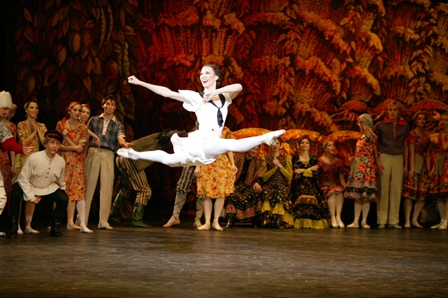
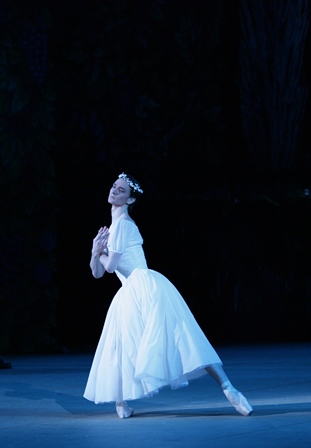
Maria Aleksandrova in 'The Bright Stream'. Photo: Damir Yusupov
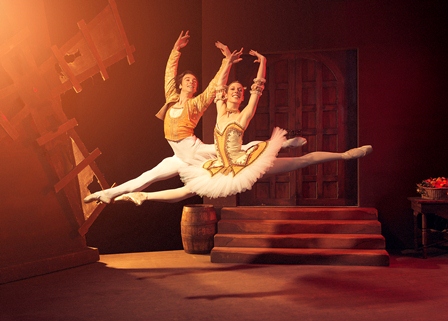
Maria Aleksandrova as the Ballerina in The Bright Stream. Photo: © Damir Yusupov

What a joy it was to see the beautifully accomplished Bolshoi dancers performing Ratmansky’s choreography. Whether whipping off a few fouettés (with never a hint of moving across the stage), performing a series of jetés, or tossing off a manège of jumps, they danced with such attack, made everything look so easy, and always looked as though performing was pure pleasure for them. The two leading ladies, Maria Aleksandrova as the ballerina from the city and Nina Kapstova as Zina the local entertainment organiser, both gave finely sculpted performances, but the entire cast deserves bouquets.

Ratmansky’s choreography for groups of women was especially captivating. He often arranged steps in canon and the overall image that emerged as arabesque followed arabesque, for example, was a little like the movement of plaiting and unplaiting. I loved too the characters that populated The Bright Stream—the elderly folk in particular—and I especially liked that, while they were all drawn with broad, comic brush strokes, there seemed to be no desire by the dancers to overplay their characterisations. As a result these folk were funny and eccentric but believably so.
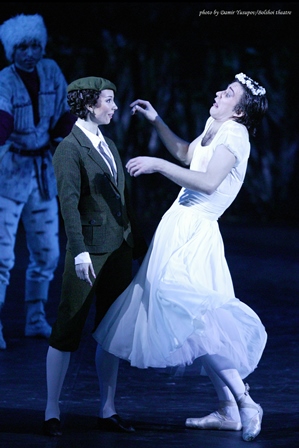
But perhaps the most fascinating aspect of The Bright Stream was Ratmansky’s development of those scenes in which, as a joke, two of the main characters, the Ballerina from the city and her partner, dress in each other’s costumes and set up a romantic tryst with two elderly dacha dwellers who have joined the harvest festivities. Ruslan Skvortsov, dressed in a long white Romantic tutu, gave a wonderful performance as the (cross-dressed) Ballerina. Ratmanksy’s choreography for him was an absolute delight. It had moments that recalled Giselle, Pas de Quatre, Les Sylphides and La Sylphide, all arranged in a topsy-turvy mix. The image of Skvortsov with his index finger under his chin à la Pas de Quatre will remain in my mind for some time.

So was there any hint of politics in this work? After all, collective farms did not always operate as happy and productive initiatives in Soviet Russia. Well, the Grim Reaper appears during the final scenes as the harvest festival begins. He joins in the dancing with his scythe swinging wildly round and round. But the people largely ignore him and he disappears as unexpectedly as he appeared. We can make what we like of this appearance but it adds a touch of politics to a fascinating ballet that shows Ratmansky as a choreographer of unusual and diverse strengths and abilities.

Michelle Potter, 9 June 2013
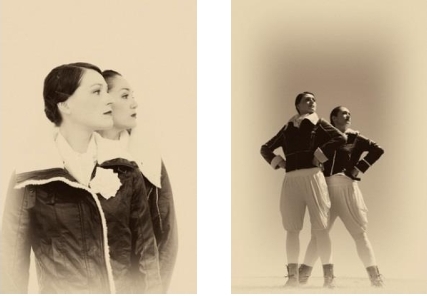
Alison Plevery and Liz Lea, 'InFlight'. Photos: Lorna Sim

InFlight. Liz Lea & Co

31 May 2013, National Library of Australia Theatre, Canberra

The National Library’s theatre is quite unsuited to dance. It is a lecture theatre really, although capable also of acting as a cinema. It has a small, oddly-shaped area at the front of an auditorium that holds about 300 people. The auditorium is raked but anything that is ‘grounded’ movement is difficult to see unless one is sitting in the first few rows. Liz Lea did her best to accommodate the space and its severe limitations. From a practical point of view, for example, a small dais allowed some movement to be seen to better advantage, and she had some lovely black and white screens at each side of the performing space that allowed the performers to change costumes at various points. But I think she did herself a disservice by performing InFlight in the National Library Theatre.

InFlight is in two parts. Part I, ‘Aviatrix’, is inspired by the exploits of Charles Kingsford Smith, Charles Ulm and female aviation pioneers, the British woman Amy Johnson and the American Amelia Earhart. In this section, four dancers play out a fantasy of becoming aviatrixes themselves.

The choreography was severely limited by the space available. I enjoyed the dance that opened the show, a 1920s–1930s style number with fabulous black and silver costumes and gorgeous red and black feather fans. But so often the dancers, Melanie and Marnie Polamares, seemed to be just moving on the spot. It did however serve its purpose well by setting the scene in the era of pioneer aviation activities.

The audio-visual material screened throughout Part I included the voices of Ulm and Kingsford Smith, footage of Johnson and others, still photographs of them all (interspersed with photos of the dancers dressed in aviation gear), and contemporary newspaper headlines. There was so much audio-visual material that the choreography became a side issue. This section seems to me to be more suited to being shown as something other than a dance performance. A history lesson about pioneering moments in aviation?

Part II, ‘Aviary’, leaves aviation history behind and the four dancers are transformed into birds, staking out a territory and building nests. Miranda Wheen’s solo was a highlight as she, wearing an elegant long white dress and manipulating two large white feather fans, sought a place to build her nest. Alison Plevey, dressed in red, also made a mark in another solo as a more aggressive bird. But again there was just no room for the dancers to move and no way for the audience to enjoy Lea’s usually expansive choreography. Naomi Ota’s feathery, trailing installation also got a little lost. It needed space to be seen at its best (some of it had to be hung along a side wall), and space for the dancers to manipulate it effectively. The ending was a bit of a mystery to me. Something was carried onstage in what seemed to be a piece of bark. This moment in the story was performed with great solemnity.

Lea has a great eye for the theatrical and a wonderful capacity to use all kinds of unexpected additions to her shows. But basically she is an artist working in the medium of dance. Dance doesn’t really exist without choreography and if the choreography is compromised in the way it was in InFlight, both by lack of space and by being overshadowed by audio-visual material, the show becomes something else. Perhaps it doesn’t matter? However, I think it does in this case because Lea’s choreography deserves to be seen in a situation that allows it proper range. Whatever were the political needs of performing it at the National Library, it is impossible for me to ignore the fact that Lea did herself, and her four very accomplished dancers, a disservice.

Michelle Potter, 3 June 2013

Featured image: Alison Plevey (foreground) and Liz Lea in a study for InFlight. Photos: © Lorna Sim

Alison Plevery and Liz Lea, 'InFlight'. Photos: Lorna Sim

Postscript: The photocopied handout/program did little to make me feel better about the show. It contained many of the errors that creep in when one does a cut and paste to a document and then doesn’t check and recheck for extraneous words. It was an unprofessional publication.

For more about the background to the show see ‘Come fly with me’.

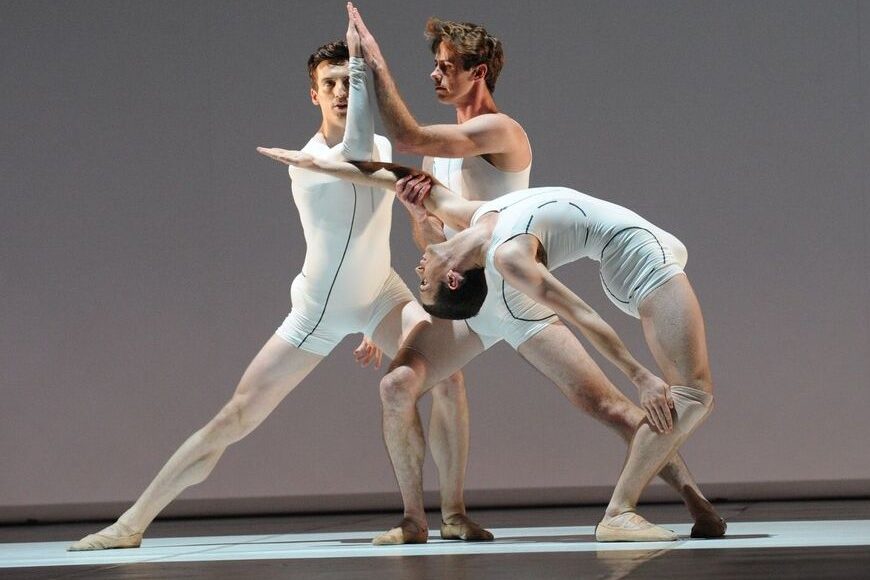
Scene from 'Monument', Canberra 2013. Photo: Branco Gaica

Garry Stewart’s Monument. The Australian Ballet

The buzz around Canberra is that Monument, Garry Stewart’s new work for the Australian Ballet and the Centenary of Canberra, may well be that elusive item, ‘a great work’. Monument elicits shouts, screams and whistles as the curtain falls. Audiences exit the auditorium agog and, returning for a second viewing, I was filled with anticipation and excitement. Its appeal seems to be universal—young, old, dance fans, those who don’t often go to a dance performance—so many are talking about it.

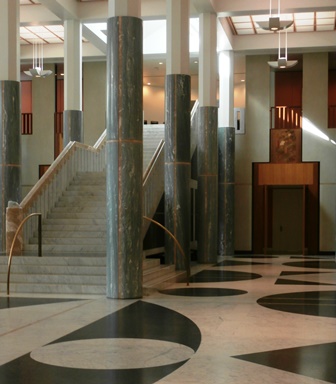
It also sent me back to Parliament House to take a look at Romaldo Giurgola’s imposing Marble Foyer, which was the inspiration for much of the visual design for Monument. It is indeed an imposing, high-ceilinged space filled with marble columns. But Giurgola has frequently expressed his pleasure that few people look for the lifts to get to the next floor. They climb the marble staircase instead. Despite its imposing qualities it exists on a human scale as well. So too Monument. The formal qualities that define it, its reference to the architectural process, do not alienate. They touch a human nerve.

Parliment House Marble Foyer
The Marble Foyer, Parliament House, Canberra.

I was also able to take a close look at Mary Moore’s body-hugging costumes made from white lycra with a fine black lycra trim. Three costumes, some designs on paper and a selection of rehearsal photographs are on display in a corridor just off the foyer’s central space.

Here is a link to a PDF of my Canberra Times review of the Australian Ballet’s Canberra program, Symmetries, of which Monument is part. I will be writing more about Symmetries, including Monument, for Dance Australia Reviews, coming soon. There is much more to say, especially about how Stewart has constructed and choreographed the work.

The Canberra Times review is also available online with a gallery of images [sadly no longer available—MP 26/06/2016]. The gallery is worth exploring. It gives [gave] some great views of Mary Moore’s costumes and Paul Lawrence-Jennings’ graphics.  Although there is no footage, the image gallery also indicates [indicated] the nature of Stewart’s choreographic approach. The images by Karleen Minney were taken at a media call and so are unposed.

Michelle Potter, 25 May 2013

Featured image: Scene from Monument, Canberra 2013. Photo: © Branco Gaica

Scene from 'Monument', Canberra 2013. Photo: Branco Gaica

UPDATE, 28 May: My Dance Australia review is available at this link.

Elise May, 'R & J' Act III. Photo: Chris Herzfeld, Camlight Productions 2012 web

R & J. Expressions Dance Company

14 May 2013, Queanbeyan Performing Arts Centre

This is a revised version of a review written for The Canberra Times. In the interests of bringing the outstanding qualities of R & J to the attention of the dance-going public as the show continues its regional tour, I am posting this expanded review now. Publication of the original, shorter review has for unexplained reasons been (apparently) delayed.

I don’t know where the expression ‘the best things come in small packages’ originates, but it is a perfect way of describing Natalie’s Weir’s R & J. Weir has worked with just six dancers (complemented in the opening scene only by a group of local dance students) to create three mini-stories inspired by Shakespeare’s Romeo and Juliet. Each story is short—the whole work lasts just 60 minutes with brief pauses in between each act—but each also delivers a powerful message.

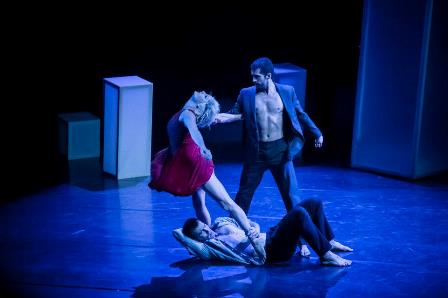
Act I is called ‘Passion’ and is set in a disco environment in the present day, hence the need for a few extra dancers. ‘Passion’ is complicated by the presence of a third person, a rival to Romeo, setting up a triangle of love.

Riannon McLean, Jack Ziesing, David Williams, 'R & J' Act I. Photo: Chris-Herzfeld
Riannon McLean, Jack Ziesing, David Williams, R & J Act I, Expressions Dance Company. Photo: © Chris Herzfeld, Camlight Productions, 2012

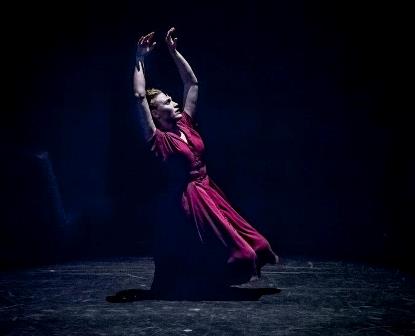
As the work begins we immediately encounter Bruce McKinven’s minimal set, which remains in place throughout the piece. It consists of a collection of white translucent boxes of different sizes: the boxes stand at angles to the floor and are spread across the stage space. The intricacies of their construction are only revealed as each story progresses—they become a table, a tomb, a television, whatever might be required as the stories unfold. McKinven’s simple costumes, always red for Juliet, are also masterly in conveying an era and a mood in a simple yet powerful manner.

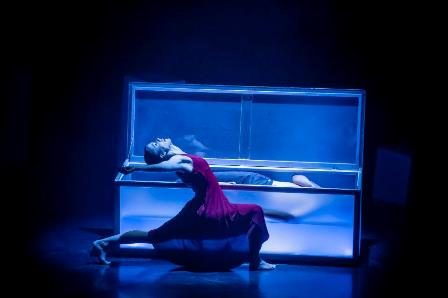
Act II is ‘Romance’ and takes us back to the 1800s. ‘Romance’ comes closest to the traditional story and reminds us of the divided families, the balcony and bedroom scenes and the final setting beside the tomb, all of which are well-known from other dance productions. This Act showed David Walters’ lighting design at its best. Throughout, Walters lights the piece evocatively according to the progress of the story but in Act II he surprises us with his lighting of McKinven’s boxes. There are moments when he focuses his light on single boxes that enclose Juliet and separate her from Romeo and, as Act II comes to a conclusion, he lights up the inside of the box that acts as a final tomb.

Samantha Mitchell and Benjamin Chapman, 'R & J' Act II. Photo Chris Herzfeld, Camlight Productions 2012
Samantha Mitchell and Benjamin Chapman, R & J Act II, Expressions Dance Company. Photo: © Chris Herzfeld, Camlight Productions, 2012

Act III is ‘Devotion’ and is set in the 1950s. ‘Devotion’ is perhaps the cleverest of the three stories and shows us a routine of life and love that is interrupted by the inevitability of an end to every union. The dancers’ movements gather speed, without losing any choreographic detail, as the repetitive nature of life becomes apparent. In all three stories the lovers are parted in some way although the endings, I think, are open to interpretation. In Act III, for example, did this 1950s Romeo die? Or did he just leave his Juliet, tired of the never ending routine of work and more work? This open ended approach is part of R & J‘s success as a production that involves us emotionally.

Weir’s choreography has always been distinguished by her ability to create strong duets and R & J is no exception. But just as affecting on this occasion are her trios and solos. I admired in particular the trio in ‘Passion’. It was often quite rough with contact between the participants in the love triangle sharply rather than lyrically defined. Her ability to make six people seem like many more in ‘Romance’ was also impressive. A dance in which Romeo, Juliet and four masked dancers changed partners in a tightly knit group set up an image of the ballroom scene from the well-known, full-length ballet.

Each of the six dancers, three men and three women, had their chance to be a Romeo or a Juliet, and each gave an outstanding, physically gutsy performance. But it was Elise May in ‘Devotion’ who really gave the performance of the night. For a good deal of her time on stage she danced with an arm chair, the chair on which her partner had sat before his exit from her life. Her movement was carefully nuanced and we rode her wave of emotions as she eventually resigned herself to loneliness.

The work was danced to an original, jazz-inspired score by John Babbage, in which the saxophone played a prominent part. When first performed in Brisbane (and also I believe in Adelaide in 2012), the music was played live by the group Topology, of which Babbage is a member. Sadly, this whistle stop regional tour was not able to offer a live performance by the musicians. However, with a dash of colour, a spot of light, a burst of sound and some telling gestures, Weir and her collaborators have created an exquisite and moving small package of love. R & J is a stand-out work that truly deserves the awards it has already won.

An earlier post on R & J is at this link.

Michelle Potter, 18 May 2013

Featured image: Elise May, R & J Act III, Expressions Dance Company. Photo: © Chris Herzfeld, Camlight Productions 2012

Elise May, 'R & J' Act III. Photo: Chris Herzfeld, Camlight Productions 2012 web

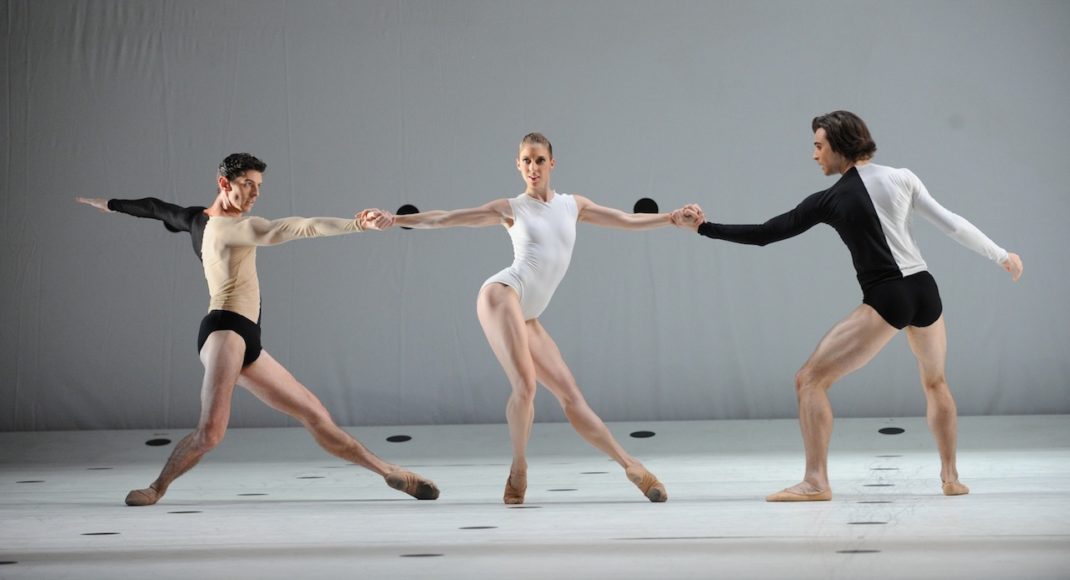
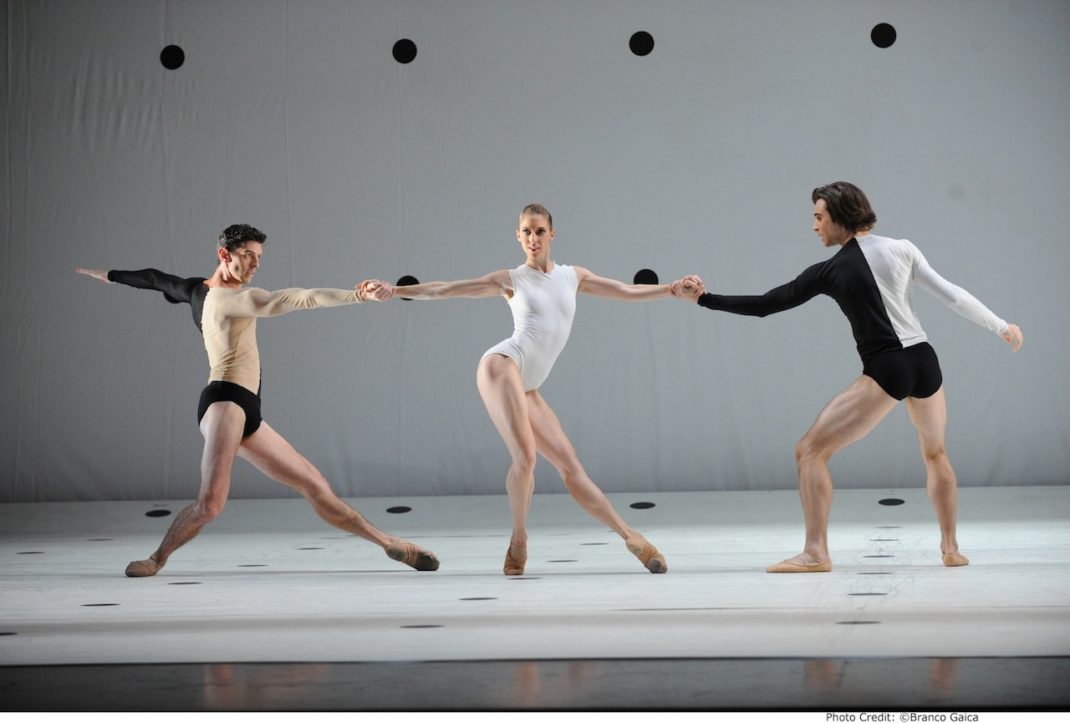
Andrew Killian, Lana Jones and Daniel Gaudiello in 'Dyad 1929'. The Australian Ballet, 2013. Photo: © Branco Gaica

Vanguard. The Australian Ballet

11 May 2013 (matinee & evening), Joan Sutherland Theatre, Sydney Opera House (The Four Temperaments, Bella Figura, Dyad 1929)

If this triple bill program from the Australian Ballet did one thing it was to show how far ahead of his time George Balanchine was in 1946 when he made The Four Temperaments.

Although the title, The Four Temperaments, suggests a link to the ancient practice of assigning behavioural characteristics to humans based on the extent to which certain fluids are present in the body, I think this is essentially an abstract ballet. It deconstructs classical ballet vocabulary before the idea of deconstruction in arts practice became a trendy phenomenon. So many of the movements—Balanchine’s different examples of supported pirouettes for example—show by the very act of deconstruction how the vocabulary of ballet is constructed. In addition, Balanchine’s use of turned in feet and legs, forward-thrusting pelvic movements, stabbing movements by the women on pointe, angular shapes made with the arms and palms of the hand, are all beyond what the eye is accustomed to think of as pure, classical movement. But seen within the context of the entire ‘Vanguard’ program, it is clear that similar movements surface in the work of choreographers coming after Balanchine. Such an attitude to the balletic vocabulary is especially noticeable in the choreography for Dyad 1929 made by Wayne McGregor in 2009.

Balanchine made his move in 1946 (at least) and I think the different look Dyad 1929 and others of McGregor’s works have, which is certainly a look more in keeping with the twenty first century, is as much a reflection of technical developments and changes in body shape since 1946 as anything else. The Four Temperaments is really a remarkable work.

The Australian Ballet has been beautifully coached and rehearsed for The Four Temperaments. There was a simple elegance and a clarity of technique in their dancing and they made the choreographic design very clear. At times, however, I wished some parts had been slightly more exaggerated—the movement in the pelvis for example. Balanchine was a showy choreographer at times and I think a little of the showiness that American companies seem to add to The Four Temperaments was missing.

Of the two casts I saw I most admired Daniel Gaudiello in the ‘Melancholic’ variation. I loved his unexpected falls, the theatrical way he threw his arms around his body, his very fluid movement, and his wonderful bend back from the waist as he made his (backwards) exit. I also enjoyed the pert and precise quality Ako Kondo and Chengwu Guo brought to ‘Theme II’ and Juliet Burnett’s languorous and smooth flowing work in ‘Theme III’. Of the corps Dana Stephensen and Brooke Lockett (in different casts) stood out for me in supporting roles in ‘Melancholic’.

Felicia Palanca & Sarah Peace in 'Bella Figura'. Photo: Jeff Busby
Felicia Palanca and Sarah Peace in Bella Figura, ca. 2000. Photo: © Jeff Busby. Courtesy the Australian Ballet

Then came Jiří Kylián’s emotive work Bella Figura with its mysterious lighting and half-revealed spaces.

Bella was first performed by the Australian Ballet in 2000 when it had a more than memorable cast, and it has been restaged in the intervening period, again with strong casts. So it is a pleasure to record that one cast I saw on this occasion did not make me think back to other performances. It even opened up for me a new view of the piece. The closing duet, danced in silence by Lana Jones and Daniel Gaudiello, in moody lighting with two braziers burning brightly in the background, was moving, intimate and deeply satisfying. What wonderful rapport these two dancers have and how affecting is their ability to project that rapport so strongly. Jones and Gaudiello were also outstanding in another duet earlier on in the work. I don’t remember such a comic element in that particular duet on previous occasions; this time it bordered on the slapstick. But it was brilliantly done as Jones and Gaudiello managed to retain ‘la bella figura’ in its best sense, while also making us laugh.

After these two works Dyad 1929 looked very thin to me. I have admired recent works by Wayne McGregor including his Chroma, FAR and Live fire exercise, and I was also impressed by Dyad 1929 when it was first shown in Australia in 2009. This time I didn’t get the feeling that the dancers saw any diversity within the work. They all performed the steps very nicely but brought little else. After The Four Temperaments and Bella Figura it was a disappointment, not so much choreographically as in terms of performance.

Michelle Potter, 13 May 2013

Featured image: Andrew Killian, Lana Jones and Daniel Gaudiello in Dyad 1929. The Australian Ballet, 2013. Photo: © Branco Gaica

Andrew Killian, Lana Jones and Daniel Gaudiello in 'Dyad 1929'. The Australian Ballet, 2013. Photo: © Branco Gaica

Don Quixote. The Australian Ballet

13 April 2013 (matinee), Joan Sutherland Theatre, Sydney Opera House

My single viewing of the Australian Ballet’s current production of Don Quixote was entertaining, if not theatrically thrilling.

I enjoyed seeing Reiko Hombo and Yosvani Ramos in the leading roles of Kitri and Basilio. The male jota-style variation in Act I suited Ramos beautifully and showed off his neat footwork and the lightness of his jump. His portrayal of Basilio worked really well in Act III when his ‘death’ scene captured a certain craziness and was quite hilarious. But I missed a sense of passion in his encounters with Kitri.

Hombo performed nicely and her technical execution was precise and clear. But again I missed the fiery quality I associate with Kitri and I felt the consequent lack of a strong emotional connection or a sense of physical repartee with Basilio.

What I really liked about the production was the characterisation of the Don, played by Steven Heathcote; Sancho Panza, the Don’s squire played by Frank Leo; and the wealthy Gamache, played by Matthew Donnelly. At last here was an approach that didn’t seem to think that over-the-top behaviour was necessary in these kinds of roles. All were still strong individuals demanding of our attention and thoughts but without the ridiculous pantomime elements that for me went out of fashion years ago.

Amongst the corps and soloists I admired Brett Chynoweth as one of the leading townsfolk, Dana Stephensen as one of Kitri’s friends and Eloise Fryer as Amour. Both Stephensen and Fryer looked wonderful onstage. They were technically assured and dancing as if they loved it. No Don could have resisted Fryer’s arrows! Chynoweth was full on into the action at every moment.

It’s a hard act, still, to follow in the footsteps of Rudolf Nureyev and Lucette Aldous and the cast that made up the first Australian Ballet production way back in the 1970s. But some have followed on brilliantly since then, and maybe some casts that I didn’t see in this season did in fact inject some of the fiery and passionate give and take that makes this ballet a bit more than just interesting entertainment. The subscriber I sat next to yesterday was singing the praises of Lana Jones and Daniel Gaudiello.

And for those who weren’t even born in the 1970s that first Don Q is still available on DVD as a digitally remastered version of the original film.

Lana Jones and Daniel Gaudiello in a publicity shot for Don Quixote, 2012. Photo: © Georges Antoni. Courtesy the Australian Ballet

Michelle Potter, 14 April 2013

Inwonderland. James Batchelor

6 April 2013, Courtyard Studio, Canberra Theatre Centre

James Batchelor’s dance and multimedia installation has already been seen in various manifestations, often as a work in progress, in Sydney, Melbourne and Canberra. This particular Canberra showing was, however, my first taste of the work and in fact my first taste of Batchelor’s approach to making art. It is an impressive production showing Batchelor’s strong film making skills—he has been mentored by Sue Healey—and some beautifully detailed costumes and settings. Overall it is a remarkably cohesive show.

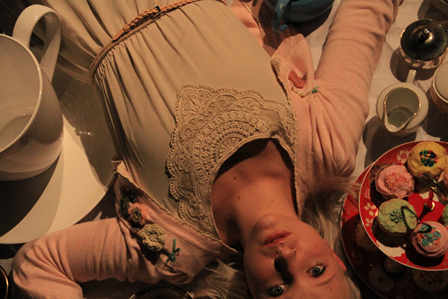
Amber McCartney in James Batchelor’s Inwonderland. Courtesy James Batchelor

The title, Inwonderland, evokes of course Lewis Carroll’s Alice in wonderland and there are many clear allusions to that story. At the beginning of the work we enter a darkened space with our camp stools (shades of an art gallery installation) and notice that there are several separate areas where the work will unfold. At first we encounter a circle of toy rabbits with a dancer dressed in a long Victorian-style dress moving in the middle of this ring. The rabbit-hole of course! She engages in conversation with one rabbit, she twitches and twists—in fact circles seem to be a choreographer signature here. And as the work continues and we move on with it to other parts of the performing space there are other allusions to Alice in wonderland. The most obvious comes when the work takes place around a long table set up for a grand tea party.

But we can spend a lot of time searching for connections with Alice in wonderland when in fact the work goes beyond that. It’s an expressionistic work where ideas are subjectively presented, where experiences are exaggerated, removed from reality and often distorted. A scene where Amber McCartney, the ‘Alice’ of the piece, sits reading in the glow of a Tiffany-style lamp is a case in point. As she does so film footage of the Inwonderland characters moving through a hedge maze and a tangle of branches appears on a screen that looks as if it is made from unspun wool (in fact it’s wadding). This screen distorts what is in fact beautifully crisp footage (see the excerpt at the link below). The dream-like quality that emerges as the footage is screened in this way is mirrored by McCartney who moves in slow motion, sometimes almost imperceptibly.

The tea party is a great example of Batchelor’s approach as well. It becomes almost a slapstick adventure for the three characters: a schoolmarm, ‘Alice’, and a brightly dressed, crazy character, all of whom wreak havoc at the beautifully set up table. Stretched above the table is another screen on which footage is again distorted, both as a result of the screen’s location high above the table and because the screen is not stretched taut.

Inwonderland falls down slightly in terms of choreography, which I thought needed some pruning particularly in the opening rabbit-hole sequence. And a stronger movement vocabulary is needed I think. I’m not sure if Batchelor works in a particular manner in creating his vocabulary but it looks like he needs a firmer foundation from which to build and develop his movement ideas. I would have liked to know more too about the sound track and the scenic and costume design. The hand-out missed giving these credits.

Inwonderland is, however, a wonderful example of how dance, film, and scenic and costume design can work together, and its presentation as an installation is beautifully thought through and thoroughly refreshing. It is a dreamscape of the mind. I look forward eagerly to seeing more of Batchelor’s work and hope that he doesn’t move entirely into the area of dance film, although he is clearly talented in that area, but keeps a live component in his works as well.

Michelle Potter, 7 April 2013

Here is a link to the footage filmed at Berrima, New South Wales.

(UPDATE August 2020. Link no longer available.)

[Modern] Masterpieces. Pacific Northwest Ballet

21 March 2013, McCaw Hall, Seattle

This program was a particularly generous one from Peter Boal’s Pacific Northwest Ballet, consisting as it did of four works: George Balanchine’s Concerto Barocco, Paul Gibson’s Mozart Pieces, Ulysses Dove’s Dancing on the Front Porch of Heaven and Twyla Tharp’s In the Upper Room. It was also a diverse program showcasing a range of American choreographers, past and present.

I have to admit to being an Upper Room fan and recall with much pleasure the performances given of it by the Australian Ballet now more than a decade ago. So I was surprised by the interpretation given to it by dancers of Pacific Northwest Ballet and it made me ponder on the notion of a vernacular in dance, and also on the role of a personal style in dance. The standout dancer for me was Kiyon Gaines who, especially in the men’s trio towards the end of the work, looked like he was in another space, in the upper room as it were, so engrossed was he in the performance. To me he was the only dancer who really got the ascendancy of emotion and physicality that drives the work to its conclusion. Others put in personal tweaks of expression or added small technical eccentricities but didn’t give the appearance of being in the same show as their colleagues. All in all a bit of a disappointment.

Balanchine’s exquisite Concerto Barocco opened the program. It was nicely danced by the company who have a youthfulness that suits many Balanchine works, including this one, and whose training and heritage give them a particular feeling for the style. I especially admired the two leading ladies, Maria Chapman and Lesley Rausch, both of whom are elegant, long-limbed dancers and who used these attributes to advantage.

Paul Gibson’s Mozart Pieces is a development of an earlier piece made for a Pacific Northwest Ballet School performance. It is a series of showy episodes performed by seven men and two women. Several of the sections are danced to Mozart minuets and there is a certain inevitability to the choreography. But Gibson has counteracted what could have become a predictable work with some unexpected changes of movement and lots of variety in the way the arms and head are used. I enjoyed watching the leading male dancer, Karel Cruz. His feet and ankles seemed amazingly articulate and I could see so clearly how they held together perfectly in fifth in his double tours. This is perhaps a bit of an esoteric comment to make, but the way he executed those tours remains clearly fixed in my mind.

Ulysses Dove’s Dancing on the Front Porch of Heaven was made in response to Dove’s grief at the loss of friends and colleagues who died from complications associated with AIDS. Originally made on the Royal Swedish Ballet, it is set on three couples and is an unusual work in that it seems confrontingly static. Movements tend not to flow together or even be fluid within themselves. The six dancers periodically come together in a circle, which is also pretty much a static formation, before breaking apart. The whole might be seen as a fractured view of life and the relationships made within it. I found it hard to be emotionally involved so obvious was the movement metaphor.

This was my first viewing of a performance by Pacific Northwest Ballet since the company was in Australia in the 1990s for the Melbourne Festival. There were moments to be savoured but I would have loved to have been uplifted!

Michelle Potter, 24 March 2013

The Rite of Spring. Houston Ballet

15 March, Brown Theater, Wortham Center, Houston, TX

Houston Ballet’s most recent program had the slightly confusing title of The Rite of Spring when in fact it was a triple bill in which Stanton Welch’s reimagining of Stravinsky’s Rite of Spring was simply the final offering on the program. Nevertheless, it was probably the most anticipated of the three works on show although I’m not sure the extensive media build-up was entirely justified.

Welch dispensed with the narrative of human sacrifice that marked the original, infamous 1913 production of Rite of Spring. His production began in something of a primeval manner with a horde of Neanderthal-looking men whose fearsome arrival onstage caused a band of women to flee the stage, thus establishing a primitive, tribal background to the work. But from there the piece seemed to disintegrate into a mixture of cultural references culminating midway through in some kind of wedding or association between a man and a woman, who for the occasion was bound in white garments by her female friends. Just what happened to the couple later on was not clear to me other than that they danced with the rest of the tribe in a passionate frenzy of movement. The work seemed to peter out at the end.

Nor was it clear just exactly who theses tribes were. Costumes and make-up, which included heavy body markings, recalled Aztec ornamentation, a least to me, although there were times when the grass skirts of Polynesia and Melanesia seemed to surface. Heavy, black eye make-up sometimes made the dancers look like they were wearing sunglasses and at other times made their eyes look quite red as though they had been caught in a camera flash. I thought overall the costume/make-up design was considerably overwrought.

This stood in sharp contrast to two magnificent backcloths created from two paintings by Australian indigenous artist Rosella Namok. Namok’s works, ‘Stinging Rain’ and ‘Marks on the Sand, After King Tide’, were beautifully enlarged by Houston Ballet’s backstage team. They had a strong but simple message and it is curious that Welch, according to all press material and published interviews, chose her work because he thought it had a universal quality to it. Well that’s just what Welch’s production didn’t have. It lacked a simple, strong message and a clear sense of focus and, with its myriad of references to other cultures, couldn’t be called universal.

Choreographically Welch worked very closely with the music and there was scarcely a note that didn’t have a corresponding step. Everything looked very busy and as a result the Stravinsky score sounded quite different. To me it seemed to have lost its integrity.

Creating a new Rite of Spring will always bring out a very personal side of any choreographer it seems. The Welch production was not to my liking I’m afraid and I’m beginning to suspect that the versions that work best for me maintain the links to the original narrative or else diverge entirely from it. Welch was unable to establish a new, satisfying pathway or a link to the old one.

The evening opened with Mark Morris’ Pacific danced to Lou Harrison’s Trio for Violin, Cello and Piano. It seemed a little like a religious celebration possibly because of the constant use of uplifted  arms and the placing of the hands in front of the body, palms facing each other, as if holding an devotional item between the hands, or as if in a kind of open praying gesture. Morris’ choreography followed the impetus of the music but the constant bending to the floor as if in homage to something (the music?) also emphasised a kind of religiosity.

Edwaard Liang’s Murmuration, especially created on Houston Ballet and receiving its world premiere in this program, began with a single female dancer moving slowly down a diagonal, But just as one began to ponder the serenity with which she accomplished this walk, the stage was filled with dancers. They formed groups broke apart, met and left the stage in a flurry of movement that lasted for the entire first movement of Ezio Bosso’s Violin Concerto No. 1, Esoconcerto. As explained in a program note the title of the work refers to the intricate patterns formed by starlings during flight and the constantly changing choreographic groupings alluded to these patterns.

The second movement consisted of a series of duets which showed Liang’s emphasis on how bodies can work together as they intertwine and contort, and in so doing how they often appear as one. The men hold our attention in the third movement and for a while the women group themselves at the back and watch the men display their athleticism.

Murmuration is beautifully designed. The simple, grey costumes, designed by Liang and Houston Ballet’s wardrobe manager Laura Lynch, move beautifully with the dancers. The pale grey leotards with attached chiffon panels for the women, and the wide legged trousers softy gathered at the waist for the men enhance and never detract from the choreography. The background, which relies on Lisa J. Pinkham’s lighting for its strongest effect, changes from a simple grey-lit cloth in the first movement to what looks like a cascade of fireflies in the second. And as the third movement progresses the fireflies turn to small white shapes (of paper I guess) falling softly to the ground.

Murmuration deserved the ecstatic reaction it received from the audience at the performance I attended although there were times when I thought there was a little too much repetition in the choreography.

Michelle Potter, 18 March 2013

Guide to Strange Places, Beaux, The Rite of Spring. San Francisco Ballet

10 March 2013, War Memorial Opera House, San Francisco

In a year that has already seen various dance productions set to Stravinsky’s 100 year old Rite of Spring, and will see more as the year progresses, Yuri Possokhov’s new version for San Francisco Ballet will surely have to count as one of the most dramatic. Full of suspense and tension, the work looks to the subject matter of the original staging, that is the pagan ritual of human sacrifice, for its narrative line.

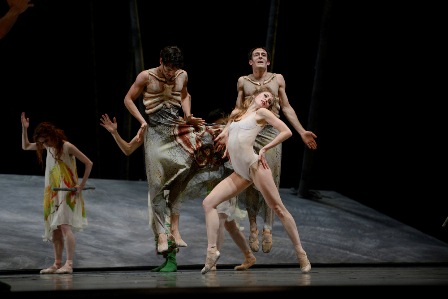
There was a distinctly Russian feel to the work. Costumes by Benjamin Pierce, with their largely red-toned on white designs (with a touch of spring green), recalled the Roerich originals, and the set, also by Pierce, consisted of a sloping platform upstage, OP side, with a mini-forest of poles representing silver birch trees. Again recalling the original, Possokhov’s choreography, which had the women on pointe, emphasised the down beat in the music and often used parallel or turned-in movements. There the similarities ended, however, as Possokhov made the story his own by emphasising the evil he saw as underlying the story of human sacrifice. His two elders, conjoined as a double personification of evil via a costume of stretch fabric and skeletal additions, drove the piece relentlessly to its inevitable and terrifying conclusion in which the birch trees played a major role as they were dragged down onto the body of the Chosen One.

What made this work especially mesmerising was the dancing of Possokhov’s tribe of people. They seemed sometimes sexually driven, sometimes just plain obsessed, sometimes filled with fanaticism. They slithered down the ramp. They seemed to side with the elders once the Chosen One had been selected, waving a hand in the air as if agreeing. They danced with the drive that characterises the music and occasionally played along with it by drumming sticks on the ground. It was absolutely absorbing from beginning to end and brilliantly performed.

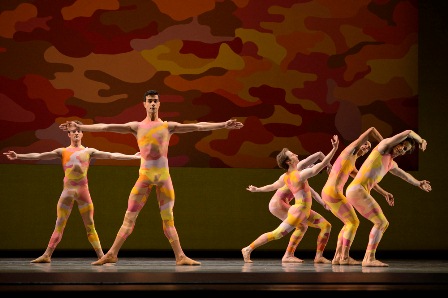
The middle work was Beaux by Mark Morris, a subtitle for which might be ‘Boys Playing’ or even ‘Beautiful Boys Playing’. Choreographically there were moments that briefly reminded me of Cunningham, especially when the dancers’ upper body was held still and erect with arms stretched straight right through to the palms while the legs executed various movements. But mostly the movement was softly balletic with men partnering men in ways that are usually reserved for men partnering women. Some charming images remain—a line of men resembling cut-out dolls, a wave from one man to the rest of the cast and three men carrying another aloft and running with him across the stage.

Artists of San Francisco Ballet in Mark Morris’ Beaux. Photo: © Erik Tomasson, 2013. Courtesy San Francisco Ballet

Set and costumes were by New York-based fashion designer Isaac Mizrahi. An oversized painting was hung upstage against a plain cloth. Its myriad of organic shapes in orange, lemon and shades of pink overlapped each other and the cloth was lit variously with similar colours. The nine gentlemen in the cast wore high-necked, sleeveless all-overs in similar colours to those of the painting and with similar shapes printed on them. It was a pleasant work but that’s all.

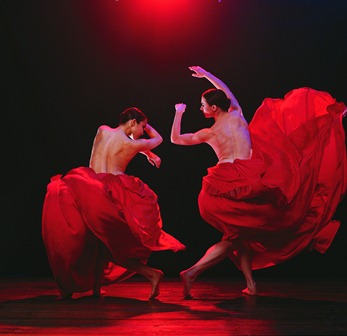
The program opened with Ashley Page’s Guide to Strange Places, which was premiered by San Francisco Ballet in 2012 and which is danced to music of the same name by John Adams. It seemed to be mostly about legs—especially women’s legs—and how and where they can extend, and how they can be manipulated by a partner. San Francisco Ballet’s dancers are beautifully athletic and so they accommodated the hyper-extensions very nicely. But to me it was uninspiring choreography. The fact that it was meant to refer to an old French book called (in English translation) A Black Guide to Mysterious Provence explained its strangeness to a certain extent. But even thinking along these lines couldn’t save it. It had so little to touch the soul.

My soul was touched by Possokhov’s Rite of Spring and I regret that I only had the opportunity to see one performance.

Michelle Potter, 14 March 2013

Featured image: Artists of San Francisco Ballet in Yuri Possokhov’s The Rite of Spring. Photo: © Erik Tomasson, 2013. Courtesy San Francisco Ballet