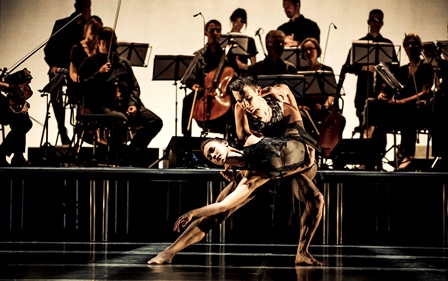
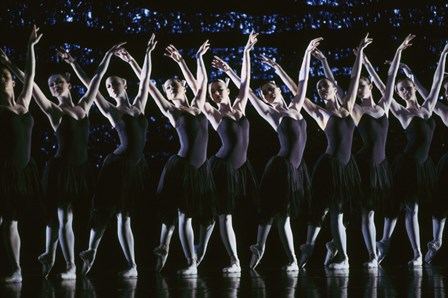
As the curtain went up on Project Rameau in Canberra, with the Australian Chamber Orchestra seated on a platform at the back of the stage space and the dancers of Sydney Dance Company lined up in front of the platform, I wondered whether this collaboration would in fact work. One or two companies have been critical of the Canberra Theatre space because of its relatively small performing area (compared with some stages in Sydney and Melbourne), and there before my eyes were two companies sharing the stage. Well I need not have worried. Project Rameau was one of those made-in-heaven collaborations and the size of the stage seemed of little consequence and, after all, exceptional artists are always adaptable.
Musically Project Rameau consisted of nineteen selections of music by Jean-Philippe Rameau, two by Antonio Vivaldi and a single piece by Johann Sebastian Bach. Sydney Dance Company’s director, Rafael Bonachela, responded choreographically to this musical selection with a varied series of dances ranging from duets and trios to pieces for larger groups, at times for his entire ensemble of dancers. Occasionally within these group pieces, we saw short, mesmerising solos.
Several pieces stood out. I especially admired the dance made to the presto movement from ‘Summer’’ in Vivaldi’s Four Seasons. This trio for one female and two male dancers overflowed with energy as Janessa Dufty was tossed through the air between her two partners. In contrast was a slow, intimate duet for two men danced to a section from Rameau’s Castor and Pollux.
But the true colours of Sydney Dance Company shone in the dances made for the full company. Here Bonachela created a sense of hierarchy and formality looking back to the courtly nature of Baroque dance, with the odd wiggle of the backside thrown in. And the precision of those dancers as they moved together was absolutely stunning. Dance director Amy Hollingsworth take a bow for magnificent skills in the rehearsal room. Moving in unison creates perfection in patterns and that was what we got.
I never tire of watching Chen Wen. I admire the sense of shape and space in his every movement, not to mention his athleticism and his beautifully stretched extensions. The other individual dancer who stood out for me in Project Rameau was Andrew Crawford, dancing with exceptional fluidity. He makes a great partner too for Juliette Barton. But it is with reservation that I single out any one dancer. They are such a wonderful ensemble of movers and it is an absolute joy to watch them.
Ben Cisterne’s lighting added a very contemporary element to the show but also realised ingeniously that sense of perspective that marked Baroque stages.
Project Rameau was nothing short of an enthralling collaboration with a thrilling final sequence to a contra danse from Rameau’s Les Boréades that turned into a choreographed curtain call.
Michelle Potter, 14 September 2013
Read my preview story on Project Rameau published in The Canberra Times, 31 August 2013, at this link. (UPDATE 12/11/2019 link no longer available)
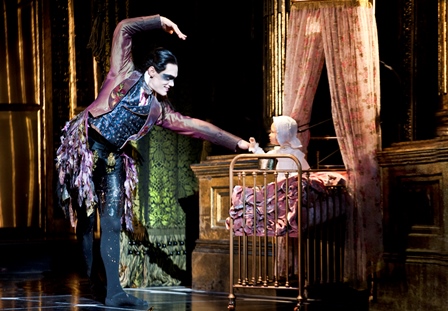
Matthew Bourne’s film of his re-imagined Sleeping Beauty, a work that premiered as a live show late in 2012, was recorded over a week during performances at the Bristol Hippodrome. It was filmed in HD, not 3D. Personally, I remain a sceptic of dance in 3D and Bourne’s film confirms for me that in this day and age a well thought through and edited film of a live performance can have all the visual impact and passion for dance that one might wish to see. As I have not seen the live show at this stage my comments on the film are also comments on Bourne’s version of what is generally regarded as an iconic work in the ballet repertoire. My preview story, published in The Canberra Times on 7 September 2013, is at this link. It gives something of the background to the work, which I won’t go over in this post.
Count Lilac with the baby Aurora in Matthew Bourne’s Sleeping Beauty. Photo: Simon Annand. Courtesy Sharmill Films
What struck me instantly about the work itself was that Bourne is an amazing storyteller and has a great way with theatrical tricks. Nothing surprising there though. We have seen it before from Bourne. Nevertheless, I need to say it again. Moving the storyline from 1890 and the babyhood of Aurora, to 1911 and her coming of age and on to the present and her marriage—and the surprise of what comes right at the end, Bourne has indeed as he says ‘created a different look and set of manners, including theatrical manners, for each era’. I loved the dancing in the Edwardian scenes (Aurora’s coming of age) with great use made of Tchaikovsky’s well known waltz. But my favourite ‘set of manners’ came as the 100 years of sleep passed by and Aurora’s palace home became legendary and a spot for tourists to gather and take photos of themselves and the site with their mobile devices.
Perhaps the most difficult ‘era’ to reconcile (for those who have been brought up with Aurora’s Wedding as a staple in their dance-going experiences) is the present day nightclub scene when Aurora is sacrificed on the altar of Caradoc, son of Carabosse and the rival love interest. Aurora’s Wedding was never like this! But her rescue and the subsequent events washed away any feeling of being ill at ease.
I couldn’t help feeling at times that Bourne was making allusions to other ballets as the work proceeded. Those tennis players who appeared in the Edwardian scene were surely a reference to Nijinsky’s Jeux and as Aurora lay on the ground falling into her deep sleep with her mother leaning over her, grief-stricken, we seemed to be seeing an allusion to the end of Giselle Act I. And was that bespectacled man in the white suit and hat lurking in the background as the Edwardian scene came to an end a reference to Aschenbach in the Visconti film Death in Venice? I saw those allusions whether or not they were intended and I guess this is what made this Sleeping Beauty so rich and engrossing for me. There was never a moment when one tended to drift away. Too much happening, too much to think about.
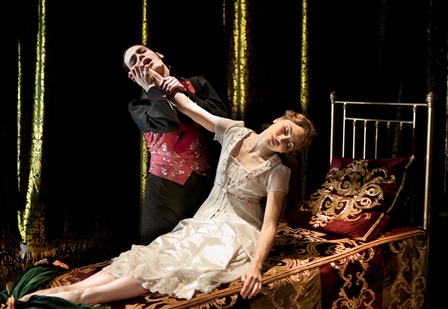
Looking at the work as a film, I admired in particular the way close-ups were judiciously shot to advance our understanding of the characters. I am thinking in particular of the close-up shots of Caradoc. Dressed magnificently in red and black by Lez Brotherston, whose designs for the work are extraordinary, we got the picture pretty quickly—a scheming, brooding man. Takes after his mother no doubt!
Caradoc and the sleeping Aurora in Matthew Bourne’s Sleeping Beauty. Photo: Simon Annand. Courtesy Sharmill Films
Filmed live as it was, it was charming to have an audience reaction—both laughter and applause—that wasn’t canned. And the intertitles that told the story as the work moved along from scene to scene were set inside a border of roses that themselves told a story—a black rose, a white rose, a red rose. All had a special meaning within the work. The production sped along. I was immersed in it all and relished the performances, especially from Hannah Vassallo as Aurora. Even the credits were gorgeous with action shots of the main characters as their names flashed up.
This is one to see a few more times and, although Bourne says that it is good to know the traditional version as then it becomes more apparent how he has treated the storyline and developed the characters, I suspect this is a film that can also be enjoyed by those who aren’t so aware of the traditional version.
4 September 2013, State Theatre, Victorian Arts Centre, Melbourne
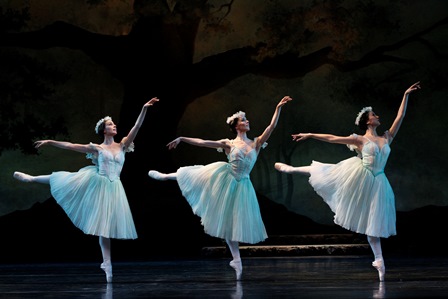
This double bill opened with Paquita (or parts of it), a work in the classical tradition of Marius Petipa. It concluded with a Romantic work, La Sylphide, with the Erik Bruhn choreography after August Bournonville. Putting a work from the classical era with one from the Romantic age is probably a little risky. For such a program to be a success stylistically the company involved needs to have a good understanding of the differences between the styles and, more importantly, dancers who can demonstrate those differences. With the cast I saw, I’m not sure this happened.
Paquita was led strongly by Leanne Stojmenov and Daniel Gaudiello and the corps de ballet worked beautifully together giving a performance that made me smile with pleasure at how exciting pure classical ballet can look. The brilliance, the formality, the elegance and decorum that characterise classicism in ballet were all there. Ako Kondo was the absolute star in this performance of Paquita. She hadthe third solo and her series of relevé turns in attitude and arabesque, and her diagonal of double pirouettes were spectacular. And how gorgeous to see her execute a grand jeté en tournant with the arms lifting and lifting into and through 5th position as if the arms were (as they should be) part of the movement and not just an add on. Wonderful. Other soloists performed well but could not come anywhere near Kondo for pushing the ballet technique to the limit.
On the other hand, La Sylphide, led by Lana Jones as the Sylph and Chengwu Guo as James, was a little disappointing. I don’t believe Jones is suited to the Romantic style, or else she was not well coached in her preparation for this role. Although she is more than capable in a technical sense of executing all that is needed throughout the ballet, she looked more than a little coy and her movements seemed stiff, especially in the upper body. She certainly didn’t seem ethereal to me. Chengwu Guo has a a beautiful jump and technique in general. His entrechats and other beaten steps were outstanding, especially in his Act II solo. But it all looked so forced, as if he were trying too hard. And for me the beautiful ballon that so characterises Bournonville was missing. Bournonville doesn’t have to look spectacular, it has to look easy, which is different from hard-edged spectacular. In looking easy it gains its own very distinctive, remarkable appearance.
But what was really disappointing was that I thought the supernatural element was totally missing in Act II. Little of the mood had changed from Act I and, really, if the Australian Ballet is going to stage a work of the Romantic era it needs to work to make the dichotomy between the real and the surreal more clear, whatever cast we might be looking at. That dichotomy is at the heart of Romanticism in ballet.
I went to the theatre to see this show with a somewhat petulant review from a well-known English critic in my mind. ‘Impertinent’ he wrote (amongst other things), referring in this case to the use of Igor Stravinsky’s first name in the expanded title. Well I found iTMOi, despite its odd title, a fascinating show. Did I understand what was going on? Not completely. But then that was part of the show’s appeal. It generated a conversation with my companion, which went on for some time. Was it an example of that dreaded concept, postmodern? Did it relate to French literary theory? And so on.
The work, choreographed by Akram Khan and danced by his company, is in celebration of Igor Stravinsky and the centenary of his ground breaking composition, The Rite of Spring. Khan sets out, somewhat ambitiously, to investigate Stravinsky’s transformative approach to musical composition. But iTMOi also had, at least in my mind, more than one reference to the Nijinsky ballet created to the Stravinsky score. One dancer, small and vulnerable, is ‘chosen’ to bear the torment of the other dancers when a woman in a crinoline with a top that exposes her breasts throws white dust in her hair.
The work opens with the sonorous sound of a bell ringing over and over and a preacher of sorts shouting, or perhaps ranting is a better word, about the biblical story of Abraham, Abraham’s willingness to sacrifice his son Isaac, and the intervention by which Abraham’s god provides a ram in a bush as a replacement sacrificial body. ‘And the angel of the Lord came down’, the preacher shouts. (It took me a while to work out, I have to admit, that the dancer dressed as a horned beast who dragged himself across the stage at various intervals was probably the ram in the bush). From there we were bombarded with a score that went from sounding at times like a gramophone needle stuck in the groove of a vinyl record to being a variation on the religious prayer, kyrie eleison, not to mention the inclusion of what seemed like the ‘beep’ of a truck reversing. The score is the work of three composers, Nitin Sawhney, Jocelyn Pook and Ben Frost.
The dancing by Khan’s company was stupendous. Sometimes they looked like whirling dervishes. Sometimes they were totally idiosyncratic, as was the case with a male dancer wearing a hooped skirt who turned variations on a cart-wheel and balanced on his hands while transforming his feet into an expressive instrument. But the dancers were always powerful movers as they stamped, twisted, turned and threw themselves around the stage. The show was visually mesmerising as well with its strong lighting design and frequent use of shadow play.
Michel Foucault once wrote: ‘One day, perhaps, we will no longer know what madness was…All that we experience today as limits, or strangeness, or the intolerable, will have joined the serenity of the positive.’ And was that Foucault’s pendulum (the other Foucault that is) swinging back and forth as the work closed? Dance doesn’t usually offer the opportunity to wonder and ponder to the extent that was offered by iTMOi. I’m glad that all dance is not like iTMOi, but it was an exceptional experience to have seen it.
3o August 2013, Studio Theatre, Sydney Opera House
With his latest program, Les Illuminations, Sydney Dance Company’s Rafael Bonachela has given audiences a new look at his spectacular dancers. This is an intimate program, made so by its venue, the Studio at the Sydney Opera House, and by its setting within that venue. The program, which consists of two short pieces both to music by Benjamin Britten, Simple Symphony and Les Illuminations, is danced on a T-shaped catwalk with the audience seated in the round. On the cross bar of the ‘T’ sits a string ensemble of musicians from the Sydney Symphony Orchestra. They are joined in the second part by singer Katie Noonan, who sings the soprano role in Les Illuminations. The dancers perform entirely on the long line of the T.
What struck me instantly as Simple Symphony began was that Bonachela was taking advantage of the restricted performance space and was using more high lifts than usual. ‘Boisterous Bourrée’, the opening duet danced by Janessa Dufty and Andrew Crawford, began with a kind of ‘presage’ lift and continued with some gorgeous partnering, including more lifts. These two dancers set up a lovely partnership not only by dancing so well but also through their emotional connection with each other. Touch, glances, head movements, all played a part in making this duet a wonderful opener. The third part, ‘Sentimental Sarabande’ also stood out for its strong and emotionally engaging dancing by Fiona Jopp and Bernhard Knauer. With Toni Maticevski’s close fitting, light coloured costumes, decorated with pale turquoise trimmings, and the often playful moments in the choreography, Simple Symphony reminded me of a pastoral romp.
There was nothing pastoral about the second section of the program, Les Illuminations. This was a darker side of life and featured just four dancers once more—Juliette Barton, Charmene Yap, Thomas Bradley and Cass Mortimer Eipper. The title Les Illuminations relates to a poem written by the Frenchman Arthur Rimbaud and the choreography seemed to me to have many elements that characterise Symbolism, a movement in the arts that was ‘in the air’ at the time when Rimbaud and his lover Paul Verlaine were writing. Ideas were suggested as dancers prowled around their long, narrow space casting telling glances at each other. Nothing seemed obvious. Maticevski’s costumes, this time sleeveless bodysuits in black with the addition of a black feathered headdress worn by Barton and a black face mask worn by Bradley, suggested a kind of decadence to me, again part of the Symbolist mood.
This second part of the program was certainly striking and as ever beautifully danced but I’m just not sure that the ideas that Rimbaud was writing about can be well portrayed through the medium of dance. It did, however, set up an effective contrast with Simple Symphony.
Michelle Potter, 1 September 2013.
NOTE: A dance work to Simple Symphony was first seen in Australia in October 1947 during a tour by Ballet Rambert. That version was choreographed by Walter Gore. Gore’s Simple Symphony was filmed in Brisbane (outdoors, or at least partly outdoors, if I remember correctly from watching the film some years ago) in 1948. Here is the National Film and Sound Archive’s catalogue record. Although of course Bonachela’s Simple Symphony is quite, quite different, it makes a nice tie-in with the Gore production, given Bonachela’s connections with Rambert Dance.
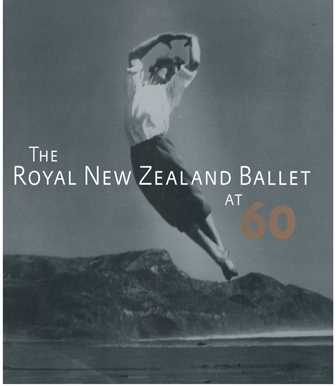
This handsomely produced book celebrates sixty years of performances by the Royal New Zealand Ballet. I say handsomely produced because its square-ish format is aesthetically pleasing and easy to hold in one’s hand, its illustrations are well reproduced and there are plenty of them both in black and white and colour, its paper is smooth and glossy and lovely to touch, and the layout of text and image leaves plenty of white space on the page so nothing looks jammed up.
Edited by Jennifer Shennan and Anne Rowse and published by Victoria University Press, The Royal New Zealand Ballet at 60 brings together a collection of articles, letters, reminiscences and poems covering the company’s fortunes from 1953 when it was set up by Danish dancer Poul Gnatt to its present manifestation under the direction of American artist Ethan Stiefel.
The first section consists of contributions from each of the company’s artistic directors, where they are still living. Poul Gnatt and Bryan Ashbridge, who are no longer alive, are represented with writing from Jennifer Shennan and Dorothea Ashbridge respectively. Then follows a collection of reminiscences and thoughts from a whole variety of people who work or have worked with the company—dancers, choreographers, board members, wardrobe staff and others closely connected with the company’s activities.
With this kind of arrangement of material, where there are at least fifty different contributors, some writing is bound to stand out and some is bound to be less interesting, less well written. The unevenness in the quality of the writing is perhaps the book’s shortcoming. But this is tempered by some vibrant writing and some fascinating stories that bring to life both the highs and lows of the company’s chequered history.
What struck me as I was reading the section on artistic directors was how much is revealed of a person’s approach to life and work through his or her writing. Harry Haythorne’s essay, for example, reveals the depth of thought that went into, and that continues to inform his work. Haythorne directed the company from 1981−1992. From this perspective I also enjoyed the essay by Gary Harris, artistic director from 2001−2010. It reminded me of the times I interviewed him and the friendliness of the man that I encountered on those occasions. I also enjoyed Shennan’s essay about founding director Poul Gnatt, filled as it is with information about Gnatt’s early life in Denmark.
From the reminiscences, I loved reading about Eric Languet, dancer with the company from 1988−1998 and for a few years resident choreographer, in his essay ‘I would like to come home one day’. Although he has some Australian connections, his and my paths have never crossed. He writes with admirable honesty about his time in New Zealand and one of my favourite images in the book is from Alice, which he choreographed in 1997. And reading Douglas Wright’s account of performing the leading role in Petrouchka is, quite simply, a rare privilege. It is unusual to hear in some depth from artists about their approach to a role and their thoughts as they prepare for and then perform it. Wright’s essay is followed by a poem, ‘Herd’ written by Wright and beginning with the delicious line ‘a herd of cows does not need a choreographer’. Readers may be surprised at how the poem ends too!
One typo in the book makes me wince somewhat. In Una Kai’s essay (Kai was director from 1973−1975), which is interesting for a whole variety of reasons, Lew Christensen’s name is wrongly spelt. Typos are the bane of all our lives but it is not the best when personal names don’t get the attention they deserve.
Unlike other recent publications in a similar vein, and despite any shortcomings I might find in it, The Royal New Zealand Ballet at 60 makes a useful contribution to the history of the Royal New Zealand Ballet. Its editors, contributors and publisher deserve to be congratulated for avoiding making it into some kind of media driven, ultimately barren publication.
Jennifer Shennan and Anne Rowse (eds), The Royal New Zealand Ballet at 60, (Wellington: Victoria University Press, 2013) Hardback, 350 pp., illustrated ISBN 978086473891 RRP NZD 60.00
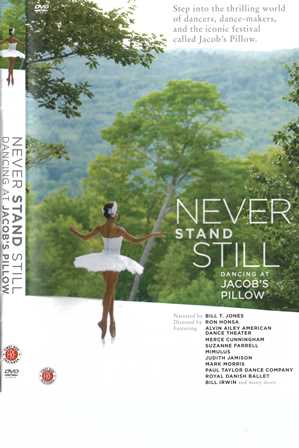
I finally got round to getting myself a copy of the DVD Never stand still: dancing at Jacob’s Pillow. And I’m so glad I did. What is particularly satisfying about this DVD documentary is that there is no promotion of a particular company or a person and no media hype. It’s simply about dance in its many and varied forms. ‘Dancing is direct and honest,’ says Mark Morris, one of the several illustrious interviewees appearing on Never stand still. And that’s what we get: direct, honest and simply beautiful dance.
A few sections particularly stood out for me, although others will have their own favourites I am sure. I especially enjoyed segments featuring Mark Morris and his dancers, perhaps because those works of his I have seen recently have not impressed me to any great extent—Beaux danced by San Francisco Ballet and Pacific from Houston Ballet, both of which I saw earlier this year, left me feeling underwhelmed. Never stand still has some lovely footage from Morris’ Italian Concerto and LoveSong Waltzes and a brief look at a work called Falling Down Stairs, which Morris made in conjunction with cellist Yo-Yo Ma, whom we also see on the DVD. The excerpts from these works show quite clearly what Morris is best known for, his astonishing musicality. And Morris is a forthright and articulate speaker in his interview segments.
I was also especially taken with Shantala Shivalingappa, a solo Kuchipudi dancer born in Madras and raised in Paris. What an amazingly expressive body she has and how she uses it to her advantage. Every movement fills the space and she seems to linger a little at the high point of each movement before seamlessly continuing to the next.
Segements featuring Suzanne Farrell speaking about her transition from Balanchine ballerina to company director make interesting viewing as do excerpts from Balanchine ballets she has set on her own company. Natalia Magnicaballi, a principal with Suzanne Farrell Ballet, is startlingly good in the lead in Tzigane.
Gideon Obarzanek makes an appearance and there are excerpts from his work I want to dance better at parties performed by Chunky Move. I also loved the all too brief footage from Bournonville’s Napoli courtesy of the Royal Danish Ballet, along with a brief discussion of the Danes making their first appearance in the United States at the Pillow at the invitation of Ted Shawn. Then there’s Paul Taylor, Merce Cunningham, Judith Jamison, tap, vaudeville…so much more.
Interspersed throughout the contemporary footage is rare archival material showing some of the early performances at Jacob’s Pillow along with an underlying narrative about Shawn and the founding of the this renowned festival, an annual event held at Becket, Massachusetts, in the beautiful surroundings of the Berkshire Hills. If you’ve been there it will bring back wonderful memories not just of the variety of dancing on offer, but of that glorious outdoor stage, those barns and the spectacular surrounding countryside. If you have not had the good fortune to be there Never stand still will make you want to pack your bags for 2014.
Never stand still is so worth watching and is available online at the usual places for quite a small amount of money, even with our dollar falling against the greenback. Watch the trailer below.
28 June 2013 (dress rehearsal), National Gallery of Australia, Canberra
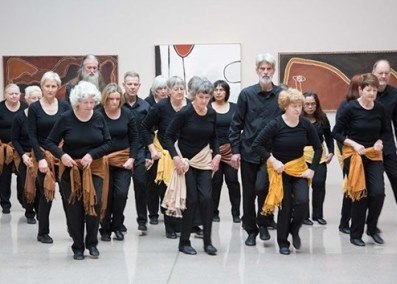
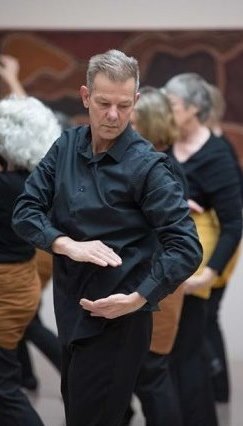
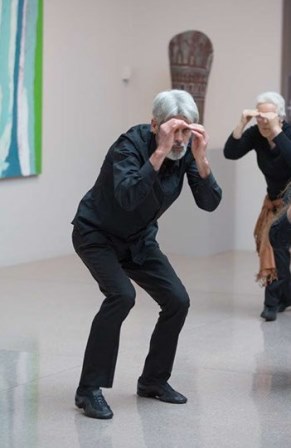
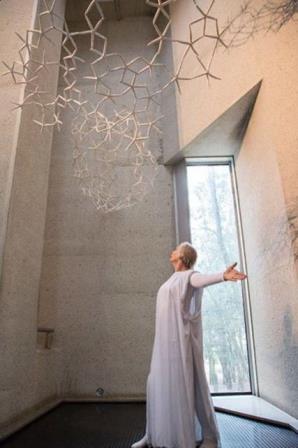
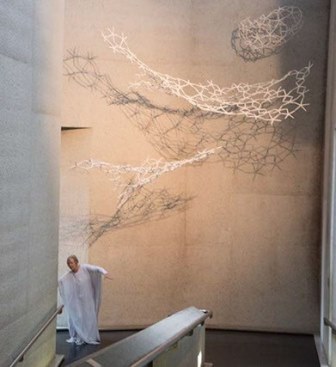
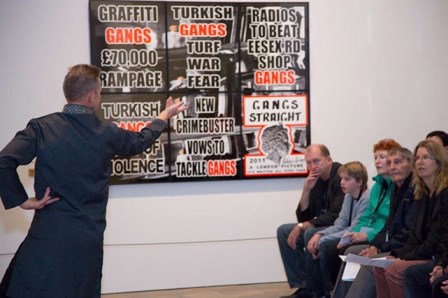
In my June 2013 dance diary I mentioned a show at the National Gallery of Australia called Life is a work of art performed by the GOLDs, a group of performers over the age of 55. I have now received some images from that show and what follows is not a review as such, as GOLD is not a professional company, but rather some observations on some parts of the show. Life is a work of art was co-directed by Liz Lea and Jane Ingall and was a processional performance leading the audience through the National Gallery of Australia, pausing in particular galleries where specially commissioned dances were performed.
The section that worked best for me was staged in the Kimberley Gallery where art by Rover Thomas and other indigenous artists from the Kimberley region is on display. The section, called ‘Black/GOLD’, was choreographed by Tammi Gissell, a descendant of the Muruwari nation of northwestern New South Wales. It was performed to music composed and played by Francis Gilfedder.
Gissell wrote in her program notes: What a wonderful opportunity for Aussie Elders from all walks of life and cultural heritage to dance together in celebration of the rhythms and memories of this land. Australia now sensed freshly with knowing eyes and ears and footsteps. Black/GOLD is concerned with claiming ownership over one’s self, for this must occur to accept your role within a mob—the second yet equally important concern of the piece.
It struck me as I watched it that what made it especially powerful was perhaps the fact that in indigenous communities everyone dances. It seemed quite appropriate for these older, non-indigenous people to be dancing in front of indigenous art. And Francis Gilfedder, who sang and played the didgeridoo, was magnificent. Reading Gissell’s program note just increased my respect for her and the work. In the case of ‘Black/GOLD’ she chose a concept that is deeply entrenched within her heritage, made it relevant to the occasion, made it inclusive of her cast, and gave it a simplicity that belied the complexity of the concept. A real gem.
I was also impressed with ’A gentle spirit’ as a wonderful example of a site specific piece. As we progressed down a ramp to the sculpture gallery on a lower floor, we passed by Carol Mackay. She had a solo piece, which she performed at the corner of the ramp under Maria Cadoza’s Starfish. While our view of it was gone in a flash as we walked by, it was perfectly sited. Music for it was composed and played live by cellist David Pereira, but as I was at the dress rehearsal, at which he was not present, I’m not sure if he was a visual part of the piece, although from the images I received it appears not.
Finally, I enjoyed two pieces in the galleries of contemporary, international art: ‘Pop Art’, a piece choreographed by Liz Lea against a backdrop of works by Andy Warhol and others from the period of the 1960s; and ‘Caught between Kapoor’, an improvisation by Luke Mulders in Gallery 3.
Some parts of Life is a work of art, as I mentioned in my June dance diary, worked better than others for me. Here I have simply extracted a few sections that I especially enjoyed, which is not to say that the rest of the show was not enjoyable as well. It is a wonderful community dance concept and, despite the worries that staff at the National Gallery of Australia must have had as people (carrying stools) processed past and performers danced among such precious items, I hope the Gallery will consider doing it again.
All images courtesy of the National Gallery of Australia.
Michelle Potter, 30 July 2013
Featured image: A moment from ‘Black/GOLD’, Kimberley Gallery, National Gallery of Australia, 2013
22 June 2013 (matinee), State Theatre, Victorian Arts Centre, Melbourne
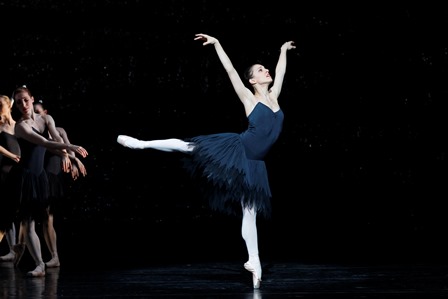
The first thing to say about this performance of Graeme Murphy’s Swan Lake is that Leanne Stojmenov as Odette was absolutely stunning. It all began with that Act I wedding waltz. Partnered by Andrew Killian as Siegfried, Stojmenov not only danced with delicious fluidity in the upper body, she was also so attuned to the music and was so much the happy young bride. And how often does that beautiful white gown with its long, long train impede parts of the movement? Not this time. The gown was manipulated pretty much perfectly so that, as intended, it was an intrinsic part of the choreography. It was a beautiful and absolutely captivating moment so early into the show and it was followed by some charming encounters between Stojmenov and the guests, especially with the children.
From there Stojmenov delivered some technically sumptuous dancing and swept us through a whole range of emotions until her final disappearance into the depths of the dark waters of the lake. As Odette at the lakeside in Act II her solo, with its remarkable ending—a backwards slide along the floor, was magnificent, as was the pas de deux with Killian, again with its breathtaking ending that moves from Siegfried holding Odette as a limp, bent-over body, which is then stretched out fully but is held parallel to the floor, to a fish dive, and finally to another slide to the floor. And perhaps nothing was more moving in a dramatic sense than Stojmenov’s encounters with Killian in the final moments of Act III. They were danced with all the abandon of a woman in the full knowledge that these moments were to be her last with the man she loves. A series of very fast, perfectly executed turns down the diagonal towards Siegfried, arms flailing up and down, summed it all up.
The second thing to say is that Murphy’s choreography in this work is nothing short of remarkable. Perhaps it is seeing this Swan Lake so soon after Stephen Baynes’ more traditional version that highlights what an expressive choreographer Murphy is. Not many choreographers are able to use the classical medium as an expressive, narrative tool, to move the story along through movement. Murphy does. Take, for example, Siegfried’s solo in Act I as he is torn between his new bride and his old love. He bends into himself, opens his palms wide and places them on his face, and at times moves with little jerky or contorted steps. It all speaks of indecision, inner turmoil, unspoken guilt even. Or take Odette’s meeting with Siegfried in the asylum. Here Murphy gives us all the twitching movements we might associate with Odette’s state of mind and yet there is something about her arm movements that recall those of a more traditional Odette, which not only links us with other stagings of Swan Lake, but also presages Odette’s lakeside dream, which is soon to come.
There are some magnificent images that surface throughout the work. In Act III, as the guests leave the party following the little tantrum by the Baroness, unevenly played on this occasion by Amy Harris, we see Siegfried and his friends against a backcloth that is a representation of M. C. Escher’s linocut, Rippled Surface. They are frantically looking for Odette who has left the party and a very new vision of Siegfried, Benno and friends on their swan hunt (seen in very old productions!) comes straight to mind. And shortly afterwards, when Siegfried arrives suddenly at the lakeside, alone this time, the beautiful choreographic patterns being made by those black swans are just as suddenly scattered into a flurry of different poses and different arm movements. We are left with a fleeting image of a flight of birds disturbed from their ordered existence as if a shot had been fired into their formation.
And I can’t forget Harry Haythorne in Act I as the Marquis (the photographer). While he commands centre stage at times, he also spends a lot of time up in the back OP corner with his camera and his little hanky, a wave of which indicates that a shot has been completed. Taking my eye off the central action for a moment I noticed him arranging a group of children in a special pose, and also photographing a kite that one child was flying. Never one to stand still and just watch the action!
And the third thing to say is that all the drama that was missing from the recent Baynes production was there for all to see in this Murphy production. Murphy’s knack of moving seamlessly from one situation to another and back was evident in Act II as we saw the lakeside dream begin with Siegfried and the Baroness meet outside the asylum window, and saw the dream end with a return to that same meeting. But more than anything the drama was gripping as Odette teetered from one emotion to another.
I do have a couple of gripes. It is annoying that so few of the cast were mentioned by name on the cast sheet. I didn’t have the best seat in the house. It was a way back and a little too much on the side so it was quite hard to identify who was dancing in smaller roles. Who danced the two leading Hungarians in Act I, for example? I thought they did a splendid job, especially the female dancer. [It was Dana Stephensen—see comment from Anna below]. And who danced the little swans and the two leading swans? It is extremely frustrating to have some of the minor characters in Act I named, characters who really have very little to do and certainly no dancing to speak of, when dancers who have relatively substantial dancing roles are not named. And I will never understand why the magic of those last moments has to be spoilt as the black cloth disappears from that circular piece of wood that is the lake leaving us to see a bit of cut chipboard. Come on!
Gripes aside, I was immensely moved by this performance. It was one of those rare performances, I think, where so much pours out, so much underlying logic becomes apparent, so much of the detail of the choreography is made clear, and so much is impossible to record! A huge bouquet to Stojmenov for carrying the dramatic line so well and dancing so sublimely. Performances like this are why I keep going back for more.
Michelle Potter, 23 June 2013
Featured image: Artists of the Australian Ballet in Graeme Murphy’s Swan Lake, ca. 2003
IMAGES: I have no images of this current production as yet and in any case, with Stojmenov giving the performance she did I really am not inclined to post an image of another Odette. The featured image is one supplied by the Australian Ballet some years ago, probably around 2002 or 2003. No photographer’s name is mentioned but I would be more than happy to correct that if someone can supply the name. Looking closely you might notice some dancers who are now principals!
UPDATE (later, 23 June 2013): The second image on this post is indeed of Stojmenov in Murphy’s Swan Lake kindly supplied by the Australian Ballet and by one of my favourite and most generous photographers, Jeff Busby.
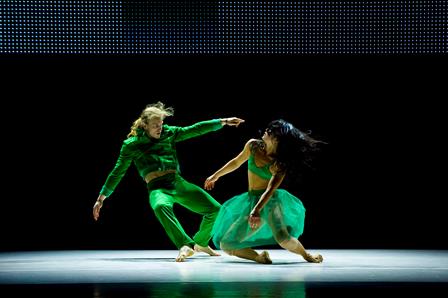
Garry Stewart’s G had a short run in Canberra last week. Although it first had a showing in 2008, this was my first opportunity to see it and once again I was impressed by Stewart’s exceptional approach, which combines his unique intellect with his emphasis on the physical. My review was published in The Canberra Times on 15 June 2013 and is reproduced below.
‘G is Garry Stewart’s deconstruction of Giselle made for the company Stewart directs, the Adelaide-based Australian Dance Theatre. But although G refers back to a ballet made in the 19th century, there are no happy, smiling peasants in pretty matching outfits celebrating harvest time, and no lines of ghostly Wilis dancing in the moonlight. Instead Stewart gives us a no-holds-barred examination of states of being that the traditional Giselle hints at but never blatantly puts before our eyes.
Stewart condenses the narrative and the story unfolds before us in words on an LED screen. Each of the main characters is known by the initial of his or her name. We read of the betrayal of G (Giselle) by A (Albrecht), a prince disguised as L (Loys) but who is really betrothed to a princess B (Bathilde, and the subsequent death of G and her entry into a spirit world of Wilis headed by M (Myrtha).
Props play a part in making the narrative clear. A sword, the weapon by which G dies, is used at various points, B and her party arrive wearing crowns to signify their royal status, and some dancers are carried, stiff and lifeless, across the stage wearing shrouds to represent the Wilis who have risen from their graves. Elements of the traditional Giselle are there.
But what really drives G is Stewart’s research into illness, hysteria, suicide and the inter-connectedness that was believed to exist between madness and sex at the time Giselle was created in 1841. It is largely a look at the state of mind of Giselle, the woman, rather than a story of love and betrayal. The dancers’ movements are often flagrantly sexual or irrationally repetitive. The work moves from left to right across the stage, unchanging and inexorable in direction but constantly changing in rhythm and intensity. Sometimes the dancers walk slowly and purposefully, sometimes they cross the stage with fast moving feet. Sometimes the movement looks quite classical but is soon followed by sequences where the dancers hurl themselves through the air in displays of extreme dancing.
There are, nevertheless, a number of references to traditional productions of Giselle, enough for audiences to make the link if they wish. Some such references are choreographic. Two dancers often partner each other with arms linked, imitating the steps Giselle and Albrecht perform in Act I of traditional versions, and dancers often walk across the stage with arms crossed over their chests, palms facing upwards in the pose that is characteristic of the Wilis in Act II. In addition, the electronic score by Luke Smiles includes a brief section taken from the 1841 score for Giselle by Adolphe Adam. And some more props remind us of the traditional Giselle, including a daisy held by one dancer as she crosses the stage towards the end of the work. It harks back to the ’he loves me, he loves me not’ game played by Albrecht and Giselle in Act I of traditional productions.
The physicality of the dancers of Australian Dance Theatre has become legendary and they certainly show their thrilling athleticism in G. But what is also admirable is the way in which they show the madness, the hysteria and the unstable, manic qualities that Stewart is seeking. Shaking hands, nodding heads, wildly flailing limbs, crazed eyes, they are all there and all electrifying to watch.
At its best, the traditional Giselle is a moving work leaving us to ponder, perhaps a little loftily, on many aspects of love, loss, betrayal and grief. Most of those who stage it look to the notions of Romanticism in the arts for their inspiration. Stewart’s G is clearly of today: there is nothing of the 19th-century Romanticism about it. But what makes it such a compelling work is that it makes new art from an old work without destroying the old and without compromising Stewart’s constant push towards the new.’
Michelle Potter, 17 June 2013
I had previously spoken briefly to Stewart about his interest in an article entitled ‘Giselle, madness and death’ published in the journal Medical Humanities in 2004, which has some bearing on the approach Stewart took. For anyone interested in this background here is a link to the article.