More thoughts on Nutcracker: The Story of Clara

I have to admit to disliking intensely the dumbing down of Graeme Murphy’s Nutcracker: The story of Clara with the ridiculous description of it as ‘The Gum-Nutcracker.’ The work might have strong Australian resonances, but it is much more than a story about early developments in Australian ballet. The so-called ‘affectionate dubbing’ of it with reference to the fruit of the eucalyptus tree makes the work sound pathetic. Below are a few published comments that suggest that we should grow up and resist the temptation to trivialise.

Speaking of the slight nature of, and problematic issues surrounding the more traditional productions of Nutcracker (going right back to 1892), Professor Rodney Stenning Edgecombe writes:

‘When foundations are sandy, it’s better to re-lay them in concrete. And that is indeed what the brilliant Graeme Murphy has done in his version of the ballet, which, having subtitled The Story of Clara, he conceives it, as Bournonville did his ballets, as ‘frames around the biographical and travel pictures which constitute [an] actual theatre life’.

He then proceeds to analyse the ballet, its story, its choreography, its music, and its place within the history of ballet (not necessarily Australian ballet), in the most erudite terms, making reference to, and using quotations from some of the great names of world scholarship—August Bournonville, T. S. Eliot, E. M. Forster, Marcel Proust, William Shakespeare, Percy Bysshe Shelley, Patrick White, and others. Speaking about the Snowflakes scene, for example, he writes:

‘The snowflakes’ wild pirouettes with upflung arms … show how inventively Murphy can work within restrictive confines of the danse d’école. Indeed one can’t help thinking that the writing for this ensemble is deliberately transitional, Petipa Duncanised as it were. And because ‘Petipa Duncanised’ is all but a synonym for ‘Fokine’—at least the Fokine of Les Sylphides—this episode illustrates the transformation that the very art of ballet witnessed during Clara’s childhood.’

What thrills me is that Edgecombe treats the work as an artistic creation of the highest order, one that deserves to be interpreted within the widest cultural context, not as some Snugglepot and Cuddlepie story (with apologies to May Gibbs). In his final paragraph, after discussing some issues he has with Marius Petipa’s work, and a similar issue he sees relating to the way Murphy has used a section of the music, Edgecombe says:

‘And what one allows to Petipa, one must allow to Murphy, a choreographer, in my opinion, of entirely comparable genius.’1

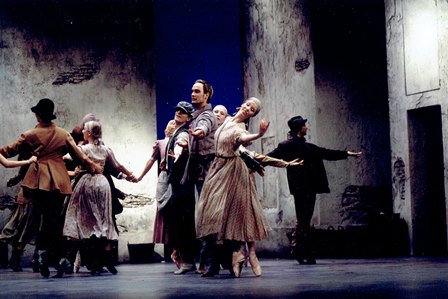
Dame Margaret Scott, Vicki Attard and David McAllister in Graeme Murphy's 'Nutcracker'. The Australian Ballet 1994. Photographer not identified
Dame Margaret Scott, Vicki Attard and David McAllister in Graeme Murphy’s Nutcracker. The Australian Ballet 1994. Photographer not identified

I am aware that not everyone will relate to the way Edgecombe writes and analyses but, like Edgecombe, Dame Margaret Scott, who danced Clara the Elder in 1992, 1994 and 2000, also speaks of the slight nature of traditional productions and recognises the extent to which Murphy’s ballet recontextualises the traditional work into something with more narrative and choreographic depth. In an interview in 2000, in which she replies to a question about why some found the Murphy production hard to accept, Dame Margaret says:

‘In the crits in the 1892 production, there was one critic who said, ‘It’s a pity that [such] fine music is expended on nonsense unworthy of attention.’ And in the 1992 production here, one of the crits said: ‘One of the great achievements of this production is that Tchaikovsky’s music sounds as if it was written to a brief from Murphy.

And then it goes on about the ballet itself. In 1892 the crit said, ‘Ballet is sliding downhill having lost its footing and moving away towards some kind of fragile and sugary Nutcracker.’ And then in Australia, ‘With Nutcracker the Australian Ballet came of age.’ I juxtaposed those two because it is relevant to the production.

I think if it had been called from the beginning, The Story of Clara, they would have accepted it. But it’s difficult to change the traditionalists. They still want the tutu ballet. And I mean, people don’t realise that the history of Nutcracker itself is a very chequered one. It only came into this popularity when the pantomimes died and it took the place of pantomimes because of its Christmas story. It became the cash cow, the Christmas entertainment. So to say it is popular because of a great love [is wrong] because a lot of people find it very dissatisfying.’2

It is common knowledge that Murphy was at first hesitant to accept the commission from Maina Gielgud to create a new Nutcracker. In an interview in 1996 he says:

‘Maina Gielgud had asked me years ago to think about doing a Nutcracker and I’d rejected the idea on the basis that the story was silly, the piece was clichéd, and I’d never really seen one I liked.’

But, thankfully, he eventually did accept the commission. He explains:

‘The clinch for me was the music, which I adore. So Kristian [Fredrikson] came over and we played the tape and I think somewhere in the course of that listening I was going ‘I can’t do a Nutcracker set in a postcard snowland, white Christmases and all that stuff. It doesn’t really mean anything. Maybe if you could do a Nutcracker set in arid Melbourne suburbia …’ And that was really the beginning of it.’3

What we have with Murphy’s visionary production should be regarded, especially by those who write media notes, as a ballet of international reach. Save gumnuts for other less sophisticated things. But if some see a need to dumb down the work with a crazy name (in order to attract more people and bring in more money?) then perhaps they should rename the Australian Ballet the Ocker Ballet?

Michelle Potter, 17 June 2017

References

  1. All quotes from Professor Edgecombe are from Rodney Stenning Edgecombe, ‘Graeme Murphy’s Nutcracker.’ Brolga, 17 (December 2002), pp. 23–32.
  2. Lee Christofis, ‘Coming of age. Retrieving history with Dame Margaret Scott and Valrene Tweedie OAM.’ Brolga, 13 (December 2000), pp. 44–58.
  3. All quotes from Murphy are from ‘Graeme Murphy. Humanity revealed’ in Michelle Potter, A passion for dance (Canberra: National Library of Australia, 1997), pp. 61–77.

See also the text of a program article I wrote for the Australian Ballet’s 2009 season of Nutcracker. The story of Clara. As a concluding remark I wrote, ‘This is a Nutcracker to be loved and cherished. Its Australian connections are heart warming and a source of pride and pleasure. But the dramatic text is universal.‘ Here is the link.

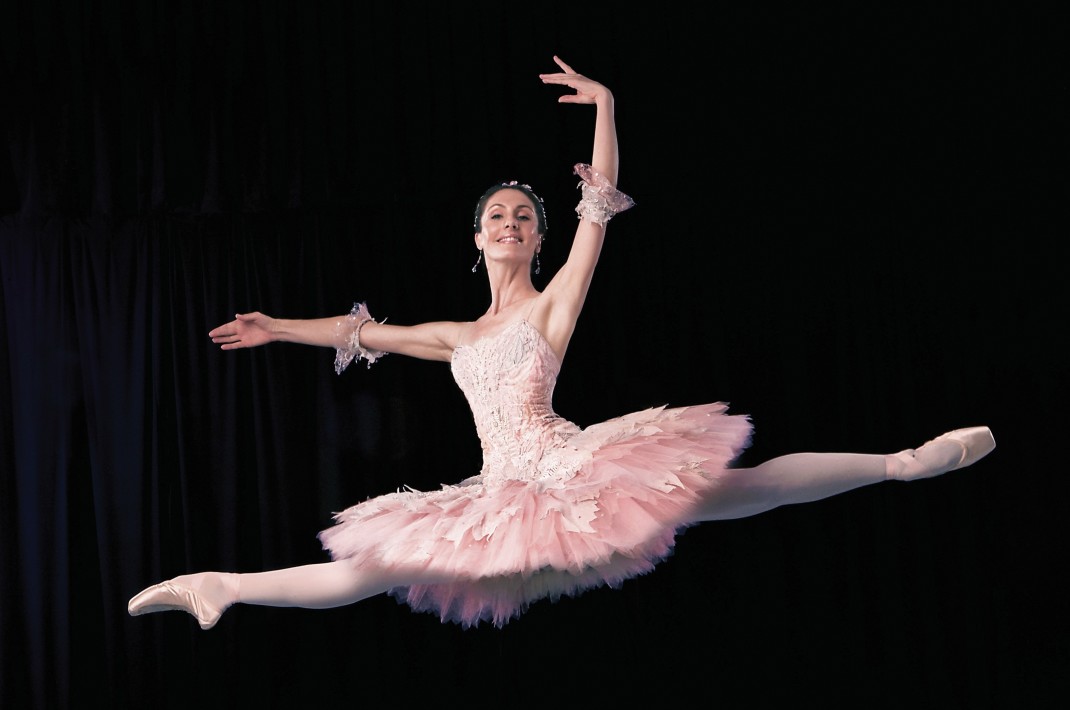
Featured image: Chrissa Keramidas as Clara the Elder in Nutcracker: The story of Clara. The Australian Ballet, 2017. Photo: © Jeff Busby

Chrissa Keramidas as Clara the Elder in 'Nutcracker. The story of Clara.' The Australian Ballet, 2017. Photo: © Jeff Busby

George Balanchine. Paris Opera Ballet

9 November 2016, Palais Garnier, Paris

This all Balanchine program, which consisted of Mozartiana, Brahms-Schönberg Quartet and Violin Concerto, was staged in honour of Violette Verdy (1933-2016) who directed the Paris Opera Ballet between 1977 and 1980. I recall too that Mme Verdy coached Australian Ballet dancers during the directorship of Maina Gielgud and, of course, Verdy was a ballerina of international standing with a strong heritage of performing Balanchine. She died in February 2016. Earlier performances of this program also included Balanchine’s Sonatine, created for Verdy and Jean-Pierre Bonnefous in 1975, although by the time I got to see the program, Sonatine (for reasons unknown to me) had been dropped.

I have to admit to being slightly disappointed with Mozartiana. I have wonderful memories of it as performed by New York City Ballet where I loved the pride and the dignity that accompanied the dancing, and where the four young dancers who are included in the cast (in New York always from the School of American Ballet) seemed to be the recipients of a great tradition. While there was nothing amiss with the dancing by the Paris Opera Ballet cast I saw, including the young performers from the Paris Opera Ballet School, the work looked like nothing more than a pretty ballet to me. I did especially enjoy, however, the folk overtones in the choreography, and the performance by the second male lead, Fabien Revillion. Mozartiana is a new addition this season to the repertoire of the Paris Opera Ballet so it will be interesting to see how it develops on this company.

On the other hand, Brahms-Schönberg Quartet, which I had not seen before, and Violin Concerto were a huge pleasure to watch. In part it was seeing them together that gave such pleasure as they embody two quite different aspects of Balanchine’s choreographic approach.

Brahms-Schönberg Quartet, also a new addition to the repertoire of Paris Opera Ballet but originally made in 1966, had startling yet quite beautiful, newly created designs by Karl Lagerfeld. For the ladies, the classical long tutu was maintained but the designs on the bodices were black and white geometric patterns, as were the designs on the jackets and vests worn by the men. Choreographically, the style was clearly classical with groupings occasionally reminding me of those in Les Sylphides, especially in the third movement. There were some very lyrical, swooning lifts in the second movement, in which the colour scheme was pink and black, and some strong male dancing throughout. The final movement, however, came as a shock, albeit a pleasant and probably very Balanchinian one. The ladies continued to dance in pointe shoes but the men were in boots and the movement was in a rousing Hungarian peasant style.

The Stravinsky Violin Concerto, on the other hand, was one of Balanchine’s black and white ballets and showed him in his ‘show pony’ style where dancers bounced through every movement with individuality, even when strong unified movement was required (and given).

Artists of Paris Opera Ballet in 'Violin concerto', 2016: Photo: Sebastien Mathe/Opera national de Pari
Artists of Paris Opera Ballet in Violin Concerto, 2016. Photo: © Sébastien Mathé/Opéra national de Paris

For me, the standout dancer in this work, and in fact in the entire program, was Hugo Marchand who partnered Amandine Albisson in the ‘Aria 1’ section. His own dancing showed great technical skills and his partnering displayed beautiful interaction with Albisson. I also loved his proud carriage of the body and particularly the way his body occupied the space around it—a very unusual quality possessed by very few.

Violin Concerto was given a remarkable performance and, while I’m not sure whether I was imagining this or not, I kept hearing brass instruments situated outside the orchestra pit. Surround sound? But wherever the brass instruments were, the sound from the orchestra of the Opéra national de Paris conducted by Kevin Rhodes was spectacular.

Michelle Potter, 10 November 2016

Featured image: Artists of the Paris Opera Ballet in Brahms-Schönberg Quartet, 2016. Photo: © Sébastien Mathé/Opéra national de Paris

Artists of Paris Opera Ballet in Brahms Schoenberg Quartet, 2016. Photo: Sebastien Mathe/Opera national de Paris

For my Australian and New Zealand readers, sadly Hannah O’Neill was not performing the night I was there.

Romeo and Juliet. The Royal Danish Ballet

11 March 2016. The Royal Theatre, Copenhagen

What a pleasure it was to be sitting in the auditorium of Copenhagen’s beautiful, old Royal Theatre waiting for the curtain to go up on a production of Romeo and Juliet—John Neumeier’s version too, which I had never seen: such a sense of anticipation not just because for me it was a different production, but also because it was about ten years since I last saw the Royal Danish Ballet. What a sense of occasion too because just as it was time for curtain up Queen Margrethe II of Denmark, a true balletomane, appeared in the Royal Box and the audience rose as one to welcome her.

But to the show …

The Neumeier Romeo and Juliet is said to have been partly inspired by John Cranko’s production, so well known to Australian audiences during the period of Maina Gielgud’s directorship of the Australian Ballet.  And yes, there is a spectre of Cranko somewhere there. But on the other hand, Neumeier’s production is quite distinctive. Choreographically it is absolutely fascinating, especially in the way it contrasts the movements of the elders of the Capulet and Montague families and those of the younger folk across the social strata. Both groups are given what I can only say are beautifully eccentric movements, especially for the arms and upper body. The elders often use a highly formalised vocabulary, while the young people have a freedom that sometimes verges on the wild. Gorgeous. And how beautifully did the dancers of the Royal Danish Ballet respond to this vocabulary!

Ida Praetorius as Juliet was completely entrancing. She showed off a stellar technique—the highlight for me came when she was refusing the attentions of Paris and at one point, in desperation, tossed off an amazing, perfect double turn in arabesque with arms flung upwards and body slightly tilted. But not only did she dance with such perfection, her characterisation of Juliet was brilliant. She played the role as it was written—she was a thirteen year old. She often seemed slightly awkward of limb, she often made her youth clear by seeming not to know how to behave in every situation, and her nervousness and vulnerability were clear, especially when she executed that wonderful stumble on the last few stairs as she entered the ballroom for the Capulet ball. But throughout, her youthful, slightly crazy love for Romeo was always obvious.

Andreas Kaas and Ida Praetorius. The Royal Danish Ballet. Photo: © 2016 Costin Radu
Andreas Kaas and Ida Praetorius in Romeo and Juliet. The Royal Danish Ballet. Photo: © 2016 Costin Radu

As Romeo, Andreas Kaas was as ardent and dramatic in love as one could hope. His enthusiasm and desire for Juliet showed in his every movement. He rushed to her. He could scarcely hold back his longing for her. Kaas and Praetorius, together, made the two characters come alive in a way I have never seen before. It seems like a partnership made in heaven from both a dancerly and dramatic point of view.

Another stand-out performance came from Sebastian Haynes as Mercutio, dashing and charismatic as a character, thrilling as a dancer. His death scene was powerfully moving and made more so by the feisty way Romeo took on Tybalt after the stabbing. I also admired Susanne Grinder as Lady Capulet. She moved with such strength and such elegance, sweeping her way through Neumeier’s formal choreography and wearing her bright orange gown with style and aplomb—a true aristocrat. And I have never taken all that much notice of the entourage that enters the square to try to restore some peace to the conflicts between the Capulets and the Montagues. But in this production Poul-Erik Hesselkilde was a towering presence as the Prince of Verona. Mostly he stood still, centre stage, but he was so in command of the role that his power spread across the stage and out into the auditorium.

There were so many magical moments, too, inserted by Neumeier to make more sense of the story. The potion that the friar gives to Juliet, for example, we know is not a deadly poison but Neumeier introduces a group of street performers who, in a commedia dell’arte manner, mime the effect the liquid will have. Juliet and the friar stand motionless, in a kind of freeze frame, in the act of giving and receiving the vial.

As is usual in Royal Danish Ballet performances, the presence of children in the crowd scenes was always noticeable. I loved the way the adult dancers in the corps de ballet interacted with them, shielding them from fight scenes, making sure they hurried off during the more gruesome moments. And as for the corps, I loved that they looked as though dancing was their life and not just their job.

Costumes and sets were by Jürgen Rose, also responsible for the design of the Cranko production. But his work for Neumeier had a very different feel and was often unusual in the way Neumeier’s choreography was unusual. His striking red wedding dress with white turban for Juliet was quite startling, for example, and the church for the wedding, which was created as plain brown flats slid beautifully and noiselessly into place, had all the simplicity of a Cistercian abbey church. Nothing was overdone but everything contributed beautifully and economically to the unfolding story.

This Romeo and Juliet was such a striking production, so beautifully danced by the entire company and musically thrilling—it just took my breath away. The evening sped by and it was by far the most exciting and captivating performance I have seen for years, anywhere in the world.

Ida Praetorius and Andreas Kaas. The Royal Danish Ballet. Photo: Costin Radu
Ida Praetorius and Andreas Kaas in Romeo and Juliet. The Royal Danish Ballet. Photo: © 2016 Costin Radu

Michelle Potter, 15 March 2016

Coppélia. Australian Conservatoire of Ballet

18 December 2015 (evening), Hamer Hall, Victorian Arts Centre, Melbourne

What a wonderful surprise this performance was! The venue was interesting—Hamer Hall is basically a venue for concerts and so the performance space is without a proscenium arch. But the unusual space was used thoughtfully and little of the theatricality that is achieved with a proscenium-style theatre was lost.

This Coppélia was staged by Maina Gielgud especially for the Australian Conservatoire of Ballet, a training establishment led by former Australian Ballet dancers Christine Walsh and Ricardo Ella. Gielgud had added some choreography and had made some changes in order to accommodate her cast, including giving Swanilda (Swanhilda in this production) a little sister called Elysia, adding two extra friends for Swanilda and, with fewer male dancers than might be available in a company, rearranging some dances slightly. Gielgud also re-imagined somewhat the character of Dr Coppélius having him make two swans, a spider, a caterpillar and other creatures, which we saw in his workshop in Act II,  in addition to his ultimate creation, the doll Coppélia. Otherwise the ballet ran as we have come to expect.

Coppelia's friends in rehearsal, Australian Conservatoire of Ballet, 2015
Coppélia’s friends in rehearsal, Australian Conservatoire of Ballet, 2015

But this was no ordinary school production. The dancers had been beautifully trained, thoroughly rehearsed and looked like professionals. It was a thrill to see such a sense of engagement among the cast throughout the show, which of course transfers across into the auditorium and gives the audience a sense of engagement as well. And this theatricality began early with a wonderful performance of the Act I Mazurka. This was not one of those staid renditions that we often see. This was real character dancing with bodies bending, faces beaming with pleasure, and steps being performed strongly. And the same can be said of the Czardas that followed later in the act

Two guest artists from Tokyo Ballet, Maria Kawantani and Arata Miyagawa, took the leading roles. Both were beautiful dancers but, in particular, Miyagawa as Franz was technically superb. Everything was so cleanly executed. His double tours were done with such perfection in the body and feet (and amazing landings in a perfectly placed demi-plié), but they also soared upwards in a way that made me gasp. Then there were the manèges of various steps, the pirouettes, his partnering—he was just brilliant. But more than that, he too had that sense of engagement with everything and everyone on stage. I just loved the way he blew kisses across the stage to Swanilda as she was about to start a variation in Act III.

Another standout performer was the young girl, Hana Glasgow-Palmer, who played Swanilda’s little sister. Too young yet to be part of the Conservatoire’s professional training program, she nevertheless gave the role real character. Her outstanding stage presence and, again, that ability to engage, augurs well for her future. I also especially enjoyed Prayer, danced calmly and serenely by Victoria Norris. But every dancer contributed beautifully to this performance and, quite honestly, in a number of ways it outshone many a professional show I have seen.

The music was played by the Australian Conservatoire of Ballet Orchestra, with some musicians seated on a dais upstage, others above the stage space. The orchestra was led by conductor Peter Tandy and there were times when the music gave me goose bumps, again something I don’t normally feel when listening to orchestral accompaniments at the ballet.

This Coppélia was a significant achievement for all concerned.

Christine Walsh, Maria Kawatani, Maina Gielgud

Michelle Potter, 22 December 2015

Artist of the Australian Ballet in costume for 'Coppelia'. Photo: Justin Ridler

The Australian Ballet in 2016

Mixed in with old faithfuls like Swan Lake and Coppélia, the Australian Ballet’s program for 2016 contains one or two works that we can anticipate with a bit of excitement. One of them is John Neumeier’s Nijinsky, which will be seen in Melbourne, Adelaide and Sydney, although we will have to wait until the last few months of the year.

Nijinsky was created in 2000 for Neumeier’s Hamburg Ballet and was seen recently in Australia when Hamburg Ballet performed it in Brisbane in 2012. On that occasion it received a standing ovation on its opening night—and I mean a real standing ovation where the theatre rose as one. No stragglers, no people leaving to catch the subway before the rush, no one standing up because they couldn’t see what was happening because the person in the row in front was blocking their view. A proper standing ovation. Neumeier calls Nijinsky ‘a biography of the soul, of feelings, emotions, and of states of mind’. It needs wonderful dancing, and fabulous acting. My fingers are crossed. Here is what I wrote about it from Brisbane.

Another program that fills me with anticipation is a triple bill called Vitesse presenting works by Christopher Wheeldon (DGV: Danse à grande vitesse), Jiří Kylián (Forgotten Land) and William Forsythe (In the Middle, Somewhat Elevated). It is scheduled for the early part of the year and will be seen in Melbourne and Sydney.

Forgotten Land and In the Middle are not new to the Australian Ballet repertoire having been introduced during Maina Gielgud’s artistic directorship. I remember watching people leave the auditorium after the opening sounds of Thom Willems score for In the Middle (it was 20 years ago), but it showed off certain dancers of that era absolutely brilliantly. But the Wheeldon is new to Australia. It is a work for 26 dancers with four pairs of dancers at the heart of the work. It shows in particular Wheeldon’s skill at creating pas de deux. In the Royal Ballet program notes from its showing in 2011, Roslyn Sulcas writes of Wheeldon that ‘[He]—like his ballets—is both traditional and innovative, able to inhabit an older world while moving firmly forward towards the new.’ Here is what I wrote after seeing it, on a very different mixed bill program, in London in 2011.

Then I await Stanton Welch’s Romeo and Juliet, exclusive to Melbourne in June and July, with anticipation mixed with trepidation. I was not a fan of his Bayadère, although I have loved some of his shorter works. But the word is that his R & J is ‘quite good’. Fingers crossed again.

Dancers of Houston Ballet in Stanton Welch's 'Romeo and Juliet'. Photo Amitava Sarkar
Dancers of Houston Ballet in Stanton Welch’s Romeo and Juliet. Photo: © Sarkar

As for the rest of the year, Brisbane will get Ratmansky’s Cinderella in February; Stephen Baynes’ Swan Lake returns with seasons in Sydney, Adelaide and Melbourne; a program called Symphony in C will run concurrently in Sydney with the Vitesse program, although it is not exactly clear as yet of what the Symphony in C program will consist; and Coppélia will be in Sydney and Melbourne towards the end of the year. I think this is the Peggy van Praagh/George Ogilvie production from 1979, but the media release is a little confusing. ‘Having first revisited Coppélia in 1979, the great choreographer re-invigorated it thirty years later with this joyful and sumptuous production.’ Who is that great choreographer? Not PVP who was not really the choreographer and who died anyway in 1990.

And for my Canberra readers, we won’t be seeing the Australian Ballet in 2016 in the national capital where we too pay taxes.

Michelle Potter, 23 September 2015 

Featured image: Dancer of the Australian Ballet in costume for Coppélia, 2015 (detail). Photo: © Justin Ridler

Artist of the Australian Ballet in costume for 'Coppelia'. Photo: Justin Ridler
  • Full details of the 2016 season are on the Australian Ballet’s website.

Dance diary. May 2015

  • Oral history

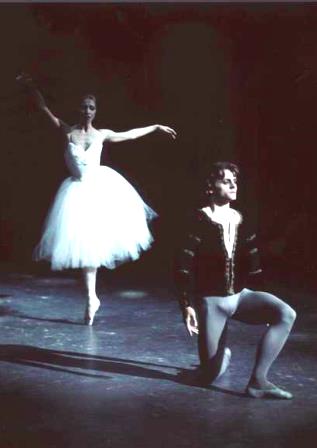
I recently had the pleasure of recording an oral history interview for the National Library with Marilyn Jones. I first interviewed Jones in 1990 as part of the Esso Performing Arts and Oral History Archive Project, so this 2015 interview was a follow-up after 25 years. The image below captures, I think, the essence of Les Sylphides and Jones’ ability to dance that elusiveness.

Marilyn Jones and Jonathan Watts in 'Les Sylphides'. The Australian Ballet 1963. Photo Walter Stringer, National Library of Australia
Marilyn Jones and Jonathan Watts in Les Sylphides. The Australian Ballet, 1963. Photo: Walter Stringer, National Library of Australia

The interview requires written permission for use so will not be available online, but in many respects oral history is for the future. I certainly have become more and more aware of its intrinsic value as time passes. The full story of the Australian Ballet strike of 1981, for example, which took place during the artistic directorship of Jones, is yet to be told. Several interviews in the National Library’s collection give a variety of perspectives and await the historian.

Other dance interviews I have recorded in the past six months have been with Peter Bahen, Lisa Pavane and David Deverelle-Hill.

On the subject of the Esso Performing Arts material, there are 41 interviews, not all of which are dance-related, in that collection and a list can be accessed via the National Library catalogue. Many are available online.

  • Juliet Burnett

It came as something of a shock to learn that Juliet Burnett is leaving (has already left I think) the Australian Ballet. She has given me, and I’m sure many others, such a lot of pleasure over the past few years. Just recently, her performances in the leading roles in Graeme Murphy’s Swan Lake and Maina Gielgud’s production of Giselle have suggested wonderful things to come. But let’s hope that wherever the future takes her she will find much happiness. My posts mentioning Burnett are at this link.

  • Press for May

‘Visiting dance troupe’s double bill a triumph.’ Review of Quintett and  Frame of Mind, Sydney Dance Company. The Canberra Times, 2 May 2015, p. 19. Online version.

‘Circus acts unmissable.’ Review of ‘Le Noir: the dark side of Circque.’ The Canberra Times, 8 May 2015, ARTS p. 6. Online version.

‘Magical production of a great Giselle.’ Review of the Australian Ballet’s Canberra season of Giselle, The Canberra Times, 25 May 2015, ARTS p. 6. Online version.

Michelle Potter, 31 May 2015

Giselle. The Australian Ballet (2015 third viewing)

21 May 2015, Canberra Theatre Centre

This is an expanded version of a review published by Fairfax Media online on 22 May and which will appear shortly in print in The Canberra Times [published 25 May].

Giselle is one of the great works of the balletic repertoire. Its story of love, betrayal and forgiveness needs powerful acting as well as exceptional dancing, and its Romantic heritage (it was first performed in Paris in 1841) requires that its two acts be very different from each other. The first act, showing village life at harvest time, is grounded in reality; the second, set in a ghostly forest clearing at midnight, is just the opposite. The opening night of the Australian Ballet’s Canberra season of Giselle, the Maina Gielgud production, ticked all the boxes and was nothing short of stunning.

In the leading roles of the peasant girl Giselle, and Albrecht, the man Giselle loves, Lana Jones and Adam Bull danced exceptionally well, both together and in their respective solos. I have never seen Jones dance with such lightness and elevation and her held arabesques lingered beautifully every time. The relationship between Jones and Bull unfolded carefully throughout Act I as a result of their expressive faces and their constant eye contact. Then, when Albrecht’s true identity was revealed—he is not the peasant he seems to be but a Count in disguise—Jones brought compelling dramatic force to her mental collapse. Bull played Albrecht as a man genuinely in love and, although he could not deny his aristocratic lineage when confronted with it, we felt his anguish as he faced Giselle’s onstage death.

By Act II Giselle, as prefigured in Act I, has become a Wili and rises from the grave to join others like her who have been betrayed in love. They prey upon men who enter their domain at night and, at the command of Myrtha, their Queen, condemn them to dance until they die. Jones and Bull again showed their exceptional technical skills but also consistently stayed in character. Their first encounter, after Albrecht had entered the forest to mourn at Giselle’s grave, was a moving one. Jones drifted past Bull as an apparition whom he could not catch. As the act progressed we felt Bull’s desperation as he obeyed the command to keep dancing, and we felt Jones’ all-consuming love as she pleaded that he be saved. None of this was at the expense of their dancing in a technical sense, but neither did they allow their dancing to intrude on the development of the story.

As Myrtha, Ako Kondo was superb. She was, as ever, technically assured. But she also brought just the right imperious quality to her performance. No one could escape her cold-heartedness.

Ako Kondo as Myrtha in 'Giselle'. The Australian Ballet, 2015. Photo: Jeff Busby
Ako Kondo as Myrtha in Giselle. The Australian Ballet, 2015. Photo: © Jeff Busby

Hilarion, the rough and untutored gamekeeper also in love with Giselle, was strongly danced by Andrew Killian. His role in unmasking Albrecht in Act I is crucial and Killian made his every move and thought unmistakably clear. As Wilfred, Albrecht’s right hand man, Andrew Wright also gave a strong performance. He was forever anxious as he tried again and again to persuade Albrecht not to pursue his deception of Giselle, and then was in the right place at the right time to usher him out of the village following Giselle’s death.

The peasant pas de deux, a highlight of Act I, was danced by Miwako Kubota and Christopher Rodgers-Wilson. They made a charming couple, both in their dancing and in the way they engaged with each other, and with us in the auditorium. What I especially admired was that they maintained their roles as two people from the village community. While technically they certainly matched others I have seen perform this pas de deux, they were the first who didn’t look as though they belonged elsewhere.

Natasha Kusen and Robyn Hendricks also caught my eye for their lyrical performance as the leading Wilis in Act II. Kusen in particular had a wonderfully fluid upper body and arms and continues to stand out as a dancer to watch.

Although the size of the Canberra stage caused one or two difficult moments, the dancers of the Australian Ballet performed as the true professionals they are. It was a wonderful Giselle, beautifully danced, thoroughly engaging, and dramatically convincing throughout.

Michelle Potter, 23 May 2015

Postscript

On the question of the size of the Canberra Theatre and its relation to the Australian Ballet’s abilities to stage its current repertoire in the present theatre, at the post-performance event, John Hindmarsh, current chair of the ACT Cultural Facilities Corporation announced that he had had some success in his ongoing initiative to develop a new Canberra Theatre. While there is, apparently, still much to achieve Hindmarsh was in a relatively buoyant mood about possibilities.

I am also curious that the name Loys, the pseudonym that used to be given to Albrecht while he assumes a village identity, seems to be disappearing. It didn’t appear in this production. And is he a Count as the Australian Ballet program says, or is he the Duke of Silesia as others note? Pedantic points perhaps, but interesting nevertheless.

And one disappointment, no media images were available of Jones and Bull, which seems a missed opportunity to me.

Giselle. A second look

4 April 2015 (matinee), Joan Sutherland Theatre, Sydney Opera House

Seeing an artist make his or her debut in a principal role is always an exciting prospect, especially when it is in one of the important classics of the ballet repertoire. It was a double thrill for the audience at the Sydney Opera House on 4 April when two Australian Ballet dancers, senior artist Juliet Burnett and coryphée Jared Wright, appeared for the first time in the leading roles of Giselle and Albrecht in Maina Gielgud’s Giselle.

In rehearsal for Giselle.  (l-r)  Juliet Burnett and Jared Wright; Jared Wright; Juliet Burnett and Robyn Hendricks. All photos © Lynette Wills, 2015

Perhaps what stood out more than anything for me was the way in which both Burnett and Wright looked unhurried. There was time to savour each moment of their dancing and their interpretation of the roles. They were strongest in Act II. Burnett was as light as a feather, a frail wisp, as she moved across the stage. Wright was filled with the right amount of sorrow and desperation to atone for his betrayal of Giselle. Their first encounter was sweepingly poetic. Then Burnett pleaded for mercy from Myrtha and did her best to protect her love. Wright pleaded too and did his best to keep dancing. While each danced well technically, to the credit of these two dancers I wasn’t looking so much at execution of steps, I was swept up in the mood.

In Act I Wright struggled a little I thought with the duality of Albrecht and I was never quite sure how he saw himself at any one time, peasant or royalty? There are moments of each for Albrecht in Act I and it is not easy to work between the two. Burnett was quite frightening in the mad scene as her limbs shook and her blank expression removed her from the real world. It lacked a certain theatricality, however, which would have lifted the scene to another level. Sometimes too real isn’t quite enough.

Of the minor principals, Olga Tamara gave an interesting interpretation of Berthe, Giselle’s mother. She set herself apart as a matter-of-fact lady, and her apprehension that the Wilis were present in the village and waiting for her daughter was conveyed strongly. Amanda McGuigan made a commanding Myrtha, cold and haughty.

I hope it is not as long between Australian Ballet seasons of Giselle as it has been recently. Both Burnett and Wright showed great promise of things to come and they deserve the opportunity to hone their interpretations, to polish their technique and to grow as artists. There are few ballets that offer such a great opportunity to reach new heights in one’s career as Giselle gives to those who are entrusted to carry on its beauty, its demands and its legacy.

Michelle Potter, 5 April 2015

My review of another performance of Giselle with Natasha Kusch and Chengwu Guo is at this link.

Dance diary. March 2015

  • Hannah O’Neill

Although the Paris Opera Ballet’s website is still listing Australian Ballet School graduate Hannah O’Neill as a coryphée on its organisational chart, O’Neill is now a sujet with the company. Several French websites are carrying this news including Danser canal historique. O’Neill’s promotion took place as a result of a competitive examination, held at the end of 2014, for promotion within the company. O’Neill performed a set piece, Gamzatti’s variation from Act II of Rudolf Nureyev’s La Bayadère, and her chosen piece, a variation from George Balanchine’s Walpurgis Night.

Hannah O'Neill in William Forsythe's Pas./Parts. Photo (c) Sébastien Mathé
Hannah O’Neill in William Forsythe’s Pas./Parts. © Sébastien Mathé–Opéra national de Paris. Reproduced with permission

O’Neill will also make her debut as Odette/Odile in the Nureyev Swan Lake at the Opéra Bastille on 8 April, and the performance is sold out! Quite an astonishing rise for someone who joined the Paris Opera Ballet on a temporary, seasonal contract only in late 2011 (the same year she graduated from the Australian Ballet School). O’Neill was given a life-time contract in 2013, another astonishing feat for someone who is not French by birth; was promoted to coryphée at the end of 2013; and now is a sujet (closest Australian equivalent is probably soloist).

And what a beautiful photograph from Sébastien Mathé. That ‘Dutch tilt’ is so perfect for conveying the feeling of a Forsythe piece.

  • Madeleine Eastoe

The news that Australian Ballet principal Madeleine Eastoe will retire at the end of the current season of Giselle set my mind racing. How lucky I have been over the years. She has given me so many wonderful dancing moments to remember. Some were unexpected: a mid-season matinee in Sydney many years ago (probably during the Ross Stretton era come to think of it) when she made her debut as Juliet in Romeo and Juliet—the Cranko version. Some were thrilling: those fouettés in Stanton Welch’s Divergence! Some have rightly been universally acclaimed: her performances in works by Graeme Murphy, notably the leading roles in Swan Lake and Romeo and Juliet. One made history: her debut in Giselle in Sydney in 2006 after which she was promoted to principal. But, from my extensive personal store of memories, I loved her debut as the Sylph in La Sylphide in Melbourne in 2005. Looking back:

At the next day’s matinee, the leading roles of the Sylphide and James were danced by Madeleine Eastoe and Tim Harbour. Eastoe caught easily the feathery and insubstantial nature of the Sylphide but she also conveyed a bit of artifice in her dealings with James. She hovered. She darted. She was here. She was there. Her bourrees were as delicate as the wings of the butterfly she catches for James in Act II. But when she wept at the window in Act I, when she melted with grief as she rebuked James that he loved another, and when she capriciously snatched the ring meant for Effie from his hand, we knew that James was trapped not by love but by the trickery of a fey person. Here was the beautiful danger. This was Eastoe’s debut performance as the Sylphide and she showed all the technical and dramatic strengths that mark her as one of the Australian Ballet’s true stars. (Michelle Potter, ballet.co magazine, April 2005)

Madeleine Eastoe in a study for 'La Sylphide', 2005. Photo: Justin Smith
Madeleine Eastoe in a study for La Sylphide, 2005. Photo: © Justin Smith

Again, a stunning image and one that has inspired my writing about the Romantic era. And may Eastoe lead a fulfilling life after Giselle.

  • The Goddess of Air at the Stray Dog Café

This blog article from the British Library is a lovely read and includes a gorgeous portrait of Tamara Karsavina by John Singer Sargent.

  • Press for March 2019 (Update May 2019: Online links to articles published by The Canberra Times before early 2015 are no longer available).

‘Note [on Quintett].’ Program note for Sydney Dance Company’s Frame of Mind season.

‘Undercover Designs.’ Article on Kristian Fredrikson’s designs for the film Undercover (1983), The National Library of Australia Magazine, March 2015, pp. 20–23. Online version.

‘Classical ballet a dance to the death.’ Article on Maina Gielgud’s production of Giselle, The Canberra Times (Panorama), 7 March 2015, p. 18.

Michelle Potter, 31 March 2015

Giselle. The Australian Ballet (2015)

My review of Giselle with the Australian Ballet is now available on DanceTabs at this link.

Artists of the Australian Ballet in 'Giselle'. Photo: Jeff Busby, 2015
Artists of the Australian Ballet in Giselle. Photo: Jeff Busby, 2015

I am disappointed that I was not able to be more positive in this review. But the experience did set me thinking about the importance of every character in a narrative ballet having a strong vision of where their character fits within the overall story. When it happens audiences are the beneficiaries, but the experience also reflects back really well on the dancers and the company. In the performance of Giselle I saw there were occasions when there seemed to be a lack of understanding of why certain things were happening, and a consequent lack of reaction between characters. Ballet companies are time-poor these days, I know, and it struck me that perhaps a dramaturg is needed occasionally?

I look forward to seeing other casts in Sydney and Canberra.

Michelle Potter, 16 March 2015

Update (7 April 2015): My review of another Giselle cast, featuring Juliet Burnett and Jared Wright, is at this link.