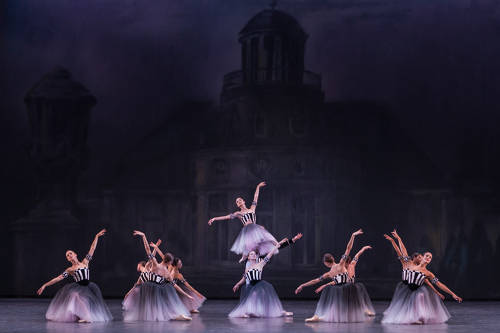
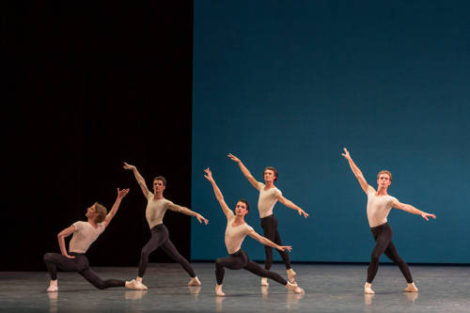
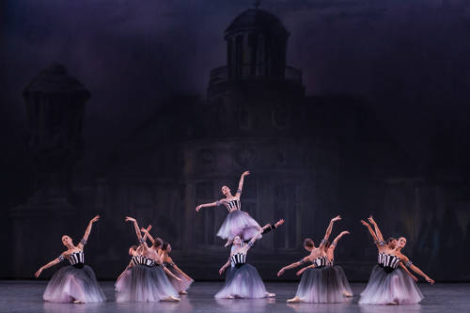
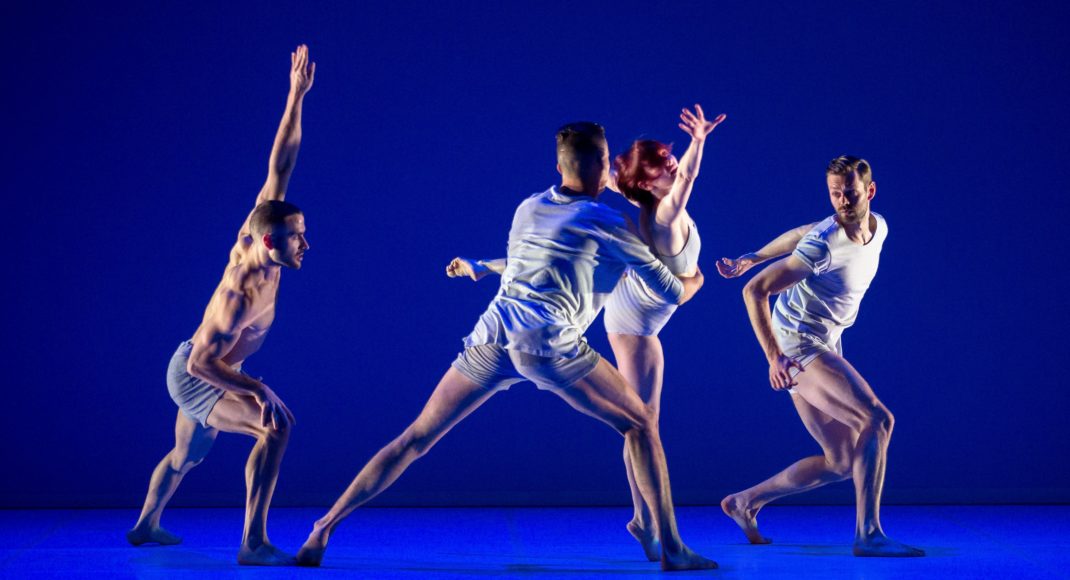
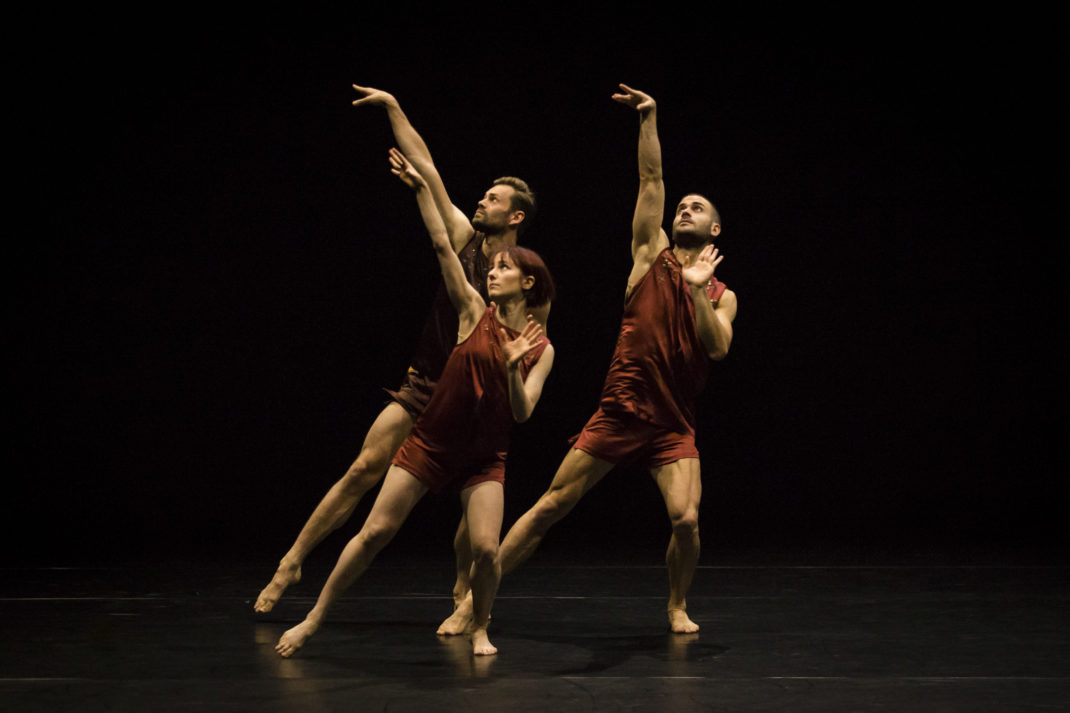
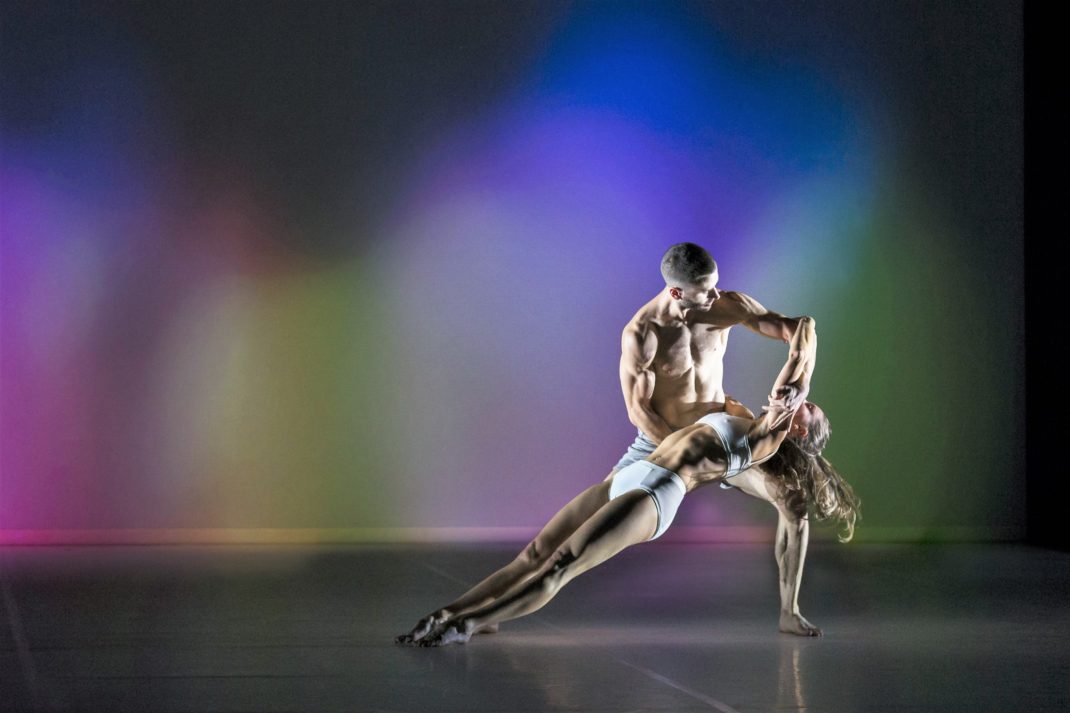
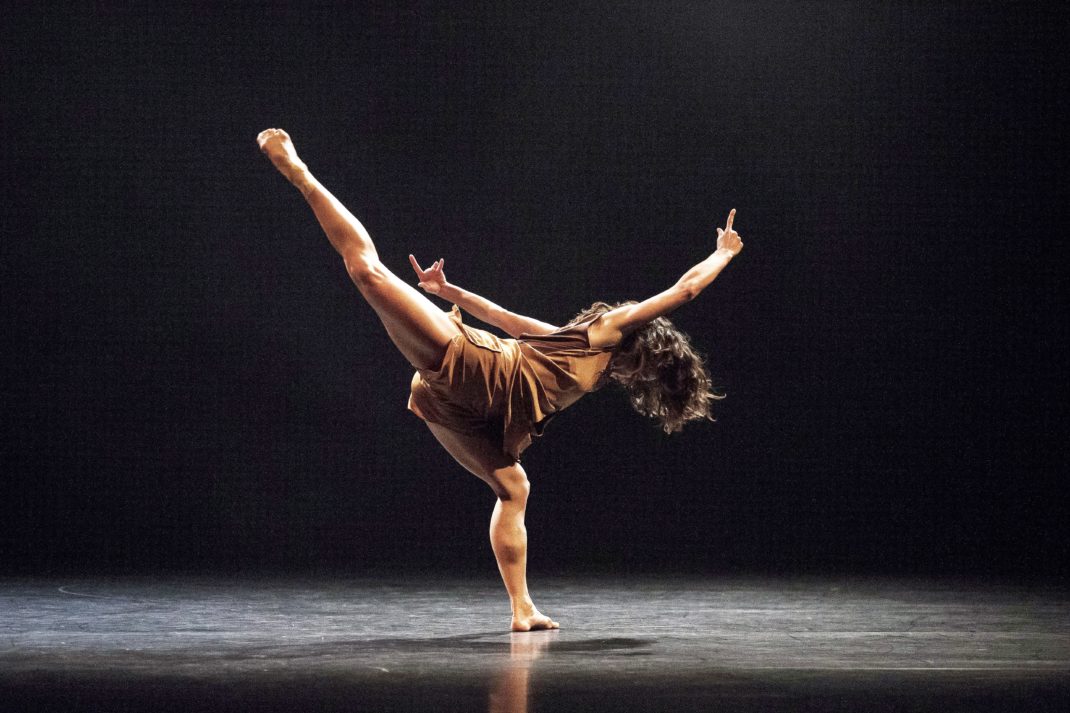
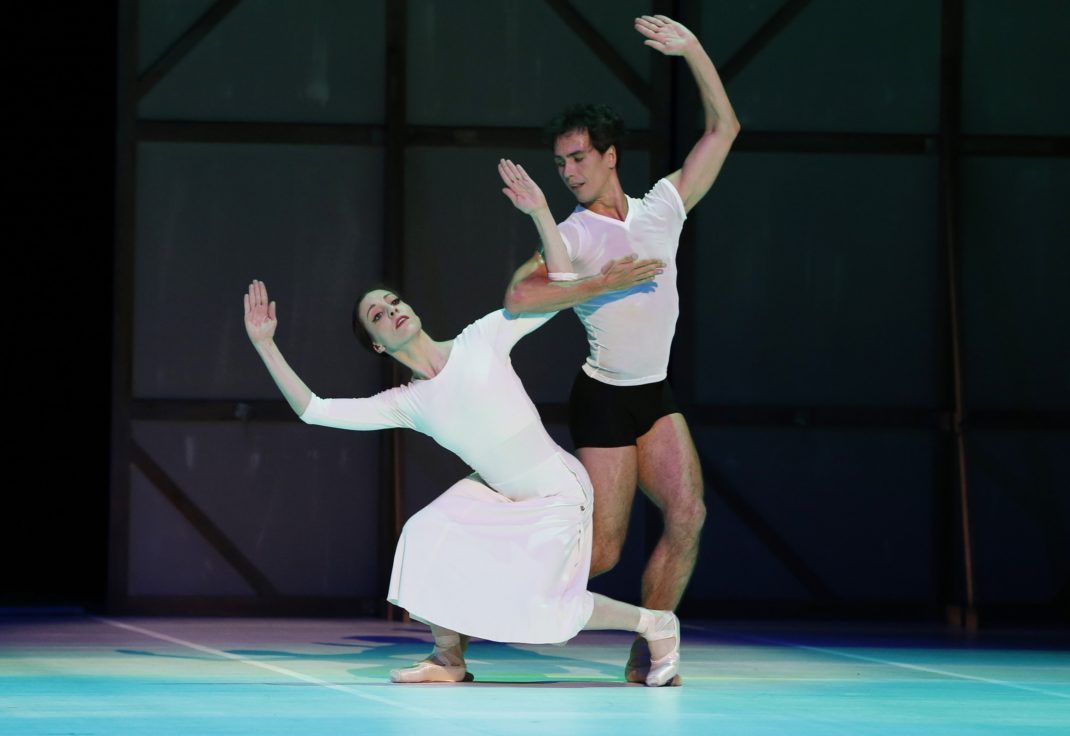
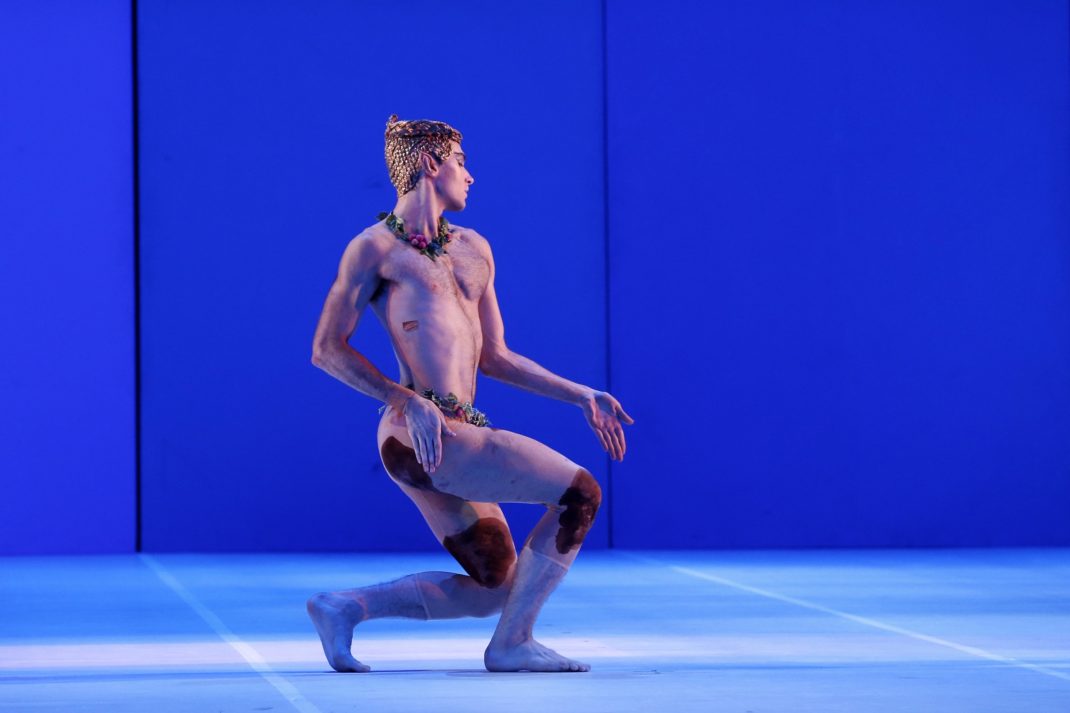
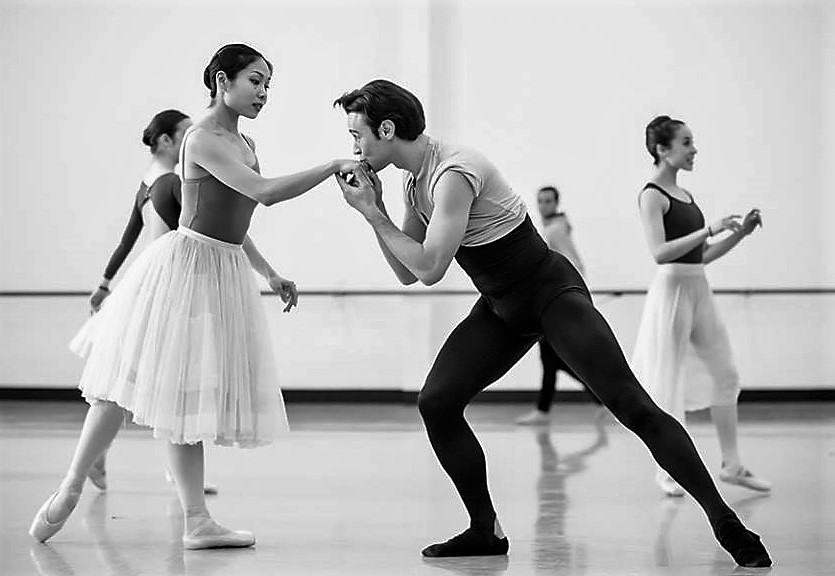
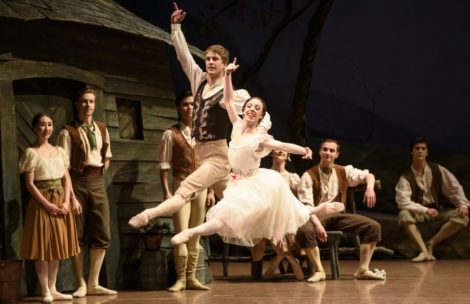
This all Balanchine program, which consisted of Mozartiana, Brahms-Schönberg Quartet and Violin Concerto, was staged in honour of Violette Verdy (1933-2016) who directed the Paris Opera Ballet between 1977 and 1980. I recall too that Mme Verdy coached Australian Ballet dancers during the directorship of Maina Gielgud and, of course, Verdy was a ballerina of international standing with a strong heritage of performing Balanchine. She died in February 2016. Earlier performances of this program also included Balanchine’s Sonatine, created for Verdy and Jean-Pierre Bonnefous in 1975, although by the time I got to see the program, Sonatine (for reasons unknown to me) had been dropped.
I have to admit to being slightly disappointed with Mozartiana. I have wonderful memories of it as performed by New York City Ballet where I loved the pride and the dignity that accompanied the dancing, and where the four young dancers who are included in the cast (in New York always from the School of American Ballet) seemed to be the recipients of a great tradition. While there was nothing amiss with the dancing by the Paris Opera Ballet cast I saw, including the young performers from the Paris Opera Ballet School, the work looked like nothing more than a pretty ballet to me. I did especially enjoy, however, the folk overtones in the choreography, and the performance by the second male lead, Fabien Revillion. Mozartiana is a new addition this season to the repertoire of the Paris Opera Ballet so it will be interesting to see how it develops on this company.
On the other hand, Brahms-Schönberg Quartet, which I had not seen before, and Violin Concerto were a huge pleasure to watch. In part it was seeing them together that gave such pleasure as they embody two quite different aspects of Balanchine’s choreographic approach.
Brahms-Schönberg Quartet, also a new addition to the repertoire of Paris Opera Ballet but originally made in 1966, had startling yet quite beautiful, newly created designs by Karl Lagerfeld. For the ladies, the classical long tutu was maintained but the designs on the bodices were black and white geometric patterns, as were the designs on the jackets and vests worn by the men. Choreographically, the style was clearly classical with groupings occasionally reminding me of those in Les Sylphides, especially in the third movement. There were some very lyrical, swooning lifts in the second movement, in which the colour scheme was pink and black, and some strong male dancing throughout. The final movement, however, came as a shock, albeit a pleasant and probably very Balanchinian one. The ladies continued to dance in pointe shoes but the men were in boots and the movement was in a rousing Hungarian peasant style.
The Stravinsky Violin Concerto, on the other hand, was one of Balanchine’s black and white ballets and showed him in his ‘show pony’ style where dancers bounced through every movement with individuality, even when strong unified movement was required (and given).
For me, the standout dancer in this work, and in fact in the entire program, was Hugo Marchand who partnered Amandine Albisson in the ‘Aria 1’ section. His own dancing showed great technical skills and his partnering displayed beautiful interaction with Albisson. I also loved his proud carriage of the body and particularly the way his body occupied the space around it—a very unusual quality possessed by very few.
Violin Concerto was given a remarkable performance and, while I’m not sure whether I was imagining this or not, I kept hearing brass instruments situated outside the orchestra pit. Surround sound? But wherever the brass instruments were, the sound from the orchestra of the Opéra national de Paris conducted by Kevin Rhodes was spectacular.
5 November 2016, National Portrait Gallery, Canberra
James Batchelor never ceases to surprise with his new choreographies. Smooth translation, commissioned by the National Portrait Gallery and performed by Batchelor and visual artist and designer Madeline Beckett, was no exception. And, as is usual, it was only later that the thought behind the work became clear to me—or, perhaps better stated, that I was able to make a personal interpretation of the work.
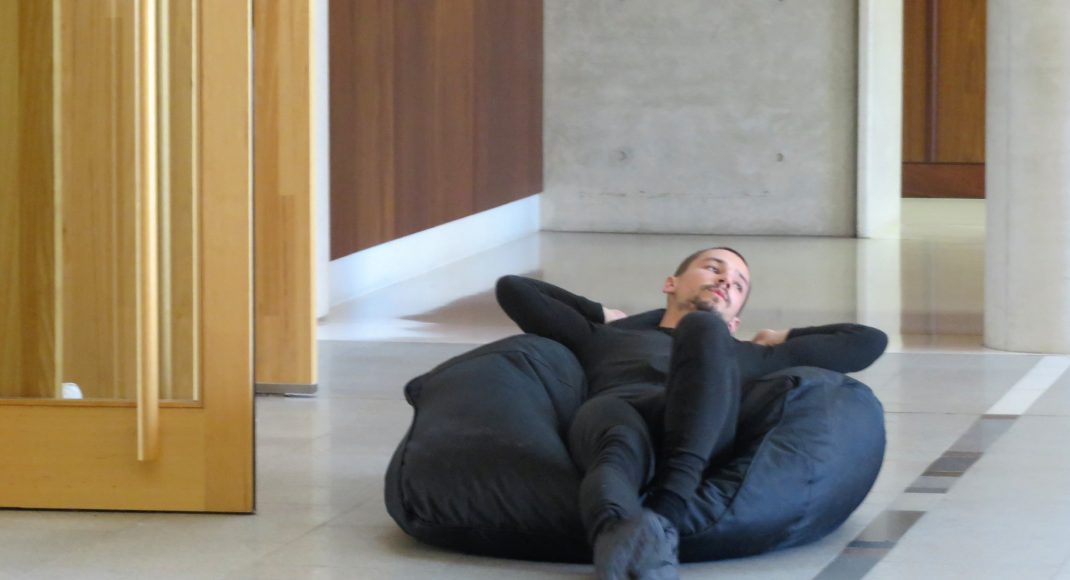
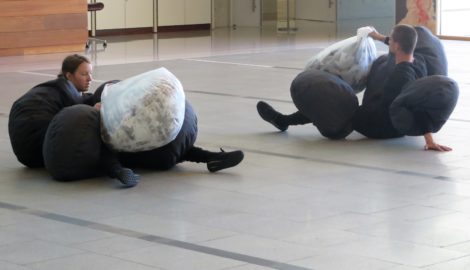
Smooth translation began with a pile of bean bag-like items piled in a heap in a corner of Gordon Darling Hall at Canberra’s National Portrait Gallery. Slowly, from underneath the pile, human hands began to emerge, then legs and finally two bodies.
The bodies (now clearly Batchelor and Beckett) proceeded to manipulate the bean bags in various ways.
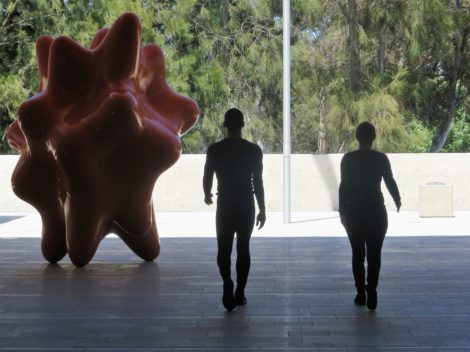
There was one moment, too, when the two performers left the bean bags and strode purposefully out of the performing space via the exit doors and onto the paved entrance area. They kept going, to the surprise of the audience, who wondered whether the show was in fact over. Well it wasn’t, and on reaching the end of the entrance plaza they turned around and, just as purposefully, marched back into Gordon Darling Hall.
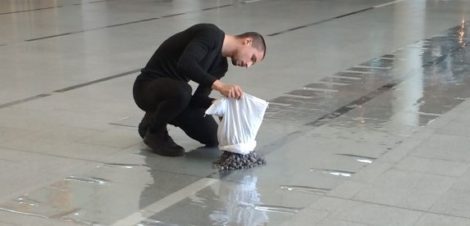
Later they carefully emptied pebbles out of small bags onto a long sheet of clear plastic.
And so it went on with a series of mysterious but absorbing actions.
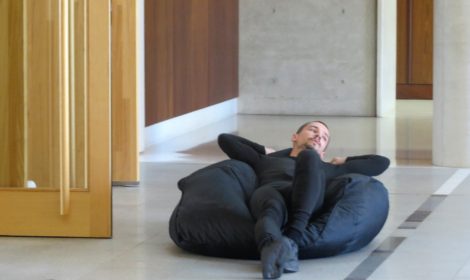
So what was Smooth translation about? In his notes, Batchelor acknowledges the British sculptor Barbara Hepworth as inspiration and remarks that the work ‘examines carving as an entry point to the interiority of matter. It is a choreography of sculpting, building and forming a landscape, a moment of translation from one body to another.’ As has so often happened for me when I encounter Batchelor’s work, I wondered what the words meant and how the actions related to those words. But after a while thoughts came crowding in. I loved the idea that a a work of art, and the ideas for such a work, were emerging in the opening scene. I loved the thoughtful traversing of the room by the two performers, while lying back in the bean bags as if pondering how to develop the work. I loved those moments when Batchelor and Beckett seemed to be measuring the space and objects in Gordon Darling Hall as if deciding on how large the work in progress should be. I loved the exit from the performing space as if they had decided it was all too hard, only to return to complete it. And so on.
There is no doubt that Batchelor has a deeply intellectual approach to choreography. And such an approach may not be to everyone’s liking especially when it isn’t immediately apparent what is going on! But personally I love being able to ponder and Batchelor always gives me the opportunity to do so. His work allows the construction of a narrative around the choreography, whether or not such as narrative was the intention of the choreographer or not.
Michelle Potter, 6 November 2016
Featured image: James Batchelor moves around Gordon Darling Hall in Smooth translation
19 October 2016. Roslyn Packer Theatre, Walsh Bay, Sydney
The latest program from Sydney Dance Company—a double bill with the title Untamed—showed once again what a high energy, physically accomplished company Sydney Dance is. Gabrielle Nankivell’s Wildebeest opened the evening and opened it in an extraordinary manner with a solo from Bernhard Knauer. ‘The wildebeest as image morphs easily between living animal and fanciful creature’ writes choreographer Nankivell in her program note and Knauer was given movements that were eccentric, idiosyncratic, half human, half beast. The wildebeest was never quite sure of his true nature (or her nature as the case may be since Knauer alternates in the role with Juliette Barton). But the animal struggles to be born into the world with a shudder and a shake and often a kind of liquid movement within those animal limbs.
From the opening solo the work proceeds through a series of further solos, duets, trios and quartets and, against the pack-like, wild and wilful movements, a certain vulnerability creeps in at times when small, intricate movements of the head, hands, fingers and other extremities of the body become visible. Then there are sections where the entire cast moves in a mechanical fashion, like clockwork. And yet, within these sections, we often see a single dancer moving erratically through the order like a misfit in an ordered world. A powerful duet from Todd Sutherland and Holly Doyle had antagonistic overtones while Janessa Dufty stood out throughout the work, especially in her closing solo.
For better or worse we have become accustomed to dark lighting of contemporary dance these days but, for once, Wildebeest’s gloomy lighting (by Benjamin Cisterne), which was punctuated by sudden, sharp, completely unexpected flashes of brightness, was appropriate to the theme of the work. I was lucky, however, to be sitting quite close to the action so I’m not sure how the gloom looked from further back. A soundscape by Luke Smiles rode beautifully with the action. Its sounds were often as startling and unexpected as the movement but, like the lighting, totally appropriate for the nature of the work. Smiles and Nankivell have been working together for several years now and their understanding of each other’s work was clearly evident. I admired Fiona Holley’s simple, easy-flowing, red earth coloured costumes.
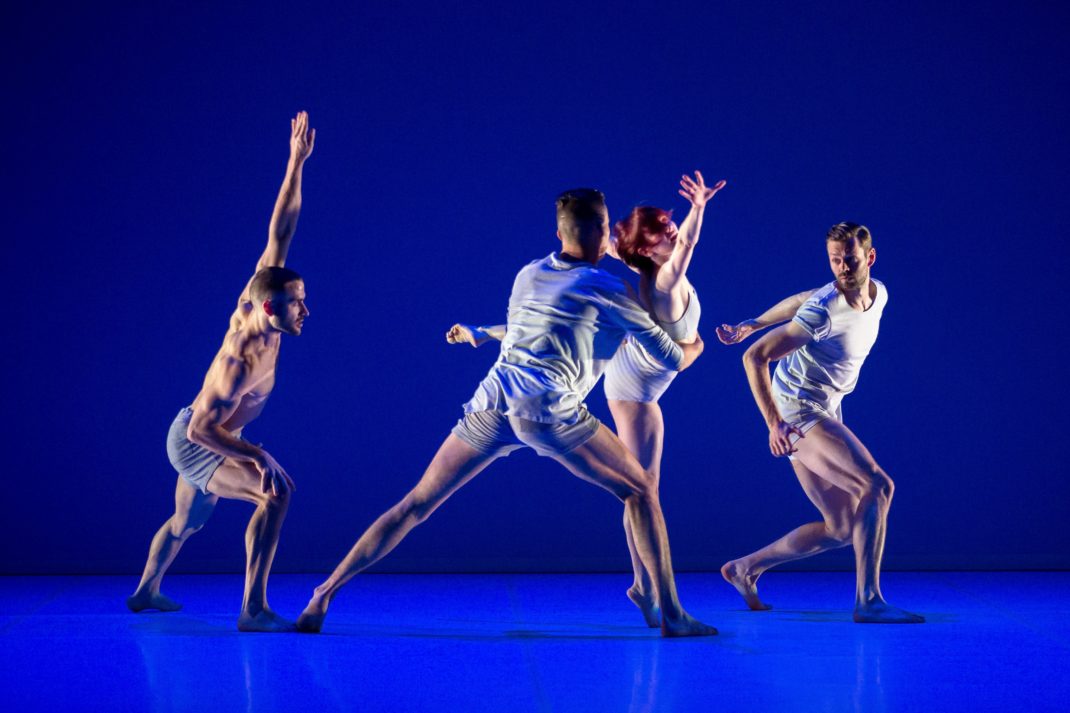
After the extremes and idiosyncracies of Wildebeest, the second work on the program, Rafael Bonachela’s new work, Anima, had something of a romantic feel to it. True, its choreography was highly physical and without a narrative line in the manner we have come to expect from Bonachela. But along with the extended limbs, the partnering involving turning, twisting bodies being flung about, and the fast and thrilling movement around the stage, there were moments that were thoughtful in nature, when a humanistic approach seemed to surface.
Anima opened strongly with a duet between Juliette Barton and Izzac Carroll, which in particular showed off Barton’s delicious, long-limbed extensions and her absolute control of every movement. But at the heart of Anima is a male duet, long and intimate, although punctuated by occasional tension, between Cass Mortimer Eipper and Petros Treklis. The male duet has become something of a signature element for Bonachela and this one, which required huge stamina and body strength from Eipper and Treklis, was filled with exceptional moments when we had to ponder at the nature of the relationship between the two protagonists.
Group sections broke up the focus on duets, trios and quartets and Sydney Dance Company dancers have a remarkable facility for unison dancing, which always surprises me given the speed at which the dancers are usually asked to move in such sections and the individual qualities Bonachela’s dancers always display in their work. Bonachela’s group sections give me a shiver of excitement.
Lighting for Anima was also by Cisterne and several sections were lit red. Sometimes we also saw abstracted, coloured shapes dancing across the back screen. I’m not sure that these coloured lighting effects offered anything additional to Anima and I would have preferred the more ordered (or less colourful and fanciful) approach that usually marks Cisterne’s designs. There was enough emotion generated by the music from Bulgarian-born, London-based Dobrinka Tabakova, and from Bonachela’s intuitive response to this music, Insight for string trio, created by Tabakova in 2002. Aleisa Jelbart’s white/grey costumes occasionally looked too much like underwear for my liking, but luckily there was so much else to focus on that they didn’t detract too much from the overall experience.
Anima was greeted with tumultuous applause. People stood, a few left their seats and rushed towards the stage, while the dancers taking their bows could not hide their pleasure at this response. But of the two works Wildebeest was, for me, the more thrilling, more creative, more satisfying work.
This review was originally published on DanceTabs at this link.
Those who were lucky enough to see this show on opening night were, I feel sure, taken by the colourful T-shirt worn by Bonachela as he took a curtain call with his collaborators. The message on it read: Say ‘I do’ Down Under.
15 October 2016. National Portrait Gallery, Canberra
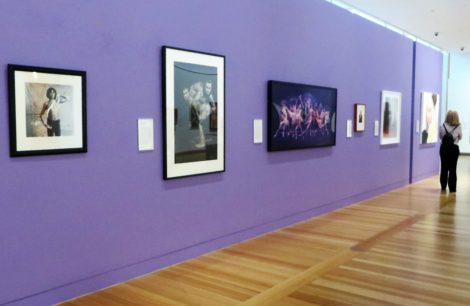
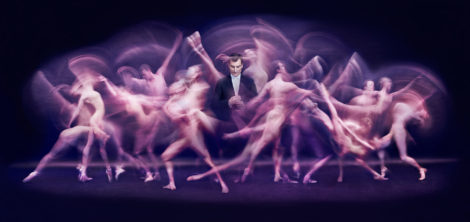
The National Portrait Gallery is currently showing a number of images from its performing arts collection—mainly images of dancers but also musicians and designers. Along with Jenny Sages’ wonderful image of Irina Baronova ‘passing on the torch’ to an unknown (seen from the back only) young dancer, there are images of Steven Heathcote, Graeme Murphy, Meryl Tankard, Russell Page, Stephen Page, Marilyn Rowe (not the Gallery’s best acquisition I have to say), Kenneth Rowell, Sidney Nolan, Peter Sculthorpe, and others. They are there to support a new acquisition, a photographic portrait of artistic director of the Australian Ballet, David McAllister, by Peter Brew-Bevan.
National Portrait Gallery, Canberra. A selection of performing arts images on display, October 2016
Portrait of David McAllister by Peter Brew-Bevan, National Portrait Gallery, Canberra
And as has been happening with a certain frequency recently, the National Portrait Gallery commissioned four dancers, Elle Cahill, Julia Cotton, Anca Frankenhaeuser, and Patrick Harding-Irmer, to present a short program of dances to celebrate the acquisition. There were four dances in all: Solo from steppingstone by Patrick Harding-Irmer, Duet for David by Julia Cotton and Elle Cahill, Ebba by Anca Frankenhaeuser, and Quartet for David by all four dancers. All dances had a certain technical simplicity to them, which is not to deny their appropriateness for the occasion.
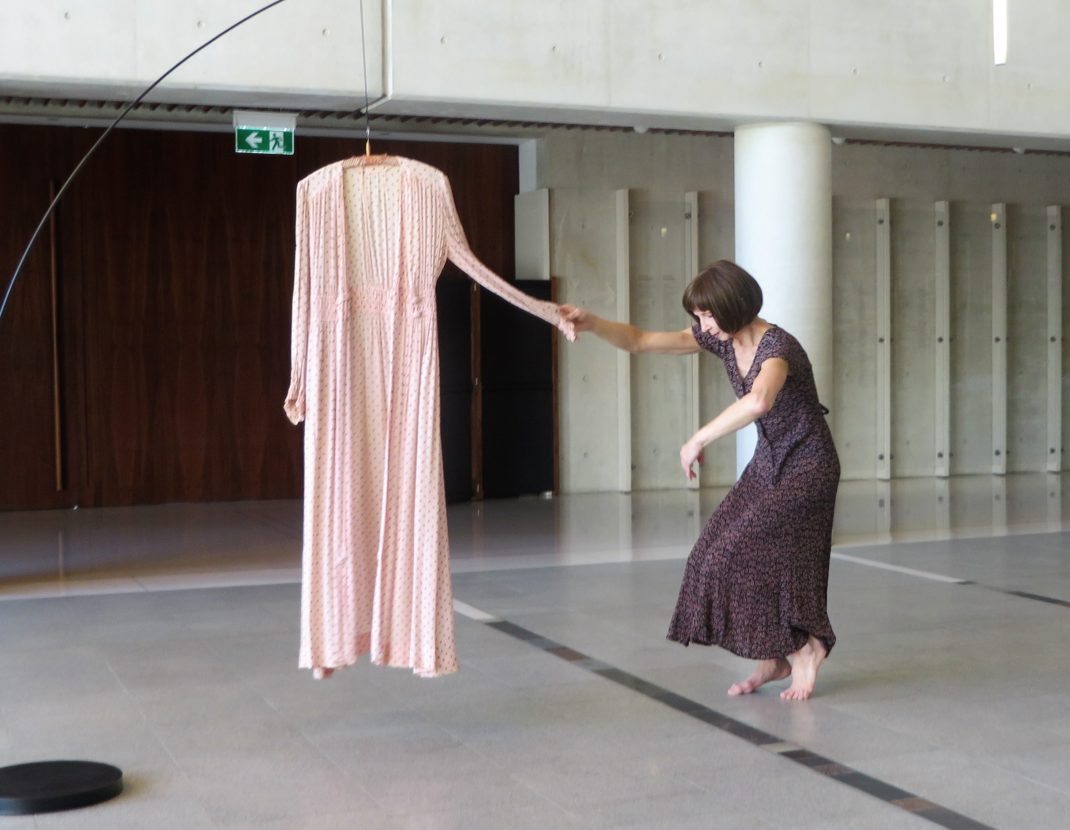
Two of the pieces, those featuring Harding-Irmer, seemed to refer specifically to McAllister. The duet from Cotton and Cahill seemed to be more of a dedication to the art that McAllister has promoted throughout his career, while the connection that Frankenhaeuser’s quite beautiful but mysterious solo with a hanging garment had to McAllister wasn’t all that clear to me.
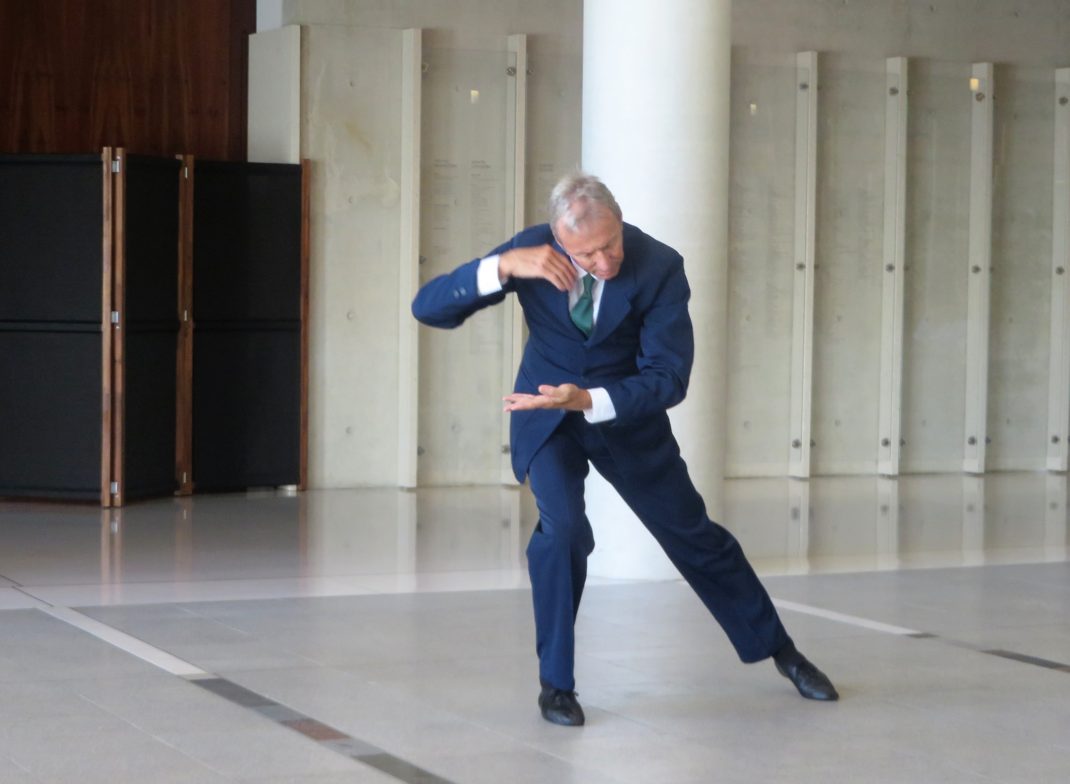
Harding-Irmer’s Solo was a work of poses. Some were quite a simple ballet positions—first position of the feet, fifth positions of the arms. for example. We all start our careers learning the basics. As the piece progressed the poses became more introspective but always searchingly so. And Harding-Irmer, impeccably dressed in suit and tie (although he did remove the coat at one stage), suggested that a dancer’s life moves more and more into a complexity of thought.
(left) Patrick Harding-Irmer in Solo from stepping stones; (right) Anca Frankenhaeuser in Ebba.
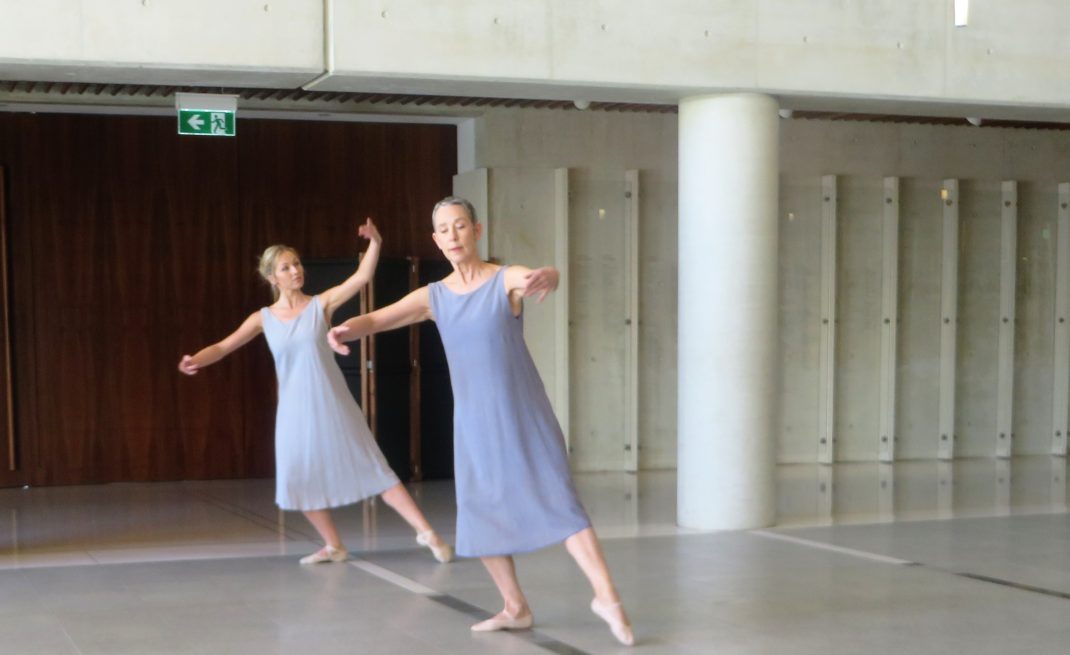
Duet for David was the most balletic of the dances and in many respects it reminded me of the Jenny Sages portrait of Baronova ‘passing on the baton’. Cahill’s youth in relation to Cotton (and Harding-Irmer and Frankenhaeuser) was clear and, as Cahill and Cotton danced together, they seemed to change places in the performing space. There was a lovely entrance by Cahill followed by a quiet arrival from Cotton, who then seemed to take the dominant position. But as they circled each other, dancing simple but fluid and attractive steps in differing spatial patterns, Cahill came to the fore, as if representing the future of classical dance.
Julia Cotton and Elle Cahill in Duet for David, National Portrait Gallery, 2016.
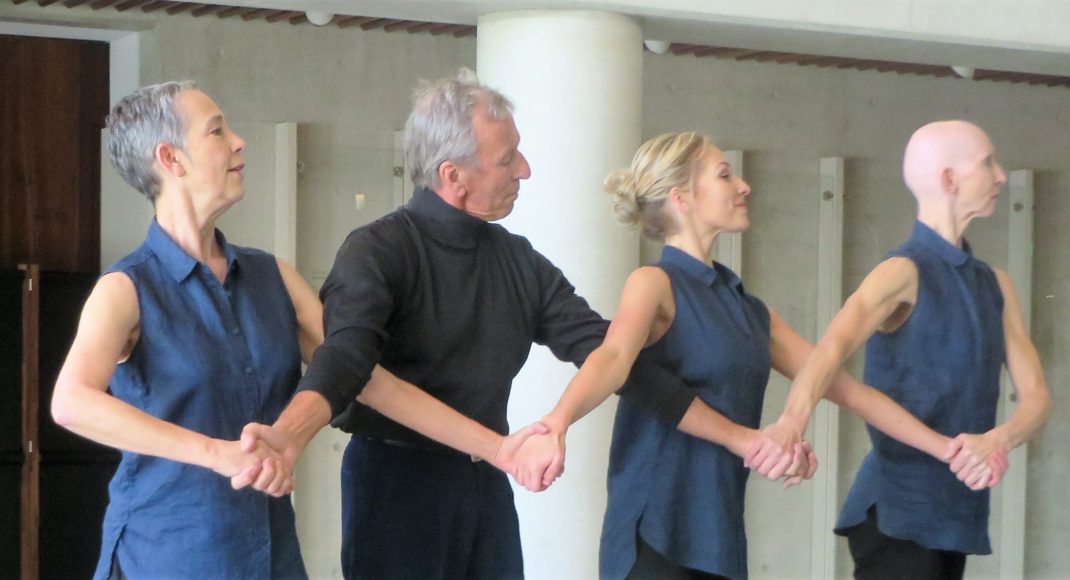
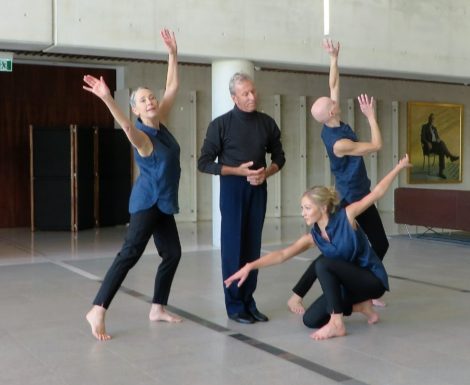
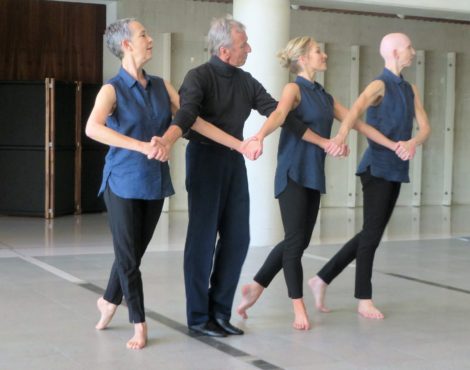
But if Duet for David was the most balletic in a technical sense, the closing piece, Quartet for David, was filled poses (again) that recalled the manner of McAllister in the classroom or rehearsal process, along with references to ballets with which McAllister might be identified. From Swan Lake, for example, we had a reference to the linked arms of the Four Little Swans and from The Sleeping Beauty there was a nod to the Rose Adagio. And the final moment saw Harding-Irmer taking the very pose McAllister takes in the Brew-Bevan portrait.
Finale from Quartet for David, National Portrait Gallery, 2016. Back row (l-r) Julia Cotton, Patrick Harding-Irmer and Anca Frankenhaeuser; in front Elle Cahill
What was especially attractive about this show was the element of time that it encompassed—time past, time present, and time future all seemed to have a place. But I wish I knew more about Frankenhaeuser’s Ebba. For the first time in my experience with these Portrait Gallery shows there was a mini printed program, which listed the names of the works and the creatives behind them—a welcome initiative. I am dead against judging a work according to the artist’s intention, but I would have liked a bit more information. A search online didn’t help all that much.
Dance in Canberra is flourishing as a result of this kind of show. And it is refreshingly ‘underground’ in the sense that it doesn’t rely on the fads and puffery of popular mainstream organisations. Good, honest dance with something to say.
Michelle Potter, 17 October 2016
Featured image: (l-r) Julia Cotton, Patrick Harding-Irmer, Elle Cahill and Anca Frankenhaeuser in Quartet for David, 2016.
29 September 2016, Ralph Wilson Theatre, Gorman Arts Centre, Canberra
Wiggle Room? The name arouses curiosity. But on arriving at the Ralph Wilson my heart sank. ‘This is a standing show,’ we were told. I rather like sitting down to see a show. But, as it happened, the show was a stunner and, for ageing bodies like mine, there were stools for sitting on, when that was possible given the nature of the show.
Wiggle Room was part of a new program in the ACT, Ralph Indie, named for Ralph Wilson, who died in 1994 and who was both a former principal of Canberra High School and a producer of unconventional and thought-provoking theatre shows in Canberra. Wiggle Room was performed by dancer Alison Plevey, singer Ruth O’Brien, and Cher Albrect and Deb Cleland, two artists from the Canberra-based women’s aerial dance and circus arts group, Solco Acro. Like Wilson’s shows, Wiggle Room was also unconventional and thought-provoking.
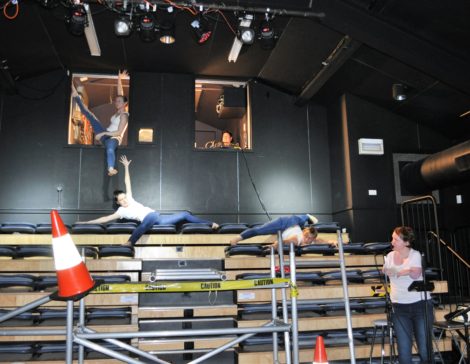
The work was inspired by and named after an essay by Sara Ahmed and examined the politics of space. Who can occupy a certain space? Who must move aside to let another take up the space? And this explains the need for it to be a ‘standing show’. The entire space of Ralph Wilson Theatre was used by the performers and for those of us sitting on stools, and indeed those standing around the edges of the space, there was the need on occasions to move so that the performers could occupy the space we were inhabiting. No such thing as a designated aisle and seat number.
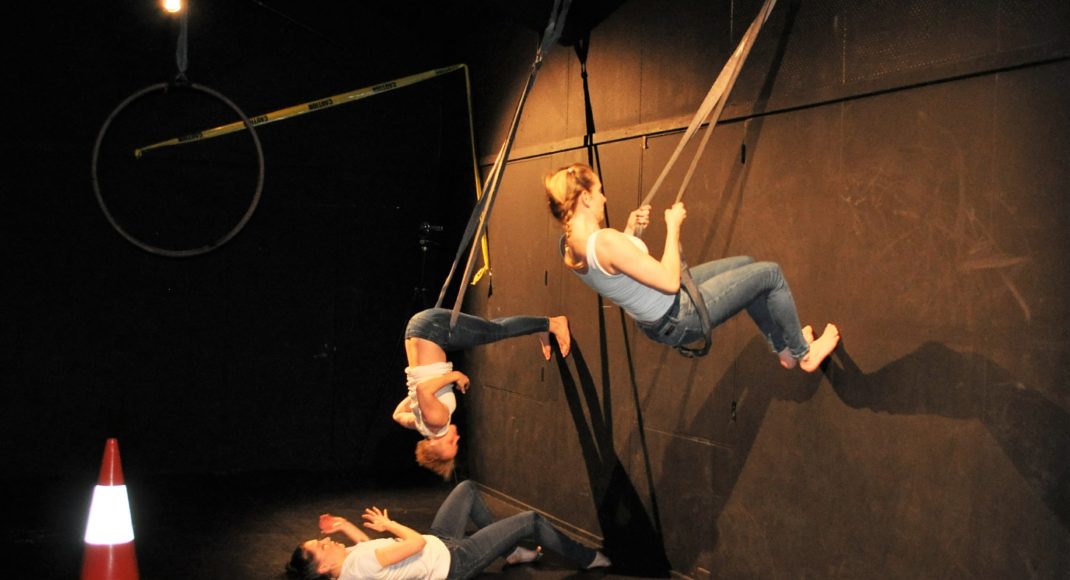
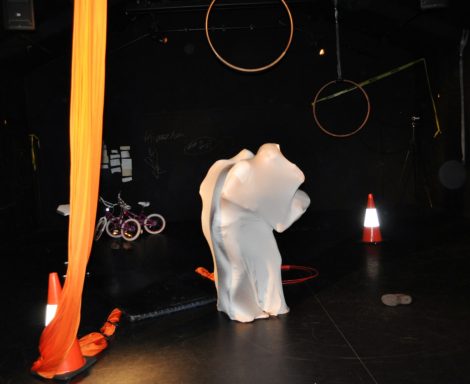
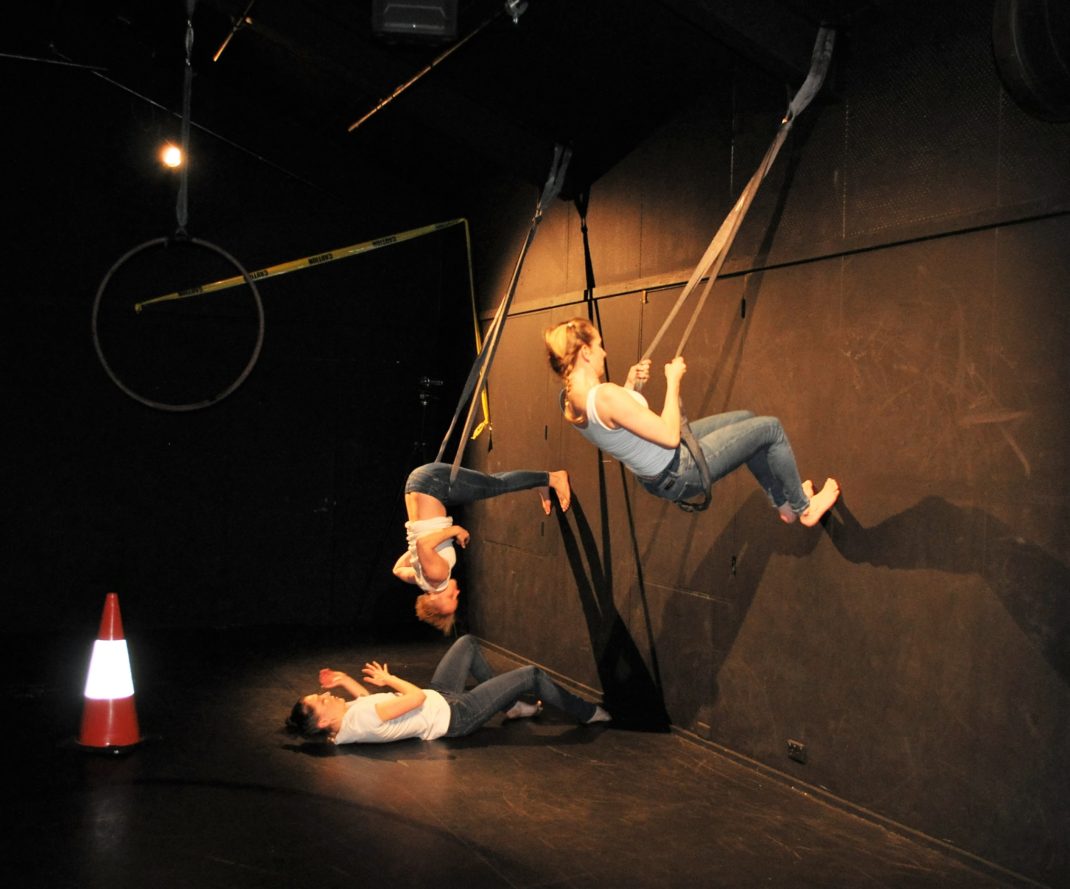
Some of the movement happened on swinging hoops, or with the performers twisting themselves around lengths of red cloth hanging from the ceiling. Some took place against the walls with the performers attached to a kind of harness. There were moments when bikes were driven at break-neck speed around the space. Even the usual seating in the Ralph Wilson Theatre had been folded back and this fold-back space used by the performers.
The work was, however, more than simply about space. The notion of the politics of space came over loud and clear, on the one hand through spoken word and song, and on the other by the interpretations of the words by the performers. There were feminist references, references to workplace issues, and issues about personal space, for example.
But what made Wiggle Room a work to be reckoned with was the way in which these issues surrounding the politics of space were addressed in such an engaging and often hilarious way. It was so easy to recognise the situations presented to us, it was so easy and pleasurable to laugh at what was happening. And yet there was always the lingering knowledge of a political message.
Perhaps my favourite moment came when the three performers found themselves together in the confined space of a slip-off mattress cover made from flimsy material—shades of Martha Graham’s Lamentation, without the 1930s seriousness. I have to admit to thinking ‘Eat your heart out, Martha.’ This was so much more enjoyable.
All in all a funny, strangely serious, and rather remarkable evening.
18 September 2016, National Portrait Gallery, Canberra
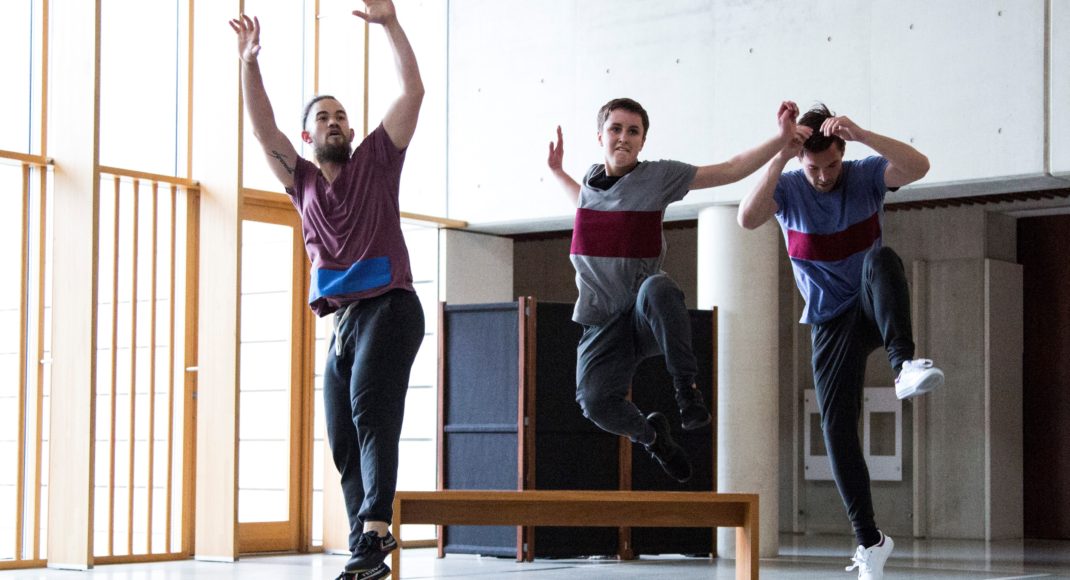
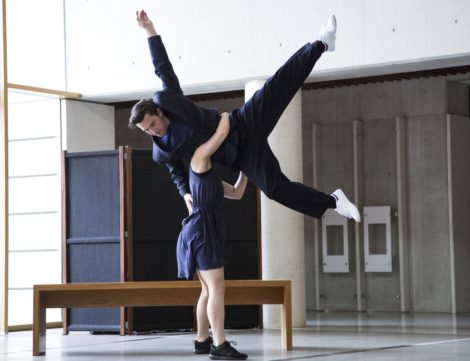
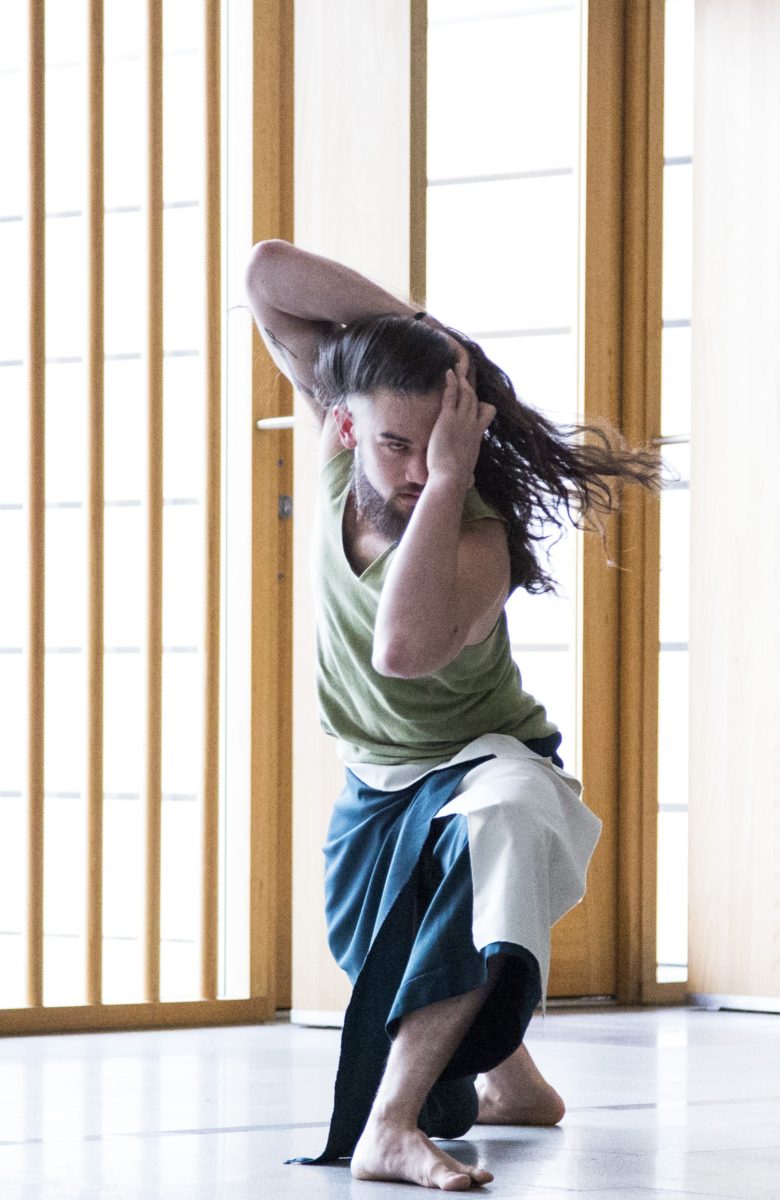
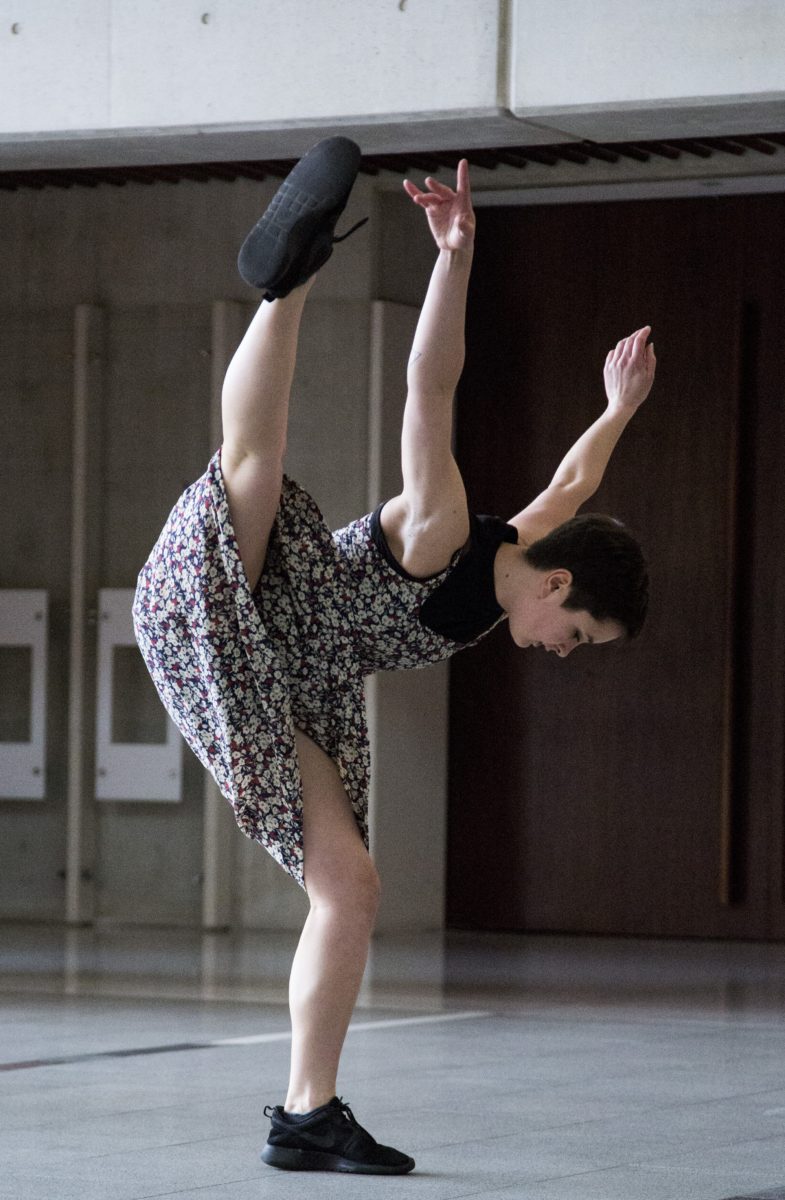
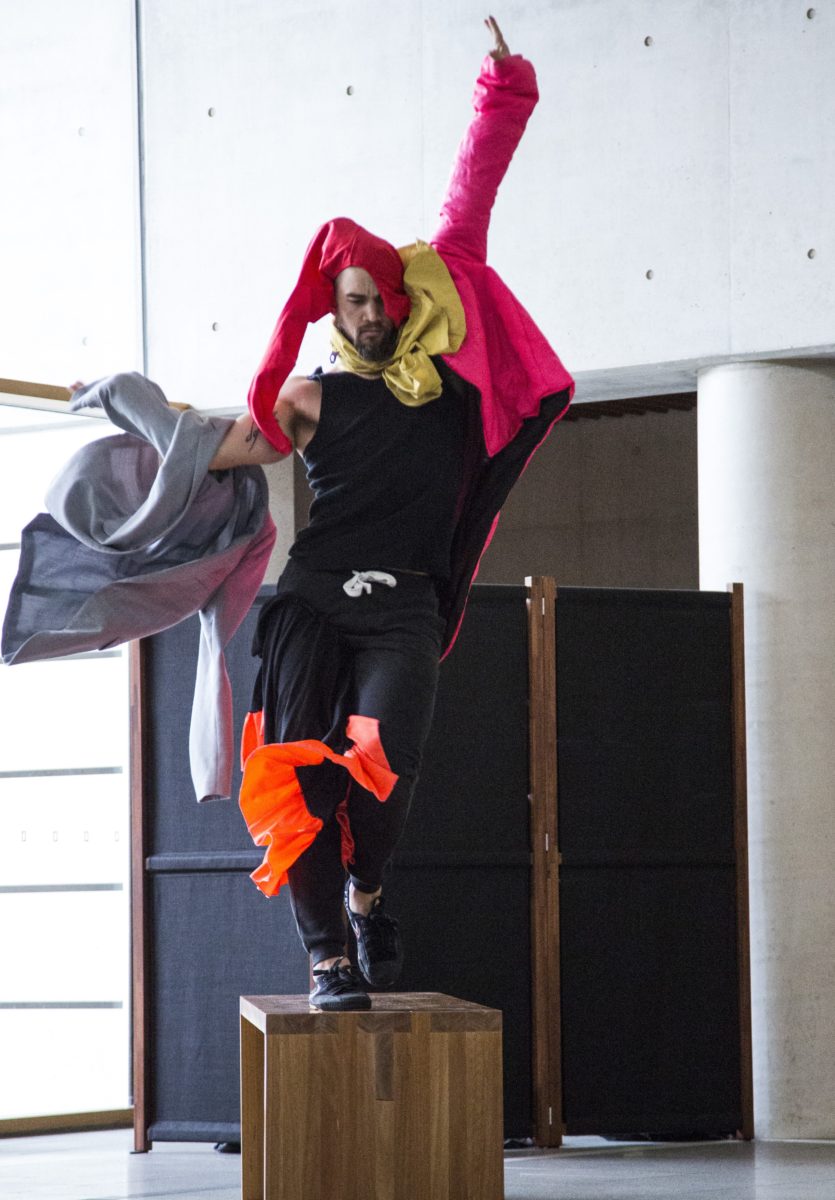
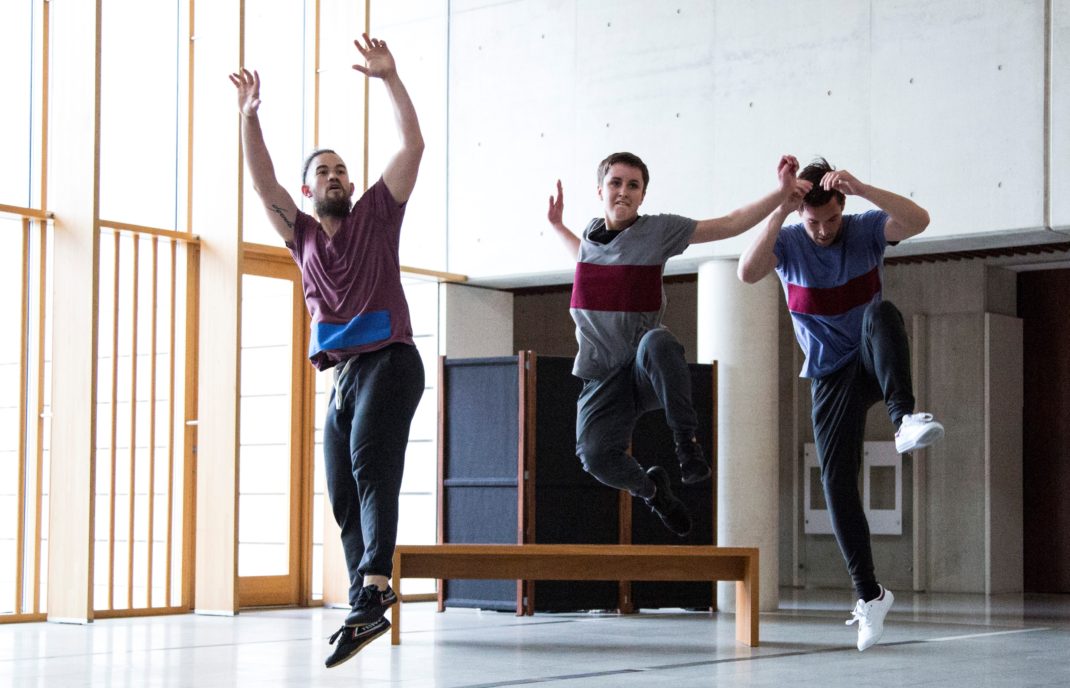
Canberra’s National Portrait Gallery continues to commission short dance works as public program events associated with its exhibitions. Other moments, made in response to a photographic exhibition, Tough and tender, was given twelve performances on two successive weekends by dancers from QL2—Gabriel Comerford, Dean Cross and Eliza Sanders. The portraits on display in Tough and tender revealed young people, often in intimate settings or situations, tough on the outside (mostly) but often appearing to be quite vulnerable. The dance work set out to suggest moments before and after the single moment captured by a photograph.
The choreography, by Ruth Osborne (in collaboration with the dancers), and the performance itself captured a beautiful range of emotions, from tough to tender as was appropriate, but also sometimes amusing and often intense. With its range of solos, duets and trios, and its variety of costuming, it also highlighted different kinds of interpersonal connection.
Dean Cross and Eliza Sanders in Other moments. QL2, 2016.
(left) Gabriel Comerford and (right) Eliza Sanders in Other Moments, QL2, 2016
As she did in Walking and Falling, a previous work for the National Portrait Gallery, Osborne showed her skill in working with a minimum of space and little in the way of design. A wooden bench and an array of costumes was all that she needed to make this compelling short work. And of course good dancing from three strong, versatile performers.
Gabriel Comerford in Other Moments. QL2, 2016.
Michelle Potter, 19 September 2016
Featured image: (l-r) Gabriel-Comerford, Eliza-Sanders-and-Dean-Cross-in-Other-Moments.-QL2-2016
7 September 2016, State Theatre, Victorian Arts Centre, Melbourne
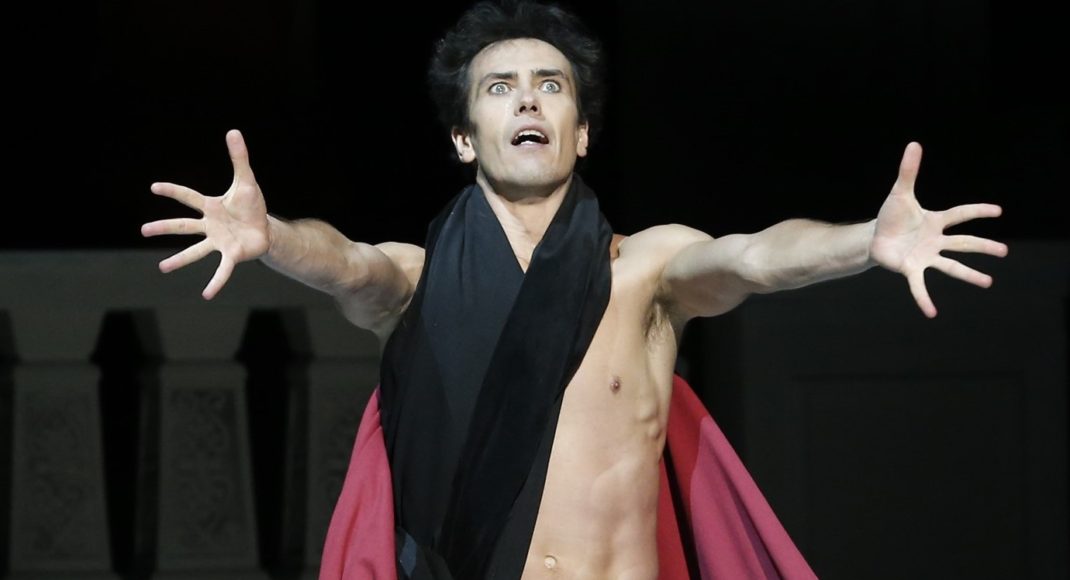
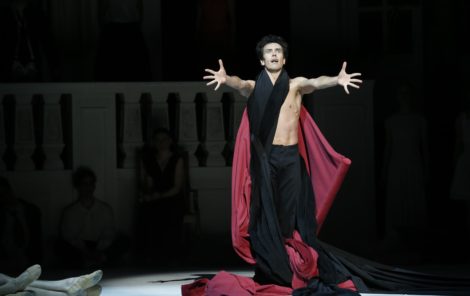
Alexandre Riabko, guesting with the Australian Ballet in the lead role on the opening night performance of John Neumeier’s Nijinsky, has been dancing that role since at least 2003 when Hamburg Ballet guested in Paris. He may well have danced it even earlier. At the work’s world premiere in Hamburg in 2000 he took the role of the dancer Nijinsky as Harlequin in Le Carnaval and the Spirit of the Rose in Le Spectre de la rose. Thus the ballet Nijinsky, and the role of Vaslav Nijinsky, have been part of his dancing life for more than fifteen years. And so it was not surprising, but nevertheless thrilling, that his performance throughout the ballet was exceptional. It was exceptional from his first commanding entrance and walk down the steps leading to the space where he was to dance, through to his dramatic finale, performed in the same space, albeit now an arena that contained signs of destruction, as indeed did Nijinsky’s state of mind. Riabko held the work together. It was a tour de force by a dancer who communicated with every inch of his body.
Those with whom Riabko shared the stage—characters representing Nijinsky’s family, especially his wife Romola; characters that Nijinsky danced during his career; dancers from Diaghilev’s Ballet Russe, including Tamara Karsavina and Leonide Massine; Diaghilev himself; soldiers and others representing war, against which Nijinsky was so opposed—had mixed success.
Leanne Stojmenov was a standout as Nijinsky’s sister, Bronislava Nijinska, especially in the Rite of Spring scene (of which sadly there seem to be no media images available, but see below for Stojmenov as the Young Woman in Jeux).
In the Rite of Spring scene, where Stojmenov played the Chosen Virgin, she danced as if there was no tomorrow, tossing her body into Neumeier’s demanding positions, flinging herself from side to side, hair in disarray. In fact this scene, with Riabko/Nijinsky standing on a chair shouting out instructions to the performers, is one of the most exciting of the evening. (To the Australian Ballet: oh please get access to the Pina Bausch Rite of Spring and put Stojmenov in the lead. She would be stunning).
I also thought that François-Eloi Lavignac was outstanding as Stanislav, Nijinsky’s brother. His small, compact but very flexible body perfectly suited Neumeier’s writhing movements. Stanislav’s death was a compelling scene.
Along with Lavignac and Stojmenov, I was also impressed by Cristano Martino as the dancer Nijinsky as the Faun in L’après-midi d’un faune, and the Golden Slave in Schéhérazade. His Golden Slave was slinky and strongly sexual. His Faun was beautifully controlled and conveyed an innate power.
As ever, however, I longed for so many of the others in the cast to have more artistry in their performance and, for the first time in my various encounters with this ballet, I felt as though Neumeier’s Nijinsky was too long and too slow in parts. I still get the feeling that the dancers of the Australian Ballet focus on steps, and Neumeier’s Nijinsky is not about steps. I was disappointed, for example, with Adam Bull’s portrayal of Diaghilev. Bull is an excellent dancer but I think of Diaghilev as an eccentric character and there was nothing eccentric about Bull’s interpretation. For me he was a ballet dancer pretending to be Diaghilev. Similarly with Amy Harris as Romola. I got no feeling for what kind of person she might have been.
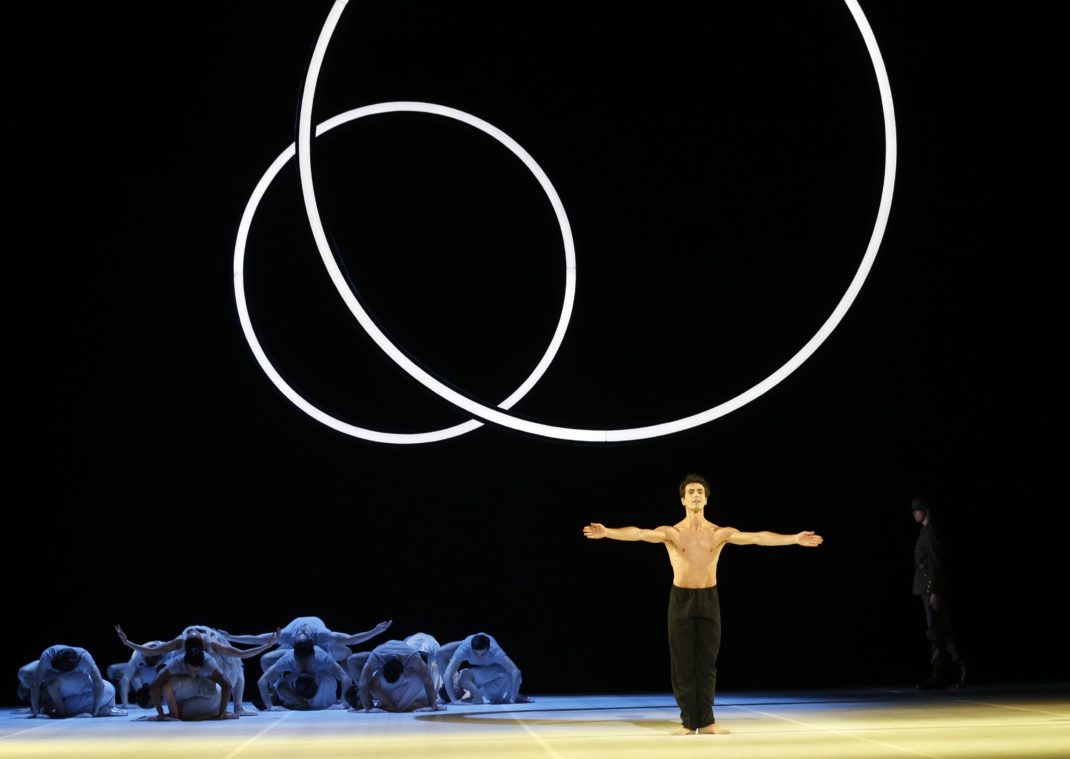
I did enjoy the sets and costumes (concept by Neumeier) more in this viewing than previously, when I guess I was more focused on what was happening and who was who. Neumeier’s use of ‘attributes’ rather than detailed costuming to distinguish characters was aesthetically pleasing and the circles of light that occasionally appeared as part of a particular setting recalled Nijinsky’s fascinating circular drawings, some of which are part of Neumeier’s personal collection of Nijinsky memorabilia.
Nijinsky is a thrilling work and I bow to Neumeier’s concept. But I hope that throughout the Australian Ballet season, as it continues in Melbourne, and then goes to Adelaide and Sydney, that stronger characterisations might emerge from more of the dancers.
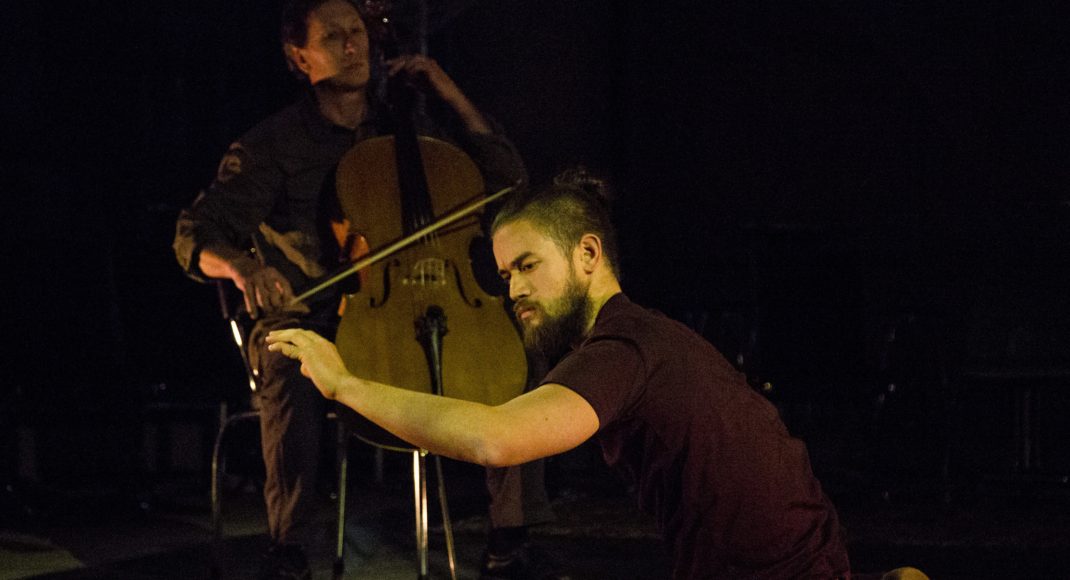
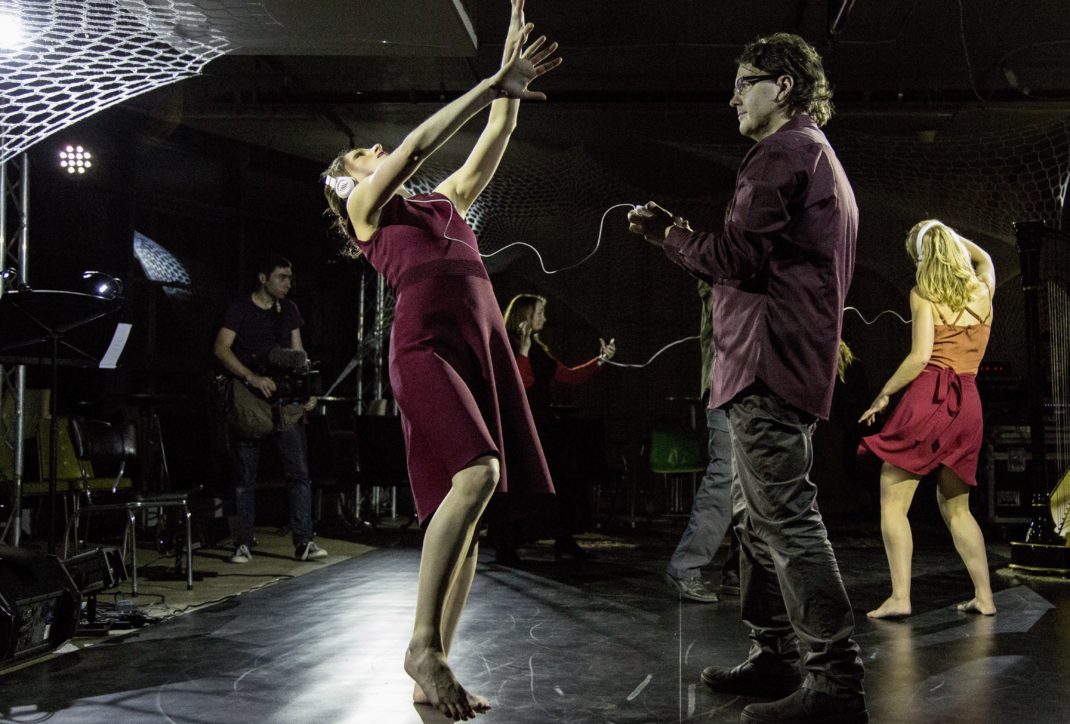
Strings Attached, the debut show from Canberra’s new contemporary dance company, Australian Dance Party, is a knockout. The concept behind the show, devised by the ‘Party Leader’, dancer Alison Plevey, sounds simplistic: an investigation of the relationship between music and dance in a collaboration between four dancers and six musicians from the Canberra Symphony Orchestra. But as developed in performance it was totally engaging, illuminating and just plain exciting to watch.
The show began with the sounds of breathing, gentle at first but gathering volume as dancers and musicians met in the performing space before taking their positions to begin the show proper. ‘Before people spoke, we moved,’ the program states. ‘We moved to the innate rhythm of our hearts, our breath and the patterns of our lives.’ And so the dance and its musical accompaniment began, starting with some improvised movement and accompanying sound, moving on to a gentle piece with music by Jean-Baptiste Lully and a kind of slow and refined dance for all four dancers. The show continued its pathway through different musical and dancerly episodes—a lament, a tango, on to Jimi Hendrix with the dancers hooked up to iPods, and, finally, to an ‘Electronic Piece’ that became a riotous party/disco dance in which the audience was encouraged, and sometimes specifically invited to participate.
What was especially noticeable throughout was the absolute commitment of dancers and musicians. They were totally engaged with each other and with the sound and movement they were producing. Alison Plevey and Janine Proost both showed exceptionally fluid, high energy movement, Liz Lea was somewhat more restrained but added a way of engaging socially with the musicians that the others didn’t quite have—Lea always uses strong facial expression as a way of engaging. As for Gabriel Comerford, whose dancing I had never seen before, he knocked me for six with his movement that was on the one hand highly disciplined but on the other totally free.
The venue, a pop-up space in Canberra’s trendy Nishi building, was set up a little like a theatre restaurant with tables and chairs placed around a central performing area. Around the edge of the performance space the musicians sheltered under two white canopies of string sculpture crocheted by installation artist Victoria Lees.
Some particular highlights, personal favourites perhaps:
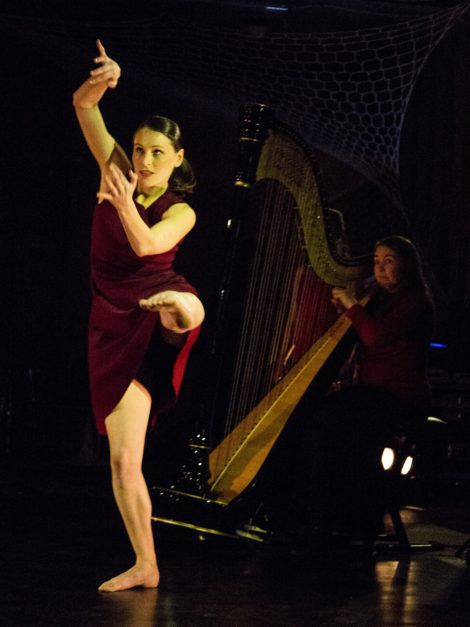
Alison Plevey and harpist Meriel Owen improvising in the early stages of the show. Amazing, especially in the second part where Owen had to follow Plevey’s rising and falling movements, which she did as if it were second nature.
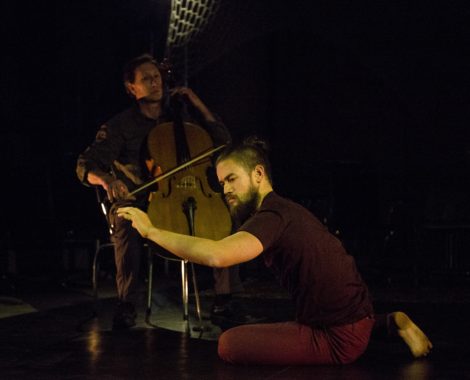
Gabriel Comerford in ‘March’ (‘Command and Conquer Red Alert Theme—Soviet March’), in which he got totally lost, trance-like, dancing to a stirring, politicised composition by James Hannigan. His long, black hair came loose from its topknot, and his movement was at times absolutely precise and powerful, but at others wildly erratic. Thrilling to watch.
A ‘conversation’ between dancer Liz Lea and trumpeter Miroslav Bukovsky.
The musicians who played more than one instrument throughout, swapping seamlessly between them. And fascinating to look at (as well as to listen to) was Tim Wickham’s white ‘skeleton’ electric violin.
But in many respects it is unfair to single out individuals because everyone in this show gave so much of themselves to make this a standout evening of live music and dance.
I guess my one hope for this brave new venture is that the format of the debut show will not always be the format in the future. Plevey has a rare intelligence as a director and I hope she will find ways of occasionally presenting her work in different spaces, including in more mainstream performing arenas. The party line (as in its celebratory rather than political meaning) is fine for a start but I am hoping for something different as well.
Canberra has been without a professional dance company since Sue Healey left town in the 1990s. If Strings Attached is anything to go by we now have much to anticipate.
India Meets received just one performance, which is a shame because it offered a truly fascinating and diverse experience of Indian and Indian-inspired dance. And it was a sold-out performance.
The evening was the brainchild of Liz Lea, who took the opportunity to put the show together to bring to a close a visit to Australia by British Indian dancer, Seeta Patel. Patel’s training is in the Bharata Natyam technique, a style which Lea has also studied and has performed throughout her career, so the focus of the evening was strongly on this style of movement. The live component of the show, for example, began with a solo, Ashtapadi No. 19, beautifully performed by Canberra-based exponent of Bharata Natyam, Jenni White, who danced to a mesmerising voice and percussion accompaniment by Mahesh Radhakrishnan.
For those in Canberra, however, who remember Kuchipudi dancer Padma Menon whose work was an integral part of the Canberra dance scene in the 1990s, it was a more than pleasurable experience to see Shivashtakam, performed by local Kuchipudi dancers Vanaja Dasika and Suhasini Sumithra. Their exuberant performance was a delight and offered insight into another South Indian technique.
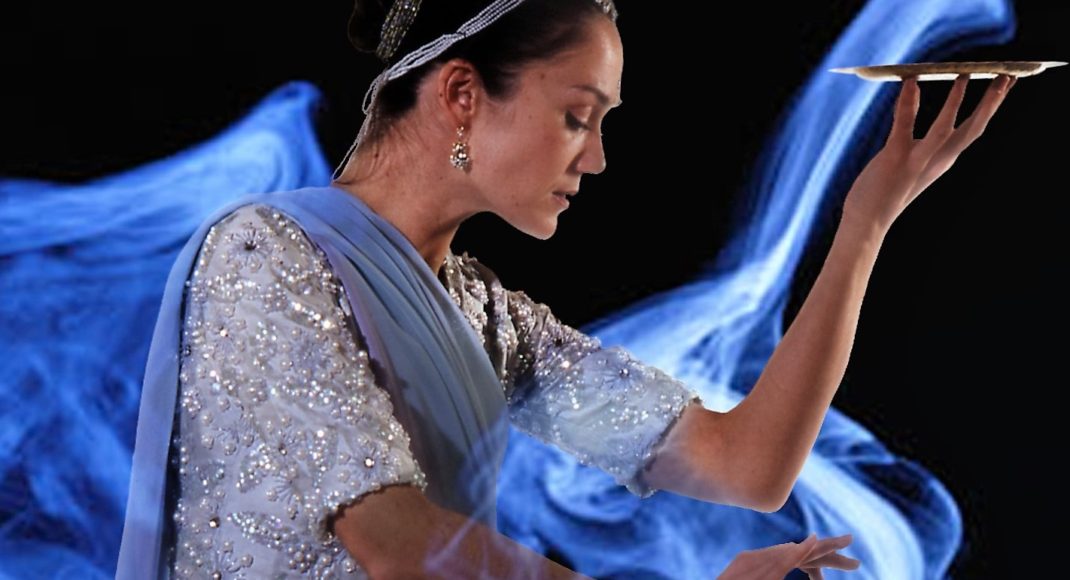
Lea herself performed two pieces. The first, The Incense, was based on a 1906 work by American dancer Ruth St Denis whose interest in spirituality led her to look to India for inspiration to nurture her choreographic and performance career. In TheIncense the dancer enacts an incense burning ritual and Lea’s reinterpretation was strongly performed. She held the attention with some fine lyrical movement and arresting poses. The second of Lea’s solos, When Tagore met Einstein, was based on a discussion that took place between poet Rabindranath Tagore and scientist Albert Einstein in 1930. This work perhaps needs to be seen more than once for its full value to be realised. It was hard to follow the extraordinary complexities of the conversation, which was used as a voice-over, and at the same time to focus on the choreography and its performance. Both pieces represented Lea’s interest in historical conjunctions between the cultures of East and West and also demonstrated, in particular with When Tagore met Einstein, her interest in using classical techniques in a contemporary manner.
Patel showed two solos. Patra Pravesham—Ananda Nartana Ganapatim, which concerned the elephant-headed god Ganesha, and which included a strong display of some of the technical aspects of Bharata Natyam; and Padam (Theruvil Vaaraano)—Raga Kamas, showing the expressionistic side of the style. Patel has a powerful sense of focus, meticulous attention to detail, and is an extraordinarily articulate dancer in the manner in which she moves through the choreography and the complex expressionistic language. Only the very best dancers, in whatever dance style they might espouse, have the ability to make their movement look as though it is completely at one with the body. Patel has it all and her performance was moving and utterly entrancing. She is an extraordinary dance artist.
Two short (very short) films were also part of the program. Both gave insight into Patel’s process and practice with one focusing on the work in which she has been engaged in Australia with contemporary choreographer Lina Limosani. For more on Patel’s Australian visit, including a link to the Limosani collaboration, see this link.
12 & 13 August 2016, St James Theatre, Wellington, New Zealand
There are a number of things to admire in Royal New Zealand Ballet’s current production of Giselle, choreographed and produced for the company by Ethan Stiefel and Johan Kobborg in 2012. As one enters the theatre a front curtain is down and it immediately promises something interesting. We see a finely drawn tree with a brown trunk and spreading brown branches with small, red, heart-shaped leaves attached. The colours set the season (the ballet traditionally takes place at harvest time), as well as giving a clue to the emotional story we will encounter. As the curtain rises, small white shapes, a little like tear drops, appear on the cloth, and dark twisted roots emerge and move mysteriously (lighting by Kendall Smith). It is a wonderful piece of scenic art by American designer Howard C Jones. It has a beautiful simplicity and yet prefigures so many of the ballet’s themes.
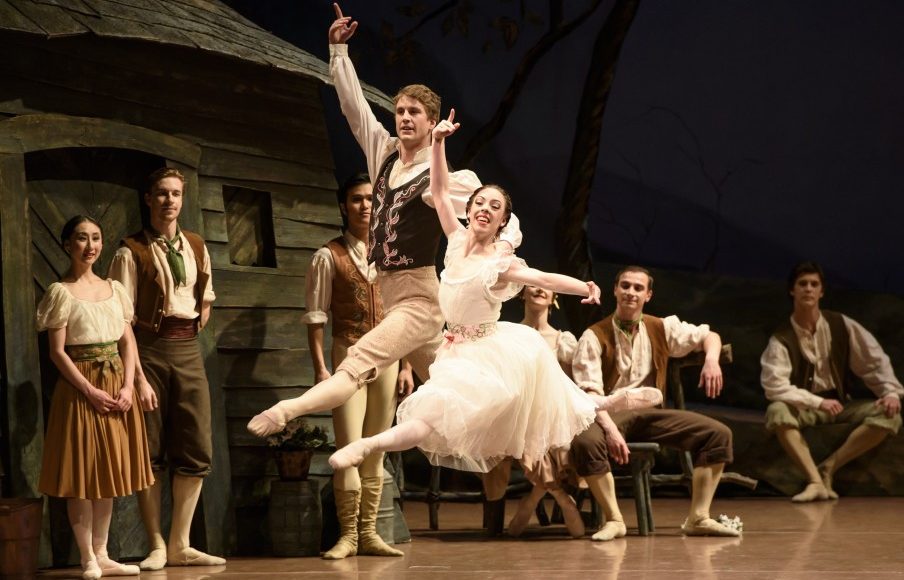
As Act I unfolded, I admired the way in which Stiefel and Kobborg had developed the male characters. The peasant men seemed a rough and tumble lot and at one stage engaged in a bout of light-hearted pushing and shoving. They were not the overly genteel peasants we so often see standing in perfect ballet poses. In fact we often saw them slouching around in the background.
The character of Hilarion was also nicely developed. He was given a solo in the first act, which drew more attention to his participation in the life of the village and his place in the story as Giselle’s long-term admirer. The role was strongly danced by Jacob Chown in one cast and Paul Mathews in another. Mathews in particular showed some exceptional elevation and seemed to relish every vigorous moment of the Act I solo. On the other hand, Chown was the one who put up a thrilling fight against the Wilis in Act II and in his dancing seemed to be buffeted back and forth by some supernatural power.
Wilfred, aide to Albrecht (disguised as Lenz—not Loys!), was also encouraged to be a stronger character than usual. It was not that he was given anything extra to do, so bouquets to the dancers and to the coaching staff. I saw Jacob Chown and William Fitzgerald and enjoyed both interpretations, although Chown seemed to add a mature factor to his characterisation, which I thought particularly suitable.
I also was surprised, but pleased, to find, with the arrival of the titled landowners (usually on a hunting excursion, but in this production out riding), that the Duke and and his daughter Bathilde did not enter Giselle’s cottage to rest, as usually happens—I have often pondered why they would take a rest in such a rudimentary structure. Instead, in this production, they headed off to continue their ride. This of course meant that other arrangements had to be made to call them back to the village for the unmasking of Albrecht, of which more later.
I also enjoyed the inclusion of children and older people as extras in the village scenes of Act I. It made for a more natural look than what we are used to.
Choreographically Stiefel and Kobborg have kept some of the well-known sections, especially in Act II where the steps performed by Giselle and Albrecht (pas de deux and solos); some sections by Myrtha, Queen of the Wilis; and some of the corps de ballet work were familiar. But large sections of Act I, especially the dances for the corps de ballet, had been reworked and were more like character dances than the classically-based choreography we usually see. Some of the group dances for the Wilis in Act II had also been reworked and there seemed to be focus on circular patterns and movements.
I saw two casts in the leading roles of Giselle and Albrecht—Mayu Tanigaito partnered by Daniel Gaudiello and Lucy Green partnered by Qi Huan and all danced more than adequately. Gaudiello made something spectacular of Albrecht’s solo dances in Act II. His cabrioles were breathtaking in their precision and he soared into his jumps. A triple attitude turn was a thrill to see, and his set of entrechats was stunning. But he also brought many charming extras to his portrayal—a little brush of his hand along Tanigaito’s arm before taking her hand, a benign glance here and there. Such things have long been a feature of Gaudiello’s acting and it was a treat to see him once again.
But in this production of Giselle, there were also a number of things not to like. Much impact was lost in Act I when Berthe, who needs to recount the story of the Wilis and the effect they have on jilted young girls, had been allocated a much reduced story to tell. Neither of the dancers I saw as Berthe—Alayna Ng and Madeleine Graham—was able to impart a sense of impending doom. And not only that, Giselle’s friends took absolutely no notice of Berthe’s story. They were busy upstage admiring a friend’s wedding outfit. And sadly, nothing in a mime or choreographic sense was made of the musical leitmotif for the Wilis, which we hear during Berthe’s mime scene. It is the musical link between the first and second acts and recurs during the mad scene and then at the beginning of Act II. Berthe needs to be clearly aware of this leitmotif in her mime, or with some kind of reaction, so she can begin a dramaturgical link.
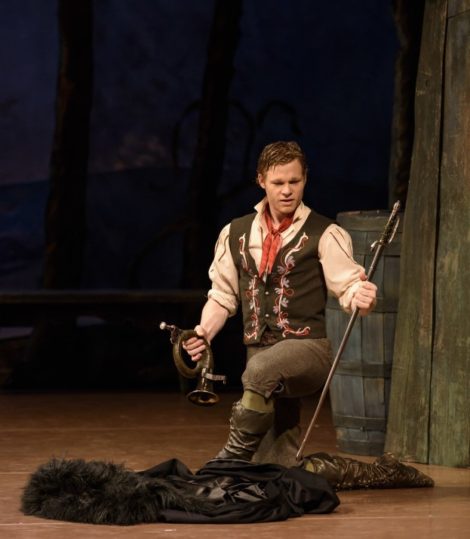
Then there was the issue of the horn, usually hung outside the cottage by a member of the hunting party when the Duke and Bathilde retire to the cottage. Hilarion uses it to call the hunting party back after he has discovered Albrecht’s true identity. But since there was a change to the storyline in the Stiefel/Kobborg production, Albrecht arrives in the village with a sword at his side and the horn around his neck. Now why would he be carrying a horn? It didn’t make sense to me and looked like a clumsy addition and simply (as indeed it was) a way of sneaking the horn in so that Hilarion had something to use when he needs to summon the hunting/riding party.
I also wondered why there was a need to remove the grape harvest part of the original narrative, thus weakening the story. The grape harvest is a rationale for the Duke and his party to stop to quench their thirst at Giselle’s village. They drink the wine of the area, which is served with pride by Giselle and/or Berthe. Removing this aspect of the story also denies Giselle a place as the Harvest Queen and makes her, in many ways, a lesser person in the village. Replacing the Harvest Queen with a Wedding Couple, who also dance the peasant pas de deux, is interesting but to my mind is playing with the story for no apparent purpose.
I was also unimpressed by some of the costumes (designed by Natalia Stewart) especially that for Albrecht in Act II. His jacket had such a high collar that his neck all but disappeared and occasionally reduced the classical look of the choreography. And there were times when Albrecht seemed to have a hunchback due, I can only surmise, to the cut of the jacket. This happened more in the case of Gaudiello as the costume seemed to be a better fit on Qi. I wish too that Myrtha had been given the wreath of flowers she usually wears as a headdress. It would have given Clytie Campbell, whom I saw as Myrtha at both performances, added presence and would have distinguished her somewhat from the band of Wilis she leads. It may not have seemed so annoying had the role of Myrtha been given the same attention as the minor principal roles of Hilarion and Wilfred. As it was parts of the second act seemed a little underwhelming.
Stiefel and Kobborg have added a rather nice framework within which the story unfolds. When the ballet opens we see, through a scrim and seemingly within the swirling roots of the tree of the front curtain, the figure of a man, the Older Albrecht. He appears briefly at the beginning and end of both acts as an observer and relives, as a program note tells us, ‘the story that has possessed his being for nearly a decade.’ But for me this Giselle does not stand up to those productions that have brought tears to my eyes and sent me home from the theatre on a high.