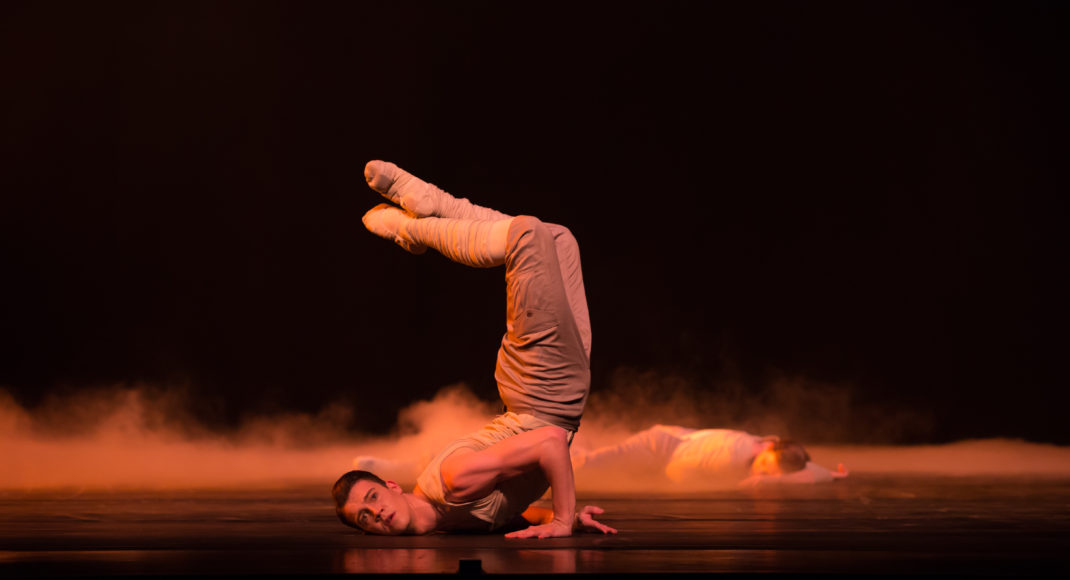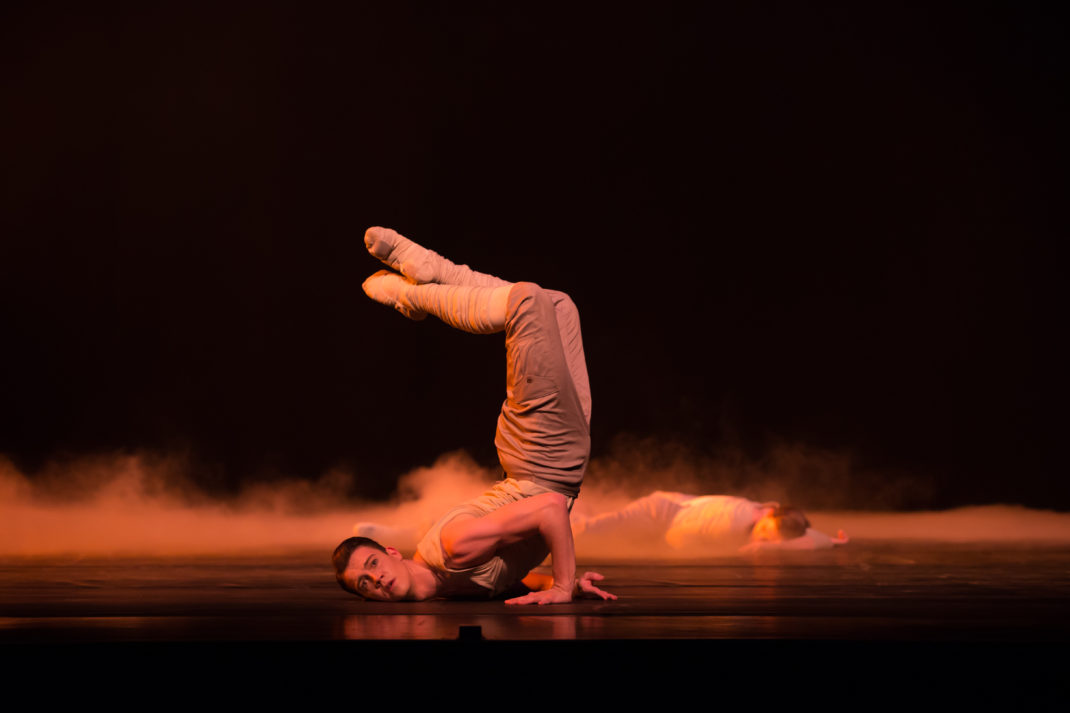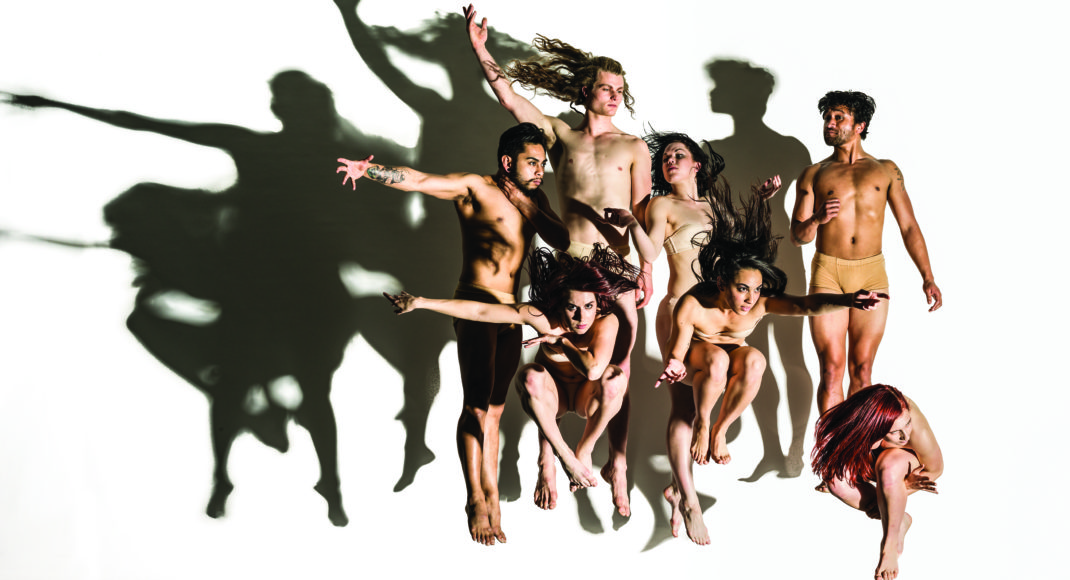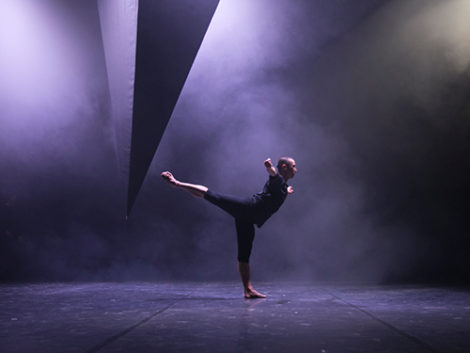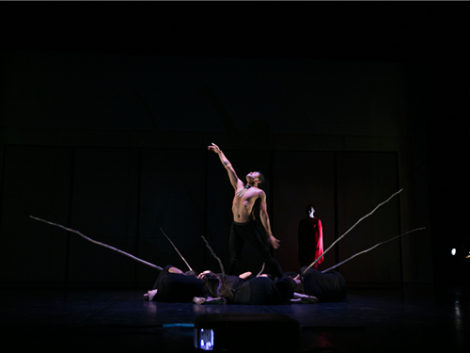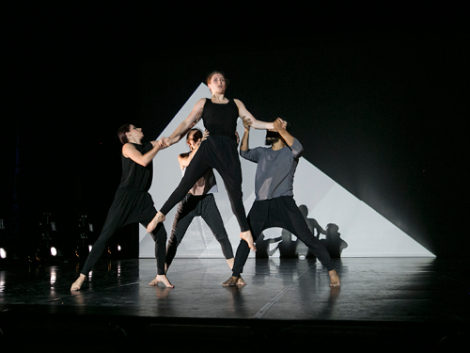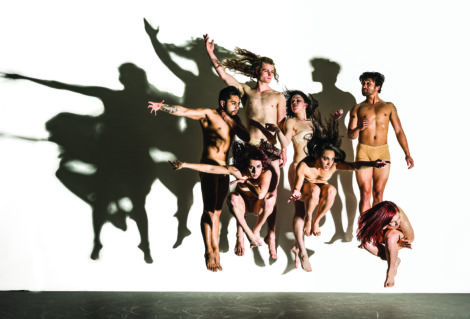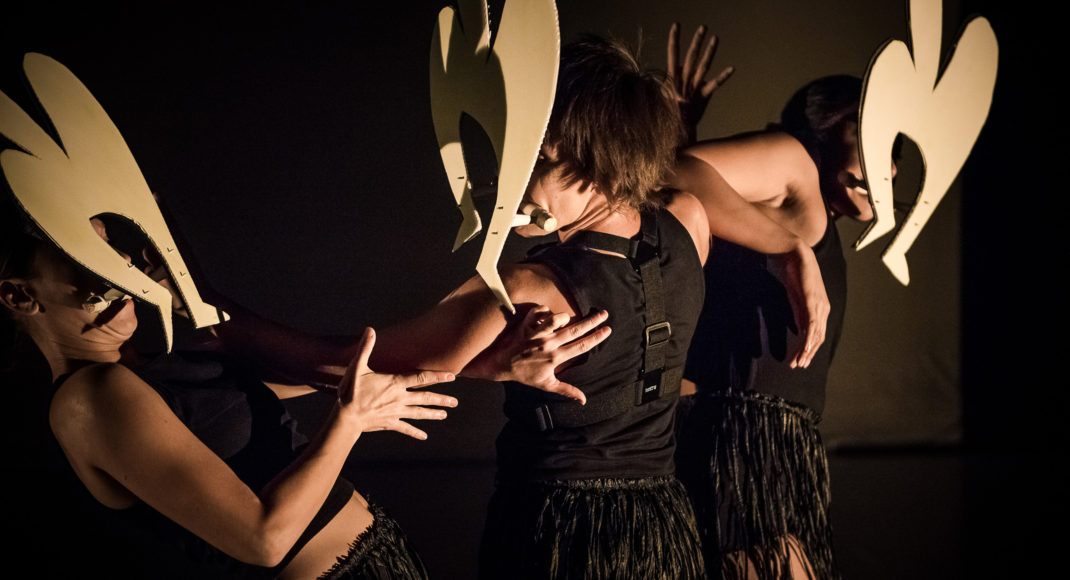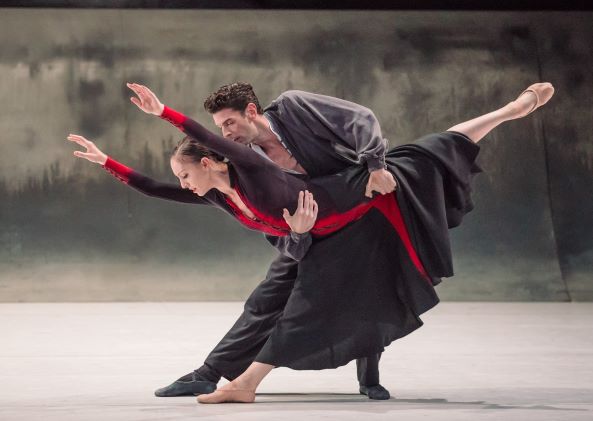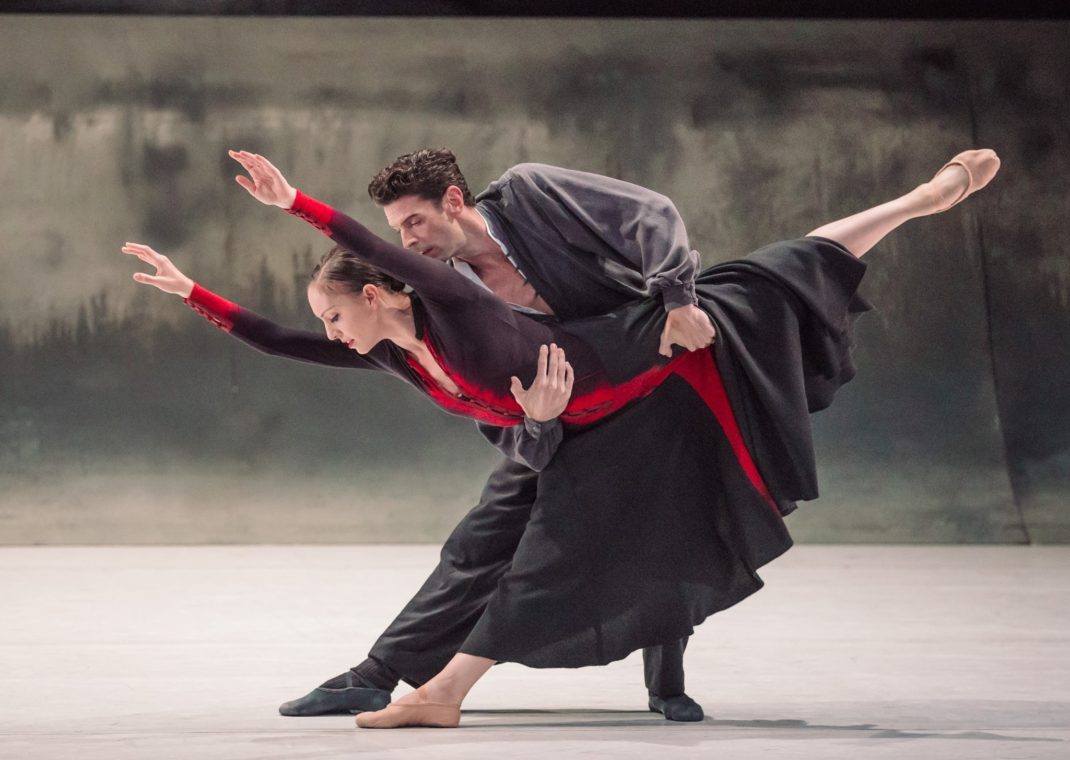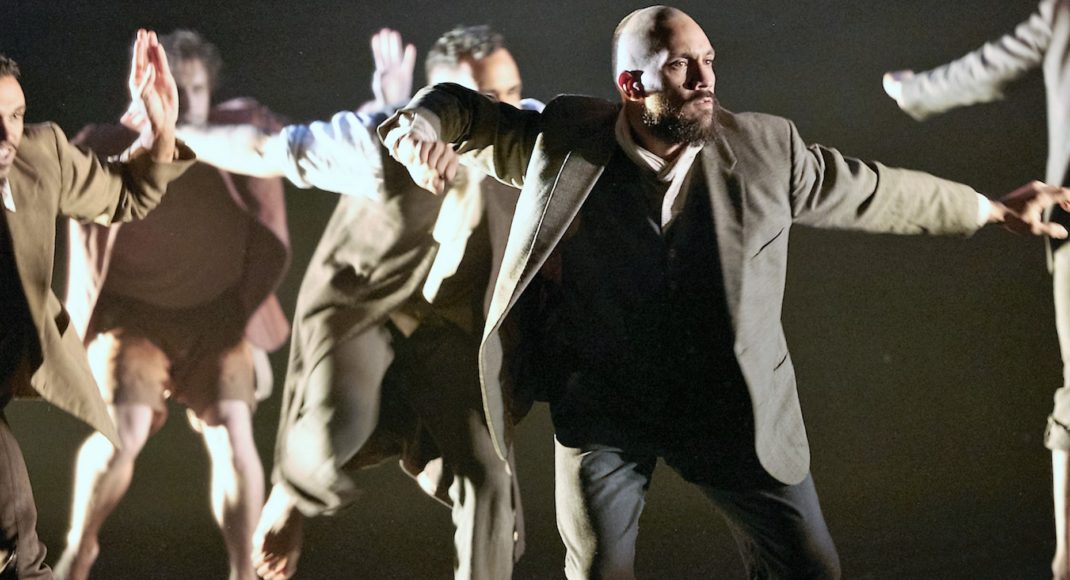
Waangenga Blanco in 'Miyagan' from OUR land people stories. Photo: Edward Mulvihill

OUR land people stories. Bangarra Dance Theatre

28 July 2016, Canberra Theatre

Bangarra Dance Theatre has had what artistic director Stephen Page calls a ‘bitter sweet’ year so far. On the one hand the company has had to face the death in April 2016 of David Page, much loved and admired composer, Bangarra’s music director, and brother of Stephen. On the other there have been successes in so many areas. Most recently, Bangarra—the company, its dancers and its productions—has been short-listed in six categories for the 2016 Australian Dance Awards.

Bangarra’s major production for 2016, a triple bill with the title OUR land people stories, has to be counted as a sweet moment. Although it is dedicated to David Page and it is impossible not to be moved hearing his music, which features in the program, OUR land people stories moves forward proudly and is sweet as much as anything because it showcases the work of three emerging choreographers from within the company ranks.

First up on the program was Macq, choreographed by Jasmin Sheppard to a score by David Page. Macq takes as its starting point a confrontation in 1816 between white settlers in the Appin region, south of Campbelltown, New South Wales, and Aboriginal inhabitants of the region, the D’harawal people. As the confrontation over territory escalated and tensions mounted, Colonial forces, under instructions from Governor Macquarie, began what has come to be known as the 1816 Appin massacre. Sheppard researched Macquarie’s diaries and consulted with descendants of the D’harawal and portrays Macquarie as a conflicted man who, on the one hand appeared to have good intentions towards First Nation peoples, but on the other who went to extreme lengths to maintain territorial control of areas under his jurisdiction.

One especially challenging sequence occurs between Macquarie, danced powerfully by Daniel Riley, and Beau Dean Riley Smith, also outstanding in his role as one of the D’harawal men killed in the massacre. As they dispute territorial boundaries, they interact on, under, and around a long table. The movement is fast, dramatic, determined and confronting and makes astonishing use of the table. Another compelling scene shows Riley acting out Macquarie’s conflicted state of mind as he frantically scribbles down his diaries. It is a courageous statement by Sheppard.
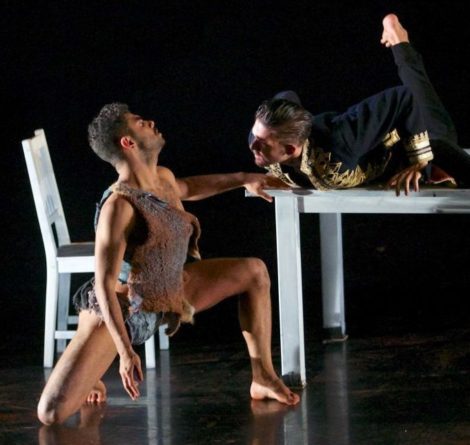
Beau Dean Riley Smith and Daniel Riley in a scene from 'Macq'. Bangarra Dance Theatre, 2016
Beau Dean Riley Smith and Daniel Riley in a scene from Macq. Bangarra Dance Theatre, 2016

But what I found especially powerful about Macq was the way Sheppard had structured the work so as different moments in time were visible even as the main story was unfolding before us. As the work began, for example, in a kind of half light we could see the aftermath of the massacre as D’harawal people mourned the death of their kin. In fact the work moved backwards and forwards in time in a well developed and emotionally satisfying way.

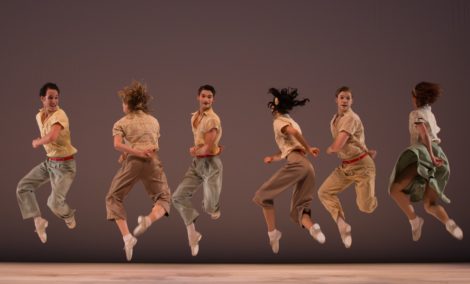
The second work on the program, Miyagan (meaning ‘our family’ in the language of the Wiradjuri Nation) was choreographed by cousins Daniel Riley and Beau Dean Riley Smith. It was structurally complex with sections referring to the matrilineal nature of Wiradjuri system, and to moiety, clan and family, although the the work also referred to life in the early 1900s on the Talbragar Reserve in Dubbo, where Riley and Smith had a common ancestor in Jack Riley. Choreographically the work was vibrant and moved along smoothly to a soundscape by Paul Mac. The intricate web of kinship relationships and responsibilities was highlighted by Jacob Nash’s spectacular hanging sculpture which served as the set for Miyangan.
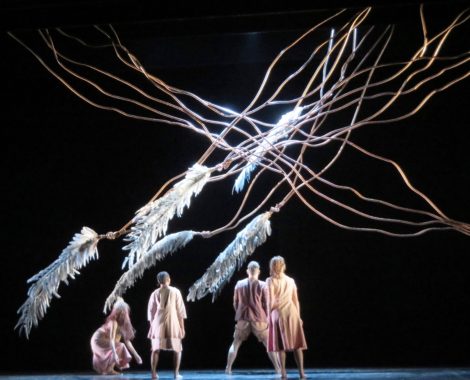
Myagan
Jacob Nash’s set for Miyagan, Bangarra Dance Theatre, 2016. Photo: Michelle Potter

Page said, in a pre-show forum at the Canberra Theatre, that his aim in curating OUR land people stories was to give an opportunity to Sheppard, Riley and Smith to create main stage works for Bangarra—to nurture emerging choreographers from within the company. He added, however, that he thought perhaps he should also do a work! The result was the closing piece, Nyapanyapa, a work inspired by the art of Yolngu woman, Nyapanyapa Yunupingu. At the heart of the work is the story of Nyapanyapa’s encounter with a water buffalo, which left her badly injured. But we are given insight into many other aspects of her life, and see reproductions of her work as background. Elma Kris is at her charismatic best as Nyapanyapa and the Bangarra dancers show off dancerly skills that range from full-on rock ‘n’ roll to sublimely meditative moves.
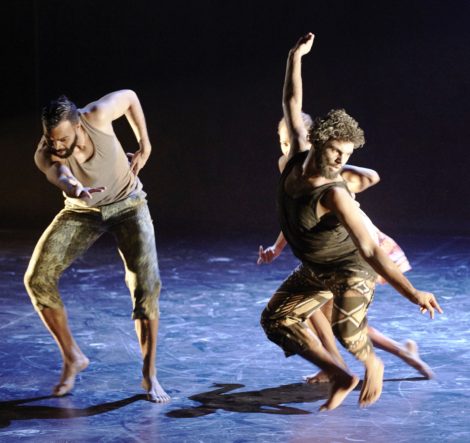
Luke Currie-Richardson and Beau Dean Riley Smith in 'Nyapanyapa' from 'OUR land people stories'. Photo: Edward Mulvihill
Luke Currie-Richardson and Beau Dean Riley Smith in ‘Nyapanyapa’ from OUR land people stories. Bangarra Dance Theatre, 2016. Photo: © Edward Mulvihill

OUR land people stories once again shows Bangarra as a company where dance meets theatre, meets art, meets music. After its Australian season of this program, Bangarra moves on to New York for the Fall for Dance season and then goes on to Paris to perform in the splendid, ethnographically-oriented venue, Musée du Quai Branly.

Michelle Potter, 5 August 2016

Featured image: Waangenga Blanco in ‘Miyagan’ from OUR land people stories (detail). Photo: © Edward Mulvihill
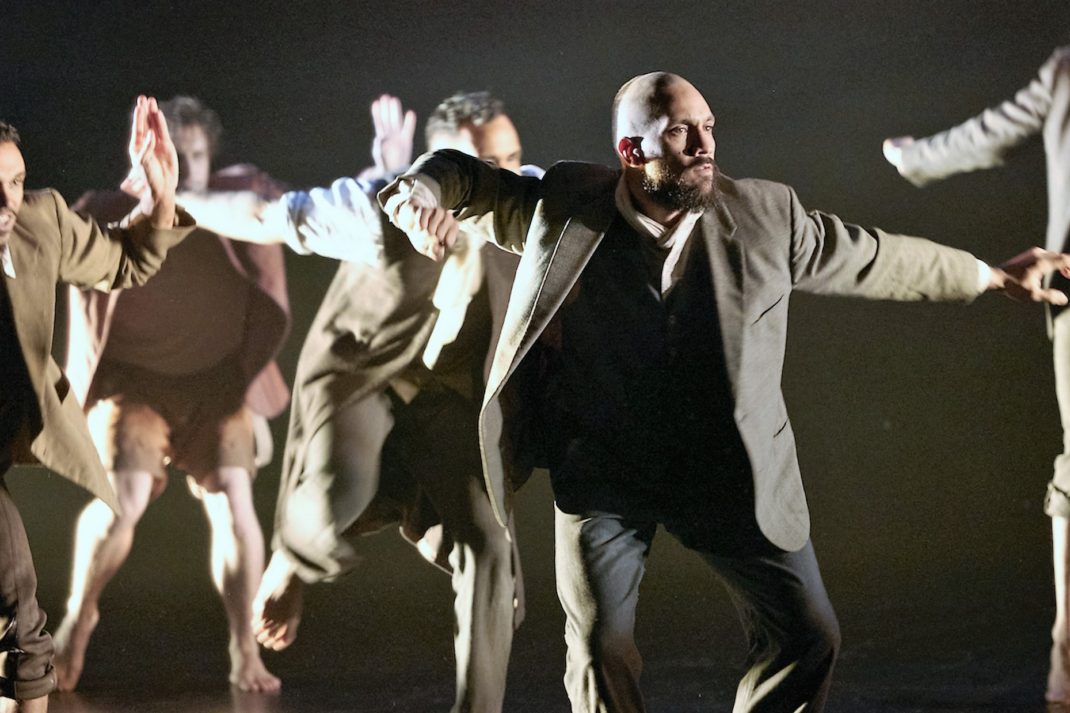
Waangenga Blanco in 'Miyagan' from OUR land people stories. Photo: Edward Mulvihill
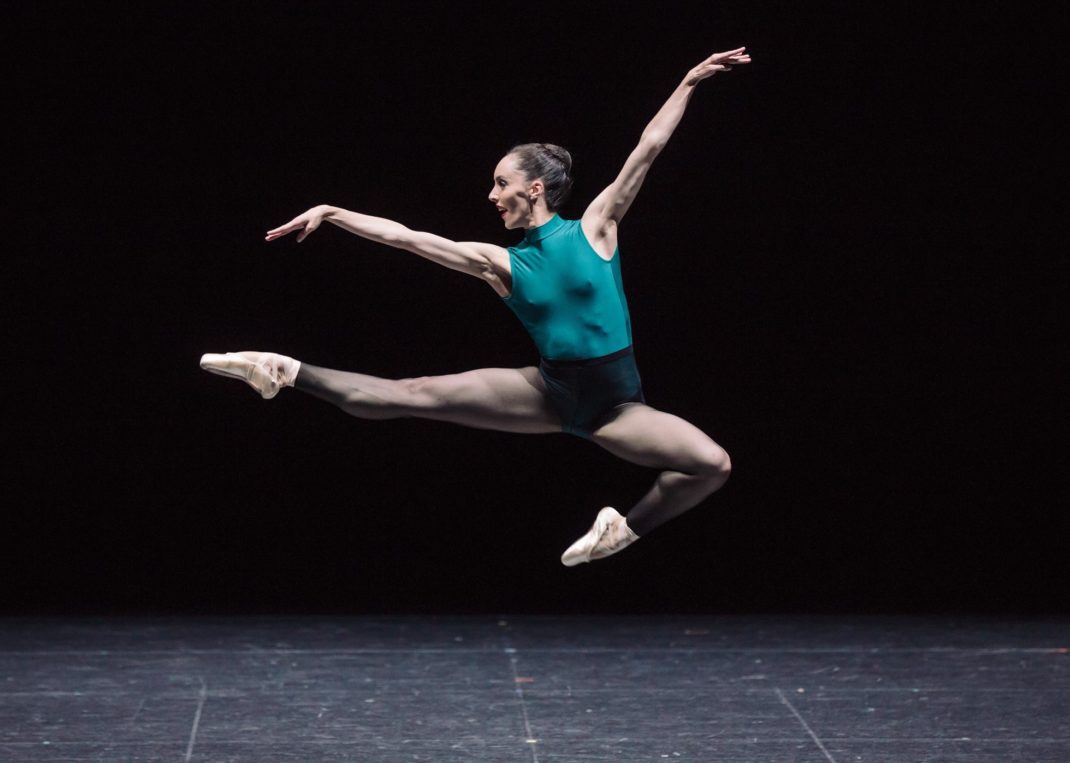
Jack Lister in 'We who are left'. Queensland ballet, 2016. Photo: David Kelly

Lest we forget. Queensland Ballet

29 July 2016, Playhouse, Queensland Performing Arts Centre, Brisbane

My review of Queensland Ballet’s triple bill, Lest we forget, has been published on DanceTabs at this link.

One aspect of the production I didn’t mention on DanceTabs was the lovely piece of Americana on the cast sheet. The dancers in Company B were referred to not by first name and surname but with the surname preceded by Ms. or Mr. as in:

‘Pennsylvania Polka’        Ms. Crilly & Mr. Thompson.

Artists of Queensland ballet in Paul Taylor's 'Company B', 2016. Photo: David Kelly
Artists of Queensland ballet in Paul Taylor’s Company B, 2016. Photo: © David Kelly

I recall being asked by a former principal of the Australian Ballet if I could refer to her in this way in reviews. I had to decline as it is not the Australian way. But I loved that the format was used in Paul Taylor’s very American work. Or should I say Mr. Taylor’s very American work?.

Michelle Potter, 31 July 2016

Featured image: Jack Lister in Natalie Weir’s We who are left. Queensland Ballet, 2016. Photo: © David Kelly

Jack Lister in 'We who are left'. Queensland ballet, 2016. Photo: David Kelly
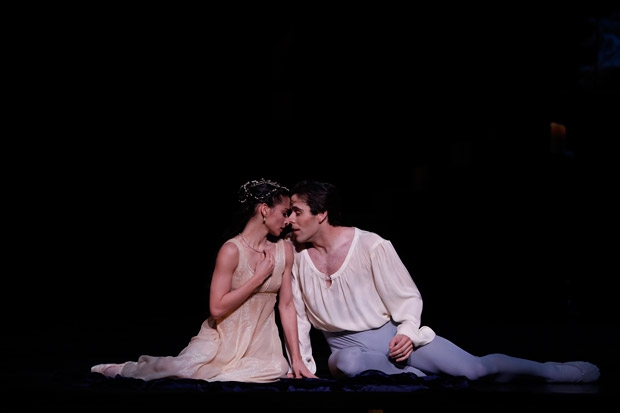
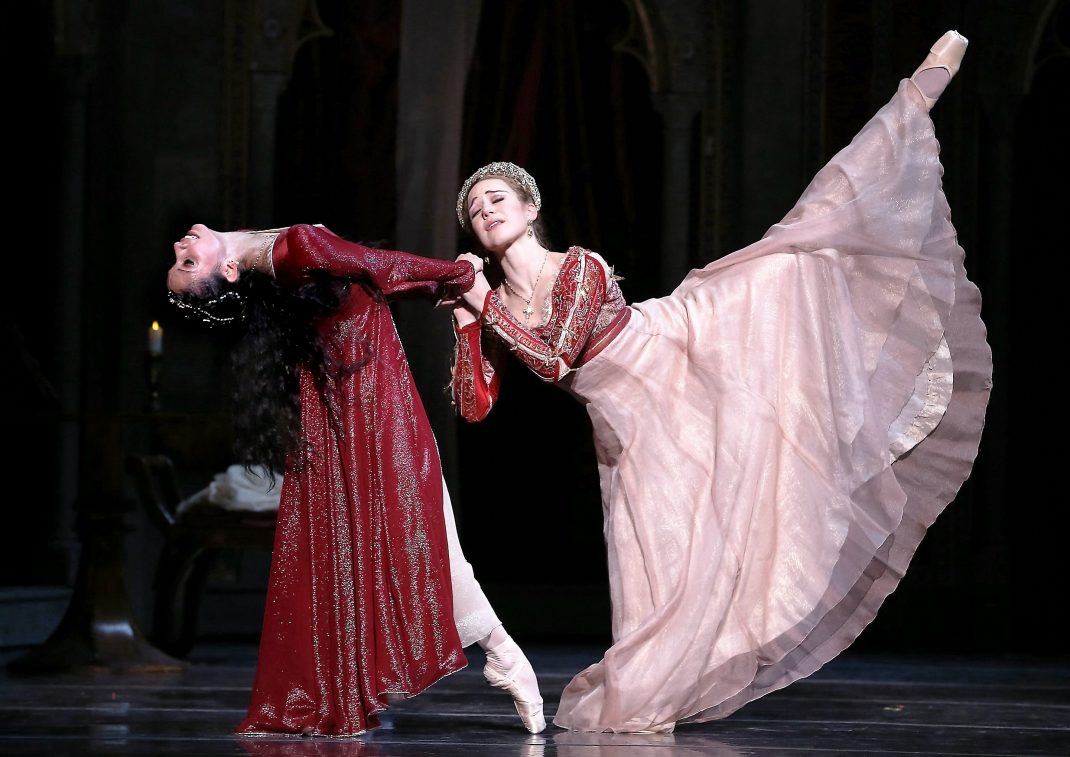
Karina González and Connor Walsh, Houston Ballet's Romeo and Juliet, Melbourne 2016. Photo: © Jeff Busby

Romeo and Juliet. Houston Ballet

30 June 2016, State Theatre, Victorian Arts Centre, Melbourne

My review of Stanton Welch’s spectacular Romeo and Juliet for Houston Ballet is now available on DanceTabs at this link. In relation to the DanceTabs review, below is an image of Karina Gonzalez as Juliet and Jessica Collado as Lady Capulet showing the ‘exclamation mark’ arabesque I mention in the review.

Karina González and Jessica Collado, Houston Ballet’s Romeo and Juliet, Melbourne 2016. Photo: © Jeff Busby

While in the review I didn’t go into much detail about the children who appeared in the work (courtesy of the Australian Ballet School), I am am curious to know the name of the fair-haired boy who led the Blind Man’s Buff game, and who appeared whenever children were required. He had such charisma for someone so young.

Michelle Potter, 3 July 2016

Featured image: Karina González and Connor Walsh, Houston Ballet’s Romeo and Juliet, Melbourne 2016. Photo: © Jeff Busby

The Peasant Prince. Monkey Baa Theatre Company

4 June 2016, Playhouse, Canberra Theatre Centre

In 2003 the story of Li Cunxin’s remarkable journey from a village in Shandong province in rural China to the world stage was published as Mao’s last dancer. The story was subsequently made into a film and then written as a children’s book, The Peasant Prince. Now it has become a theatre work for children presented, astonishingly, by a cast of just four from Monkey Baa Theatre Company.

The show begins with John Gomes Goodway, who plays Li, standing on stage waiting for the curtain to go up on his performance as the Nutcracker Prince in a Houston Ballet production of Nutcracker (and of course Li, now artistic director of Queensland Ballet, made his debut outside of China with Houston Ballet). It then flashes back to his childhood, his selection by an official sent by Madame Mao to join a dance academy in Beijing, his training, his homesickness, his determination to keep moving forward, his eventual invitation to visit Houston Ballet for a residency, and finally his decision to remain in the West. It returns in the closing scene to the opening and the moment when Li, watched by his parents, takes the stage in Nutcracker.

From a dance perspective, the choreography by Danielle Micich (called ‘Movement Director’ on the printed program), is beautifully conceived for a young audience. My almost-six-year old companion could recognise some of the ballet movements she is taught in her beginners’ class, for example. But it is also developed enough for an older audience to enjoy, especially for the way in which an exercise barre is used to indicate the passing of time, and for the expertise of the cast who move from one character to another with apparent ease.

I’m not sure how much of the political context (necessary for the unfolding of the story of course)—that is the constant praise of Chairman Mao and his policies along with the critical comments about America—was understood by younger children. And the scene where officials from the Chinese Embassy in the US tried to make sure that Li did not stay in the West was rough and a little scary for some. Some explanation beforehand by parents/grandparents is probably necessary if their charges have not read the book.

But in essence The Peasant Prince was an engaging show, beautifully staged with minimum fuss.

Michelle Potter, 15 June 2016

Featured image: John Gomes Goodway (centre) as Li Cunxin, with Jenevieve Chang as the school teacher and Edric Hong as a Chairman Mao official. Photo: © Heidrun Lohr

Strictly Gershwin. Queensland Ballet (2016)

27 May 2016, Lyric Theatre, Queensland Performing Arts Centre, Brisbane

Derek Deane made his Strictly Gershwin for English National Ballet in 2008 when it was shown in London’s cavernous Royal Albert Hall. I have to admit I wondered how it would look on Queensland Ballet in the rather more confined space of Brisbane’s Lyric Theatre. Well I need not have worried. It looked spectacular!

Strictly Gershwin is a show in the true sense of the word—an impressive spectacle. It highlights all kinds of dance from ballet to tap to the charleston. It has an onstage jazz orchestra, largely consisting of musicians from Queensland Symphony Orchestra conducted by a very charismatic Gareth Valentine, and musically it is enhanced by the presence of some outstanding vocalists. It has eye-catching, Hollywood-style lighting and razzle dazzle costumes. And Queensland Ballet is augmented by special guest dancers, a corps of tap dancers and a larger corps of pre-professional dancers. It was some feat to bring this show together. The stage looked a little crowded only occasionally, and a few opening night problems and fumbles will, I am sure, be ironed out in later performances. The audience reaction was loud and appreciative throughout, especially for lead tappers, Kris Kerr and Bill Simpson, with a standing ovation for all at the end.

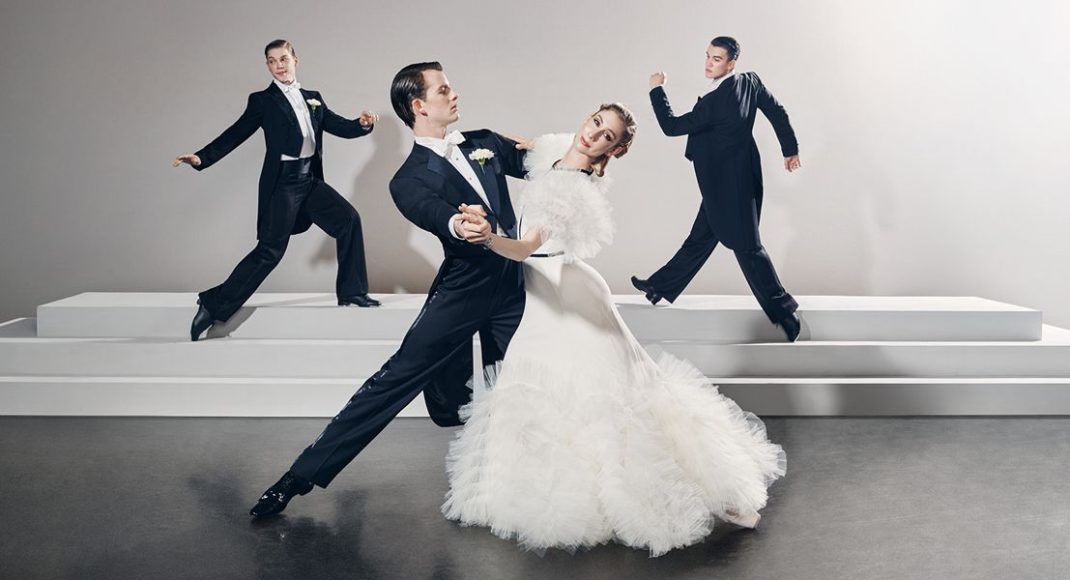
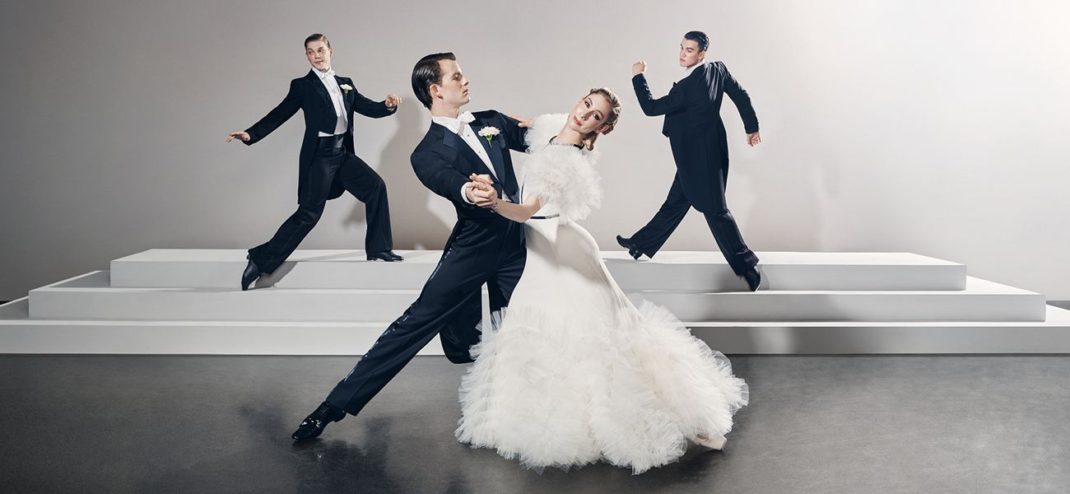
As the name implies, the show celebrated the music and lyrics of George and Ira Gershwin, from works made for film and musicals to concert hall compositions. The fun begins with the overture in which Valentine displays his dancing skills in addition to his skills with the baton. But the big number from the first half of the program for me was ‘Shall we dance?’ which, with its glamorous black, white and sparkling silver costumes, and its images of Fred Astaire and Ginger Rogers that are flashed onto an upstage screen, reminded us of those great Hollywood movies of the 1930s. Led by Clare Morehen and Christian Tátchev, it was distinguished by a wonderful range of choreography from quite formal ballroom-style partnering and poses to fast jitterbug moves. What a versatile company of dancers we saw.

In the second half the standout number for me was another big one, ‘Oh, lady be good’, featuring tappers Kerr and Simpson along with Rachael Walsh making a return appearance with Queensland Ballet. They were joined by a guest corps of tap dancers and each and every dancer shone, sparkled and smiled from beginning to end. Such a pleasure to watch.

Overall, my pick of the dancers on this occasion was Lina Kim, beautifully fluid and partnered strongly by Rian Thompson in ‘Someone to watch over me’. She appeared at other times in less featured roles throughout the evening and showed off some fabulous footwork and dancing that carried me away with pleasure as I watched her joyous dancing. I was also swept away by the tango-esque choreography of ‘It ain’t necessarily so’ danced by Yanela Piñera and Camilo Ramos, both perfectly cast to bring a slinky sexuality to the choreography. Then there was Mia Heathcote and Shane Wuerthner in an apache-style duet to music from ‘An American in Paris’. Gorgeous choreography here too especially those subtle changes to the placement of the legs as Heathcote was lifted, turned, lowered and twisted by Wuerthner.

Perhaps the one section that seemed a little messy was the Paris scene. It showed off such a range of characters—people riding bikes, nuns, circus people, characters on roller skates, the full gamut of Parisian characters—that the stage seemed overpopulated to me. Perhaps this was where the Albert Hall was needed? But Strictly Gershwin is a fabulous show, filled with great music and dancing, and an event to be enjoyed rather than analysed. Definitely a major coup for Queensland Ballet.

Michelle Potter, 29 May 2016

Featured image: Promotional image for Strictly Gershwin. Queensland Ballet, 2016

New Zealand Dance Company in a study for 'Lumina'. Photo: John McDermott

Lumina. New Zealand Dance Company

Reviewed by Jennifer Shennan

The New Zealand Dance Company’s Lumina has just toured to five centres in the north island—one performance in Whangarei, in Mahurangi, Napier, Wellington, New Plymouth—after a premiere season last year of the same program in its home base, Auckland, and appearances earlier this year at the Holland Dance Festival—where incidentally Black Grace also performed.

The company has been performing since 2012, with the dancers recruited on a project base, rather than employed on continuous contracts. There are eight dancers in the company, all of them strong, svelte and with refreshingly individual qualities. Six are graduates from Unitec in Auckland and two are from New Zealand School of Dance.

We saw NZDC’s Rotunda last year, with the New Zealand Army Band sharing the stage. The three works on this program are choreographed by Dutch/American Stephen Shropshire, and by New Zealanders Louise Potiki Bryant and Malia Johnston. The works result from a specific commission ‘to engage with light, illumination, space, image, movement’.

To some degree of course all choreography does do  that—with music usually the defining part of the equation. In this program though, many graphic effects are sourced by playing with light at various levels, which creates some striking sculptural images. So in a way the evening is more visual than aural, though the music for one work does guide and follow the development of the choreographic structure in an interesting way.

The Geography of an Archipelago, by Stephen Shropshire, makes analogy of the physical isolation of an island, or string of islands, with a human or group of humans.  A huge sculptural triangle is slowly transported about the stage, with the resulting shadows suggesting spaces, real and imagined, that isolate individuals. Some dancing in a pocket of light engages us, then we perceive that a similar sequence is being danced parallel in the dark. How alike we are, how separated we are. The movement has strong contrast between a dancer’s limbs and his torso, as if striving to belong together. The dancers’ ceaseless tramping of feet in another section seems to take us journeying with them.

image
Xin Ji in The Geography of an Archipelago. Photo: © John McDermott. Courtesy New Zealand Dance Company

The work integrates well with the music by Chris O’Connor, his driving percussion leading to Beethoven’s Moonlight Sonata, then sighs, bells and taonga puoro to suggest opposite ends on the spectrum. One dancer playing a quiet conch implies live music is closer than you think, echoing the ‘meandering journey towards oneself’ from the program note. In this strong and confident choreography, Xin Ji dances with an electric clarity that becomes poetry. A sudden blackout ended the work whereas a slow-motion quiet fade would have suited me better, but I can imagine that for myself.

In Transit, by Louise Potiki Bryant, is a powerful and poignant choreography. Long sticks are used as props, suggesting weapons of defence and attack, of palisade and territory marker. It is not a narrative in the obvious sense, but there are numerous references to the memories of past encounters that Maori have experienced within and between groups. Posture dances but with lyrical rather than forceful limbs are hinted at. A telling female figure in red in the background is a grieving witness to the many incidents obliquely referred to. Numerous stylized images of human forms are projected on to screens and moving bodies, in metaphors that suggest experiences among preceding generations and memories of history.

image

Tupua Tigafua and artists of New Zealand Dance Company in In Transit. Photo: © John McDermott. Courtesy New Zealand Dance Company

Brouhaha (a trope from early times used ‘to warn of the devil disguised as clergy’) is Malia Johnston’s whirlwind work that pitches speed of dance movement against the projected lighting effects which build exponentially with the sound throughout. A plethora of light lines travels across the set and connects to the busyness of the soundscape. Extreme stamina is demanded from the dancers throughout—close to exhaustion, they certainly earn the ecstatic and beautiful choral cadence of reaching heaven after such a hard time on earth but it was tantalisingly brief. We needed that too to last longer…

image
Hi Katie Rudd and artists of New Zealand Dance Company in Brouhaha. Photo: © John McDermott. Courtesy New Zealand Dance Company

Each of the three works has strong choreography, wide ranging visual effects with light and shade, and performances in tight tandem. Overall it is sophisticated, and the graphic effects tethered to electronic sound will be exciting for some, but I found at times that these elements of moving light spectacle almost overpowered the dancers’ presence. It’s good to think of them performing in New Plymouth where Len Lye’s kinetic sculptural work, overlapping with dance movement, is housed.

Program notes are an opportunity for a choreographer to speak in clear prose, the thoughts and concerns of a work.  It is pretentious to claim that we should be left to make our own sense of what we see. Of course that is exactly what we do—but a program note is just like an abstract, précis, synopsis, introduction, commentary, caption or storyboard. Such forms have a clear function and need to use specifics, not to philosophise in generalisations or universals if they are to fulfill their purpose. I often find this an area for improvement in dance productions these days.

This is a well-resourced national dance company so it’s a pity there was only one performance in each venue since considerable technical set-up is involved and one assumes that the touring itself is the major outlay. A second performance would allow word of mouth, always the best publicity, to filter through. Most of all, if the performance is astonishing, you can go back for a second viewing. I would certainly have wanted to see the opening work a second time, to savour its dynamic integration of choreography with music.

An aside: I saw a few weeks ago a screening at the New Zealand Film Archive of Douglas Wright’s work, Now is the hour, from 1988.  It is extraordinary and insightful choreography, and wonderful that the work has been so skilfully filmed. Shona McCullagh, now artistic director of the NZDC, is in the cast and moves with very great grace. Dance is such an ephemeral art. Anything to save and savour its repertoire is to be treasured. It shows us where we were and where we are going.

Jennifer Shennan, 25 May 2016

Featured image: Artists of New Zealand Dance Company in a study for Lumina. Photo: © John McDermott. Courtesy New Zealand Dance Company

New Zealand Dance Company in a study for 'Lumina'. Photo: John McDermott
Scene from Ghenoa Gela's Fragments of Malungoka-Women of the Sea. Photo: (c) Gregory Lorenzutti for Dancehouse, 2016.

Keir Choreographic Award. Finals 2016

7 May 2016, Carriageworks, Eveleigh (Sydney)

There is no doubt that the Keir Choreographic Award,* generously sponsored by the Keir Foundation, is a major opportunity for emerging choreographers to make a mark on the contemporary dance scene. A packed Carriageworks venue last Saturday suggested that there is also more than a passing interest in the outcome of this award. And the winner of both the award itself and the people’s choice award was Ghenoa Gela, whose work Fragments of Malungoka—Women of the Sea explored Gela’s Torres Strait Islander heritage. The other finalists, who also presented their work at Carriageworks, were Sarah Aiken, Martin Hansen and Rebecca Jensen.

(l-r) Sarah Aiken, Ghenoa Gela, Rebecca Jensen, Martin Hansen. Keir Choreographic Award 2016. Photo: Daniel Boud
(l-r) Sarah Aiken, Ghenoa Gela, Rebecca Jensen, Martin Hansen. Keir Choreographic Award 2016. Photo: © Daniel Boud

The work of all four finalists had certain similarities, the most obvious of which was not our present fascination with technology and social media. Nor was it the effects on our lives of technological advances. Nor was it any similar notion such as how dance might embody digital trends, although there was some of that. But rather the common element was a lack of strong movement vocabulary. I began to wonder, in fact, what choreography actually means. Does it have to have a variety of steps and movements? I think it does, although none of the four works on the program seemed to focus on developing any kind of strong, visually arresting movement vocabulary.

What gave Gela’s work the edge was, I think, its innate theatricality. Her choreography (in my sense of steps and movements) was very simple, and consisted of a lot of walking, but I too would have chosen her work over the others because it looked completed. It used lighting well, and it did have an interesting digital component that looked professional in delivery. One dancer had a camera strapped on her body and the images being recorded were, at times, projected and manipulated wirelessly onto a backcloth/screen. Nothing intrinsically remarkable in this approach, but Fragments of  Malungoka looked like a production that had been clearly thought through and then professionally presented.

Gela says that she was curious about her female ancestry within her Torres Strait Islander culture and she had chosen three non-indigenous female performers to work with her to explore ideas, such as whether traditional dance can maintain its integrity when performed by non-indigenous people. Her costumes, including a stylised headdress/mask, made reference to Torres Strait Island cultural traditions. But despite everything, I’m not sure that the work overall answered the questions Gela posed to herself as ‘a performer caught between two cultures’. It was nevertheless the most theatrically satisfying of the four works.

Scene from Martin Hansen's 'If it's all in my veins'. Photo: (c) Gregory Lorenzutti for Dancehouse, 2016
Scene from Martin Hansen’s If it’s all in my veins. Photo: © Gregory Lorenzutti for Dancehouse, 2016

Martin Hansen’s interest throughout his If it’s all in my veins was in ‘reframing’ dance and his performers took their lead from moving image material from across dance history. They imitated what was being screened, and repeated over and over in short grabs, whether it was Isadora Duncan or current dance moves. But, while the concept was a fascinating one, Hansen’s approach was quite literal and had little that moved it beyond the obvious.

Rebecca Jensen’s Explorer set out to examine a ‘rapidly shifting digital world’ and Jensen was transported around the performing space by one of her dancers who enabled her, amongst other things, to turn somersaults against the walls. But these movements, interesting for their unusual use of space, became repetitive to the point of being predictable and the whole lacked a tight sense of production.

Sarah Aiken presented Tools for personal expansion, which she says was ‘A study into social, digital and physical means of expanding one’s self’. This was perhaps the most carefully composed of the three remaining works. It also had a certain fascination when one or other of the four dancers began filming (using a smart phone of course). Standing in a stationary position she filmed a particular part of a moving dancer’s body. As the resulting film was projected onto the back screen, we saw limbs grow (expand) in length. Fascinating but not to my mind moving dance forward.

I love dance that provokes thought, that has an intellectual framework behind what goes on stage, but it has to have some clear (and hopefully diverse and/or complex) movement as well. That is, it needs to be choreography.

Michelle Potter, 9 May 2016

* The Keir Choreographic Award is Australia’s first major choreographic award presented by the Keir Foundation, Carriageworks and Dancehouse with the Australia Council. The Keir Choreographic Award is dedicated to the commissioning of new choreographic work and promoting innovative, experimental and cross-art form practice in contemporary dance. 

Featured image: Scene from Ghenoa Gela’s Fragments of Malungoka—Women of the Sea. Photo: © Gregory Lorenzutti for Dancehouse, 2016.

Scene from Ghenoa Gela's Fragments of Malungoka-Women of the Sea. Photo: (c) Gregory Lorenzutti for Dancehouse, 2016.

Vitesse. The Australian Ballet

7 May 2016 (matinee), Joan Sutherland Theatre, Sydney Opera House

The Australian Ballet’s triple bill, Vitesse, was not so much about vitesse (FR: speed) as about the look of ballet over the past thirty years or so. It began with Jiri Kylian’s Forgotten Land, moving, dramatic and emotion filled, continued with William Forsythe’s fiercely uncompromising In the Middle, Somewhat Elevated, and closed with Christopher Wheeldon’s DGV (Danse à grande vitesse), an attempt to capture the essence of speed and referring to France’s TGV (Train à grande vitesse) and Michael Nyman’s score MGV (Musique à grande vitesse).

Forgotten Land, a Kylian work from 1981, is in essence a series of duets expressing a yearning for past memories and events. I particularly enjoyed the dancing of first couple, Leanne Stojmenov and Andrew Killian, who brought a delicious lyrical quality to their pas de deux and who brought out so well Kylian’s choreographic focus on bending bodies and swirling, extended arms. I also admired the performance by Rina Nemoto and Joseph Chapman as the last couple. Their delicacy and gentleness stood in contrast to some of the more fast-paced duets. The work is such a joy to watch and has a particularly emotive ending as the female dancers, backs to the audience, stretch their arms upwards, heavenwards, as if pining for what has been forgotten.

In the Middle left something to be desired, at least for those who remember it from 1996 when it first entered the Australian Ballet’s repertoire. It made a huge impression then with its high-energy choreography, its extraordinary off-centre poses, and its stunning performances in which the dancers missed no opportunity to draw the audience into the work. Not so much this time when it seemed a little tame. Although the dancers (again) executed the steps admirably enough, I missed (again) the physicality and the passion that needs to be added to the steps, to be the essence of movement, to make any ballet, but especially this one, have one on the edge of one’s seat with excitement. Surprisingly too, I also missed the Sylvie Guillem-style wig that was worn by Nicole Rhodes (as the leading female dancer) in the 1996 production. Not only did that wig have its own movement, it also set the work, which was made on Guillem and the Paris Opera Ballet in 1987, in a particular context. It had a definite role.

Amy Harris in 'In the Middle, Somewhat Elevated. The Australian Ballet 2016. Photo: Daniel Boud
Amy Harris in In the Middle, Somewhat Elevated. The Australian Ballet 2016. Photo: © Daniel Boud

The leading trio of artists, Amy Harris, Nicola Curry and Ty King-Wall, danced admirably enough. But for me, the most interesting performance came from Chengwu Guo, who at the last minute replaced Jarryd Madden. I am used to seeing Guo throw himself around the stage, executing spectacular beats, turns and jumps (sometimes inappropriately as happened in Giselle). So it was a pleasure to see him dancing differently. I wondered whether he felt held back by the Forsythian choreography, which is spectacular in its own way of course, but which does not ask for excess in the old Russian manner? Without losing any of his technical skills, there was a certain austerity to his approach on this occasion and I enjoyed his performance immensely.

Wheeldon’s DGV is an interesting work but never seems to have the excitement that its name suggests. It’s interesting too that Australian Ballet publicity says that ‘Wheeldon hurtles his dancers through a high-speed journey’. What drew my attention, on the other hand, was the extent to which Wheeldon seemed to create static poses, especially in the several pas de deux that are sprinkled throughout the work. I started to look on DGV as a kind of series of travel posters rather than a comment on a fast train and speed. It is not my favourite Wheeldon work and a review of another performance is at this link.

Despite my various reservations, it was an experience to have the work of Kylian, Forsythe and Wheeldon on the one program. Kylian rarely fails to move, Forsythe sees the body in movement differently from most, and Wheeldon … well I’m still making up my mind.

Michelle Potter, 9 May 2016

Featured image: Leanne Stojmenov and Andrew Killian in Forgotten Land. The Australian Ballet, 2016. Photo: © Daniel Boud

Leanne Stojmenov and Andrew Killian in 'Forgotten Land'. The Australian Ballet 2016. Photo: Daniel Boud

Symphony in C. The Australian Ballet

29 April 2016, Joan Sutherland Theatre, Sydney Opera House

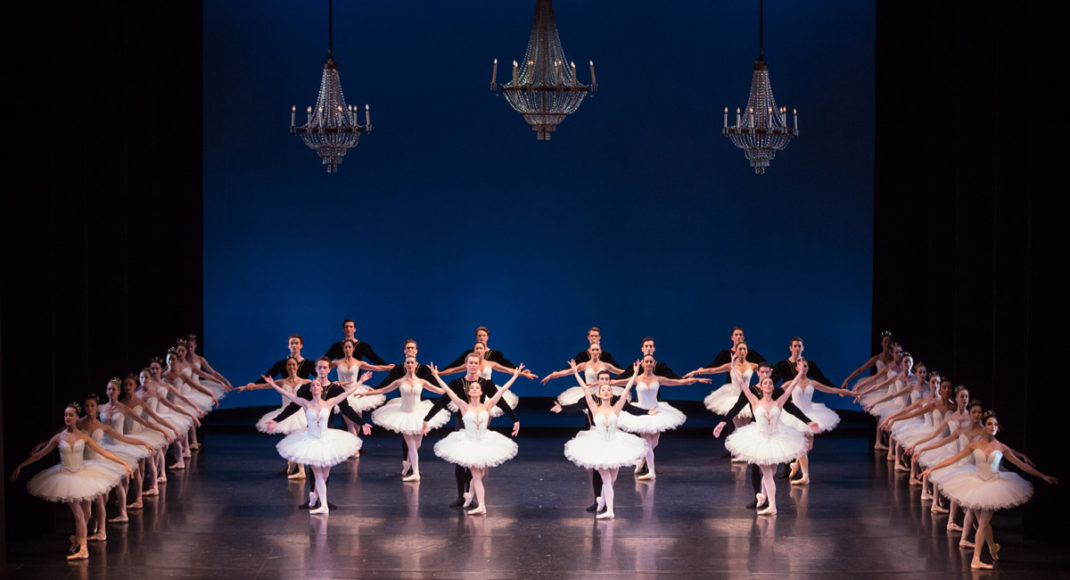
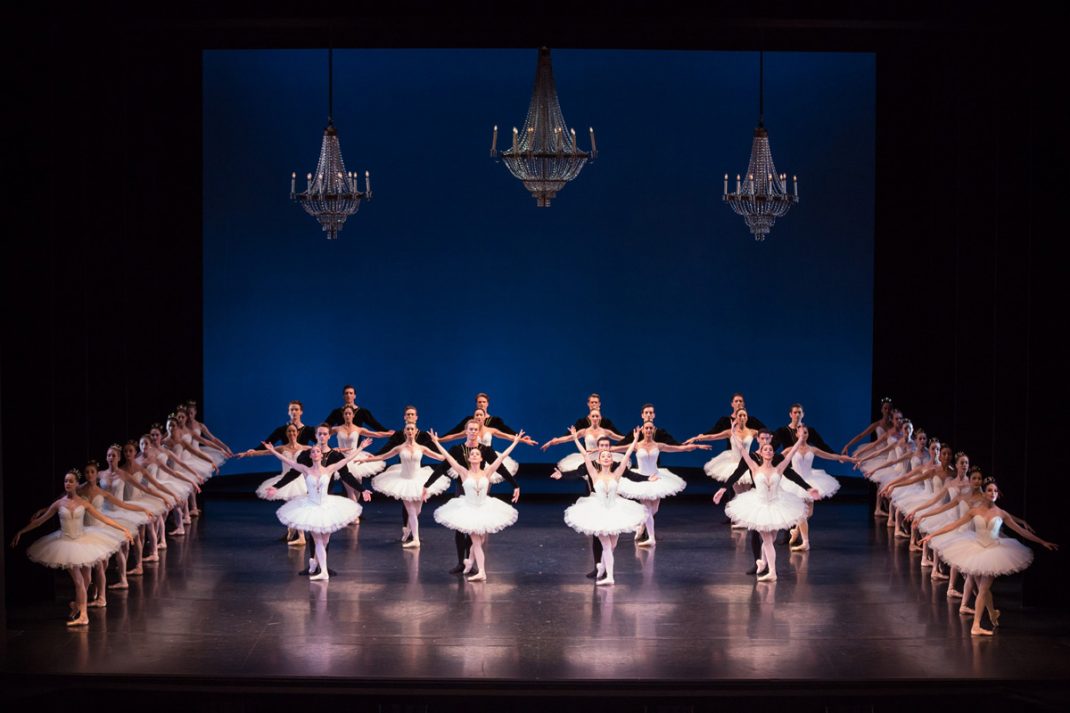
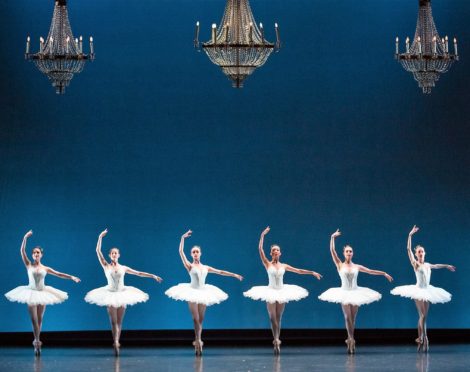
Artists of the Australian ballet in 'Symphony in C', 2016. Photo: Daniel Boud
Artists of the Australian Ballet in George Balanchine’s Symphony in C, 2016. Photo: © Daniel Boud

My review of the Australian Ballet’s Symphony in C program has now been published on DanceTabs. The program consisted of

  • George Balanchine’s Symphony in C
  • Victor Gsovsky’s Grand pas classique
  • Agrippina Vaganova’s Diana and Acteon pas de deux
  • Christopher Wheeldon’s After the Rain pas de deux
  • Richard House’s Scent of Love
  • Alice Topp’s Little Atlas

My DanceTabs review is available at this link.

Extra thoughts

In Jane Albert’s interview with Alice Topp and Richard House in the printed program, Topp speaks of her hopes for the future. She says: ‘…my ultimate dream would be to become [the first female] resident choreographer of The Australian Ballet.’ It isn’t clear who actually said or inserted the bit in square brackets but it’s not correct. The honour of being the first female resident choreographer of the Australian Ballet is already taken. It belongs to Natalie Weir who was resident choreographer during the directorship of Ross Stretton.

Looking back to 2010, when I last saw Balanchine’s Symphony in C, I can’t believe I was so lucky to see the cast I did. My review of that performance is at this link.

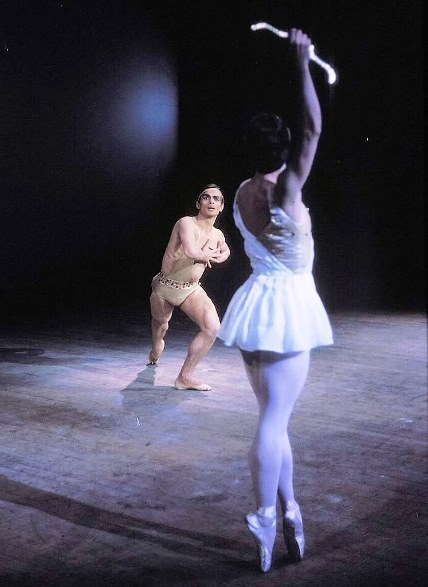
Looking back even earlier, I was also lucky way to see the Diana and Acteon pas de deux when it was first performed by the Australian Ballet in 1964. It featured Rudolf Nureyev and Lupe Serrano! The photographer Walter Stringer captured a few images of Nureyev and Serrano from the wings.

Rudolf Nureyev and Lupe Serrano, 'Diana and Acteon' pas de deux. The Australian Ballet, 1964. Photo: Walter Stringer

Rudolf Nureyev and Lupe Serrano, Diana and Acteon pas de deux. The Australian Ballet 1964. Photo: Walter Stringer, National Library of Australia

Michelle Potter, 2 May 2016

Featured image: Artists of the Australian Ballet in George Balanchine’s Symphony in C, 2016. Photo: © Daniel Boud

A Midsummer Night’s Dream. Queensland Ballet (2016)

16 April 2016, Playhouse, Queensland Performing Arts Centre, Brisbane

Liam Scarlett’s version of A Midsummer Night’s Dream for Queensland Ballet is nothing short of sensational. Design (Tracy Grant Lord), lighting (Kendall Smith), and Scarlett’s choreography all contribute to a show that begins beautifully as fairies dust down the scenery, light up the forest glade, and generally prepare the setting for what is to follow. And what follows holds the attention completely until the final moments.

Choreographically the work is full of surprises. Nothing seems predictable, not even the several pas de deux scattered throughout the work: Scarlett creates lifts, for example, that are fluid, dramatic, and visually exciting. Beyond the pas de deux arms flutter, feet move quickly, jumps and turns are fast-paced and every choreographic moment is wonderfully attuned to the Mendelssohn score, carefully crafted by Nigel Gaynor from several of Mendelssohn’s compositions.

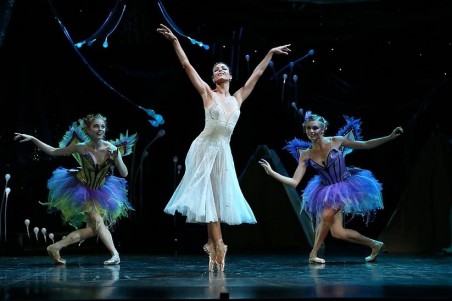
Yanela Pinera as Titania, Queensland Ballet
Yanela Piñera as Titania, A Midsummer Night’s Dream, Queensland Ballet 2016. Photo: © David Kelly

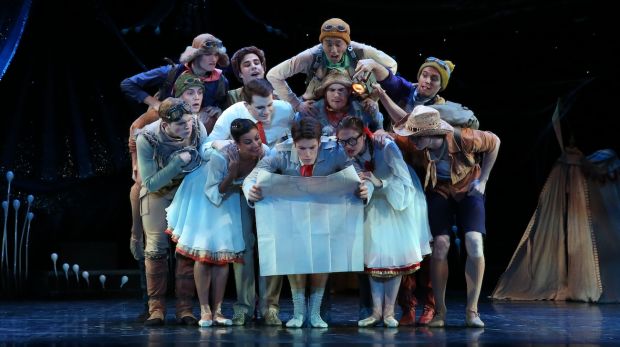
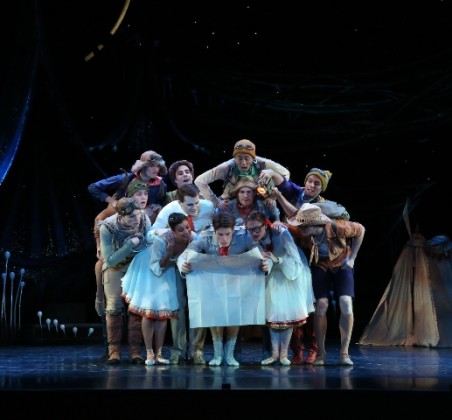
The storyline is also full of surprises. Why do those lovers, Hermia and Lysander, Helena and Demetrius, find themselves in a forest? Because they are out on a scientific expedition of course! Scarlett has them setting up tents, reading maps and carrying magnifying glasses and butterfly nets. And in their endeavours they are assisted by a group of local rustics, wonderfully dressed by Tracy Grant Lord in an assortment of working clothes, including some hilarious headgear.

Queensland Ballets Midsummer Nights Dream. The Lovers and Rustics. Photo David Kelly web
The Lovers and the Rustics, A Midsummer Night’s Dream, Queensland Ballet 2016. Photo: © David Kelly

As for Queensland Ballet, it just goes from strength to strength. The corps de ballet of fairies and rustics had been beautifully rehearsed and did themselves proud. Yanela Piñera as Titania, Camilo Ramos as Oberon and David Power as Puck kept the story moving along. Lina Kim as Hermia was a delight, even when angry with Lysander (Joel Woellner), and Eleanor Freeman as the bespectacled Helena drew out the best of Scarlett’s choreographic humour in all her dealings with Demetrius (Jack Lister). Vito Bernasconi’s performance as Bottom was engaging and Scarlett prepared us well, giving this particular rustic a bumbling manner from the beginning.

It is hard to single out individual moments and people from such a strong and entrancing work but I especially admired:

  • Mia Heathcote as the fairy Mustard Seed. She was vibrant, funny, and engaging. She danced surely and beautifully in a technical sense, and had really thought out an individualistic interpretation of this role. It was hard to take one’s eyes off her when she was onstage.
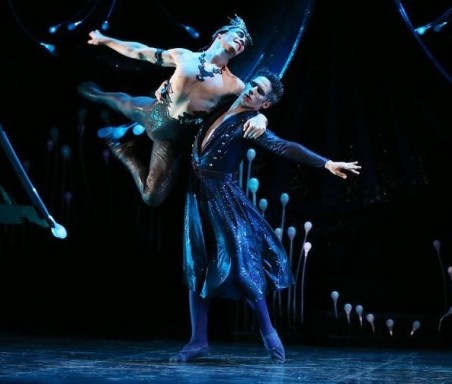
  •  The relationship between Oberon and Puck. This relationship was a much stronger and a more personal one than in other balletic productions of this Shakespearean tale (at least ones that I have seen). It was partly, no doubt, a result of Scarlett’s vision for the ballet, and how he made the relationship unfold through the choreography and mime, but it was also given a strong performance by Ramos and Power.
David Power as Puck and Camilo Ramos as Oberon, 'A Midsummer Night's Dream', Queensland Ballet 2016. Photo: David Kelly
David Power as Puck and Camilo Ramos as Oberon, A Midsummer Night’s Dream, Queensland Ballet 2016. Photo: © David Kelly
  •  The Changeling Boy. The child over which Titania and Oberon quarrel in the early part of the ballet was not, in this production, a little Indian prince, or anyone of unusual background as is often the case, but a regular little person wearing a purple onesie with a bedtime storybook and a soft donkey toy (yes, donkey—a wonderful early reference to Bottom).
  •  The multi-level setting. Tracy Grant Lord’s setting is an absolute delight. With its suspended bridge going almost the width of the stage, and its gorgeous little canopied spaces, it allowed characters to appear in, on and from many corners of the stage.
  •  The sexy bits. Scarlett brilliantly added little sexy touches here and there. In particular there was a gorgeous moment in the pas de deux of reconciliation between Oberon and Titania where he ran his hand along her extended leg and she followed that movement with a little shake of the lower part of the leg. A frisson of excitement. Wonderful. And there were others.

Liam Scarlett’s Midsummer Night’s Dream is a co-production between Queensland Ballet and Royal New Zealand Ballet. A winner!

Michelle Potter, 18 April 2016

Featured image: The Lovers and the Rustics, A Midsummer Night’s Dream, Queensland Ballet 2016. Photo: © David Kelly