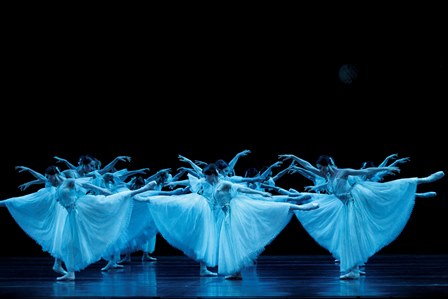
My review of Giselle with the Australian Ballet is now available on DanceTabs at this link.
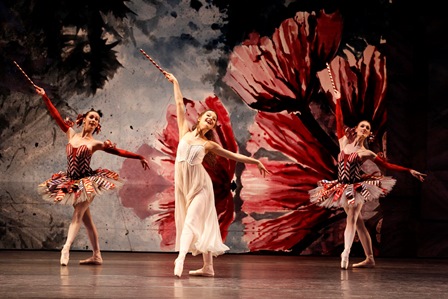
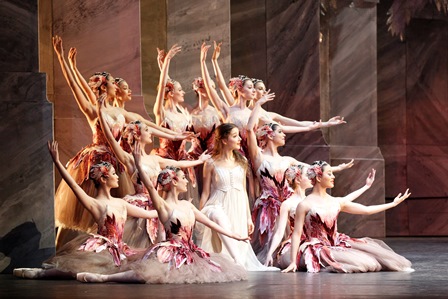
Artists of the Australian Ballet in Giselle. Photo: Jeff Busby, 2015
I am disappointed that I was not able to be more positive in this review. But the experience did set me thinking about the importance of every character in a narrative ballet having a strong vision of where their character fits within the overall story. When it happens audiences are the beneficiaries, but the experience also reflects back really well on the dancers and the company. In the performance of Giselle I saw there were occasions when there seemed to be a lack of understanding of why certain things were happening, and a consequent lack of reaction between characters. Ballet companies are time-poor these days, I know, and it struck me that perhaps a dramaturg is needed occasionally?
I look forward to seeing other casts in Sydney and Canberra.
Michelle Potter, 16 March 2015
Update (7 April 2015): My review of another Giselle cast, featuring Juliet Burnett and Jared Wright, is at this link.
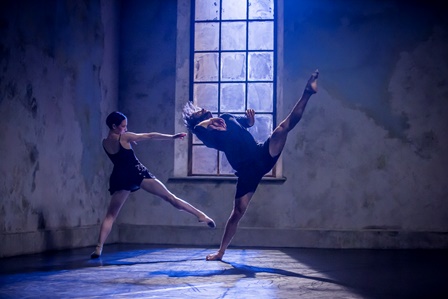
My review of Sydney Dance Company’s new program, Frame of Mind, encompassing William Forsythe’s Quintett and Rafael Bonachela’s Frame of Mind, is now available on DanceTabs at this link. This program was ecstatically received on opening night, 9 March 2015 at Sydney Theatre, and deservedly so. It tours to Canberra in April–May and Melbourne in May.
The Forsythe piece, danced to Gavin Bryars’ Jesus’ blood never failed me yet, reminded me of an event that occurred several years ago now, at a time when people used to go into shops to buy their music. My husband went into a then very well-known music store in Canberra (since closed down) to try to buy a copy of the Gavin Bryars’ work. ‘Oh,’ said the gentleman behind the counter, ‘we have been trying to move this CD for some time. Here, have this copy with our compliments.’
Well, Forsythe’s use of the homeless man’s chant in Quintett was absolutely fascinating. The diversity of the emotions expressed in the choreography was a perfect foil for the repetition of the words and by the end, as the score grew louder and the music became a dominant feature, the optimism of the homeless man soared. It was quite stunning.
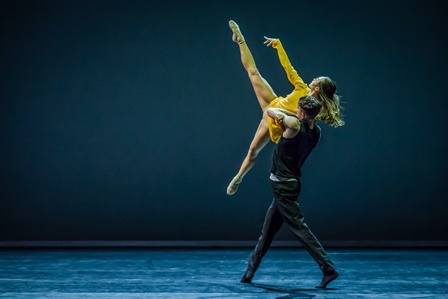
Graeme Murphy’s Swan Lake is currently making a return to the stage for a brief season at the wonderfully ornate Capitol Theatre in Sydney’s Haymarket district. I was lucky enough to have a ticket for a performance with Juliet Burnett as Odette, Rudy Hawkes as Siegfried and Miwako Kubota as the Baroness von Rothbart. And what an interesting and transfixing performance it was.
I never tire of the brief prologue to this Swan Lake where we encounter the three main characters. We understand the apprehension of Odette, the bride to be, shown especially in a Murphy-esque motif of fluttering hands that are like palpitations of the heart, and that also prefigure Odette’s fantasy dream of swans by the lake. The mental fragility of Odette is set against the lust of her groom, Siegfried, as he takes the alluring Baroness to bed on the night before his wedding.
But as the first act, the wedding, began I was shaken a little. Both Odette and Siegfried seemed to be two-dimensional characters with little interest in interacting strongly with their guests. Only the sexed-up Baroness seemed to be in character as she flounced her way around the stage. There were a few standouts amongst the other characters—the very feisty leading Hungarian couple of Ella Havelka and Rohan Furnell, a delicious Brooke Lockett as the Young Duchess-to-be, and an elegant Amanda McGuigan as the Princess Royal. But I found the first act mostly underwhelming.
As the second act opened, however, Burnett was into her stride, and very convincing as she descended further into a state of mental torment. She twitched and shook as she was bathed by two nuns and collapsed into another world of anguish as Siegfried came to visit her, and when she noticed the Baroness outside the asylum impatiently waiting for Siegfried. And by the time she had moved into the icy world of swan maidens, Burnett had the audience in the palm of her hand. Now there was a calmness to her movements, in beautiful contrast to the twitchy anguish of the asylum.
Burnett and Hawkes make fine partners. They move together smoothly and sympathetically, as one really. As a result I wasn’t watching technique, although I did love those expansive sissones from Burnett in Odette’s solo and the very airy grands jetés from Ako Kondo and Dimity Azoury as the two Guardian Swans. But I was following the story, which was developing with immense clarity. And I got the feeling that the rest of the audience was as absorbed in the unfolding narrative as I was. A really unusual and very beautiful, almost palpable silence filled the auditorium.
As Act III began the atmosphere oozed glamour and perhaps superficiality, or so it seemed after the moving qualities that emerged from Act II. Kubota’s presence was strong as she took on the role of party hostess. Odette was radiant as she arrived at the party. The central pas de trois, however, between Odette, the Baroness and Siegfried, in which Siegfried’s struggle with himself over what has happened to his love-life comes to the fore, seemed somewhat weak. But with the return to the icy lake, now populated by black rather than white swans, the dancing qualities that marked the partnership between Burnett and Hawkes reappeared. Once again the story took over. It was deeply moving.
The trio of Burnett, Hawkes and Kubota has a way to go yet to reach the potential that seems inherent in it. But I was lucky I think to have been at this performance, which got the loud ovation it deserved as the curtain came down. I can’t remember this combination of dancers in these roles previously and it may well have been their first show together.
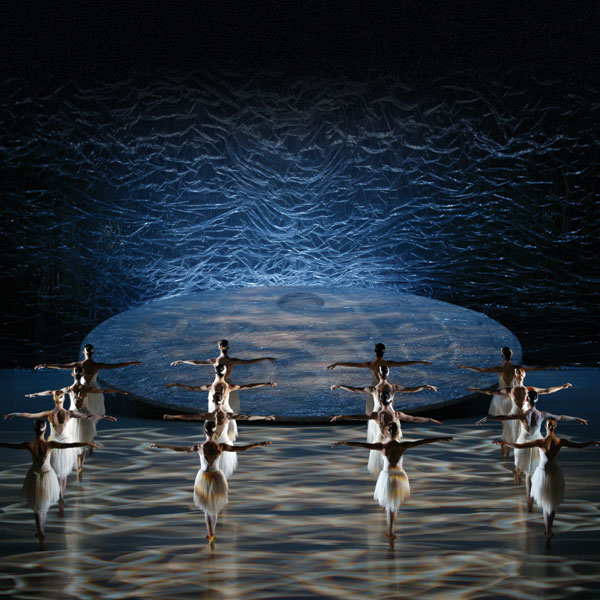
And on another line of thought, what I noticed more than I have on previous viewings of the Murphy Swan Lake was the choreography for the swan maidens’ arms. They are rarely lifted into a ‘regular’ fifth position, not always even a ‘regular’ fifth position with palms turned outwards. His swans have long, slender arms that intertwine, criss-cross, turn their palms in unusual directions, and otherwise form intricate patterns. They reminded me a little of the long necks of the real birds that seem to dip and curve and stretch in infinite ways. I love this aspect of Murphy’s work. There is always something new, something personal, to discover no matter how many times one sees the same show. I have noticed these intertwining arms before, but in this performance, perhaps because it was so beautifully focused on the story and had such a powerful inner strength to it, the choreographic imagery became more noticeable and more expressive.
Michelle Potter, 22 February 2015
A review from 2013 of the Murphy Swan Lake with Stojmenov, Killian and Harris is at this link
12 February 2015. Courtyard Theatre, Canberra Theatre Centre as part of Canberra Multicultural Fringe
James Batchelor began working on Metasystems in 2014 for the inaugural Keir Choreographic Award, an award dedicated to commissioning new work and promoting innovation in contemporary dance. Batchelor was a semi-finalist in the award. A longer version of Metasystems was recently performed in Canberra as part of the Canberra Multicultural Fringe, and in conjunction with ‘Pulse: reflections of the body’, an exhibition at the Canberra Museum and Gallery. I have briefly commented on Batchelor’s involvement with Pulseelsewhere. Below is an expanded version of my review of Metasystems, originally published in The Canberra Times on 14 February 2015.
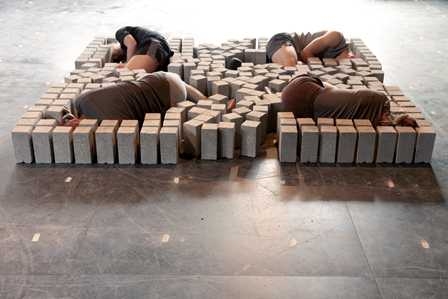
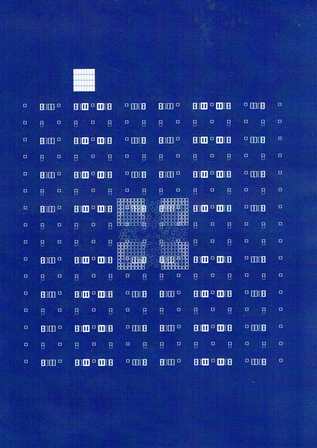
James Batchelor’s Metasystems appears to be an austere work about construction and deconstruction. Four performers spread two piles of concrete bricks across the floor of the performing space. Two different kinds of bricks, both concrete, are used during the performance—regular-sized house bricks, and Besser blocks. They are arranged in meticulously laid out but changing patterns. Part of the handout as we enter the theatre is a card bearing a plan by architect Anna Tweeddale of potential arrangements. Visual artist Madeline Beckett also worked on the design of the system of stacking and unstacking the bricks.
Drawings by Anna Tweeddale for Metasystems, 2015.
We usually hear a deliberate thump as each brick is placed in position, although at times the performers move the bricks as silently as they can. We watch as the bricks are rearranged over the course of the performance. It all seems to be working according to a mathematical formula, although one or two minor mishaps spoilt the purity of the arrangement on opening night.
Two of the performers, James Batchelor and Amber McCartney, have a dual function. They not only assist the other two performers, Madeline Beckett and Emma Batchelor, in laying out the bricks, but there are times when they dance between and around the rows and piles of bricks. Their movements take on an expressive function, often mirroring in dance the construction and the shape and placing of the bricks. Particularly absorbing is a sequence in which the bricks are arranged into long channels—lines of single bricks placed upright on the floor. James Batchelor and McCartney squeeze themselves into the channels and worm their way down the narrow spaces from top to bottom while occasionally balancing parts of the body precariously on the top of the bricks.
Two aspects of Metasystems stand out. Firstly, inherent in this work is a powerful understanding of body time. With no music and not always even the steady thump of bricks on the floor to guide them, Batchelor and McCartney frequently dance in unison without obviously watching each other. They sense the timing of the other and rarely falter.
Secondly, the work ends in an unexpected way. Having watched some 45 minutes of walking and brick-carrying, it is something of a shock when, as the work is concluding, the dancers separate out an individual space for themselves within the final arrangement, a tightly knit square of bricks. They then snuggle down into the construction. Suddenly something personal is injected into the show, even a hint of emotion. It is the human element inhabiting the built environment and disturbing its mathematical precision.
It occurred to me only later that the earlier confrontation with the bricks, as McCartney and James Batchelor wriggled their way down those narrow spaces between the bricks, touching them occasionally and taking care not to disturb them, that this too was part of a human engagement with the built environment.
That Batchelor can surprise like this is what makes his work so worth following.
17 January 2015, Carriageworks, Eveleigh (Sydney). Sydney Festival 2015
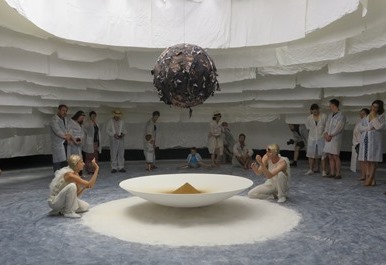
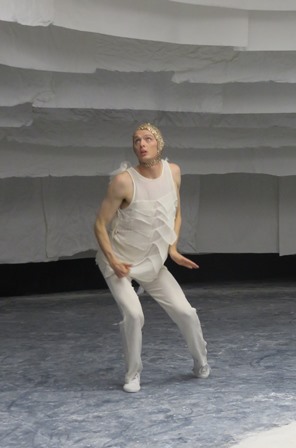
My review of the Sydney Festival production of Inside There Falls, a collaboration between London-based artist and musician, Mira Calix, and Sydney Dance Company, has been posted on DanceTabs at this link.
In addition to the photographs published with the article, most of which were kindly supplied by the Sydney Festival, below are some I took during my visit to the installation — and yes, for once photography was allowed! They show the two dancers I saw, Sam Young-Wright and Laura Wood.
Michelle Potter, 19 January 2015
Featured image: Scene from Inside there falls, Sydney Festival 2015. Photo: Michelle Potter
It was a pleasure to be able to see Peter Wright’s Nutcracker once again, this time on film danced by the Australian Ballet and recorded in Melbourne on 17 September 2014. It was shown on ABC-TV on Christmas Eve and is due to be released on DVD by the ABC in early January.
The absolute star was Benedicte Bemet as Clara and I regret not having had the opportunity to see her on stage. She commanded the role from beginning to end, never losing strength or characterisation. She showed off a wonderfully fluid technique and I especially loved her use of épaulement, her gorgeous carriage of the head, those beautiful arabesques that seemed to soar upwards, and the way she always, but always, stepped forward onto a turned out foot. Those technical matters came as if they were second nature and she looked every inch the dancer from start to finish. And she showed her versatility as a performer in Act II as she joined in all the dances, Arabian, Chinese, Russian and so forth, according to Peter Wright’s vision for the role.
Ingrid Gow was also impressive as Clara’s mother where I could not help but notice how expressively she used her arms, especially in her dance with Clara’s father (Brett Simon). Andrew Killian made his presence felt as the occasionally frightening Drosselmeyer in Act I, an attitude he tempered beautifully with something more gentle in Act II as he involved Clara in the action.
But looking from a different perspective, one of the most interesting features of this recording was the way the lighting looked so different from what I remember from the Sydney performance I saw. Gone were the garish colours of that Act II set and what appears to have been a more subdued approach to the lighting design in fact made the set look quite beautiful at times. With what were always carefully selected close-up shots, it was possible to see elements of the set highlighted. Not having always to see the entire set gave a quite different impression. The downside, however, was that often the darker scenes, especially in Act I and in the final scene when Clara finds herself again by her family Christmas tree, were often scarcely visible.
The grand pas de deux was danced on this occasion by Madeleine Eastoe and Kevin Jackson and, unlike my previous experience, there was indeed a real connection between this Sugar Plum Fairy and her Prince. Jackson’s partnering was impeccable—those shoulder lifts, followed by a full circle swirl before Eastoe was lowered into a fish dive, were just wonderful. Eastoe’s command of the choreography was beyond question and her every movement was beautifully and clearly articulated. Together they danced as one.
But I was still a little disappointed. I wanted this pas de deux to look like more than just a lovely dance. It still seemed to lack excitement, daring and the power to thrill. I’m not sure what Peter Wright thinks the pas de deux should look like. I wondered whether in his version he just wanted it to be a lovely part of a lovely story? I wanted it also to be a show piece with the sense of grandeur that goes with the great classical tradition. I wanted it to be more than just a part of the storyline. It was an exquisite pas de deux but it wasn’t a ‘grand’ one for me.
Nevertheless this Nutcracker remains a joy to watch and the DVD will be a worthy addition to any ballet collection.
I had the pleasure recently of seeing a work in progress by James Batchelor. Called FACES, Batchelor describes it as:
…a study of humans in transforming spaces and temporary constructions. From the trenches of the First World War to modern urban utopias, the work analyses sites of rapid evolution, a fluid interface of body and space. It is a portrait of anonymous faces; soldiers, refugees, nomads, vagrants, boom dockers, train hoppers and the homeless; bodies temporarily held in the relentless passage of time.
As with other explanatory notes relating to Batchelor’s works, I had to wonder how such a statement would (or could) translate into dance. Perhaps this is part of the fascination of Batchelor’s choreography? He arouses our curiosity, without being so abstruse as to alienate us, before we even arrive at the performing space.
The first section we saw was for three dancers, Batchelor himself, Amber McCartney and Chloe Chignell. The slow, careful, even meticulous moves made by the dancers as they progressed down the length of the studio space, moving along a pathway of silver coloured cloth, was transfixing. (It reminded me a little of a show I saw in New York several years ago by Butoh-style performers Eiko and Koma where they moved down a ramp covered in leaves taking the full performance time to reach the bottom). Then we watched as Batchelor, McCartney and Chignell manipulated the cloth in various ways and eventually tied it up with string, again with meticulous accuracy, into a package that to our surprise became a kind of long, joint backpack with images of the dancers’ faces attached to it.
In the second section Chignell and McCartney were joined by eleven dancers from Canberra’s youth ensemble, Quantum Leap. The standout moments of this section for me were in the highly complex yet seemingly simple structure of the choreography as rows of dancers moved up and down the room crossing past each other in simple lines. It had the repetitive feel that one experiences with a piece of music by Philip Glass, or from the look of a grey, grid painting by Agnes Martin, both Americans working in a minimalist manner. The apparent repetition in the works of Glass and Martin repays careful listening or looking when small variations or gradations indicate that there is greater complexity in the structure of their works than first meets the eye. Bouquets to the dancers for being in control of the mathematical intricacies of this section of choreography.
It is hard to know at this stage how the work will unfold. The first section shown in this preview had clear overtones of wartime, but the second had no such obvious context for me. How will they connect? Or will they? Where will they be performed given the apparent links, including through specific funding bodies, to the centenary of the ANZAC landing in 2015 (indoors or outdoors or both)? How will the connections with Canberra’s Quantum Leap dancers develop?
But full marks to Batchelor for having the courage to show FACES in its current, early stage of development. I look forward to future showings.
6 December 2014 (matinee), Joan Sutherland Theatre, Sydney Opera House
There is a lot to like in Peter Wright’s version of The Nutcracker, the Australian Ballet’s final show for 2015. But once again the stage of the Joan Sutherland Theatre showed its inadequacies as an opera/ballet venue. What a squash it was at times!
I admired in particular the logic that Wright has introduced into the story, including the expanded role played by Drosselmeyer, admirably performed by Rudy Hawkes whose sense of drama and onstage presence in Act I was exceptional. I also admired that elements in the mysterious happenings after midnight in Act I (scene ii, although not referred to as such in the synopsis) are prefigured earlier in the unfolding of the story. And I enjoyed too that Clara takes on an active part in Act II.
Most of John F Macfarlane’s costumes are a delight to the eye, especially that red dress worn by Clara’s mother, and the Jack-in-the-box costume with pants that look like they are made from expandable metal or wire. I’m not sure though about that musk-stick-pink doublet worn by the Prince in the Act II pas de deux—it did nothing to add a princely look, although I guess it was appropriately lolly-like. Macfarlane’s sets for Act I are also attractive, but those over-decorative elements in the Act II set, including a large bright sun and those huge, red flowers do not sit well with the pink marble columns, although the columns themselves are lovely. Perhaps the Act II set looks better on a bigger stage?
In the performance I saw, Karen Nanasca danced Clara and was impressive from the first moment she appeared. Her charm and sense of wonder at what was happening as the ballet progressed were appropriately youthful and quite beautiful. She has such lovely arms and a technique that just needs a little more strength to carry her through some of the more difficult movements. The other standout was Thomas Palmer, a young Sydney-based dance student who played the part of Fritz, Clara’s little brother. Apart from the fact that he danced well, his acting and his ability to engage with the audience were superb. In the cameo roles of the Grandmother and Grandfather, Kathleen Geldard and Colin Peasley were a delight and all in all the dancing throughout Act I was first-rate. Benedicte Bemet and Christiano Martino made a wonderful Columbine and Harlequin, while Simon Plant and Marcus Morelli danced with panache as the Jack-in-the-box and Drosselmeyer’s assistant respectively.
Act II, however, was a different matter. Sadly, what should be the highlight—the grand pas de deux—was a bit of a let down. I felt there was no emotion between Kevin Jackson as the Prince and Miwako Kubota as the Sugar Plum Fairy, although Jackson was trying to make something happen. But there was no sense of excitement, no sense of the thrill and the splendour of the choreography. Very frustrating. There were also some unsettling moments, especially in the Russian and the Arabian Dances when the gentlemen seemed to stumble around a few too many times. And there is no excuse for ribbons on pointe shoes to come untucked as they did, very obviously, on the shoes of one dancer.
Despite these grumbles a traditional-style Nutcracker is always a treat at Christmas time. At least in the first act I was transported. It was lovely too to see a lot of children in the audience, including one behind me who whispered loudly to her parents when the toy nutcracker’s head was ripped off and the doll was lying on the floor in two pieces, ‘Oh, I hope he will be all right’.
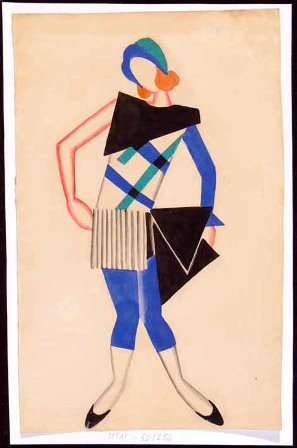
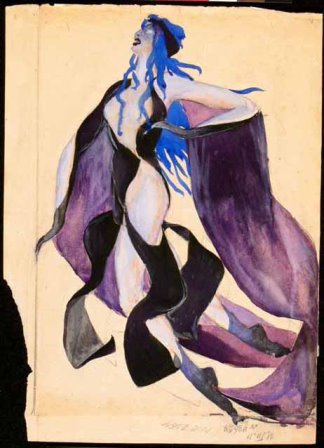
In mid-October 2014, the Victoria & Albert Museum in London opened an exhibition, Russian avant-garde theatre: war, revolution & design, in its Theatre and Performance Galleries. It consisted of around 150 works, most of which came from a twenty year period between 1913 and 1933, that is just before the Revolution of 1917 until the beginnings of Social Realism in the 1930s. The majority of items, largely works on paper, came from the Bakhrushin State Theatre Museum in Moscow with smaller amounts of material from the St Petersburg Museum of Theatre and Music, the Victoria & Albert Museum and from private collections.
The designs were mostly in spectacular condition, especially in terms of colour which seemed scarcely to have dimmed over the century or so since the designs were painted. With the prominence that has been given to the designers who worked with Diaghilev over approximately the same period, many of them Russian, this exhibition was an exceptional opportunity to see another side of Russian design.
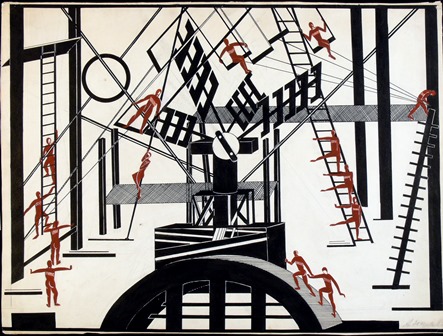
Many of the theatrical works represented had never been realised in performance. Satanic Ballet designed by Alexandra Exter, for example, is thought to have been prepared for the Moscow Chamber Ballet and was meant to be a series of improvisations without thematic content, but never made it to the stage. Other productions were of course realised but what was interesting was that the designs often showed movement despite the fact that they came from a period when the art being produced in Russia was dominated by constructivism. Some designs have a real fluidity to them, others remain within the constructivist mode but still show some potential for body movement.
A handsome book was produced for the exhibition and of particular interest as far as dance is concerned is an essay by Nicoletta Misler entitled ‘Precarious Bodies: Performing Constructivism’. Misler writes of Satanic Ballet:
Naked bodies—in keeping with Goleizvosky’s [the choreographer] interest in the culture of nudist performance—were to have leapt and twisted along diagonal ladders leaning against a void as if to confirm Exter’s conviction that ‘free movement is the fundamental element of the theatrical act’. (p. 55)
In her essay Misler also examines, briefly, the role of the Choreological Laboratory, part of the Russian State Academy of Artistic Sciences established in Moscow in 1921, and the research into the theory of movement that was carried out there. Her discussion of the various experiments carried out and the outcomes in terms of theatrical expression seem to me to be well worth following up.
Russian avant-garde theatre book cover
Unfortunately the book doesn’t have an index but it is full of illustrations of a remarkable collection of designs and a selection of essays that are mind-expanding.
Russian avant-garde theatre: war, revolution and design (London: Nick Hern Books, 2014) ISBN 978 I 84842 I 453 I
Last Saturday, 22 November 2014, I had the pleasure of seeing Gillian Murphy, whose dancing I have admired for some time now, guesting with the Australian Ballet in Stanton Welch’s La Bayadère. My comments for DanceTabs are at this link. For other posts on Gillian Murphy follow this link.