Irina Baronova and the Ballets Russes de Monte Carlo. Victoria Tennant

Victoria Tennant is the elder daughter of Cecil Tennant and Irina Baronova, the latter so well-known in Australia where she first charmed audiences with her dancing in 1938 with the Covent Garden Russian Ballet, and where she also spent her last years in a beautiful house at Byron Bay, New South Wales. Victoria Tennant, of course, knew Baronova in quite a different role from her legion of Australian fans: ‘Our mother was devoted to us,’ she writes, ‘and not exactly like anyone else’s mum. No one else’s mum did pirouettes in the butcher’s.’ This observation perhaps encapsulates the tenor of this book: it is a very intimate memento built around a personal collection of letters, photographs and other archival materials.

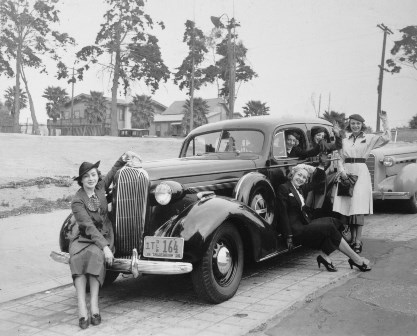
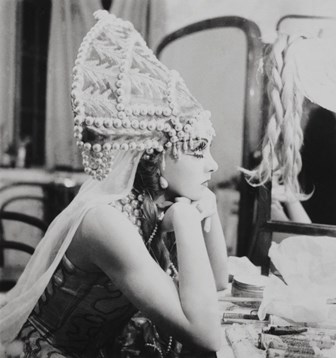
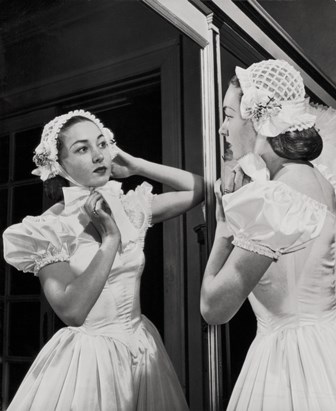
What is especially attractive about this book is its extensive use of photographs, which have been drawn largely from Baronova’s own collection. Many have never been published previously. Some are glamorous shots from Baronova’s Hollywood years. Others are informal shots of family and friends. Yet others are lesser known shots and early images from ballets in which Baronova starred.
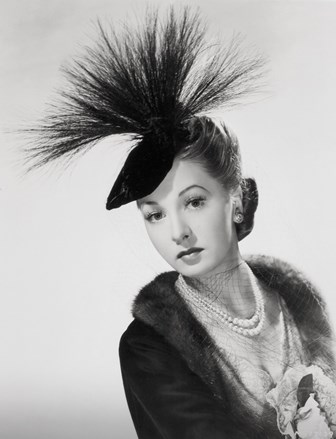
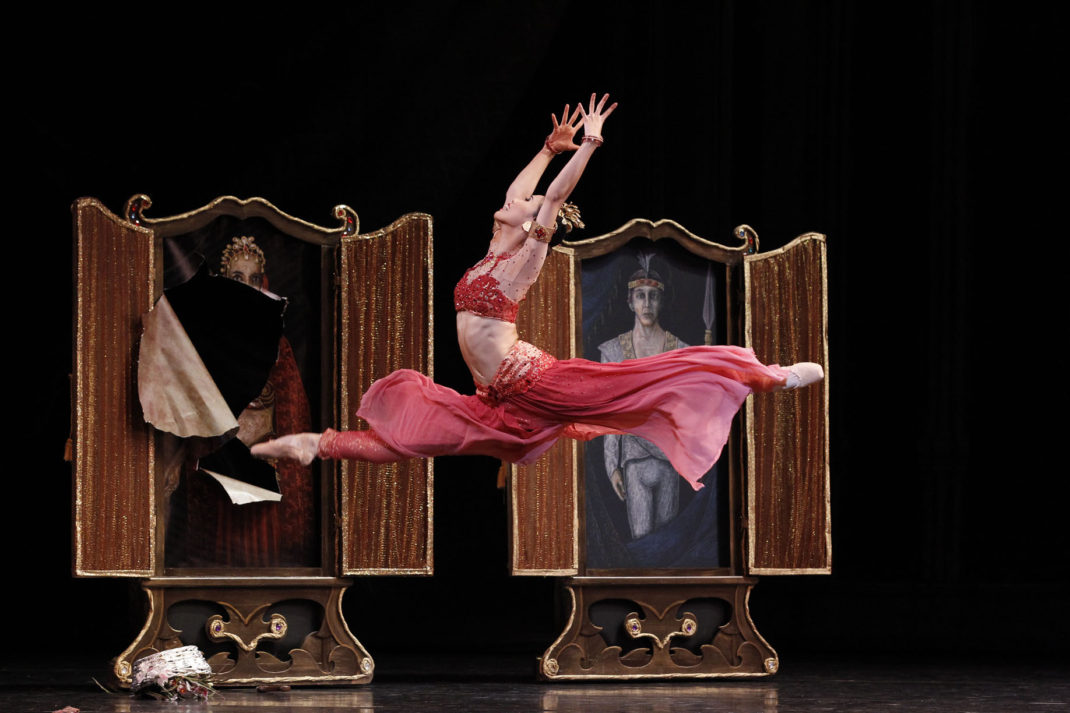
Images from Irina Baronova and the Ballets Russes de Monte Carlo by Victoria Tennant: clockwise from top left, Baronova in the movie Florian, 1940; driving with friends from San Diego to Los Angeles, 1936; in costume for Le Spectre de la rose, 1932; in costume for Thamar, 1935.

The book also has a special quality because much of the text consists of quotes from letters, an oral history made for the New York Public Library’s Dance Division, and recorded conversations made by Baronova at various times, although, unfortunately, it is not always clear which source is being used. But the informal voice of Baronova is strong. Anyone who met her, however briefly, or saw her speak in public, or teach or coach, will recognise that the words are hers and will be charmed all over again. These sections are differentiated from the linking text, written by Tennant, by the use of a differently coloured font.

There are some beautifully insightful moments when Baronova talks about working with various choreographers in different ballets. I was especially taken by her comments on Les Sylphides.

Nobody realizes that in Les Sylphides the whole thing is a dialogue between the Sylphides and the invisible creatures of the forest. It’s a whispering talk. All the gestures are listening, questioning, whispering back. It’s a conversation, and the Sylphides turn in the direction of the voice they hear and run to it. If you don’t know that, there are no reasons for doing anything, it’s just empty and boring. The whole ballet should be acting and reacting. To do it any other way is not fair to Fokine.

The chapter on Baronova’s time in Australia, 1938–1939, is short. But much has been written now about that time in Australia’s ballet history (although the last word has not yet been said I am sure) and the book is balanced in its coverage of the many strands of Baronova’s life. From a reference point of view it is good to have a list of Baronova’s repertoire from 1931 to 1946, although it is a shame that her film roles are not included as well.

Irina Baronova and the Ballets Russes de Monte Carlo has been beautifully designed and produced and, with its strong focus on imagery, makes a wonderful companion to Baronova’s autobiography.
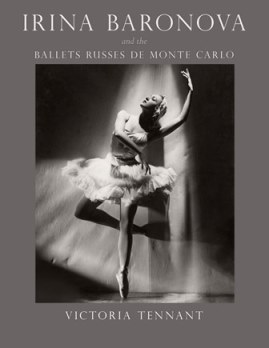
Irina Baronova/ Victoria Tennant cover

Victoria Tennant, Irina Baronova and the Ballets Russes de Monte Carlo (Chicago and London: University of Chicago Press, 2014)
Hardback, 244 pp. ISBN 978 0 226 16716 9 RRP USD55.00/£38.50.

Michelle Potter, 1 November 2014
Dance. Lucinda Childs Dance Company

25 October 2014, Théâtre de la ville, Paris, Festival d’automne

Lucinda Childs made her hour-long work Dance, performed to music by Philip Glass, in 1979. The work was revived in 2009 and a filmed version from 1979, shot by visual artist Sol LeWitt as his part in the 1979 collaboration, was digitally remastered and used as an accompanying component in the revival. I didn’t manage to catch Dance in Australia when it was shown at the Festival of Perth in 2012, but the revival is currently touring in the northern hemisphere and I was lucky enough to see it recently at the Festival d’automne.

The title, as notes for the production tell us, was inspired by Merce Cunningham’s statement that dance is expressive only of itself, and by Gertrude Stein’s remark that ‘A rose is a rose is a rose’. Dance is indeed ‘about’ dance. There is no narrative and the work is most commonly regarded as an iconic piece of late minimalist art. But behind the facade of minimalism is a structural and visual complexity.

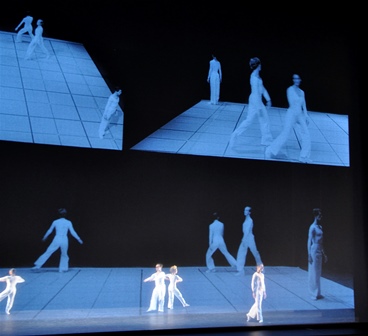
Artists of Lucinda Childs Dance Company in 'Dance'. Photo: © Sally Cohn
Artists of Lucinda Childs Dance Company in Dance, 2009. Photo: © Sally Cohn

The work consists of three separate sections each about the same length—twenty minutes. In the opening section, the dancers—eleven in the company I saw—move across the stage from left to right, mostly working in pairs, with their dancing pushed along comet-like by the Glass score. At first they seem to be repeating the same movements—small jetés (grands jetés style but done sideways); small turns; and off-centre, tilted movements—but gradually it becomes clear there are many small variations and changes of tempo, punctuated by moments of stillness, or moments when the stage is briefly empty. The footage, projected onto a scrim, follows the dancers’ real-time movements, giving two views of the choreography. At times the footage seems to be super-imposed onto the dancers. Sometimes still shots from the film appear. Sometimes single figures are there. Sometimes the projections are above the dancers, as if the stage space is a two-storeyed structure. Sometimes the screen is split.

This technique, finely integrated with the performance, produces some interesting results, not only because of the visual complexity it produces, but because it shows the different styles of the dancers of 1979 and those of today. While the dancers on film appeared to be much more relaxed and loose limbed, I admired the precision of the present company, especially in the arms and carriage of the upper body. Their dancing seemed to me to be much more aligned with the mathematical, or highly ordered qualities of Childs’ choreography.

The central section, a solo originally danced by Childs, begins with a larger than life-sized image of Childs, almost pushing itself into our space. At first it seems like a still from the footage, but then Childs blinks! After a while the image disappears and the solo in real-time begins, with choreography more focused on ‘every day style’ movements—casual walking and swinging of the arms.

In the final section the dancers work in fours and the floor patterns they create are square, or take on the form of a parallelogram, in contrast to the horizontal lines of the first section. The work comes to a climax superbly, with a quartet of dancers demonstrating the strength of the company’s technique—those fouettés sautés with arms whipping into stretched second position were beautifully executed. Then in a surprise move, which I probably should have expected, the work came to an abrupt end.

I was curious that the film showed Dance being performed on some kind of a floor cloth marked out in squares, large and small. Some had dark borders, others had lighter ones. It was like one of those puzzles that asks, ‘How many squares can you see in this drawing’? I assume this was Sol Le Witt’s work but I can’t be sure. I wondered if the original production was performed on this squared design, or whether it was created just for the film. But all in all Dance was a totally fascinating collaborative work full of intricacies, and splendidly performed.

Michelle Potter, 26 October 2014

Ashton mixed bill. The Royal Ballet

18 October 2014 (evening), Royal Opera House, Covent Garden

The prospect of four works by Frederick Ashton on the one program is something that fills those not brought up in an Ashton environment with anticipation. Of the four works on the Royal Ballet’s recent program, Scènes de Ballet, Five Brahms Waltzes in the Manner of Isadora Duncan, Symphonic Variations and A Month in the Country, I had never seen Five Brahms Waltzes and had seen the others on only one previous occasion each.

Symphonic Variations, led by Marianela Nuñez and Vadim Muntagirov supported by Yasmine Naghdi and James Hay and Yuhui Choe and Tristan Dyer, perhaps moved me most. What clarity and fluidity those six dancers brought to the work. It was a breathtaking performance where everyone was a star, although perhaps it was Muntagirov, with his elegant bearing and his exceptional technical accomplishments, who attracted my attention most. But the ballet as a whole was beautifully danced to an elegant rendition by pianist Paul Stobart of Cesar Franck’s Symphonic Variations. And I had forgotten how fresh and entrancing Sophie Fedorovitch’s decor is—a spring green, box-like space with fine black lines weaving a flowing pattern across the backdrop and flats. It was a sensational twenty minutes of unstoppable beauty of movement. No in depth analysis can ever do it justice.

Five Brahms Waltzes was danced by Helen Crawford, replacing an injured Lauren Cuthbertson. The sense of gravity and weight in her dancing in the first and second waltzes contrasted nicely with her performance of the third waltz in which she manipulated a soaring rectangle of silk. Equally impressive was the contrast between a somewhat fierce fourth waltz and the gentle fifth with its rose petals falling liberally from her arms. I loved too the contrast between those light skips à la Isadora and the lower, almost crouching poses with fists clenched that appeared every so often. It was a finely thought through performance.

Scènes de ballet, which opened the program, was distinguished by the presence of Sarah Lamb as the ballerina. The quality of her dancing was especially noticeable in her main solo with its loosely swinging wrists and arms and lyrical movement of the whole body. But this ballet really needs to have every performer dancing with exactness. I missed straight lines, equal spacing and sameness in height of legs. The geometry of the work falls apart without such precision. And it was a disappointment to see Steven McRae, who partnered Lamb, begin with such promise—those sharp turns of the head and the pride with which he held his upper body were mesmerising—only to falter often as the work progressed.

The program closed with A Month in the Country and I found myself swept along by a strong performance from Zenaida Yanowsky as Natalia Petrovna and by Ashton’s ability to define characters through movement. The young, the old, different levels of society, everything was there in the choreography.

It was a real pleasure to see four quite different Ashton works brought together in one program but it was curious to see how those little runs on pointe kept appearing over and over. I was almost waiting for the next one by the time we reached A Month in the Country.

Michelle Potter, 22 October 2014

Delia Mathews as the Suicide and Iain Mackay as the Minister, Birmingham Royal Ballet, 2014. Photo: Bill Cooper

Shadows of War. Birmingham Royal Ballet

18 October 2014 (matinee), Sadler’s Wells Theatre, London

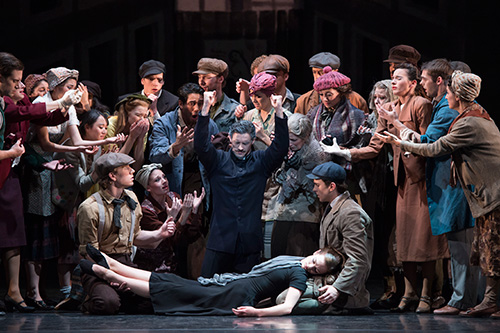
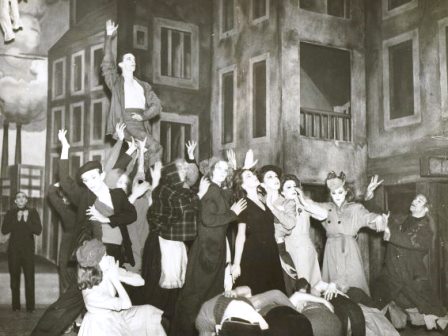
None of the works on Birmingham Royal Ballet’s triple bill program, Shadows of War, focuses on war itself. Rather the focus is on the effects of war on humanity. Of the three works, I have to admit that I was especially interested in Robert Helpmann’s Miracle in the Gorbals, first performed in London in 1944. Archival photos from the National Library of Australia’s various collections relating to Helpmann have always aroused my interest. It was a ballet with a name that I really didn’t understand. Well Birmingham Royal Ballet’s production turned out to be a fascinating restaging of the original, with choreography by Gillian Lynne, ‘after Helpmann’. Lynne appeared in the original production and remained a close friend of Helpmann throughout his life.

Robert Helpmann as the Stranger in 'Miracle in the Gorbals', Sadler's Wells Ballet, 1944
Robert Helpmann as the Stranger in Miracle in the Gorbals, Sadler’s Wells Ballet, 1944. National Library of Australia

There are aspects of this restaging that look dated, which is hardly surprising given that the work is 70 years old. The obvious themes of the evils of prostitution and power of Christianity (or religion), the latter shown via the return to earth of a Christ figure (the Stranger, played originally by Helpmann), seem a somewhat melodramatic way of developing the universal themes of love, betrayal, forgiveness and so forth.

But the strength of the production lies in the strength of the collaborative elements of the original. Edward Burra’s front cloth is a powerful opening image. A huge ship’s prow appears to jut out into the auditorium. It represents the shipyards along the river Clyde in Glasgow where the story is set in slum tenements, the Gorbals. The image is instantly arresting, as is the commissioned score by Arthur Bliss, which reflects so clearly the changing moods and events of the story.

To write down, or explain the narrative is complex but, in fact, the story, in which a mysterious stranger brings a woman back from the dead and reforms a prostitute but is eventually killed by the town’s jealous minister, is instantly understandable as we watch events unfold on stage. And here the collaborative nature of the original comes to the fore again. The libretto was written by Michael Benthall and focuses strongly on developing characters without going into extraneous detail. When Arnold Haskell saw Miracle in 1944 he wrote: ‘With rare skill [Benthall] avoided the pitfalls of novelising his story. Everything that he put down could be made clear in balletic action and was discussed in detail with Helpmann.’ And so it was with the Lynne restaging.

The balletic action is very much in the mode of dance-drama rather than ballet per se. In fact the action was sometimes quite static, often relying on group poses or dramatic stillness. Every dancer gave a powerful performance. Apart from the leading players, Elisha Willis as the Prostitute, César Morales as the Stranger, Iain Mackay as the Minister, and Delia Mathews as the Suicide, standouts for me were Michael O’Hare as the Beggar and three Old Women played by Ruth Brill, Jade Heusen and Marion Tait.

Delia Mathews as the Suicide and Iain Mackay as the Minister, Birmingham Royal Ballet, 2014. Photo: Bill Cooper
Delia Mathews as the Suicide and Iain Mackay as the Minister, Birmingham Royal Ballet, 2014. Photo: © Bill Cooper

Kenneth MacMillan’s La fin du jour opened the program. This work, which dates to 1979, is danced to Ravel’s Piano Concerto in G Major, and examines the lifestyle of a certain class of people in the inter-war years. It left me a little cold, although I enjoyed the second act, the adagio. Here MacMillan’s skill at using stillness as a choreographic tool was clearly evident as we watched the dancing of two women, each partnered by five men in different combinations with none leaving the stage throughout the scene.

The triple bill closed with David Bintley’s Flowers of the forest. It was a joyous series of dances in the Scottish mode. Bouquets to the gentleman who executed double tours en l’air ending in a full plié in 5th position. Wonderful.

Michelle Potter, 19 October 2014

The Golds. A film by Sue Healey

The Golds is the latest production from Sydney-based film maker, Sue Healey. It does much to strengthen her position as a leading maker of dance films in Australia. With an earlier career as a dancer and choreographer to inform her work, Healey is able to hone in on what is intrinsic to dance, as indefinable as those intrinsic qualities might be.

The Golds are the dancers of Canberra’s mature age dance group, GOLD. (Growing Old Disgracefully, is the expanded form of the name). They are all over 55, some are much older. What is especially noticeable, and what is perhaps the most moving aspect of the film, is that most of these older men and women dance without a trace of self-consciousness. Their bodies are not, and mostly never have been, dancers’ bodies but they show the transformative power of dance. From this point of view The Golds is a truly beautiful film and much credit must go to Liz Lea for her inspirational leadership of the group.

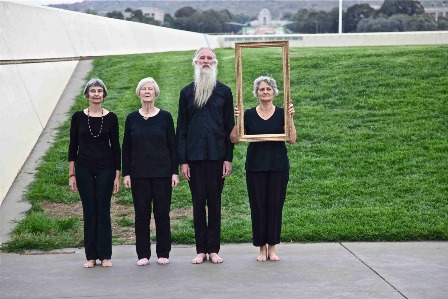
I especially enjoyed a solo by Greg Barrett, a tall man with a long white beard. Made as a slow motion segment, his beard and his black, loose-fitting outfit moved beautifully with his very fluid body. Then there were some lovely segments with another dancer, whom I only know at this stage as Jane, a nun of (I think) the Brigidine order, dancing with Abbie, her little blind dog. She showed such honest movement, both with Abbie and in another section, in which she performed in front of a wall covered in what looked like graffiti or old, torn posters.

Scene from Sue Healey's film 'The Golds' (2)
Scene from Sue Healey’s film The Golds, 2014

The film might also be seen as a series of vignettes as individual dancers recount why they joined GOLD and what their backgrounds have been. Thus The Golds becomes a mini documentary. There are the expected responses to questions posed (off camera and not heard by the viewer). ‘It’s good exercise for an ageing body’, ‘I want to stay active’ and other similar remarks. But there are also some surprises. ‘No I can’t do the splits, but is it necessary? I don’t think so’, or ‘I was attracted by the word disgracefully in the name’.

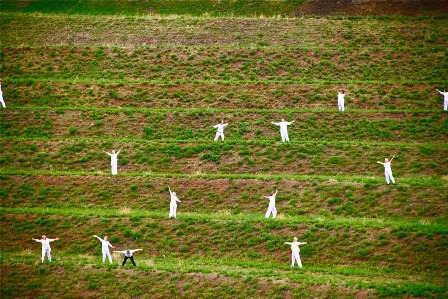
Director of photography, Judd Overton, has selected some spectacular locations for this film. Canberra’s landscape and some of the city’s well-known architectural features form the background for much of the film. There are some eye-catching shots of figures in the landscape and figures interacting with features of the architecture. But there are also some interior locations. Some are domestic interiors, some are in Canberra institutions, including the National Portrait Gallery. They have all been carefully chosen and add a layer of exceptional visual interest.

Scene from Sue Healey's film 'The Golds' (1)
Scene from Sue Healey’s film The Golds, 2014

The first public screening of The Golds was at the National Film and Sound Archive, Canberra, on 3 October 2014 as part of the Archive’s final Silver Screenings program. Sadly, this program now goes into limbo as part of budget cutbacks.

This screening of The Golds was essentially a preview, as Healey noted in her opening remarks. There are one or two technical issues to be fine tuned, she said, one of which she hopes will make the program suitable as a TV documentary.

Michelle Potter, 6 October 2014

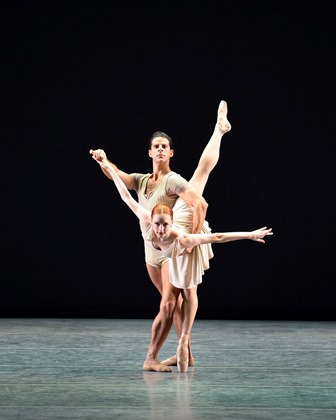
Twyla Tharp's 'Bach Partita', opening scene, American Ballet Theatre. Photo: Gene Schiavone

American Ballet Theatre in Brisbane

My coverage of American Ballet Theatre’s first Australian visit as part of Queensland Performing Arts Centre’s International Series has just been posted on DanceTabs. Making the most of an expensive trip to Brisbane, I saw two performances on consecutive nights, the last night of Swan Lake and the first night of Three Masterpieces. I would have really liked to have seen Three Masterpieces again, especially Twyla Tharp’s Bach Partita, which, given its complexity, was difficult to take in on one viewing.

In addition to what I wrote about Bach Partita in the DanceTabs post, I especially enjoyed a solo by Marcelo Gomes, who is seen below with Gillian Murphy. It is quite clear from this image that Gomes has a powerful presence and his solo was strong and controlled and lost nothing of that presence.

Gillian Murphy and Marcelo Gomes in Twyla Tharp's 'Bach Partita', American Ballet Theatre. Photo: Gene Schiavone
Gillian Murphy and Marcelo Gomes in Twyla Tharp’s Bach Partita, American Ballet Theatre. Photo: © Gene Schiavone

The DanceTabs post is at this link.

Michelle Potter, 7 September 2014

Featured image: Opening scene from Twyla Tharp’s Bach Partita, American Ballet Theatre. Photo: © Gene Schiavone

Twyla Tharp's 'Bach Partita', opening scene, American Ballet Theatre. Photo: Gene Schiavone

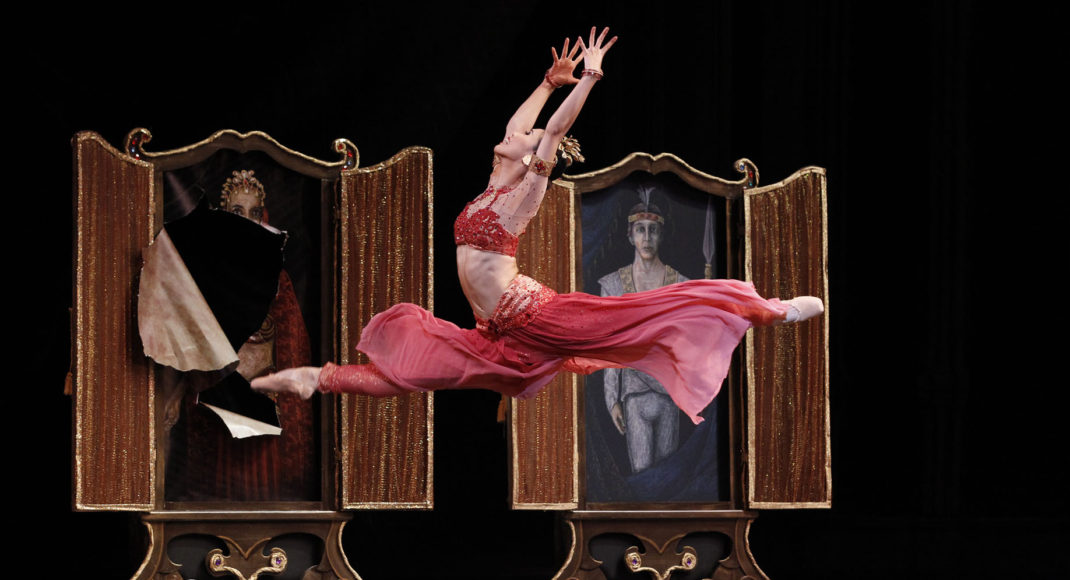
La Bayadère. The Australian Ballet

29 August (evening) and 30 August (matinee), 2014. State Theatre, Victorian Arts Centre, Melbourne

Stanton Welch made his new version of La Bayadère for Houston Ballet, of which he has been artistic director for ten years. Its premiere was in 2010. He has now restaged it for the Australian Ballet, where he still holds the position of resident choreographer.

It was always going to be a problematic ballet: an updated version of a work that is entrenched in nineteenth-century cultural values where countries beyond Europe were regarded as little more than examples of exotica, and were represented as such in the theatre. Choreographically, Welch’s Bayadère makes passing references to traditional Indian greetings and hand movements from forms of Indian dance. There are also plenty of attitudes (the ballet step) with angular elbows and hands bent at the wrist, palms facing upwards. They remind us of a dancing Shiva. But there is also a lot of waltzing at certain points and the mixture doesn’t ring true today. So much of what we can accept from a production that claims to look back to the original (Makarova’s production for example), we can’t accept from a new production made in the twenty-first century. It all becomes a frustrating jumble.

So too with the costuming. There are no tutus (thankfully) until the Kingdom of the Shades scene, although there is a confusion of costuming, especially with Solor who is dressed like a balletic prince in tights and jacket while everyone else has a costume that approximates an Indian-style outfit.

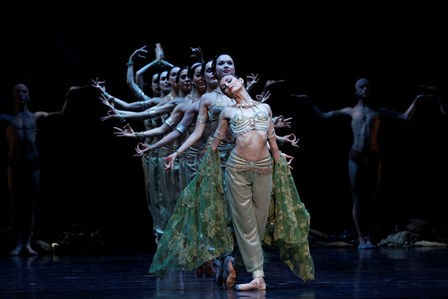
Amber Scott and artists of the Australian Ballet in 'La Bayadère'. Photo: Jeff Busby.
Amber Scott and artists of the Australian Ballet in Stanton Welch’s La Bayadère. The Australian Ballet, 2014. Photo: © Jeff Busby

My enjoyment of the work depended very much on the casting. The first show I saw, with Lana Jones as Nikiya and Adam Bull as Solor, was a lack-lustre performance, which only highlighted the feeling that the work was a cultural and choreographic jumble. While Jones’ first solo was beautifully danced—she has such a fluid upper body—she and Bull were not connecting and it seemed like a very sullen pairing. Robyn Hendricks as Gamzatti, whose villainous nature Welch has strengthened nicely, overplayed the role somewhat and didn’t look good in that harem costume, which reveals the rib cage rather dramatically.

In that first viewing, I loved the two children who accompanied Solor’s mother wherever she appeared. They were an absolute delight and took an active interest in everything happening on stage. And Vivenne Wong executed the first solo in the Shades scene with precision and attack—those relevés on pointe down the diagonal were spectacular.

In a second viewing I had the pleasure of seeing Amber Scott as Nikiya and Ty King-Wall as Solor. My interest in the work soared.

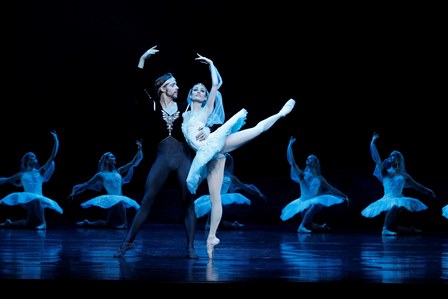
Ty King-Wall and Amber Scott in 'La Bayadère', the Australian Ballet. Photo: Jeff Busby
Ty King-Wall and Amber Scott in Stanton Welch’s La Bayadère, 2014. Photo: © Jeff Busby. Courtesy the Australian Ballet

King-Wall and Scott danced beautifully together and their various pas de deux were silky smooth and imbued with tenderness. This was the first time I have seen King-Wall in a principal role since he was promoted and he certainly lived up to that promotion, both technically and in terms of successfully entering a role and developing a partnership. Ako Kondo as Gamzatti once again danced with superb technical skill. Perhaps she was a little too nice for the role in its new guise, but she engaged well with Laura Tong as Ajah, her servant, and it is impossible not to be swept away by her superb dancing.

The issue of Indian references aside, Welch’s choreography is always interesting to watch. I have written elsewhere that I think his best works are abstract rather than story ballets and I enjoyed watching how he structured scenes for larger numbers of people in Bayadère. His choreography for the Rajah’s four guards was simply constructed but often surprising in the way each came forward for a mini solo. And later, during the wedding celebrations for Solor and Gamzatti, Welch handled a bevy of guards and guests easily and maintained interest, despite the waltzing, in each of the different groups throughout that sequence of dancing.

Design-wise, Peter Farmer’s chaise-longue, on which Solor reclined to smoke his opium before the shades of Nikiya began their procession down the ramp, was gorgeous. Its luscious curves gave it an art nouveau feel and its back reminded me of the underside of a mushroom, magic mushrooms no doubt.

This production of La Bayadère is full of melodrama, a ‘cat fight’ between Nikiya, Gamzatti and Ajah; people being killed left right and centre; appearances by men in gold paint; and temples tumbling into ruins. But Petipa’s choreography has been maintained in certain places and, with a good cast, the story speeds along and much can be forgiven.

Michelle Potter, 2 September 2014

Featured image: Ako Kondo as Gamzatti in Stanton Welch’s La Bayadère. The Australian Ballet, 2014. Photo: © Jeff Busby.

Le palais de cristal & Daphnis et Chloé. Paris Opera Ballet

Watching dance on the big screen has many pleasures. Perhaps the biggest joy these days is being able to see, so soon after a premiere, works presented by major companies from the other side of the world. The recent screening in Australia of a filmed performance from the Paris Opera Ballet is a case in point. Filmed just days after the opening at the Opéra Bastille, this program brought together Le palais de cristal from George Balanchine and Daphnis et Chloé, a new work from Benjamin Millepied, shortly to take over at POB from Brigitte Lefèvre.

Le palais de cristal opened the program. Made by Balanchine in 1947 especially for POB, it is better known around the world in a revised form as Symphony in C. One of the aspects of the filming that I especially liked was that the recording was often made from a position high up in the theatre. As a result the precise and very formal patterns Balanchine created for Le palais de cristal were easily appreciated. But we were also given many occasions to see the dancers as if we were  sitting in the best seats in the house. The closer shots provided a good view of the costumes, newly designed by Christian Lacroix. Some have seen them as overly decorative. I thought they suited the work and I was especially fascinated by the tutus for the corps de ballet. They seemed to have a hoop-like addition to the skirt that gave them a kind of puff-ball look.

But of course the highlight was the dancing. It is always amazing to see the precision of the dancers of the Paris Opera Ballet. Never a foot wrong! One dancer from amongst the soloists stood out. Not knowing the dancers as much as I would like I don’t know her name but she was, I think, of Japanese extraction. What appealed to me was the way she stepped forward into the space in front of her, generously, and the way her movements seemed to have an ongoing existence. A lift of the arm didn’t finish at the finger tips but looked as though it continued through space. Beautiful.

Paris Opera Ballet, 'Le palais de cristal'. Photo: © Agathe Poupeney
Amandine Albisson, Matthieu Ganio and dancers of the Paris Opera Ballet in Le palais de cristal, 1st movement. Photo: © Agathe Poupeney

Daphnis et Chloé had a certain fascination, given that I remain an admirer of Graeme Murphy and his works made for Sydney Dance Company made over a thirty year period between the mid 1970s and the early 2000s. Murphy’s Daphnis and Chloe, made in 1980 and designed by Kristian Fredrikson, could not have been further apart from that of Millepied. But I have no wish to make a comparison, just a comment on what a different take it was, visually, choreographically and in terms of portrayal of the narrative.

I found Millepied’s work hard to follow. The choreography certainly flowed and there were some lovely moments of mass movement from the corps. But the storyline wasn’t really conveyed strongly. It was something of a cross between a story ballet and an abstraction, but in the end neither. The standout dancer was François Alu as Bryaxis. Millepied gave him a solo full of spectacular jumps and turns and he rose to the occasion.

Daniel Buren’s large, brightly coloured shapes that descended from the flies and then withdrew back upwards were beautiful in themselves but they didn’t help with understanding the story. In the interview Buren gave to Mme Lefèvre prior to the start of the performance he talked about voids and the idea of occupying space. He is a conceptual artist but the concept he was aiming for with his design to my mind didn’t help the ballet. And why, at the conclusion of the ballet, were the dancers’ costumes transformed into colour from the white they were throughout the rest of the work? At the same time, Buren’s shapes were removed only to reappear a little later for a curtain call. The whole thing escaped me. I wondered whether, for this work, I would have been more satisfied had I been in the theatre watching live.

Despite my problems with Daphnis et Chloé, it is always a huge pleasure watching Paris Opera Ballet performances. The practice of filming live and then transmitting around the world is a great initiative. May it continue.

Michelle Potter, 30 July 2014

Imperial Suite. The Australian Ballet

10 May 2014 (evening), Joan Sutherland Theatre, Sydney Opera House

It is a long time since I have had a seat in the circle for a ballet performance (in any theatre come to think of it), but that’s where I was seated at the Sydney Opera House for Imperial Suite, the Australian Ballet’s mixed bill of Ballet Imperial and Suite en blanc. It was certainly exciting to see Ballet Imperial from that vantage point. Looking down on a George Balanchine work gives a stunning view of the patterns of his choreography—the circles, squares, diamonds, straight lines, and flowing waves of dancers threading their way through the arched arms of other dancers—provided of course that the work on view is well danced and well staged. Which it certainly was at this performance. The ballet was beautifully led by Lana Jones and Adam Bull, with Jones the shining ballerina and Bull the gallant Balanchinian partner.

Adam Bull and Lana Jones in 'Ballet Imperial', 2014. Photo courtesy of the Australian Ballet
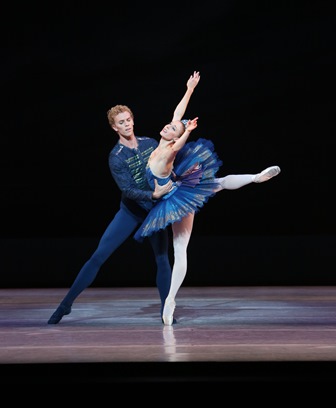
Adam Bull and Lana Jones in Ballet Imperial, 2014. Photo courtesy of the Australian Ballet

There were some particularly lovely moments in the pas de deux in the first movement. I loved the backwards hops on pointe with the leg in arabesque after Jones rose from a swoon-like fall with her arms around Bull’s neck, and also a little later her lift of the leg to second position followed by a slow pull in to retiré, followed by the same sequence of movement on the other side but at double speed. Both were exciting to watch and Balanchine is so good at showing these things more than once so we don’t miss them! And of course Bull was there supporting all these technical feats. Both dancers allowed us to see Balanchine’s exquisite musicality.

Hugh Colman’s new tutus are just gorgeous. Regal in blue and black and one or two complementary shades for the soloists, they are made with sharp lines to the skirt so they seem to represent the cut of a diamond or other precious stones, and they are decorated with a silver sash-like decoration at the back. Very imperial!

What a joy the performance was and it inspires me to say ‘thank you, thank you’. And with Eve Lawson on board as a repetiteur with the Australian Ballet—and what an asset she is—I am looking forward to (or perhaps ‘hoping for’ are better words) a revival of Theme and Variations soon.

Serge Lifar’s Suite en blanc closed the evening. It is certainly a classically-based work and has many interesting features. Its opening scene as the curtain rises, with dancers arranged on several levels on the stage and clad in various white costumes with a very slight touch of contrasting black, usually generates a round of applause, as it did on this occasion. But Lifar’s limitations as a choreographer are, perhaps unfortunately, highlighted by placing Suite en blanc on the same program as Ballet Imperial. Suite en blanc looks very static in comparison and movement is in no way a static event.

Nevertheless, there were some outstanding performances from some cast members and it is always special to see good dancing. Amber Scott and Rudy Hawkes performed stylishly in the pas de deux and Scott was a stand-out in the ‘Variation de la flûte’. But I especially admired Ako Kondo for her technical accomplishments in the ‘Pas de cinq’ and Laura Tong for a beautifully languid and delicious ‘Variation de la cigarette’.

Ako Kondo in 'Suite en blanc', the Australian Ballet, 2014. Photo courtesy of the Australian Ballet
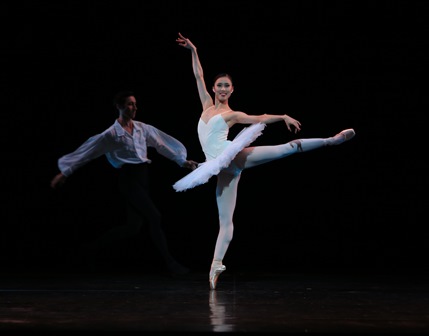
Ako Kondo in Suite en blanc. TheAustralian Ballet, 2014. Photo courtesy of the Australian Ballet

Michelle Potter, 11 May 2014

Chroma, Art to Sky, Petite Mort & Sechs Tänze. The Australian Ballet

10 May 2014 (matinee), Joan Sutherland Theatre, Sydney Opera House

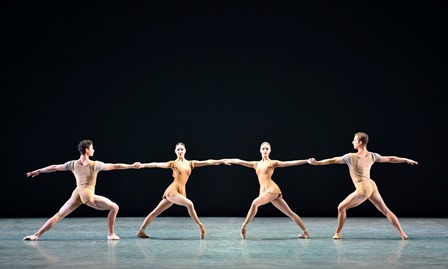
What an inspiring performance the Australian Ballet gave of Wayne McGregor’s Chroma. Not an easy ballet to bring off, but all the diverse features that make McGregor’s choreography so eminently watchable were there. Limbs extending through space, off-centre partnering, moves that were in turn twisted, contorted, angular and sometimes smooth and undulating. And all were all set cleanly and articulately against John Pawson’s stripped back, white box space with its rectangular ‘window’ of changing colours. McGregor is a master at exploiting the balletic body to produce astonishingly shaped movements—movements of the twenty-first century perhaps? What I especially like is that his choreography make us see how perfectly amazing the balletic vocabulary can be.

I particularly admired Vivienne Wong’s performance throughout the work and also a powerful trio from Brett Chynoweth, Rudy Hawkes and Andrew Killian—fast, assertive dancing from them all. But it was a duet from Lana Jones and Daniel Gaudiello that stole the show for me. McGregor’s choreography suits Jones with her strong, unassailable technique and Gaudiello has such a way of adding his own signature to everything he does while still remaining true to the intentions of the choreographer.

Artists of the Australian Ballet in 'Chroma', 2014. courtesy the Australian Ballet
Artists of the Australian Ballet in Wayne McGregor’s Chroma, 2014. Photo courtesy of the Australian Ballet

Stephen Baynes’ new work, Art to Sky, began with some lovely, lingering choreography, beautifully performed by Leanne Stojmenov and Gaudiello again. It was romantic, softly falling from step to step. The corps de ballet also had some memorable choreography in the opening sections, surprising at times and always pure and fresh. But after that there were a few too many somersaults, cartwheels and legs in the air, not to mention twee sections of humour that didn’t quite work. It is a little problematic too that one of George Balanchine’s most exquisite ballets (in my mind anyway) is Mozartiana danced to the same music, Tchaikovsky’s Mozartiana, that Baynes chose for Art to Sky. Balanchine has a habit of lingering in the mind, making it hard to accept anything else to the music he uses.

Hugh Colman’s shadowy, upstage portal that comprised the set, lit by Rachel Burke to give a hint of the mysterious, were strong additions to the look of Art to Sky. Colman, Burke and Baynes work well together as collaborators and bring a sense of visual cohesion to each other’s work.

The program concluded with Jiří Kylián’s companion pieces, Petite Mort and Sechs Tänze and it was a treat to see some more Kylián back onstage with the Australian Ballet. It was interesting to have Kylián on the same program as McGregor, as also happened last year with Bella Figura and Dyad. Kylián, too, pushes the dance vocabulary and gives us a surprising array of movement, but he adds a degree of humanity and humour to his works that McGregor passes over (at least in Chroma, although perhaps not to the same extent in others of his works).

This mixed bill was a relief from the full-length ballets that we are told draw the best houses. To me the house looked pretty much full  for what was a diverse and well danced program. I’d like more in this vein.

Michelle Potter, 11 May 2014

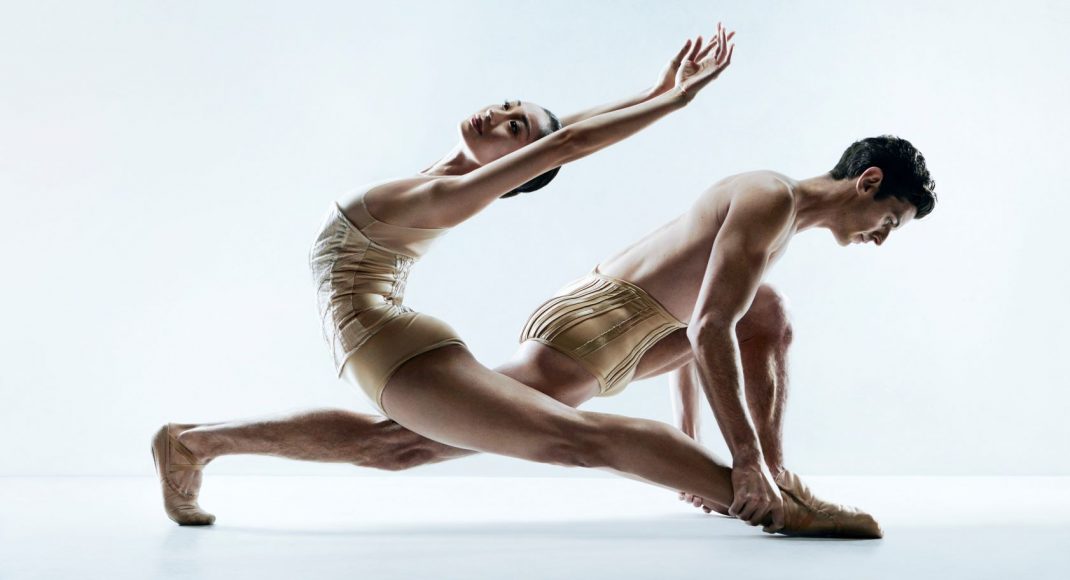
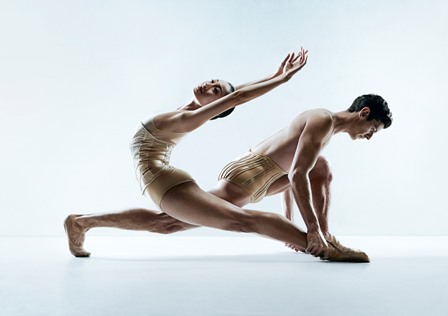
Featured image: Natasha Kusen and Andrew Killian in a study for Petite Mort. The Australian Ballet 2014. Photo: © Paul Scala

Natasha Kusen and Andrew Killian in 'Petite Mort'. Photo Paul Scala. Courtesy the Australian Ballet