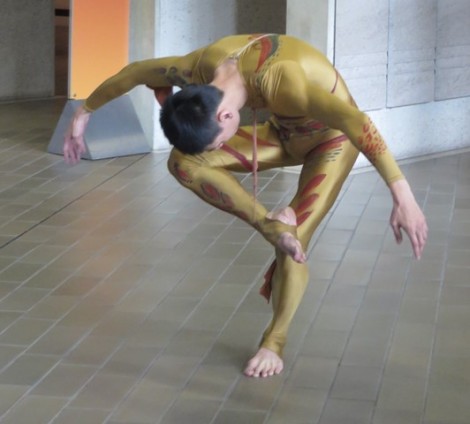
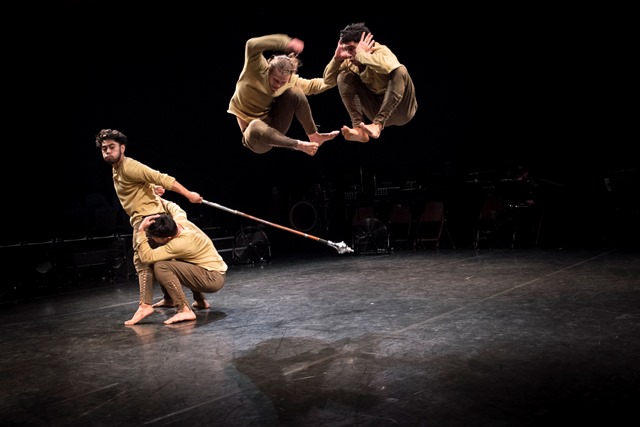
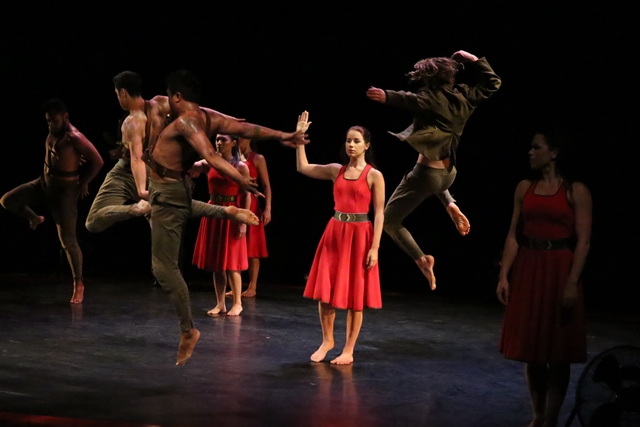
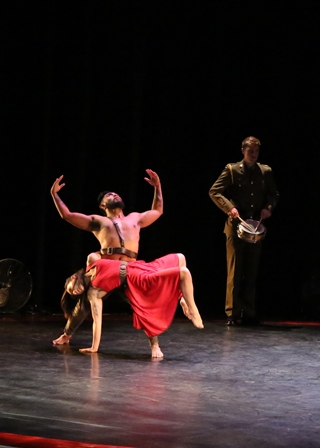
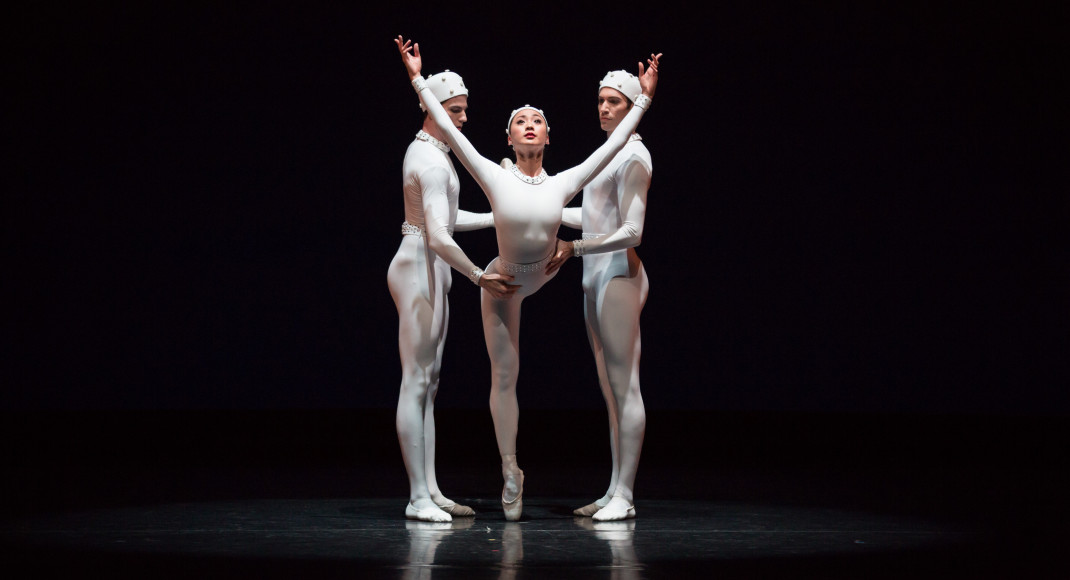
Dancers of Royal New Zealand Ballet in 'Passchendaele', 2015. Photo: Evan Li

Salute. A program of four works by Royal New Zealand Ballet

22–24 May 2015, St. James Theatre, Wellington (and following national tour)
Reviewed by Jennifer Shennan

  • Dear Horizon—choreography, Andrew Simmons; music Gareth Farr
  • Soldiers’ Mass—choreography Jiří Kylián; music B. Martinu
  • Salute—choreography Johan Kobborg; music H.C. Lumbye
  • Passchendaele—choreography Neil Ieremia; music Dwayne Bloomfield

with

  • New Zealand Army Band
  • Rolf Gjeltsen, cello
  • Graham Hickman, conductor

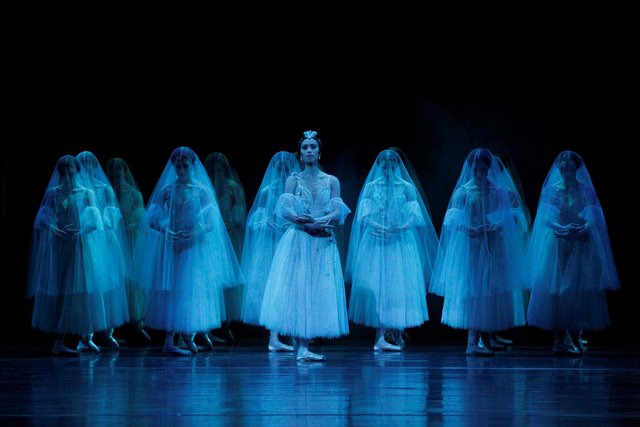
This program is strong, the season short, dance and music groundbreaking, the impact immense. Salute is the Royal New Zealand Ballet’s tribute to the country’s experiences at war, but it has much to offer the conscientious objector as well. There are two major premieres, one searing classic from the 20th century, and a bagatelle of most welcome levity.

The utter futility, red carnage and grey grief of war is unambiguously referenced, yet there is also a dance of first love in peacetime, as poignant as anything all evening. I don’t often tell Australian cousins to cross the Tasman to come to the ballet, but I think I am suggesting just that for Salute—and hey, half the roll call of dancers is Australian.

Andrew Simmons has had a number of commissions to choreograph for this company (outstandingly, Of Days. q.v.) and Dear Horizon is a welcome addition to the list. He responds with empathy to Gareth Farr’s remarkable music, which opens with a high tremolo from the brave solo cello, so quiet, so carrying, before the brass enters the fray. The ballet is dreamlike, dark shadowed, hazy, enigmatic. Time runs both forward and back. War means death, or damaged lives. Dancer Mayu Tanigaito is extraordinary, and designer Tracey Grant Lord’s evocative set of letters and red poppies is suspended on high above this poetic opener.
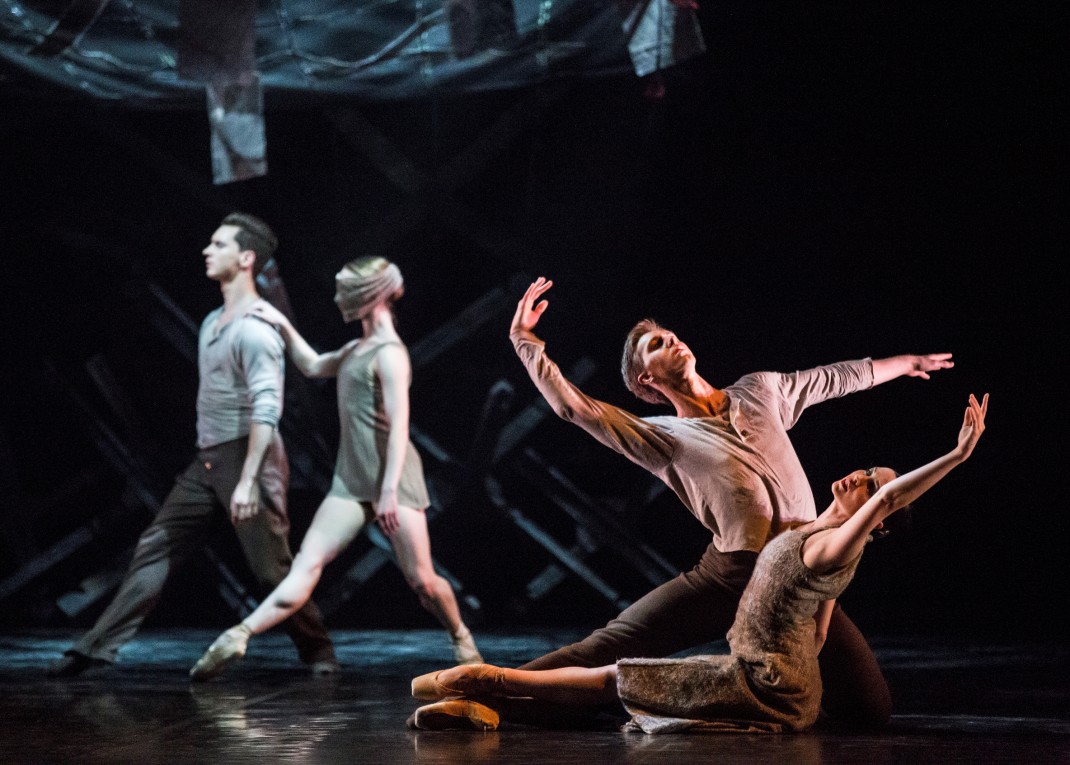
Dancers of Royal New Zealand Ballet in 'Dear Horizon', 2015. Photo: Ellie Richards
Dancers of Royal New Zealand Ballet in Dear Horizon, 2015. Photo: © Ellie Richards

Next is Soldiers’ Mass, for twelve men, Jiří Kylián‘s masterwork made in 1980. This marks a return season from 1998–1999 when Royal New Zealand Ballet first performed the work. Performers from that season have left the company now, but were remarkably evoked again here … Paul Mathews ‘playing’ Ou Lu, Shaun James Kelly ‘playing’ Shannon Dawson. Loughlan Prior and Joseph Skelton are transformed, but a phenomenal performance is given by one woman dancer called in to replace an injured male. Back then it was Pieter Symonds, ‘Joan of Arc comes to town’ I called it—well, Joan of Arc returned to town when Laura Jones, tall, young and spunky, replaced an injured male this weekend, but gave the performances of her life, as good as any man.
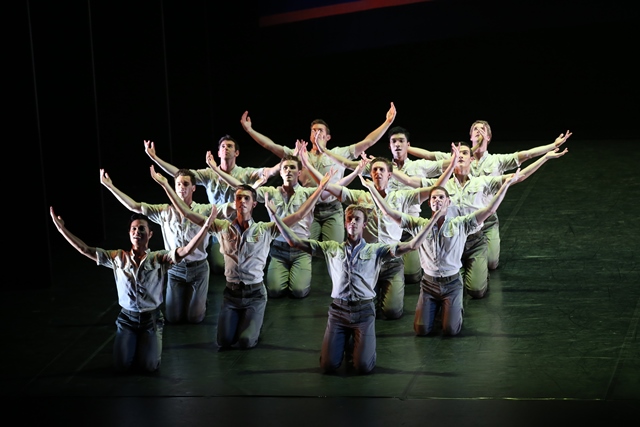
Dancers of Royal New Zealand Ballet in 'Soldiers' Mass', 2015. Photo: Evan Li
Dancers of Royal New Zealand Ballet in Soldiers’ Mass, 2015. Photo: © Evan Li

Kylian has put a couple of telling movement quotes early in his piece to the ‘great’ (anti) war ballet of all time, Kurt Jooss’ The Green Table, and it’s too sad that politicians and armaments manufacturers don’t know these ballets as well as dancers do. The most remarkable truth about Kylian’s choreographic marathon is that, by the time of the Kyrie in the Martinu Mass, the dancers have actually metamorphosed into real soldiers. The effect is devastating, and makes it one of the finest works this company has ever brought into their repertoire.

An interval is welcome but an ice-cream seems ridiculous, it’s cold here, though I don’t refuse when Jon Trimmer shouts me champagne. Soon we are back in the theatre, and it’s Salute, with Lumbye waltzes and galops from old-world Denmark, and a 19th century romp at the cadets prom, young girls all coy, the lads up for a lark, and a stitch of a sergeant-major. It’s a long way from a battlefield and one resists its charms for a while, till remembering, hang on, I’m still sipping champagne, and everyone around me is wearing sparkly earrings and a bit of dress-up, we are at the ballet after all, so Salute is no sillier than we are. Just because it’s full of biedermeier charm doesn’t mean the dancing’s easy. Lucy Green dances with Damir Emric and her serious first love tugs your heart.
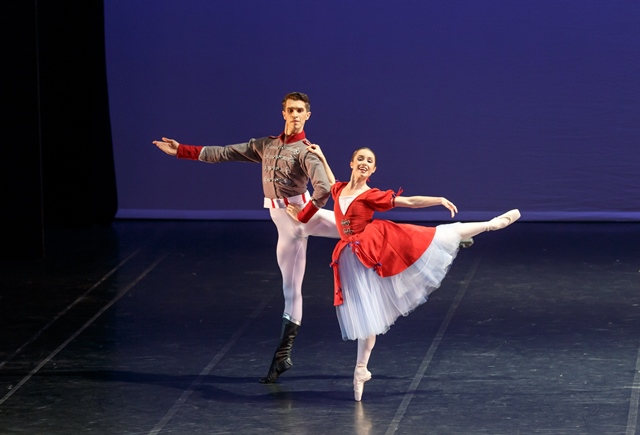
Damir Emric and Lucy Green in 'Salute'. Royal New Zealand Ballet, 2015. Photo: Evan Li
Damir Emric and Lucy Green in Salute. Royal New Zealand Ballet, 2015. Photo: © Evan Li

Neil Ieremia has made a colossus of a choreography in Passchendaele. It may be short by number of minutes but it brings that miserable battle home to us like nothing else. Of course all battles are miserable but I’ve always been especially choked by Passchendaele since hearing in a millenium documentary in 2000, where one soldier’s tale was of spending all day every day in a trench of mud up to his neck, close enough to see ‘the enemy’ yet unable to advance. Come nightfall, if you could get back through the mud you could expect some food rations but the only way to cross the sea of mud was to step on your fallen comrades, though only so long as they were lying face down, so their bony spines could offer you footfall. That might be the most disgusting thing I have ever heard in all history—that you went to war so as to die so your spine could be a footprint for your mate to go and get an army biscuit. The disappointment we all share is that war seems genetic in the human condition, and that ‘the Great War to end all wars’ has proved anything but. Historians seem to be still puzzling as to why it even happened at all. One of my great uncles lies buried ‘near the Somme’. Another returned but had been so badly gassed that he coughed and choked for the next 53 years back home. Which would be worse?

Well, Ieremia has put all of this anger into his thundering dance. Abigail Boyle and Jacob Chown are on fire. All the dancers punch out the fight, and phrases from haka were never more tellingly choreographed on a stage. The composition is a tour de force by Dwayne Bloomfield, his own name echoed in the red and black back projections, the work of Geoff Tune. Out of sight but well within earshot are more dancers, not onstage but underneath it, playing snare drums to add to the orchestra pit swelling full of brass. The dancing women have to walk away and leave their men lying there motionless. There’s a knock on the door from the telegram boy, then a tune from a lone whistler in the dark. Curtain.

Jennifer Shennan, 25 May 2015

Featured image: Dancers of Royal New Zealand Ballet in Passchendaele, 2015. Photo: © Evan Li
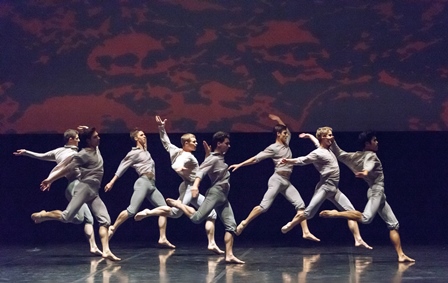
Dancers of Royal New Zealand Ballet in 'Passchendaele', 2015. Photo: Evan Li

Giselle. The Australian Ballet (2015 third viewing)

21 May 2015, Canberra Theatre Centre

This is an expanded version of a review published by Fairfax Media online on 22 May and which will appear shortly in print in The Canberra Times [published 25 May].

Giselle is one of the great works of the balletic repertoire. Its story of love, betrayal and forgiveness needs powerful acting as well as exceptional dancing, and its Romantic heritage (it was first performed in Paris in 1841) requires that its two acts be very different from each other. The first act, showing village life at harvest time, is grounded in reality; the second, set in a ghostly forest clearing at midnight, is just the opposite. The opening night of the Australian Ballet’s Canberra season of Giselle, the Maina Gielgud production, ticked all the boxes and was nothing short of stunning.

In the leading roles of the peasant girl Giselle, and Albrecht, the man Giselle loves, Lana Jones and Adam Bull danced exceptionally well, both together and in their respective solos. I have never seen Jones dance with such lightness and elevation and her held arabesques lingered beautifully every time. The relationship between Jones and Bull unfolded carefully throughout Act I as a result of their expressive faces and their constant eye contact. Then, when Albrecht’s true identity was revealed—he is not the peasant he seems to be but a Count in disguise—Jones brought compelling dramatic force to her mental collapse. Bull played Albrecht as a man genuinely in love and, although he could not deny his aristocratic lineage when confronted with it, we felt his anguish as he faced Giselle’s onstage death.

By Act II Giselle, as prefigured in Act I, has become a Wili and rises from the grave to join others like her who have been betrayed in love. They prey upon men who enter their domain at night and, at the command of Myrtha, their Queen, condemn them to dance until they die. Jones and Bull again showed their exceptional technical skills but also consistently stayed in character. Their first encounter, after Albrecht had entered the forest to mourn at Giselle’s grave, was a moving one. Jones drifted past Bull as an apparition whom he could not catch. As the act progressed we felt Bull’s desperation as he obeyed the command to keep dancing, and we felt Jones’ all-consuming love as she pleaded that he be saved. None of this was at the expense of their dancing in a technical sense, but neither did they allow their dancing to intrude on the development of the story.

As Myrtha, Ako Kondo was superb. She was, as ever, technically assured. But she also brought just the right imperious quality to her performance. No one could escape her cold-heartedness.

Ako Kondo as Myrtha in 'Giselle'. The Australian Ballet, 2015. Photo: Jeff Busby
Ako Kondo as Myrtha in Giselle. The Australian Ballet, 2015. Photo: © Jeff Busby

Hilarion, the rough and untutored gamekeeper also in love with Giselle, was strongly danced by Andrew Killian. His role in unmasking Albrecht in Act I is crucial and Killian made his every move and thought unmistakably clear. As Wilfred, Albrecht’s right hand man, Andrew Wright also gave a strong performance. He was forever anxious as he tried again and again to persuade Albrecht not to pursue his deception of Giselle, and then was in the right place at the right time to usher him out of the village following Giselle’s death.

The peasant pas de deux, a highlight of Act I, was danced by Miwako Kubota and Christopher Rodgers-Wilson. They made a charming couple, both in their dancing and in the way they engaged with each other, and with us in the auditorium. What I especially admired was that they maintained their roles as two people from the village community. While technically they certainly matched others I have seen perform this pas de deux, they were the first who didn’t look as though they belonged elsewhere.

Natasha Kusen and Robyn Hendricks also caught my eye for their lyrical performance as the leading Wilis in Act II. Kusen in particular had a wonderfully fluid upper body and arms and continues to stand out as a dancer to watch.

Although the size of the Canberra stage caused one or two difficult moments, the dancers of the Australian Ballet performed as the true professionals they are. It was a wonderful Giselle, beautifully danced, thoroughly engaging, and dramatically convincing throughout.

Michelle Potter, 23 May 2015

Postscript

On the question of the size of the Canberra Theatre and its relation to the Australian Ballet’s abilities to stage its current repertoire in the present theatre, at the post-performance event, John Hindmarsh, current chair of the ACT Cultural Facilities Corporation announced that he had had some success in his ongoing initiative to develop a new Canberra Theatre. While there is, apparently, still much to achieve Hindmarsh was in a relatively buoyant mood about possibilities.

I am also curious that the name Loys, the pseudonym that used to be given to Albrecht while he assumes a village identity, seems to be disappearing. It didn’t appear in this production. And is he a Count as the Australian Ballet program says, or is he the Duke of Silesia as others note? Pedantic points perhaps, but interesting nevertheless.

And one disappointment, no media images were available of Jones and Bull, which seems a missed opportunity to me.

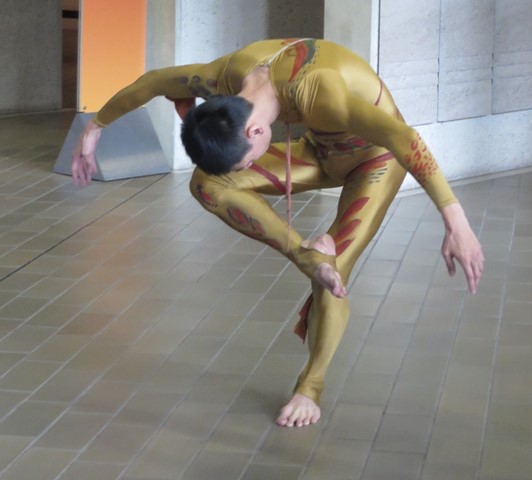
Chen Fu-rong in Landscape, Mirramu Dancecompany and guests, national Gallery of Australia, 2015. Photo: Michelle Potter

Fortuity. Mirramu Dance Company and Guests

My review of Fortuity from Mirramu Dance Company with guest artists from Taiwan is now available on DanceTabs at this link.

Elizabeth Dalman and her guests also appeared on several occasions during May in various public places and institutions around Canberra. I was able to see two such performances, one in the National Gallery of Australia and one in the Canberra Museum and Gallery. The National Gallery of Australia show began in the foyer with a solo by Chen Fu-rong from Dalman’s work Landscape, made originally in 1967 for Australia Dance Theatre to music by Nomad and Clifford Brown. Chen’s solo was Dalman’s response to works in the Mandala series by South Australian artist Lawrence Daws and was memorable for Chen’s strong sense of balance and his capacity to extend his limbs into the off-centre poses that characterised Dalman’s choreography during the 1960s.

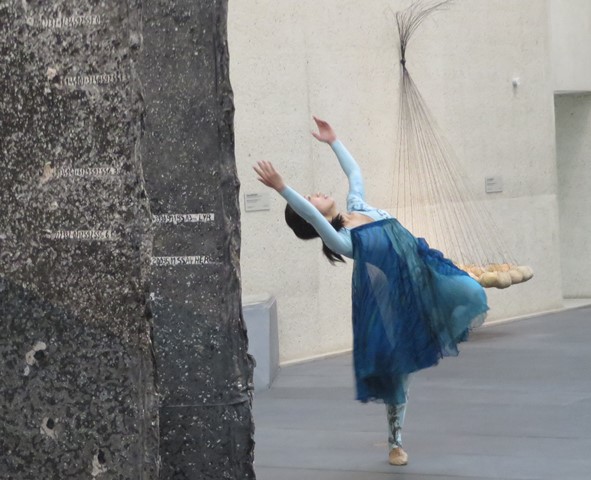
A second highlight of the program, which also included improvisations in response to various works as we moved from the foyer to the downstairs sculpture gallery, was another solo, this time from Peng Hsiao-yin entitled Woman of the River. This piece was made by Dalman for herself in 1987 to music of the Penguin Café Orchestra and was recently handed on to Peng by Dalman. Peng’s performance was filled with lyricism as she danced Dalman’s flowing, swirling choreography, weaving her way around the varied sculptural items currently on display.

Peng Hsiao-yin in Woman of the  River, National Gallery of Australia, 2015. Photo: © Michelle Potter

The showing at the Canberra Museum and Gallery was largely characterised by improvisations but concluded with solo danced by Vivienne Rogis, which was mesmerising for the calmness Rogis was able to bring to the piece.

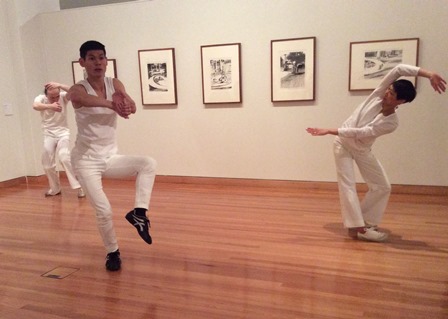
Taiwanese guest of Mirramu Dance Company at CMAG, 2015
Taiwanese guest of Mirramu Dance Company improvising at the Canberra Museum and Gallery, 2015. Photo: © Michelle Potter

Michelle Potter, 23 May 2015

Featured image: Chen Fu-rong in a solo from Landscape, Mirramu Dance Company and Guests, National Gallery of Australia, 2015. Photo: © Michelle Potter

Chen Fu-rong in Landscape, Mirramu Dancecompany and guests, national Gallery of Australia, 2015. Photo: Michelle Potter
'Rotunda', the New Zealand Dance Company. Photo: John McDermott

Rotunda. The New Zealand Dance Company

My review of Rotunda, a very special piece of dance theatre from Shona McCullagh and her New Zealand Dance Company, has now been posted on DanceTabs at this link.

Take another look, too, at Jennifer Shennan’s comments on Rotunda at this link.

Michelle Potter, 20 May 2015

Featured image: Scene from Rotunda. The New Zealand Dance Company. Photo: © John McDermott, 2013

'Rotunda', the New Zealand Dance Company. Photo: John McDermott
Jared Wright, Natasha Kusen and Brett Simon in 'Monotones II'. The Australian Ballet, 2015. Daniel Boud

The Dream. A second look

16 May 2015 (matinee), Joan Sutherland Theatre, Sydney Opera House

After feeling less than satisfied with my earlier viewing of the Australian Ballet’s triple bill of Ashton works—Monotones II, Symphonic Variations and The Dream—it was such a pleasure to have a second look and come away feeling much more fulfilled.

Monotones II was danced by the same cast that I saw on opening night, Natasha Kusen, Brett Simon and Jared Wright, but all my feeling that the work was outdated disappeared. Gone too were those hideous shadows that marred my first viewing, although they linger a little on the photograph below. This time, the visually pristine quality of the work was all there. I had a much better seat, but was that the only reason? I suspect not.

There was a real serenity to the performance. All three dancers were attuned to each other’s movements. There were gorgeous moments of symmetry that gently broke into asymmetry. Bodies twisted and threaded through arched shapes. Winding and unwinding. It was a truly beautiful, calm, technically satisfying performance.

Symphonic Variations too was danced in a far superior fashion to what I saw on opening night. The three women, Lana Jones, Amanda McGuigan and Ingrid Gow were well cast together. They are of similar height and body shape and it made a huge difference. The men, Andrew Killian, Ty King-Wall and Andrew Wright, were experienced enough to manage the difficult partnering without looking as though they were fumbling around. They also handled better the experience of being on stage for the entire ballet.

Technically, all six dancers showed every beautiful and often intricate detail of Ashton’s choreography—the elongated fingers, the hands turned up from the wrists, the lines made between dancers, for example. The spacing and patterning of the work was also clear, and the movements flowed smoothly. A delight to watch. I loved that moment for the women when they turned chaînés around their partner, starting one after the other and with one arm spiralling upwards as if propelled by the twirling of the feet. And I gasped as the men, in a line upstage, all turned a double pirouette ending in attitude and finished perfectly, in the same line, in time, and with their attitudes at the same height. Just beautiful and surely how Ashton imagined this work would be danced.

Still something missing there though—that incredible feeling that I got from the Royal that this was an awakening from the darkness. And it was only after reading (much later) the Royal’s program notes that I realised the circumstances behind Ashton’s creation of the work. So I didn’t set out with a preconceived idea. But thank you to the six Australian Ballet dancers I saw on this occasion. It was a lovely, serene performance, despite the medical emergency that was going on in the auditorium at the time.

The Dream looked mostly as beautiful as it did on opening night, this time with Miwako Kubota and Jared Wright taking the leading roles of Titania and Oberon. Wright stood out in his solo variation in the final pas de deux. His movements were beautifully shaped and coordinated. Andrew Wright and Christopher Rodgers-Wilson gave excellent performances as Demetrius and Lysander. Wright in particular was able to demonstrate how skilled Ashton is at incorporating humour into his works. Marcus Morelli, with his exceptional elevation, made Puck look as if he belonged in the air.

Overall, what a difference!

Michelle Potter, 17 May 2015

Featured image: Jared Wright, Natasha Kusen and Brett Simon in Monotones II. The Australian Ballet, 2015. Photo: © Daniel Boud

Jared Wright, Natasha Kusen and Brett Simon in 'Monotones II'. The Australian Ballet, 2015. Daniel Boud

My initial review is at this link.

Raghav Handa in Tukre'. Photo Gregory Lorenzutti

Raghav Handa’s Tukre’. Dance Bites 2015

1 May 2015 (matinee), Lennox Theatre Riverside, Parramatta

Tukre’ means ‘pieces’ in Hindi and Raghav Handa’s solo show was a series of moments from his life—memories, thoughts, recollections. These intimate pieces from his life as an Australian of Indian heritage were spread across about 50 minutes of dance, conversation and projections.

Raghav Handa in Tukre'. Photo © Gregory Lorenzutti
Raghav Handa in Tukre’. Photo: © Gregory Lorenzutti

Handa is a beautiful mover and his qualities as a dancer were obvious from the first moments of Tukre’. In semi-darkness Handa bent over a small candle and acted out the faceting techniques of his Indian forbears, who were jewellery makers. Every movement was precise and clearly articulated. And from then on, while the movements became more expansive, and changed in dynamics, there was always the same precision of movement. Throughout the performance his clearly defined musculature allowed us to see his exceptional capacity to isolate movement in individual parts of the body.

There were references in his choreography to his background in Kathak dance, especially when he changed into a long garment, with a full skirt and finely detailed top, and began to turn with the skirt swirling around his body. There were also Indian references in the electronic score from composer Lachlan Bostock, which maintained beautifully the Indian/Western links apparent throughout Tukre’.

At times Handa stopped dancing and picked up a microphone to talk to us about his life. He told us of how his Australian life interacted with his Indian heritage and we were privy to a conversation with his mother, via a film clip projected onto a scrim hanging in the performance space. At first this halt to the movement was a little jarring, but slowly it became clear that this was the structure of Tukre’. We were seeing Handa as a multi-faceted person and artist. There were some particularly affecting moments in his conversation with his mother as they discussed his sexual orientation and the passing on to him of a family heirloom. In addition there was footage of his mother meticulously folding a sari, which was also affecting as it reflected the precision that marked Handa’s choreography. As the work closed we saw Handa wearing the heirloom, an ornate, bejewelled necklace.

I found Tukre’ quite fascinating as a work that set out to cross boundaries between cultures. It didn’t always flow as smoothly as it might have, and I continued to feel a sense of annoyance whenever Handa picked up a microphone and changed the mood of the piece so abruptly. But I look forward to seeing more of Handa’s work, which seems to me to be quite unique on the current dance scene.

Michelle Potter, 3 May 2015

Featured image: Raghav Handa in Tukre’. Photo: © Gregory Lorenzutti

Raghav Handa in Tukre'. Photo Gregory Lorenzutti
Artists of The Australian Ballet in 'The Dream'. Photo: Daniel Boud

The Dream. The Australian Ballet

29 April 2015, Joan Sutherland Theatre, Sydney Opera House

There were peaks and troughs in the Australian Ballet’s second program for 2015, a triple bill of works by Frederick Ashton. There were also a few surprises.

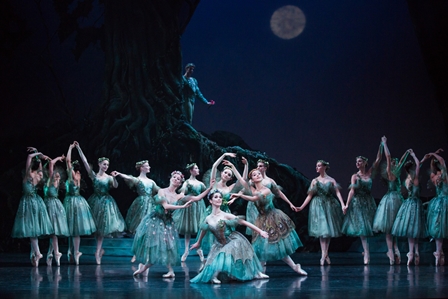
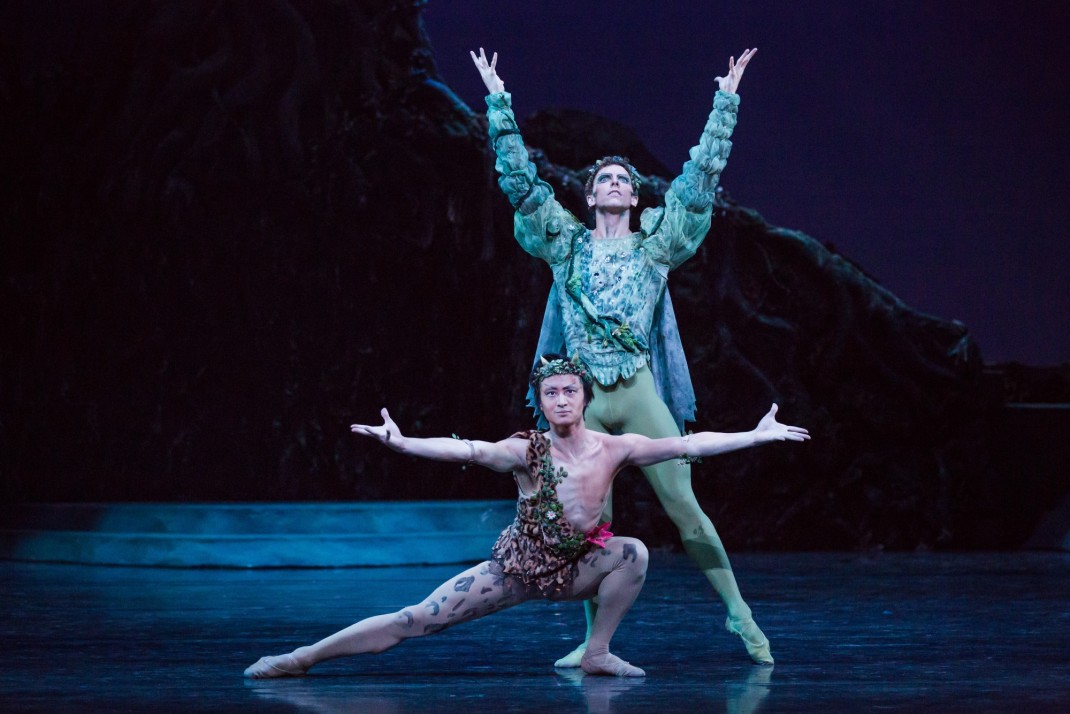
The undoubted highlight was The Dream, which was also used as the overarching title for the program. We have been told over and over that Ashton was a genius, and many aspects of his work that support that idea were apparent onstage in The Dream, Ashton’s take on Shakespeare’s Midsummer Night’s Dream. Most obvious is the incredible way in which Ashton is able to make a story so clear through movement and mime. No need to know the story beforehand. Everything is comprehensible and coherent. The entire cast of The Dream is to be congratulated for the way they handled Ashton’s approach, and bouquets to the two gentlemen who staged the work—Anthony Dowell and Christopher Carr.

Then there is Ashton’s complex choreography with all its tricky steps, swirling arms, fluid upper body, unexpected combinations, and so forth. Madeleine Eastoe as Titania was superbly in control and made even the trickiest of movements look easy. Her solo with its many hops, turns, swoons and swirls was captivating. And the final pas de deux between a reconciled Titania and Oberon (danced by Kevin Jackson) was  a delight. Their partnership has grown into one from which we now expect, and receive, nothing but the best.

Chengwu Guo as Puck and Kevin Jackson as Oberon in Frederick Ashton's 'The Dream', the Australian Ballet, 2015. Photo: Daniel Boud
Chengwu Guo as Puck and Kevin Jackson as Oberon in Frederick Ashton’s The Dream, the Australian Ballet, 2015. Photo: © Daniel Boud

Chengwu Guo was a standout as Puck. I continue to gasp at his beautifully controlled multiple turns, his leaps, his beats. But best of all those amazing technical skills were, on this occasion, put to such good use. They combined perfectly with his particular brand of physicality, and with his personality, to advance the story. Guo was as puckish as they come.

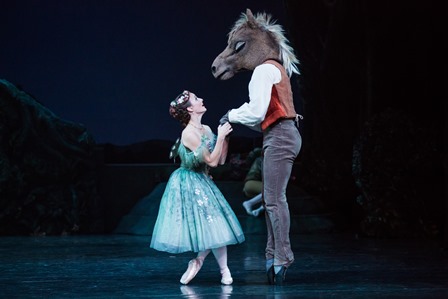
Joseph Chapman delighted the audience as Bottom, the crazy mechanical who wears the head of an ass, courtesy of Puck, and who dances on pointe. His characterisation was strong and maintained consistently and, unbelieveably, he was believable. He was the one everyone was talking about as they left the auditorium.

Madeline Eastoe as Titania and Joseph Chapman as Bottom in Frederick Ashton's 'The Dream', the Australian Ballet, 2015. Photo: Daniel Boud
Madeline Eastoe as Titania and Joseph Chapman as Bottom in Frederick Ashton’s The Dream, the Australian Ballet, 2015. Photo: © Daniel Boud

The corps de ballet had been beautifully rehearsed and nothing was forgotten of the Ashton style—head and arm movements especially. And take a bow Benedicte Bemet as Moth. To me she looked like a born Ashton dancer. But then I think she is just a born dancer.

That’s where the peaks ended I’m afraid!

The first half of the program consisted of Monotones II and Symphonic Variations. Monotones II, danced by Natasha Kusen, Brett Simon and Jared Wright, has not really stood the test of time for me. It looked quite outdated and very static. As for Symphonic Variations, could it really be the same ballet I was lucky enough to see in London last year danced by the Royal Ballet? As the curtain went up I got a thrill to see Robyn Hendricks and Cristiano Martino looking stunning as the lead couple—elegant with proud bearing promising much. But where was the ‘sensational twenty minutes of unstoppable beauty’ that I saw in London that set my heart singing? The dancing was all over the place, technically beyond the experience of one or two of the dancers, and with little feeling for the spacing and floor plan of the work. A huge disappointment as far as I am concerned.

As for the surprises, well one was pleasant, one wasn’t. Why on earth did the cast sheet say that the performance of Symphonic Variations was ‘The world-premiere performance’? The ballet was made in 1946. But a pleasant surprise came at the end of The Dream as the entire cast was taking its final curtain. The Australian Ballet’s ingrained manner of acknowledging the orchestra during the final curtain call by coming forward and leaning into the orchestra pit and clapping for an inordinate amount of time was gone, thankfully. Instead, the company moved forward, stood in poses that maintained the mood of the work they had just danced and, with an elegant sweep of one arm to the side, acknowledged the orchestra. The integrity of the dance was maintained and the company looked stylish and dignified. Thank you to whomever decided to dispense with what we have been watching over several years now, which I find crass. May this new-found elegance in curtain calls continue.

Michelle Potter, 30 April 2015

Featured image: Artists of the Australian Ballet in Frederick Ashton’s The Dream, 2015. Photo: © Daniel Boud

Artists of The Australian Ballet in 'The Dream'. Photo: Daniel Boud

A second look at this program is at this link.

Paris Opera Ballet, 'Défilé'

Celebrate Dance. Paris Opera Ballet

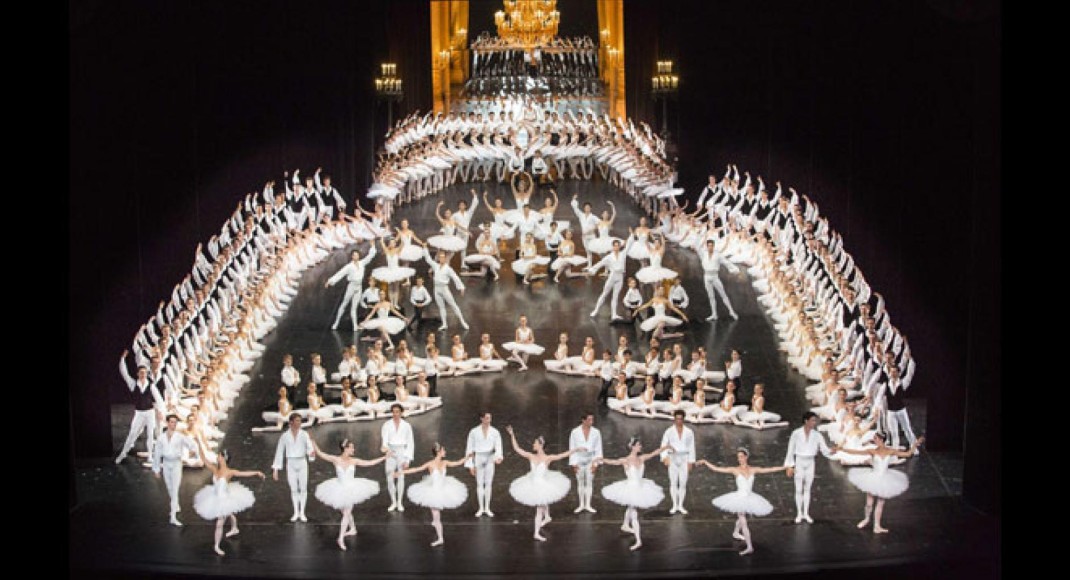
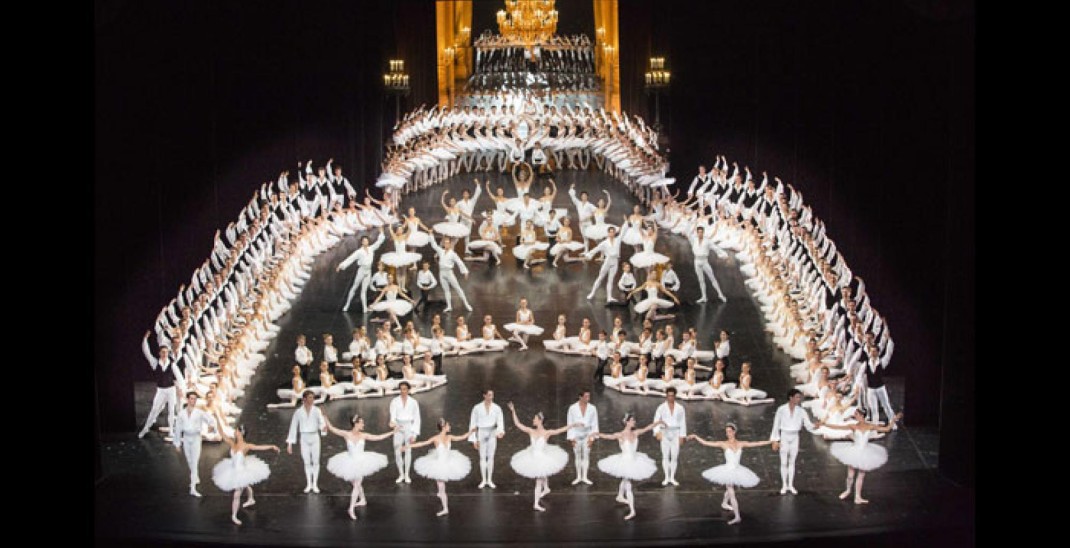
The Paris Opera Ballet once again demonstrated its incredible technical and artistic strengths in Celebrate Dance, a film introduced by the company’s retiring director Brigitte Lefèvre and recently released in Australian cinemas. Opening the program was the Paris Opera Ballet’s traditional parade of dancers from the company and its school—the défilé—seen for the first time on film. This spectacular presentation begins in a chandeliered ante-room, the foyer de la danse of Degas fame. Some 350 artists and artists-to-be, beginning with the youngest children from the ballet school and ending with the étoiles of the company, make their way from the ante-room down the stage of the Palais Garnier, giving a bow as they reach the front of the stage before moving into assigned places. There is no formal dancing as such but it generates goose-bumps to see these dancers on parade, and to hear the audience honour them with, as might be expected, the greatest applause given to the étoiles, who enter singly rather than in a group as happens with the rest of the artists. Finally they form a tableau which Robert Greskovic has described in his book Ballet 101: a complete guide to learning and loving the ballet: ‘In its final tableau the défilé amasses a garden of ballet beauty, paying homage to the art form’s continuity and freshness.’

Paris Opera Ballet, 'Défilé'
Le défilé du ballet, final tableau, Paris Opera Ballet, 2014

There is also an account of the origin of the défilé du ballet, as it is now called, in Greskovic’s book. He notes that this parade of dancers was introduced by ballet master Léo Staats in 1926, when it was called Le défilé. The name was changed to Le grand défilé when the director of the company was Serge Lifar. Currently it is performed to the March of the Trojans from Les Troyens of Hector Belioz. Staats set it to the March from Richard Wagner’s Tannhäuser.

The défilé was followed by a performance of Études, which Lefèvre spoke of in her introduction as being a rather challenging ballet! But the Paris Opera Ballet seemed to sail through the performance with all the precision and technical expertise that the work demands. I enjoyed in particular one of the opening sequences done at the barre in which the dancers showed three different types of ronds de jambe—à terre, en l’air and grands, with perfect timing and precision, every leg at the same height, every foot closing at the same time and so on. Mesmerising mechanics performed with speed! These opening sections at the barre were enhanced, I thought, by moody lighting in which the upper part of the body was scarcely visible at times. It gave absolute focus to the precise movements of the lower body, a special effect of the film not usually achieved in a stage performance.

Dorothée Gilbert danced the leading female role in Études and she was partnered by Joshua Hoffalt and Karl Paquette. It was impossible not to be stunned by their joyous dancing—in particular by Gilbert’s beautifully controlled balances and multiple turns, and the beats, turns and jumps of the two men. But every dancer performed astonishingly well. And again yes, O’Neill was there turning fabulous fouettés and making her presence well and truly felt.

I regret that circumstances did not allow me to stay to see the final section, excerpts (as far as I could tell) from Nutcracker. I would be delighted to receive comments on this last section.

Michelle Potter, 19 April 2015

Footnote: And on the subject of Études, I recently interviewed Lisa Pavane for the National Library of Australia’s oral history program. When this interview goes online, hopefully soon, it is worth listening to Pavane’s account of dancing in Études. It was after her opening night performance in this extremely demanding ballet in 1986 that she was promoted to principal.

Giselle. A second look

4 April 2015 (matinee), Joan Sutherland Theatre, Sydney Opera House

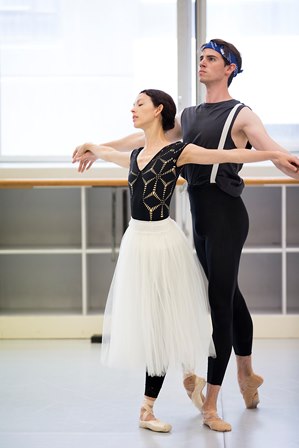
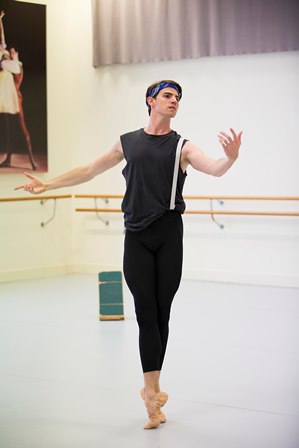
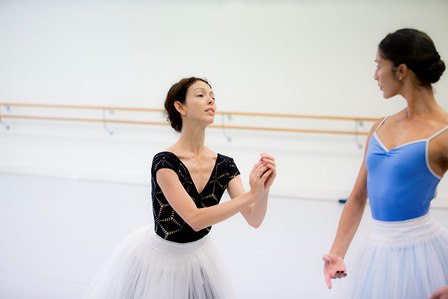
Seeing an artist make his or her debut in a principal role is always an exciting prospect, especially when it is in one of the important classics of the ballet repertoire. It was a double thrill for the audience at the Sydney Opera House on 4 April when two Australian Ballet dancers, senior artist Juliet Burnett and coryphée Jared Wright, appeared for the first time in the leading roles of Giselle and Albrecht in Maina Gielgud’s Giselle.

In rehearsal for Giselle.  (l-r)  Juliet Burnett and Jared Wright; Jared Wright; Juliet Burnett and Robyn Hendricks. All photos © Lynette Wills, 2015

Perhaps what stood out more than anything for me was the way in which both Burnett and Wright looked unhurried. There was time to savour each moment of their dancing and their interpretation of the roles. They were strongest in Act II. Burnett was as light as a feather, a frail wisp, as she moved across the stage. Wright was filled with the right amount of sorrow and desperation to atone for his betrayal of Giselle. Their first encounter was sweepingly poetic. Then Burnett pleaded for mercy from Myrtha and did her best to protect her love. Wright pleaded too and did his best to keep dancing. While each danced well technically, to the credit of these two dancers I wasn’t looking so much at execution of steps, I was swept up in the mood.

In Act I Wright struggled a little I thought with the duality of Albrecht and I was never quite sure how he saw himself at any one time, peasant or royalty? There are moments of each for Albrecht in Act I and it is not easy to work between the two. Burnett was quite frightening in the mad scene as her limbs shook and her blank expression removed her from the real world. It lacked a certain theatricality, however, which would have lifted the scene to another level. Sometimes too real isn’t quite enough.

Of the minor principals, Olga Tamara gave an interesting interpretation of Berthe, Giselle’s mother. She set herself apart as a matter-of-fact lady, and her apprehension that the Wilis were present in the village and waiting for her daughter was conveyed strongly. Amanda McGuigan made a commanding Myrtha, cold and haughty.

I hope it is not as long between Australian Ballet seasons of Giselle as it has been recently. Both Burnett and Wright showed great promise of things to come and they deserve the opportunity to hone their interpretations, to polish their technique and to grow as artists. There are few ballets that offer such a great opportunity to reach new heights in one’s career as Giselle gives to those who are entrusted to carry on its beauty, its demands and its legacy.

Michelle Potter, 5 April 2015

My review of another performance of Giselle with Natasha Kusch and Chengwu Guo is at this link.

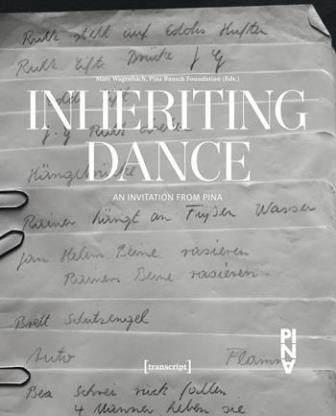
Inheriting dance. An invitation from Pina.

I have had an ongoing interest in archiving dance for almost three decades, fuelled in particular by curatorships at the National Film and Sound Archive and the National Library of Australia in Canberra, and the Jerome Robbins Dance Division at the New York Public Library for the Performing Arts. They were three quite different experiences, especially in relation to the kinds of format on which dance is, or might be, recorded and how these formats are, or might be, preserved; and also in relation to the strength of focus on dance (or lack of it) I encountered at each of these institutions. The book Inheriting dance: an invitation from Pina, published by the Pina Bausch Foundation, was a chance to be reminded of the problems that face us if we want dance to be preserved for future generations. And of the pleasures encountered when positive steps are taken.

Pina Bausch died in 2009 and left a diverse range of materials in different formats as a legacy of her career. The chapter ‘Wild gardens. Archiving as translating’ lists them for us and the authors of this chapter (Gabriele Klein and Marc Wagenbach) remark:

Archiving was part of her choreographic process, an essential element of her work. It was an attempt to retain the momentary and the transient, to be able to remember, in order then to once again create an artistic present.

The Pina Bausch Foundation was set up shortly after Bausch’s death in order to carry on her heritage and find a way to archive her material so that it might remain a creative force in the future. Various archiving processes are discussed: the model of the so-called ‘static repository’; the ‘living archive’, that is one that is more open and collaborative; the idea of an archive being a ‘future workshop’; and other ideologies relating to interdisciplinary approaches and digitisation strategies.

The book gives some interesting examples of how the current Bausch archive has been used to bring certain Bausch works to the stage. I have to admit, however, to being most fascinated by a chapter by Royd Climenhaga relating to the reception of Bausch’s works in America. The juxtaposition he sets up between German and American dance traditions, and his discussion of efforts to incorporate Bausch’s vision into his own teaching and other experiences in America, make thought-provoking reading.

On the subject of archiving dance, my experience has been that most dance collections fall, for a whole variety of reasons, including financial and time-related ones, into the category of ‘static repositories’. But they certainly don’t have to be ‘arcane models of scholarship and institutionalized academic projects’, although personally I like using them for academic purposes, and feel lucky that I can. Not enough academically-inclined folk realise that dance is a worthwhile area of study. But static repositories can also be used as ‘living archives’. And here I am thinking of some performances created by Liz Lea, artistic director of Canberra Dance Theatre using cross-disciplinary and cross-institutional resources from Canberra’s collecting institutions including the National Library of Australia, the National Film and Sound Archive and the National Gallery of Australia. Lea, I am sure, is not the only choreographer using dance resources from static repositories to create work, although I realise that this is a little different from recreating the work of a particular choreographer now no longer alive, as is the aim of the Pina Bausch Foundation.

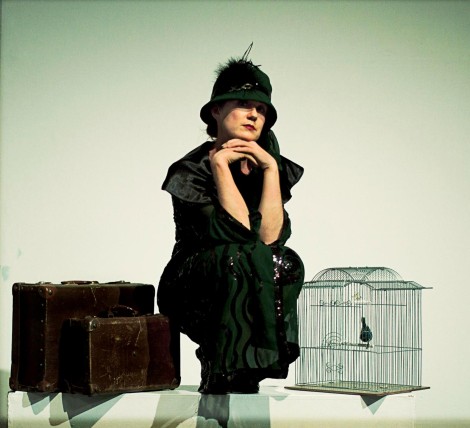
Publicity shot for '120 Birds', 2011
Liz Lea in 120 Birds, a work drawing on resources from the National Library of Australia

I guess I am arguing for the role of all models of dance archives to be treasured and developed. In that context, this is a book worth reading by anyone who is interested in how dance will be perceived, created and recreated in the future, as it is, of course, for anyone interested in how one organisation is undertaking a particular project.

  • Marc Wagenbach and Pina Bausch Foundation (eds), Inheriting dance: an invitation from Pina  ([Transcript]: Bielenfeld, 2014). Paperback, 1992 pp., illustrated
    ISBN 978-3-8376-2785-5

See also the website of the Pina Bausch Foundation at this link.

Michelle Potter, 22 March 2015

Featured image: Book cover, Inheriting dance. An invitation from Pina.

'Inheriting dance' cover image