21 November, 2025. Civic Theatre, Auckland
reviewed by Jennifer Shennan
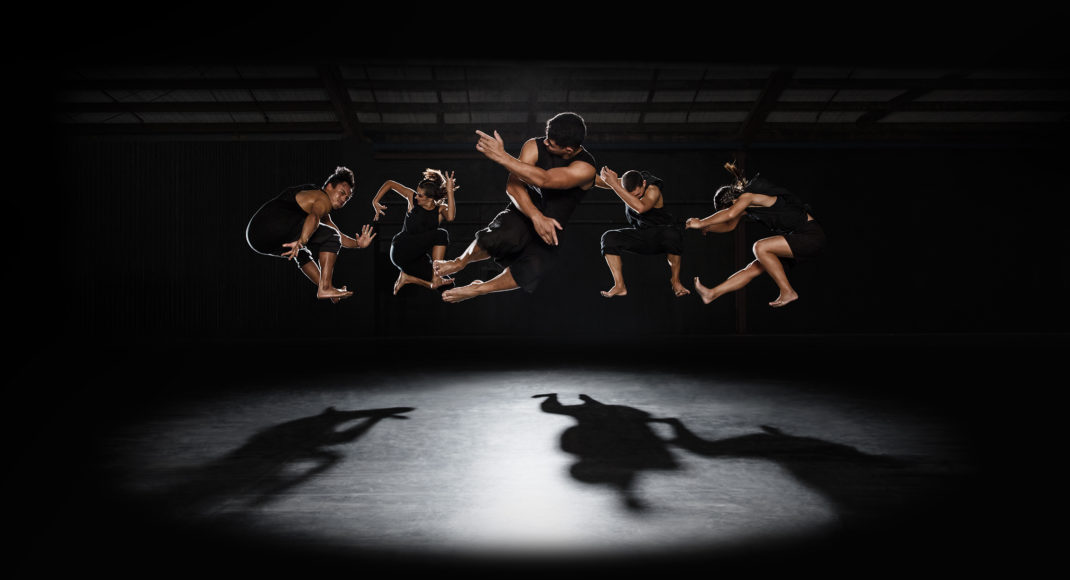
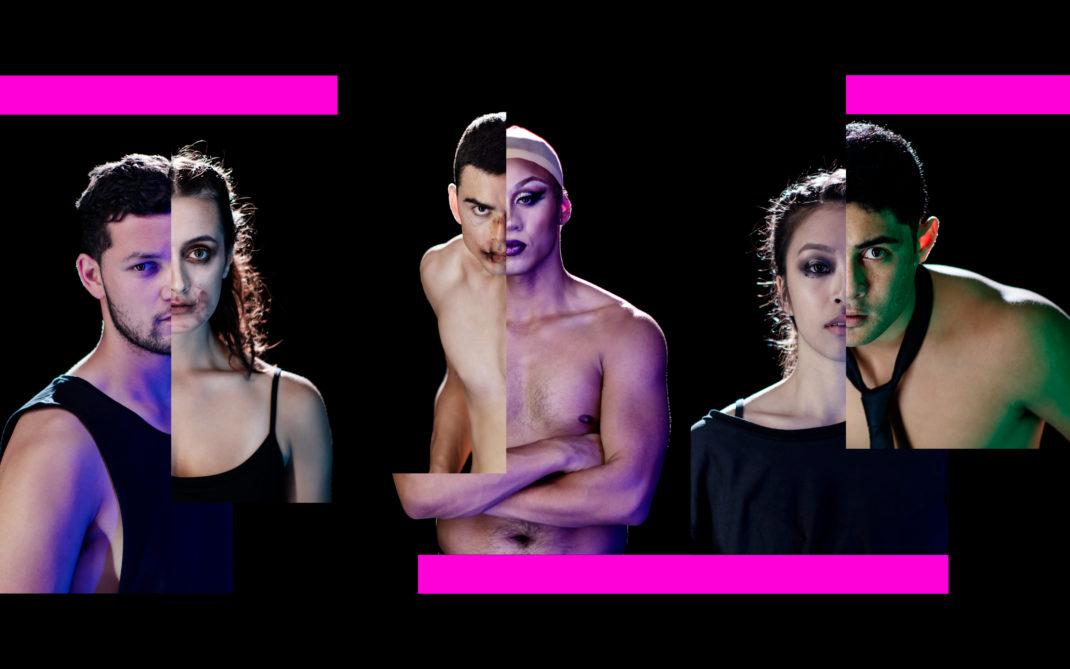
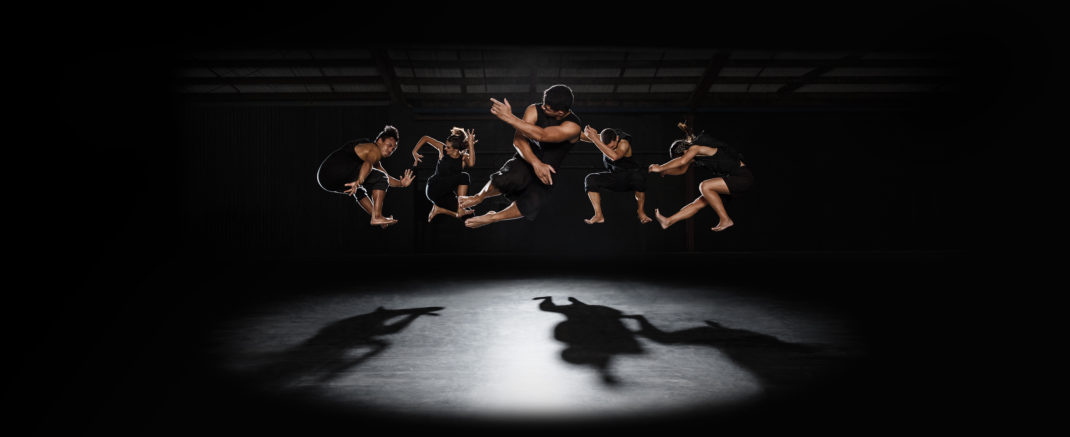
The program opens with the premiere of If There Ever Was a Time, choreographed by Neil Ieremia, artistic director of Black Grace, the company he founded in 1995, so the company is 30 years old and counting. Then follows Esplanade, choreographed by Paul Taylor for his New York dance company in 1975, so the choreography is 50 years old and counting.
Ieremia takes the stage at the start of the performance and addresses the audience with the skill of a Polynesian orator, a theme here, a thought there, his plans for the years to come, a joke, an aside, a wink, then a bombshell in the form of an epic poem … ‘just something I wrote in the dressing-room an hour ago…’ (yeah right) whereas its message, in truth, has been 40 years in the making.
Here is his program note in full since there’s no point in my paraphrasing it…
I consider myself a hopeful optimist. Like many Pacific Islanders, I was raised in the church, carried along by its stories, its hymns, its promises. I have been losing my religion for the last forty years. This work is my response to what I see as the weaponisation of faith, how religious and spiritual belief systems are used to steal from the poor, erase culture and indigenous knowing, shout down freedom of choice, and justify unimaginable brutality. It’s a pattern repeated throughout history and I imagine it will continue for as long as greedy hands keep rubbing together. So, if ever there was a time for rebellion, for action, for hope, for humanity, for love—it’s probably now
Echoing writings of author Albert Wendt, Ieremia is calling out Samoan churches in the home islands and in New Zealand, many of them known for the oppressive demands of tithes imposed on their congregations. There’s also the widespread perception that much-needed programs of health education and community welfare that the churches could lead are meantime woefully neglected. (Black Grace plans to support a new health programme to target the worryingly high rate of rheumatic fever in Pasifika children in New Zealand, a cause near to Ieremia’s heart, as it were).
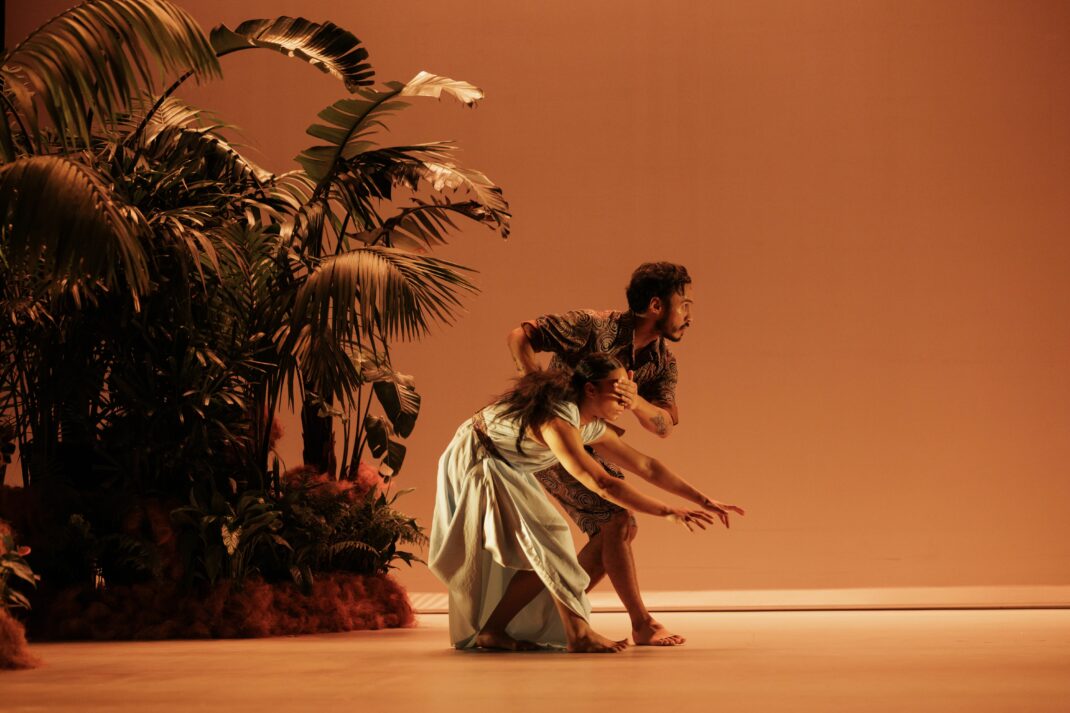
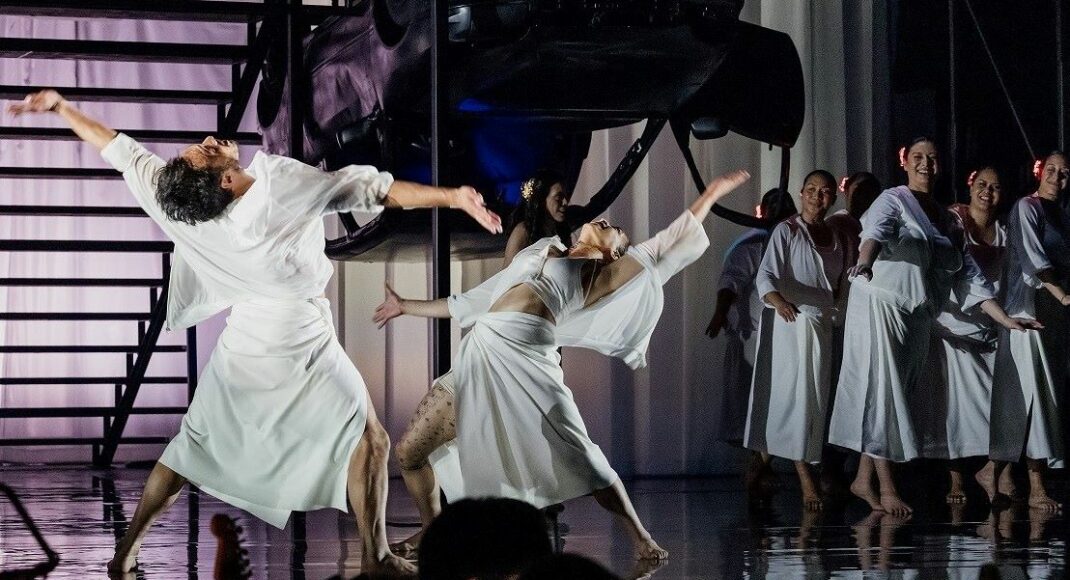
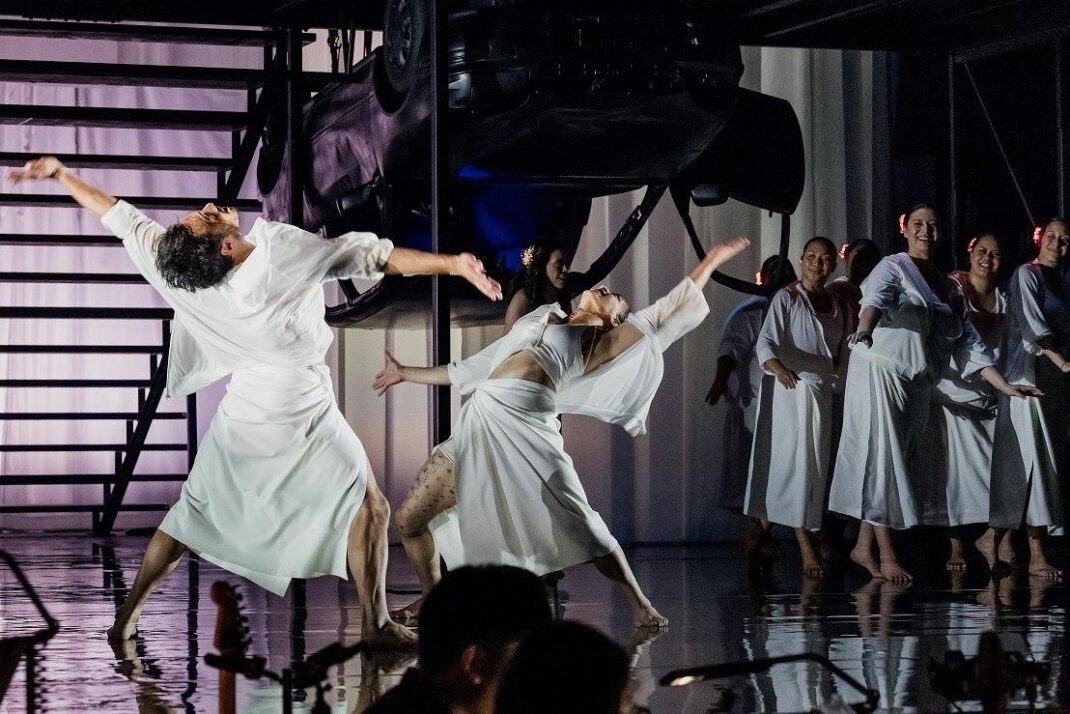
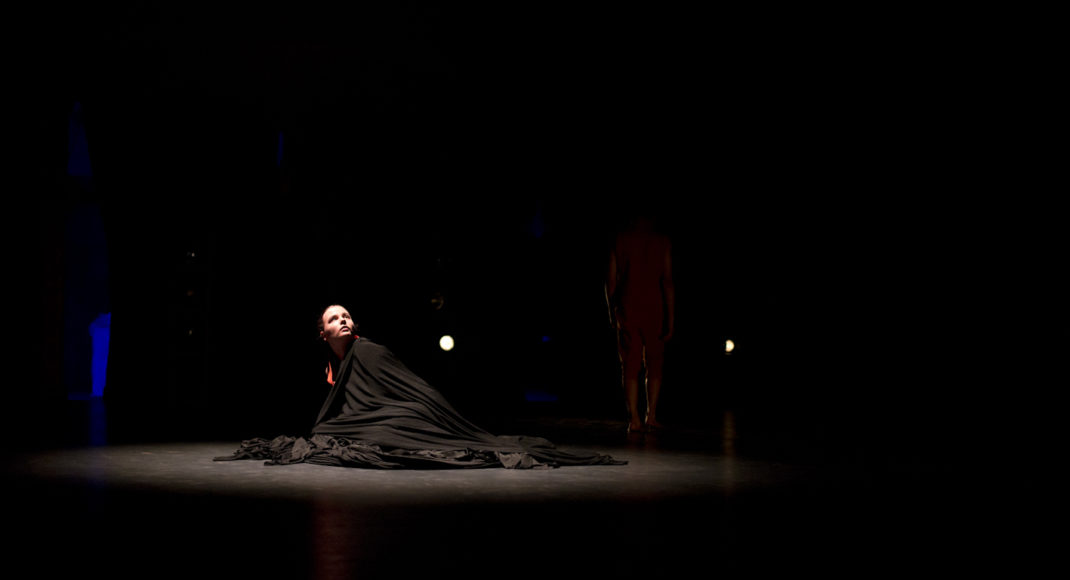
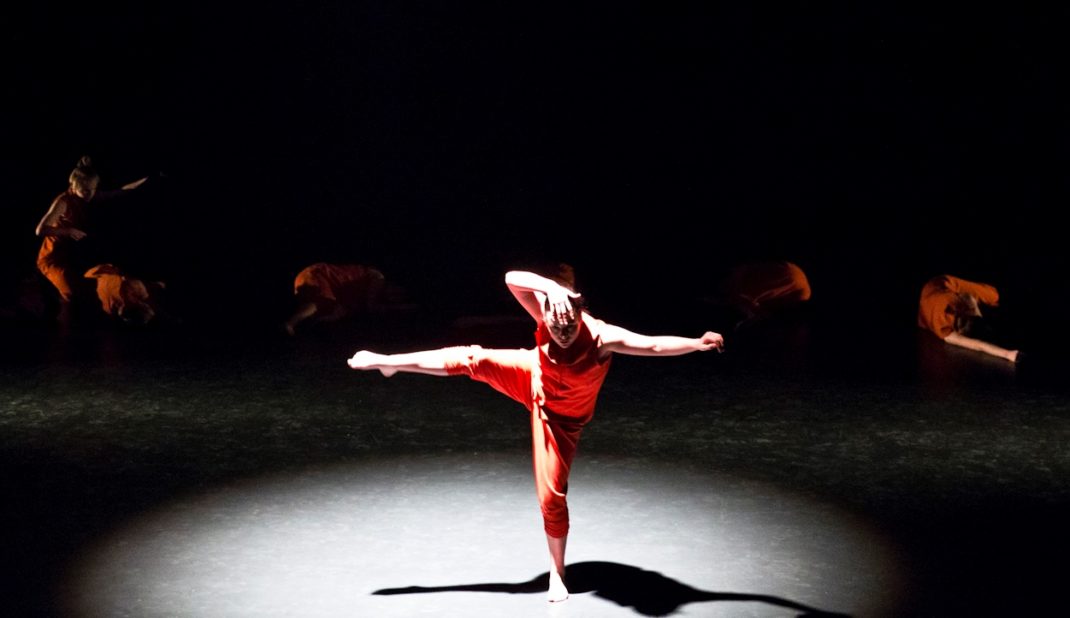
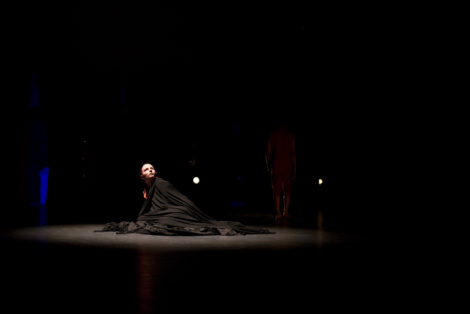
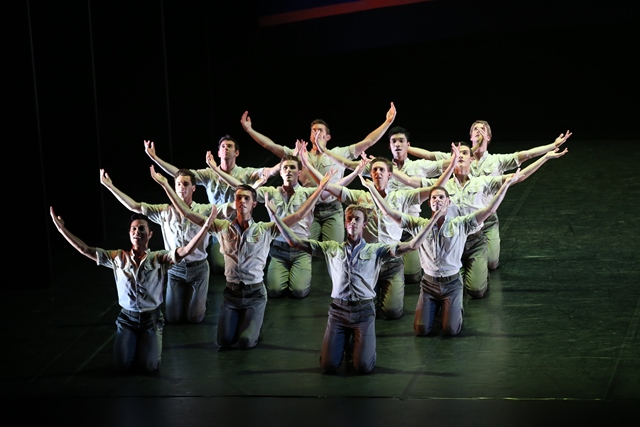
The choreography opens with a centrestage pile of bodies that struggle to emerge from shadows, like some giant octopus slowly rising from ocean depths. A giant bright moon is suspended but doesn’t seem to shed much light on those below. A huge billowing cloud of cloth hangs above the stage. Will it open then descend to suffocate everything beneath it? There is loud and challenging drumming combined with rap-like singing that conveys urgency, but the texts are not easy to follow. The fast and furious pace of dancing is fuelled by this accompaniment, and the performers have to find phenomenal stamina to sustain long sequences of movement derived from break dance or martial arts, interlaced with cameo images referencing fragments of traditional Samoan dances that barely survive.
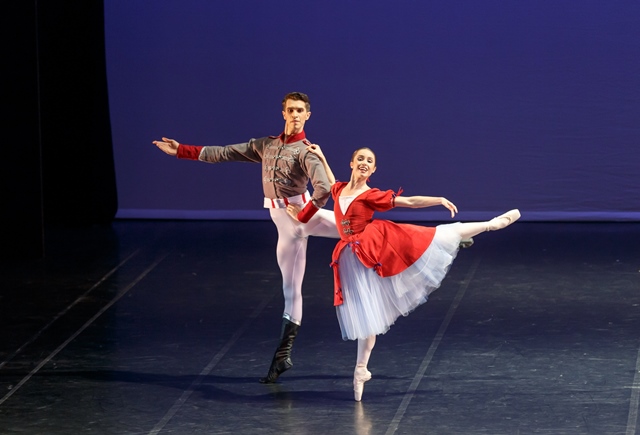
A young girl manically skips with an electric blue rope for what seems like a lifetime, but we have to imagine for ourselves what her story is. From left field in the shadowy background an unlikely quartet dances the cygnets from Swan Lake, with snatches of Tchaikovsky’s accompaniment hidden beneath and between layers of drum and song.
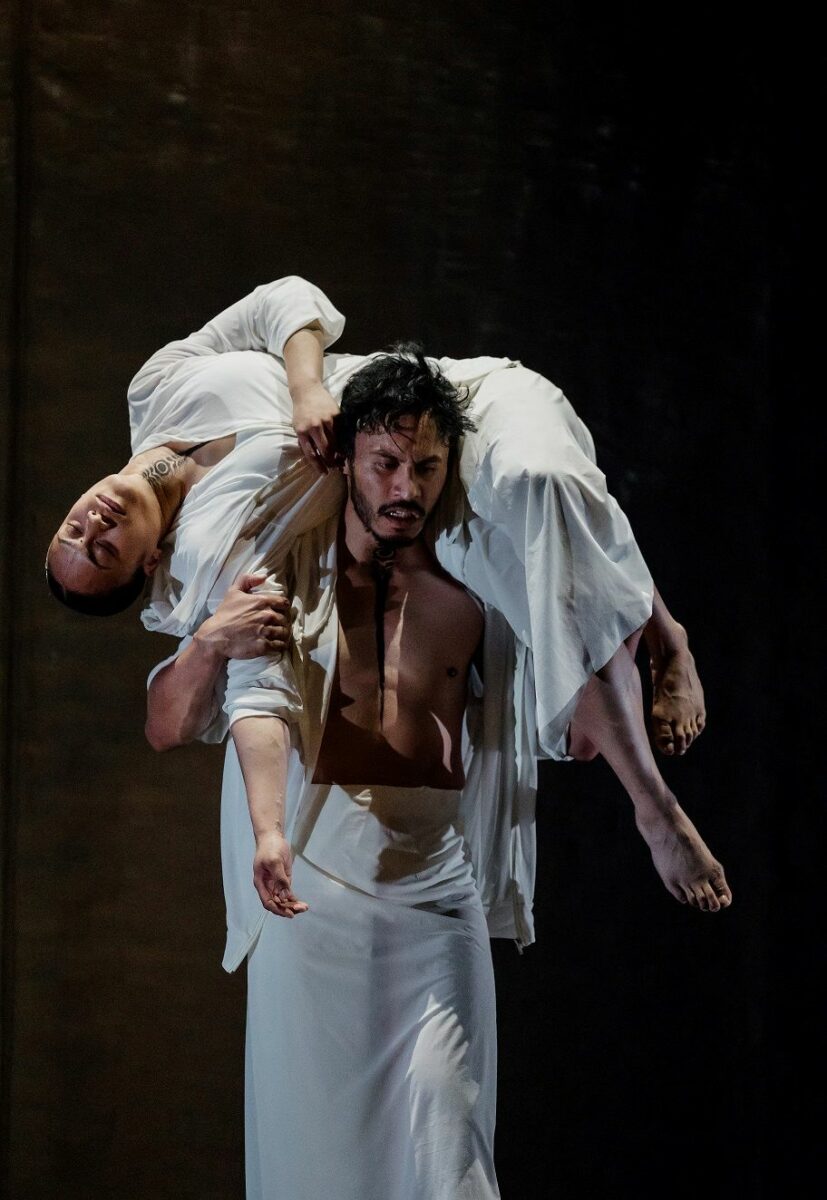
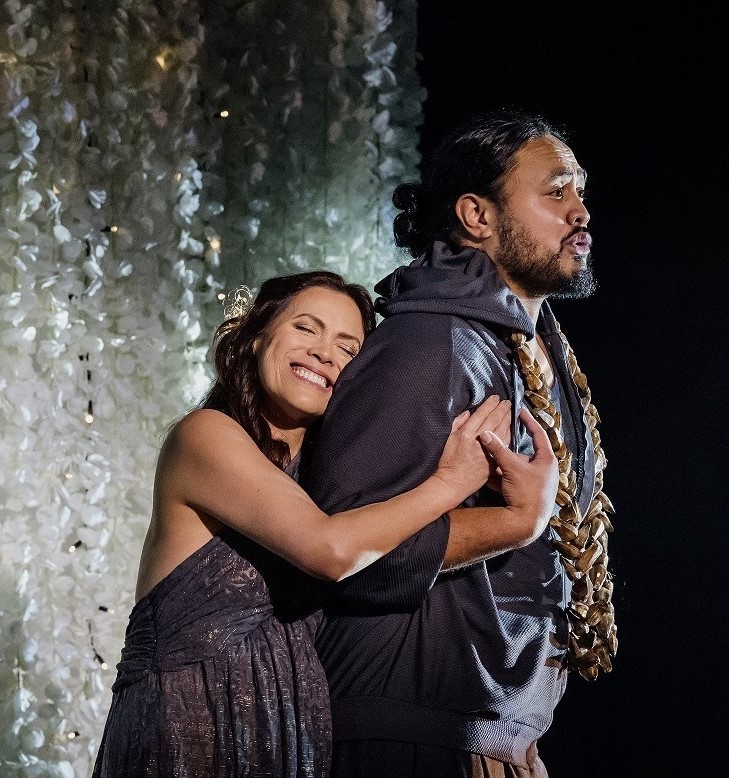
A couple longing to be together, to marry, are instead blindfolded, blocked and constrained by forces of family? society? church? all in the name of god knows what and he’s not telling.
A crowd of protestors wave an enormous banner, white with a central red cross held—so it’s now more than Polynesian religious denominations being called out, but has grown to reference a global emergency, putting up a desperate cry for help. Although not specifically detailed in the choreography, it doesn’t take much for us to be reminded of current infamous world ‘news’ (such as the recent image of Zelensky fronting up to a press conference when he had clearly spent all night weeping in despair. Well, wouldn’t you?). You don’t need reminders of what’s wrong in a too often brutal, selfish, greedy world where much human life seems to have lost sanctity, and the dollar is the only measure of value or worth. Was it ever thus? Will we ever, or never, be pulled along by love instead of by greed?

Ieremia’s choreography is a lament for all of that, and in case we think troubles only happen in a hemisphere well to the north of here, may I remind us that our Minister of Defence recently admitted that a New Zealand company is doing very well indeed with export trade of 3-D printed guns and she has no plans to intervene because their profits are up so it’s ‘better for the economy’. Would we export chemical warfare germs in test tubes if the profit was high enough? Is there no bottom line to shame? ‘Don’t be despondent, don’t be cynical, just get out there and vote,’ as Don McGlashan would say.
You’d think it would take more than a hopeful optimist to climb out from under all this, but Ieremia offers hints of resilience in shaping the motifs of siva, fa’ataupati and taualuga, Samoan traditional dances, that cadence the final sequence. So this uncompromising choreography is dark with a shaft of light. Will it be performed in 50 years time? How will it and the world be seen then?
*******************
Before the performance, during the interval and after the performance there is throughout the theatre amplified continuous pumping beat ‘music’. Is this the company’s choice? or the theatre’s? muzak within the ticket price? We certainly don’t need it since our heads and hearts are quite full enough with what we witness on stage, the need to think about the themes, and what possible responses there could be to this call to action. Pull the plug on the muzak I say, it cancels thought and conversation.
********************
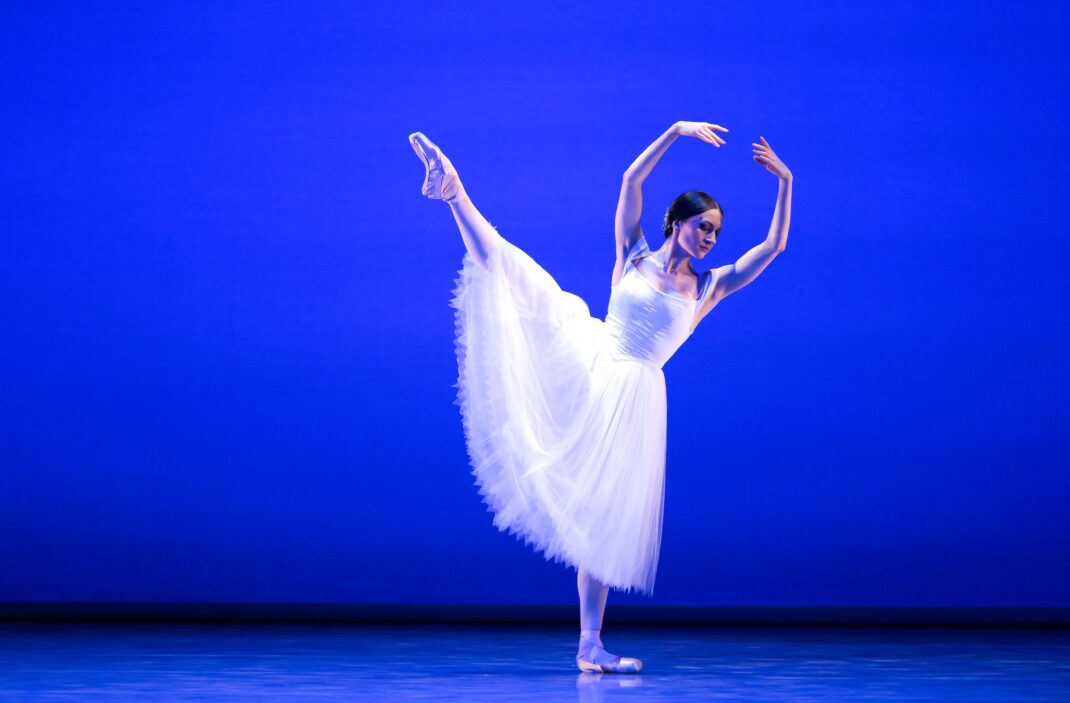
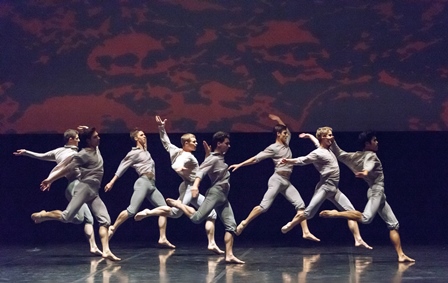
Esplanade is staged here by Richard Chen See who safeguards the legacy of Paul Taylor. Performed to Bach violin concertos, it allows the performers to surf on all the waves of rhythms Bach drew from the baroque dance repertoire. There’s walking and there’s running, lots of both, patterns and play, leaping and catching, with the joyously coloured costumes of the eight dancers contributing to that exuberance. It is a committed and spirited work that suits the company well.

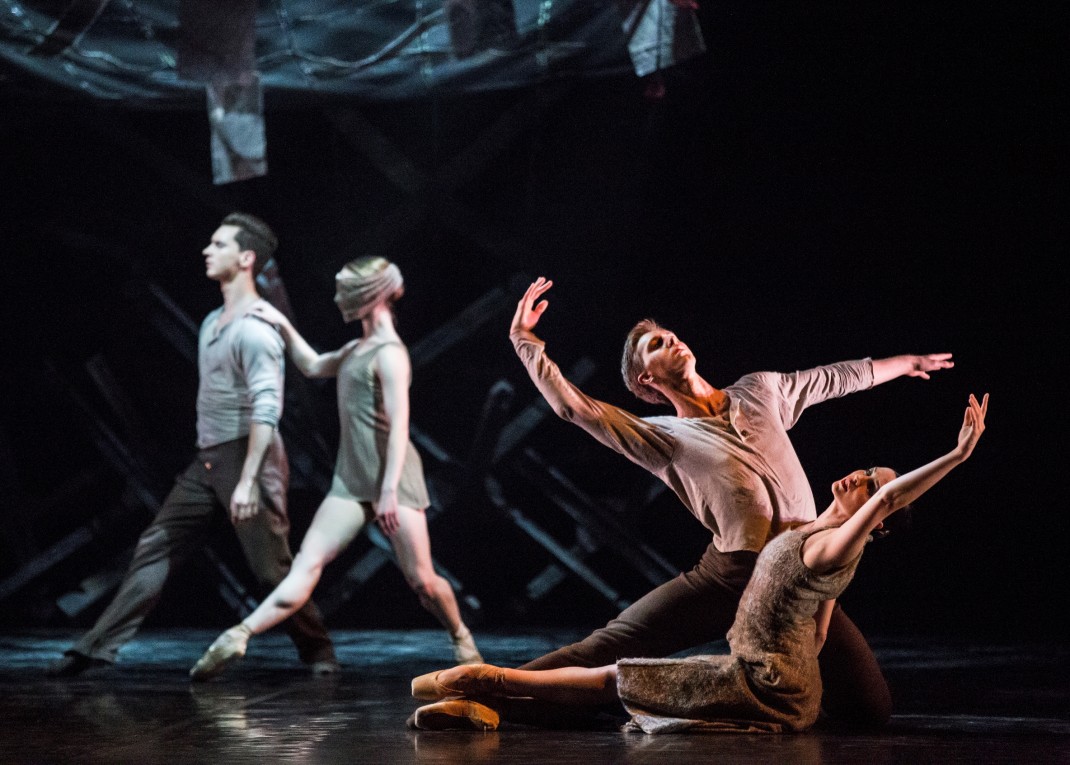
The work is light with a shaft of dark. There’s a quiet theme of one group within the cast whose members are not quite so engaged. As the program note tells:
An adagio for a family whose members never touch reflects life’s sombre side…a woman standing tenderly atop her lover’s prone body suggests that love can hurt as well as soothe. The final section has dancers careering fearlessly across the stage… the littlest of them—the daughter who had not been acknowledged by her family—is left alone on stage, triumphant: the meek inheriting the earth.
That littlest dancer turns to face the audience, beams broadly and opens her arms wide as if to embrace us all. We are being assured that hopeful optimism is possible. I guess the rest is up to us.
Jennifer Shennan, 25 November 2025
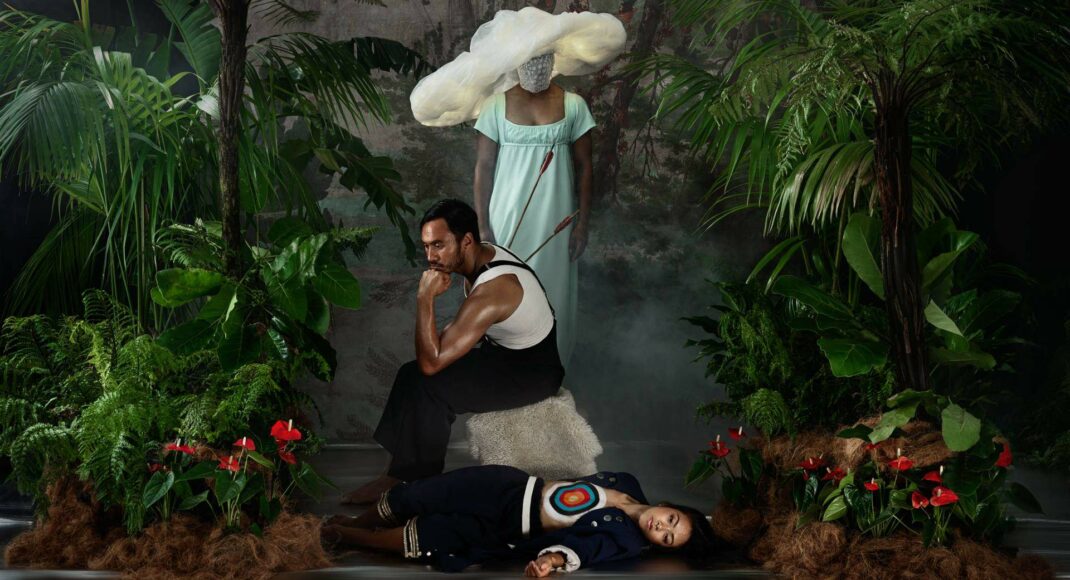
Featured image: Scene from If Ever There Was a Time. Black Grace, 2025. Photo: © Jinki Cambronero