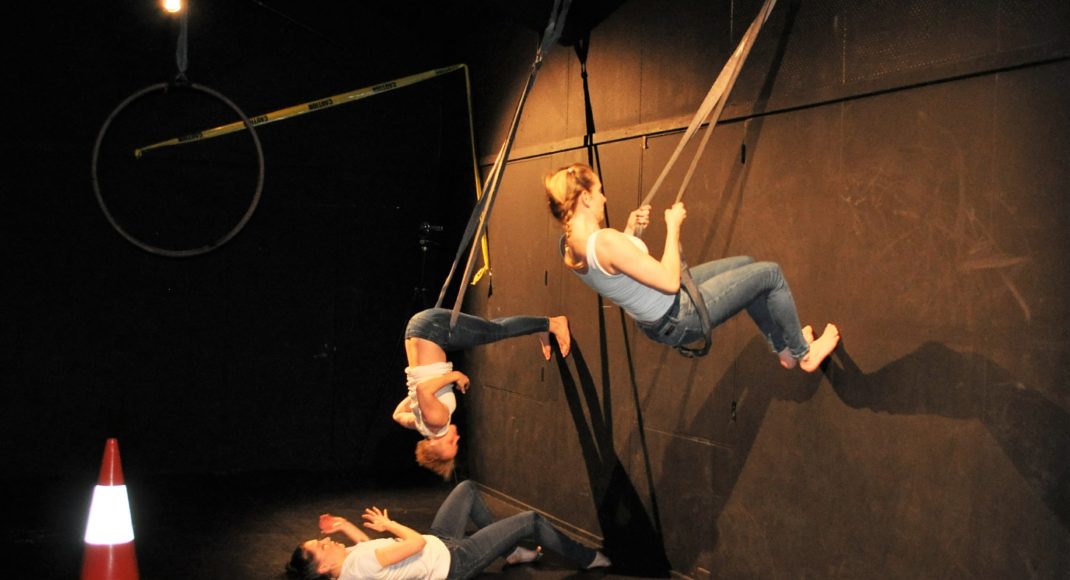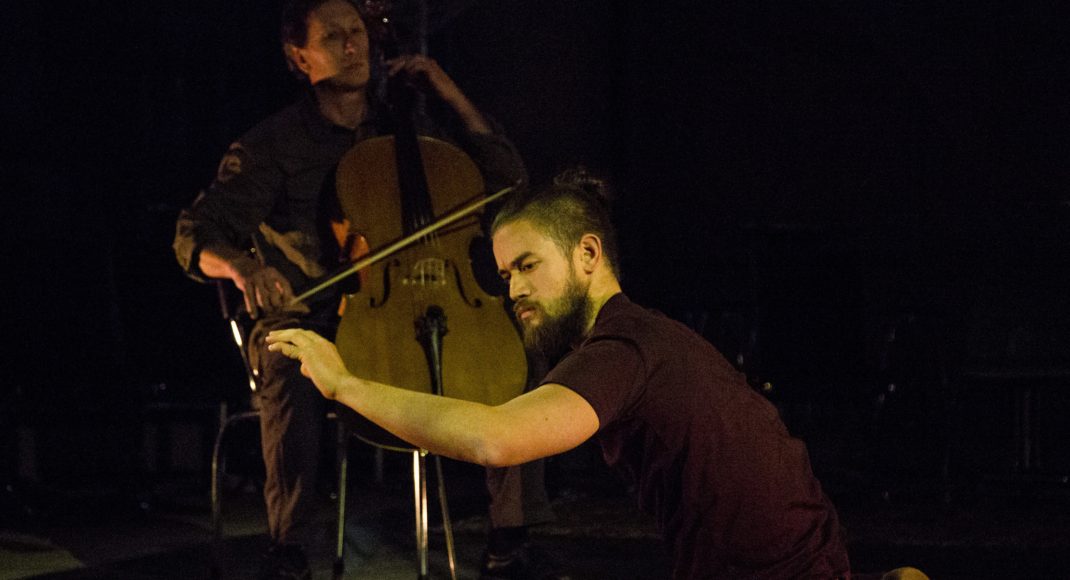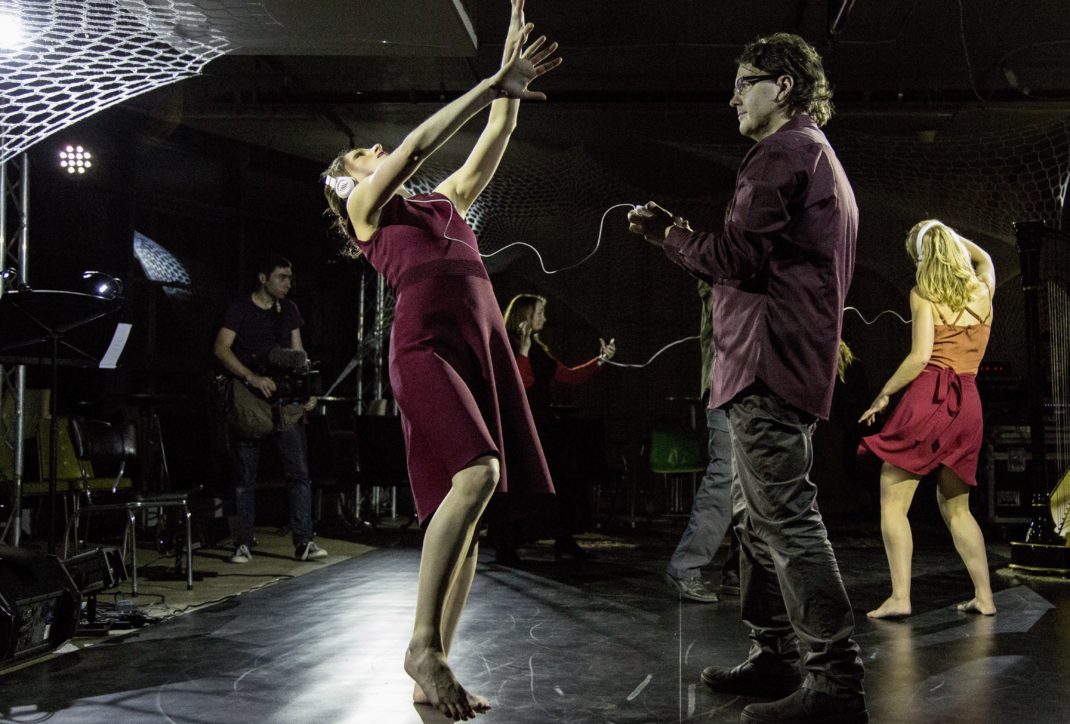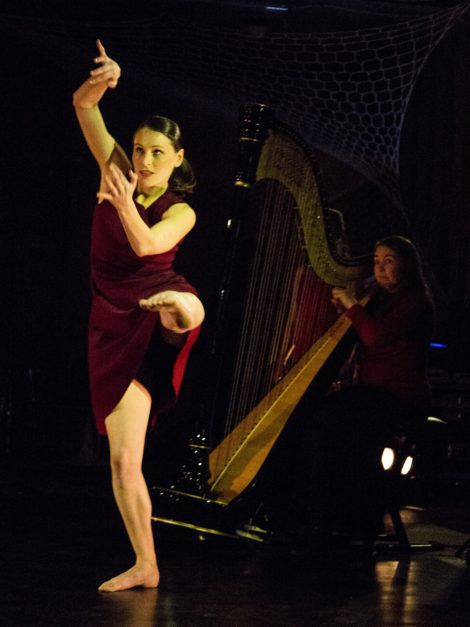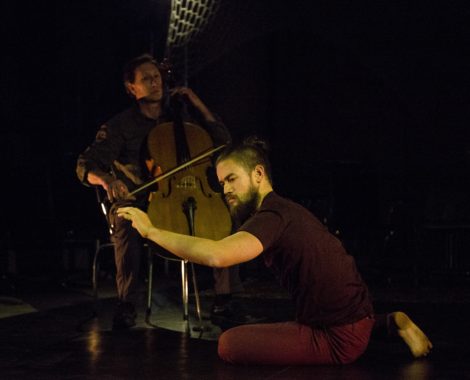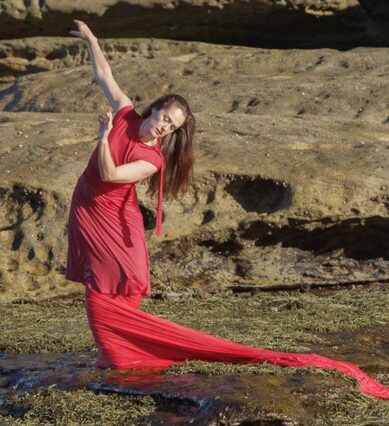
Liz Lea in a study for a forthcoming show, 'RED'. Photo: © Nino Tamburri

Dance diary. November 2016

  • Canberra Critics’ Circle Awards: Dance 2016

The Canberra Critics’ Circle, a group of Canberra-based, practising critics from across art forms, presented its annual awards in November. Two awards were given in the dance area.

Liz Lea: For her innovative promotion of dance in the ACT exemplified by her co-ordination and presentation of “Great Sport!” at the National Museum of Australia, which spectacularly showcased the work of The Gold Company, Dance for Parkinson’s, Canberra Dance Theatre, and of a number of local and interstate choreographers, in a memorable and remarkable presentation.

Alison Plevey: For her tireless and consistent efforts as a dancer, choreographer and facilitator towards advancing professional contemporary dance in the A.C.T through her performances, collaborations, and programs, culminating in the establishment of her dance company, Australian Dance Party.
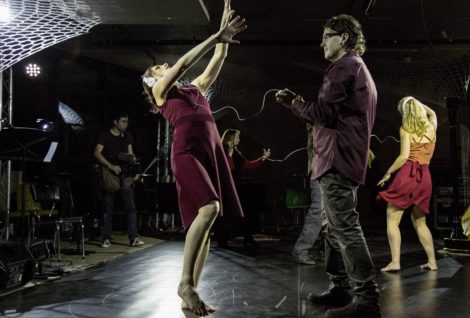
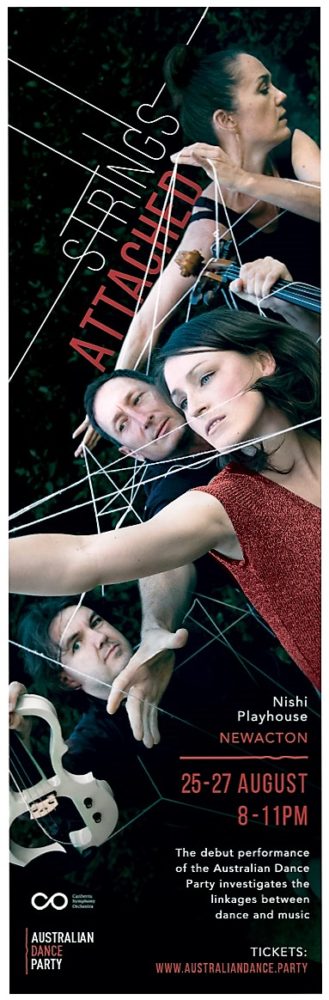
Alison Plevey (left) in 'Strings Attached', Australian Dance Party 2016.
Alison Plevey (left) in Strings Attached, the inaugural show from Australian Dance Party, 2016. Photo: © Lorna Sim

As indicated in the citations, both Plevey and Lea have contributed to the growth of a renewed interest in dance in Canberra. A preview of Plevey’s forthcoming show, Nervous, is below under ‘Press for November 2016’. My review of Great Sport!, facilitated, directed, and partly choreographed by Lea is at this link.

  • The Nutcracker: Queensland Ballet

A second viewing of Queensland Ballet’s Nutcracker, with a change of cast, had some new highlights. Neneka Yoshida was a gorgeous Clara. She was beautifully animated and involved throughout and there were some charming asides from her with other characters during those moments when she wasn’t the centre of attention. Mia Heathcote took on the role of Grandmother, a role that couldn’t be further from her opening night role as Clara. But she created a very believable character and, as we have come to expect, never wavered from her characterisation. Tim Neff was a totally outrageous Mother Ginger and Lina Kim and Rian Thompson gave us a thrilling performance as the leading couple in the Waltz of the Flowers.

Another exceptional performance from Queensland Ballet.

  • Ella. A film by Douglas Watkins

Ella, which premiered earlier in 2016 at the Melbourne International Film Festival, traces the journey of Ella Havelka from a childhood spent dancing in Dubbo, New South Wales, to her current position as a corps be ballet member of the Australian Ballet. My strongest recollection of Havelka with the Australian Ballet is her dancing with Rohan Furnell as the leading Hungarian couple in Graeme Murphy’s Swan Lake when I called their performance ‘very feisty’.
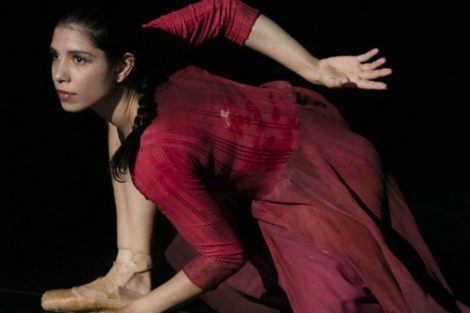
Scene from the film 'Ella'
Scene from the film Ella, 2016

I found the film largely unchallenging, however, and footage of Havelka dancing with Bangarra Dance Theatre was far more exciting to watch than that showing her with the Australian Ballet. Not only that, the commentary from Stephen Page on the nature of Bangarra, and Havelka’s role as an Indigenous Australian in that company, was far more pertinent and gutsy than the rather non-committal remarks from interviewees from the Australian Ballet. An opportunity missed from several points of view?

  • Royal New Zealand Ballet

Royal New Zealand Ballet is seeking a new artistic director to replace Francesco Ventriglia who will leave his position in mid-2017. Ventriglia will depart ‘to pursue international opportunities.’ Before he departs New Zealand he will take on the new role of guest choreographer to stage his own production of Romeo and Juliet in August. His planned repertoire for 2017 includes works by Roland Petit and Alexander Ekman.

  • Late news: Ruth Osborne

Ruth Osborne, artistic director of QL2 Dance in Canberra, has been awarded a Churchill Fellowship to pursue her interest in developing dance projects for young people. More in a future post.

  • Press for November 2016

‘Wonderful version of Christmas classic.’ Review of The Nutcracker from Queensland Ballet. The Canberra Times, 25 November 2016, p. 37.  Online version.

‘Under the microscope.’ Preview of Nervous from Australian Dance Party. The Canberra Times —Panorama, 26 November 2016, p. 15. Online version.

Michelle Potter, 30 November 2016

Featured image: Liz Lea in a study for a forthcoming show, RED. Photo: © Nino Tamburri, 2016
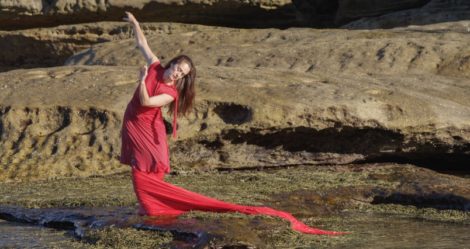
Liz Lea in a study for a forthcoming show, 'RED'.

Wiggle Room. Alison Plevey & Solco Acro

29 September 2016, Ralph Wilson Theatre, Gorman Arts Centre, Canberra

Wiggle Room? The name arouses curiosity. But on arriving at the Ralph Wilson my heart sank. ‘This is a standing show,’ we were told. I rather like sitting down to see a show. But, as it happened, the show was a stunner and, for ageing bodies like mine, there were stools for sitting on, when that was possible given the nature of the show.

Wiggle Room was part of a new program in the ACT, Ralph Indie, named for Ralph Wilson, who died in 1994 and who was both a former principal of Canberra High School and a producer of unconventional and thought-provoking theatre shows in Canberra. Wiggle Room was performed by dancer Alison Plevey, singer Ruth O’Brien, and Cher Albrect and Deb Cleland, two artists from the Canberra-based women’s aerial dance and circus arts group, Solco Acro. Like Wilson’s shows, Wiggle Room was also unconventional and thought-provoking.

The work was inspired by and named after an essay by Sara Ahmed and examined the politics of space. Who can occupy a certain space? Who must move aside to let another take up the space? And this explains the need for it to be a ‘standing show’. The entire space of Ralph Wilson Theatre was used by the performers and for those of us sitting on stools, and indeed those standing around the edges of the space, there was the need on occasions to move so that the performers could occupy the space we were inhabiting. No such thing as a designated aisle and seat number.

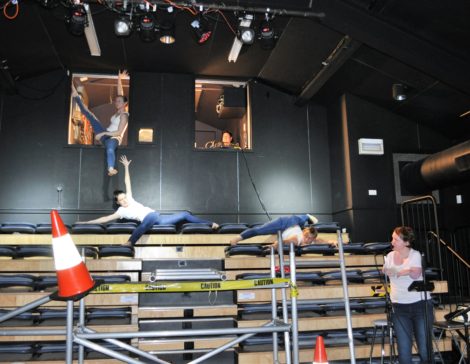
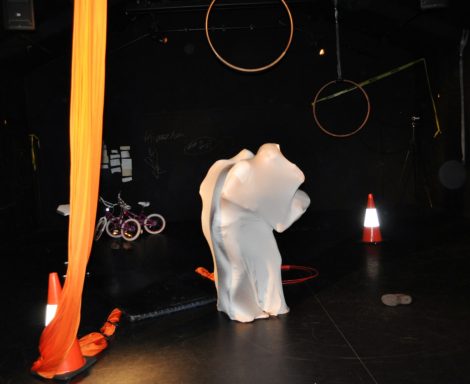
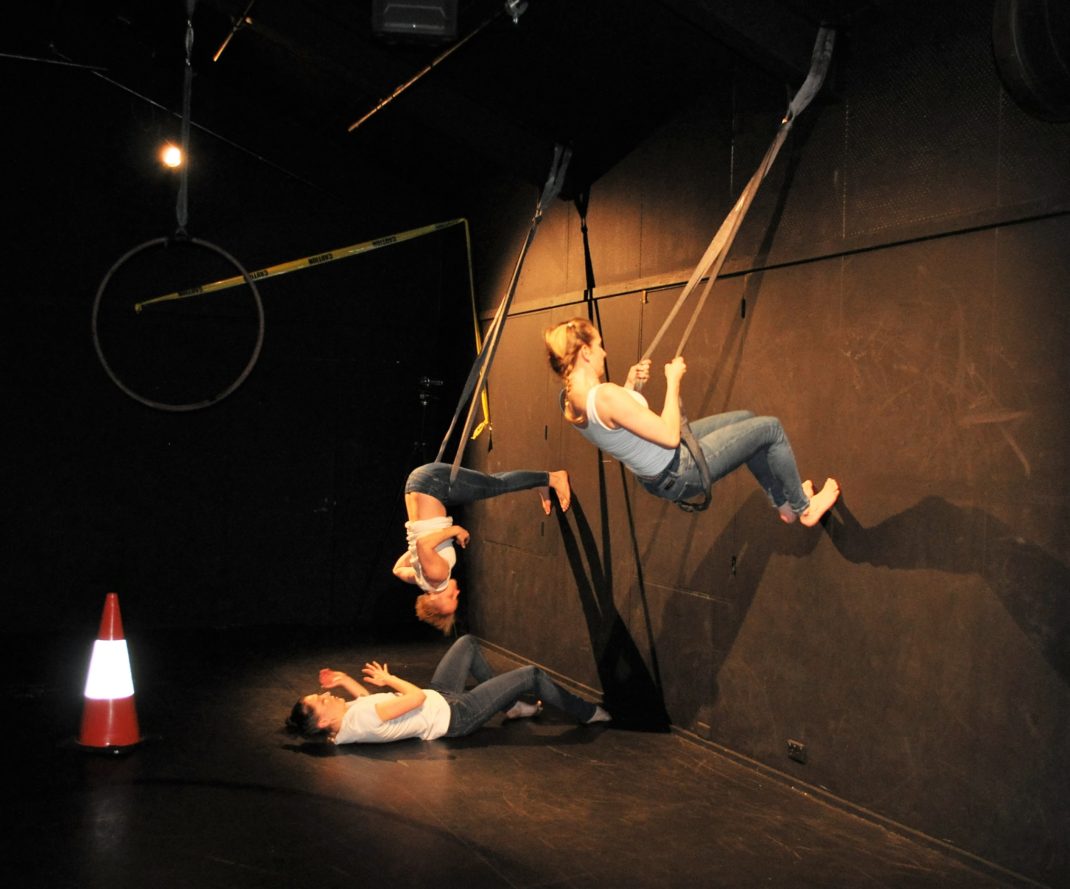
Some of the movement happened on swinging hoops, or with the performers twisting themselves around lengths of red cloth hanging from the ceiling. Some took place against the walls with the performers attached to a kind of harness. There were moments when bikes were driven at break-neck speed around the space. Even the usual seating in the Ralph Wilson Theatre had been folded back and this fold-back space used by the performers.

wiggle-room-5-photo-justin-ryan

The work was, however, more than simply about space. The notion of the politics of space came over loud and clear, on the one hand through spoken word and song, and on the other by the interpretations of the words by the performers. There were feminist references, references to workplace issues, and issues about personal space, for example.

But what made Wiggle Room a work to be reckoned with was the way in which these issues surrounding the politics of space were addressed in such an engaging and often hilarious way. It was so easy to recognise the situations presented to us, it was so easy and pleasurable to laugh at what was happening. And yet there was always the lingering knowledge of a political message.

Perhaps my favourite moment came when the three performers found themselves together in the confined space of a slip-off mattress cover made from flimsy material—shades of Martha Graham’s Lamentation, without the 1930s seriousness. I have to admit to thinking  ‘Eat your heart out, Martha.’ This was so much more enjoyable.

wiggle-room-4-photo-justin-ryan

All in all a funny, strangely serious, and rather remarkable evening.

Michelle Potter, 30 September 2016

Featured image: Scene from Wiggle Room.

All photos © Justin Ryan

Strings Attached, Australian Dance Party, 2016. Photo: Lorna Sim

Strings attached. Australian Dance Party

25 August 2016, Nishi Building, Canberra

Strings Attached, the debut show from Canberra’s new contemporary dance company, Australian Dance Party, is a knockout. The concept behind the show, devised by the ‘Party Leader’, dancer Alison Plevey, sounds simplistic: an investigation of the relationship between music and dance in a collaboration between four dancers and six musicians from the Canberra Symphony Orchestra. But as developed in performance it was totally engaging, illuminating and just plain exciting to watch.

The show began with the sounds of breathing, gentle at first but gathering volume as dancers and musicians met in the performing space before taking their positions to begin the show proper. ‘Before people spoke, we moved,’ the program states. ‘We moved to the innate rhythm of our hearts, our breath and the patterns of our lives.’ And so the dance and its musical accompaniment began, starting with some improvised movement and accompanying sound, moving on to a gentle piece with music by Jean-Baptiste Lully and a kind of slow and refined dance for all four dancers. The show continued its pathway through different musical and dancerly episodes—a lament, a tango, on to Jimi Hendrix with the dancers hooked up to iPods, and, finally, to an ‘Electronic Piece’ that became a riotous party/disco dance in which the audience was encouraged, and sometimes specifically invited to participate.

What was especially noticeable throughout was the absolute commitment of dancers and musicians. They were totally engaged with each other and with the sound and movement they were producing. Alison Plevey and Janine Proost both showed exceptionally fluid, high energy movement, Liz Lea was somewhat more restrained but added a way of engaging socially with the musicians that the others didn’t quite have—Lea always uses strong facial expression as a way of engaging. As for Gabriel Comerford, whose dancing I had never seen before, he knocked me for six with his movement that was on the one hand highly disciplined but on the other totally free.

The venue, a pop-up space in Canberra’s trendy Nishi building, was set up a little like a theatre restaurant with tables and chairs placed around a central performing area. Around the edge of the performance space the musicians sheltered under two white canopies of string sculpture crocheted by installation artist Victoria Lees.

Alison Plevey (left) in 'Strings Attached', Australian Dance Party 2016. Photo: © Lorna sim
Dancers and musicians in the final moments of Strings Attached, Australian Dance Party, 2016. Photo: © Lorna Sim

Some particular highlights, personal favourites perhaps:

  • Alison Plevey and harpist Meriel Owen improvising in the early stages of the show. Amazing, especially in the second part where Owen had to follow Plevey’s rising and falling movements, which she did as if it were second nature.
Dancer Alison Plevey and harpist in Strings Attached, Australian Dance Party, 2016. Photo: Lorna Sim
Dancer Alison Plevey and harpist Meriel Owen in Strings Attached, Australian Dance Party, 2016. Photo: © Lorna Sim
  • Gabriel Comerford in ‘March’ (‘Command and Conquer Red Alert Theme—Soviet March’), in which he got totally lost, trance-like, dancing to a stirring, politicised composition by James Hannigan. His long, black hair came loose from its topknot, and his movement was at times absolutely precise and powerful, but at others wildly erratic. Thrilling to watch.
  • A ‘conversation’ between dancer Liz Lea and trumpeter Miroslav Bukovsky.
  • The musicians who played more than one instrument throughout, swapping seamlessly between them. And fascinating to look at (as well as to listen to) was Tim Wickham’s white ‘skeleton’ electric violin.

But in many respects it is unfair to single out individuals because everyone in this show gave so much of themselves to make this a standout evening of live music and dance.

I guess my one hope for this brave new venture is that the format of the debut show will not always be the format in the future. Plevey has a rare intelligence as a director and I hope she will find ways of occasionally presenting her work in different spaces, including in more mainstream performing arenas. The party line (as in its celebratory rather than political meaning) is fine for a start but I am hoping for something different as well.

Canberra has been without a professional dance company since Sue Healey left town in the 1990s. If Strings Attached is anything to go by we now have much to anticipate.

Michelle Potter, 27 August 2016.

Featured image: Dancer Gabriel Comerford and cellist Alex Voorhoeve in Strings Attached, Australian Dance Party, 2016. Photo: © Lorna Sim

Strings Attached, Australian Dance Party, 2016. Photo: Lorna Sim

Dance diary. July 2016

  • Focus on Canberra

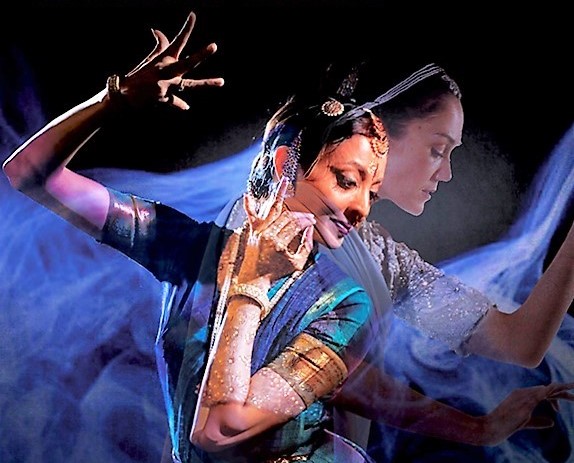
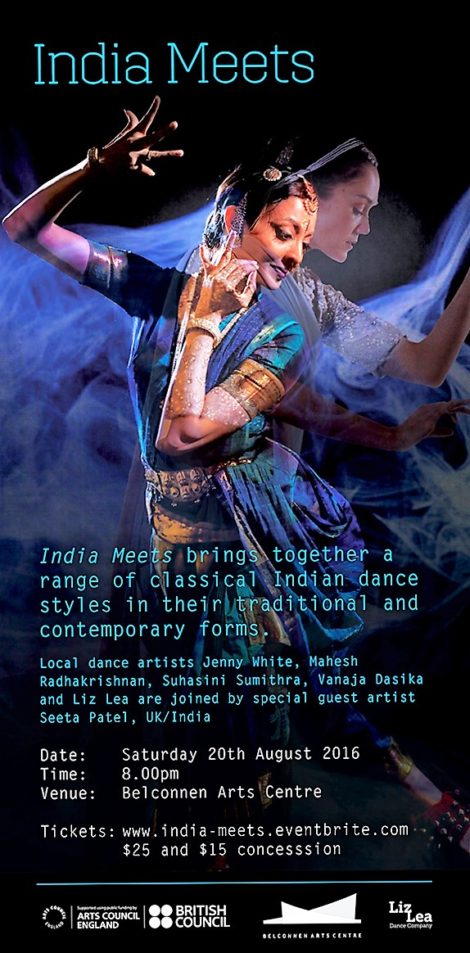
A one-off show, India Meets, is scheduled to take place at Belconnen Arts Centre on 20 August. It will feature Seeta Patel and Liz Lea along with other local dancers trained in a variety of Indian dance styles. Patel is in Australia with British Council support and, in addition to working on India Meets with Lea, has a number of other engagements, which I hope to feature in a future post.

In other Canberra news, a new dance company, Australian Dance Party, is about to be launched. It is led by Alison Plevey, a 2009 graduate of WAAPA who has been teaching and performing in Canberra since her graduation. ‘Out of the political capital comes Australian Dance Party: Canberra’s newest dance and performance company,’ she says. For its debut production, ADP dancers will collaborate with six artists from the Canberra Symphony Orchestra on Strings Attached at the Nishi Playhouse (a pop-up theatre), New Acton, on 25–27 August.

image
second_concept_v3
 
  • Dancer to watch: Seu Kim

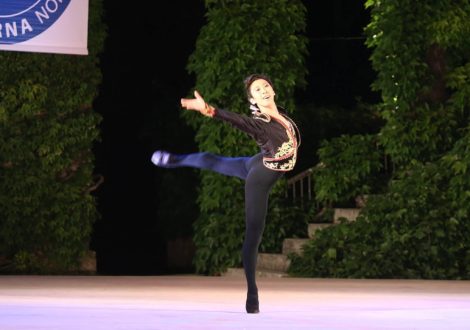
Seu Kim graduated from the Australian Ballet School in 2015. A colleague sent me some online footage of him performing at Varna recently, where he was placed second. Looking at his work via YouTube I love what shines through—honesty and passion in particular. And I love the lengthening of the neck and the emotion that radiates from that beautiful lift of the chest. Gorgeous.

Seu Kim at Varna, 2016


Kim identifies as Korean, although his family has lived in Japan for many years. He will join Royal Swedish Ballet as an apprentice dancer in August.

  • Oral history update

I had the pleasure in July or recording an oral history interview with Dr Elizabeth Dalman, founding director of Australian Dance Theatre and currently director of Mirramu Creative Arts Centre and Mirramu Dance Company. I first interviewed Dr Dalman for the National Library’s oral history program in 1994 so an update was definitely in order. Catalogue record at this link.

  • The Australian Ballet and CinemaLive

Dates are now available for the first three CinemaLive presentations of the Australian Ballet’s Fairytale Series, as mentioned in last month’s Dance diary. The Sleeping Beauty will screen on 8–9 October 2016, Cinderella on 12–13 November 2016, and Coppélia on 29–30 April 2017. 

  • Press for July 2016

‘Triple treat shows off Bangarra’s finest.’ Preview of Bangarra Dance Theatre’s OUR land people stories. The Canberra Times—Panorama, 23 July 2016, pp. 10–11. Online version.

Michelle Potter, 31 July 2016

Featured image: Seeta Patel and Liz Lea, detail from the poster for India Meets