Gary Harris. Man of the theatre

On my recent visit to Brisbane to catch a performance of Greg Horsman’s Sleeping Beauty by Queensland Ballet, I was especially taken by the designs of Gary Harris. In particular, I loved his sets with their sweeping sense of space, which is clearly evident in the image below from the Queensland Ballet season.
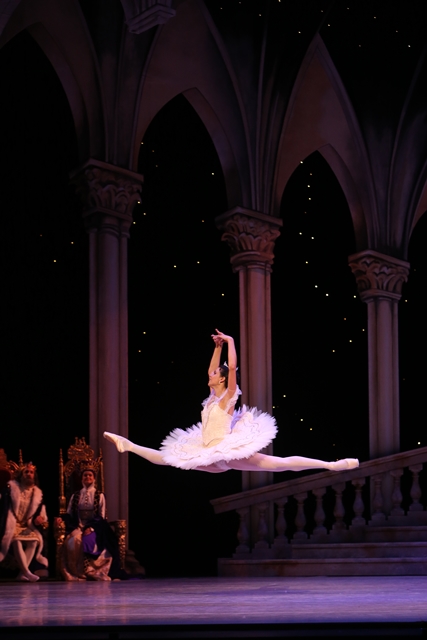
Yanela Pinere as Aurora 'The Sleeping Beauty', Queensland ballet, 2015. Photo: David Kelly
Yanela Piñera as Aurora in The Sleeping Beauty, Queensland Ballet, 2015. Photo: © David Kelly

I recall talking to Harris, over ten years ago now, while he was artistic director of Royal New Zealand Ballet and I recently came across the text of the article based on that interview. I wrote it for ballet.co in the UK, where it was published online in May 2003. As my ballet.co articles are not presently available online due to a server change, and also because I only recently found the text of the ballet.co article, which I thought was lost, I am re-publishing it below.

****************

‘Oh he’s wearing a shirt with Mambo written all over it today,’ the theatre usher tells me as I wait in the foyer of the Princess Theatre in Launceston, Tasmania. Gary Harris, artistic director of Royal New Zealand Ballet, is running late (or has forgotten our appointment?). He arrives, Mambo clothes and all, full of apologies. It’s the final day of performances for the sixteen dancers of Royal New Zealand Ballet who are on tour to Tasmania for the biennial festival, Ten Days on the Island. It’s just a short season, four performances in three days—3–5 April 2003. The rest of the company, another sixteen dancers, is touring back home in New Zealand. We find time for our interview over a meal between the late afternoon matinee and the evening show.

London-born Harris, a warm and engaging man, first visited New Zealand in 1996 as guest teacher for Royal New Zealand Ballet and kept returning over the next few years. In 2001 he was appointed artistic director of  the company and is full of enthusiasm for his job and his dancers.

‘I loved the honesty I found amongst the New Zealand dancers,’ he explains. ‘They are so versatile too. They work beautifully with what they’ve got and respond to the space they’re in. I want the company to keep that honesty and to have a real understanding of the rules of classical ballet and of correctness of presentation.’

Watching his dancers in the repertoire they have brought to Tasmania—a mixed bill comprising four works—there is certainly a distinctive quality to the way they move. Dancing on the tiny stage of the Princess Theatre is not an enviable task. There’s not much space to fling oneself around and Harris’ staging of Paquita Variations, the opening work on the program, perhaps suffers most. The formal quality of its choreography, which Harris based on that of Petipa for the original Paquita of 1846, really needs a bigger stage to do it justice. But the delicious freedom that the dancers have in the upper body makes up for the feeling that things are a bit cramped. The sense of the body moving through rather than in space is also quite noticeable, as is the turn-out of the feet and legs. There is real teaching going on behind the scenes of this company.

‘I really like teaching,’ Harris says. ‘And I love getting together with the dancers for the process of rehearsing. The New Zealand dancers here are very responsive and I love getting an energetic atmosphere going.’

In addition to showing the classical strengths of the Royal New Zealand dancers, Paquita Variations shows up Harris’s talents as a designer. The costumes are his design, with the women’s tutus inspired, he says, by a Degas sculpture of which he is very fond. The softness of the skirts is beguiling. A blouse-like top and a corset-like bodice, which fits closely from the top of the rib cage to the hips, completes what is a beautifully old-fashioned costume. Harris says he loved to draw as a child and also mentions that his father made him a play theatre, complete with working lights. So his wide-ranging involvement in all aspects of getting a show on stage is something he accepts as a perfectly normal part of an artistic director’s life.

Harris’s international connections are clearly evident in the company’s repertoire, although he is quick to mention that nurturing New Zealand artists is part of his plan. Nevertheless in Launceston, along with Paquita Variations, the company danced two works by Mark Baldwin, Melting Moments and FrENZy, and one by Javier de Frutos, Milagros.

The de Frutos piece, a commissioned work and de Frutos’ first for Royal New Zealand Ballet is the surprise package. Milagros takes its name from the Spanish word used to describe both miracles and votive offerings, and the work is danced to Stravinsky’s Rite of Spring recorded on a piano roll. Played on a pianola the music sounds distorted and lacks the orchestral colour that the ear expects. But the drama is still there, the rhythms are still frenetic and the new and unexpected sound sets the scene for a work that is far from ordinary. Both the men and women wear long white skirts that swirl and swing with the motion of the dancers. On top both sexes wear flimsy, white, straight-cut shirts with long, loose sleeves. On the back of each shirt, quite hard to see but definitely there, is a number. The costumes, designed by de Frutos, give a clue to the piece. There is uniformity yet diversity. There is calmness and purity yet an eddy within.
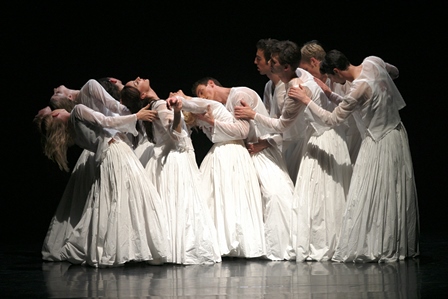
Dancers of Royal New Zealand ballet in 'Milagros'. Photo: Bill Cooper
Dancers of Royal New Zealand Ballet in Milagros. Photo: © Bill Cooper

Choreographically de Frutos juxtaposes highly sculpted sequences—long lines of dancers, clear circular formations for example—with phrases that appear to be wildly individualistic. This dualism is accompanied by other sets of opposites. Some movements flow expressively, others look quite stilted. At times the dancers react with restraint to their colleagues; at other times they appear to be absolutely fired with passion. The light changes back and forth from a stark white to a soft gold. The work also has a few unusual phrases of movement that keep occurring and remain in the memory afterwards. There is a limping step. There is another where the dancers thrust the chest out, fling the head and one arm back and move purposefully forward by transferring the weight on and off one heel. And another where a woman in a deep plié in second position with hands on hips propels herself in a circle, again using the heels to give the momentum. Sometimes dancers make their exit by walking on their knees as if doing penance. It’s absolutely mesmersing choreography.

Milagros on the one hand discomposes the viewer. It never answers the questions that it seems to present. It suggests both vodoo activities as well as organised religion. But it is also an incredibly satisfying piece that speaks to the viewer on an intuitive level. There is something inevitable about the way it unfolds and something fulfilling about its unexpectedness.

The two Baldwin pieces look a little tame by comparison. While Melting Moments is a lyrical and seamless duet, a serious piece, first made for New Zealand’s Limbs Dance Company in 1980, its vocabulary seems dated, almost contrived, by comparison with the de Frutos work. FrENZy on the other hand is great fun. Danced to a selection of top of the pops songs from the band Split Enz, it was first performed by the Royal New Zealand Ballet in 2001. It has a contemporary edge that recalls, without appropriating, the vocabulary of William Forsythe. There’s lots of movement that’s upside down, off centre, racy. There’s lots of glamour, lots that’s out there and in your face. It’s a real crowd pleaser. How often does a contemporary ballet have an audience whistling and shouting with enjoyment at the end? Twyla Tharp’s In the Upper Room has that effect and so does Baldwin’s FrENZy.

Royal New Zealand Ballet has lots to offer, not the least of which is its own, unique repertoire. Its dancers are unpretentious, technically capable and move with a real freedom. It’s history is fascinating too. The company is fifty years old this year having been founded in 1953 by Poul Gnatt who trained at the Royal Danish Ballet School and was a principal with the Royal Danish Ballet. Gnatt is also fondly remembered in Australia as a principal with the Borovansky Ballet and as a teacher in the 1960s at the Australian Ballet School.

Christopher Hampson’s Romeo and Juliet is Royal New Zealand Ballet’s next work. It opens in Wellington on 6 June 2003. And the company has been invited to appear at Sadler’s Wells next year. Plans for a five week tour include visits to Manchester, Edinburgh and Glasgow. Next year Adrian Burnett, a New Zealander by birth who is currently a senior artist with the Australian Ballet, will be making a work for the company. And Harris mutters about wanting a Nutcracker in there somewhere. He wants a repertoire that is solid but that also challenges and educates and he’s well on the way to having it.

Michelle Potter, 4 November 2015
(originally published in the May 2003 edition of ballet.co magazine)
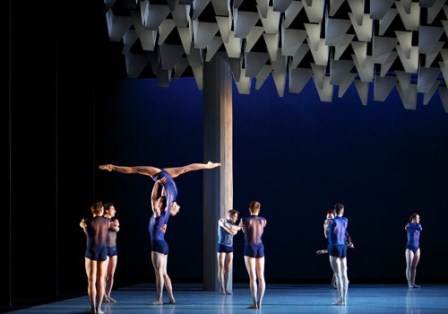
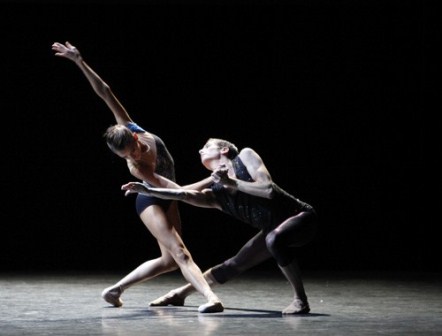
Run for it, Workwithinwork, 5 tangos. Scottish Ballet

05 October 2012, Theatre Royal, Glasgow

Scottish Ballet’s triple bill of works by Martin Lawrance, William Forsythe and Hans van Manen was designed, according to artistic director Christopher Hampson, to show choreography across three generations. To my mind, however, the evening showed more that choreography sometimes looks dated and that for it to have a powerful effect it needs something more than extreme physicality.

The evening opened with Lawrance’s Run for it, performed to John Adams’ Son of Chamber Symphony. It was made originally for Dance GB, a program associated with the London Olympics, although I’m not sure whether Olympic references in Run for it were specific or merely general (as a result of the athletic performances by the dancers). This was my first encounter with the choreography of Lawrance and, while his ability to create energetic, highly physical movement was absolutely evident, I’m not sure he has yet established an individual choreographic voice that makes his brand of movement vocabulary distinctive. To me it seemed like a series of random movements lacking focus.

In many respects the Olympic references came through more clearly in the design. The set by recent Turner Prize winner Martin Boyce recalled ancient Greece, home of the Olympics. A Grecian-style, fluted column set slightly off centre-stage was topped by a conglomeration of geometric shapes spreading across the upper space a little like a cloud. Yumiko Takeshima’s close fitting costumes, looking like an outfit one might wear to the gym, emphasised the sleek and athletic bodies of the dancers.

Eve Mutso, Owen Thorpe and dancers in Martin Lawrance’s Run for it. Scottish Ballet, 2012. Photo: ©Andrew Ross

Closing the program was Hans van Manen’s 1970s piece 5 tangos to music by Astor Piazzolla. This mixture of ballet and tango moves was well performed by the dancers of Scottish Ballet, who wore their red and black costumes with panache. The men in particular moved as an ensemble with admirable ease. Sadly, I don’t think the choreography gave the dancers the opportunity to move with the passion I associate with the tango, although they made the best of what they were given to dance. For me the piece showed how choreography has changed over the past 30 or so years. The carefully arranged moves and patterns of 5 tangos seemed overly structured and, with an emphasis on canon forms, repeats and so forth, the whole seemed too obvious and almost predictable.

The pièce de résistance was the middle work on the program, William Forsythe’s Workwithinwork set to Luciano Berio’s Duetti per due violini. While the off-kilter moves, extended limbs thrashing through the air, and the highly physical partnering we associate with Forsythe were all there, this work began with the dancers looking as though they were in comic mode. Repeatedly they looked almost as if they were poking fun at classical poses and in general fooling around. But by the close of the work, largely a series of duets and trios, all seemed to come together in a cohesive whole and, as the curtain came down, we were left with wisps of movement being traced in the air by the dancers to remind us of what had gone before. It was a mesmerising work with many levels of meaning. One viewing simply made me long to see it again.

Daniel Davidson and Luciana Ravizzi in William Forsythe’s Workwithinwork. Scottish Ballet, 2012. Photo: Andrew Ross

This program was my first encounter with the work of Glasgow-based Scottish Ballet. Not knowing any of the dancers, I am sorry not to be able to comment on individual performances. Christopher Hampson has been artistic director of Scottish Ballet for a very short time, since August 2012. His personable nature was evident in his onstage introduction to this program, which must have been that of previous director, Ashley Page.  It will be interesting to see how Scottish Ballet develops under Hampson’s leadership. He has some excellent dancers to work with.

Michelle Potter, 9 October 2012

Dance diary. September 2011

  • Publication news

In September The Canberra Times published my preview of the Australian Ballet’s 2012 season, a review of the recent book The Ballets Russes in Australia and Beyond under the title ‘Dancing round a few home truths’, and my review of Graeme Murphy’s new take on Romeo and Juliet. Romeo and Juliet has certainly sparked some discussion and the amount of traffic that the extended review has generated over this website has been quite astonishing. It has more than quadrupled the previous record of visits to any one post. The suggestion that this Romeo and Juliet is just not a profound work has been made, not only in published comments but also in other communications to me. But whatever we think, it appears to be selling remarkably well and it will be interesting to see what Sydney audiences make of it when it opens there in December.

Editing and design began in September on an article of mine to be published in the December issue of The National Library Magazine. This article looks at the ballet designs of Arthur Boyd for Robert Helpmann’s Elektra, and those of Sidney Nolan for Kenneth MacMillan’s Rite of Spring. Both ballets were given their premieres by the Royal Ballet in London in the early 1960s. We’ve never seen the MacMillan Rite of Spring here in Australia, but Elektra was staged by the Australian Ballet in 1966 when there were some interesting changes to Boyd’s designs, which in fact had already undergone changes before they even made it to the Covent Garden stage.

joseph-janusaitis
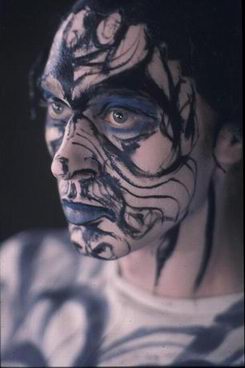
Joseph Janusaitis in make-up for Elektra, the Australian Ballet, 1966. Photo by Walter Stringer. National Library of Australia
  • Nijinsky’s costume for Le Dieu bleu

While the Romeo and Juliet post has attracted instant interest, the post from late last year on Nijinsky’s costume for the Blue God quietly continues to generate visits. I was recently contacted by author Denise Heywood, whose book Cambodian dance: celebration of the gods was published in 2008 in Bangkok by River Books. The book is an interesting examination of the history of Cambodian dance and reproduces some remarkable photographs from across many decades. Denise suggests in her recent communication with me that it is not just the costume has links to the Khmer culture, as I suggested in the post, but the choreography for the ballet Le Dieu bleu must surely also have been influenced by Khmer dance, especially the ‘slow, statuesque movements’.

  • The Royal New Zealand Ballet

The Royal New Zealand Ballet has just announced its 2012 season, its first full year under the directorship of Ethan Stiefel. Stiefel will begin the year in February with a very American program entitled NYC, ‘New Young Classic’ (although the other meaning of that acronym is in there too). NYC will feature works by Larry Keigwin, Benjamin Millepied and George Balanchine. Keigwin has a big following in New York and he will create a new work on the dancers of RNZB. Millepied is now probably best known for his contribution to The Black Swan, but he has been making dances for several years for a range of high profile companies including New York City Ballet, American Ballet Theatre and the Paris Opera Ballet. RNZB will dance Millepied’s 28 Variations on a Theme by Paganini (2005).  The program will also include Who Cares?, Balanchine’s popular and beautifully polished work set to songs by George Gershwin.

Later in the year RNZB will restage its production of Christopher Hampson’s Cinderella and in November Gillian Murphy will take the lead role in a new staging of Giselle to be co-produced by Stiefel and that exceptional interpreter of the role of Albrecht, Johann Kobborg.

tonia-looker-2012-giselle-h-photo-ross-brown1
Tonia Looker in a study for Giselle 2012. Photo: © Ross Brown. Courtesy Royal New Zealand Ballet
  • Memory lane

Canberra is currently in the middle of Floriade, its annual celebration of spring (although the weather is decidedly cold). I have never forgotten a remarkable Floriade, the only one I have ever attended I have to admit, back in 1990. The Meryl Tankard Company was then Canberra’s resident dance company and Tankard staged Court of Flora outdoors against the backdrop of Commonwealth Gardens.

Inspired by the engravings in J. J. Grandville’s book, Les Fleurs animées first published in 1847, Court of Flora was given eleven performances in October 1990. Its spectacular costumes, designed by Sydney-based couturier Anthony Phillips, drew sighs of delight from audiences. So too did the ability of Tankard’s dancers to pose decoratively behind bushes and around trees while at the same time investing the flowers that they represented with clearly discernible human qualities, as indeed Grandville had done with his illustrations. In particular, an impish Paige Gordon as Thistle and an elegant Carmela Care as Rose still remain in the mind’s eye.

  • The Little Mermaid

I continue to be confounded by Rex Reid’s Little Mermaid, the version he made for Laurel Martyn’s Victorian Ballet Company in 1967. All sources seem to indicate that it opened as part of a mixed bill on 1 September 1967, but reviews seem to have appeared in Melbourne papers on the same day, 1 September. There is probably a simple explanation—perhaps there was a preview before 1 September to which reviewers were invited? But if anyone was there and can assure me that it did open on 1 September, despite reviews appearing on the same day, I would be thrilled to hear.

  • Site news

Traffic across the site during September increased by over 20% compared with August, due largely to the exceptional interest in Romeo and Juliet. The review attracted a large number of visits, more than any other post in the two year history of the site. Not surprisingly visits from Melbourne topped the list. Other Australian cities generating significant numbers of visits during September were, in order, Sydney, Canberra, Brisbane and Adelaide.

Some small updates will be made to the site in the next few weeks. On the home page I am having a link to the full tag cloud inserted under the list of top 20 tags. This will facilitate searching from the home page.

I am also having two new sub-pages added to the Resource page. One will be for National Library of Australia articles and will allow me to separate articles written for National Library of Australia News/The National Library Magazine from other online publications. The second will be for articles written for theatre programs.

Michelle Potter, 1 October 2011