Por vos muero, Scuola di ballo & Dyad 1929, 21 August to 1 September 2009, State Theatre, Victorian Arts Centre, MelbourneJ
The Australian Ballet finally hit the jackpot! In the dying months of its four year long celebration of the Ballets Russes, Wayne McGregor arrived in Melbourne and created his Dyad 1929—a work that is truly in the adventurous spirit of the Diaghilev period.
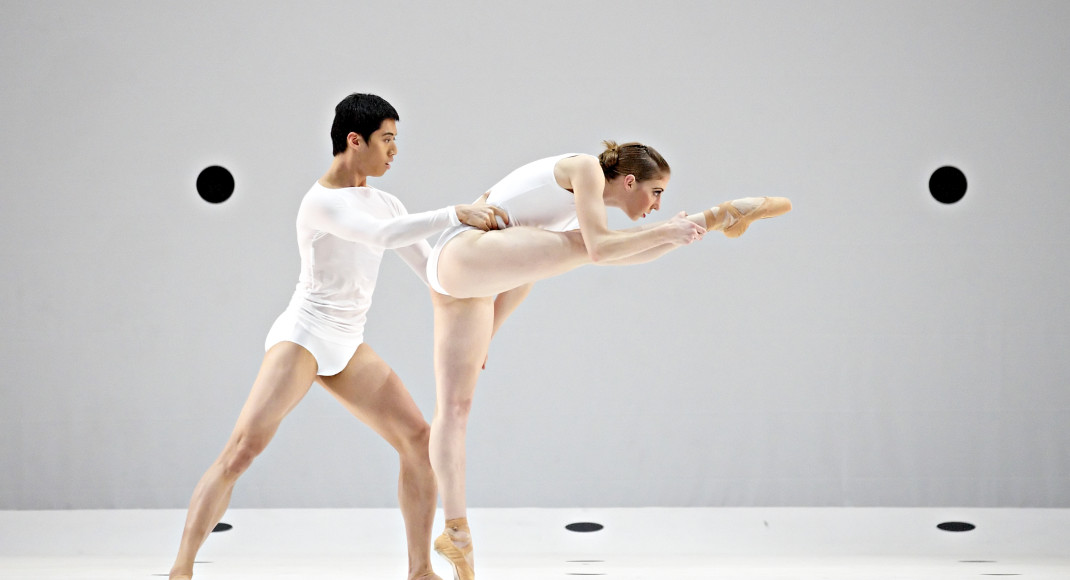
Dyad 1929 is made for a cast of twelve dancers, six women and six men. It is danced against a white backcloth, patterned all over with regular rows of black dots, which extends to a floorcloth. A thin horizontal bar of acid yellow light is raised and lowered in the extreme downstage area during the piece. Occasionally yellow light floods onto the backcloth. This ‘stage concept’ is by McGregor and the work’s lighting designer Lucy Carter. The dancers are costumed by Moritz Junge in close-fitting leotards, or all-overs, or trunks and tops in various combinations and patterns of white, black and fawn. The overall design concept is startling and exhilarating, as is the music—Double Sextet by Steve Reich.
But it is the choreography that lifts Dyad 1929 beyond the startling to the brave and the challenging. There is a matter-of-factness in the way the dancers enter and leave the stage. A la William Forsythe they walk, simply but decisively, on and off. Once on, however, their bodies become an experimental field. They are pushed, pulled and stretched. They crumple, bend and fold. Sometimes the movements look hard-edged. At other times they look more curvaceous. And what seems quite extraordinary is that often movements that are commonplace in a particular situation are put into completely new context. A stretching exercise commonly done at the barre becomes part of a duet, for example. And again extraordinarily, McGregor occasionally follows a twisted movement with a classical, centred one so that the eye can better discern what is central to each.
Standout dancers in two viewings were Lana Jones, cool and poised in a duet with Tzu-Chao Chou, and Danielle Rowe, more softly sinuous in a duet with Adam Bull—Jones a diamond, Rowe a pearl, both using their prodigious technical capacity to dance this audacious and demanding choreography. They dance purposefully, but also with what borders on ecstasy so intently and intensely do they articulate the choreography. This is what dancers crave: to be challenged to use their bodies to do the seemingly impossible, and thus to understand more about their art form.
This triple bill with the overarching name of ‘Concord’ opened with Nacho Duato’s sublime Por vos muero. Por vos remains a compelling work swinging between a stripped back look at human relationships, which we see in the three duets that open the work, to highly theatrical moments as in the scene in which six men in brocade cloaks swirl across the stage swinging censers that fill the air with incense. Daniel Gaudiello gave a particularly strong performance. It highlighted all the remarkable nuances of Duato’s choreography.
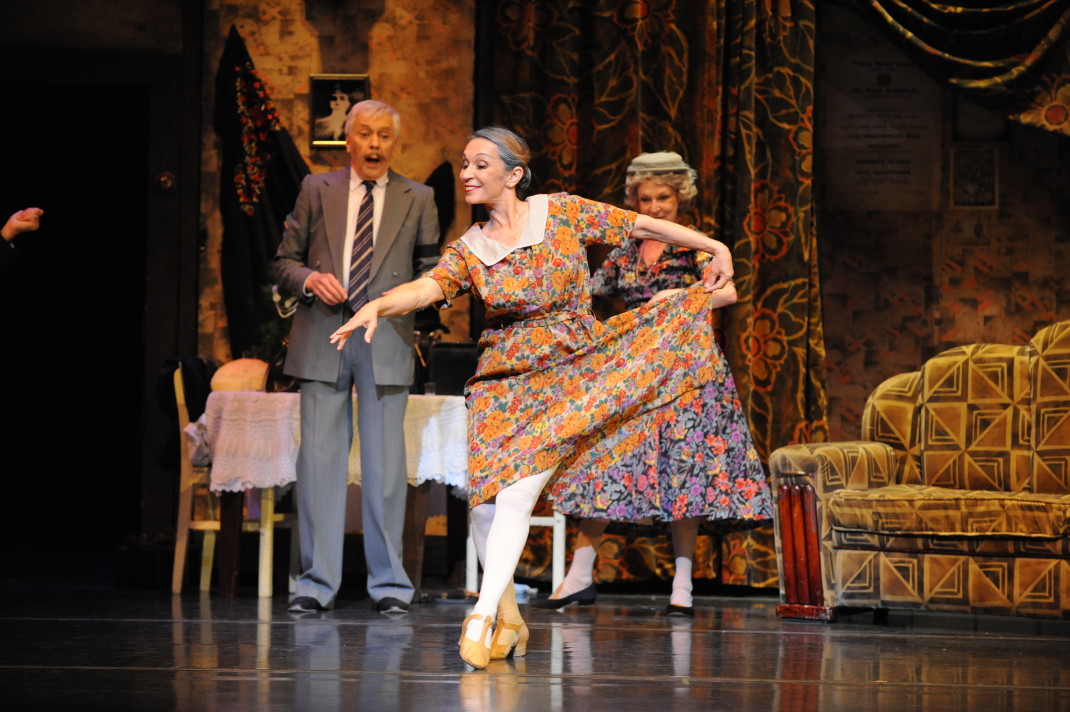
The third work on the program, also part of the Ballets Russes project, was a new production of Léonide Massine’s 1933 work, Scuola di ballo, in this case choreographed by Alexei Ratmansky. Ratmansky adhered to the narrative and choreographic structure of Massine’s work but, in terms of movement, the work looked more like a homage to August Bournonville. Ratmansky emphasised beaten footwork for the men and his pas de deux contained very few lifts, especially big overhead lifts. In typical Bournonville style the man for the most part danced alongside his partner. This was especially noticeable in the pas de deux between the characters Rosina and Carlino, which was prettily danced by Leanne Stojmenov and Daniel Gaudiello in one cast and Danielle Rowe and Ty King-Wall in another.
Scuola‘s comic elements were a hit with the audience but I am not convinced that attempting to reproduce what was clearly not Massine’s best ballet was a worthwhile endeavour. What it did was remind me that not all ballets from the Ballets Russes era (whether from the Diaghilev period or from that of his followers) are worth recalling. Restaging or reproducing works as museum or celebratory pieces only works if the original was a piece of major importance in the first place. I don’t believe that Scuola di ballo was. Ballet has moved on. Thankfully.
And thankfully there are choreographers like Wayne McGregor to show that the way ahead can be as adventurous as it was under Diaghilev.
Michelle Potter, 23 August 2009
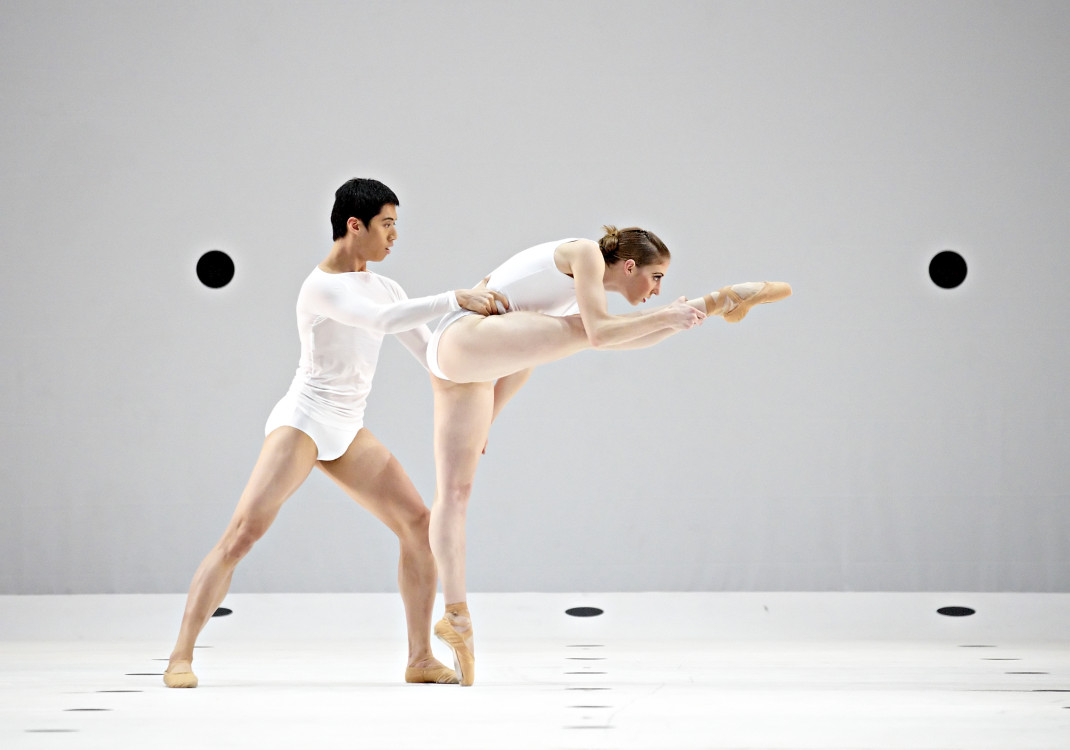
Featured image: Tzu-Chao Chou & Lana Jones in Dyad 1929. Photo: © Jim McFarlane. Courtesy of the Australian Ballet
Footnote: Showing in Melbourne at the same time as ‘Concord’ is an exhibition documenting the career of Salvador Dali. Included in the show, which is at the National Gallery of Victoria, is film footage of Massine’s 1939 collaboration with Dali on the ballet Bacchanale for Sergei Denham’s Ballet Russe de Monte Carlo. It makes an interesting comparison with Scuola di ballo and comments on Bacchanale and its reception by Frederic Franklin, one of the original cast, are easily found via any search engine and are eminently readable.