The Canberra Times recently published ‘Pushing 50 but still dancing’, my preview of the Australian Ballet’s 2012 season.
What didn’t get covered in that article was the Australian Ballet’s use of the term ‘triple threat’ in relation to the triple bill of new Australian works by Graeme Murphy, Stephen Page and Gideon Obarzanek, which is due to open in Melbourne in February. In subscriber brochures and media material these three choreographers are being described as the ‘triple threat of Australian dance’.
At first sight this looks like a typo. I almost fell into the trap of thinking this way, but thanks to a watchful editor I escaped.* It’s probably not a typo (although one can never be sure) since a ‘triple threat’ is, it seems, someone who excels in three areas, be it in baseball (where perhaps the term originated to describe someone who can catch, bat and run with equal skill) or show business, where apparently it can mean having skills in any three areas of activity.
But a ‘triple threat’ can also be something rather than someone. It can be a sports bar of the edible variety (with three ingredients?), or a game show—check your favourite search engine for more. There is also an interesting opinion piece published in The Guardian in 2006.
So where does this leave the Murphy/Page/Obarzanek trio? What are the three areas in which we might expect them to excel in this triple bill? I am a little amused at the idea of being threatened by them or by what they come up with, but quite honestly I’d rather be challenged, excited, enthused, or any number of other more appropriate expressions. The use of ‘triple threat’ is a gimmick in my opinion and takes its place alongside those images of dancers in costumes representing no ballet and taking poses from no ballet, which the Australian Ballet is currently so fond of using. And I know that it’s a bit hard to put dancers in costumes that haven’t been made yet but this fashionista thing has been going on for a while now.
It is a real thrill to see the 50th anniversary program containing so much new Australian choreography and I can’t wait for the season to begin. But it would be equally thrilling to see the Australian Ballet proudly promoting itself as an organisation with an understanding of the qualities that make dance the great art form that it is, rather than as a bunch of people at the forefront of the latest trendy but artistically empty ideas.
Michelle Potter, 18 September 2011
*On the subject of typos, the ‘Pushing 50’ article notes, wrongly, that Canberra audiences have been seeing Graeme Murphy’s choreography since the 1960s. It should read the 1970s!
Ros Warby’s Monumental has been around since 2006 but I had not seen it for one reason or another. So it was more than irritating to arrive at its showing during Spring Dance to be told that there was no program sheet. ‘Oh, it’s the last performance’, I was told. Well this is the digital age when it doesn’t take long to print off a few more copies. And there were only two performances and I was at the second, so it seems slack that such a small number of shows could not be catered for in the first place. Besides, it is offensive to the artists involved when the audience doesn’t have the opportunity of reading who did the lighting, who made the costumes, who composed the music and so forth.
But to the show! Monumental, a solo work, focused on two generic figures—a swan and a soldier. I’m not sure they had any relationship to each other but certainly as each took the stage we were reminded of the fragility and perhaps the futility of the human condition and experience. The swan, which may or may not have been Odette from SwanLake or the dying swan of Anna Pavlova fame, twitched and fluttered nervously. Warby’s headdress of a white skull cap/swimming gear looked incongruous with her white tutu but went well with her bare feet. Then the swan began to share the stage with footage of birds and of Warby herself. A beautiful blend of the living and the mechanical began to emerge and more resonances began to surface in one’s mind.
The soldier, dressed in a black jumpsuit and a headdress that recalled that worn by the Siren in the Ballets Russes production of The Prodigal Son, was a little less successful, although Warby demonstrated her versatility as a dancer, changing from the twitching anxiety of the swan to a precise, neat way of covering space—dare I say a militaristic way of moving? The Lone Ranger allusion (‘Hi, yo silver. Away’) as the soldier became a horse was again a complex layering of meaning especially as the footage changed from marching feet in a harsh environment to balletic feet, and as the soldier/horse became a black swan.
Warby’s Monumental is a strong work but not easily ‘understood’. It is emotional to a certain extent and juxtaposes ideas as non sequiturs. So it fits in a way with the Spring Dance focus on the expressionist legacy of Pina Bausch. But Warby has quite a cerebral, even dry approach to her creative practice that seems to me to be the antithesis of the Bauschian approach. Nevertheless, Monumental is a work worth watching and pondering over.
However, I do wish that Warby would avoid including obvious balletic language as part of her choreography. No matter how much one’s early ballet training may be ‘imprinted’ on the body (it’s on mine too!) one reaches a stage where turning pirouettes in a circle no longer looks the way it should. Without daily and intensive ballet classes and ongoing use of the ballet technique in a professional way, no dancer can do justice to the intrinsic qualities of the balletic vocabulary. The body seems like a slightly out of tune musical instrument, the steps suffer and we are faced with an unintended (I think) denigration of the vocabulary.
After the show I was able to confirm that the footage and lighting were the work of Margie Medlin and the cello score was by Helen Mountfort. Medlin and Mountfort are Warby’s regular collaborators but not everyone in the audience would have known that without a program sheet.
Pina Bausch died quite suddenly in 2009. It was a shock to most in the dance world and was the occasion for an outpouring of recollections and writing of various kinds. Sydney’s Spring Dance program, now in its third year, made its contribution with almost its entire program devoted in some way or another to the legacy of Bausch. A major highlight was Pina: a celebration, two days of talks and films hosted by journalist and broadcaster Caroline Baum.
In terms of format, Pina: a celebration comprised three sessions, ‘Keys to your soul’, ‘Pina’s children’ and ‘Muscle memory’. Each was held in the Playhouse at the Sydney Opera House and began with a conversation between Baum and her invited guests. On each occasion the conversation was followed by a film screening.
Although a major focus of the event was, to my mind anyway, on setting Bausch and her work within an Australian context, Bausch was absolutely central to the occasion and eclipsed most other aspects of the event. One of the unexpected highlights was a small snippet of footage shot in 1982 by Scott Hicks for a documentary on the 1982 Adelaide Festival at which Bausch and her company appeared. How warm and friendly Bausch seemed. And how cunningly she avoided the issue of how to describe her works by telling instead an amusing story about Alfred Hitchcock.
We saw Bausch again almost forty years later in ‘Dancing Dreams’, a documentary made in 2010 by Anne Linsel and Rainer Hoffmann on the creation of a new version of Kontakthof, a work Bausch first made in 1978 and which was seen in Australia in Adelaide in 1982.
In this new production Bausch used teenagers over the age of fourteen as her entire cast. Bausch watched rehearsals for this show we would occasionally see a smile break out on her now lined but always expressive face. There was again a sense of warmth and tenderness from the woman who was once accused of being a ‘theatre terrorist’ and making works that were the ‘raw pulp of abuse’.
The other two films were Pina Bausch made, again by Anne Linsel, in 2006, and Life in Movement made in 2010 by Bryan Mason and Sophie Hyde on the work of Tanja Liedtke. While both offered much insight, and Life in Movement in particular is an important addition to our knowledge of Liedtke’s creativity, both were at times a little subjective making them seem a tad too long. Not so with Dancing Dreams where the spoken words were forthright and honest, where the cast was able to be self critical and the young people able to analyse the role they were playing in the creative process, not to mention the effect that process was having on them. It was very refreshing,
In the conversations with Baum, three of the five guests were Australians whose work had been influenced in one way or another by Bausch: Michael Whaites, Kate Champion and Shaun Parker. What instantly stood out was the sense of objectivity they were able to bring out in their comments and answers to Baum’s questions. After the reverential tone of Bausch’s dancers in the Linsel film Pina Bausch, it was invigorating to hear something a little more down to earth. Whaites in particular, the only one of the three who had worked in close proximity to Bausch, spoke of the need to maintain just a little distance in dealing with life in Bausch’s Tanztheater Wuppertal. And on another Australian note, Dancing Dreams afforded us the pleasure of watching Jo Ann Endicott, an Australian dancer who has been with Bausch since 1973, in her role as co-rehearsal director (along with Bénédicte Billiet) for the new production of Kontakthof.
Alain Platel and Lutz Förster were Baum’s other guests. Both were in Sydney for performances of Platel’s Out of context: for Pina, which I wrote about last year and in which Förster was a performer.*
An unexpected (for me) addition to the program was a brief public conversation with photographer William Yang, whose images of two Bausch works, Kontakthof and 1980, taken at the 1982 Adelaide Festival were on view in the foyer. Yang, who admitted he was not really a great dance-goer, likened Bausch to Chekhov. ‘She understands the human condition’, he said.
Michelle Potter, 10 September 2011
*Platel was a guest on ‘Mornings with Margaret’ on 31 August 2011. His interview is available as a podcast. (update: Podcast no longer available)
During August The Canberra Times published my Canberra preview for Bangarra’s current production, Belong, and also my reviewof the Canberra season of the Dancers Company production of Don Quixote. The Dancers Company was a breath of fresh air for dance goers in the national capital, especially for those interested in ballet as a genre of dance.
I was especially impressed by Hannah O’Neill and Benedicte Bemet. It is well known now that Hannah O’Neill has a seasonal contract, beginning this month, for the Paris Opera Ballet, so it was good to see her in this early stage of her professional career. She was dancing beautifully as one of Kitri’s friends. She also took the role of the Queen of the Dryads in the dream sequence and it is not too much to say that her serenity in the Queen’s solo, in part deriving from her technical assurance, was thrilling to watch.
But it was Benedicte Bemet, also dancing as one of Kitri’s friends, and as Cupid in the dream scene, who really captured my attention. She too handled skillfully the quite different but equally demanding technical requirements of Cupid’s solo. But what really stood out was her engagement with the art form rather than with just the technique. Her dancing appears to come from deep within the soul. I hope she doesn’t lose such a rare and wholly engrossing quality as she moves into a professional company.
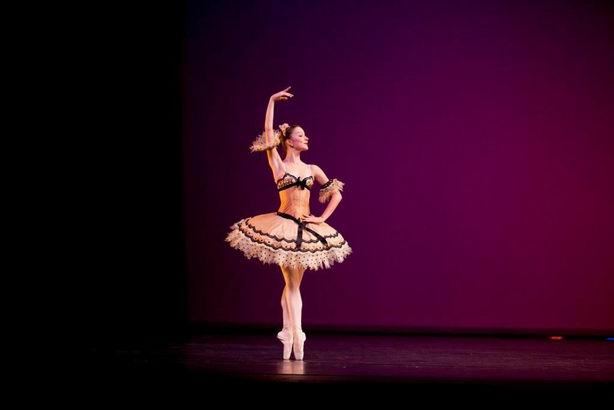
Benedicte Bemet in ‘Paquita’, 2011. Photo: Sergey Konstantinov. Courtesy: The Australian Ballet School
Ted Shawn and Laurel Martyn’s Ballet Guild
Ted Shawn was the subject of an August post that drew some comments, including one regarding the sponsorship of the Shawn visit by Laurel Martyn’s Ballet Guild. While on the hunt for information about a production of The Little Mermaid, a work choreographed by Rex Reid and designed by Kristian Fredrikson for Martyn in 1967, I discovered that Shawn was a patron of Martyn’s company, which was variously called Ballet Guild, Victorian Ballet Company and Ballet Victoria depending on the date. Shawn’s name appears on programs as a patron of the company from at least 1958 through to at least 1968 (and perhaps before and after those dates? I have yet to examine earlier and later programs).
Paul De Masson
In last month’s dance diary I mentioned Paul De Masson and indicated that he was to perform in the Melbourne season of Checkmate in the Australian Ballet’s British Liaisons program. I have since discovered from Paul that this is no longer happening. It is unclear why, although it seems not to be his health!!
Jennifer Irwin
In August I also had the pleasure of recording an oral history interview for the National Library of Australia’s Oral History and Folklore Collection with costume designer Jennifer Irwin. Long standing followers of Sydney Dance Company will remember her many costume designs for Graeme Murphy and Janet Vernon, while those who have followed Bangarra will recall that she and Peter England produced costumes and sets for some of Bangarra’s most celebrated productions across the two decades of its history to date.
Irwin’s other design credits include the ‘Awakening’ section of the Sydney 2000 Olympic Opening Ceremony, much of the Closing Ceremony and the musical Dirty Dancing. In October audiences will see her designs for Stephen Page’s production of Bloodland for Sydney Theatre Company, and in 2012 her commissions include two new works for the Australian Ballet.
Land, sea and sky: contemporary art of the Torres Strait Islands
While in Brisbane for the Queensland Ballet Gala, I took the opportunity to visit an exhibition at the Gallery of Modern Art called Land, sea and sky: contemporary art of the Torres StraitIslands. The exhibition included a variety of dance materials. Particularly interesting were several ‘dance machines’, hand held objects manipulated by dancers to give extra strength to the narrative line of the dance. I loved the one made by Patrick Thaiday and commissioned especially for the exhibition. It comprised 20 ‘machines’ each constructed as a stylised, blue cumulus cloud, made of wood and painted with white stars. From each cloud radiated a series of small, movable, dark red poles each with a white star at its top point. It was easy to imagine a dance representing the movement of the stars across the sky using these devices as a major inclusion.
Footage of Dennis Newie teaching dances on the beach to Islanders of various ages was another important feature of the show.
The Australian Ballet’s 2012 season
Late in August the Australian Ballet announced its season for 2012, its 50th anniversary year. What a great program it looks like too. In May I posted on the English National Ballet’s Swan Lakeand remarked how satisfying it was to see a traditional version of this ballet, as much as I love Graeme Murphy’s new take on it. So I am especially looking forward to seeing Stephen Baynes’ new but old version, which will be seen first in Melbourne in September before moving on to Sydney in November.
The year will open with a triple bill of new works by Australian choreographers: Graeme Murphy, Stephen Page and Gideon Obarzanek. Something to anticipate!
Statistics
In August the Australian Ballet’s Concord season of 2009 finally lost its top place as most accessed post of the month. My dance diary for Julyand my post on the Queensland Ballet galashared top spot with Concord coming in in third place.
Pina, shot in 3-D and directed by the acclaimed German artist Wim Wenders, has been touted by many as showing the way forward in terms of filming dance, giving back to dance the physicality that it apparently loses in regular filming. But I’m not sure that many of the reviewers who have hailed it as a breakthrough have actually sat in a theatre and watched a performance by Pina Bausch’s company, or any other dance company for that matter.
For me the most interesting review to date has been by Australian playwright and commentator Louis Nowra. Writing in the August edition of The Monthly, Nowra astutely says, amongst other things, that the scenes shot out of doors are ‘[drained] of their claustrophobic power’, and that ‘the uterine universe that Bausch created onstage is dissipated’. His concluding statement is: ‘For all its 3-D marvels, the film finally doesn’t do her work justice’. And it doesn’t.
Pina is not really a documentary. Nor is it really a dance film. It sits uneasily between the two. It shows sequences from four major Bausch works, Rite of Spring, Café Mueller, Kontakthof and Vollmond, in most cases danced by the current company. It contains some archival footage, although not as much as one might have hoped to see. It contains solos performed outdoors in locations around Wuppertal, the German city where the company, led by Pina Bausch and now since Bausch’s death in 2009 by Dominique Mercy and Robert Stürm, has resided for almost four decades. It shows Bausch’s current dancers talking about their experiences with the company and their thoughts about what it was like working with Bausch.
Company dancers now, as they have been across the history of the company, are great movers. No doubting that. They are also articulate about their experiences and their emotional involvement in the act of working with Bausch. But what horrors are perpetrated by the 3-D technology! The scenic space in which the dancers perform is often far too deep and distorts the dancers. They often look far too small and far too thin. They don’t inhabit the space as living human beings but as kinds of puppet figures. We also, especially in footage of Rite of Spring, get some hideous close-up images (3-D close-up) of faces—images that we never see in performance, and that we are really never meant to see. Distance in the theatre has a place.
Also having a place in the theatre and often missing in Pina is the intimate contact between performers that develops in the enclosed space of a theatre stage. In the deep 3-D recesses, dancers seem to be separated or disengaged from each other, from the props and indeed from the performing space itself, not to mention from the viewer—and I don’t consider having a face thrust straight into mine courtesy of 3-D an engagement with the viewer. How much more engaging is the archival footage (not filmed in 3-D) of Bausch herself performing in Café Mueller where we see her interacting with the space around her body, her personal space, as all great dancers are able to do, rather than seeing her placed within a technological extension of space.
Going back to Louis Nowra, he is absolutely right that the very inward looking, almost narcissistic approach that seems necessary for the creation of a work by Pina Bausch is lost when the works (or parts of them) are placed out of doors. In fact for me the most interesting part of the footage shot out of doors was seeing the Schwebebahn, Wuppertal’s suspended monorail system that, as far as I am aware, is a somewhat over-engineered rail system that has never been replicated elsewhere.
Worse than that, as far as I am concerned, is that the works lose their inherent, dancerly theatricality when shot in 3-D.