As part of my current research project into the career of Kristian Fredrikson, I came across four designs in the National Library’s Fredrikson collection labelled Sleeping Beauty Act I. They were for four Princes: English, Indian, Russian and Saracen and so were clearly for the ‘Rose Adagio’. But I was a little puzzled by them as they were not for the Stanton Welch version of Beauty, which Welch choreographed for the Australian Ballet in 2005 and which was designed by Fredrikson. I was not aware of another Sleeping Beauty with Fredrikson designs.
The English Prince had the name DeMasson written on the back and Paul De Masson kindly identified the costume as one he wore while a dancer with West Australian Ballet. He recalled that in the 1970s he had partnered Elaine Fifield in the ‘Rose Adagio’ during a season that contained a number of divertissements.
After a bit more investigation I uncovered a flyer and some programs in the National Library’s Rex Reid collection. Reid directed West Australian Ballet from late 1969 to 1973 and in November 1971 presented a season of two programs, which included a number of divertissements, at the Octagon Theatre, Perth. It was the first program, staged from 8-13 November, that included the ‘Rose Adagio’. The printed program contained the following details:
Rose Adagio,
Producer: Bryan Ashbridge Music: Tchaikovsky Costumes: Kristian Fredrikson Choreography: Frederick Ashton ‘A new production by Bryan Ashbridge’
Princess Aurora: Elaine Fifield, Patricia Sadka Indian Prince: Robert O’Kell Saracen Prince: Laurence Bishop Russian Prince: Ron Deschamps English Prince: Paul DeMasson
I was also curious about the choreographic credit to Ashton, but the Ashton scholar David Vaughan has noted that Ashton created a ‘Rose Adagio’ in 1963 especially for a Royal Performance at the Prince of Wales Theatre. Bryan Ashbridge, who produced the 1971 West Australian Ballet version, retired from the Royal Ballet in 1965 so could well have been part of that Royal Performance or subsequent stagings of this Rose Adagio.
Rex Reid’s second 1971 Octagon program, presented from 15-20 November, included ‘The Dying Swan’ as one of the divertissements. A design for ‘The Dying Swan’, which was danced by Fifield, is also part of the National Library’s Fredrikson collection.
More items to add to the growing ‘List of works designed by Kristian Fredrikson’.
Michelle Potter, 26 October 2011
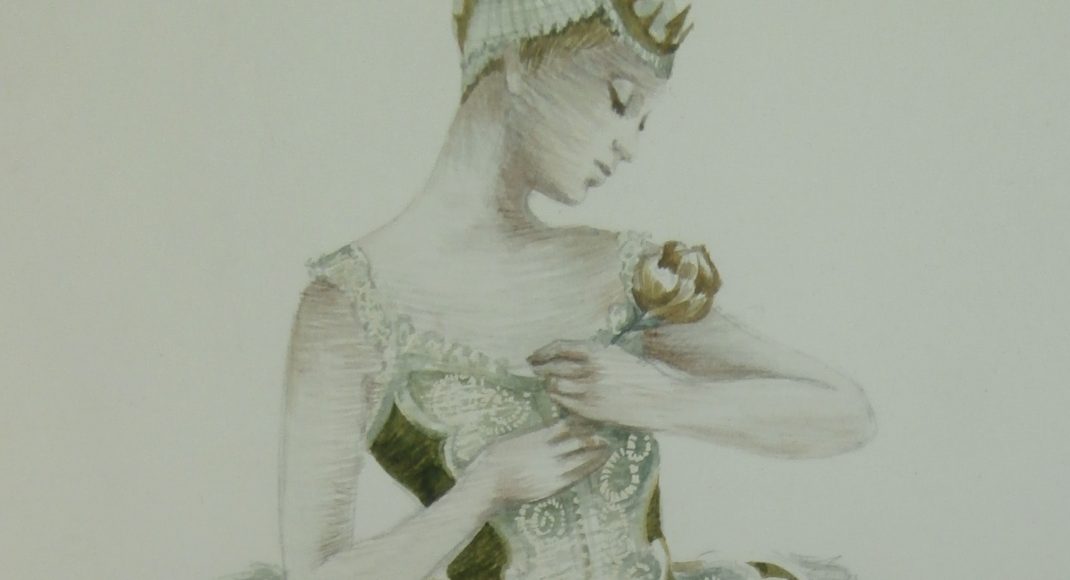
Update, 31 January 2017. The Fredrikson material also contains a design, from the same production, for Aurora, a detail of which is the featured image on this post.
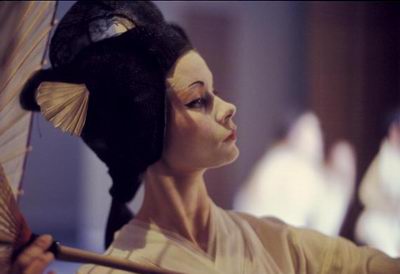
Gail Ferguson as a woman of the village in Yugen, 1965 or later. Photo by Walter Stringer. Reproduced with permission of the National Library of Australia
While pursuing research into the career of designer Kristian Fredrikson I was surprised to find Fredrikson’s name mentioned in production credits for Yugen, Robert Helpmann’s 1965 one-act work for the Australian Ballet. Fredrikson, whose home base was Melbourne at the time Yugen was being created, is listed, along with William Miles, as having made the headdresses.
Yugen was designed by Desmond Heeley who tells me that he worked on the designs in London and sent the drawings to Australia by mail with copious instructions to the wardrobe department at the Australian Ballet. Helpmann requested, however, that the costume for the leading role of the Goddess, danced in the original production by Kathleen Gorham, be made by costume makers who had worked with him on previous occasions at Sadler’s Wells and Covent Garden, including Hugh Skillen who made the very delicate headdress worn by Gorham and those who followed in the role.
Fredrikson’s interest in headdresses and wigs—millinery in general—can be traced back to his very first works made in New Zealand. For what is reputed to be his first theatrical commission, the Strauss operetta A Night in Venice, one reviewer wrote:
An intriguing effect has been created for the doxies in the opera by giving them flowing wigs in vivid purple, green, blue and orange. Making these wigs occupied two days—they had to be dyed, teased, shaped, curled, brushed and, where necessary, lacquered.
His interest in framing the face in some way can also be followed throughout his career and many of his designs on paper contain detailed instructions to the millinery department of the companies for which he worked.
In 1965 Fredrikson had just a few design commissions behind him, perhaps the most prestigious being designs for Aurora’s Wedding for the Australian Ballet in 1964. Making the Yugen headdresses to Heeley’s designs was no doubt an important and prestigious step for him and he often mentioned Heeley as an influence on his own work.
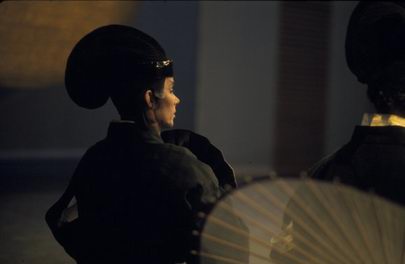
Scene from the Australian Ballet production of Yugen, 1965 or later. Photo by Walter Stringer. Reproduced with permission of the National Library of Australia.
I have commented elsewhere on this site and in The Canberra Timeson the legacy tour of the Merce Cunningham Dance Company, now drawing to an end. The tour has generated all kinds of reviews over the almost two years of its run to date, not the least of which is a recent one by Clement Crisp published in The Financial Times of 6 October 2011, which relates to a Cunningham season at the Barbican in London. I love reading Crisp’s reviews, which are often outrageously opinionated (in my opinion!!), but which often also contain many words of wisdom born of many years of experience.
Given that choreography has been a point of discussion among readers of and contributors to this website recently, the following extract from Crisp’s Cunningham review is more than interesting.
‘The Merce Cunningham Dance Company, as the choreographer left it when he died two years ago, will cease to exist at the year’s end. Cunningham’s wish that his troupe should cease must be seen as wise. The keepers of the flame who proclaim that “this is what our Dear Master intended” are among the added indignities to mortality.
Choreography mutates, Chinese-whispers fashion and for all the stern guardianship that seeks to protect dance, it alters, as do bodies and training and the social attitudes of an audience. Today’s Ashton, even today’s carefully guarded Balanchine, change as transmission of a text oh-so-insidiously erodes a step, an emotional point. Cunningham decided his company—dancers with whom he worked on a daily basis—must end ‘as near as dammit with him’.
In September The Canberra Times published my preview of the Australian Ballet’s 2012 season, a review of the recent book The Ballets Russes in Australia and Beyond under the title ‘Dancing round a few home truths’, and my review of Graeme Murphy’s new take on Romeo and Juliet. Romeo and Juliet has certainly sparked some discussion and the amount of traffic that the extended reviewhas generated over this website has been quite astonishing. It has more than quadrupled the previous record of visits to any one post. The suggestion that this Romeo and Juliet is just not a profound work has been made, not only in published comments but also in other communications to me. But whatever we think, it appears to be selling remarkably well and it will be interesting to see what Sydney audiences make of it when it opens there in December.
Editing and design began in September on an article of mine to be published in the December issue of The National Library Magazine. This article looks at the ballet designs of Arthur Boyd for Robert Helpmann’s Elektra, and those of Sidney Nolan for Kenneth MacMillan’s Rite of Spring. Both ballets were given their premieres by the Royal Ballet in London in the early 1960s. We’ve never seen the MacMillan Rite of Spring here in Australia, but Elektra was staged by the Australian Ballet in 1966 when there were some interesting changes to Boyd’s designs, which in fact had already undergone changes before they even made it to the Covent Garden stage.
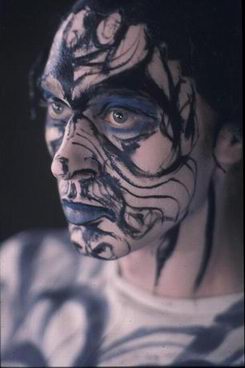
Joseph Janusaitis in make-up for Elektra, the Australian Ballet, 1966. Photo by Walter Stringer. National Library of Australia
Nijinsky’s costume for Le Dieu bleu
While the Romeo and Juliet post has attracted instant interest, the post from late last year on Nijinsky’s costume for the Blue God quietly continues to generate visits. I was recently contacted by author Denise Heywood, whose book Cambodian dance: celebration of the gods was published in 2008 in Bangkok by River Books. The book is an interesting examination of the history of Cambodian dance and reproduces some remarkable photographs from across many decades. Denise suggests in her recent communication with me that it is not just the costume has links to the Khmer culture, as I suggested in the post, but the choreography for the ballet Le Dieu bleu must surely also have been influenced by Khmer dance, especially the ‘slow, statuesque movements’.
The Royal New Zealand Ballet
The Royal New Zealand Ballet has just announced its 2012 season, its first full year under the directorship of Ethan Stiefel. Stiefel will begin the year in February with a very American program entitled NYC, ‘New Young Classic’ (although the other meaning of that acronym is in there too). NYC will feature works by Larry Keigwin, Benjamin Millepied and George Balanchine. Keigwin has a big following in New York and he will create a new work on the dancers of RNZB. Millepied is now probably best known for his contribution to The Black Swan, but he has been making dances for several years for a range of high profile companies including New York City Ballet, American Ballet Theatre and the Paris Opera Ballet. RNZB will dance Millepied’s 28 Variations on a Theme by Paganini (2005). The program will also include Who Cares?, Balanchine’s popular and beautifully polished work set to songs by George Gershwin.
Later in the year RNZB will restage its production of Christopher Hampson’s Cinderella and in November Gillian Murphy will take the lead role in a new staging of Giselle to be co-produced by Stiefel and that exceptional interpreter of the role of Albrecht, Johann Kobborg.
Canberra is currently in the middle of Floriade, its annual celebration of spring (although the weather is decidedly cold). I have never forgotten a remarkable Floriade, the only one I have ever attended I have to admit, back in 1990. The Meryl Tankard Company was then Canberra’s resident dance company and Tankard staged Court of Flora outdoors against the backdrop of Commonwealth Gardens.
Inspired by the engravings in J. J. Grandville’s book, Les Fleurs animées first published in 1847, Court of Flora was given eleven performances in October 1990. Its spectacular costumes, designed by Sydney-based couturier Anthony Phillips, drew sighs of delight from audiences. So too did the ability of Tankard’s dancers to pose decoratively behind bushes and around trees while at the same time investing the flowers that they represented with clearly discernible human qualities, as indeed Grandville had done with his illustrations. In particular, an impish Paige Gordon as Thistle and an elegant Carmela Care as Rose still remain in the mind’s eye.
The Little Mermaid
I continue to be confounded by Rex Reid’s Little Mermaid, the version he made for Laurel Martyn’s Victorian Ballet Company in 1967. All sources seem to indicate that it opened as part of a mixed bill on 1 September 1967, but reviews seem to have appeared in Melbourne papers on the same day, 1 September. There is probably a simple explanation—perhaps there was a preview before 1 September to which reviewers were invited? But if anyone was there and can assure me that it did open on 1 September, despite reviews appearing on the same day, I would be thrilled to hear.
Site news
Traffic across the site during September increased by over 20% compared with August, due largely to the exceptional interest in Romeo and Juliet. The review attracted a large number of visits, more than any other post in the two year history of the site. Not surprisingly visits from Melbourne topped the list. Other Australian cities generating significant numbers of visits during September were, in order, Sydney, Canberra, Brisbane and Adelaide.
Some small updates will be made to the site in the next few weeks. On the home page I am having a link to the full tag cloud inserted under the list of top 20 tags. This will facilitate searching from the home page.
I am also having two new sub-pages added to the Resource page. One will be for National Library of Australia articles and will allow me to separate articles written for National Library of Australia News/The National Library Magazine from other online publications. The second will be for articles written for theatre programs.
This is an expanded version of my review first published in The Canberra Times, 17 September 2011, p. 30 under the title ‘Fluid postmodern take on a classic’.
13 September 2011, State Theatre, Victorian Arts Centre, Melbourne
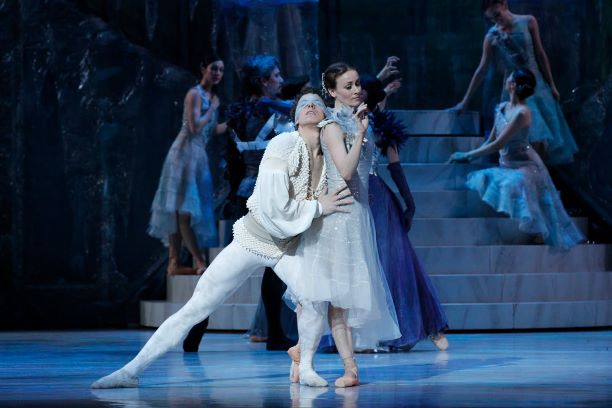
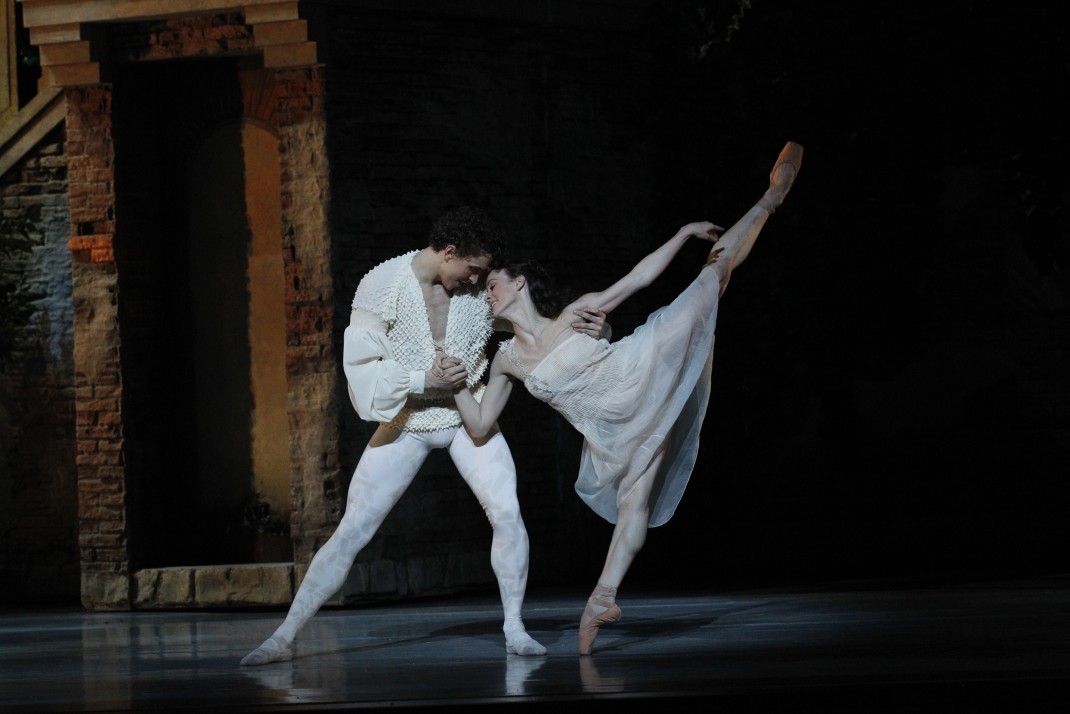
In an interview published in the September issue of the Qantas inflight magazine, choreographer Graeme Murphy said of his new production of Romeo and Juliet for the Australian Ballet that we should ‘bring a lifeboat’. Well he had a point because this production, which had its world premiere in Melbourne on 13 September, is a very fluid one indeed. It opens in a town setting, which could be Verona at the time Shakespeare’s Romeo and Juliet is set. But over the course of the evening the location and the era change wildly. We see the marriage of Romeo and Juliet in Japan, the killing of Tybalt and Mercutio in India and the mourning of Juliet in a harsh, blood red desert setting. The characters ride bikes in one scene. Romeo, Mercutio and Benvolio find themselves in a row boat in another. And more.
Graeme Murphy’s Romeo and Juliet is quintessentially postmodern. It has moments of humour and irony. It is filled with allusions to all kinds of cultural objects and issues—devotees of the Hare Krishna movement even make an appearance. Murphy also references himself and his work through some choreographic moments that look back to the vintage days of Sydney Dance Company. The scene in which Juliet receives a potion to induce a death-like sleep, when six black clad figures support Juliet in expansive swooping and flying movements, is just one example of this glance back at previous choreography.
Murphy also incorporates fabric into the choreography and the production overall. And while on this occasion his costume designer, Akira Isogawa, may well have had a strong input into how fabric has been used, Murphy has been playing with lengths of cloth and curtains of fabric throughout his choreographic career. One of the most dramatic uses of fabric in Romeo and Juliet occurs when a bolt of scarlet silk, initially resting amongst other rolls of fabric on the side of the stage in the Indian market place, unwinds and streams across the stage as the Capulets and the Montagues engage in their bloody feud.
This Romeo and Juliet is a collage of ideas playfully deconstructed and the remarkable thing is that it works. Everyone knows the story and Murphy has assumed this familiarity with the plot and has pursued a vision for a work that is like no other that the Australian Ballet has ever presented.
On opening night Madeleine Eastoe and Kevin Jackson as Juliet and Romeo led us on this journey of love and death. Eastoe in particular danced with joy, passion, despair, every emotion that the story requires. Her opening dance, with its quick footwork and fluid upper body movement, filled us with pleasure and anticipation.
Daniel Gaudiello continued to impress as Mercutio and moved, as his name in this ballet implies, like quicksilver, darting here and there, unpredictable and always impassioned in defence of his friends. Juliet’s nurse, usually played as a somewhat plump and bumbling if kind-hearted older woman, was intelligently performed by Elizabeth Hill and became (thankfully) a much less pantomimic role. A character introduced by Murphy—Death, the Prince of Darkness—provided a through line for the meandering locations and times. Death picks up bodies, which he places in a wooden cart (rather like the carts that carried the French to the guillotine in 1789—another reference). Or sometimes he just hovers menacingly in the background. It’s not a big dancing role but one that requires a very strong presence. It was very ably performed on opening night by Adam Bull.
In addition to Akira Isogawa, the collaborative team on this production included Murphy’s creative associate, Janet Vernon, set designer Gerard Manion, and Damien Cooper who lit the show. From among literally hundreds of costumes created by Isogawa, I especially liked the beautifully cut, high-collared black coat for Death and the pale olive, very simple costume for Juliet’s nurse. I was amused by the costume for Paris, which seemed to have a kind of gold ‘breast-plate’ of muscles. Paris is rarely portrayed in a sympathetic way and this addition to his costume suggested an inherent vanity. Manion’s strongest contribution was a visually arresting painted front cloth comprising a huge bunch of gold, pink and blood red lilies from which the deepest colours drained to grey as the cloth rose at the beginning of the work.
This Romeo and Juliet may not appeal to everyone, especially those who like their ballet to be more in a modernist vein, that is somewhat coherent in form. Did I miss the John Cranko version of Romeo and Juliet, which has been in the Australian Ballet’s repertoire for decades? Yes, a little, but in the same way as I occasionally yearn to see a traditional Swan Lake, rather than Murphy’s newer production. It’s part of the balletic legacy and we need to be reminded occasionally that we have a heritage.
But Murphy’s approach in 2011 raises many issues that are discussed across other art forms and it is refreshing to see this occurring in ballet, an art form that is so often seen as a little dowdy. Of course such issues include the notion that postmodernism is dead so we have to wonder whether this Romeo and Juliet is already outdated? But whatever one might think, it is a production worth seeing.