19 and 20 Nov. 2026. Te Whaea Theatre, Wellington
reviewed by Jennifer Shennan
The NZSD Performance Season is a bright and confident showcase of the two separate streams, Contemporary and Classical, that comprise the School’s curriculum. Always with a high standard of performance, it is more of a showcase across two evenings than a graduation atmosphere, and many in the audience still wish for combinations of items from both so we can all admire the range of techniques and aesthetics on offer at the school if we can only attend one of the two performances.
The Classical program bursts open with Les Valseurs—all sweetness and light, 16 young dancers in love with waltzing—so Tchaikovsky’s Eugene Onegin fills the bill very nicely and the performers’ joy is infectious. How poignant that Jenna Lavin, the American choreographer of the 2020 work, died young three years ago, almost to the day of this performance. ‘Not all of me shall die’, as Chapman-Taylor would say.
Children’s Songs, choreographed by American Val Caniparoli in 2005, was in total contrast of style and theme, and especially in the music of Chick Corea’s composition … jazz syncopations and cross rhythms played with great skill on piano sidestage, by Phillip O’Malley, long-standing pianist of the school. Music is half the art, so it is always welcome to have it live whenever possible. A dancer enters walking heel first in her pointe shoes, an early clue that what’s to follow will be a shift back from ballet’s usual conventions. It’s a quirky piece that interplays between preparing and performing by turns, and the students deliver it with aplomb.
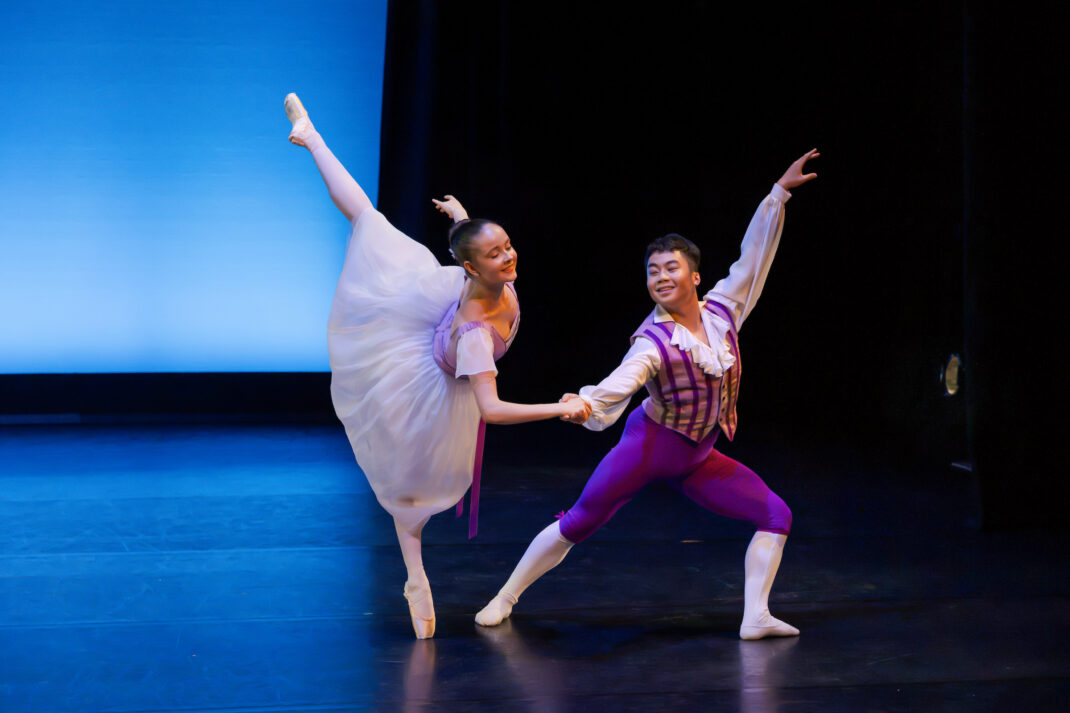
A pas de deux, an excerpt from English choreographer Kenneth MacMillan’s celebrated Concerto of 1966, to Shostakovich piano concerto no.2, is beautifully danced by Phoebe Ewington and Daniel McLaughlin, in a partnership showing a confident yet sensitive rapport that is impressive to witness.
The fourth and final work, Airs de Ballet, choreographed in 1972 by American Lew Christensen, is a spirited work for five dancers who perform with palpable energy and a most attractive enthusiasm. Shanwen Tan is a chivalrous partner as well as standout soloist—as also were Coco Giera, and Olivia Yeo and Hiroki So earlier in the evening.
The Contemporary program has, by contrast with the above, four works, all choreographed by New Zealanders, either as commissions and therefore seen here as premieres, or in one case an excerpt from a recent work. Each piece is themed for a Maori concept or dimension, and they share a similar structure of a large group with fleeting solo cameos as appropriate to each. Two of these works combined with two from the Classical program, times twice, would have brought a much-appreciated balance to both performances.
The opening work, Te Whaea, by Brydie Colquhoun, with an all-female cast, is built around the strength and support between succeeding generations of Maori women. There are many strikingly sculptured groupings of the dancers which trace that theme well, within their committed performance.
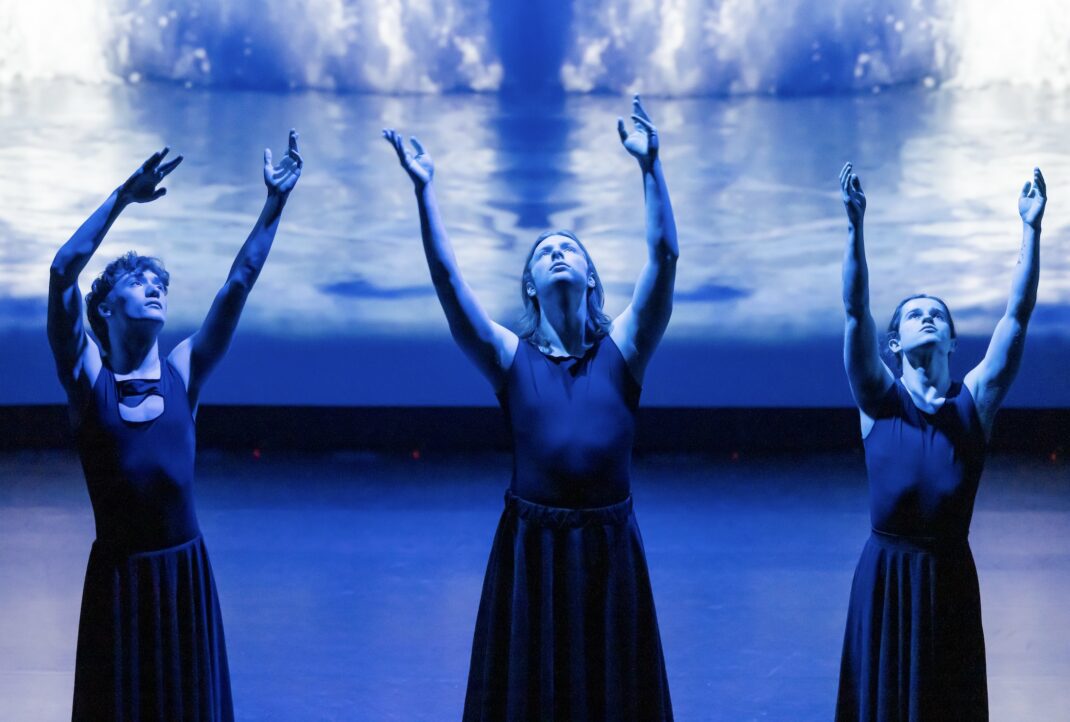
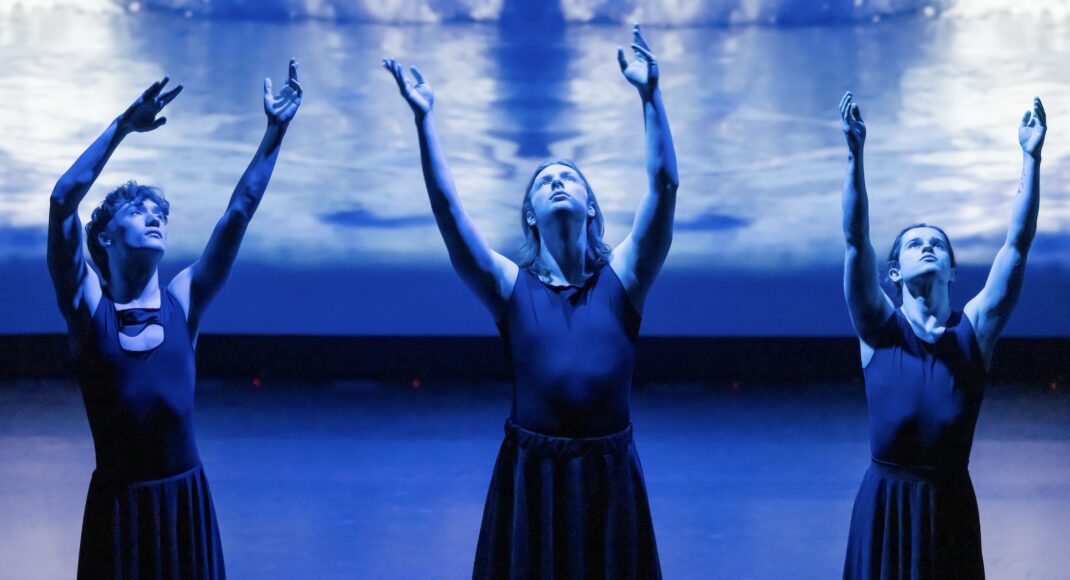
The second work, He Taonga Ki Tai-a-Roa, by celebrated alumnus of the school Taiaroa Royal (so the title is a nice pun on his name) has an all-male cast carrying the force of the long tide of the ocean rising, breaking and reaching the shore. A sustained opening sequence of upraised arms moving as reeds and seaweed underwater were not random wavings but, I suspect, clearly defined within the mesmerising choreography. The building waves of a mighty ocean were traced as though in abstract allegory, and I was thrilled to be reminded of the masterwork by Pina Bausch, Masurco Fogo, and equally of Teresia Teaiwa’s words ‘We sweat and cry salt water so we know that the ocean is really in our blood.’ If only COP3 would read those words and see this dance.
Helena May’s piece is another group work that develops as sculpture unfolding, expressing the strength found in togetherness. Each move grows from what preceded it, the hallmark of choreography as its best. Gabrielle Stevenson’s costume designs are striking in colour and movement and the work is a credit to all involved.
The final piece assembles excerpts from Moss Paterson’s Home, Land and Sea, premiered last year by Royal New Zealand Ballet. (Interesting if a little ironic that this is the only obvious link between the School and the Company across the two programs). It is fast paced, driven by Shayne Carter’s score, and gives all of the dancers a galvanising challenge which they rise to with nothing less than everything.
All the performers have futures in dance or allied fields if they so desire. We wish them the long and fruitful careers they deserve.
It is a pleasure, if an old-fashioned one, for a reviewer to be offered a press kit with printed cast lists included, even though I would have appreciated short profiles of the choreographers in the printed program.
Kia kōrero te katoa o te tinana. Make all the body do the talking. Not a bad whakatauki, proverb, for dancers to aspire to, indeed for us all.
Jennifer Shennan, 24 November 2026
Featured image: Contemporary Dance Students in a moment from He Taonga Ki Tai-A-Roa. Choreography by Taiaroa Royal. Photo: © Stephen A’Court