With New Zealand Symphony Orchestra
29 October 2026. St James Theatre, Wellington
reviewed by Jennifer Shennan
This season of The Sleeping Beauty is a restaging of RNZB’s spirited production from 2011, and artistic director Ty King-Wall has ingeniously invited back a number of the original players for the project. That’s not just a matter of nostalgia but brings mana to the stage, and echoes the Royal Danish Ballet’s practice of incorporating mature dancers as character artists in their productions. This company was founded by Danish dancer Poul Gnatt over 70 years ago, and the fact that Gnatt was one of the most renowned Bluebird dancers in Europe in his day is not lost on us either.
This production scores on many levels, and does RNZB and NZSO proud. There is an extensive national tour to seven cities across as many weeks, the logistics of which, for a production on this scale, including different orchestras in various centres, are staggering. This Company has never been cowed by challenges however (remember RNZB is the ‘most touring’ ballet company in the world) and while that is not the focus of the opening night, I thought I’d mention it anyway.
Choreographic treatment ‘after Petipa’, is by Greg Horsman, (former ballet-master at RNZB, later associate-artistic-director at Queensland Ballet), with set and costume design by Gary Harris (former artistic director of RNZB). Between them they create an assured elegance and classicism, with an impressively mobile set (dancers cleverly doubling as stage hands), of mediaeval grandeur (originally inspired by First Church, Dunedin), leavened with colour, much mischief, and a ditzy cat.
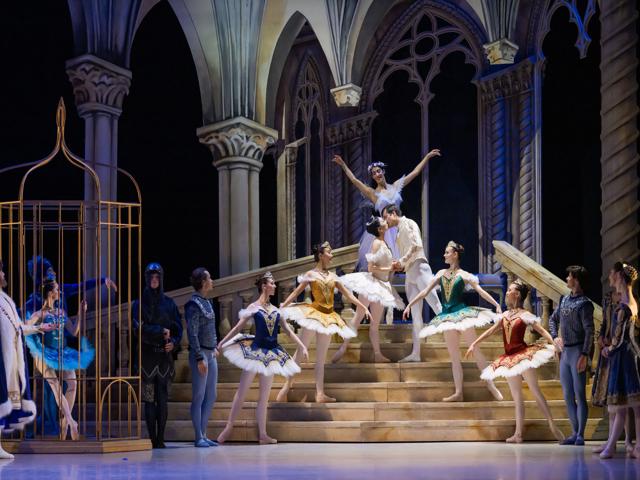
Tightened dramaturgy gives sustained roles to several characters traditionally only encountered as entertainers in the final wedding scene. Catalabutte the cat is Private Secretary to the King and responsible for all the mayhem that follows from getting the christening guest list wrong. A pair of caged Bluebirds are the parents’ wedding gift, the bluebirds of happiness encountered in many literary and visual art representations… even if the crazy cat has a different quest in mind all evening.
Such innovations are all of course bound by Tchaikovsky, and the over-long original score, arranged by Nigel Gaynor (former music director at RNZB, then with Queensland Ballet), is as keen and skilful as was all his work in his time here with Company.
The classic fairy-tale is known in early European iterations, some of them horrifyingly macabre, from wildly Gothic Charles Perrault, to the somewhat milder version by the Brothers Grimm. My young grand-daughter helpfully brings me up to date with Walt Disney’s additions of The Shield of Protection, The Sword of Truth, and The Fiery Dragon, though we’re getting ahead of ourselves here. Does it all make for good theatre? Yes, it does.
This allegory of parents’ concern for the wellbeing of their children starts with joy at the birth of a first baby, turning to terror when a curse is visited on the child’s health and future. The death sentence is commuted to a life sentence, the child will come of age at 16, there will be blood, no longer a child, followed by a 100 year wait for true love, which as we know can take at least that long in the world off-stage.
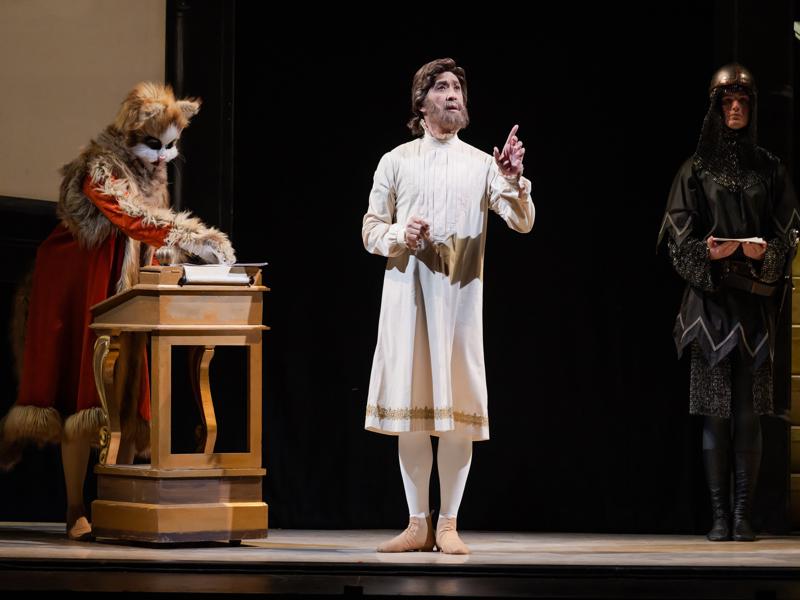
The opening scene has the King played by guest artist Vivencio Samblaceno (formerly a valued dancer with RNZB). His superb timing of gestures is the ‘Once upon a time’ of the evening. Alone in a room of the palace, nervously pacing the floor, as does every father of a first-born, while his wife is in labour (off-stage!). To help calm his nerves the King engages Catalabutte, to prepare the invitation list for the forthcoming christening. Here’s trouble for a nervous king and a ditzy cat.
The full cast rich with colour and character make poignant contrast to the central role of the Princess Aurora, Mayu Tanigaito. She keeps her fabulous technique discreet while her musicality and sense of alignment bring the poetry and delicacy of her interpretation to the fore. Her Rose Adagio is exquisitely danced. Later the pairing with the Prince, Laurynas Vejalis, brings pas de deux of real rapport and deep joy, greater than the sum of its steps. His dancing is equally pedigree, always avoiding the distractions of bravura. Theirs is a partnership of consummate quality in the ballet canon. Tell your grandchildren you saw them dance.
The line-up of fairies, colour coded to the gifts they bring, deliver attractive solos each of distinctive quality. Lilac Fairy, by Ana Gallardo Lobaina, another artist of formidable technical ability, is beautifully danced with calm authority and grace throughout.
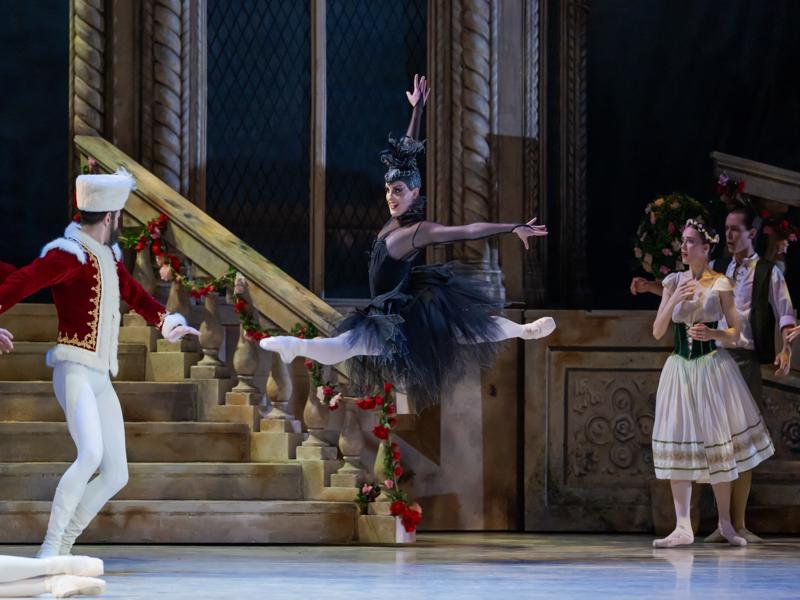
So now to Carabosse, pure evil disguised as great beauty, beware of that, the thorn on the stem of the black crystal rose. Kirby Selchow always delivers the drama of a character centre stage and in this role, tailor-made for her, she excels. But good eventually prevails, sealed with a kiss (and what a kiss!), and Carabosse is banished to the realm of war-mongering dogs this world knows too well.
There are multiple changes of cast throughout the extended season. We do not get cast lists except online, but we’re required to turn our cell phones off before curtain up ̶̶̶ so how do we know who is playing Catalabutte tonight with such hilarious timing and ubiquitous presence? Aha, we find out later, and are not surprised that it is Kohei Iwamotu, the adored dancer (formerly with RNZB, later with Queensland Ballet) who was Puck and Mercutio and more besides when he was here. Never forgotten.
Hamish McKeich is conducting the NZSO, impeccably of course, using the one arm that works. Let that be an example to us all.
Jennifer Shennan, 5 November 2026
Featured image: A moment from The Sleeping Beauty. Royal New Zealand Ballet, 2026. Photo © Stephen A’Court

If I may add a Comment to my own review…
I appreciated the chance to see an additional performance later in the season to view an alternate Principals cast (impressive that the Company manages four such alternate casts across the national tour) and also to consider again other aspects of the production. Jemima Scott uses her statuesque alignment to great effect as a charming 16 year old Aurora, and is in complete control of the many challenging balances required within that role. Zacharie Dun is an enthusiastic prince and attentive partner. The cast list projected in the foyer states that Hamish McKeich is conducting but that in fact was not the case… so we imagine it was the associate conductor, Brent Stewart in the pit? The tempi for Aurora’s solos in several places seemed to be extremely slow but she nonetheless danced rubato in an impressively sustained performance. (I always register much disappointment when someone in the audience excitedly breaks into applause because a balance lasts one second longer than it might … so of course others follow suit, with even some cheers thrown in. Are we at the ballet or the circus? A previous artistic director some years back actually invited this mid-performance cheerleading but I always felt it belonged more on the sports field than in the theatre). The long dream sequence when the Prince dances first with Lilac Fairy then with Aurora has proved somewhat confusing for some since he hasn’t actually made it through the forest yet. (That scene could with advantage be trimmed down). Lilac Fairy was beautifully and subtly danced by Gretchen Steimle, and Ana Gallardo Lobaina made a striking Carabosse. Bluebirds, Katerina Estevez-Collins and Kihiro Kusukami (same cast as opening night) were again a very successful pairing. This is altogether a celebratory season–and one wishes the Company well on its national tour.