Vaslav Nijinsky’s costume for Le Dieu bleu. Some comments

In the very glamorous exhibition, Ballets Russes: the art of costume, currently showing until late March 2011 at the National Gallery of Australia in Canberra, one of the most discussed items is the tunic from the costume for the Blue God from the ballet of the same name—in its French form Le Dieu bleu.
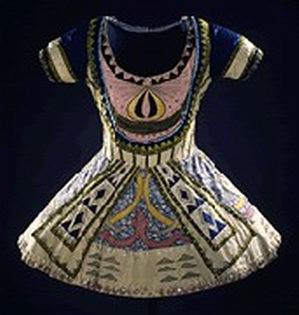
Léon Baskt, Tunic from costume for the Blue God, c 1912, from Le Dieu Bleu National Gallery of Australia, Canberra, purchased 1987

Its popular appeal rests largely on the fact that the tunic was worn by Vaslav Nijinsky, creator of the role of the Blue God and dancer and choreographer with Serge Diaghilev’s Ballets Russes. Not only was the costume worn by Nijinsky and as far as we know by no-one else, but traces of the make-up Nijinsky wore as the Blue God can still be found as marks on the inside the costume.

But we also know that the ballet was not a major success and was given very few performances after its 1912 premiere and quickly disappeared from the repertoire. That there were only a few performances of the ballet is both a blessing and a curse.

From a positive point of view it means that the costume, designed by Léon Bakst one of Diaghilev’s best known designers, is in excellent condition. While this situation reflects in part the exemplary conservation that has been carried out by the National Gallery’s conservation staff, it also reflects the fact that despite that the fact that the tunic is almost 100 years old it has not suffered from the wear and tear that constant use has on the fabric, decoration and stitching of dance costumes. Its excellent condition may also relate to the fact that it was made by two of the top Parisian costumiers of the time, M. Landoff and Marie Muelle. Madame Muelle in particular is known to have insisted that only the best quality fabrics be used and that decorative elements be appliquéd or embroidered rather than stencilled onto the fabric. She was also said to have had a secret metal thread that never tarnished.

A close-up look at the costume reveals that it encapsulates many of the principles that Bakst used throughout his design career, in particular a use of different textures in the one costume and daringly juxtaposed patterns and colours. He always made his interests, which included his understanding that dance was about movement, very clear in his designs on paper.
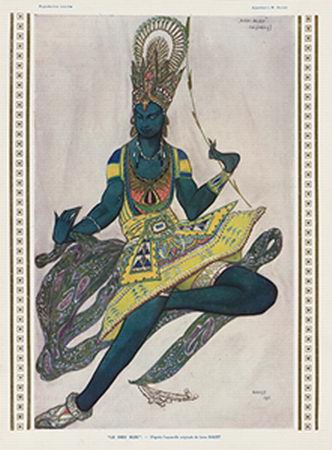
Léon Baskt, Design for tunic for the Blue God, c 1912, from Le Dieu Bleu National Gallery of Australia, Canberra, purchased 1987

The costume is largely made from silk, satin, velvet ribbon, braid and embroidery thread, although set against the luxury silken fabrics are panels made from a simpler cotton or rayon material patterned with a floral, lotus-inspired design. The tunic’s dominant colours are pink, blue, gold and green and black and triangular and diamond patterns sit beside curves and half circles. Emerald green jewel-like sequins spill down strips of olive green braid.

Some parts of the tunic have been machine stitched. Others have been sewn by hand. The faux mother of pearl decorations along the hem of the tunic, for example, were hand sewn onto the fabric and the tacking stitches joining them together in a row can be seen where some of the decorations, now extremely fragile, have fallen off. The tunic has a row of metal fasteners, hooks and eyes, running right down the back—no zips, no Velcro in those days. Nijinsky would have simply held out his arms as the tunic was slipped on by his dresser, who would then have hooked him into the costume.

The Gallery’s collection also includes the gold headdress for the costume. It is equally as fascinating to study close up. Its double row of decorative points attached to a tight fitting skull cap is made of metallic gauze stitched by hand onto a wire frame with metallic thread—perhaps even with Mme Muelle’s untarnishable secret thread?

But in a more negative vein, because the work was performed on such a small number of occasions, what do we know about the choreography? Probably very little really. However, a number of historians have noted that Bakst and Michel Fokine, Le Dieu bleu‘s choreographer, had been deeply impressed by performances given in St Petersburg in 1900 by the dancers of the Royal Siamese Court and had incorporated choreographic and visual ideas from these performances into several Ballets Russes productions on which they worked, including Le Dieu bleu. Still photographs of Nijinsky show that static poses rather than a fluid and expressionistic form of movement may have been dominant, recalling the dance style of the Siamese dancers.

But another dance troupe from the other side of the world probably had just as much influence on the creation of Le Dieu bleu as did the dancers of the Royal Siamese Court. In 1906 the Royal Cambodian Ballet came to France for the Colonial Exhibition staged in Marseille, Cambodia being at that stage a protectorate of France. The Cambodians gave several performances in Paris in July of that year, just as Diaghilev was in Paris preparing for his major exhibition of Russian paintings, which was presented a little later that year at the Salon d’automne. It is hard to imagine that Diaghilev and his team would have been unaware of the Cambodians. They caused a sensation in Paris and had a major influence on a number of French artists, including the sculptor Auguste Rodin who followed the company to Marseille and executed a major series of drawings of the dancers. Many newspapers, including the Parisian daily Le Petit Journal and the influential Le Petit Parisien, carried news of and advertisements for the Cambodians and most carried drawings and posters of the dancers against a background of Cambodian temples.
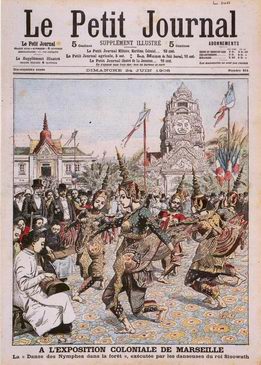
Cover of Le Petit Journal, 24 June 1906

Bakst appears to have drawn on these printed sources for his backcloth, which features a huge rock face carved with faces of gods. It clearly recalls the posters in Parisian newspapers, which in turn recall the huge faces carved into the rock at the gateways to the Angkor Thom temple in Siem Reap, Cambodia.

Costumes for subsidiary characters in the ballet as held by the Victoria and Albert Museum and on display in their London exhibition, Diaghilev and the golden age of the Ballets Russes 1909–1929, confirm that Bakst was indeed influenced by the interest in Cambodia that was generated in 1906. In particular the costume for a Little God, illustrated on p. 79 of the Victoria and Albert Museum’s catalogue, shows a towering headdress with four god-like faces smiling beatifically out to the potential auditorium. The headdress looks totally unlike anything a Cambodian dancer would have worn (or currently wears). The faces look a little more like Western-style putti than anything else and one can’t help but wonder whether Bakst only ever saw the cover of French magazines of the time and never the dancers themselves. However, the Cambodian influence is clearly there.

But the tunic for the Blue God will always evoke the man who created the role and who caused so many scandals for the Ballets Russes of Serge Diaghilev, that is Vaslav Nijinsky. The power of his name, like that of Anna Pavlova, will always make anything associated with him appealing to a wide spectrum of the population. One of Nijinsky’s colleagues, the ballerina Lydia Sokolova, has described in her memoirs the first sight the audience would have had of Nijinsky as the Blue God. She writes that he was seen ‘at the top of a flight of wide steps at the back of the stage, seated on a throne with legs crossed, holding a flower’. He was wearing the tunic now on display in Ballets Russes: the art of costume.
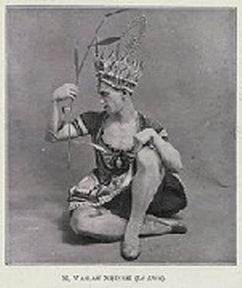
Unknown photographer, M Waslaw Nijinski (Le Dieu), p 36 in Comœdia Illustré, special edition, no 16, 15 May 1912.  National Gallery of Australia, Canberra

© Michelle Potter, 27 December 2010

This post is an amplified and enhanced version of my article ‘Homage to the Blue God’ first published by The Canberra Times on 18 December 2010.

The website for the National Gallery’s exhibition is at this link.

BIBLIOGRAPHY

  • Bell, Robert (ed.). Ballets Russes: the art of costume (Canberra: National Gallery of Australia 2010)
  • Buckle, Richard (ed). Dancing for Diaghilev. The memoirs of Lydia Sokolova. Paperback edition (San Francisco: Mercury House, 1989)
  • Misler, Nicoletta. ‘Siamese dancing and the Ballets Russes’ in Nancy van Norman Baer (ed.), The art of enchantment: the Ballets Russes 1909–1929 (San Francisco: Fine Arts Museums of San Francisco, 1988), pp. 78–83
  • Musée Rodin. Rodin and the Cambodian dancers: his final passion (Paris: Editions du Musée Rodin, 2006)
  • Pritchard, Jane (ed.). Diaghilev and the golden age of the Ballets Russes 1909–1929 (V & A Publishing, 2010)

Comments on this post are now closed. The discussion continues on part two.
The Nutcracker. The Australian Ballet (2010)

There was a time when Christmas in Sydney without a production of The Nutcracker was unimaginable. The ballet attracts a festive audience, there is no doubt about it. So it is hardly a surprise that the Australian Ballet’s staging of Peter Wright’s Nutcracker as its final offering for the 2010 Sydney season was a total sell-out.

This Nutcracker does not strive too hard for psychological explanations or modernisations and the production has a clear and very welcome logic to it. Nothing happens in the transformation scene, when the Christmas tree grows, mice (rats I think in this production?) emerge and engage in a fight in which they are ultimately the losers, and Clara’s Christmas gift of a nutcracker doll turns into a handsome prince, which is not prefigured in some way in the party scene. The second act too has more logic than usual. Clara’s involvement with the dances is a welcome addition, as is her transformation—she is an aspiring dancer in this production—into the Sugar Plum Fairy. While the ballet still of course requires suspension of belief, there is a coherence that is unusual in a staging that does not diverge markedly from the traditional storyline.

The production was also pleasing from a technical point of view. And by this I mean that for once there were no loud bangs and crashes from backstage as scenery was moved in and out. I have winced more than once throughout the 2010 season at noises off stage that were never meant to be heard in the auditorium.

There was also some great dancing, and what a treat that is! A total standout was Madeleine Eastoe as the Sugar Plum Fairy. She was technically assured, her feet sparkled and there was such a delicious flow of movement in her torso as her spine stretched upwards through to her beautifully poised head. She gave such light and shade to the choreography with some unexpected changes of pace in her movements. She was every inch the ballerina—commanding but never overbearingly so. And what a magnificent, beautifully placed and perfectly executed diagonal of fouettés at the beginning of the coda!

As for her partner, Yosvani Ramos, he was sadly encumbered by a jacket in a startling shade of lolly pink—very unbecoming I thought. And to make matters worse the neckline seemed quite stiff and much too high for him. It made him look as though he had an incredibly short neck—not good when he is not the tallest of dancers in the first place. It quite detracted from some really nice dancing on his part.

Reiko Hombo danced the role of Clara and acquitted herself well showing absolute engagement with the role. Leanne Stojmenov as the Rose Fairy could scarcely put a foot wrong. The choreography here demands a dancer with a strong sense of classical order and in such situations Stojmenov always displays a natural ability and an exceptional level of expertise. Daniel Gaudiello had a small role in the first act as Drosselmeyer’s assistant. With his ability to realise a character, his powerful presence on stage and his technical prowess, especially when it comes to beaten steps and steps of elevation, Gaudiello turned this role into something exceptional and quite idiosyncratic. There were also fine performances from Andrew Killian as Drosselmeyer and Tzu-Chao Chou as the Jack-in-the-Box

There were moments when I found the costume and set design by John F. Macfarlane overbearing and fussy. Apart from wishing that the Prince’s pink jacket was not quite so inelegant, I also craved a little more subtlety in the set for Act II, which suffered in my opinion from a surfeit of colourful motifs including two different kinds of very large flowers, a stylised (anthropomorphised) sun and a bunch of swirly ribbons. But this Nutcracker is a Christmas treat to delight young and old alike and closed the Australian Ballet’s 2010 season on a high note.

Michelle Potter, 12 December 2010

Balinese dance performance, 1934

Dandré-Levitoff Russian Ballet. The Balinese interlude

I have been curious for some time about an alleged visit to Bali by the dancers of the Dandré-Levitoff Russian Ballet following their departure from Surabaya on 28 September 1934 bound for Brisbane. Anton Dolin in The Sleeping Ballerina records that in Bali ‘there was time for Olga [Spessivtseva] to visit the many temples and see the dances of Bali, which interested her profoundly’. But hard evidence of this visit has seemed non-existent, until now.

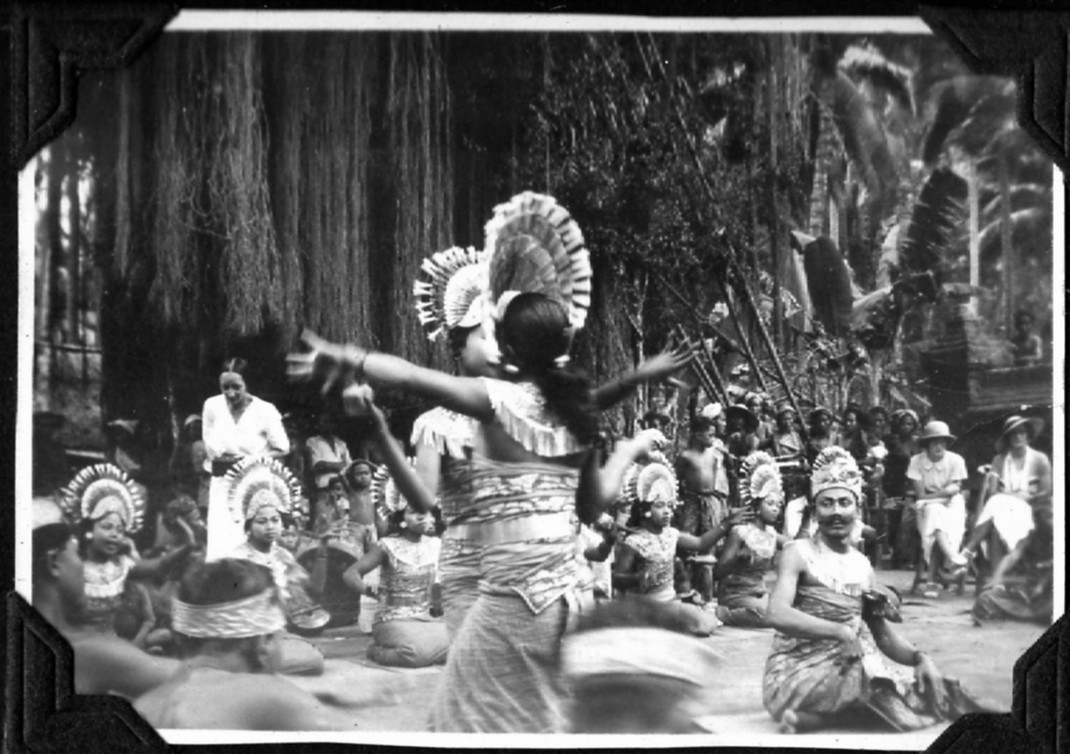
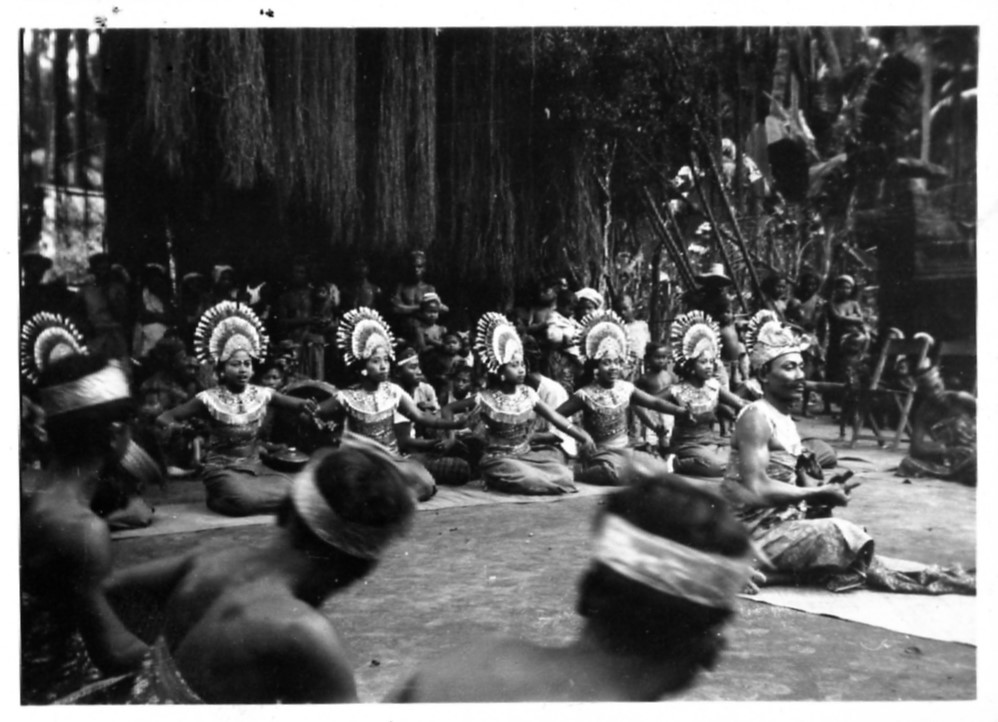
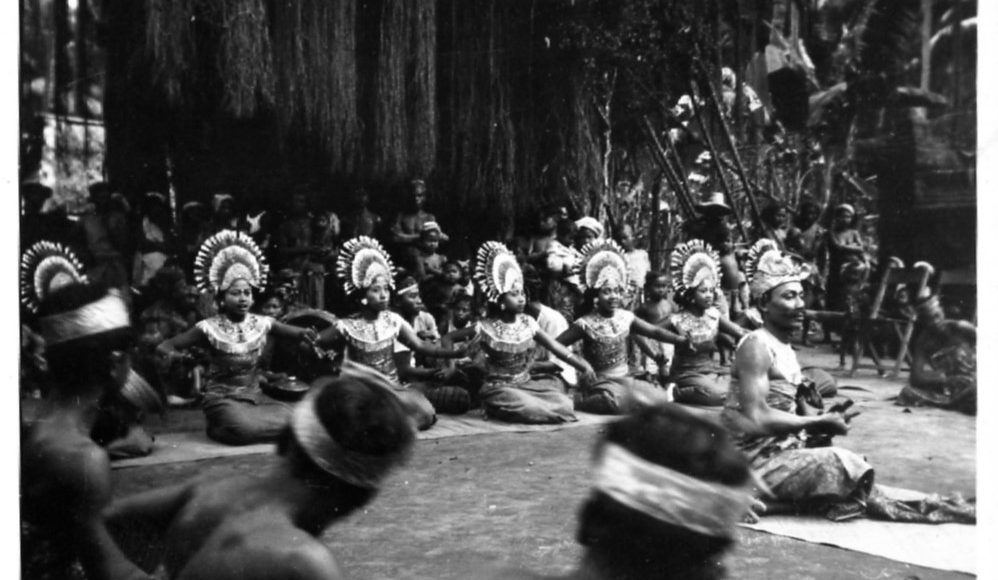
English dancer Anna Northcote had been part of this touring company from its beginnings early in 1934 when the dancers assembled in Paris to rehearse parts of their repertoire with Alexandra Fedorova and Mikhail Fokine. She records her experiences in Paris in an article written in the magazine MOVE in 1970. But it is her photograph album that is of particular interest in the Balinese context. It shows quite clearly that the dancers did indeed visit Bali—Northcote gives the date as 29 September 1934—and were present at one or more performances of Balinese dance. Her album contains several pages of photographs from Bali, most of which record an outdoor performance under the shade of a large banyan tree. In some Spessivtseva can be seen in the background, dressed in white with her dark hair parted in the middle and pulled back in its signature style, absorbed in taking photographs herself.

Olga Spessivtseva taking photographs of a Balinese dance performance for the Dandré-Levitoff Russian Ballet, 1934. Personal Archive, Anna Northcote (Severskaya), Private Collection

The exact location of these photographs is hard to pinpoint. The London Illustrated News for 21 March 1931 contains images taken in what appears to be the same location and notes that the performance recorded in the magazine’s photographs took place ‘in the village of Kedaton’.  This is more than likely an error as kedaton is a variant spelling of kraton meaning ‘palace’ and both the performance in The London Illustrated News and that photographed by Northcote probably took place in the temple courtyard of a royal palace somewhere on the northern coastline of Bali, probably Singaraja.

At the time the dancers visited Bali, the town of Singaraja was the Dutch colonial administrative centre for Bali and the Lesser Sunda Islands. It was the port of arrival for most visitors who, if they visited the southern region, usually did so by road. Moreover, the Dandré-Levitoff Russian Ballet travelled to Brisbane on the Nieuw Holland a ship of the Dutch KPM line. It was the KPM line that initiated the first tourist passages to Bali initially on its cargo ships, which regularly visited Singaraja anchoring at its port of Buleleng.*

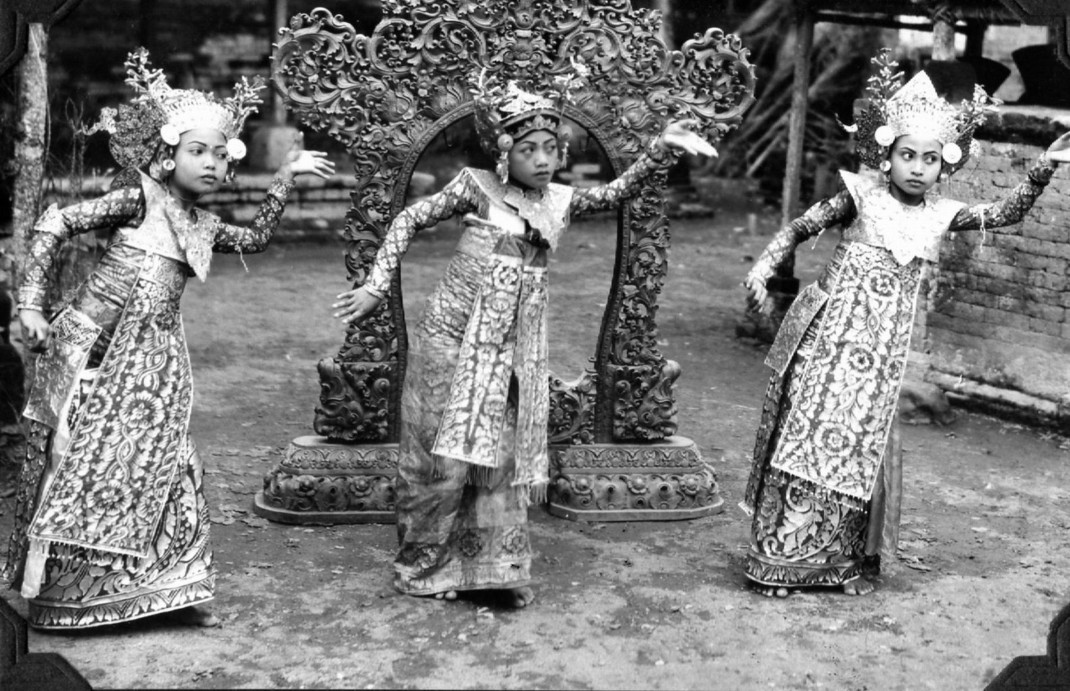
Northcote’s album also contains an image of three Legong dancers taken in what seems to be a different location suggesting that the dancers may well have seen more than one performance.

Legong dancers. Personal Archive, Anna Northcote (Severskaya), Private Collection

The Balinese interlude continues to invite questions and needs further research. But now it is certain that the dancers called at Bali after boarding the Nieuw Holland in Surabaya.

© Michelle Potter, 9–10 December 2010

Featured image: Balinese dance performance. Personal Archive, Anna Northcote (Severskaya), Private Collection

Balinese dance performance, 1934

*Colin McPhee in his book A House in Bali (1947) mentions a village called Kedaton in the Den Pasar region. But it does not seem likely that the dancers would have had time to take the then arduous road trip from Singaraja to Den Pasar and back, given Bali was a stopover rather than a final destination for the ship (and assuming that the Nieuw Holland was following its usual route and anchored in Buleleng harbour).

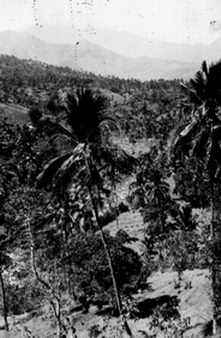
The dancers did, however, visit part of Bali beyond the coastline as Northcote’s album again indicates. Her photograph entitled ‘Valleys and volcanoes’, with its steeply terraced rice fields, is typical of the countryside immediately to the south of the northern Balinese coastline.

‘Valleys and volcanoes’, 1934. Personal Archive, Anna Northcote (Severskaya), Private Collection

Information on the company’s touring activities in Java immediately prior to their Balinese visit is in a previous post: Dandré-Levitoff Russian Ballet: Indonesia, September 1934

Edge of Night. The Australian Ballet

This last triple bill of the Australian Ballet’s 2010 season was an opportunity to revisit two ballets created by resident choreographer Stephen Baynes and to ponder on the emergence of a new force in Australian choreography, Tim Harbour.

Edge of Night, which gave the program its name, was first seen in 1997. What especially stood out for me from this 2010 viewing was the visual strength of the work. Michael Pearce’s set and costumes and Stephen Wickham’s lighting evoked just the right atmosphere of nostalgia, longing and sad (and perhaps not so sad) memories. A real sense of collaboration was evident and Pearce in particular deserves many accolades for bringing a quality of surrealism to the design, which suggested the role of the subconscious in our most nostalgic encounters. Pianist Stuart Macklin added to the mood with his expressive playing of the seven Rachmaninov Preludes to which Edge of Night is set.

Kirsty Martin was elegant in the leading female role and the partnership with Robert Curran as the man in her past was as smooth as silk. But Martin played the part a little coldly for my liking missing the opportunity to develop an emotional connection with the audience. The stand-out performer was Laura Tong as the girl on the swing. She did connect with us and the youthfulness and the ‘breath of spring’ quality to her dancing was a joy.

Harbour’s new work, Halcyon, had a strong narrative line and suffered from being pretty much incomprehensible unless one knew intimately the Greek myth concerning the wind goddess Halcyon’s doomed love affair, and its consequences, with the mortal Ceyx. The ballet needed surtitles! However, if one ignored the narrative and watched from a purely visual and theatrical point of view—and I’m ignoring for the moment the implications of that idea—there was much to admire. Harbour’s choreography was brimming with ideas and I was especially taken by the fact that he had managed to imbue the choreography with the look of ancient Greek sculpture while also giving it a real contemporary edge. Stage concept and lighting was by the Melbourne-based lighting and design company, Bluebottle, and their designers made effective use of backlighting to create two worlds of action by at times turning what initially looked like a backcloth into a scrim. The work looked fabulous and the dancers looked beautifully rehearsed and absorbed in executing the choreography for maximum effect. But oh … that need for surtitles!

The closing work on the program, Baynes’ Molto Vivace, is a crowd pleaser, and to my mind an exercise in silliness, danced to a compilation of works by Handel. It was first seen in 2003. Dourly I have to say that I have never been a fan of this work but I laughed my way through it unable to do anything else when the woman behind me was almost hysterical with laughter from opening to closing moment. Laughter breeds laughter.

Leanne Stojmenov danced the leading role of the Lady but again like Martin in Edge of Night I found her performance beautifully rendered but a little cold. In the glorious central pas de deux with its exquisite lifts and soft, sighing movements, which for me is the raison d’être of this work, she looked perfect in an Alice in Wonderland kind of way. But thoughts of Simone Goldsmith, who created the role in 2003 and whose extreme vulnerability gave to the pas de deux a deep humanity, were hard to erase from my mind.

Michelle Potter, 28 November 2010

Out of context—for Pina. Les Ballets C de la B

Alain Platel founded Les Ballets C de la B (Les Ballets contemporains de la Belgique) in Ghent in 1984 and since then he has always taken rather large risks in creating work for the company. Out of context—for Pina is no exception.

The work begins slowly. We sit in our seats looking for a time at a bare, sparsely lit stage. We listen to the beginnings of a soundscape of animal-like sounds. Eventually, one by one, nine dancers stand up from seats in the auditorium, move to the stage, take their places upstage with their backs to us and begin to strip down to their underwear. They wrap themselves in orange blankets and turn to confront us before beginning to interact with each other. In these initial stages the interaction is minimal. The dancers nuzzle each other gently, sniff and rub against each other. They are a little like dogs greeting each other, sniffing out territory.

The work gathers pace from here with the dancers shedding their blankets to perform and returning to their folds when lesser activity is required of them. At one stage there is a kind of disco sequence when the dancers attempt to sing snatches of popular songs although their language carries a kind of speech impediment and their movements are marked by odd twitches and tics recalling physical disability.

Platel was previously a teacher for people with motor disabilities and throughout the piece his choreography explores some kind of dichotomy between apparently dysfunctional movement and a kind of transcendental power of the human body in motion. This is nowhere more apparent than in the closing solo by a male performer whom I was unable to identify (there was no program). Dragging two full-length microphone stands with him, one in each hand, this dancer seemed on occasions to have a disability, both physical in his slightly uncoordinated movements, and otherwise as he stared out at us at the end of the solo. Yet at other times he seemed more like an Olympic athlete with a javelin in each hand.

The strongest performer overall to my mind was, however, a woman who looked a little like Frida Kahlo and who I imagine was Rosalba Torres Guerrero (similar problem with identification—no program and I relied on advertising material to guess). She had a commanding presence that showed itself in every movement, large or small. She was especially remarkable in her duets with male members of the cast, which often bordered on the erotic and which involved complex partnering, and in a scene in which she lay on the ground wrapped in her orange blanket and reacted with diverse facial movements to the appearance of an opera singer (who was not one of the dancers but who appeared from the auditorium at one stage during the performance).

As for the work’s relationship to Pina Bausch, whose name appears in the title, Platel has remarked in an interview for the Canadian newspaper The Globe and Mail:

‘Pina died during the creation process, so I added on the dedication. I’d known her for 30 years and admired that special way she used dancers, transforming them into personalities. She also established the practice that any movement or thought could be used in dance.’

I would argue that there were choreographers in the United States working with the concept that anything could be dance well before Bausch. However, the notion of ‘anything’ is likely to be more expressionistic and emotionally confronting in choreography made in Europe than in a society like that of the United States, where a veil is often drawn over the less pleasant aspects of human behaviour (99% of the time the toilet is euphemistically referred to as the bathroom for example). The ‘anything’ vocabulary created for Out of context is confronting, but like that of Bausch demands that one have an opinion.

Michelle Potter, 16 November 2010

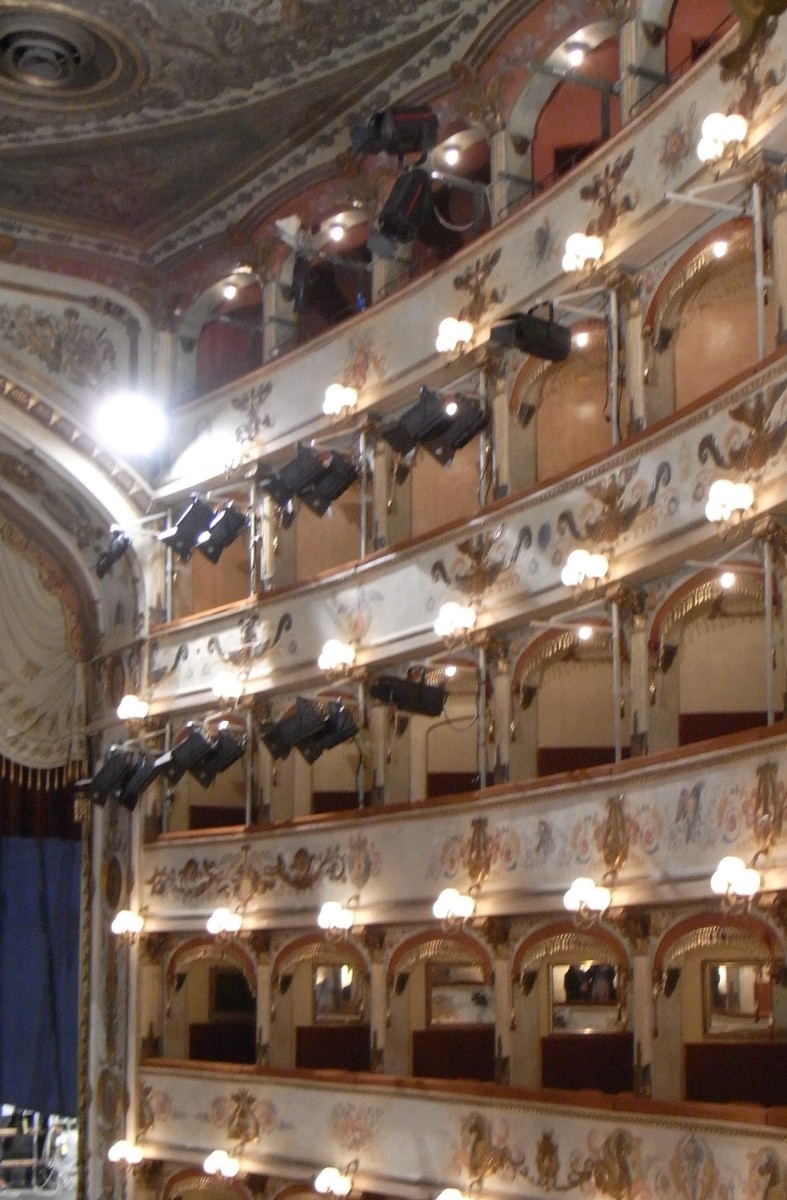
Postscript: The performance I saw took place in the beautiful old Teatro comunale di Ferrara. The construction of this theatre, whose auditorium is horseshoe shaped in the tradition of many old European opera houses, began in 1773 and much of its original decoration remains.

Teatro comunale di Ferrara