Mirrors and Scrims. Marcia B Siegel

Marcia Siegel’s recently published collection of reviews and essays, Mirrors and Scrims: the life and afterlife of ballet, is a real stunner. Such collections are usually useful to dip into to find a contemporary opinion when researching a particular work, choreographer or era. Mirrors and Scrims is, of course, useful in this way. But it also offers so much more. Siegel’s writing is perceptive, lucid, coherent and honest. It also often pushes the reader to investigate or question further his or her own assumptions about dance. What a delight that is in this twenty-first century when much of the readily available dance writing is little more than a regurgitation of a puffed-up media release.

On an obvious level, Siegel has an enviable capacity to describe what she sees on stage in terms that can easily be visualised by the reader. Take her description of the second movement of Balanchine’s Mozart Violin Concerto for example. Siegel writes:

‘In this movement, essentially a long adagio pas de deux, the corps is always present, sometimes as witness, posing in lines and semicircles around the principal couple, and sometimes, strangely, forming little sub-groups that seem engaged in their own private colloquies. Then, toward the end, the women become almost an abstraction, coming forward in a straight line so that they discreetly mask the solo man and woman just as she’s fallen into his embrace.’

This is deceptively simple writing. On the one hand it gives us a clear, straightforward idea of the formal structure of this movement of the work. But on the other, it also subtly gives an insight into an emotional underpinning with just an apposite word or two, judiciously placed.

At the same time, Siegel’s writing has the capacity to analyse a work within its wider cultural and historical context. Take for example her discussion of the revival of Balanchine’s Cotillon by Tulsa Ballet. She writes:

‘The ballet is a clear choreographic bridge between the lush, narrative Diaghilev era ballets and the neoclassical austerity of the latter-day Balanchine. It does, however, represent a strain of romanticism and fantasy that the choreographer kept to the end of his life.’

The whole discussion of the Cotillon revival is a fascinating read, as are Siegel’s discussions of other revivals from the Diaghilev era, a subject that is clearly of great interest to her.

Siegel has also worked through many philosophical issues as they relate to dance writing and reviewing. She takes a clear, personal stand. Right from the beginning she states:

‘I see myself as both a demystifyer and a validator, sometimes an interpreter, but not a judge.’ She fearlessly carries through with this stance. In an analysis of the position of the much-admired critic Arlene Croce (as understood from her reviews), Siegel writes:

‘I think a critic has to take even mavericks and crackpots at their word. In not doing so, Arlene Croce places herself above the artists. She implies she knows better than they do what’s right for dance. To my mind, that’s the one thing a critic isn’t allowed’.

The essay in which this comment occurs, ‘Balanchine and beyond’, is full of points for further discussion and development in those situations (I wish they occurred more frequently) where those who love dance come together to discuss dance and how to look at it. Reading ‘Balanchine and beyond’, I couldn’t help thinking of the concept of intentional fallacy, the idea (probably unfashionable at the present time) that what an artist intends is not a standard by which to measure a work. Intentional fallacy veers onto a slightly different pathway from Siegel’s discussion of the need ‘to take mavericks and crackpots at their word’ but it is nevertheless a related and equally as interesting issue.

Mirrors and Scrims covers close to three decades of Siegel’s writing in publications that include Ballet Review, Boston Phoenix, Christian Science Monitor, Dance Now, Dance on Camera Journal, Hudson Review, Village Voice and Washington Post Book World. And although the excerpts I have quoted above all relate to Balanchine in some way, the writing in this collection covers the work of many choreographers. It also covers many genres of dance and analyses many formats in which dance reaches an audience, including dance on film and books about dance.

Siegel notes in her introduction that she has organised the entries around themes of authenticity and change. To give further shape to the collection she has grouped her selections into seven sections. Each section reads well as a variation on a theme making the book a satisfying, and often an edifying journey rather than simply a chronological one as often happens with such collections of essays. And as with all collections of this nature, some pieces and some themes will touch a individual nerve in a special way. I particularly admired Siegel’s obituary for the critic Edwin Denby, ‘Edwin Denby, 1903-1983’—a moving and personal tribute, which includes the following comment:

‘He knew long before I did that dancing is like living, and that the better we can perceive the ordinary specialness in living, the better we’ll see the out-of-the-ordinary specialness of dancing.’

I also relished reading an essay called ‘Reclaiming the ordinary’. It deals with PASTForward, a program staged by Baryshnikov’s White Oak Dance Project that revived some of the works from the Judson era in American dance. At one point Siegel writes:

‘Judson made the acceptable dance vocabulary immensely bigger by reducing the stimulus: with almost nothing to look at, there’s suddenly so much more.’

Marcia Siegel knows dance and is not afraid to call it the way it is. Mirrors and Scrims deservedly won the 2010 Selma Jeanne Cohen Memorial Prize.

Michelle Potter, 7 November 2010

Marcia B. Siegel, Mirrors and Scrims: the life and afterlife of ballet, Wesleyan University Press, 2010
416 pp; 27 illustrations
ISBN 978-0-8195-6875-5 (cloth) USD85.00
ISBN 978-0-8195-6926-4 (paperback) USD27.95
Ethan Stiefel to direct the Royal New Zealand Ballet

In an astonishing coup, the Royal New Zealand Ballet has just announced that Ethan Stiefel, currently principal dancer with American Ballet Theatre and dean of the School of Dance at the University of North Carolina School of the Arts, will be its next artistic director, taking up the position in the second half of 2011.  Stiefel will be joined by Gillian Murphy, his partner in life and also a principal with ABT.

Stiefel’s comments on his appointment are: ‘I am enormously appreciative and enthusiastic about having been appointed the next Artistic Director of the Royal New Zealand Ballet. Becoming RNZB’s Artistic Director provides me with an exceptional opportunity to professionally and personally evolve and to contribute to the art form I truly love. It is very encouraging to see how much the company has already achieved, the potential it possesses and how the nation embraces its national ballet company. I look forward to building on the company’s fine reputation, while seeking to be a fresh, innovative and inspiring new leader for the RNZB in any way I can. Both myself and my partner in life; American Ballet Theatre Principal Dancer, Gillian Murphy, are ready for this new chapter in our lives and wholeheartedly make a commitment to the new adventures and prospects it holds. Finally, I also look forward to connecting with my relatives living in New Zealand today and, being a sports enthusiast with Kiwi blood, I’m also looking forward to supporting the All Blacks!’

I can see that ‘crossing the ditch’ will become more common for Australian dance folk. One of my fondest memories of living in New York between 2006 and 2008 was seeing an ABT production of La Bayadère in which Stiefel danced Solor, Murphy Gamzatti and Diana Vishneva Nikiya.

Michelle Potter, 30 October 2010

La Valse; Invitus, Invitam; Winter Dreams; Theme and Variations. The Royal Ballet

15-30 October 2010. Royal Opera House, London

Frederick Ashton’s La Valse—what a swirlingly beautiful opening to the Royal Ballet’s recent mixed bill program. Ashton’s choreography seemed slightly idiosyncratic with its unexpected shifts in épaulement, swift lifts of the arms, quick bends of the body and a range of nuanced movement. Yet it was perfectly attuned to the changes of colour and rhythm in the Ravel score. In addition, the Royal Ballet dancers performed with such aplomb and brilliant attack not to mention a beautiful classical technique based, as it should be, on turned-out, centred movement.

The two works that followed were both exceptional distillations of involved narratives. Kim Brandstrup’s new work, Invitus, Invitam (Against his will, against her will) essentially compressed Racine’s play Bérénice into three pas de deux, while Kenneth MacMillan’s Winter Dreams distilled Chekov’s work The Three Sisters into one dramatic act.

In Racine’s version of part of Suetonius’ history of the Roman emperors, Titus is forced by the senate to send Bérénice, his mistress, away, against her will and against his will. In Brandstrup’s work we see three encounters between Titus and Bérénice: in the first Bérénice is aware that Titus has a concern that he is not speaking openly about; in the second Bérénice knows what is to happen and is devastated, as is Titus; and in the third they part in mutual sorrow. Leanne Benjamin is perfectly cast as Bérénice. All her maturity as an artist comes to the fore as the inevitable parting approaches. Edward Watson is her partner and he too captures the sense of impending drama.

Choreographically Brandstrup’s three pas de deux draw the two protagonists together and at the same time separate them from each other. Both Benjamin and Watson gave exceptional performances, strong yet tremulous with emotion. Benjamin’s dancing was faultless and her portrayal of the role was vulnerable in the extreme. Richard Hudson was responsible for the costumes and minimal setting, so in empathy with the distillation of the story. His screens and scrims and his use of computerised writing and sketches, which appeared sporadically on the screens, added just the right sense of location. The contemporary score by Thomas Adès was based on the work of Couperin and again was empathetic to Brandstrup’s overall conception. Invitus, Invitam was intensely moving and certainly deserves further performances.

Winter Dreams was led by Sarah Lamb as Masha and Thiago Soares as Vershinin with minor principal roles being taken by Mara Galeazzi as Olga and Roberta Marquez as Irina. Together they provided a strong performance of this bleak story.

The closing work on this generous program, the pièce de resistance in my mind, was Balanchine’s Theme and Variations. I was not at the opening night’s performance when, I am told, Tamara Rojo and Sergei Polunin took the leading roles and when Alicia Alonso, creator of the ballerina role for Ballet Theater in 1947, was in the audience. But I was more than happy to see a radiant Marianela Nuñez partnered by a dashing Nehemiah Kish dancing with all stops out in this ferociously demanding work. From the opening moments when the ballerina and her partner present themselves to us, to that wonderful moment as the work comes to a close when grands battements merge into high-kicks, this is a work to be savoured for the remarkable display of the classical technique that it is. And again the entire complement of dancers showed what an outstanding company the Royal is at the moment.

I could, however, have done without Peter Farmer’s set for Theme, which to my mind suffers from a surfeit of draperies. Simplicity is all that is needed as a foil to Balanchine’s intricate weaving of bodies across the stage. But what a pleasure it was to see such beautifully trained bodies dancing with such a secure sense of classicism.

Michelle Potter, 27 October 2010

Trisha Brown Dance Company at the Tate Modern

What is it about Trisha Brown’s 1976 work Line Up (Spanish Dance) that is so enticing? Is it the brevity—it can’t last  more than two minutes or so? Is it the Bob Dylan song (Early Morning Rain) that accompanies it? Is it the apparent simplicity of the choreography as the cast lines up equidistant from each other and one by one moves towards the person in front to create a mini-train of tightly bunched-up bodies. Is it the inevitability of it all as the wall looms closer and we know what the outcome has to be? Is it the sexy, hip-swaying walk with which the dancers proceed towards the wall in front of them? Whatever it is, it was there as the Trisha Brown Dance Company performed this work at London’s Tate Modern as part of the UK’s Dance Umbrella 2010.

The Trisha Brown event at the Tate Modern began on the bridge that crosses the vast Turbine Hall, which is the first encounter many visitors have with Tate Modern’s spaces. On the bridge four dancers, Tamara Riewe, Leah Morrison, Laurel Tentindo and Elena Demyanenko, performed Group Primary Accumulation a Brown work from 1970. While one’s own mind is allowed to wander and to speculate on many things as one watches, there is no room for the dancers’ minds to wander as, lying on the floor for the duration of the piece, they perform a sequence of movements that grows in complexity as the moves are repeated and added to with each repeat. The dancers’ level of concentration is more than admirable and the effect quite mesmerising.

Group Primary Accumulation was followed by Leaning Duets (1970) in which three groups of two dancers made their way down the sloping entry space of the Turbine Hall. With hands joined, inside arms extended tautly and sides of the inside foot pushed against that of the partner, each pair of dancers walked a step at a time down the slope, each testing the extent to which he (or she) could lean to the side without losing balance. It was especially interesting to see, a little later in the Tate’s film tribute to Brown, such duets being performed in 1970 in what appeared to be the streets of downtown Manhattan. Then the duets took place in a much more relaxed and casual environment and amongst curious and bemused passers-by.

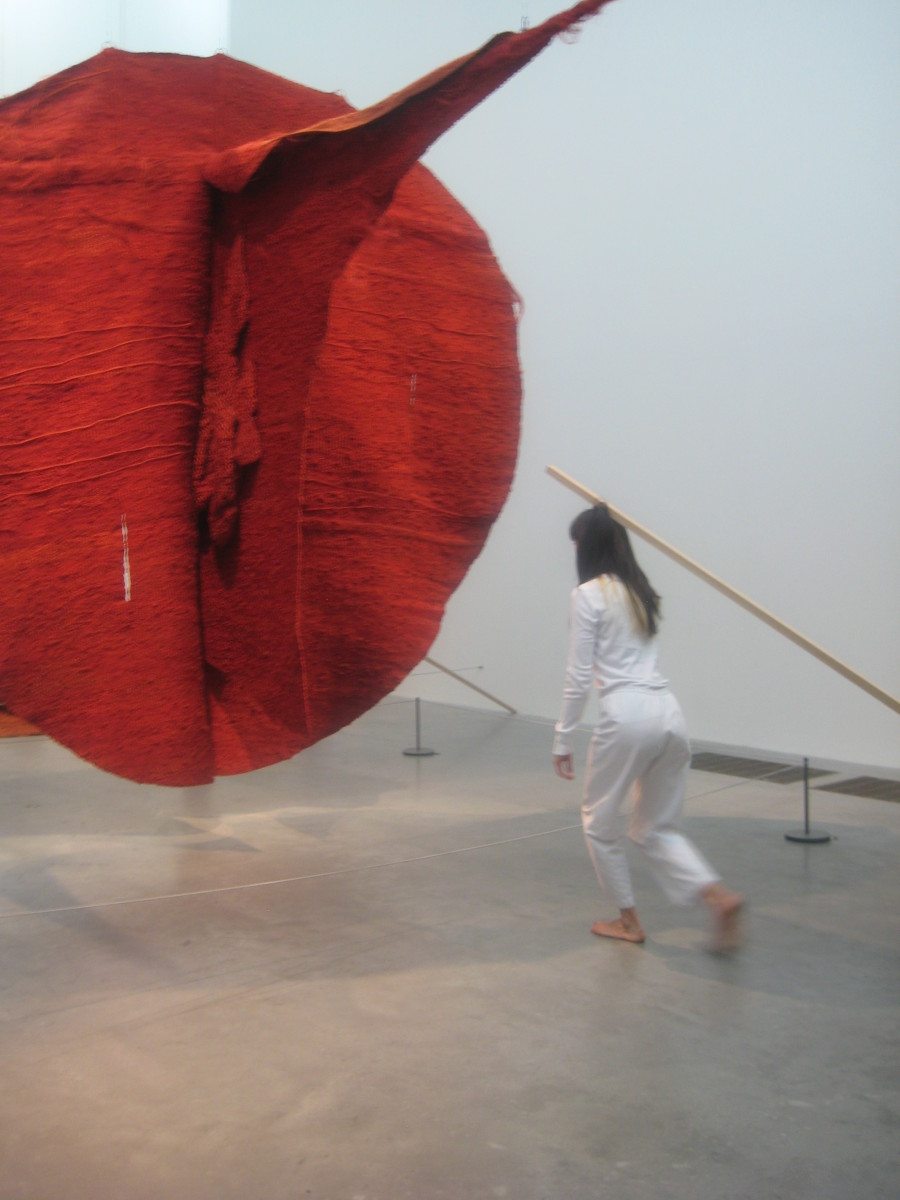
Tamara Riewe in Sticks, Trisha Brown Dance Company. Art work: Abakan Red (1969) by Magdalena Abakanowic

From the Turbine Hall the dancers moved to various of the Tate’s gallery spaces and danced amongst the art works, making art amongst art. Here the program comprised another accumulation work, another version of the leaning duets, Line Up and two different versions of Sticks (1973). Sticks requires the performers secure one end of a long stick against a wall or to anchor it it some other way, balance the other end on a part of their body and then undertake a series of simple moves such as kneeling or lying down, all the while keeping the stick balanced. One version was performed by three dancers in three separate gallery spaces No dancer could see another and the dance unfolded with the performers indicating the stage they had reached by calling out to the others across the galleries. The dance concluded when the third dancer called ‘Done’.

For those who were not New York City residents in the 1960s and 1970s the Tate Modern event was an  exceptional opportunity to see the early work of one of the twentieth century’s most significant dance pioneers. The works shown at the Tate represented on the one hand Brown’s interest in process and problem solving and on the other her attempts to redefine what constitutes dance and to blur the boundaries of dance and installation art. While nothing can ever replicate the original works performed in streets, on roof tops, down the side of buildings and the like, it was a rare privilege to see a twenty-first century manifestation of this early work by the current Trisha Brown Dance Company in London’s most impressive contemporary art space.

Michelle Potter, 23 October 2010

Diaghilev and the Golden Age of the Ballets Russes. Victoria & Albert Museum

The Victoria & Albert Museum, London, has an enviable collection of theatrical costumes from the Diaghilev era, many of which (or is it all of which?) are displayed in the museum’s current, celebratory exhibition Diaghilev and the Golden Age of the Ballets Russes. There are some real gems to be seen. I was especially attracted by a costume worn by Tamara Karsavina as Zobeide in Schéhérazade. Not the more familiar Zobeide costume of harem pants and bodice but a soft, deep purple dress with painted gold designs scattered over the skirt and a top decorated with golden braid. Designed by Bakst, it was apparently worn only briefly before the more familiar costume became popular.

Also quite fascinating was a costume worn by a child performer in Le Dieu bleu, a golden costume of pants and top with a tall headdress reminiscent in shape of those worn by Thai and Cambodian dancers (although far less complex in decoration). While we are used to seeing the costume worn by the Blue God himself, costumes for the ancillary characters, in this case a ‘Little God’, are less common.

Some of the costumes are displayed with quite dizzying effect. For example, some ten or twelve costumes from the famous (or infamous) Nijinsky/Stravinsky/Roerich Rite of Spring are arranged on a tiered framework and are grouped into men’s and women’s costumes. The display gives a very clear view of the range of patterns and colours used by Roerich in designing the work. It is truly an embarrassment of riches.

I also loved the two appearances of Lydia Sokolova on film. One snippet is a two minute silent film made in 1922 called Dancing grace: novel studies of Lydia Sokolova the famous dancer. By today’s technical standards Sokolova’s turn out is pretty much non existent and she rarely points her feet, but as she executes a cabriole followed by an assemblé her sense of movement throughout the whole body is breathtakingly expansive. In another piece of footage Sokolova is wonderfully eccentric as she exclaims over one of the costumes she once wore, which was going under the hammer at the Sotheby’s auction of 1968. Clearly an outstanding dancer and a great lady.

The moment of greatest impact for me, however, came as I turned a corner into a new room to be confronted by the magnificent backcloth by Natalia Goncharova for the final scene of The Firebird. The huge and imposing cloth representing a Russian walled city, inspired we are told by frescoes by Andrea Mantegna, is familiar from many images in books. But to see it in real life is a remarkable experience. It is hung diagonally across the space of a quite small gallery. Above a brick wall that stretches horizontally across the bottom one eighth or so of the cloth, Russian buildings are piled vertically on top of each other, stretching upwards to a patch of deep blue sky. It’s a brilliant piece of work by Goncharova, impressively constructed with its horizontal lower and upper sections anchoring the towering verticality of the block of buildings. In terms of colour it is equally impressive with the golden onion domes of the Russian towers set off against patches of rich, red on the building walls.

Stravinsky’s Firebird music fills the space and the other walls show shadowy images of the Firebird, in this case Begoña Cao of the English National Ballet, dancing against a changing background of fire, original programs, images of Karsavina as the first Firebird, the musical score and a range of other images. Subsidiary material relating to The Firebird is shown on the walls of the previous gallery and includes a squared up design for the cloth and various versions of the design. All together it makes for a wonderful gallery-going experience.

The morning I was there the place was packed with people, all of whom had their favourite items as I did I am sure. And therein lies the rub. Diaghilev and the Golden Age of the Ballets Russes is a hugely ambitious show, perhaps overly ambitious. I couldn’t see the point of some items on display. Was there really any need to display a perfume bottle that once held the Guerlain perfume thought to be the favourite scent of Diaghilev? And there was the usual selection of devotional items—Diaghilev’s top hat and opera glasses and an assortment of pointe shoes worn by various Ballets Russes stars. But what was the argument at the heart of the show? In the end it became nothing more than a huge cabinet of curiosities, which is perhaps fitting given its location in a museum named after two giants of the Victorian age, when such cabinets were all the rage.

Michelle Potter, 21 October 2010