Some who log on to this site have asked about Alan Brissenden’s and Keith Glennon’s recently published book Australia Dances: creating Australian dance 1945–1965. With the kind permission of The Canberra Times, who published my overview of the book on 2 August 2010, I am posting a PDF of that review. While I was extremely fortunate to have been allocated a whole page for my comments there is always much more to say than is possible in a review. I would be more than happy to publish any comments on Australia Dances from readers of this site.
Inspired by a comment on my August 2010 post regarding Olga Spessivtseva in Australia, I went back to that amazing National Library of Australia resource, Trove, and began looking again for passenger lists around the end of 1934 that might contain the names Olga Spessiva or Leonard G Braun.
It appears that Spessivtseva and Braun left Sydney on board the London-bound R. M. S Orama, a ship of the Orient line, on 22 December 1934. A passenger list including both names appears in The Sydney Morning Herald for that day. The ship passed through Fremantle on 31 December and news of Spessivtseva’s departure was reported in The West Australian on 1 January 1935 in a brief article headed ‘A famous dancer. Olga Spessiva leaves Australia’. In that article the story of the injured leg surfaces again with the reporter noting that her withdrawal from the company was the result of ‘An injury to her left leg, occasioned through over-work’. The article also reports that Spessivtseva was anxious to return to Australia ‘with the object of establishing a school of instruction and of producing ballet with entirely Australian casts’!
What makes this information particularly interesting, however, is that there was almost a full month between the last Sydney performance by the Dandré-Levitoff company on 28 November and the sailing date of 22 December. What did Spessivtseva and Braun do during that time? It appears on the one hand that the Blue Mountains story discussed in a previous post may indeed have a grain of truth, and also that Algeranoff’s information about Spessivtseva having already left by 2 December, also discussed previously, is wrong. Do we assume that there was an effort to cover-up what appears to have been more than an injured leg not only to the press but even to other members of the company?
Michelle Potter, 27 September 2010
With many thanks to Boris Fedoff for spurring me on to keep looking. Read his comment about Spessivtseva and her early departure from a US tour. And here is the full tag archive relating to Spessivtseva and the Dandré-Levitoff Russian Ballet tour to Australia.
The interview with Paul Knobloch recorded by Stateline Canberra during Paul’s recent Australian visit screened on Friday 24 September. Its online availability will, it seems, expire in December so it’s worth having a look before that happens. In addition to the words from Paul and his mentor, Jackie Hallahan, there are some photos of Paul as a student and some tantalisingly short footage of his performance in Webern Opus V as well as snippets from an impromptu dance performed in the studio for the Stateline cameras.
Here is the link. (See update below for new link)
Michelle Potter, 26 September 2010.
UPDATE: 27 July 2013: The video on the link above has been removed although the transcript of the interview is available. The footage, however, is still available at this link from ABC Western Victoria.
Wrong Skin, performed by the indigenous company Chooky Dancers, is really a play with dance sequences included. Its narrative line concerns traditional law, in particular as it relates to kinship and marriage in indigenous society, and the difficulties of adhering to tradition in the face of an encroaching Western world with quite different values. It might even be called a version of Romeo and Juliet, or an indigenous West Side Story.
The story is not spoken in English but in an Aboriginal language spoken by the Yolngu people of Elcho Island off north east Arnhem Land where the Chooky Dancers have their home. As the story begins the words of the protagonists are translated into English and the translation projected onto a screen. The audience learns that in Yolngu culture marriage between people of opposite moieties—the Yirridja and Dhuwa moieties—is forbidden as being between people of the ‘wrong skin’. And the inevitable has happened. Two young lovers find themselves in the category of ‘wrong skin’. After this initial explanation to English-only speakers, there is no more translation and it is a credit to the strength of the show and its direction that we don’t need further translations. The storyline is perfectly easy to follow and understand.
The dance sequences range from a reference to Zorba the Greek Yolngu style, a piece of choreography that became a worldwide hit via YouTube in 2007, to a take on that iconic Hollywood movie Singing in the Rain complete with clips from the movie and a traditional rain dance that merges into a dance sequence in contemporary mode complete with umbrellas. The dance is high energy, youthfully raw, and powerful in its capacity to carry a message. It is also sometimes funny, although not perfect in its attempts at comedy. At times I felt the humour was overdone when less might have been more.
The work is not without modern day political implications either. The footage that is projected as backcloth often shows appalling living conditions endured by some Elcho Island inhabitants. And on one occasion we are shown on one of the television monitors that dot the stage an excerpt from one of former prime minister John Howard’s less than acceptable speeches on indigenous issues. But again it is a credit to the direction of the show that there is a great balance between politics and the telling of the main story in words, music and dance.
I loved this show. At last a group of dancers has used a technique that the music world has been using for some time now. We had a mashup from a dance group and got a derivative new work, as we should from a mashup, which was also provocative and entertaining.
Open the link for an Opera House interview with the director of Wrong Skin, Nigel Jamieson. *(See note below)
Michelle Potter, 18 September 2010
* Postscript, May 2011: Sadly the interview mentioned above is no longer available online from the Sydney Opera House site and I have removed the broken link. The original version of Zorba by the Chooky Dancersis still going strong on YouTube.
16–18 September 2010. The Playhouse, Canberra Theatre Centre
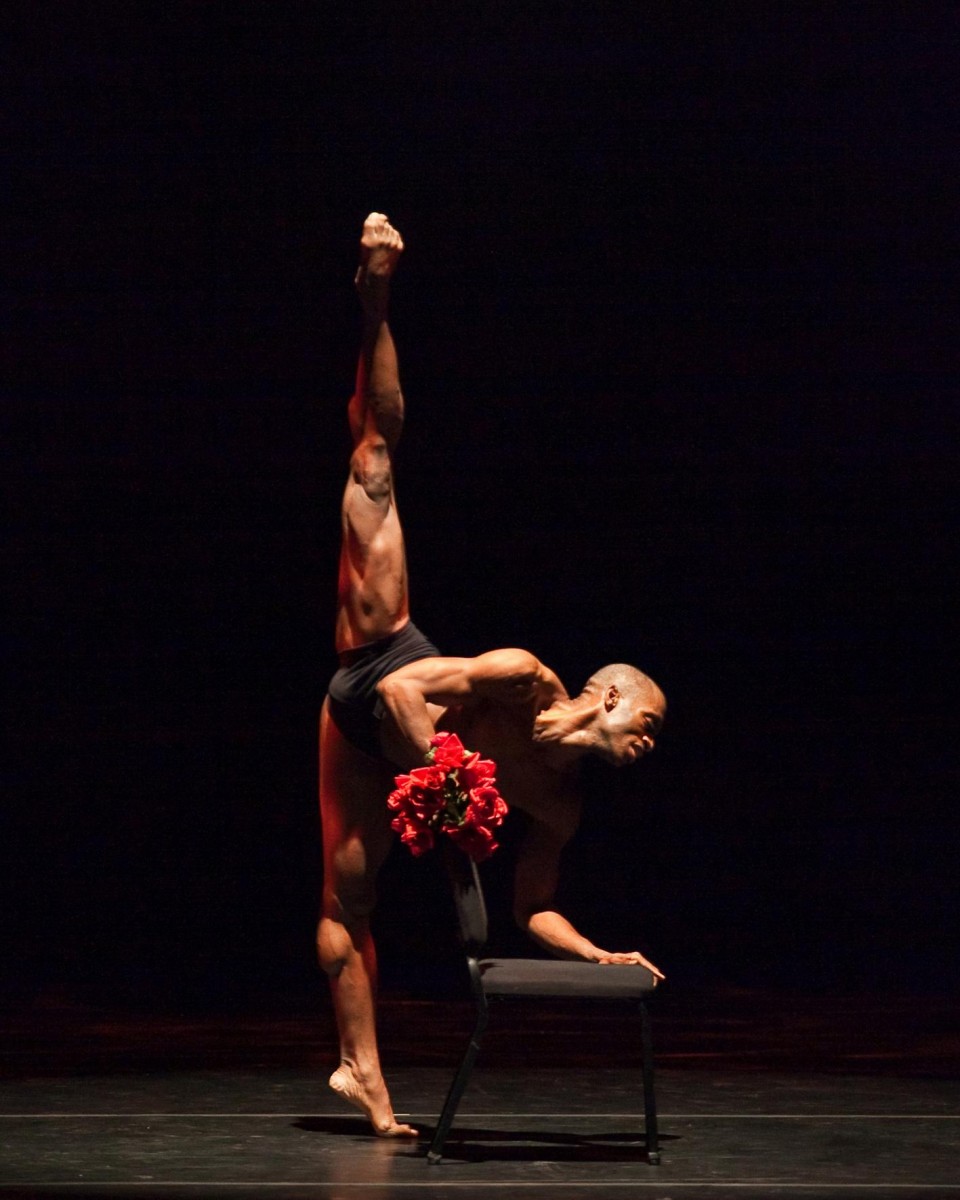
One work saved (just) the Canberra program by Complexions Contemporary Ballet: Moonlight, a very brief solo for Desmond Richardson, co-artistic director of this New York-based company, and also its leading dancer. Richardson has a Mr Universe body with fabulously defined musculature and extraordinary flexibility. He used it to advantage in this solo.
The work was not, however, listed in the printed program, even though it appeared to be a generic program for the whole Australian season, so I had to Google post-performance to discover that apparently Moonlight is part of a 25 minute ballet called FRAMES, made in 1992 by Dwight Rhoden, the other co-artistic director and main choreographer for Complexions. Rhoden also wrote the music, a song whose words were difficult to discern because the music was so loud (all through the evening) and sounded distorted from where I was sitting. I gathered though that Moonlight is about the demise of a relationship. But watching Richardson move was enough without wondering what the chair and bunch of roses, which were used as props, meant.
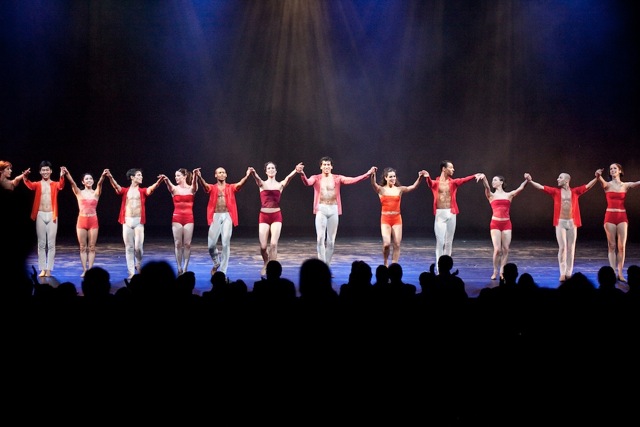
The other works on the program suffered, in my opinion, from choreography that contained a surfeit of arabesques, big jumps, dramatic poses and other steps designed to show off a particular kind of technique without any feeling for what happens between such steps, or for the need to balance showiness with subtlety or punchy-ness with smoothness. I felt often that the steps were fighting the dancers and as a result few of them seemed to ‘own’ the choreography in a physical sense.
The most disappointing for me was On Holiday, a work for four couples danced to songs made famous by Billie Holiday. I guess in my mind I was thinking of Twyla Tharp’s Nine Sinatra Songs, a beautiful series of dances for seven couples and a benchmark for this kind of format of dancing to popular songs. But On Holiday had none of the sophistication and emotional impact that marks the Tharp work and nothing else to make it stand proudly alongside Nine Sinatra Songs or even Paul Taylor’s Company B danced to songs from the Andrew Sisters.
The audience responded with gusto to the last work on the program, Rise, with its strong rhythmic base from music by the Irish rock group U2. Other works on the program were Moon over Jupiter danced by the full company to music by Rachmaninov and Moody Booty Blues danced by two women and three men to blues music by Roy Buchanan.
And to return to the printed program, casting was given for some of the works and was set out according to specific dates. But those dates all seemed to be in October and referred, therefore, only to the Sydney season. So what about Canberra and Perth audiences? For them there was (or will be in the case of Perth) no way of knowing which dancers were performing specific works. At $20 the program is very poor value. Some kind of (free) cast sheet for the night would have been helpful.