7–12 September, 2010. Sydney Opera House, Spring Dance Season,
Narelle Benjamin says her latest work, In glass, was inspired by the partnership of the two dancers who perform the work, Paul White and Kristina Chan. The best parts of the work are indeed when White and Chan are dancing either separately but in unison, or when one is being partnered by the other (that is when there is physical contact between them). Their opening sequence was breathtaking—liquid, silky smooth, perfectly synchronised and stunningly executed.
While White and Chan have shared many experiences dancing together, and this in itself builds a partnership, what makes this pairing work so extraordinarily well is that White and Chan also share many physical similarities. They are similarly proportioned—length of limbs in relation to trunk for example—and probably most importantly they have similar muscle tone, even acknowledging the gender difference. Great partnerships grow from these kinds of physical similarities because dance is ultimately a physical art form.
I’m not sure, however, that the work as a whole was as successful as the White/Chan partnership. In glass tries, I think, to explore some intangible ideas that don’t necessarily translate well into dance. Benjamin’s program notes say that the work ‘hovers between planes at a liminal place of transition’. To tell the truth, I’m not sure what she means by this but I guess the idea was given shape at those moments when, looking into the mirror surfaces that made up the set, I wondered whether I was looking at reality in the shape of a dancer or some other idea made visible by film projection onto the surface. There was one quite surreal moment when an image of White’s body morphed into a tree, for example. There was also one unsettling, but also surreal occasion when White held two oval mirrors, one on either side of his head so that it seemed that he had sprouted two extra heads from the one neck. The footage and other visuals, the work of Samuel James, were at times entrancing, whether or not their interaction with the movement connected in my mind. Sequences showing Chan, softly focused and drifting through a hilly, forested landscape were especially engrossing.
Watching White and Chan is a huge joy. The opening sequence promised so much and many other moments of dancing built on that promise. But I would rather have watched White and Chan just dancing Benjamin’s challenging choreography without other philosophical distractions, especially when those distractions were not meant to be ignored but were less than obvious (to me anyway).
Transports exceptionels. Spring Dance Season, Sydney Opera House, 9-12 September 2010
A perfect Sydney spring day
A large, orange earthmover with driver
The remarkable voice of Maria Callas
A dancer, Philippe Priasso
Billed as a duet for dancer and earthmover, this free event on the Sydney Opera House Forecourt was a remarkably moving occasion as the dancer, Philippe Priasso, engaged fearlessly with a huge piece of machinery. He bowed before it, chased it (and it chased him), stood on top it, lay across it and otherwise moved with and on it. But despite the amazing sound of Callas filling the air, the sun glinting on the tiles of the Opera House sails and the daredevil activities of Priasso, the earthmover and its unnamed driver were the stars. This huge, clunky looking machine danced with such lyricism as its driver made it swing, swoop and swirl. Theatrical!
Listen to Philippe Priasso talking about performing this remarkable 20 minute dance (with excerpts from the dance itself). * (See note below)
Michelle Potter, 11 September 2010
*Postscript, May 2011: Sadly the Sydney Opera House interview mentioned above is no longer available online and I have removed the broken link. I found a brief clip from a performance in the UK on You Tube. Nothing like the stunning Sydney venue, which also impressed Priasso as he discussed in the interview, but it does give a vague idea of what the work was like.
For those who may not have read the interview by Alan Helms with dance critic Alastair Macaulay, published recently in the summer issue of the ballet.co magazine, I recommend it. It is quite long but a totally fascinating read.
One of the highlights of my tenure as curator of the Jerome Robbins Dance Division in New York was the launch of the restored film of George Balanchine’s Don Quixote featuring that amazing ballerina Suzanne Farrell as Dulcinea and Balanchine himself as the Don. Macaulay was invited to speak at the launch. I was familiar with Macaulay’s writing but not with his public speaking style. However, shortly before the launch I heard him honour dance scholar David Vaughan at a forum presented by the Dance Critics’ Association. As one might expect, Macaulay gave an incredibly knowledgeable account of Vaughan’s vast contribution to dance. But it was not simply knowledgeable, it was brilliantly entertaining as well. So he seemed the ideal choice for the Don Q launch. Luckily he accepted.
What he gave us at the launch was an overview of Farrell’s career complete with demonstrations of her technical prowess! It too was brilliantly entertaining and my clearest memory is of Macaulay constantly moving away from the lectern so we could see him quite clearly as he demonstrated this or that step. Of course the words were there too and the combination of his erudition and his willingness to engage with the physicality of dance — despite not being a dancer by training himself — was dazzling. So I was more than interested to read his thoughts in the Alan Helms interview on why he likes to demonstrate in this way, and to notice the emphasis he places throughout the interview on the concept of physicality.
Another aspect of the interview that I personally found inspiring was Macaulay’s brief discussion of finding that what he was writing as a young critic was controversial, and of being on one occasion struck off a press list. Having myself been ‘counselled’ against writing on a certain subject for this (my own) website, and having once been the source of a defamation case as a result of a review I wrote for a newspaper (the claim was unsuccessful), it is always helpful to be reminded, even as an ‘old’ critic as I am, that one needs to be resolute in one’s beliefs.
There are so many other moments in this interview that sparkle with Macaulay’s particular brand of perceptive thought. Definitely worth a read and a bouquet to Bruce Marriott of ballet.co for publishing it.
[Update 30 November 2017: Sadly, the link to Alan Helms’ interview is no longer available]
During August I spent some time investigating the spelling of Valentin Zeglovsky’s name and posted some results under the title ‘Valentin Zeglovsky: some Australian notes’. It was a somewhat esoteric exercise but it did yield other information about Zeglovsky, of which I was not previously aware. So for me it was a worthwhile excursion, although it did envelop Zeglovsky in further mystery.
Place of birth
I mentioned in the previous post that Zeglovsky completed the various procedures to become a permanent resident in Australia and to acquire the status of a British subject. One document that was part of that process contains a short but closely packed, typewritten section entitled ‘General Remarks’. The document, dated 11 December 1945, was typed not by Zeglovsky but by a public servant from information provided by Zeglovsky. Under ‘General Remarks’ the document states, in part: ‘Applicant states that his birthplace is Riga Latvia not Kharkov as per Declaration. Passport verified this statement’. This is interesting because in his autobiography, Ballet Crusade, Zeglovsky records that he was born on 26 July 1908 in Kharkov.
Ballet Crusade
Zeglovsky’s account of his life from birth to the early 1940s was published by Reed & Harris as Valentin Zeglovsky’s Ballet Crusade in December 1943 with a reprint in 1944. Ballet Crusade‘s title page (at least for the 1944 reprint) says ‘translated from the Russian’, although no acknowledgement of the translator is given. However, letters from Valrene Tweedie written in the 1940s from Cuba to her friend in Sydney, Marnie Martin, indicate that Martin had been working with Zeglovsky on a book, which Tweedie confirmed before her death in 2008 was Ballet Crusade. Martin had been an extra during the Ballets Russes visits to Australia and remained a lifelong friend of Tweedie. From the letters it appears she was quite close to Zeglovsky — Tweedie frequently ends her letters to Martin with a greeting to ‘Valentin’ as well. It was also Martin’s GPO box address that Zeglovsky used on most of his applications to the patent’s office mentioned in my earlier post. I have no evidence that Martin was a Russian speaker but I suspect that ‘translated from the Russian’ may have been a euphemistic way of indicating that the book owed much to Martin. Tweedie maintained in fact that it was ghost written, at least in part, by Martin.
Work life in Australia
Tamara Finch in her autobiography, Dancing into the unknown, records the initial efforts by those Ballets Russes artists who remained in Australia in 1939 at the conclusion of the Covent Garden Russian Ballet tour to find work for themselves in Australia. Her account explains that a small company, which included Zeglovsky, formed to give recitals but disbanded in 1940 after the venture proved unsuccessful. It was probably around this time that Zeglovsky settled in Sydney and began teaching and dancing with various companies. The ‘General Remarks’ on his naturalisation application state: ‘At the outbreak of war applicant under engagement to J. C. Williamson and travel led all over the Commonwealth’.
Briefly, Zeglovsky danced and travelled with the Kirsova Ballet and danced some seasons with the Borovansky Ballet. In 1942–1943 he also performed in the J. C. Williamson revival of the popular musical White Horse Inn, which opened in Sydney in December 1942. This aspect of Zeglovsky’s Australian career will be the subject of another post.
However his naturalisation papers reveal that he also worked in decidely non-dancing jobs. The same ‘General Remarks’ mentioned above record: ‘Late in 1943 commenced work as a cement worker at the Captain Cook Graving Dock, Sydney’. And a little further on: ‘Applicant states that he is a fully qualified diamond tool setter’.
Marriage
On immigration documents relating to Zeglovky’s arrival in Australia with the Covent Garden Russian Ballet in 1938, he lists his status as married and his wife’s name is given as Mia. Later documents completed by Zeglovsky and held in the National Archives of Australia indicate that Mia was born in 1910 in Riga and that she was living in Tel Aviv, Palestine, when Zeglovsky applied for naturalisation. Mia Arbatova is mentioned on several occasions in Ballet Crusade and, although in the 1940s Zeglovsky continues to state that he is married, sources such as the Jewish Women’s Archive indicate that Arbatova and Zeglovsky, who were dance partners and who are said to have married in 1933, divorced in 1937.
Zeglovsky married dancer Pamela Nell Bromley-Smith in Sydney in 1949 according to the New South Wales Registry of Births, Deaths and Marriages. Bromley-Smith appeared as the Daughter in La Concurrence with the Covent Garden Russian Ballet in its Sydney season in December 1938. Her name appears on a program dated 17 December 1938 and a photograph (not in costume for La Concurrence but in an exotic two piece fringed and beaded costume) appeared in the Evening Post from Wellington, New Zealand, on 6 February 1939 with the caption ‘Pamela Bromley-Smith, aged 10 years, who was engaged in Sydney to dance the child role in “La Convenience” [sic], a performance by the Russian Ballet. Pamela is from the Dolee Brooks School of Dancing and holds her intermediate dancer’s diploma for operatic dancing in Australia …’. The performing arts gateway AusStage records that she appeared in a number of productions at the Minerva and Independent Theatres in Sydney in the 1940s.
Ziggy, as he was apparently known in the Ballets Russes, continues to fascinate!
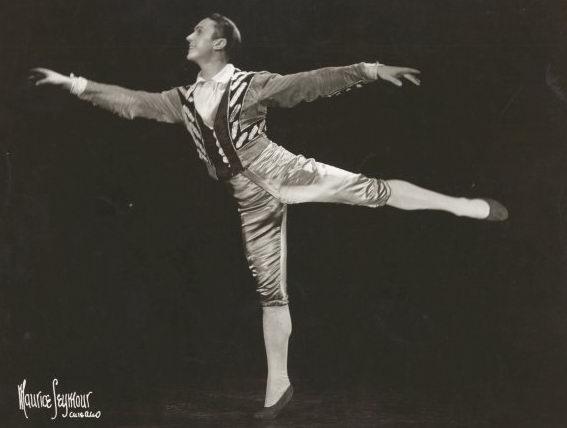
Featured image: Zeglovsky in Cimarosiana reproduced from the Geoffrey Ingram Archive of Australia Ballet with permission of the National Library of Australia.
Maurice Seymour: Valentin Zeglovsky in ‘Cimarosiana’, ca. 1936
Liz Lea reports that her show, 120 Birds, has just concluded its run at the Edinburgh Fringe. She says they ‘did well’ but the reviews suggest she and her dancers did a little more than well. It sounds like a knockout. Let’s hope Lea finds an Australian venue for the show.
Liz Lea and company in 120 Birds
Extracts from reviews:
‘Liz Lea mines the very female environment of Anna Pavlova. The world’s most famous ballerina, back in the 1920s she famously crossed the globe in a series of exhausting and exhaustive tours. In 120 Birds, a cast of four recreate both the brutal toughness and the exhilarating glamour of a ballet company out on the road, mixing live performance with vintage film footage.’ (Judith Mackrell, The Guardian)
‘What a treat this invented slice of dance history is. Inspired by the international touring of such dance legends as Anna ‘The Dying Swan’ Pavlova early in the 20th century, Liz Lea has mounted a fabulously ambitious little show for which she co-designed the drop-dead-gorgeous costumes. The glamour puss dancer-choreographer also takes the lead, narrating the saga of a fictional Australian troupe and its breathless adventures on the road. The moves Lea and three fine dancers execute are mainly her smart, stylish take on social dance, ranging from the tango and Charleston to the waltz, with a treasure trove of archival film footage as backdrop.’ (Donald Hutera, The List)
‘Liz Lea’s 120 Birds … draws inspiration—and a fabulously sparkly-swishy array of frocks—from the globe-trotting adventures of 1920s touring dance companies, with Anna Pavlova’s career an especially iconic source. Against a fascinating backdrop of old film clips, Lea and her three dancers fleet-foot it through the various crazes—including the smouldering tango—that were all the rage, while weaving them into a retrospective celebration of how ballet and contemporary dance evolved. Great fun, with some elegant hoofing in there too.’ (Mary Brennan , Herald Scotland)
‘With a little de-cluttering, this tribute to ballet star Anna Pavlova is a five star show waiting to happen. Lea is a true performer with real stage presence, turning her very able hands to acting, dancing, direction, choreography, costume design and writing. As the audience filed out post-show, one word kept coming up time and again—”fabulous”—undeniably the perfect adjective.’ (Kelly Apter, Edinburgh Festivals)
‘120 Birds … choreographed by and starring the pouting, flirting, strutting ‘Madam’ Liz Lea, is a gem. Based on an international tour that Anna Pavlova made in the 1920s to Sydney (travelling with, yes, 120 birds), this story of a young Australian company following in her footsteps is told through dance, fantastic archive footage and fashion from the period. There are more costume changes in 120 Birds than Katy Perry pulled off at last week’s Teen Choice Awards.’ (Chitra Ramaswamy, Scotland on Sunday)
And for a little more on the title, quite by accident I came across the following item in The Sydney Morning Herald for 8 November 1934, a charming story about Pavlova and those birds.