Amber Scott as Aurora

When Stanton Welch’s Sleeping Beauty premiered in 2005 Amber Scott was a relatively new member of the Australian Ballet, having joined in 2001. In 2009, as a senior artist with the company, she danced the leading role of Aurora in the Australian Ballet’s revival of Welch’s work. Her appearance in this demanding role was something to be celebrated.

While in my opinion the Welch Beauty is a flawed work, scenically in particular, it nevertheless requires, as does the original version choreographed by Marius Petipa, a dancer of exceptional classical technique to perform Aurora’s solos and the various pas de deux. Welch has in fact largely retained Petipa’s choreography for Aurora’s two key scenes, that in which she dances with four potential suitors at her sixteenth birthday celebration, and that in which she dances with her Prince as the ballet comes to an end.

Scott has a classically proportioned body. Her arms in particular are long and fluid and she has an eloquent neck, which she uses to maximum advantage, and beautifully arched feet. But she also understands the essential features of the classical technique. So, as Aurora, her execution of Petipa’s centred and pure movement was articulate and a joy to behold. Her Rose Adagio was outstanding and in fact at one stage she chose not to lower her hand to one of the cavaliers so secure was her balance. Radiant, she simply stood there in attitude as that particular cavalier retired, having been acknowledged but without having had the pleasure of Aurora’s hand on his! The audience began applauding well before the end and kept it up—something I haven’t seen for some time.

Equally, Scott’s execution of the variations in all scenes showed the same attention to cleanness of execution—such beautiful unfolding of the leg in développé or, in reverse, from à la seconde to retiré, delicate hops on pointe, gorgeous arabesque line, crisp turns. Just glorious really.

What is lacking now from Scott’s interpretation, at least of this role, is maturity. She is still in the last act very much the dewy and beautiful sixteen year old on the cusp of maturity. Her more experienced colleagues in companies around the world are able to differentiate between the beginning and the end of the ballet. But time is on her side and I look forward to seeing her grow into a luminous ballerina, which appears to be her destiny.

Daniel Gaudiello also continues to impress. His Bluebird was airborne and full of idiosyncratic flutters of the arms and hands (perhaps as befits the idiosyncratic costume, especially the racing helmet headdress?). Gaudiello is blessed with a powerful stage presence and an ability to make the most of whatever choreography comes his way. Duato or Petipa—and Welch also retained much of the earlier choreography for the Bluebird—Gaudiello immerses himself into it all in an individualistic manner, which makes engrossing watching for the audience.

Michelle Potter, 14 December 2009
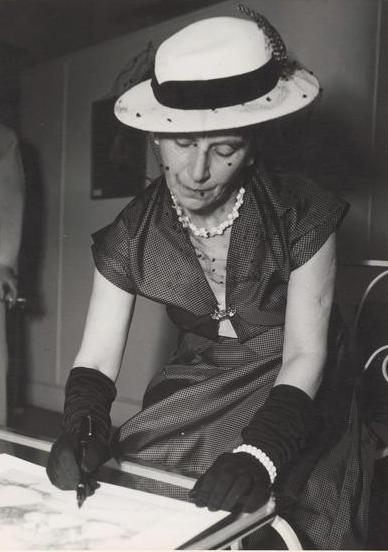
‘Mim’. A personal memoir of Marie Rambert. Brigitte Kelly

‘Mim’. A personal memoir of Marie Rambert: Brigitte Kelly (Alton: Dance Books, 2009). Available in Australia from Footprint Books or any good bookseller.

Marie Rambert, or Mim as she was familiarly known, brought her company, Ballet Rambert, to Australia in 1947. The company stayed until early 1949 and appeared in Adelaide, Brisbane, Broken Hill, Melbourne, Perth and Sydney with a short tour to New Zealand in May 1948. Astonishingly, they gave over 500 performances during those fifteen or so months.

Australian newspapers of the time refer to Rambert as a dynamic and somewhat unusual woman and it is clear that she enjoyed playing to the press. One clipping in a scrapbook held in the National Library of Australia shows her in a balletic pose supported by the entrepreneur Benjamin Fuller. He, somewhat portly, looks a little embarrassed. She is in her element! So it is not surprising to read in Brigitte Kelly’s absorbing memoir, Mim, sentences such as ‘She was a loose canon likely to explode in any direction’.

Marie Rambert in Australia, 1948. Photo: The Courier Mail (Brisbane). Reproduced by permission of the National Library of Australia.

Kelly writes in an easy style. It is anecdotal but full of information and it offers opinions but is not opinionated. Perhaps what comes through most strikingly is the way Rambert’s personality, and that of her husband Ashley Dukes, affected the growth of Ballet Rambert. Kelly writes: ‘The strength and weakness of Mim and Ashley lay in the fact that they wanted complete autonomy over their enterprises, an understandable wish since they could then keep control over the artistic standards they set themselves’. There were serious and ongoing consequences especially of a financial nature according to Kelly.

A jolt to the Australian story is that the company left for Australia hoping to pay off large debts with profits made on tour. They returned from Australia bankrupt. Kelly writes: ‘[T]he manager, Dan O’Connor, had disappeared taking all the money and somewhere along the line lost the costumes and scenery’.

But the book also opens up the story of Rambert in an affectionate way offering many insights that only a dancer who was personally close to the company and its directors can offer. Rambert’s career with Diaghilev is touched upon as well as her ongoing connections with Diaghilev dancers. Her life in France before moving to England makes intriguing reading. And of course the trials and tribulations of the early company from the perspective of someone who performed in those early works of Frederick Ashton, Antony Tudor, Andree Howard, Walter Gore and others of equal note is engrossing.

Mim is a beautifully personal book. A memoir. And well worth the read.

Michelle Potter, 10 December 2009

For more about Ballet Rambert in Australia see my article published in National Library of Australia News, December 2002.

Postscript:

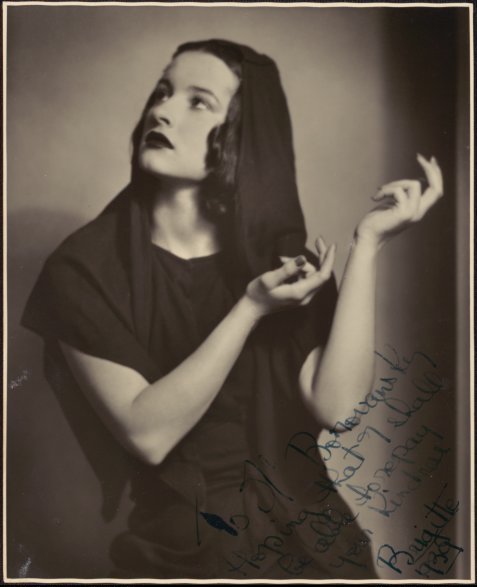
The author of Mim, Brigitte Kelly, came to Australia with the Covent Garden Russian Ballet on its 1938-1939 tour dancing under the name Maria Sanina. She speaks about the photo below, taken by Melbourne-based photographer Spencer Shier, in part three of her memoir ‘Dancing for joy: a memoir’ published in Dance Chronicle, 22, Nos 1, 2 & 3 (1999) saying that it represents her decision to model herself on film star Hedi Lamar. She writes ‘There was a photo call for the souvenir program. I dressed myself in the nun’s costume from the second movement of Choreartium, and when I look at the photograph the “look-alike” effect is really quite good’. (p. 362).

Maria Sanina (Brigitte Kelly) in costume for Choreartium, Covent Garden Russian Ballet, Australian tour, 1938 or 1939. Photo: Spencer Shier. Reproduced by permission of the National Library of Australia

Sydney friends of the Ballets Russes. Dr Ewan Murray-Will

Dr Ewan Murray-Will (1899-1970) was by profession a dermatologist with a practice in Macquarie Street, Sydney. He studied medicine at Sydney University graduating in 1923 and followed that initial study with further work in Vienna and London. He was honorary dermatologist to a number of Sydney hospitals including Sydney Hospital, St Vincent’s Hospital and the Coast Hospital (later Prince Henry Hospital). Murray-Will also served in World War II in the Middle East and later in North Queensland and was awarded an MBE at the conclusion of the War. He was also a passionate supporter of the arts and a friend and patron of the Ballets Russes dancers who visited Australia between 1936 and 1940.

His home movies documenting performances by, and weekend activities of the dancers of the visiting Ballets Russes companies have been known in Australian dance circles since the late 1990s when they were donated to the National Film and Sound Archive. Some of this remarkable footage was used in The Ballets Russes in Australia: an avalanche of dancing, produced in 1999 by the National Film and Sound Archive and the National Library of Australia. Some was also screened in a compilation of archival footage that accompanied the National Gallery of Australia’s 1999 exhibition of Ballets Russes costumes, From Russia with love.

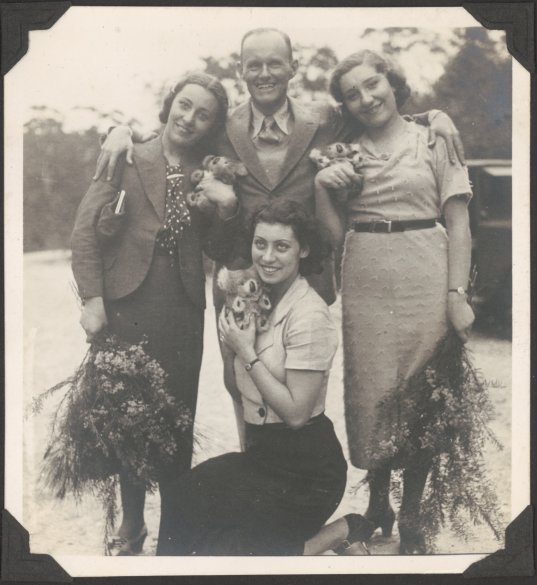
Perhaps the most engaging of the footage is that shot on Bungan Beach, a beach north of Sydney that even today remains relatively isolated. It is hidden from the main road and accessible only by a walking track. It was at Bungan Beach that Murray-Will regularly rented out a beach house and also regularly invited a number of the dancers to visit on weekends. Much of the beach footage is filmed in slow motion and often shows the dancers demonstrating particular steps or lifts: Paul Petroff seemed to delight in performing grands jetés en tournant the length of the beach and Tamara Toumanova and Petroff enjoyed demonstrating the now well-known ‘presages lift’ from the slow movement of Massine’s Les presages. Other material shows the Ballets Russes dancers performing excerpts from their repertoire. A beautiful clip shows Nina Golovina in a scarlet swimming costume with her long dark hair falling over her shoulders dancing with Anton Vlassoff in an excerpt from the Bluebird pas de deux from Aurora’s Wedding. Some of Murray-Will’s footage, including the ‘Bungan Ballet’ a watery spoof created by four of the dancers, is available online from the National Film and Sound Archive’s australianscreen site:
http://aso.gov.au/titles/home-movies/ballets-russes-de-monte-carlo/

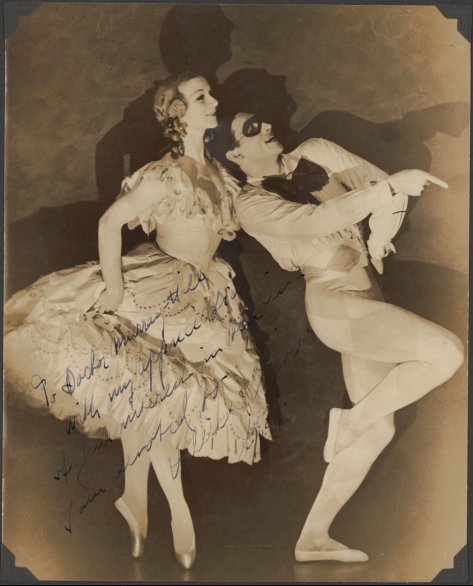
But Ewan Murray-Will also bought art and moved in those Sydney circles where contemporary art was promoted and where both developments in the visual arts and the activities of the Ballets Russes were seen as part of the same attitude to contemporary creative endeavour. Murray-Will was, for example, a friend of publisher and patron of the arts Sydney Ure Smith, as Ure Smith’s collection of letters in the Mitchell Library in Sydney indicates. He was also close to Ballets Russes dancer Hélène Kirsova, whose second husband was Peter Bellew, first secretary of the Sydney branch of the Contemporary Art Society and in part responsible for securing Sidney Nolan’s commission to design Icare for Australian performances by the Original Ballet Russe in 1940. Kirsova autographed to Murray-Will a photograph of her and Igor Youskevitch in Le Carnaval with the words: ‘To Doctor Murray-Will, With my appreciation of your interest in the arts I am devoted to, Helene Kirsova, 1937’.

Hélène Kirsova and Igor Youskevitch in Le Carnaval, 1937. Photographer unknown. National Library of Australia

Ewan Murray-Will’s contribution to our knowledge of the Ballets Russes aesthetic as it was understood in Australia also includes that he collected, and then bequeathed to major institutions, paintings and drawings with a connection to the Ballets Russes. At least two designs by Alexandre Benois for Petrouchka were bequeathed by Murray-Will to the Art Gallery of New South Wales. They are a costume design for ‘Un jeune artisan ivrogne’ (A drunken young workman), a character that perhaps never appeared on stage in productions of Petrouchka, and a set design for ‘La chambre du nègre’ (The Negro’s bedroom), which is a variation on the better-known set for that scene in the ballet.

But perhaps more pertinent in the context of the influence the Ballets Russes had on Australian artists are those items bequeathed to the National Gallery of Australia by Murray-Will that are currently on display in the exhibition Rupert Bunny: artist in Paris at the Art Gallery of New South Wales. They include three oils on canvas painted in Paris between 1913 and 1920: Peleus and Thetis, The prophetic nymphs and Poseidon and Amphitrite. Any Ballets Russes influence on Bunny, best described perhaps as an expatriate Australian, came of course from Serge Diaghilev’s Ballets Russes rather than from the touring companies that Australians saw in the years following Diaghilev’s death in 1929. The colours of Bunny’s palette in all three paintings recall the juxtapositions for which Léon Bakst became famous with his costume and set designs for Diaghilev. And the swirl of Amphitrite’s hair in Poseidon and Amphitrite, which was owned at one stage by Edouard Borovansky, recalls the decorative elements of flowing scarves and other items that feature in Bakst’s costume designs.

The most interesting of the three paintings, however, is Peleus and Thetis and, while Bunny’s colour juxtapositions may be a result of the influence of late nineteenth/early twentieth-century European artists, including Paul Gaugin, rather than, or as well as Baskt, there are nevertheless clear references to the Ballets Russes in this painting. Bunny painted Peleus with her feet and knees turned to the side as if on a frieze. Her body, however, is facing the front although her head is in profile. Such a pose clearly recalls the choreography for the nymphs in Afternoon of a Faun (1912), Vaslav Njinsky’s groundbreaking work for Diaghilev. Moreover, the angular position of Peleus’ arms, especially the way her left elbow is bent into a triangular shape as she resists Thetis’ advances, is similar to the arm positions of Nijinsky and the leading nymph in Faun as the two engage with each other before the nymph drops her scarf and flees. Even the hairstyle of Peleus recalls the wigs worn by the nymphs in the ballet, which closely fitted the head like a skull cap but had long strands of curls emerging at the back from the nape of the neck.

Ewan Murray-Will is reported to have been a reserved man. He left, however, a legacy to the arts world whose significance is probably yet to be fully explored. That legacy is largely a result of his exploits as an amateur filmmaker. But his activities as a collector of paintings and drawings, especially as they elucidate further the activities and aesthetic of the Ballets Russes in Australia and on Australians, are also of significance.

Postscript: Rupert Bunny: artist in Paris is at the Art Gallery of New South Wales until 21 February 2010 and then travels to Melbourne and Adelaide.

© Michelle Potter, 27 November 2009

BIBLIOGRAPHY

  • Australia Dancing. ‘Dr Ewan Murray-Will’ as archived at this link
  • Benois, Alexandre-Nikolayevich. ‘Jeune artisan ivrogne’, costume study for Petrouchka, 1936, watercolour, gouache and pen and ink over pencil sketch, 32.2 x 24.8 cm sheet (irreg), Art Gallery of New South Wales, Bequest of Dr Ewan Murray-Will 1971, 11.1971
  • Benois, Alexandre-Nikolayevich. ‘The Negro’s Bedroom’, set design for Petrouchka, 1931, drawing, gouache and pen and ink over pencil sketch, 25.3 x 36.2 cm image/sheet, Art Gallery of New South Wales, Bequest of Dr Ewan Murray-Will 1971, 12.1971
  • Edwards, Deborah. Rupert Bunny: artist in Paris (Sydney: Art Gallery of New South Wales, 2009).
  • Potter, Michelle. ‘Mutual fascination: the Ballets Russes in Australia 1936-1940’. Brolga 11 (December 1999), pp. 7-15.
  • Turnbull, Clive. The Art of Rupert Bunny (Sydney: Ure Smith, [1949?])

Por vos muero. The Australian Ballet

The Australian Ballet’s triple bill Concord is currently in its Sydney season. It’s at the Opera House until 30 November.

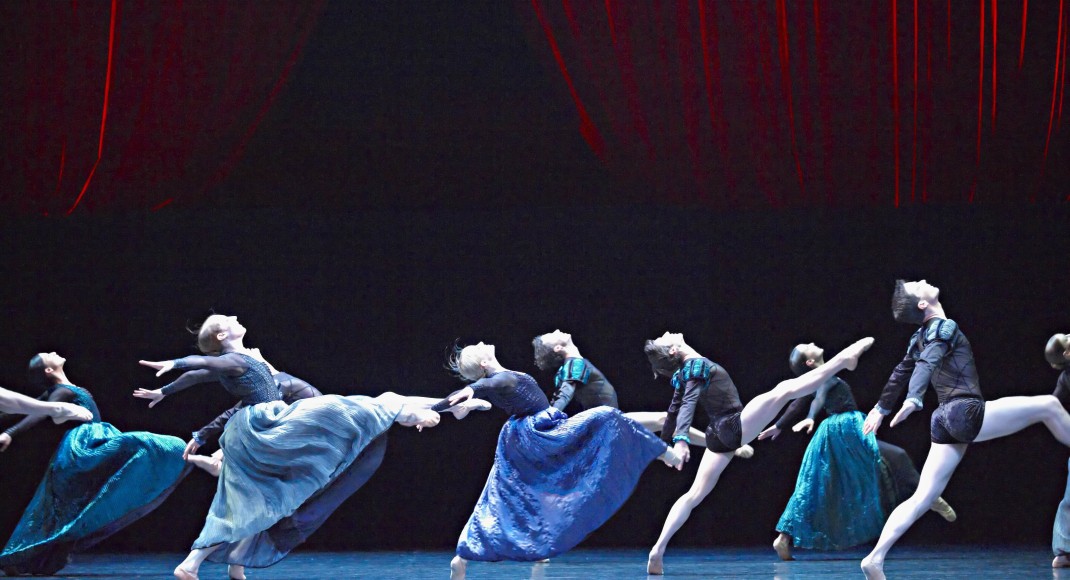
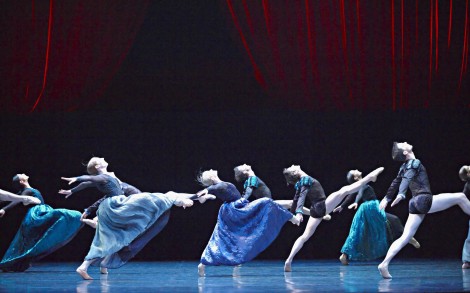
Wayne McGregor’s Dyad 1929 is as startling as ever, although the cast I saw did not manage to achieve the same degree of technical precision and sense of purpose that made the opening night in Melbourne this past August such a brilliant occasion. Alexei Ratmansky’s Scuola di Ballo remains pantomime for those who like their ballet that way. As for Nacho Duato’s sublime Por vos muero, it continues to give and give of itself in a way that only the very best works of art can do.

Por vos in its Australian Ballet production goes back to the directorship of Ross Stretton who introduced it to Australian audiences in 2000. Who can forget the ravishing Felicia Palanca in the leading female role in that first season? Her passion for her role knew no bounds. But then who can forget Daniel Gaudiello on opening night in Melbourne this year with his capacity to show to advantage the intricacies of Duato’s choreography?

On the second matinee of the Sydney season no dancer really stood out, which allowed the opportunity to think more about the work itself, especially its seamless yet choreographically idiosyncratic duets, its use of humour and its delicious sensuousness. In fact it sent me back to the DVD to look more closely at how Duato had structured the work and at his use of props, especially the masks in his dance for six women and his decorative screens at the back of the stage space and the way they were used by the dancers to link each section.

But in addition I turned on the DVD’s subtitles and saw for the first time an English translation of the narrator’s Spanish words. The work stands brilliantly by itself—no translation of the words is necessary to feel that it is about love and passion in their many manifestations. Duato also explains on the DVD that everyone danced in fifteenth and sixteenth century Spain: dance was not thought of as an art but simply as a way of expressing oneself on pretty much any occasion. Such a desire to dance is also inherent in the choreography without our being told. Both the words of the narrator and Duato’s explanation simply confirm what we know. Por vos is an exceptional work.

But the words of the narrator are deeply affecting. As six dancers, clothed in stripped back skin-coloured costumes, move off and give up the stage for a final solo by the leading female dancer, whose consort appears in the closing moment to enfold her in his arms, we are told:

For thee I was born/Through thee I have life/For thee I must die/And for thee I die.

Por vos is an exceptional work.

Michelle Potter, 23 November 2009

Featured image: Dancers of the Australian Ballet in Por vos muero, 2009. Photo: © Jim McFarlane.

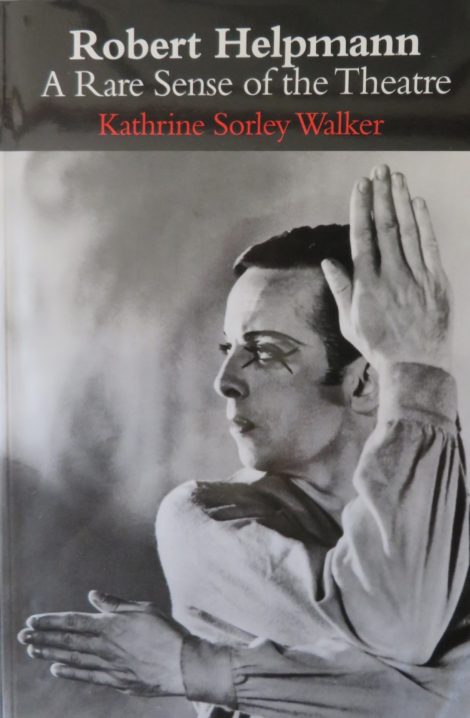
Robert Helpmann: a rare sense of the theatre. Kathrine Sorley Walker

Robert Helpmann: a rare sense of the theatre: Kathrine Sorley Walker (Alton: Dance Books, 2009). Available in Australia from Footprint Books or any good bookseller.

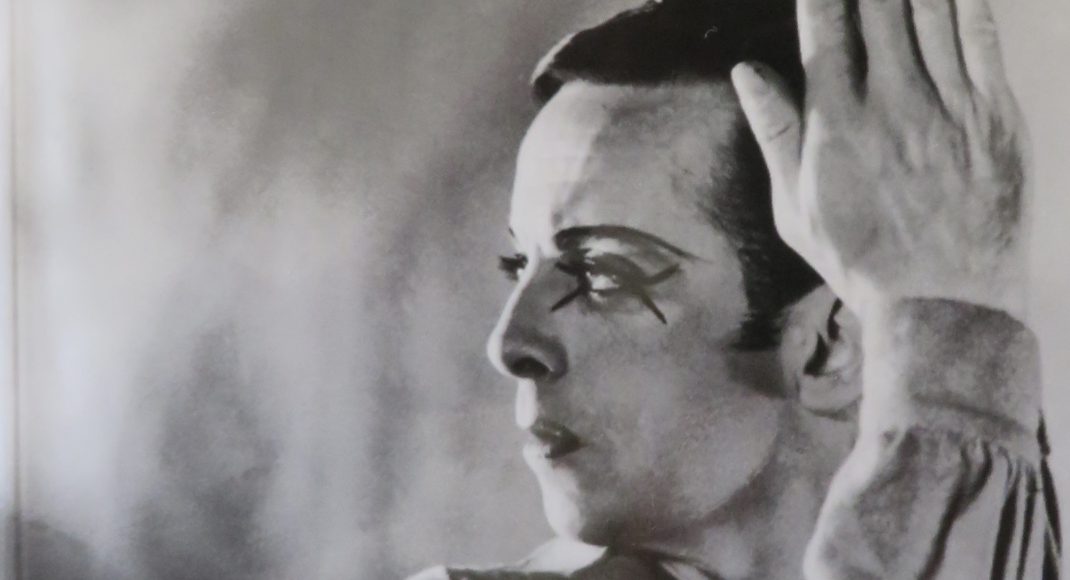
Robert Helpmann is a popular subject for biographical and other writing. Apart from the fact that he was clearly a showman both on and off stage making his exploits a source of fascination, he also was quite meticulous about documenting his career. He kept scrapbooks of his early stage and film appearances and, as he became more influential in the theatrical world, gave countless interviews and appeared in many documentaries. There is much material on which to base books, articles and feature pieces. The bibliography and notes to Anna Bemrose’s biography of Helpmann, published in 2008, give some insight into the amount of material that has already been written about Helpmann. Yet writers continue to be drawn to him and his exploits and undoubtedly this situation will persist. Kathrine Sorley Walker’s Robert Helpmann: a rare sense of the theatre is the latest in this line-up of published works.

The strength of Kathrine Sorley Walker’s book is that she was in the theatre for some of Helpmann’s most significant early productions and performances. Her best writing in this book lies, therefore, in her descriptions of Helpmann’s interpretation of roles whose performances she witnessed, especially when she describes the physical aspects of those interpretations. So, for example, she writes:

‘His Don Quixote, in fact, was an interpretation of dignity and power, a very noble portrait. Speaking for myself, I was awed by his controlled action, his vivid quality of stillness. As in Rake [The Rake’s Progress] and Miracle [Miracle in the Gorbals], he brought into play his ability to convey, without any sense of strain, a tremendous emotional effect. This was done by turns of the head, half-movements, the crook of a hand, a light in the eyes, a slight tremor in the muscles of the face. In contrast, a few swift moments of dancing, a wild beating at the bars of an imaginary cage, were immensely telling’.

This is wonderful observational writing.

Similarly, Sorley Walker reminds us of the qualities of Helpmann’s partnership with Margot Fonteyn. She writes:

‘The magnificent poetry and true Romantic understanding of the Fonteyn-Helpmann partnership in Giselle has been forgotten in the wake of the eulogies about the Fonteyn-Nureyev partnership. In Act II, the dream-like fluency of the dancing, the supernatural inevitability with which they allowed the drama to unfold were so absorbing that no one would have thought of disturbing the mood by applause until the final curtain. There were neither showpiece moments nor any sense of endeavour, merely an eloquent demonstration of skilfully unified music, dance and mime’.

Sorley Walker has also made use of material in her personal collection, as well as material in collections in the United Kingdom not usually quoted or referred to in other writing. So her extracts from an unpublished article by British dance critic A.V. Coton on Helpmann’s theatrical qualities and on his value to the Australian Ballet make interesting reading. So do her comments on an unrealised film production of The Sleeping Beauty largely based on treatment details housed, Sorley Walker records, in the Theatre Museum in London.

But the book also has its frustrating elements. Some relate to the way the book has been edited. It is not an enticing book to pick up randomly for a browse prior to a possible purchase. There are 27 chapters and three appendices but none has a distinguishing heading to it. Thus there is no way of knowing by looking at the list of chapters at the beginning of the book what is contained in the text. Would it appeal to someone without a particular interest in Helpmann? Maybe not.

Other frustrations relate to the way Sorley Walker has written her reminiscence of Helpmann. The book becomes at times an account of what happened next, which sometimes has the effect of encouraging the reader to skip past some sections looking for more of the informed analysis that is the most satisfying feature of the book. More than occasionally there is also a surfeit of quotations from others. In the space of just over a page of writing on The Merry Widow, for example, there are relatively lengthy quotations from four Australian critics – John Cargher, Jill Sykes (two), Leonard Radic and Neil Jillett (two). I would rather know in more depth what Kathrine Sorley Walker as the author of the book thought, or at least as well as what Cargher, Sykes, Radic and Jillett thought.

Robert Helpmann: a rare sense of the theatre deals not just with Helpmann’s dance career, which has provided all my examples in this review. In a slim volume of 162 pages of text it also covers his work as an actor on stage and in film and deals with his personal life as well. On this latter point Sorley Walker’s writing includes references to Helpmann’s long-terms relationship with his partner Michael Benthall, to his work and friendship with Katharine Hepburn and to his relations with his Australian family.

Dance books rarely make much money for their authors or publishers, although Mao’s last dancer may be a recent exception. The advocacy of Dance Books in persisting in publishing in a difficult field is more than admirable. And the gems that Sorley Walker presents at various intervals throughout Robert Helpmann: a rare sense of the theatre, gems coming from an informed standpoint as a result of having ‘been there’, make the book a worthwhile addition to the personal libraries of those interested in the arts.

Michelle Potter, 25 October 2009

Featured image: Book cover (detail). Robert Helpmann: a rare sense of the theatre.

Helpmann book cover

Note: A review of ‘Mim’: a personal memoir of Marie Rambert, also published recently by Dance Books, will appear on this website shortly.