Kings of the Dance. City Center, New York

19 February 2010, City Center, New York

Christopher Wheeldon’s comment was thought-provoking. In the film sequence that opened Kings of the Dance, Wheeldon remarked that the biggest challenge for choreographers working with the eight exceptional artists performing in this show was managing the different styles in which those dancers had been trained. Of the eight, Jose Manuel Carreño was trained in Cuba, Guilllaume Côté in Canada, David Hallberg and Desmond Richardson in the United States, Marcelo Gomes in South America, Joaquin de Luz in Spain, and Denis Matvienko and Nikolay Tsiskaridze in Russia. Wheeldon continued that it was a particular challenge when the dancers had to dance together in a single work, but noted that it had eventually worked well. In fact, it only worked sometimes.

The highlight of the show for me, as far as works involving more than one dancer were concerned, was Nacho Duato’s Remanso, which comprised Act III of the program. Remanso, a work made for three men in 1997, was performed by Hallberg, Côté, and Gomes on the evening I attended. Duato’s choreography is always distinctive and transcends particular methods of classical training. It allows an individual voice to emerge from the choreography rather than being pasted upon it or sublimated to it. Hallberg, Côté and Gomes responded brilliantly. They brought their undoubted talents to bear to present a thrilling performance that was both amusing and technically absorbing.

This kind of transcendence didn’t happen in Wheeldon’s own work, For 4, that followed the opening film. It was danced by Matvienko, Carreño, de Luz and Côté and, while each danced well, it was not the stylistically coherent piece that Wheeldon was obviously seeking. There were also eight distinct styles on show in the Finale when eight excellent dancers showed off their best tricks—a manège of turns or leaps or a series of grand pirouettes—although coherence was obviously not an aim here.

The middle act consisted of seven solos and one duet. They ranged from the quite cliched work by Igal Perry, Ave Maria, danced by Carreño, to the Mr Universe style of Dwight Roden’s Lament danced by Richardson.

Amongst these solos, however, was the sublimely beautiful short piece made by Frederick Ashton for Anthony Dowell in 1978—Dance of the Blessed Spirits. It began with the dancer, David Hallberg on this occasion, standing on the top of a small platform with a few steps leading down to the stage floor. Hallberg’s body was lit to resemble a piece of sculpture in a gallery and his pose initially clearly recalled Michelangelo’s David. As Hallberg descended the steps and began to dance rather than to pose, the lighting came up to reveal choreography that was simple and yet in no way simplistic. It was an understated display of what constitutes the classical body, how that body moves and how with subtle twists of the arms and turns of the head it can become an innovation. Hallberg danced with classical perfection.

In the end, in a show of this nature it is the choreography that counts. On this occasion it was Ashton and Duato who gave this show its flair.

Michelle Potter, 24 February 2010
Tatiana Stepanova (1924-2009)

Tatiana Stepanova, who arrived in Australia in December 1939 with the third of Colonel de Basil’s touring Ballets Russes companies—the Original Ballet Russe—died late last year in Florida. The company’s Australian debut was in Sydney on 30 December 1939 and on that night Stepanova danced in Les Sylphides and was partnered by Serge Lifar. Her performance was noted as an ‘astonishing debut’ by ‘a sixteen-year old girl, who had never before had a leading part’. One reviewer applauded her ‘floating serenity’ and ‘technical fearlessness’.

But even before she had set foot onstage in Australia, news of a potential star was being reported by the Australian press. The Orcades, on which a large contingent of company members had travelled from London, docked first in Fremantle, Western Australia, and The Argus newspaper reported from there that Stepanova was said ‘to show promise of surpassing Pavlova’.  De Basil was recorded as saying ‘She is the kind of dancer one finds once in 50 years. She has created a sensation in Europe’.

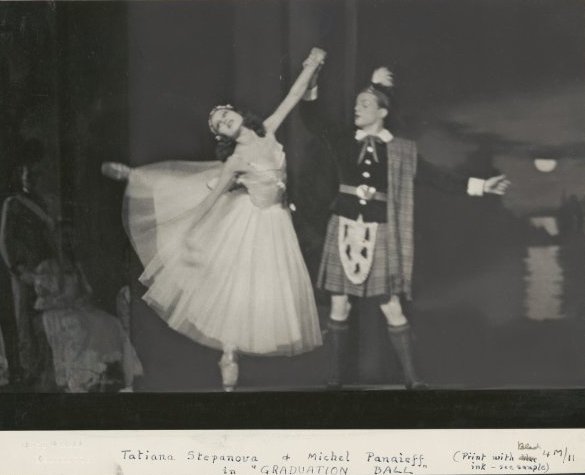
Stepanova also appeared in early performances of David Lichine’s Graduation Ball, which had its world premiere in Sydney on 1 March 1940. She danced the Sylphide in the divertissement ‘The Sylphide and the Scotsman’ partnered by Michael Panaieff. She did not created this role—opening night was given to Natasha Sobinova and Paul Petroff, but cast sheets indicate that Stepanova danced it at least as early as 5 March. A number of photographs of her as the Sylphide were shot by Melbourne-based photographer Hugh P. Hall and many show the expressiveness of her upper body and her long and exquisite line.

Hugh P. Hall, Tatiana Stepanova and Michael Panaieff in ‘The Sylphide and the Scotsman’, Graduation Ball, Original Ballet Russe, Melbourne. National Library of Australia.

An obituary of Stepanova appeared earlier this month on the ballet.co.uk site. It was written by Renee Renouf Hall who had also been working with Stepanova on her memoirs.

UPDATE: Unfortunately the link to this obituary is no longer available

©  Michelle Potter, 28 January 2010

Discover more on Trove.

Dark Matters. Crystal Pite and Kidd Pivot Frankfurt RM

Dance in performance does not respond easily or well to intellectualising—except in the hands of a truly exceptional choreographer. Dark Matters, a work by Canadian choreographer Crystal Pite shown recently at the Sydney Festival, makes that quite clear.

Dark Matters is in two quite discrete sections. The work opens with a man hunched over a table making something. It turns out to be a marionette, which is then manipulated by a number of people dressed all in black who also double as stage hands moving props and set when required. The marionette eventually turns on his maker, stabs him and proceeds to demolish the set.

The second part is more ‘dancerly’ in a conventional sense, and the six dancers of Kidd Pivot are remarkable movers. They have beautifully fluid bodies and they connect with each other seamlessly. Pite is skilled too at arranging her dancers in the space of the stage to create haunting images of bodies meeting, communicating and parting. An absorbing duet for Pite and partner closes the work.

The connecting thread through the entire work is an extract from Voltaire’s Poem on the Lisbon Disaster, written in 1756, including the lines:

  • What is the verdict of the vastest mind?
    Silence: the book of fate is closed to us.
    Man is a stranger to his own research;
    He knows not whence he comes, nor whither goes. (Translation by Joseph McCabe, ca. 1911)

It is not instantly clear, however, exactly what connection the two sections have to each other, nor how they connect to Voltaire. It’s not clear later on, on reflection, either. And herein lies my issue with Dark Matters. It relies on Voltaire to move its intellectual content forward, not on the choreography. It relies in my opinion on Voltaire to connect the two sections as well. Without Voltaire it is hard to see any connection. I yearn for choreographic exposition.

While the dancers of Kidd Pivot can scarcely be faulted in terms of their mastery of movement, I also yearn to see choreography that is more than a series of movements, each one attempting to be more inventive in where parts of the body are put, more flexible and rubbery, more twisted and contorted than the one before. It’s beautiful and engaging, but what does it mean in the context of a work that purports to be ‘about’ something?

Sydney Festival publicity for Dark Matters invoked the name of William Forsythe, quoting words from the British newspaper, The Independent: ‘Think William Forsythe with a woman’s touch, drawn more to beauty than its opposite.’ Forsythe is one of those exceptional choreographers who is able to intellectualise AND do so choreographically. I don’t think Dark Matters measures up. It did, however, send me to Voltaire.

Michelle Potter, 25 January 2010

Dandré-Levitoff Russian Ballet. Indonesia, September 1934

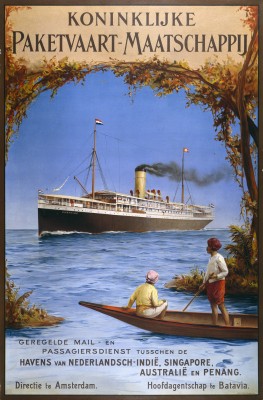
The Dandré-Levitoff Russian Ballet arrived in Brisbane on 8 October 1934 for the Australian leg of a tour that had begun in South Africa in May 1934. The company sailed into Brisbane aboard a Dutch ship, the S.S Nieuw Holland, part of the fleet of the KPM line (Koninklijke Paketvaart-Maatschappij or Royal Packet Navigation Company). KPM maintained sea connections between the islands of Indonesia, formerly the Netherlands East Indies, and also sailed between Indonesia and Australia and New Zealand. The ballet company had embarked for the trip to Australia in the east Javanese city of Surabaya on 28 September following a number of performances across Java.

Poster for the KPM line

Scant attention has been paid to this Indonesian interlude, yet it was significant. It was in Java, for example, that Russian ballerina Olga Spessivtseva (known as Spessiva during her appearances in Indonesia and Australia) gave her first performances with the Dandré-Levitoff Russian Ballet. She had not performed with the company in South Africa but had joined them in Singapore although she had not danced there. Her presence was essential to the success of the company for she was perceived of as continuing the classical heritage of Anna Pavlova, whose popularity in the southern hemisphere was without any doubt.

George Zoritch, an American-born member of the Dandre-Levitoff Russian Ballet, is one of the few authors who has attempted to provide any form of documentation of the company’s performances in Indonesia. Zoritch wrote in his memoir, Ballet mystique, that the company performed in ‘Batavia (now Jakarta), Surabaya, Java and Borneo’. But, like many of those who have written about this company to date, Zoritch has relied on memory and some errors and misunderstandings are instantly discernable. Why, for example, does he include Java in his list as if it were a separate destination from Batavia and Surabaya, both of which are located on the island of Java? In addition, here is no documentary evidence that the company performed in Borneo, an island in the Indonesian archipelago not all that close to Java and not on the main routes of passenger ships? From a distance of 70 years or so perhaps he confused Borneo with Bandung, a city in Java where the company did perform?

The most reliable information yet uncovered about the Indonesian schedule comes from a Dutch newspaper—De Locomotief—published in Semarang, a city on the northern coast of central Java. According to De Locomotief, the Indonesian tour lasted from 8 September 1934 when most of the company arrived in Jakarta from Singapore on another KPM vessel, the S. S. Ophir, until 28 September 1934 when they sailed on the S. S. Nieuw Holland via the island of Bali to Brisbane. The proposed season dates as listed by De Locomotief on 7 September 1934 were:

  • Batavia (Jakarta): 12-16 September
  • Bandoeng (Bandung): 18-19 September
  • Semarang: 21 September
  • Soerabaia (Surabaya): 22-27 September

Subsequently it appears that the performance in Semarang was cancelled and Semarangers were advised to travel to Surabaya to see the company. On 18 September De Locomotief noted that if at least 50 people applied an extra train would be scheduled between Semarang and Surabaya especially for the occasion.

Little information about the repertoire as performed in each Javanese city can be gleaned from De Locomotief . The newspaper does note, however, that Swan Lake was performed in Surabaya and that Spessivtseva was a great hit. It also mentions generally that Les sylphides, La fille mal gardée and Polovtsian dances from Prince Igor were part of the repertoire. Dancer Harcourt Algeranoff, who joined the company in Jakarta, also mentions in his letters to his mother in England that the repertoire included La fille mal gardée, Prince Igor, Carnaval and various divertissements, including his own Indian-inspired piece Abhinaya. In other words, the repertoire was the standard Dandré-Levitoff one as performed in all cities visited during an extensive tour to several countries in 1934-1935. This repertoire was largely that performed by the company of Anna Pavlova and the media promoted heavily the links to Pavlova through this repertoire as indeed they also promoted Spessivtseva as a successor to Pavlova’s classicism.

It was also in Java that Victor Dandré, variously described in Australia as ‘manager’, ‘backer’ and ‘guiding spirit’ of the company, joined the troupe. The Brisbane Courier Mail notes on 9 October that Dandré had made a quick decision to join the company in Java and had ‘travelled by the air mail services’. In a letter from Bandung, Algeranoff confirms Dandré’s arrival and perhaps gives a reason for Dandré’s sudden appearance. He writes: ‘We’re all very glad he’s come. His presence was badly needed. The company is strong but there was no direction’.

There is much more to this company than we have yet discovered. Knowing a little more about its visit to Indonesia is a part of the puzzle.

©  Michelle Potter, 13 January 2010

Discover more on Trove

Bibliography:

  • ‘Het Russisch Ballet’, De Locomotief (Semarang), 7 September  1934, p. 5
  • ‘Het Russisch Ballet te Soerabaia’, De Locomotief (Semarang), 18 September  1934, p. 2
  • Letter from Harcourt Algeranoff to Alice Essex from Bandoeng, 18 September 1934, Papers of Harcourt Algeranoff, National Library of Australia, MS 2376, Series 1, Item 445
  • ‘Het Ballet te Soerabaia’, De Locomotief (Semarang), 25 September  1934, p. 2
  • ‘Classical dance will return. Spessiva’s faith. Modern music too grotesque’, The Courier Mail (Brisbane), 9 October 1934, p. 21
  • George Zoritch, Ballet mystique: behind the glamour of the Ballet Russe (Mountain View, CA: Cynara editions), 2000

New York City Ballet’s Australian tour, 1958

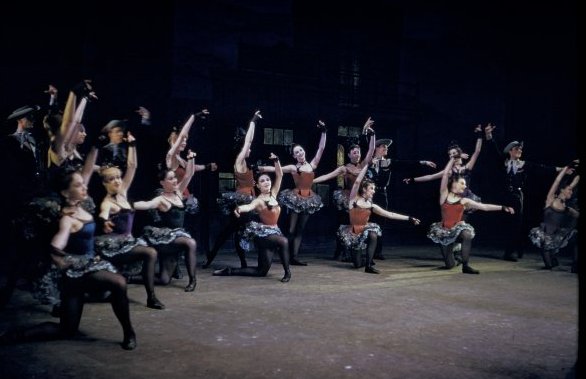
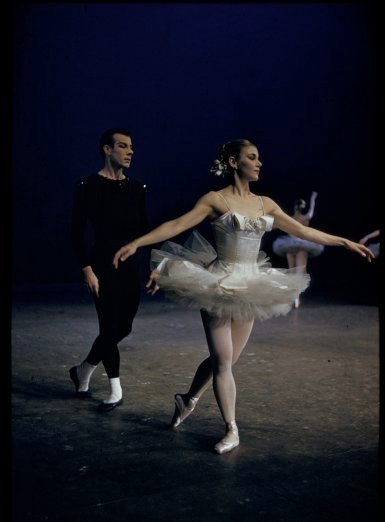
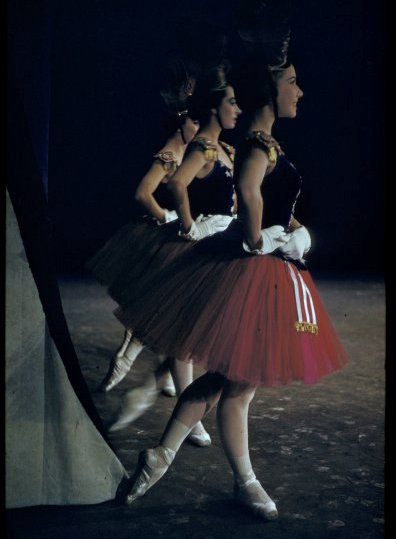
A recent comment posted on this website spoke of the differences between the styles of three major ballet companies visiting Australia in the mid-decades of the twentieth century: de Basil’s Ballets Russes, Ballet Rambert and New York City Ballet. The comment went on to note that perhaps the most enthusiastic attendees at New York City Ballet performances when that company first visited Australia in 1958 were those interested in stage and film musicals. The full remark about the attendees can be read in the comments section at the end of the post at this link, and it prompted me to post the small picture gallery below.

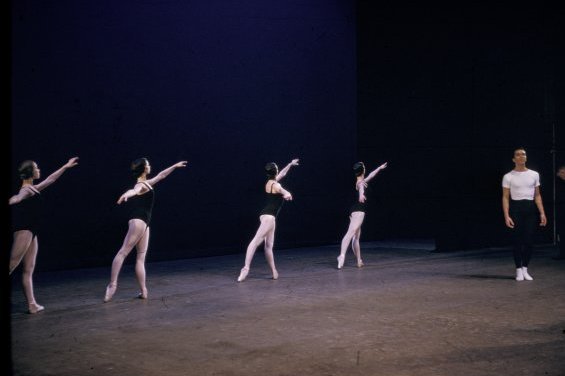
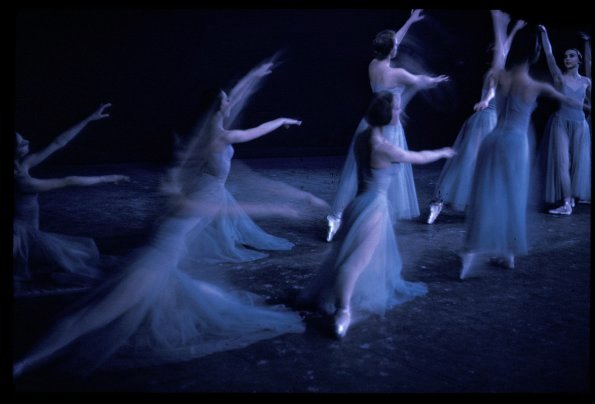
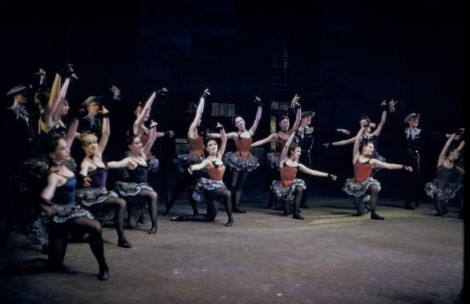
Images top row: (left) Symphony in C, (right) Stars and Stripes
Bottom row: (left) Concerto Barocco, (right) Serenade

Most of the repertoire brought to Australia by New York City Ballet was by Balanchine although works by Jerome Robbins and Todd Bolender were also included. But even looking at the small number of  images in the gallery, it is clear that the range of works was diverse. The gallery includes images of some of Balanchine’s works that might be seen as redolent of musical theatre, along with others from some of his most glorious pared-back, abstract creations.

New York City Ballet did not receive the attention in Australia that it deserved and the company was disappointed with its reception, according to Valrene Tweedie. Tweedie was a close friend of several of the dancers as a result of her decade of dancing in the Americas. She believed that New York City Ballet’s repertoire and style of dancing were way ahead of Australian audiences’ expectations at the time. Tweedie also noted that there were financial issues that caused the dancers some unhappiness. She has remarked in an oral history interview that the dancers were not able to take their salary, paid to them in Australian dollars, out of the country but had to spend it in Australia. It was the reason, she maintains, that Andre Eglevsky came but stayed only a week or so. He had a family to support in America and could not afford to spend his money on frivolous items such as souvenirs.

All the images in the gallery were taken during performance by Walter Stringer, an enthusiastic amateur photographer based in Melbourne. His photographic record of almost every dance company that performed in Melbourne between about 1940 and 1980 is of inestimable documentary value, especially given that his archive is now in public hands and so available to all for research.

Further comments, including identification of dancers in the Stringer images, are welcome. All photos are reproduced with the permission of the National Library of Australia.

Michelle Potter, 17 December 2009

Featured image: New York City Ballet in Western Symphony. Melbourne, Australian tour, 1958