Ochres. Bangarra Dance Theatre

4  December 2015, Carriageworks, Eveleigh (Sydney)

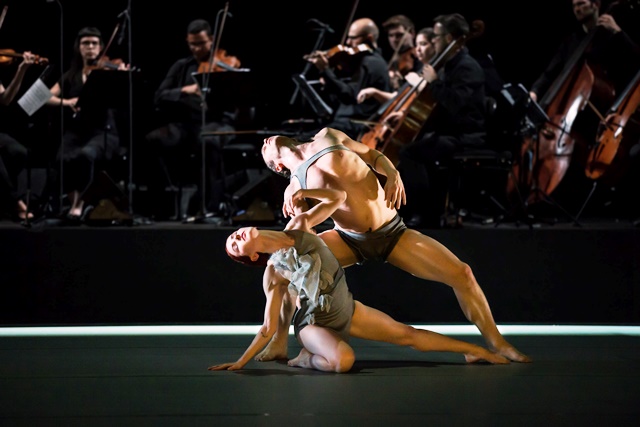
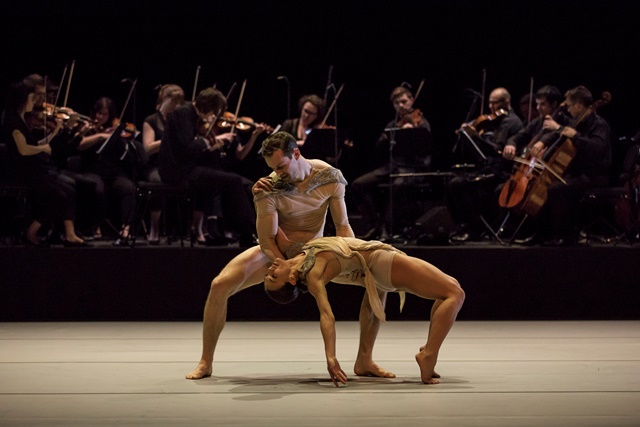
Seeing Ochres in 2015 after 21 years was a remarkable experience. More than anything it marked the astonishing achievement of Stephen Page and his team of artists. Through the creativity that has characterised Bangarra’s journey, Page has given Australian Indigenous culture a powerful voice. Ochres was an eye opener in 1994. Now it is a powerful evocation of all that Bangarra stands for.
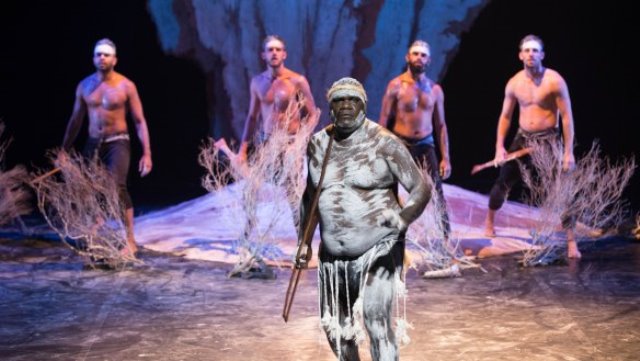
Djakapurra Munyarryun and Bangarra dancers in 'Black' from Ochres, 2015. Photo:-Jhuny-Boy Borja
Djakapurra Munyarryun and Bangarra dancers in ‘Black’ from Ochres, 2015. Photo: © Jhuny-Boy Borja

This 2015 Ochres is not an exact rendition of the original. It is promoted as a ‘reimagining’ of that early show but is definitely close enough for those who saw it in the 1990s to feel they are seeing the work again.

As it did in 1994, the 2015 Ochres begins with a scene featuring cultural consultant Djakapurra Munyarryun, not this time painting up with yellow ochre, but singing a song, Ngurrtja—Land Cleansing Song–composed especially (I believe) for this 2015 production. He has, as ever, huge power and presence. He stood perfectly still for several seconds before beginning his song and the effect was mesmerising.

Torres Starait Islander Elma Kris, another of Bangarra’s consultants, follows with a section called The Light in which she, like Djakapurra Munyarryun had done previously, smeared her limbs and face with yellow ochre.

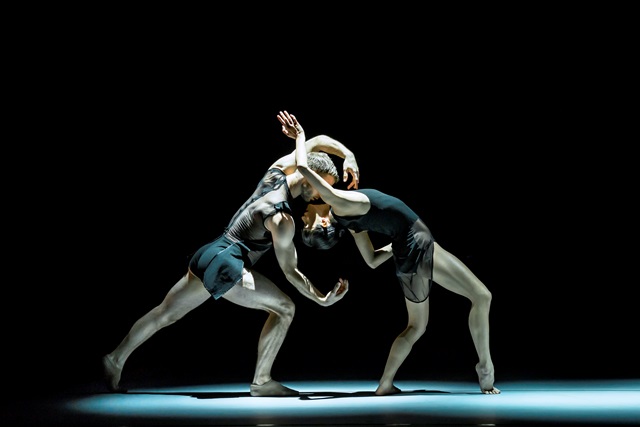
These opening scenes are followed by the four ‘ochre sections’—’Yellow’  inspired by female energy, ‘Black’ representing male energy, ‘Red’ showing male and female relations, and ‘White’ inspired by history and its influence on the future.

In ‘Yellow’, choreographed by Bernadette Walong-Sene, the women dance low to the ground. Their movements are most often flowing and they have an organic look to them. Deborah Brown shows her remarkable skills throughout this section. How  beautiful to see a relatively classical move, a turn in a low arabesque with one hand on the shoulder for example, followed by sudden movements of the head as if she is curious about, and watchful for what is happening around her. Brown always looks good no matter what style her movements represent.

‘Black’, with contemporary choreography from Stephen Page and traditional choreography from Djakapurra Munyarryun, shows power and masculinity—hunters crouching behind bushes, warriors with their weapons sparring with each other. This section is also characterised by some nicely performed unison work.

‘Red’ has the strongest narrative element of the four sections. It focuses on four different expressions of male/female relationships moving from youthful dalliance featuring Beau Dean Riley Smith, Nicola Sabatino and Yolanda Lowatta to the final section ‘Pain’ in which Elma Kris cares for an ailing man, danced by Daniel Riley. But in between we can imagine other relationships. Domestic violence and addiction perhaps?

‘White’ concludes the program. The two cultural consultants, Elma Kris and Djakapurra Munyarryun, lead this final section and, with all the dancers covered with white ochre, a spiritual quality emerges from sections representing a range of concepts from kinship to totemic ideas. The choreography is credited to Stephen Page, Bernadette Walong-Sene, and Djakapurra Munyarryun.

Jennifer Irwin’s costumes are cleanly cut and simply coloured. Jacob Nash’s set, looking like long shards of bark, hangs in the centre of the space above a sandy mound. It is lit in changing colours by Joseph Mercurio. A score by David Page is evocative of the 1990s but retains enough power and emotion to feel relevant still.

The kind of fusion of contemporary and traditional movements we have come to expect from Bangarra’s dancers is all there and reflects the fact that Bangarra is an urban Aboriginal initiative with strong links back to its cultural heritage. And, while the dancers of 1994 were extraordinary (a list of the 1994 team appears in the program), the manner in which Bangarra has grown technically is also clear. Its dancers are spectacularly good and their commitment shines through.

Michelle Potter, 9 December 2015

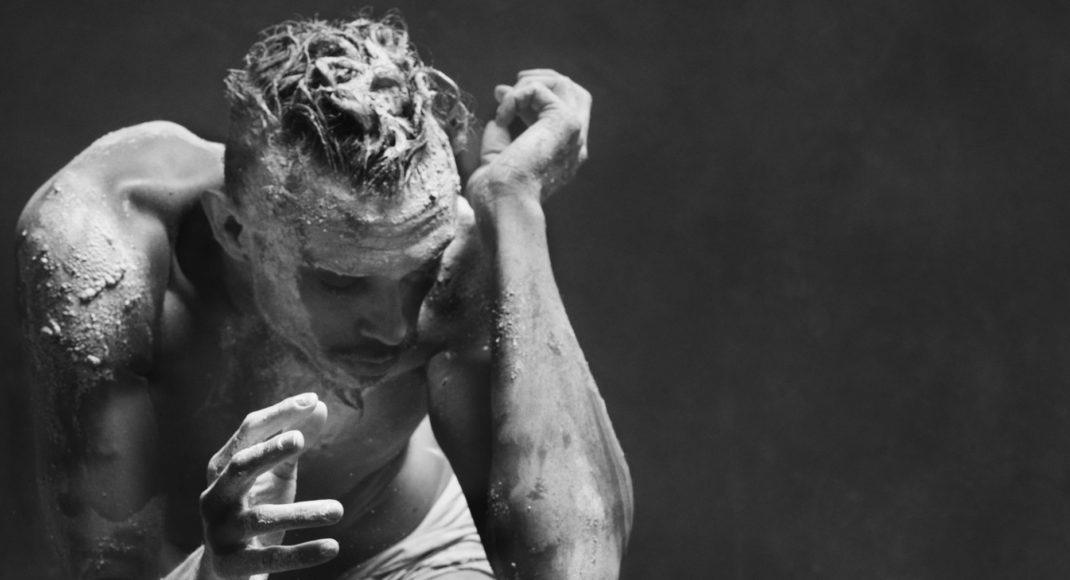
Featured image: Leonard Mickelo in a study for Ochres, 2015. Photo: © Edward Mulvihill
Ochres-landscape-wesbite

For more about Djakapurra Munyarryun follow this link.
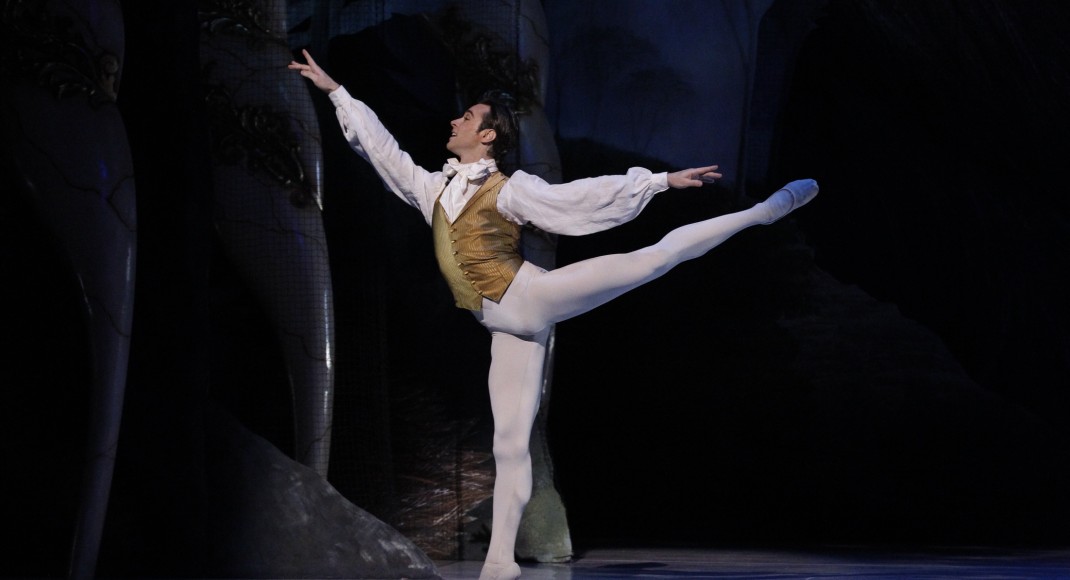
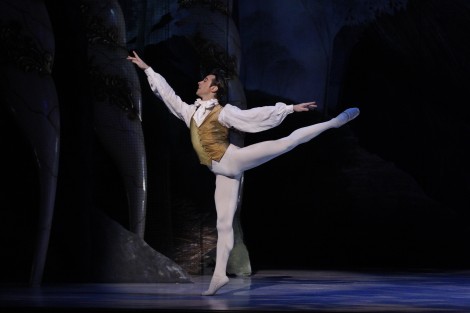
Daniel Gaudiello as the Prince in 'The Sleeping Beauty'. The Australian Ballet, 2015

The Sleeping Beauty. A second look

5 December 2015 (matinee), Joan Sutherland Theatre, Sydney Opera House

My second viewing of David McAllister’s Sleeping Beauty simply confirmed my opinion that this production is the most over-designed ballet I have ever seen since I saw my first professional ballet performance many years ago. Sold-out houses mean nothing artistically as far as I am concerned. At least this time, however, I knew what to expect and so made a concerted effort to block out the design and look at the dancing, as much as was possible.

This matinee performance belonged to Miwako Kubota and Daniel Gaudiello as Aurora and Prince Desiré respectively. As the sixteen year old Aurora, Kubota performed charmingly and was technically close to faultless. But it was in the wedding scene that she took my breath away. She was radiant. She brought so much light and shade to her dancing and, amazingly, the light and shade came mostly through her technical execution. She leant into movements, she used her head and shoulders beautifully, every movement had an expressive power. I especially loved that part in one of her variations in the pas de deux where her delicate wrist movements, enhanced by such a beautiful smile, such a fluid body, and such perfect feet, told the story of how she had grown from a child to a woman, reflecting back to her father’s similar mime sequence at her sixteenth birthday.

As her prince, Gaudiello once again showed what a wonderful dancer and partner he is. I love watching him take care of his ballerina and, as usual, his technical execution of the choreography was outstanding. I was especially taken by those moments in his variation in the coda of the grand pas de deux where his light and beautifully elevated cabrioles to the front (also beautifully beaten) were followed by a sweep of one leg, the foot passing through first position, into an attitude at the back. That foot caressed the floor making those small movements that join larger ones so clear.

The only other male dancer who has made me so aware of the beautiful tiny details that make up larger and more obvious movements is Ethan Stiefel, whom I was once lucky enough to see as Solor in Makarova’s Bayadère.

For the first time in a long time I felt that this grand pas de deux, with Kubota and Gaudiello performing as they did, was actually grand. Hurrah!

Sympathy to the gentleman in the Garland Dance in Act I who had a major wig malfunction, but bouquets to the other gentleman who, wig intact, managed to remove the fallen part from the floor. The dance went on, the gentleman left the stage and returned with wig fixed. But sadly that Garland Dance has, in this production, lost all its honourable simplicity and choreographic design as a result of those garlands that looked quite burdensome with far too many lolly-pink and ghastly-green flowers (matching the ladies’ dresses that are similarly coloured and burdened).

As I had previously, I enjoyed the newly-imagined role of Carabosse, which was carefully thought through by former Royal Ballet dancer Gillian Revie. Benedicte Bemet, fresh from the triumph of receiving the award of the 2015 Telstra Ballet Dancer of the Year, was partnered by Christopher Rodgers-Wilson in the Bluebird pas de deux. Both danced nicely but did not have the attack of Ako Kondo and Chengwu Guo. They need a little more time to reach greater heights in roles such as the Bluebird pas de deux. I’m sure those greater heights are on their way.

Michelle Potter, 7 December 2015

Featured image: Daniel Gaudiello as the Prince in The Sleeping Beauty. The Australian Ballet, 2015. Photo: © Jeff Busby

Daniel Gaudiello as the Prince in 'The Sleeping Beauty'. The Australian Ballet, 2015

My earlier review of the Australian Ballet’s new production of The Sleeping Beauty is at this link.

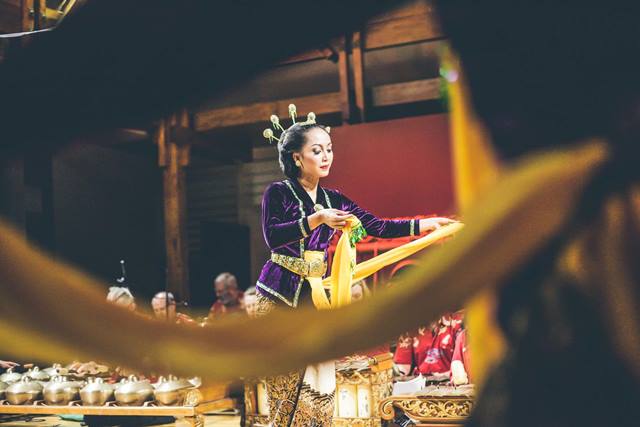
Java Dance. Swargaloka Dance Troupe (from Jakarta), and Gamelan Wellington

5 December 2015, Adam Concert Room, Te Kōkī  New Zealand School of Music, Victoria University of Wellington
Reviewed by Jennifer Shennan 

Prabhu Sri Bathara Kresna, a character in Indonesian wayang kulit shadow puppet theatre, can wield weapons of supernatural power. One of these, wijaya kusuma, is a flower so beautiful (would that be a lotus, a water lily, or passionfruit flower?), it is said to bring back the dead from their graves.

The director of Gamelan Padhang Moncar, Budi Putra, must have borrowed such a flower for the evening’s performance since Jack Body, loved musician, composer, colleague, mentor and friend, who endeavoured for such a long time to bring this troupe of dancers from Jakarta to New Zealand, died earlier this year so did not live to see their performance. But every member of the capacity audience could sense why he would have wanted to arrange the visit, and their dancing, as beautiful as any lotus, effectively means he came back to spend the evening with us. A miracle.

There are five performers in the visiting troupe, four of them young and sinewy teenagers. Their youth melts away as they begin to dance however, and the quiet authority and mature confidence with which they hold the stage is deeply reassuring. We are not thinking of how they might dance in some years time. They are doing it here and now.

The opening dance of welcome, Sesaji, is an auspicious offering that establishes a mood of serenity for the evening performance. One couple moves as traditional dancers, staying within the highly stylized angularity of etched sculpture that keeps specific emotion disguised, yet still palpably present. The other couple moves in more contemporary style, limbs freer to shape their gestures, to leap, to stretch out into lines that suggest forces of modernity, albeit still carefully measured. The dancers occasionally join in the singing as well. By placing these two generations of styles adjacent and simultaneous, the choreography speaks of past and present not simply by pitching them as alternatives to choose between, but as layers to be absorbed by degrees one into the other. What a civilised and inspired statement about the history of dance.

The second dance, Beksan Enggar-Enggar, depicts a man who has to leave for war saying a reluctant farewell to his wife.

Yani Walandari in 'Beksan Enggar-Enggar, 2015. Photo: Jasper Rain
Yani Walandari in Beksan Enggar-Enggar, Swargaloka Dance Troupe, 2015. Photo: © Jasper Rain

In 2015 as a centennial year from WW I, we have witnessed countless evocations of war and the emotional toll it takes in the lives of ordinary people. Not a one of them would be more poignant than this traditional dance for a couple—who dance so close to each other, yet do not touch, who cast discreet oblique glances as they turn, sway, step, slide, sink and rise to speak their sadness of imminent parting. Their rapport is real, and we sense it will stay strong even when apart. The menuet of French noble dancing from the 18th century court, barely known or understood today other than through its music (think of the adagio movement of Bach’s Double Violin Concerto) shares exactly this same form. When eventually the briefest physical contact is made between the two dancers (he brushes his hand along the back of her waist) the signal of the end of the dance is cast. In this timeless performance by Yani Walundari and Bathara Saverigadi Dewandoro, we saw something that words cannot paraphrase, and should not try to.

Comedy bounded in for the third dance, Bajidor Kahot, when the older member of the troupe, Tri Kadar Nugroho, with a mask-like face of bright pink, and two protruding rabbit teeth, cavorted around in his attempts to imitate the lithe and graceful skills of the younger dancers. With the consummate timing of all best comedians, he succeeded in making a fool of everyone you’ve ever met who tried to persuade you of his handsome and attractive potential. He’s flat on his back, admiring his reflection in the sky, by the time he realises the young couples have escaped far away from his oafish advances.

Balinese dance is one of the most celebrated of world dance traditions. Its shimmering, staccato, deft and unpredicatable dynamics evoke the firefly, the humming bird, the butterfly, the candle flame. To Balinese gamelan now, Taniwha Jaya, directed by Gareth Farr, we see Tari Margapati, a fascinating duo by Chikal Mutiara Diar and Denta Sepdwiansyah Pinandito. In the bebancihan genre, which combines movement from the normally contrasting male and female styles, gender is layered not demarcated. This is a seemingly simple yet subtly presented theme.

In the final dance, Nusantara Indah, several local dancers from the Indonesian community join the visitors. Beguiling sequences move into tableau-like groupings with a final firework of a multi-limbed creature bringing a festive air to the ending of a truly memorable performance.

Throughout the evening the musicians in three gamelan ensembles, as well as Indonesian community playing angklung, rendering Pokarekare ana in Maori, offered affirmation that what is different between people is opportunity for seeing what is shared.

We should treasure the wisdom embedded in the DNA of traditional dances. They are, mostly speaking, an endangered species in the world, but this spirited little troupe, by the calibre of its performance, and its beautiful costuming, is carrying its past into its future.

Jennifer Shennan, 6 December 2015

New Zealand School of Dance Graduation 2015

19 November  2015, Te Whaea, Wellington
Reviewed by Jennifer Shennan

The New Zealand School of Dance (NZSD) graduation program opened with Paquita, staged by Anna-Marie Holmes, after Petipa’s vintage choreography from 1846, offering as many challenges today as it no doubt did back then. In another layer of heritage Nadine Tyson, the tutor who rehearsed the work, danced in it at her own NZSD graduation back in 1988. The luxuriant music by Minkus demands a festive commitment, and the students aspired to this with flair. Soloist Lola Howard in one of the variations caught our eye with her sense of line, and technical command.

Sarah Foster-Sproull, also a former NZSD graduate, created Forgotten Things, to music by Andrew Foster, in a premiere work for this season. A series of highly effective images, with light shining on skin of limbs in a kinetic sculptural effect, cohered the piece throughout. The mediaeval dance-like rhythms supported well the work’s theme of community undergoing change.

Cnoditions [not a typo] of Entry,  an enigmatic and somewhat troubling work choreographed by Thomas Bradley, (no program profile so perhaps he prefers the anonymity?) had a line of robed and hooded figures in very low light levels that suggested sinister or secret machinations of covert behaviour among the members of a small and closed group. The program notes also appear to be in code (and a pity that the printed program is overall an uneven affair).

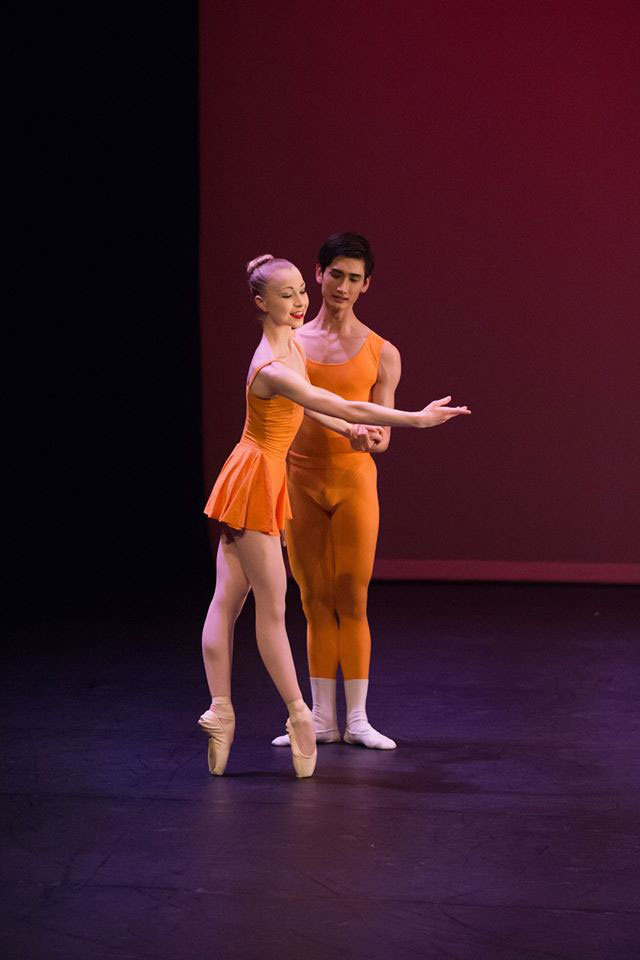
Tarantella, Balanchine’s quirky number from 1964, to Gottschalk’s jaunty music, was danced with effervescent style and vivacity by Mayuri Hashimoto and Felipe Domingos (the latter a promising young dancer from Brazil who has been confirmed in a contract to join Royal New Zealand Ballet). Diana White staged the piece which was rehearsed by Qi Huan, until recently a fine lead dancer with RNZB. His artistic conviction shone through the students’ performance (though Poul Gnatt would have required their somewhat quiet tambourines to be shredded by the end of the performance).

As It Fades, choreographed by Kuik Swee Boon of Singapore, to an atmospheric score, was performed here in excerpts, so it’s hard to gauge the work’s context. There was noticeable contrast within its structure—speed and flight, moving through to a calm and quietly iexplored place, performed with strong focus—as if above ground, but then under water.

Lola Howard and Jerry Wan Jiajing in Concerto. New Zealand School of Dance Graduation 2015

The final and major work on the program was Concerto, choreographed by Kenneth MacMillan, premiered in Berlin in 1966. The rapport between MacMillan and dancer Lynn Seymour, whose distinctive qualities as a richly poetic and dramatic dancer inspired the making of the main duet, survives to again inspire the very fine and fresh performance it received here from Lola Howard and Jerry Wan Jiajing. Lynn Wallis staged the work, with Stephen Beagley and Turid Revfeim also involved. The Shostakovich piano concerto #2 was beautifully performed by Ludwig Treviranus and Craig O’Malley on two pianos sidestage. The colour gradations of costumes made attractive foil to each other and were the most successful of the evening.

Ballet is nothing if not faithful to its repertoire, but new choreographies in that idiom are very rarely commissioned or forthcoming—yet its movement vocabulary is able to speak to us of our lives and loves and concerns—witness that serene and timeless Concerto pas de deux. Contemporary dance, by contrast, is rarely studied or staged here through the classics of its own heritage repertoire and too often it has only a single season life. These are not parallel streams in choreography since they are one and the same art. Only through studying and seeing both repertoires do we know and understand that, and ourselves, as performers and as audiences. No doubt the School’s upcoming 50th anniversary will draw attention to the legacy of those decades.

This program offers challenges to the students, and opportunities to be savoured by the audience. The fact that your favourites will be different from mine is the rich treasure that the musical and non-verbal nature of dancing invites. It matters not whether old or new, borrowed or blue, ballet or contemporary dance. What matters is that it be good, and that choreographers and dancers know what to do with their music. All encouragement to the students as they make their way into careers in dance.

Jennifer Shennan, 24 November 2015

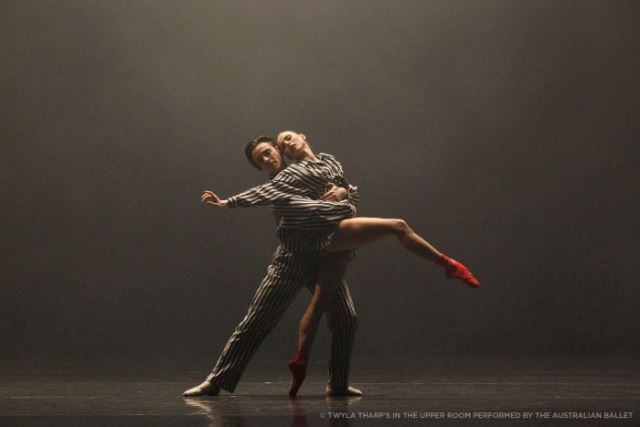
Daniel Gaudiello and Natasha Kusch in Twyla Tharp's 'In the Upper Room'. The Australian Ballet, 2015. Photo: © Jeff Busby

20:21. Another look

14 November 2015 (matinee), Joan Sutherland Theatre, Sydney Opera House

What a pleasure it was to see the Australian Ballet’s triple bill program, 20:21, for a second time, in a different theatre, and with a different cast. Clearly the dancers have become more familiar with the works over the series of performances that have been staged since I saw it in Melbourne. I suspect it also looks better on the smaller stage of the Sydney Opera House (for once). In addition, I have inched myself forward over many years of subscribing to a Sydney matinee series so that I have an almost perfect seat in the Joan Sutherland Theatre. It all adds up.

This time In the Upper Room had a simply fabulous cast. Daniel Gaudiello and Natasha Kusch were stunning throughout, as were Ako Kondo, Miwako Kubota, Ingrid Gow (great to see her in a featured role again), Chengwu Guo and Christopher Rodgers-Wilson.

Daniel Gaudiello and Natasha Kusch in Twyla Tharp's 'In the Upper Room'. The Australian Ballet, 2015. Photo: © Jeff Busby
Daniel Gaudiello and Natasha Kusch in Twyla Tharp’s In the Upper Room. The Australian Ballet, 2015. Photo: © Jeff Busby

These seven dancers worked together in different combinations in the more balletic of the various sections of Upper Room. Not only did they show off their superb technical skills, they brought their individual personalities to these sections—a perfect approach for Tharp’s choreography. Gaudiello finished off his phrases of movement with his remarkable sense of theatricality; Guo finished his with a kind of nonchalance, which was equally as satisfying. But it was Kusch who stole the show with her joyous manner and her ability to make even the most difficult move, the most outrageous lift, look so easy.

It is such a thrill to see this work performed by the Australian Ballet’s dancers and it was not just the seven I have mentioned who danced wonderfully. I could feel the excitement building from the moment the curtain rose on Dimity Azoury and Vivenne Wong in their sneakers and stripey costumes. As I have said before, for me the Australian Ballet’s dancers have the staying power, the determination to succeed,and just the right personalities to make Tharp’s Upper Room look fabulous. This time they nailed it and for once I didn’t keep thinking of previous casts I saw umpteen years ago!

Kusch was also the star attraction for me in the Balanchine piece, Symphony in Three Movements. She had the central, andante movement, which she danced with Adam Bull. Technically she was quite outstanding. Her extensions took the breath away, and her turns were spectacular. But it was her musicality that stood out. She brought out the changing rhythms and the jazzy overtones of Stravinsky’s score not just in her way of moving but also in her facial expression. She was a delight to watch. Bull was a strong partner but perhaps a little too tall for Kusch?

Gaudiello also had a leading role in Symphony in Three Movements, mostly partnering Dimity Azoury, and I never tire of watching his approach to partnering. He is so attentive to his ballerina in a way that is rarely achieved by others, but he manages at the same time to perform as an outstanding artist himself. Miwako Kubota and Brett Simon danced the third of the leading couples and the corps, wonderfully rehearsed as ever by Eve Lawson, showed off Balanchine’s choreographic patterns to advantage.

Tim Harbour’s Filigree and Shadow was again strongly danced but, as before, I saw little in it that was substantial enough to excite the mind or eye. It is admirable that the Australian Ballet is exploring new choreographic ideas of course, and large sections of the audience were thrilled with what they saw, but I am still not sure where Harbour was trying to take us.

Michelle Potter, 16 November 2015

My review of 20:21 in Melbourne is at this link.

The Sleeping Beauty. Queensland Ballet

24 October 2015 (matinee), Lyric Theatre, Queensland Performing Arts Centre, Brisbane

After my Australian Ballet brush with Beauty I was longing to see another production of The Sleeping Beauty and so took a flying visit to Brisbane to see what Greg Horsman had done with this classic of the ballet repertoire. Horsman’s Sleeping Beauty was originally made for the Royal New Zealand Ballet in 2011 and is being performed for the first time in Australia by Queensland Ballet. I did not see the international stars who had been engaged as special guests for the season, which did not bother me as it was the production that particularly interested me.

The Fairies and their Cavaliers in Queensland Ballet's 'Sleeping Beauty', 2015
The Fairies and their Cavaliers in Queensland Ballet’s Sleeping Beauty, 2015

Horsman has made some small changes to the story, some of which may well be as a result of working with a medium-sized company in both New Zealand and Queensland. Perhaps the most startling change is that Catalabutte, assistant to the King, and Catalabutte’s wife, Lady Florine, are cats. This at first is a shock. But they are so beautifully, and at times humorously, worked into the story—their dance together in the last act takes the place of Puss and Boots and the White Cat—that suspending disbelief is easy. Jack Lister as Catalabutte made a strong impression throughout, but especially as he pursued the Bluebird in the wedding scene.

There is also quite a lot of mime as explanation of the story. This is not an innovation, of course, but unless well done mime passages tend to get lost in translation as it were. The dancers of Queensland Ballet have, however, been well coached in this aspect of the ballet and they have an expansive quality to their gestures. Everything is perfectly clear. Nothing drags along.

The dancing itself had some ups and downs. The corps de ballet worked nicely together for the most part and Teri Crilly and Camilo Ramos stood out as the lead couple in what is usually the Garland Dance (although in this production there were no garlands). Ramos, who has a wonderful stage presence as well as a stellar technique, also danced strongly as one of the Prince’s friends in Act II. The fairies, too, danced nicely throughout, although my eyes kept turning to the Orange Fairy of Grace danced by Lisa Edwards. I loved the charm with which she performed and the delicious fluidity of her movement. She shone.

I found Yanela Piñera, Queensland Ballet’s 2015 guest principal artist, very engaging as Aurora. Piñera handled the rose adagio and the final grand pas de deux with strength and attack, but what really stood out was her joyful presence throughout. She involved herself in everything, and with everyone. She smiled, made eye contact, and used her head and arms beautifully. It was a real pleasure watching her.

Hao Bin as the Prince did not, however, always live up to my expectations. I enjoyed his acting at the start of Act II where he kept himself apart from his friends in the forest as he pondered the lack of love in his life. But once he started dancing I found him a little wooden. I wished he would move his upper body with more fluidity and use his feet more strongly.

Gary Harris’ sets are gorgeous. His interiors recall Gothic architecture with its emphasis on soaring space; his exteriors are airy, beautiful places in which the story can unfold; and the final scene with its starry background provides an especially elegant setting for the wedding of Aurora and the Prince. His work was evocatively lit by Jon Buswell.

The jarring elements for me in Harris’ design input were the costumes for the two Bluebirds, although perhaps it was the very heavy eye make-up they wore that made the costumes seem over the top compard with the general elegance of the last scene. Teri Crilly was a lovely female bluebird. Whether listening, fluttering her hands, or simply executing a step, everything was performed cleanly and with great style. Her partner, Zhi Fang, seemed very nervous and so did not really show himself to advantage.

Nigel Gaynor conducted a vibrant Queensland Symphony Orchestra where tempi, volume and orchestral colour contributed to the unfolding of the story and to the development of the characters in the ballet. The orchestra added an extra emotional layer to the performance and it was such a pleasure to be hearing this kind of collaboration between music and dance. From 2016 Gaynor will take up the position of principal conductor and music director of Queensland Ballet.

I came away from this Queensland Ballet performance loving the passion that the dancers put into their performance, despite the odd stumble or other mishap. But most of all I came away thrilled that the collaborative elements of music and design were working to enhance the dance, rather than ignoring it or trying to outdo it.

Michelle Potter, 25 October 2015

Elise May in Natalie Weir's 'Carmen Sweet.' Expressions Dance Company. Photo: Dylan Evans

Carmen Sweet. Expressions Dance Company (3)

9 October 2015, Queanbeyan Performing Arts Centre, Queanbeyan

This text is a slightly expanded version of my review, which appeared in The Canberra Times on 13 October 2015. A link to the online version of the review is at the end of this post.

Natalie Weir’s Carmen Sweet for Expressions Dance Company is simply sensational. Made for just six dancers with stunning, minimal design and powerful lighting, it demonstrates very clearly that less is more.

Jack Ziesing, Elise May, Riannon McLean, Samantha Mitchell in Natalie Weir's 'Carmen Sweet'. Photo Dylan Evans
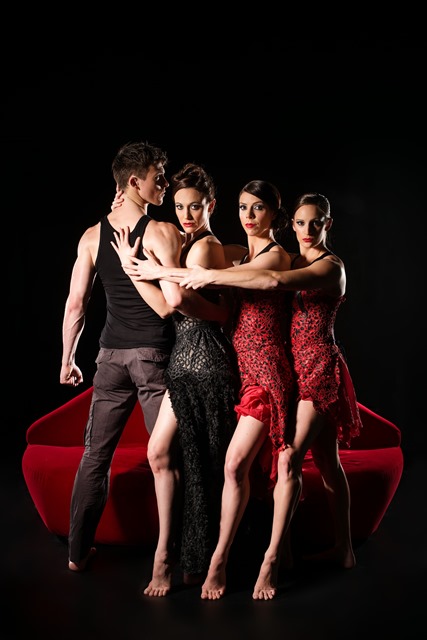
Jack Ziesing, Elise May, Riannon McLean, Samantha Mitchell in Natalie Weir’s Carmen Sweet. Expressions Dance Company. Photo: ©  Dylan Evans

Carmen Sweet follows the familiar story of Carmen as we know it from the opera, at least in essence. Two men vie for Carmen’s love. She plays with the power she wields over them before one kills her. But in typical fashion, Weir has directed the story to accommodate her tiny company, and has taken a psychological look at the personality of Carmen. We encounter three Carmens, a young, flirtatious Carmen (Rebecca Hall), a sensual, fiery Carmen (Michelle Barnett) and a mature, knowing Carmen (Elise May). But that they are three shades of the one character is made clear in some exceptional choreography. Especially memorable is the scene where Carmen moves her affections from Don José, the soldier (Jack Ziesing), to that of Escamillo, the matador (Benjamin Chapman). Weir has choreographed this moment as a kind of ballroom dance for five people dancing as one. The three Carmens form the middle of the group with a man at each end. With changes of direction that are quite hypnotic, the leadership of the dance moves back and forth from Don José to Escamillo.

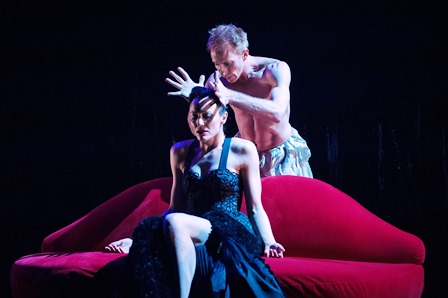
As the Fortune Teller who warns Carmen of her impending death at the hands of Don José, Daryl Brandwood gave a powerful performance. His expressive body curved and curled as he stalked around the older Carmen. He took her head in his hands and turned her gaze towards her younger counterpart, forcing her to watch as the impending murder was played out. And the final moment in this scene was set up on the diagonal for maximum theatrical impact. Our eyes were drawn back and forth from the demands of the Fortune Teller upstage, to prefigured death downstage as Ziesing hovered over the body of Carmen.

Elise May and Daryl Brandwood in Natalie Weir's 'Carmen Sweet'. Expressions Dance Company. Photo: Dylan Evans
Elise May and Daryl Brandwood in Natalie Weir’s Carmen Sweet. Expressions Dance Company. Photo: © Dylan Evans

The final scene is also choreographed on the diagonal and gives us another look at the three Carmens as one. Shrouded in moody lighting (Ben Hughes and Amelia Davis), one by one the three women fall smoothly onto the sofa, which has been moved downstage, each one not quite covering the other. Upstage the murderer, Don José, is a tense and lonely figure, his empty hands stretched forward. It is a startling image that again invites us to cast our eyes from one grouping to the other.

Weir has skilfully used the Rodion Shchedrin score, which is an arrangement for strings and percussion of extracts from music by Georges Bizet. She has, of course, used well-known melodies to identify the various characters. Escamillo, for example, enters to the familiar music that accompanies the Toreador Song in Bizet’s opera. But Weir’s skill is also noticeable in the way her choreography matches Shchedrin’s percussive sounds, exemplified especially in the last solo by the sensual Carmen where her pizzicato-style movements match beautifully with the notes.

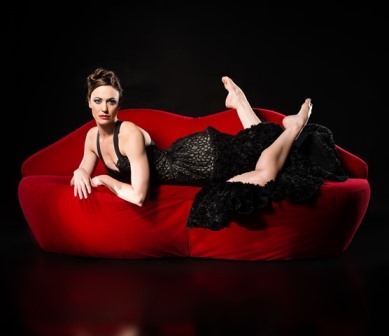
Bill Haycock’s minimal but dramatic use of colour added extra strength to what was an exceptional piece of theatre. A single, red Salvador Dali ‘lip’ sofa was all that we needed to set the scene of passion and revenge, and the dancers used it to accommodate their outbursts of fiery behaviour. Haycock’s costumes for the three Carmens continued the theatricality. The older Carmen flounced seductively in a long-ish black, flamenco-styled dress, while the younger Carmens wore shorter, sexy red numbers.

And a big bouquet to the six local dancers, each carrying a single red rose, who accompanied Escamillo’s entrance. They performed with all the aplomb of the professionals with whom they shared the stage.

Carmen Sweet is a five star show.

Here is the link to the review as it appeared in The Canberra Times.

Michelle Potter, 13 October 2015

Featured image: Elise May in Natalie Weir’s Carmen Sweet. Expressions Dance Company. Photo: © Dylan Evans

Elise May in Natalie Weir's 'Carmen Sweet.' Expressions Dance Company. Photo: Dylan Evans
Jesse Scales and David Mack in 'Variation 10'. Sydney Dance Company, 2015. Photo: Peter Grieg

Triptych. Sydney Dance Company

10 October 2015 (matinee), Roslyn Packer Theatre, Sydney

Sydney Dance Company’s latest offering, Triptych, pays homage to English composer Benjamin Britten, whose compositions, Simple Symphony, Les Illuminations and Variations on a Theme of Frank Bridge, are at the musical heart of the program. All three works have choreography by artistic director Rafael Bonachela, and the dancers are joined onstage by singer Katie Noonan in Les Illuminations, and throughout the program by musicians of ACO2, the Australian Chamber Orchestra’s string ensemble.

Simple Symphony looks a lot different on the stage of the Roslyn Packer Theatre. In its earlier outing in 2013, at the Studio Theatre at the Sydney Opera House, it was performed on a T-shaped catwalk with the dancers using the whole of a fairly narrow, if long, T-space, and with players from the Sydney Symphony Orchestra providing the accompaniment from a position at the cross bar of the T. This time the musicians sat on a dais at the back of the stage, a ploy successfully used by Bonachela in his exceptional creation, also made in 2013, Project Rameau. In addition, the dancers had a relatively large, rectangular space in which to perform and, all in all, the work was easier to see and to my mind, therefore, more interesting choreographically.

In the 2013 production of Simple Symphony I noticed Bonachela’s use of lifts in particular. This time, although I was still taken by the lifts, I was entranced by the moves in which the female dancers were swept up into the arms of their partner and dipped and swirled melodiously around, and by the beautifully playful endings to the first two sections, which brought gentle laughter from the audience. Nevertheless, ‘Sentimental Sarabande’, the third section, remained my favourite. It was sensuously performed, a lovely duet.

Bernhard Knauer and Janessa Dufty in Simple Symphony. Sydney Dance Company, 2015. Photo: © Peter Grieg

Simple Symphony is perhaps Bonachela’s most balletic looking piece, and is light and joyous. In contrast, Les Illuminations, with its background of 19th century French Symbolism via the poetry of Arthur Rimbaud, has a more moody quality. Its opening scene shows the four cast members, two men and two women, standing in pools of dark light, looking like mysterious figures from a Symbolist painting. As with Simple Symphony, Les Illuminations was easier to enjoy in a more regular space and Katie Noonan’s rendition of Britten’s songs resonated beautifully throughout the theatre.

Cass Mortimer Eipper and Charmene Yap in 'Les Illuminations' . Sydney Dance Company 2015. Photo: Peter Grieg
Cass Mortimer Eipper and Charmene Yap in Les Illuminations. Sydney Dance Company, 2015. Photo: © Peter Grieg

The most exquisite of the duets that comprise the choreography for Les Illuminations was, for me, the final one, ‘Le départ’, between the two male cast members, Richard Cilli and Cass Mortimer Eipper. It was tender, sensual, and filled with moving moments such as those where palms touched and then arms were pushed upward. The final sculptural pose was an emotional ending.

Bonachela’s new creation for this season, Variation 10, was danced to Britten’s Variations on a Theme of Frank Bridge. In particular it showed Bonachela’s skills in group work as opposed to the duet structure that characterised Simple Symphony and Les Illuminations. I especially enjoyed a quintet for five ladies and as usual was staggered at how beautifully they moved individually and as a group.

There is nothing like the passion for movement that Sydney Dance Company has, nor the choreographic passion that characterises Bonachela’s work.

Michelle Potter, 11 October 2015

Featured image: Jesse Scales and David Mack in Variation 10. Sydney Dance Company, 2015. Photo: © Peter Grieg

Jesse Scales and David Mack in 'Variation 10'. Sydney Dance Company, 2015. Photo: Peter Grieg

Carmen Sweet. Expressions Dance Company (2)

9 October 2015, Queanbeyan Performing Arts Centre, Queanbeyan

‘Natalie Weir’s Carmen Sweet for Expressions Dance Company is simply sensational.’ So begins my review for The Canberra Times to be published shortly. The text and a link to the online review will appear in due course. [See this link]

In the meantime, I can only say that, after a Sleeping Beauty from the Australian Ballet that was so over-designed that the dancers seemed secondary, and after Lord of the Dance: Dangerous Games that used every technological trick in the book throughout the evening, Expressions Dance Company finally (and rightly) made dance look as though it was the centrepiece of the evening. Natalie Weir, her collaborators, and her tiny team of six dancers, deserve the utmost praise for their courage, their exceptional skills, their well-considered focus on what constitutes the danced performance, and their intelligent understanding of the art of collaboration.

Thank you. I am humbled before you. To be continued …

Michelle Potter, 10 October 2015

Chengwu Guo and Ako Kondo in 'The Sleeping Beauty'. The Australian Ballet, 2015. Photo Jeff Busby

The Sleeping Beauty. The Australian Ballet

15 September 2015, State Theatre, Arts Centre, Melbourne

On a day when Australia got a new Prime Minister, dance-goers also got a new production of The Sleeping Beauty from David McAllister and the Australian Ballet, with McAllister being credited with ‘Production and additional choreography’. I don’t know how our new PM will fare but, as for Beauty, there was good and not so good.

The good things first. The narrative flows clearly and smoothly. Bringing in Lucas Jervies as dramaturg clearly paid dividends, especially as this Beauty is a little different from what many of us have become used to watching. Act II, for example, is somewhat changed from other productions, of which more later. And Carabosse is ‘the ancient fairy of Wisdom’ according to program notes, so she doesn’t display as much evil intent as we have seen in previous productions, although of course she is furious at being left off the invitation list to Aurora’s christening party.

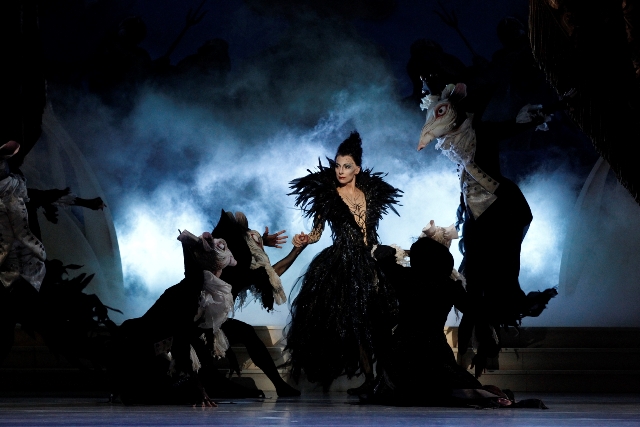
Which brings me to the second good thing. Lynette Wills as Carabosse is outstanding, just as she was as the Godmother in Cinderella.

Lynette Wills as Carabosse in 'The Sleeping Beauty'. The Australian Ballet 2015. Photo Jeff Busby
Lynette Wills as Carabosse in The Sleeping Beauty. The Australian Ballet 2015. Photo: © Jeff Busby

Wills is powerful yet restrained. Nothing is overplayed and yet we sense her presence and her impact on the unfolding story. And all this despite having a very strangely dressed entourage of rats who wear giant puppet-like heads and sport collars and black bow ties.

After that there isn’t much else that I found exhilarating. Benedicte Bemet as the Fairy of Musicality gave a distinctive interpretation to this role and brought a gorgeously lively quality to her exceptional technical capacity. Kevin Jackson as Prince Desiré made every effort to appear human. His two solos in Act II were mostly well performed, and there were moments when, as he looked at the spirit of Aurora, which the Lilac Fairy has conjured up in this Act, he sent shivers down my spine, such was his look of longing.

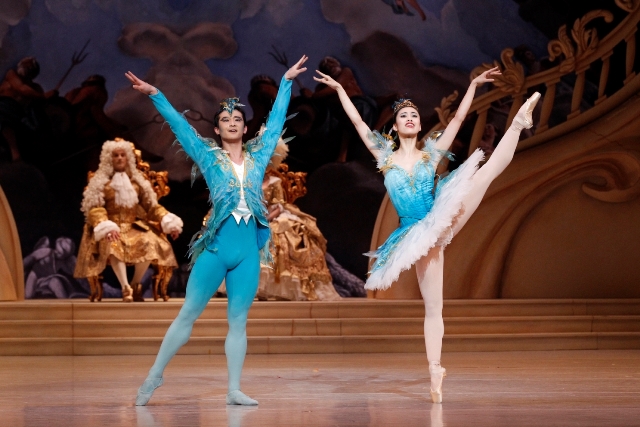
As for the Bluebird and Princess Florine, Chengwu Guo and Ako Kondo could scarcely be faulted technically. Guo’s beats and turns are astonishing, as I have said many times before. But how I missed the fluttering hands that are so often part of the choreography for Princess Florine. She is meant to be listening to the Bluebird who is teaching her how to fly, and the listening bit was all there. But in other versions, beautiful fluttering movements of the hands show her attempts to fly, to put into practice what she is hearing. This fluttering has been part of the Australian heritage of Beauty for decades. Let’s be proud of our heritage. Why leave it out now even if it is (maybe) an addition from the era of Soviet realism?

Which brings up the question of the other fairy tale characters who usually appear at the wedding of Aurora and her Prince. It was a lovely touch to include various fairy tale characters, properly disguised but recognisable, in Act II, which in McAllister’s production is a kind of picnic rather than a straight out hunting party, with the Prince joining in the excursion carrying his book of fairy tales. But what happened to the variations of Puss in Boots and the White Cat and Red Riding Hood and the Wolf in Act III? If these characters appear, somewhat in disguise, in Act II why do they have such a tiny role in Act III (and yet turn up in the final mazurka as if they had danced major parts)? It doesn’t make sense to me to leave out their pas de deux and variations. Where was the dramaturg at this point? Apart from anything else they are also part of our Sleeping Beauty heritage and I missed them.

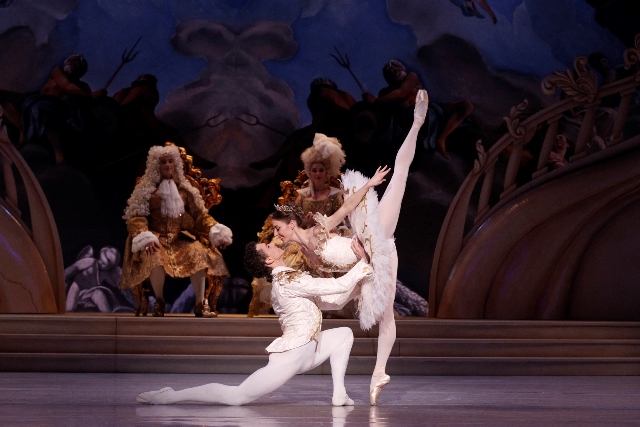
Lana Jones as Aurora missed the youthfulness that I think gives the early part of Act I so much of its charm. She looked beautifully elegant and performed everything with aplomb, but she wasn’t a sixteen year old princess. The grand pas de deux, despite being soundly performed, lacked the excitement that this part of Act III should bring.

Kevin Jackson and Lana Jones in David McAllister's 'The Sleeping Beauty'. The Australian Ballet, 2015. Photo: Jeff Busby
Kevin Jackson and Lana Jones in David McAllister’s The Sleeping Beauty. The Australian Ballet, 2015. Photo: © Jeff Busby

Other choreographic features, especially in Act II, seemed to me to be a little too close to parts of Swan Lake and Nutcracker. The woodland nymphs, who inhabit the overgrown forest in Act II, often split into small groups, link hands à la Four Little Swans, and perform various piqué-style movements. And there is a scene, also in Act II, where Carabosse’s rats fight with the Prince in an attempt to extract from him the key that will open the glass-domed casket in which Aurora has slept for 100 years. Shades of a certain part of Nutcracker?

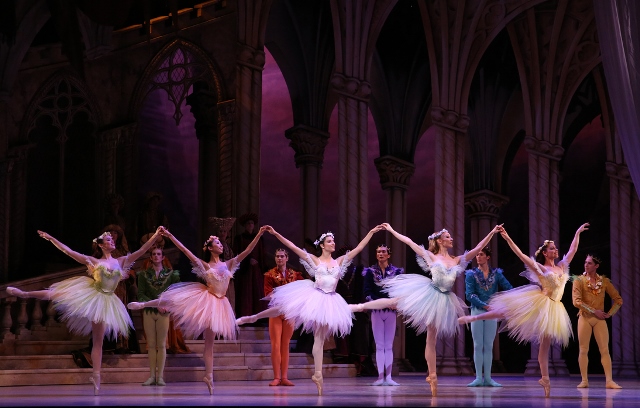
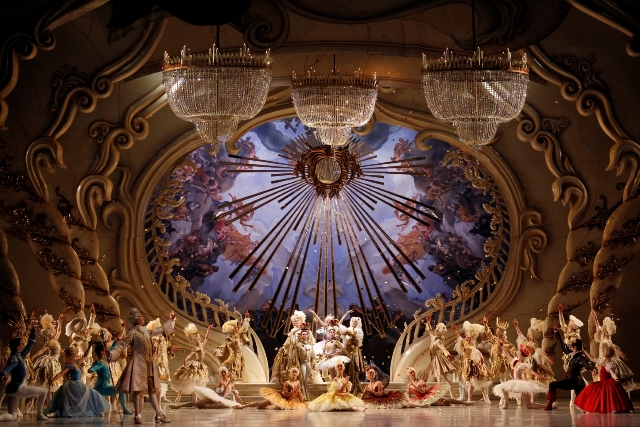
Gabriela Tylesova’s designs for costumes and set are extraordinarily lavish and, for me, they are the most curious mixture of Baroque extravagance and Rococo excess, with a Louis XIV party thrown in at the end, which occasionally looked like Carnevale in Venice, complete with a Tiepolo-style ceiling as an added attraction. And why did those three massive chandeliers start on the floor and majestically rise to the ceiling at the beginning of Act III? The audience greeted this strange chandelier behaviour with applause, although I’m not sure why. And what was the most disappointing feature of all this excess across the prologue and three acts? The dancing became secondary to the visual appearance.

Tylesova’s choice of colours for her costumes was also unattractive to my eyes. It shouted excess once again. As for those large wings worn by the fairies, they just got in the way of the dancers’ line, which is such an important part of the ballet technique we associate with Petipa and classicism.

In a feature published in the September 2015 issue of Vogue Australia, McAllister is quoted as saying: ‘With big classics like Sleeping Beauty, I really believe it’s around the staging, the look of it.’ Well, yes, he is right that the staging is important in a narrative ballet. But when the staging is such that it overwhelms the dancing it simply doesn’t work.

The audience was wildly enthusiastic as the curtain went down amid much gold, including shimmering gold leaf floating in the air, and a huge gold sun that descended over the Tiepolo ceiling. I went home dejected that such a beautiful ballet could be turned into an event like some kind of football grand final. The dancing was lost in a world of visual excess and technical invention.

Artists of the Australian Ballet in David McAllister's 'The Sleeping Beauty', 2015. Photo: Jeff Busby
Artists of the Australian Ballet in David McAllister’s The Sleeping Beauty, 2015. Photo: © Jeff Busby

Michelle Potter, 17 September 2015

Featured image: Chengwu Guo and Ako Kondo in The Sleeping Beauty. The Australian Ballet, 2015. Photo: © Jeff Busby

Chengwu Guo and Ako Kondo in 'The Sleeping Beauty'. The Australian Ballet, 2015. Photo Jeff Busby