Swan Lake. English National Ballet (2011)

The English National Ballet has just concluded a season of Swan Lake that can only be described as a triumph. As much as I admire, and love watching Graeme Murphy’s production of Swan Lake, and this is the Swan Lake Australians now see regularly, there remains deep down a craving for the traditional version, and this is just what ENB delivered.

ENB’s current Swan Lake is choreographed by Derek Deane. This season gave us not his probably better known in-the-round version seen in Australia some years ago, but a glorious, dramaturgically strong, proscenium version that moved from palace to lakeside and back again capturing attention from the moment the curtain rose until it fell.

A beautifully rehearsed and coached corps de ballet danced to perfection in the white acts, moving as one and conjuring up a sense of another world. The dancers were just as impressive as courtiers, always aware of the underlying narrative, never standing around uncertain of how to behave. From a more technical point of view, the corps demonstrated in particular just how expressive the upper body can be when actually used. Such fluidity above the waist seems a little rare to me these days.

As well as dancing brilliantly, the soloists and principals brought to the stage quite outstanding skills of characterisation. This was a production where Rothbart was a significant character (not always the case) and the relationship of Rothbart, Odette and Siegfried to each other was powerfully realised to the extent that I sat on the edge of my seat agog as the final act unfolded. This last act, which so often disintegrates into nothing more than a pretty finale, had great dramatic intensity as Odette struggled against the opposing forces that Rothbart and Siegfried represented.

I saw two casts and was most affected by the cast led by Vadim Muntagirov as Siegfried. Muntagirov, still a very young artist, dances with so much care for the details of ballet technique. He moves with elegance, he executes jumps with the lightness and grace of a panther, and his turns and tours en l’air are beautifully placed and yet exude bravura. In his solo in Act I where he ponders his predicament as a young man, who has been told he must marry but who yearns for something he can’t quite yet articulate, he displayed his refined line and his ability to show emotion through technique.

Muntagirov partnered a very secure Daria Klimentova as Odette/Odile—fragile as Odette, cunning and ultimately triumphant as Odile. Rothbart was danced with flair by Fabian Reimair. Others who stood out to me included Shiori Kase in the Act I pas de quatre at both performances I saw, and Esteban Berlanga who acquitted himself well as Siegfried in the second cast partnering Erina Takahashi.

Apart from having the pleasure of watching some really good technical dancing, and seeing a company so well rehearsed and coached, the greatest joy was seeing a performance that gave full reign to Swan Lake’s brooding Gothic character. Peter Farmer’s design helped but nothing can take the place of intelligent staging. Many bouquets to ENB. Is ballet dead? Certainly not at English National Ballet.

Michelle Potter, 3 April 2011
Legacy program. Merce Cunningham Dance Company

In the final year of its legacy program, the Merce Cunningham Dance Company has just completed a season at the Joyce Theater in New York showing CRWDSPCR (1993), Quartet (1982) and Antic Meet (1958). This program not only spanned three decades of Merce Cunningham’s creative output, but it represented three major strands in his creative process.

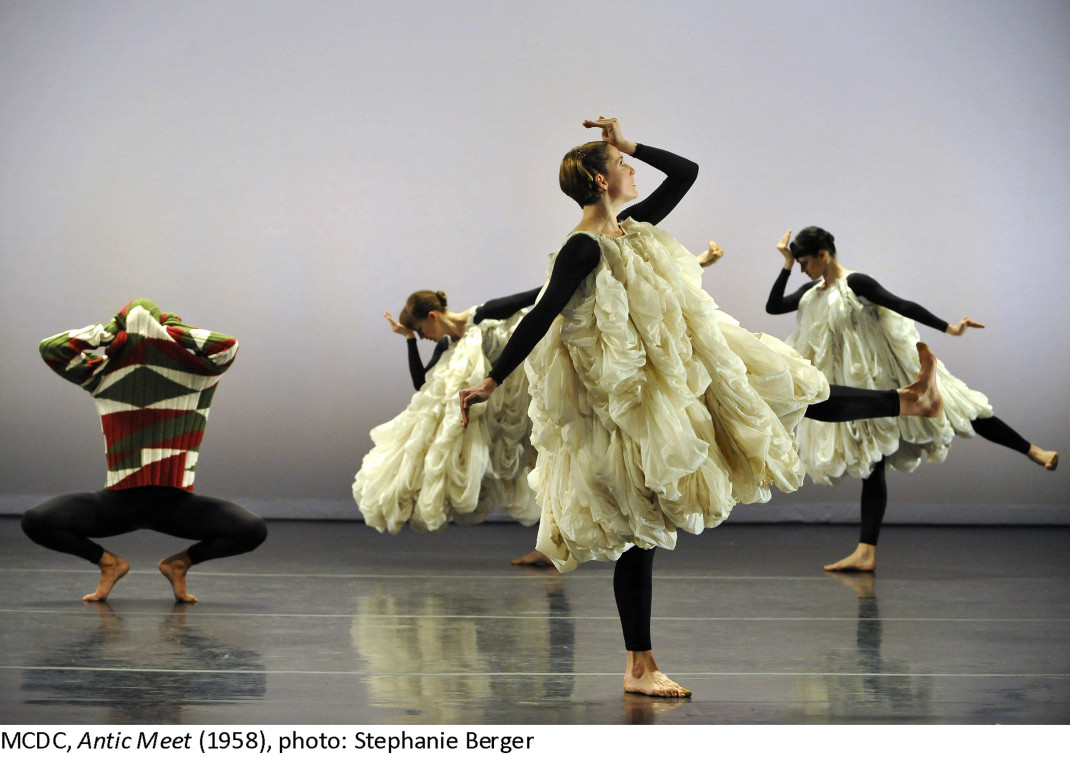
The program moved backwards in time, although this was probably not a wise programming decision. Antic Meet, which closed the program, did not have the strength to bring the evening to a conclusion on a high note. It was, however, totally fascinating as representative of work from the early Cunningham period when money was short, the company was small and collaboration between three artistic giants—Cunningham, John Cage and Robert Rauschenberg—was a highlight of the company’s work. A series of slight unrelated moments for six dancers (four women and two men), Antic Meet is vaudeville, theatre of the absurd and a dada event rolled into one with the strength of the piece coming from the visual and musical accompaniments and the juxtaposition of sections rather than from the choreography itself.

Rauschenberg’s costumes, consisting of various additions to basic black tights and a black leotard, are an eclectic mix of  ‘found’ items.

In one section the four women wear dresses originally fashioned from government surplus parachutes. The women are joined by a male dancer wearing a four-armed neckless sweater (made originally by Cunningham) and the sweater in fact becomes the dancer as it is swung, twisted, stretched and struggled with by the live dancer underneath its eccentric construction.

Others of Rauschenberg’s costumes include a fur coat (originally racoon), a long Victorian-style nightdress (both found by Rauschenberg in thrift shops), and some remarkably contemporary-looking black T-shirts with a plastic hoop inserted around the hemline—a little like very short, misplaced tutus. Along with a chair strapped to a dancer’s back, an assortment of props including a door on wheels that leads nowhere, and the accompaniment of John Cage’s Concert for Piano and Orchestra played live at the Joyce by five distinguished musicians, the whole is light heartedly bizarre.

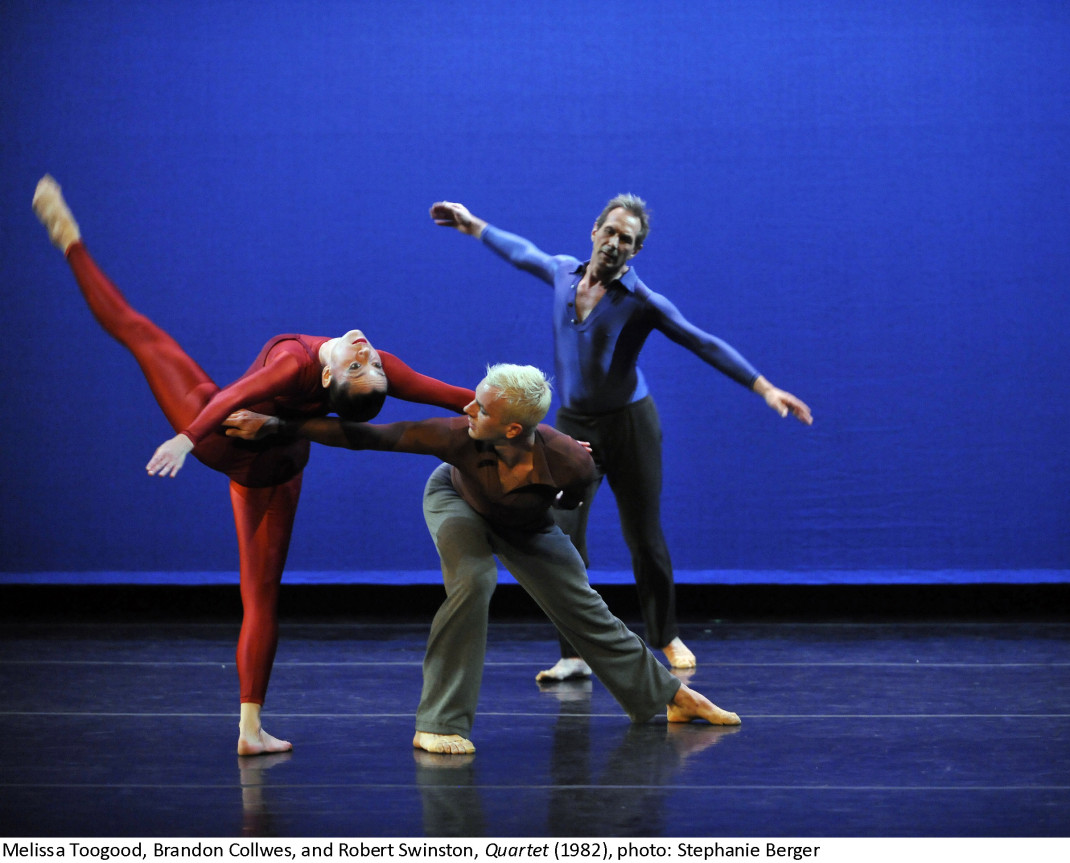
The middle piece, Quartet, is the most powerful of the three works on the program and represents Cunningham’s engagement with electronic music and with two major collaborators from the 1970s and onwards, designer Mark Lancaster and composer David Tudor. Although called Quartet, it was made for five dancers, a quartet who perform Cunningham’s signature choreography of off-balance poses, asymmetrical partnering and fast turns, and a fifth dancer who remains separated from the four and whose choreography is composed of twisted, sudden movements especially of the arms, largely made while standing on the spot. This fifth dancer was originally Cunningham and the work was created as arthritis was beginning to take its toll on Cunningham’s body. In the Joyce season the role was danced by the company’s current director of choreography, Robert Swinston. It is tempting to suggest that Swinston was posing as Cunningham. But he isn’t Cunningham and what Swinston was able to suggest was that Quartet is a work about belonging and not belonging.

With the dancers dressed simply by Lancaster in functional dance wear in luscious colours of olive, brown and burnished reds and blues, Quartet was performed to Tudor’s electronic score Sextet for Seven, played live by Takehisa Kosugi, the company’s current music director. Despite the theme of alienation and the somewhat chilling sound of the score, described as ‘six homogenous voices and one wandering voice’, Quartet is not a depressing work. In fact it seemed to me to be a very peaceful work as if in Cunningham’s mind the concept of outsider had been resolved.

The opening piece on the program, CRWDSPCR, is perhaps best summed up by a member of the audience who sprang to her feet as the work finished and shouted ‘Bit of work!!’ It is indeed a ‘bit of work’. It begins with its full complement of thirteen dancers on stage and for the twenty-five minutes or so that the dance lasts, apart from one slow solo section, the dancers weave themselves cross the space to John King’s electronic score, blues ’99. The energy is frenetic as the dancers manoeuvre past each other like the crowds at Grand Central Station, gathering momentum as they proceed. Pronounced either Crowd spacer, or Crowds pacer, a double edged notion that gives a clue to the nature of the work, CRWDSPCR is a little like ordered chaos but brilliantly designed choreographically and as brilliantly executed. The excitement it generated in the audience suggests that it would perhaps have been better placed at the end of the program.

CRWDSPCR represents Cunningham’s early but ongoing interest in using computer technology as a choreographic tool and he created it using the software program LifeForms (now DanceForms). It is costumed by Mark Lancaster in tights and leotards in fourteen blocks of colour to echo the software program. King’s score was again played live by King and Kosugi.

What a pleasure it was to see this this outstanding company in works from across the repertoire with music played live by such remarkable musicians. It was clear reinforcement of the vital role Cunningham, his company as it existed across many decades, and the astonishing collaborators with whom he worked, have made to the world’s dance culture.

Michelle Potter, 27 March 2011

Snow on the mesa. Martha Graham Dance Company

24 March 2011. The Rose Theatre, New York

The 2011 New York revival of Snow on the mesa, subtitled Portrait of Martha, began in a highly theatrical manner. Three stuffed wolf heads lay on the stage floor. Three women clad in black hooded cloaks appeared at various intervals. Dramatic colours, often a brilliant blue, washed the backcloth. A single hand belonging to one of the mysterious figures was lit briefly to glow starkly in the darkness. A soundscape of rain, wolves howling, thunder and lightning broke the silence. Towards the end of this section, the first of twelve that made up the total piece, the women each picked up a stuffed head and wore it as a glove. They exited as mysteriously as they had appeared.

This opening had all the hallmarks of the best of Robert Wilson, who choreographed and designed the work for the Martha Graham Dance Company in 1995. We saw in particular his dramatic use of space in the strategic placement of the wolf heads on the floor and the mysterious arrival of the women at separate moments; we saw and heard how brilliantly he can juxtapose elements of sound and light against objects and people to set up an atmosphere; and we saw his capacity to create allusions and resonances, all surreally personal to the audience. The opening made me think of Cathy and Heathcliff on the Yorkshire moors in Wuthering Heights. Perhaps, however, those more familiar with the work of Martha Graham could see allusions to Graham or her work since this portrait of Martha was meant to evoke Graham’s creative journey.

But after this first scene, ‘The wolf wife’, the work fell apart somewhat. Can Robert Wilson seriously be considered a choreographer? I suspect not. The third section entitled ‘Navaho Rug’ was a case in point. The sole dancer looked to me a little like a golliwog or one of those Christmas Nutcracker dolls with a string that when pulled makes the dolls’ arms and legs move in a jerky fashion. It also went on for an inordinate length of time and as a result could not escape from being  unnecessarily repetitious.

Another section, which I only realised after looking back at the program must have been the section entitled ‘Very young Kachina clowns’, was a reference to a character within the Hopi tradition who engages in exaggerated behaviour. And exaggerated is the word to describe the choreography of this section. All that face-pulling simply made good dancers look silly. Similarly when the company appeared onstage all wearing long Methuselah beards (and I mean seriously long—they almost swept the floor) in the section entitled ‘Very old: ghost walkers’, I had to wonder why any choreographer would want to dress such beautiful dancers as the very elegant Katherine Crockett in such a get-up.

Apart from Crockett, the other dancer who stood out was the Chinese-born Xiaochuan Xie whose dancing in ‘Shaker interior’ with Tadej Brdnik was as minimally beautiful as the white bench that was the only item of decoration in this section. It was a travesty to have this dancer wearing one of those hideous Methuselah beards later in the piece.

We knew the work had reached its conclusion when the snow began to fall from the flies, although there were sections before this scene that seemed (wishful thinking?) like a finale. People had left before the snow of course. But then it wouldn’t be a Robert Wilson piece without a restless audience.

Michelle Potter, 24 March 2011

For images that underscore the dramatic visual look of Snow on the mesa open this link. It also gives another account and a link to yet another.

Not entirely herself. Vicky Schick

20 March 2011. The Kitchen, New York

Vicky Schick’s newest work, Not entirely herself, is a beautifully lyrical and sensuous dance piece for a trio of young women, along with Schick herself, and another veteran performer, Neil Greenberg.

Performed in the black box space of the Kitchen in downtown Manhattan, Not entirely herself began with three dancers, Marilyn Maywald, Jimena Paz and Maggie Thom, working on a small, square platform raised slightly off the floor. As they posed, alone and together on this platform, linking and separating their bodies in a variety of ways, they set the scene for what might be considered the theme of Schick’s work: how we connect (or don’t connect) with each other. These groupings continued throughout the piece, sometimes on the platform, sometimes elsewhere in the performing space, and became a little like a photograph album with the changing nature of the groupings reflecting the changing pattern of friendships over time.

In between, passages of dancing showed Schick’s choreographic interest in small, detailed movement set alongside flowing sections of luxuriant dancing. I especially admired Marilyn Maywald who was able to imbue the simplest of movements, such as the twist of a wrist or the placement of a foot on the ground, with dancerly sensibility, and whose body sang with a feeling of abandonment as she moved through the free-flowing sections.

This trio section, the longer of the two that made up the hour-long work, was followed by a duet for Schick and Greenberg. It seemed like a statement of closure on what had gone before. Here was a couple familiar with each other’s character, able to move together, joke together, be together without concern that the relationship might flounder. And what a star performer Neil Greenberg is. His Cunningham-esque ability to isolate movement in specific parts of the body, whether hips, hands, head or any other part of his anatomy, is formidable. He must be one of the most articulate and kinetically intelligent dancers to grace the contemporary dance scene. Not only that, he has charisma in bucket loads.

The work was designed by Schick’s long-term collaborator Barbara Kilpatrick. I particularly enjoyed the contrast Kilpatrick set up between the three young women in their rather trendy outfits, which included a Sergeant Pepper style jacket, various see-through items and a kind of island sarong, and the more functionally useful outfits worn by Schick and Greenberg. Costuming highlighted beautifully the differences of personal relationships suggested in each section. Lighting was by Chloe Brown and the work was performed to an original score and sound design by Elise Kermani.

Arriving from the far-flung Antipodes without a ticket to this sold-out show I decided to take my chances with that peculiarly New York custom—the wait list. I was in luck and am grateful to whomever decided not to pick up their reserved tickets!

Michelle Potter, 21 March 2011

Kathryn Bennetts and the Royal Ballet of Flanders

The New York Times published an article this morning by Roslyn Sulcas, whose critical writing from New York and Europe, is always thought-provoking and intellectually probing. The article summarises recent events relating to the future of the Royal Ballet of Flanders, the company led by Australian Kathy Bennetts. The ongoing saga of the company is worth following. Here is a link to the Sulcas article.

Bennetts was an unsuccessful candidate for the current directorship of the Australian Ballet. Speculation on what might have been is tempting, but it is probably more productive to hope that Bennetts’ passion continues unabated in the present situation, and that the Royal Ballet of Flanders continues to flourish under her uncompromising approach.

Michelle Potter, 19 March 2011