Darcey and Rafael in conversation

The ticket said ‘Darcey and Rafael in conversation’. The menu cover said ‘Dance—collaboration, creativity and choreography’. A tall order? This luncheon event associated with the National Gallery of Australia’s current exhibition Ballets Russes: the art of costume featured former Royal Ballet star Darcey Bussell, now living with her family in Sydney, and Rafael Bonachela, artistic director of the revamped Sydney Dance Company. So what happened?

Well, about 200 people gathered in Gandel Hall, the Gallery’s new-ish public event space. Seated at round tables accommodating nine or ten people per table, we started with a main course, a most acceptable meal given that it clearly needed to be prepared in advance. Then, as dessert was brought in, Darcey and Rafael, made their way to the stage and, seated in armchairs, began to talk about dance. So far fairly predictable. Things began to get interesting as dance became the focus.

Some footage was shown. We saw the amazing Ms Bussell, with those incredibly articulate arms and legs not to mention face and entire body, in excerpts from Christopher Wheeldon’s Tryst, which Australian audiences were lucky enough to see when Ross Stretton brought the Royal Ballet to Australia in 2001, then in parts of the Black Swan pas de deux from Swan Lake Act III, and finally in the last pas de deux from Manon. Footage of Bonachela’s recent works followed, including segments from We Unfold and 6 Breaths.

The conversation centred for a while on the similarities between classical and contemporary dance in terms of the athleticism required by dancers whatever style they are performing, and on the nature of collaboration. Bonachela stressed his aesthetic of commissioning artistic collaborators to produce new work and outlined the importance of moving the art form forward through the creation of new work. Bussell introduced a certain degree of humour as she recounted the trials of rehearsal and the pitfalls (and pleasures) of performance. They both showed a beautifully human side of themselves.

But perhaps the most interesting moments came when the floor was opened up to questions. For me there were three particularly provocative questions. The first concerned narrative in contemporary dance. Did it exist? And was its lack (or apparent lack outside of ballet) what differentiated contemporary dance from ballet? Bonachela’s answer was beautifully phrased. ‘I believe’, he said ‘that the body has a narrative and I am interested in finding it through my choreography. I want to engage with the audience in an emotional way. I am interested in ideas and think the body is a strong communicative tool.’ He did add however, tongue in cheek, that perhaps he would wake up tomorrow and want to make a narrative work!

The second question of particular interest to me concerned the Australian Ballet and its now apparently entrenched decision not to perform in Canberra. How, asked the audience member posing the question, do we continue to engage with ballet when the flagship company denies Canberra audiences the opportunity to see Australian Ballet performances other than by spending large amounts of money to travel out of Canberra? Bussell rightly outlined the various problems associated with touring especially by major companies. But because she may not be aware of the situation, she didn’t mention the Australian Ballet’s apparent problems with the size and nature of the Canberra Theatre’s stage, nor its perceived issues with the Canberra Symphony Orchestra. But she did say that in the end it is up to us, the people of Canberra, to make it known that we do constitute an audience for ballet and that we want to see performances by the main company, not only those of the Dancers Company or specially contrived one-off events. Well, I’m not sure that any movement from the people would have the slightest effect.

And the third question of particular interest to me concerned the difference in physicality between the dancers of the Ballets Russes era and those of today. It is clear from watching old footage from the 1930s that the dancers who came to Australia between 1936 and 1940 were different in musculature, in technique and in the performance values they brought to the stage. But probably the luncheon conversation was not the forum in which to elaborate on the various changes we see in the way dancers look and perform today. The responses petered out a little. Another occasion perhaps?

The National Gallery of Australia has provided some inspiring events associated with its Ballet Russes exhibition. This was one of them. May there be more events where an audience feels free to ask and comment in the way it did at this event.

Michelle Potter, 10 March 2011
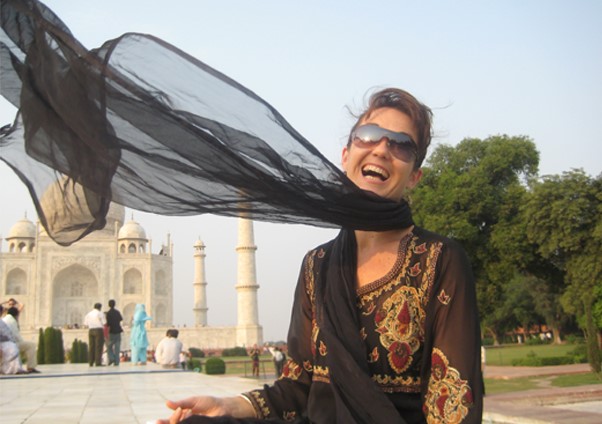
On the trail of Ruth St Denis. Liz Lea

The British-Australian choreographer and dancer Liz Lea recently presented a show at the National Gallery of Australia in which she managed, with singular success, to rework her popular piece 120 Birds, staged at the Edinburgh Fringe in 2010, from a work for a small company into a one-woman show.

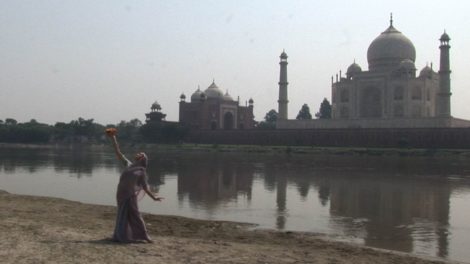
But the irrepressible Lea has another project in the pipeline—a documentary made with Kuwaiti director, Talal Al-Muhanna, and Indian cinematographer, Lakshya Katari. Lea has had an ongoing fascination with dance makers who toured to far flung destinations in the early part of the twentieth century, including Ruth St Denis and Anna Pavlova, and the documentary, entitled On the trail of Ruth St Denis, follows the journey of St Denis across India. The crew visited the locations in which St Denis performed including the cities of Amritsar, Agra, Kanpur, Lucknow, Varanasi, Kolkuta and Mumbai.

Lea acts as the on-screen presenter for the documentary and also performs some of the ‘Oriental’ dances that made St Denis famous in her day.

The film is currently being cut in the United Kingdom by editor Krishna Francis and has music by Nick Parkin. Further information (published earlier) is available. See e-press from India.

Michelle Potter, 6 March 2011

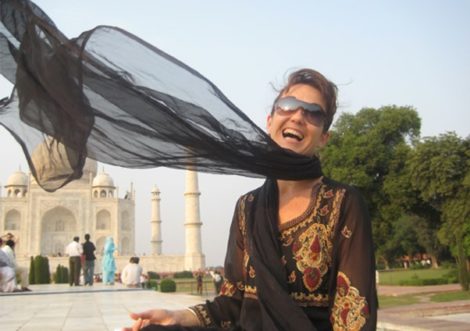
Featured image: Liz Lea in front of the Taj Mahal. Photographer not idfentified.

News from Meryl Tankard

Meryl Tankard reports that her first short documentary film, MAD, has been selected for showing at the 17th World of Women: WOW  Film Festival.

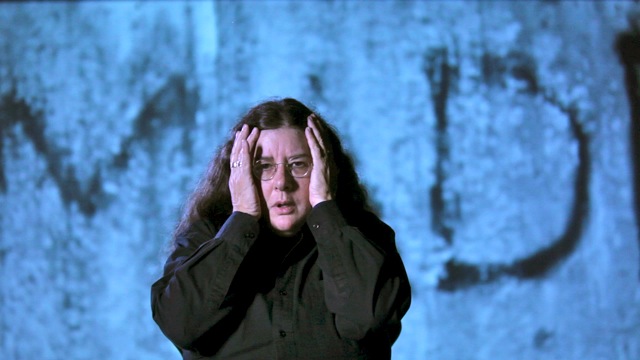
MAD focuses on madness and schizophrenia, explored by poet and writer Sandy Jeffs, who has lived with schizophrenia and all its moods for 34 years.  It features music by Elena Kats-Chernin and vocals by Mara Kiek both of whom have collaborated with Tankard on numerous previous occasions. Lyrics are by Sandy Jeffs. Jeffs was a featured writer at the 2010 Melbourne Writers Festival. She has published five books of poetry.

Sandy Jeffs in Meryl Tankard’s short documentary, MAD

Tankard says she is thrilled that her first documentary has been chosen to be screened at the Festival. She says:

‘I hope this documentary will give viewers a glimpse inside the schizophrenic mind. I have been inspired by Sandy’s works and by Sandy herself, in particular the way she deals with her inner voices and the way she articulates her feelings about her illness.’

MAD will be screened on 9 March 2011 at the Dendy Opera House Quay cinema.

Michelle Potter, 22 February 2011

Polovtsian Dances by the Dandré-Levitoff Russian Ballet

In a post in September 2009 I queried various aspects of an image held in the National Library of Australia’s Pictures Collection. The image is attributed to Axel Poignant, although I indirectly questioned this attribution as the photograph appears to have been a gift to Poignant from the Dandré-Levitoff company in recognition of the work he did with them in Perth. Why, I wondered, would the company be giving back to Poignant a print of his own image?

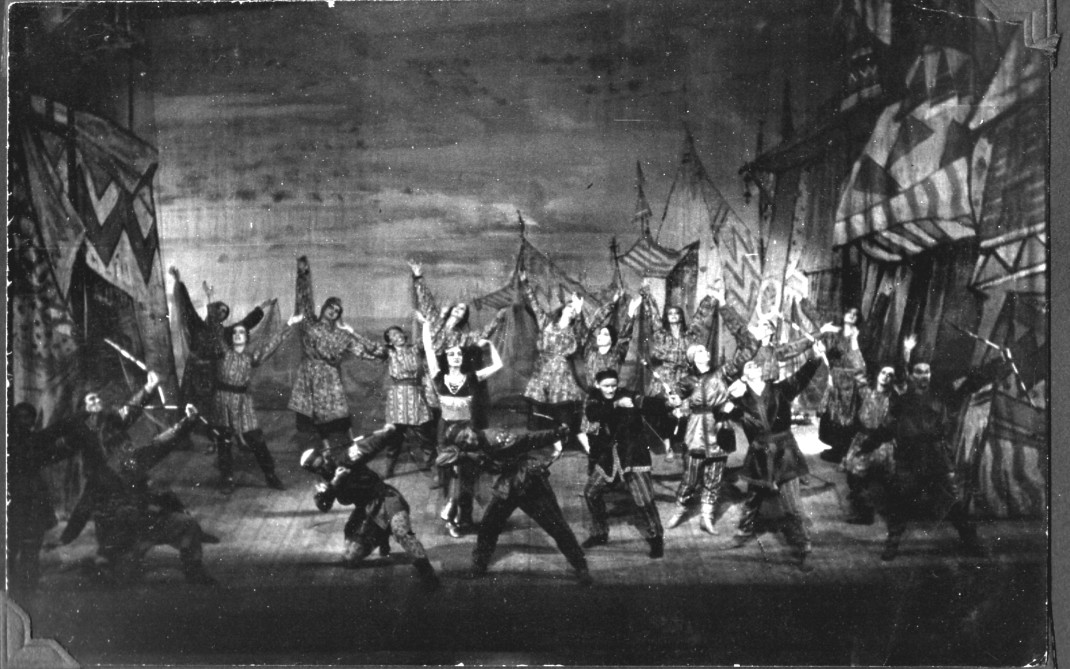
Since September 2009 I have been pursuing research into the extensive touring schedule of the Dandré-Levitoff company and was fortunate enough to be given access to archival material belonging to the family of Anna Northcote (Severskaya). Amongst photographic material in this collection I came across the photograph reproduced below:

Final position, Prince Igor. Dandré-Levitoff Russian Ballet, 1934-1935. Anna Northcote (Severskaya), Personal Archive. Private Collection

This seems to me to be very similar, if not the same, as the image held by the National Library. Perhaps most interesting of all, however, is that a very similar image, perhaps in relation to the action of the ballet taken slightly before the one reproduced above, appeared in an advertisement in Cape Town, where the company performed between 18 May and 9 June 1934, well before arriving in Australia.

Could it be that the image in Northcote’s collection and that appearing in the Cape Town advertisement are both publicity shots taken either in Cape Town, or earlier before the company’s arrival in South Africa? Given that the South African advertisement shot is slightly different, the alternative of course is that the company did give back to Poignant a print of his image with their signatures on the back as a memento of the occasion, and that the dancers were each given a copy as well (or bought one)? If this is the case, Northcote’s archive, which contains a number of performance shots, may well include other images by Poignant.

I am still not convinced, however,  that the image of the final moment of Polovtsian Dances was shot by Poignant, but I would love to be proved wrong.

This is the link to the original post . I am not permitted to display the National Library’s image on this site so readers will need to follow the Library’s catalogue link to compare the two images.

Michelle Potter, 13 February 2011

Food Chain. Gavin Webber and Grayson Millwood (Animal Farm Collective)

Seymour Centre, Sydney Festival 2011

I didn’t see roadkill or lawn, the previous works by Gavin Webber and Grayson Millwood shown in Australia in recent years. So I have no way of knowing how Food Chain, presented at the Sydney Festival 2011, fits in with their developing (or developed?) aesthetic. I have to say that if those previous works were like Food Chain I find it difficult to understand their apparent success.

Food Chain was episodic—not surprising given the experience of Webber and Millwood, which includes working with Meryl Tankard Australian Dance Theatre and in various situations in Germany. Billed as ‘a David Attenborough documentary in reverse’, it purported to examine the idea of animals experimenting on humans and on how much ‘animal’ was apparent in human beings. Men in bear suits changing into business suits. A woman wearing a bear head backwards or on the end of her leg. A conversation with a line-up of stuffed animals. A game of shadow play of a fairly simplistic nature that morphed into shadowy allusions to bestiality. Crude references to sexual smell. For me Food Chain just lacked any kind of sophistication of thought. Even those polar bear advertisements for Bundaberg rum we used to see on commercial television with some frequency had more to offer in my opinion.

For me Food Chain also lacked any kind of sophisticated movement. With no-one identified as choreographer perhaps this is not surprising. Take the closing scene when the cast spent some time slowly descending a large tree trunk that made up the major part of the set. Each performer would make it, eventually, to the floor and disappear only to return at the top of the trunk and make another descent. It seemed to last an age. The work was also punctuated with the spoken word. Some lines were just inaudible. Not all dancers have the ability or training to speak on stage. Very frustrating.

In the end it was difficult to understand exactly what Webber and Millwood were trying to say other than something on the most superficial of levels. I thought Food Chain was way down the chain of where dance is in the twenty-first century. At least the tickets were only $30.

Michelle Potter, 2 February 2011