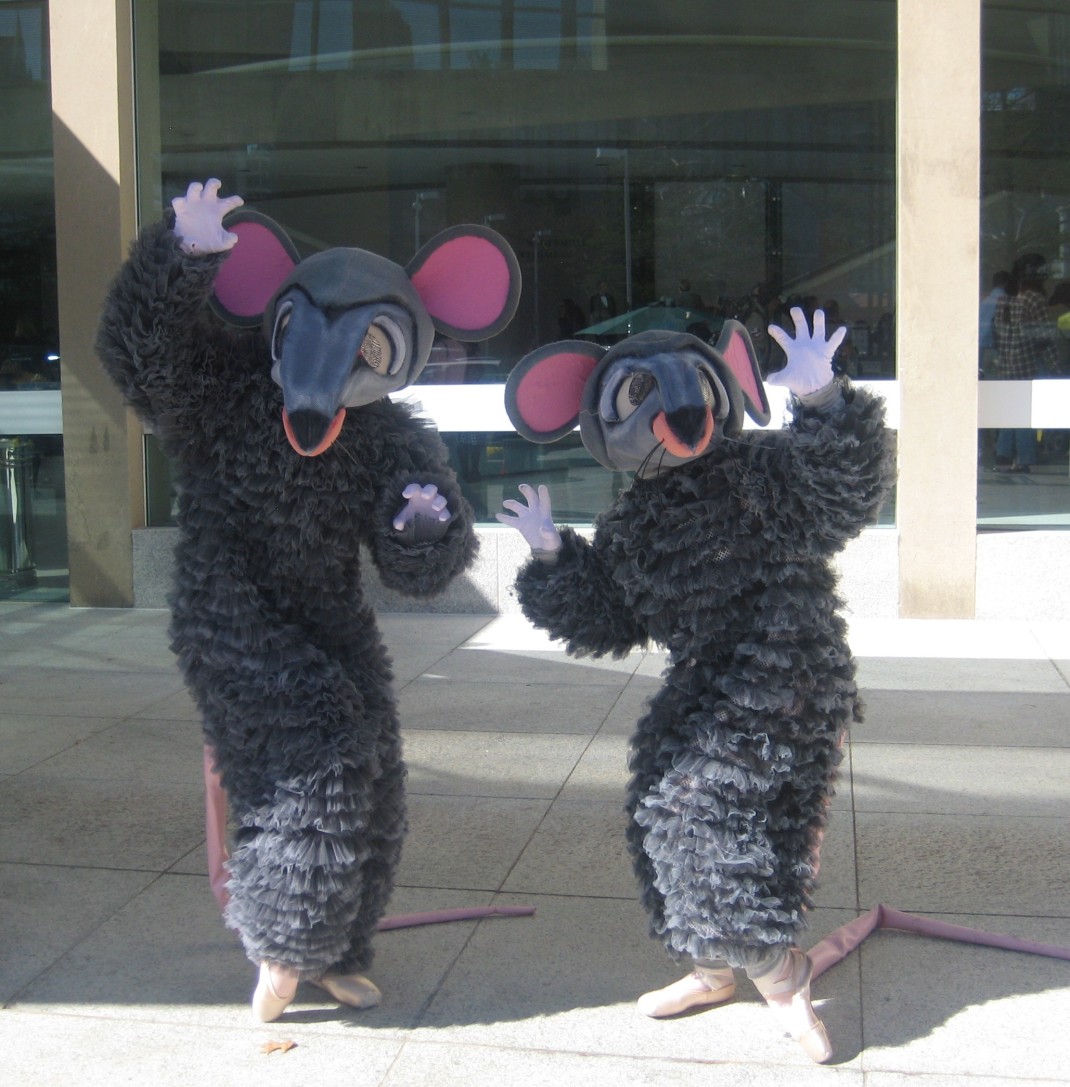
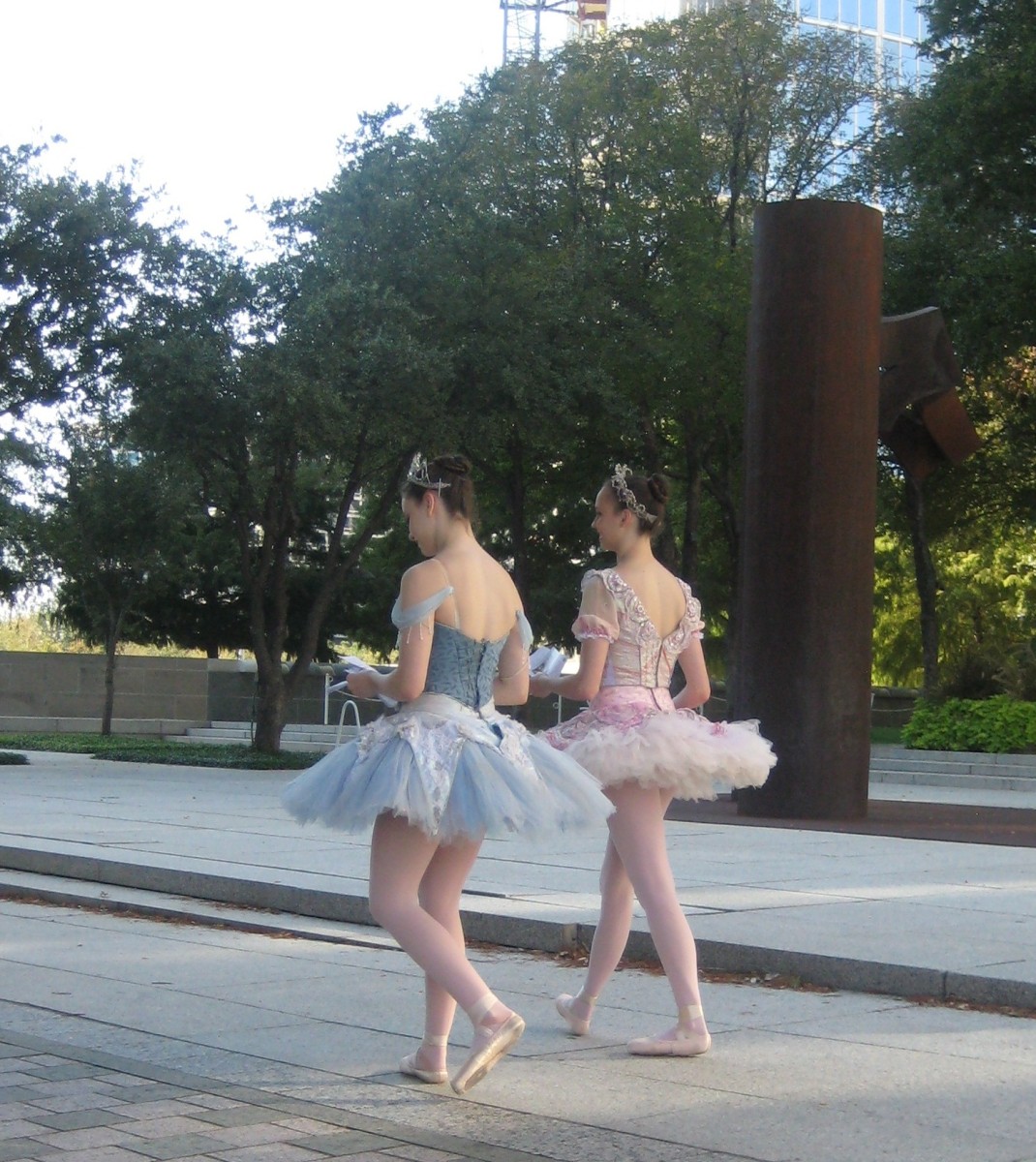
Dancers from Texas ballet Theatre, Dallas TX, 2011
It’s surprising whom one meets walking down a Dallas street on a sunny Sunday afternoon. Two somewhat frilly mice from Nutcracker for example—perhaps not dressed for combat despite the menacing gestures! Or two young dancers dressed in tutus.
Texas Ballet Theater, currently directed by Ben Stevenson, was promoting its forthcoming Nutcracker season. The appearance of dancers on this occasion was part of the last day of ‘Art in October’, a celebration of the Dallas arts district with its top class museums and theatres.
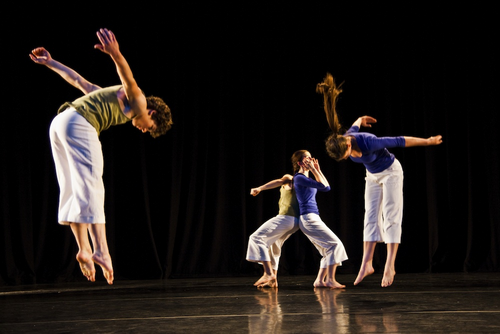
it’s all good
It’s all good, QL2Dance, 2011
I was impressed by QL2’s annual performance for younger dancers, this year entitled it’s all good and being an examination through movement of the notions of language and truth. It was not so much the choreography that impressed me: it was fairly basic, perhaps a little of necessity, and somewhat unimaginative in my opinion. But I was impressed by the production values that were in play. The young cast (they ranged in age from 8 to 17) knew a fair bit about stage techniques and behaved largely in a very professional manner. For this their director, Ruth Osborne, deserves praise as does whoever designed the simple, easy to dance in costumes. One or two of the younger of the young performers looked as though they had the potential to go on to a professional career.
Ballets Russes publication
A number of visitors to this site have asked me to post a review of the recent Ballets Russes publication. This review was published last month by The Canberra Times. Here is the link.
Those who have been following posts on this site relating to Nina Verchinina may be interested in an article published in the most recent edition of Brolga: an Australia journal about dance (issue 34, June 2011). This elegantly written article, rather lengthily entitled ‘Designing for Nina Verchinina’s choreographic vivacity: a new light on Loudon Sainthill’s art’, is by Andrew Montana. It sheds important light on Verchinina’s choreographic exploits in Australia and suggests that gender may have played a role in the fact that, in Montana’s opinion, Verchinina’s ballets were never really given adequate showings in Australia.
The gender issue is an interesting speculation and perhaps will never ultimately be more than that. But the idea does have a certain plausibility and is echoed by the difficulties faced by Hélène Kirsova as she tried to develop her own company, the Kirsova Ballet, in the early 1940s in the face of competition from Edouard Borovansky. See for example my recent post on Kirsova, my article ‘A strong personality and a gift for leadership: Hélène Kirsova in Australia’ (Dance Research, 13:2, Winter 1995, pp. 62-76) and a shorter article in National Library of Australia News published in August 2000.
Montana is perhaps at his most eloquent when describing the drawings and paintings of Verchinina executed by Sainthill. But his article also develops further than has been done so far the story of de Basil’s design competition of 1940 won by Donald Friend, along with a number of other matters relating to the Original Ballet Russe in Australia.
As something of a side issue, Montana also mentions the Sidney Nolan designed Icare and notes that there is nothing to indicate that Sainthill was approached to design this work. This appears to contradict Brian Adams’ contention in his biography of Nolan, Such is life, that Sainthill had ‘already been commissioned by Colonel de Basil’ (p. 46) to design this work. Adams gives no source reference for his statement but I believe it does warrant more investigation. Adams goes on to say that Sainthill had been ‘edged out by [Serge] Lifar and [Peter] Bellew’ (p. 46) so there is potentially source material elsewhere other than in Sainthill’s archival collection, which Montana has investigated.
One error in the text needs correction. Montana notes that the cast of Verchinina’s Etude included ‘Lydia Couprina (Valrene Tweedie)’ (p. 22). In fact Lydia Couprina was the stage name of Phyllida Cooper, an Australian from Melbourne who had joined de Basil in Paris where she had been studying with Olga Preobrajenska. Tweedie danced under the name Irina Lavrova. As a side issue, however, there is a connection beyond nationality between Cooper and Tweedie. When Tweedie returned to Australia from the United States in 1950s she eventually bought the school in Sydney jointly run by Cooper and her then husband, James Upshaw. Upshaw later became Tweedie’s second husband.
Unfortunately this most welcome article from Montana is not available online, but it is worth following up in hard copy in libraries where Brolga is held.
As the Victoria and Albert Museum’s Diaghilev exhibition is being taken down, its curator, Jane Pritchard, has made the startling discovery that there appears to be film footage of Diaghilev’s Ballets Russes in performance. And we have always thought that no such footage exists! She reports on this remarkable discovery in her latest blog post—’I eat my words’, where you can also view the footage via the website of British Pathé.
Michelle Potter, 27 January 2011
UPDATE 16 June 2020: The footage and blog post is no longer available via the link above. But the footage (lasting just 30 seconds) of a section from Les Sylphides, filmed in Montreux, Switzerland, in 1928, is below.
Jane Pritchard’s record of the itinerary of Diaghilev’s Ballets Russes from 1909 to 1929, published in two parts in Dance Research 27, issues 1 and 2 (2009), is an absolutely indispensable resource and it was remiss of me not to have recalled its publication in my previous post and comments. From her listing I have extracted the Diaghilev performance history of Le Dieu bleu.
Paris: Théâtre du Châtelet, 6 performances 1912 (13, 15, 17, 18 May, 5, 7 June)
London: Royal Opera House, 3 performances 1913 (27 February, 1, 6 March)
Monte Carlo: Opera House, 3 performances 1913 (22, 26 April, 2 May)
Buenos Aires: Teatro Colón, 3 performances 1913 (20, 24, 28 September)
Rio de Janeiro: Teatro Municipal, 1 performance 1913 (29 October)
Berlin: Teater am Nollendorfplatz, 2 performances 1914 (11, 13 March)
18 performances in total according to the current state of knowledge.
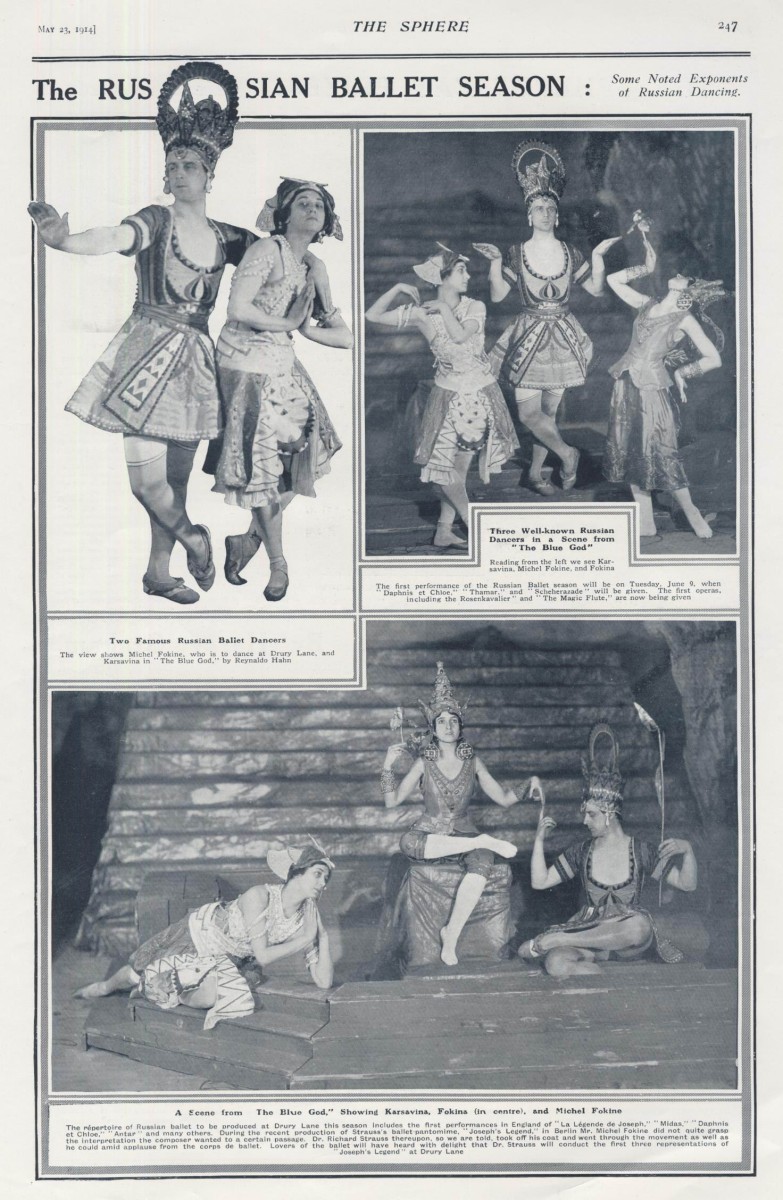
Further information is in Jane’s comments originally posted on part one of this discussion but now also reproduced below as part one has become a little unwieldy to read. In addition, the illustrations from the The Sphere, mentioned in Jane’s comments, are also reproduced below (again with thanks to Jane).
From Jane Pritchard, 31 December 2010:
Oh dear thousands of comments to make and not much time at present. Let’s not get into the changing evolution of Schéhérazade and Zobéïde’s costumes yet – Bakst must have redesigned this to flatter each of his dancers.
1. The original costume for Ida Rubinstein 1910; 2. The Karsavina/Astafieva version for autumn 1911 (I don’t know what Roshanara who also dance the role this season at the ROH wore) This is the Karsavina version currently on display at the V&A; 3. The Karsavina version for 1912; 4. The Vera Fokina version originally for performances for Royal Swedish Ballet in 1913 and then worn with Diaghilev’s Ballets Russes in 1914; 5. Schéhérazade was redesigned in 1915 (see credit in programme). This is when the Flora Revalles version comes in; 6. This is modified for Lubov Tchernicheva (and since she continues to dance the role it settles down as the costume);
What this alerts us to is that there is often not a fixed version of one characters costume in a successful ballet—and do critics ever alert audiences to changes?
And on the subject of Fokine & Fokina photos in The Ballets Russes and the Art of Design many were actually taken in Stockholm when Fokine mounted Cléopâtre, Les Sylphides, Le Spectre de la rose, Le Carnaval and Schéhérazade there when spurned by Diaghilev, 1913–14.
But to the challenges of Le Dieu bleu, a ballet full of questions and one for which a contemporary viewer (A. E. Johnson) commented that the published programme synopsis was not the action realised on stage. I recall once having an argument with a significant choreographer when his synopsis was clearly not what happened in performance but he insisted it was published none the less—what a disservice to his audience and posterity.
Whatever one thinks about Herbert Ross’ film Nijinsky it contains a wonderful scene in which we see a dress parade of the costumes for Le Dieu bleu followed by a petulant Fokine (played by a young Jeremy Irons) complain to Léon Bakst that Bakst is trying to ruin the ballet by over-designing it. This may not be an historically accurate meeting but there is a real truth to it. Le Dieu bleu to me appears to be such an old fashioned production drowning in display. I find it fascinating that when the French start contributing to the Ballets Russes productions it takes them a while from them to break away from their balletic past. Much of Le Dieu bleu was procession and mime Beaumont described the one performance he saw as having ‘dull’ music, ‘uninspired’ choreography and containing ‘too much miming and posing, too many processions’. The demons and reptiles were ‘reminiscent of a Christmas pantomime’ and comic. Gosh aren’t I excited that I’ll be able to see Wayne Eagling’s new version of this ballet at the London Coliseum in April!
But to sort out some facts. Le Dieu bleu did not receive a large number of performances but it was presented in Paris (1912), London, Monte Carlo, Buenos Aires and Rio de Janiero (all 1913) and all these performances featured Nijinsky in the title role. It was also given two performances in Berlin in 1914 when Nijinsky was no longer in the company thus the title role was performed by Fokine and his wife, Vera was the Goddess (a role created by Nelidova).
I found it extremely valuable when told I was mounting a Ballets Russes to compile a day-to-day itinerary for the Company so that I understood which productions were performed where and how often. And on the subject of itineraries, just as we say in Britain you wait ages for a bus and then three come along—the same happened with the Ballets Russes performances. Sarah Woodcock published her version in The Dancing Times; the Paris Opéra’s exhibition book Les ballets russes included a version by Boris Courrège and team and my own (the most complete for which I happily acknowledge assistance from Roland John Wiley, Andrew Foster and others) was in Dance Research Volume 27 (2009) which is available through JSTOR on line.
There appear to be two sets of photographs for Le Dieu bleu—those taken in a Parisian studio by Walery at the time of the 1912 premiere in Paris. These were initially reproduced in the souvenir programme (produced by Comœdia Illustré) and serve to document the creators of the ballet in their costumes—I feel certain many of these photos were taken to show Bakst’s magnificent costumes rather than the dancers.
Then there are the Berlin photographs taken in 1914 which were reproduced as postcards and reproduced as a full page spread in The Sphere, London 23 May 1914. I think these are taken posed on stage and what we are seeing is the Lotus pool and the golden staircase of the set. I think our god and goddess are on their plinths on which they rose from the pool (Fokine’s lower right leg is hidden) to make their first appearance. The review in the Observer, 2 March 1913, p.8 refers to ‘the Lotus flower that dreams in a large basin. From its petals the Goddess arises; at her side the blue god who proceeds to charm the denizens of the den to tameness. The tunes of his pipe and his elaborate dance play the part of Orpheus with considerable effect.’ At the end of the ballet the ‘Goddess returns to the heart of the Lotus and the blue god goes in another direction to the Indian Walhalla, with the assistance of a golden staircase that conveniently appears behind the opened rocks’. I would actually suggest that the best published description of the ballet appears in A.E. Johnson’s book The Russian Ballet (with illustrations by René Bull) London: Constable, 1913. pp. 163-177
But to return to the costume as seen in the photos . Nijinsky and Fokine are not wearing identical head dresses—once again, as with the shoes it is Fokine whose head dress is closest to the Bakst design note the drop ‘pearl’ decorations like ear-rings hanging from it.
I agree that of the two known extant versions of costumes for the Blue God—the Canberra version matches the tunic in both sets of photographs. Please note it was never in the V&A’s collection we did not de-accession it. The Canberra costume appeared on the cover of the catalogue for first major Ballets Russes Sale 13 June 1967 when according to the published list of Prices and Buyers’ Names it sold for £900 to a Mrs Gibson—incidently the costume can be glimpsed in the background of the photo of Marie Rambert in Lubov Tchernicheva’s Pas d’acier jackets at a preview of the sale on p.167 of our exhibition book. The Canberra version was on display in the amphitheatre foyer at the Royal Opera House for years so I am amazed that it is still in such good condition.
The British version is extremely fragile and was one of the two last costumes worked on, the other being one of Matisse’s costumes for Le Chant du Rossignol. Both demanded very long hours of work and were not ready to be photographed for our book (not catalogue) to accompany the exhibition. The old photo of it as reproduced in Shead is horrid. I’ll get together more specific material on our version of the Blue God costume and get back to you on this. We also have a lot of other costumes for this production.
Adrian’s suggestion about new costumes for the USA tour is an interesting speculation— I just wish I knew how many of their costumes the Ballets Russes had access to when they re-formed in 1915–all the productions that year are described as being ‘redesigned’. I would love it if that also made sense of the mystery concerning the two versions of Le Festin costumes but it does not. So over New Year I’ll have to do some more thinking about the costumes.
I’ll finish these ramblings by including the copy on the labels for our four Dieu bleu objects in the exhibition; the painting of the set, a costume design (in the Bakst section) and two costumes (in the Nijinsky case).
Le Dieu bleu 1912
Diaghilev never let concerns over authenticity override artistic impact. Le Dieu bleu (‘The Blue God’ or Krishna) was designed by a Russian in a vaguely Indian setting, with a score by a Venezuelan composer for a French audience. Bakst’s designs mixed elements from various south Asian cultures. The faces on the stone cliff resemble those on the Bayon Temple of Angkor Thom in Cambodia.
Oil on canvas, Léon Bakst (1866–1924). Private collection
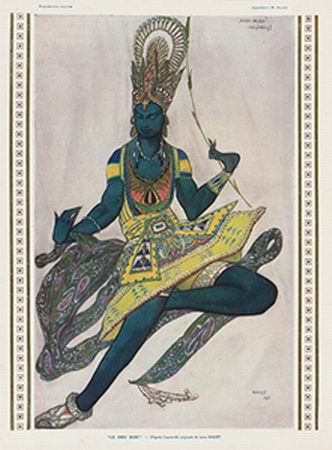
Costume design for a young Rajah in Le Dieu bleu 1912
Bakst’s designs for Le Dieu bleu were among his most elaborate, but the ballet was old-fashioned in its emphasis on design at the expense of dancing. His costume for a young Rajah, a character not individually named in the programmes, shows fantastic detail in the feathered turban, pearl decoration and stylised shoes. Pencil, watercolour and gouache, Léon Bakst (1866–1924). V&A: S.338-1981
Costume worn for Le Dieu bleu 1912–14
The Blue God (1912), a ballet based on Krishna, was created for Nijinsky. His solo included poses inspired by Hindu sculpture, and his costume featured a closed lotus flower among sunrays on the appliquéd torso. Nijinsky and Fokine, who took over the role, were each photographed wearing different versions of the costume. The example here is more richly decorated. Watered silk, inset with satin and embroidered with mother-of-pearl
Designed by Léon Bakst (1866–1924). V&A: S.547-1978
Costume for a Little God in Le Dieu bleu 1912
Léon Bakst’s lavish costumes emphasised design over choreography in The Blue God. A child performer wore this costume, whose tall headdress reveals the influence of Cambodia in its pyramid shape and sculptural forms. Gold knit, satin and gold-painted decorations
Designed by Léon Bakst (1866–1924). V&A: S.613 to B-1980
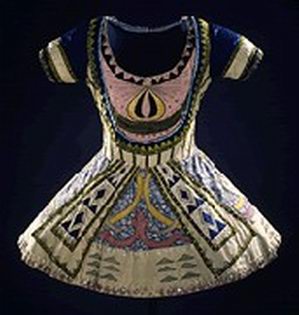
In the very glamorous exhibition, Ballets Russes: the art of costume, currently showing until late March 2011 at the National Gallery of Australia in Canberra, one of the most discussed items is the tunic from the costume for the Blue God from the ballet of the same name—in its French form Le Dieu bleu.
Léon Baskt, Tunic from costume for the Blue God, c 1912, from Le Dieu Bleu National Gallery of Australia, Canberra, purchased 1987
Its popular appeal rests largely on the fact that the tunic was worn by Vaslav Nijinsky, creator of the role of the Blue God and dancer and choreographer with Serge Diaghilev’s Ballets Russes. Not only was the costume worn by Nijinsky and as far as we know by no-one else, but traces of the make-up Nijinsky wore as the Blue God can still be found as marks on the inside the costume.
But we also know that the ballet was not a major success and was given very few performances after its 1912 premiere and quickly disappeared from the repertoire. That there were only a few performances of the ballet is both a blessing and a curse.
From a positive point of view it means that the costume, designed by Léon Bakst one of Diaghilev’s best known designers, is in excellent condition. While this situation reflects in part the exemplary conservation that has been carried out by the National Gallery’s conservation staff, it also reflects the fact that despite that the fact that the tunic is almost 100 years old it has not suffered from the wear and tear that constant use has on the fabric, decoration and stitching of dance costumes. Its excellent condition may also relate to the fact that it was made by two of the top Parisian costumiers of the time, M. Landoff and Marie Muelle. Madame Muelle in particular is known to have insisted that only the best quality fabrics be used and that decorative elements be appliquéd or embroidered rather than stencilled onto the fabric. She was also said to have had a secret metal thread that never tarnished.
A close-up look at the costume reveals that it encapsulates many of the principles that Bakst used throughout his design career, in particular a use of different textures in the one costume and daringly juxtaposed patterns and colours. He always made his interests, which included his understanding that dance was about movement, very clear in his designs on paper.
Léon Baskt, Design for tunic for the Blue God, c 1912, from Le Dieu Bleu National Gallery of Australia, Canberra, purchased 1987
The costume is largely made from silk, satin, velvet ribbon, braid and embroidery thread, although set against the luxury silken fabrics are panels made from a simpler cotton or rayon material patterned with a floral, lotus-inspired design. The tunic’s dominant colours are pink, blue, gold and green and black and triangular and diamond patterns sit beside curves and half circles. Emerald green jewel-like sequins spill down strips of olive green braid.
Some parts of the tunic have been machine stitched. Others have been sewn by hand. The faux mother of pearl decorations along the hem of the tunic, for example, were hand sewn onto the fabric and the tacking stitches joining them together in a row can be seen where some of the decorations, now extremely fragile, have fallen off. The tunic has a row of metal fasteners, hooks and eyes, running right down the back—no zips, no Velcro in those days. Nijinsky would have simply held out his arms as the tunic was slipped on by his dresser, who would then have hooked him into the costume.
The Gallery’s collection also includes the gold headdress for the costume. It is equally as fascinating to study close up. Its double row of decorative points attached to a tight fitting skull cap is made of metallic gauze stitched by hand onto a wire frame with metallic thread—perhaps even with Mme Muelle’s untarnishable secret thread?
But in a more negative vein, because the work was performed on such a small number of occasions, what do we know about the choreography? Probably very little really. However, a number of historians have noted that Bakst and Michel Fokine, Le Dieu bleu‘s choreographer, had been deeply impressed by performances given in St Petersburg in 1900 by the dancers of the Royal Siamese Court and had incorporated choreographic and visual ideas from these performances into several Ballets Russes productions on which they worked, including Le Dieu bleu. Still photographs of Nijinsky show that static poses rather than a fluid and expressionistic form of movement may have been dominant, recalling the dance style of the Siamese dancers.
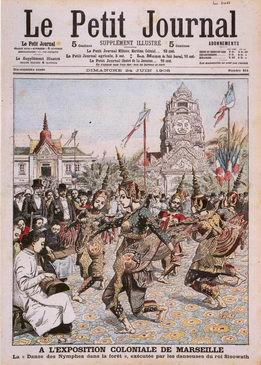
But another dance troupe from the other side of the world probably had just as much influence on the creation of Le Dieu bleu as did the dancers of the Royal Siamese Court. In 1906 the Royal Cambodian Ballet came to France for the Colonial Exhibition staged in Marseille, Cambodia being at that stage a protectorate of France. The Cambodians gave several performances in Paris in July of that year, just as Diaghilev was in Paris preparing for his major exhibition of Russian paintings, which was presented a little later that year at the Salon d’automne. It is hard to imagine that Diaghilev and his team would have been unaware of the Cambodians. They caused a sensation in Paris and had a major influence on a number of French artists, including the sculptor Auguste Rodin who followed the company to Marseille and executed a major series of drawings of the dancers. Many newspapers, including the Parisian daily Le Petit Journal and the influential Le Petit Parisien, carried news of and advertisements for the Cambodians and most carried drawings and posters of the dancers against a background of Cambodian temples.
Cover of Le Petit Journal, 24 June 1906
Bakst appears to have drawn on these printed sources for his backcloth, which features a huge rock face carved with faces of gods. It clearly recalls the posters in Parisian newspapers, which in turn recall the huge faces carved into the rock at the gateways to the Angkor Thom temple in Siem Reap, Cambodia.
Costumes for subsidiary characters in the ballet as held by the Victoria and Albert Museum and on display in their London exhibition, Diaghilev and the golden age of the Ballets Russes 1909–1929, confirm that Bakst was indeed influenced by the interest in Cambodia that was generated in 1906. In particular the costume for a Little God, illustrated on p. 79 of the Victoria and Albert Museum’s catalogue, shows a towering headdress with four god-like faces smiling beatifically out to the potential auditorium. The headdress looks totally unlike anything a Cambodian dancer would have worn (or currently wears). The faces look a little more like Western-style putti than anything else and one can’t help but wonder whether Bakst only ever saw the cover of French magazines of the time and never the dancers themselves. However, the Cambodian influence is clearly there.
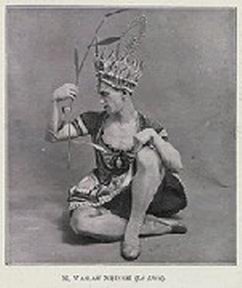
But the tunic for the Blue God will always evoke the man who created the role and who caused so many scandals for the Ballets Russes of Serge Diaghilev, that is Vaslav Nijinsky. The power of his name, like that of Anna Pavlova, will always make anything associated with him appealing to a wide spectrum of the population. One of Nijinsky’s colleagues, the ballerina Lydia Sokolova, has described in her memoirs the first sight the audience would have had of Nijinsky as the Blue God. She writes that he was seen ‘at the top of a flight of wide steps at the back of the stage, seated on a throne with legs crossed, holding a flower’. He was wearing the tunic now on display in Ballets Russes: the art of costume.
Unknown photographer, M Waslaw Nijinski (Le Dieu), p 36 in Comœdia Illustré, special edition, no 16, 15 May 1912. National Gallery of Australia, Canberra
This post is an amplified and enhanced version of my article ‘Homage to the Blue God’ first published by The Canberra Times on 18 December 2010.
The website for the National Gallery’s exhibition is at this link.
BIBLIOGRAPHY
Bell, Robert (ed.). Ballets Russes: the art of costume (Canberra: National Gallery of Australia 2010)
Buckle, Richard (ed). Dancing for Diaghilev. The memoirs of Lydia Sokolova. Paperback edition (San Francisco: Mercury House, 1989)
Misler, Nicoletta. ‘Siamese dancing and the Ballets Russes’ in Nancy van Norman Baer (ed.), The art of enchantment: the Ballets Russes 1909–1929 (San Francisco: Fine Arts Museums of San Francisco, 1988), pp. 78–83
Musée Rodin. Rodin and the Cambodian dancers: his final passion (Paris: Editions du Musée Rodin, 2006)
Pritchard, Jane (ed.). Diaghilev and the golden age of the Ballets Russes 1909–1929 (V & A Publishing, 2010)
Comments on this post are now closed. The discussion continues on part two.
The Victoria & Albert Museum, London, has an enviable collection of theatrical costumes from the Diaghilev era, many of which (or is it all of which?) are displayed in the museum’s current, celebratory exhibition Diaghilev and the Golden Age of the Ballets Russes. There are some real gems to be seen. I was especially attracted by a costume worn by Tamara Karsavina as Zobeide in Schéhérazade. Not the more familiar Zobeide costume of harem pants and bodice but a soft, deep purple dress with painted gold designs scattered over the skirt and a top decorated with golden braid. Designed by Bakst, it was apparently worn only briefly before the more familiar costume became popular.
Also quite fascinating was a costume worn by a child performer in Le Dieu bleu, a golden costume of pants and top with a tall headdress reminiscent in shape of those worn by Thai and Cambodian dancers (although far less complex in decoration). While we are used to seeing the costume worn by the Blue God himself, costumes for the ancillary characters, in this case a ‘Little God’, are less common.
Some of the costumes are displayed with quite dizzying effect. For example, some ten or twelve costumes from the famous (or infamous) Nijinsky/Stravinsky/Roerich Rite of Spring are arranged on a tiered framework and are grouped into men’s and women’s costumes. The display gives a very clear view of the range of patterns and colours used by Roerich in designing the work. It is truly an embarrassment of riches.
I also loved the two appearances of Lydia Sokolova on film. One snippet is a two minute silent film made in 1922 called Dancing grace: novel studies of Lydia Sokolova the famous dancer. By today’s technical standards Sokolova’s turn out is pretty much non existent and she rarely points her feet, but as she executes a cabriole followed by an assemblé her sense of movement throughout the whole body is breathtakingly expansive. In another piece of footage Sokolova is wonderfully eccentric as she exclaims over one of the costumes she once wore, which was going under the hammer at the Sotheby’s auction of 1968. Clearly an outstanding dancer and a great lady.
The moment of greatest impact for me, however, came as I turned a corner into a new room to be confronted by the magnificent backcloth by Natalia Goncharova for the final scene of The Firebird. The huge and imposing cloth representing a Russian walled city, inspired we are told by frescoes by Andrea Mantegna, is familiar from many images in books. But to see it in real life is a remarkable experience. It is hung diagonally across the space of a quite small gallery. Above a brick wall that stretches horizontally across the bottom one eighth or so of the cloth, Russian buildings are piled vertically on top of each other, stretching upwards to a patch of deep blue sky. It’s a brilliant piece of work by Goncharova, impressively constructed with its horizontal lower and upper sections anchoring the towering verticality of the block of buildings. In terms of colour it is equally impressive with the golden onion domes of the Russian towers set off against patches of rich, red on the building walls.
Stravinsky’s Firebird music fills the space and the other walls show shadowy images of the Firebird, in this case Begoña Cao of the English National Ballet, dancing against a changing background of fire, original programs, images of Karsavina as the first Firebird, the musical score and a range of other images. Subsidiary material relating to The Firebird is shown on the walls of the previous gallery and includes a squared up design for the cloth and various versions of the design. All together it makes for a wonderful gallery-going experience.
The morning I was there the place was packed with people, all of whom had their favourite items as I did I am sure. And therein lies the rub. Diaghilev and the Golden Age of the Ballets Russes is a hugely ambitious show, perhaps overly ambitious. I couldn’t see the point of some items on display. Was there really any need to display a perfume bottle that once held the Guerlain perfume thought to be the favourite scent of Diaghilev? And there was the usual selection of devotional items—Diaghilev’s top hat and opera glasses and an assortment of pointe shoes worn by various Ballets Russes stars. But what was the argument at the heart of the show? In the end it became nothing more than a huge cabinet of curiosities, which is perhaps fitting given its location in a museum named after two giants of the Victorian age, when such cabinets were all the rage.
During August I spent some time investigating the spelling of Valentin Zeglovsky’s name and posted some results under the title ‘Valentin Zeglovsky: some Australian notes’. It was a somewhat esoteric exercise but it did yield other information about Zeglovsky, of which I was not previously aware. So for me it was a worthwhile excursion, although it did envelop Zeglovsky in further mystery.
Place of birth
I mentioned in the previous post that Zeglovsky completed the various procedures to become a permanent resident in Australia and to acquire the status of a British subject. One document that was part of that process contains a short but closely packed, typewritten section entitled ‘General Remarks’. The document, dated 11 December 1945, was typed not by Zeglovsky but by a public servant from information provided by Zeglovsky. Under ‘General Remarks’ the document states, in part: ‘Applicant states that his birthplace is Riga Latvia not Kharkov as per Declaration. Passport verified this statement’. This is interesting because in his autobiography, Ballet Crusade, Zeglovsky records that he was born on 26 July 1908 in Kharkov.
Ballet Crusade
Zeglovsky’s account of his life from birth to the early 1940s was published by Reed & Harris as Valentin Zeglovsky’s Ballet Crusade in December 1943 with a reprint in 1944. Ballet Crusade‘s title page (at least for the 1944 reprint) says ‘translated from the Russian’, although no acknowledgement of the translator is given. However, letters from Valrene Tweedie written in the 1940s from Cuba to her friend in Sydney, Marnie Martin, indicate that Martin had been working with Zeglovsky on a book, which Tweedie confirmed before her death in 2008 was Ballet Crusade. Martin had been an extra during the Ballets Russes visits to Australia and remained a lifelong friend of Tweedie. From the letters it appears she was quite close to Zeglovsky — Tweedie frequently ends her letters to Martin with a greeting to ‘Valentin’ as well. It was also Martin’s GPO box address that Zeglovsky used on most of his applications to the patent’s office mentioned in my earlier post. I have no evidence that Martin was a Russian speaker but I suspect that ‘translated from the Russian’ may have been a euphemistic way of indicating that the book owed much to Martin. Tweedie maintained in fact that it was ghost written, at least in part, by Martin.
Work life in Australia
Tamara Finch in her autobiography, Dancing into the unknown, records the initial efforts by those Ballets Russes artists who remained in Australia in 1939 at the conclusion of the Covent Garden Russian Ballet tour to find work for themselves in Australia. Her account explains that a small company, which included Zeglovsky, formed to give recitals but disbanded in 1940 after the venture proved unsuccessful. It was probably around this time that Zeglovsky settled in Sydney and began teaching and dancing with various companies. The ‘General Remarks’ on his naturalisation application state: ‘At the outbreak of war applicant under engagement to J. C. Williamson and travel led all over the Commonwealth’.
Briefly, Zeglovsky danced and travelled with the Kirsova Ballet and danced some seasons with the Borovansky Ballet. In 1942–1943 he also performed in the J. C. Williamson revival of the popular musical White Horse Inn, which opened in Sydney in December 1942. This aspect of Zeglovsky’s Australian career will be the subject of another post.
However his naturalisation papers reveal that he also worked in decidely non-dancing jobs. The same ‘General Remarks’ mentioned above record: ‘Late in 1943 commenced work as a cement worker at the Captain Cook Graving Dock, Sydney’. And a little further on: ‘Applicant states that he is a fully qualified diamond tool setter’.
Marriage
On immigration documents relating to Zeglovky’s arrival in Australia with the Covent Garden Russian Ballet in 1938, he lists his status as married and his wife’s name is given as Mia. Later documents completed by Zeglovsky and held in the National Archives of Australia indicate that Mia was born in 1910 in Riga and that she was living in Tel Aviv, Palestine, when Zeglovsky applied for naturalisation. Mia Arbatova is mentioned on several occasions in Ballet Crusade and, although in the 1940s Zeglovsky continues to state that he is married, sources such as the Jewish Women’s Archive indicate that Arbatova and Zeglovsky, who were dance partners and who are said to have married in 1933, divorced in 1937.
Zeglovsky married dancer Pamela Nell Bromley-Smith in Sydney in 1949 according to the New South Wales Registry of Births, Deaths and Marriages. Bromley-Smith appeared as the Daughter in La Concurrence with the Covent Garden Russian Ballet in its Sydney season in December 1938. Her name appears on a program dated 17 December 1938 and a photograph (not in costume for La Concurrence but in an exotic two piece fringed and beaded costume) appeared in the Evening Post from Wellington, New Zealand, on 6 February 1939 with the caption ‘Pamela Bromley-Smith, aged 10 years, who was engaged in Sydney to dance the child role in “La Convenience” [sic], a performance by the Russian Ballet. Pamela is from the Dolee Brooks School of Dancing and holds her intermediate dancer’s diploma for operatic dancing in Australia …’. The performing arts gateway AusStage records that she appeared in a number of productions at the Minerva and Independent Theatres in Sydney in the 1940s.
Ziggy, as he was apparently known in the Ballets Russes, continues to fascinate!
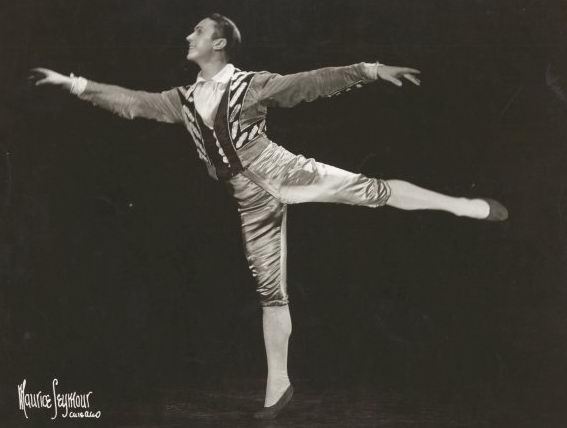
Featured image: Zeglovsky in Cimarosiana reproduced from the Geoffrey Ingram Archive of Australia Ballet with permission of the National Library of Australia.
Maurice Seymour: Valentin Zeglovsky in ‘Cimarosiana’, ca. 1936
Some recent correspondence with a friend of the family of the Ballets Russes dancer Valentin Zeglovsky sent me in search of further information. I was curious in the first instance about Zeglovsky’s name as it seems to have had a number of variant spellings. While this is not surprising in the context of the Ballets Russes, where names were changed for stage purposes and often Russianised for maximum theatrical effect, the Zeglovsky situation was a little different. There is no doubt that his stage name was Valentin Zeglovsky as this name appears on programs for the Covent Garden Russian Ballet season in Australia as well as in programs for seasons by the Borovansky Ballet and the Kirsova Ballet, in which Zeglovsky danced after he elected to remain in Australian at the end of the season by the Covent Garden Russian Ballet in 1939. But online references to documents held in the National Archives of Australia consistently indicated that his name was Valentins Zeglovskis. The family, however, while acknowledging his stage name regarded Valentin Zeglovskis as his ‘real’ name and believed that Valentins was a misnomer.
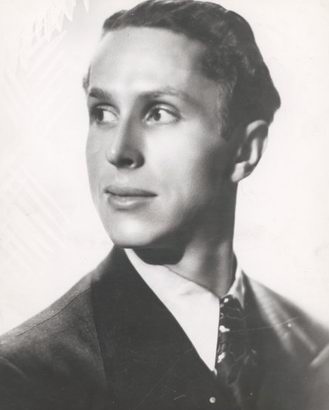
Portrait of Valentin Zeglovsky, 1940s. Photographer unknown. Courtesy National Library of Australia, Geoffrey Ingram Archive of Australian Ballet. Reproduced with permission.
Examination of the hard copy records in the Archives revealed an interesting situation. During his time in Australia, Zeglovsky spent some of his time teaching in Sydney. He set up a school in a studio in the house in which he lived in Macdonald Street, Potts Point, in the early 1940s. From there he submitted four patent applications to the Sydney office of the Commonwealth of Australia’s Registrar of Copyrights. The applications were for four ballets, The Red Poppy, Les Amoreux, Miralda and Morning Noon and Night. They were probably never realised but the libretti were submitted and approved between late 1942 and mid 1943. On these applications the name Valentins Zeglovskis appears quite clearly both in typewritten and handwritten form, including as an official signature. Not only that, Zeglovsky applied to be naturalised in 1945 and this was achieved in 1946. On naturalisation documents held by the Archives, including copies of newspaper declarations of his intent to seek naturalisation, his name appears as Valentins Zeglovskis. It seems that this situation remained until his Australian passport, issued in 1949, was cancelled and his naturalisation certificate returned to the Department of Immigration in Canberra in 1954 from the London office of the High Commissioner for Australia. In 1954 he registered as a citizen of the United Kingdom and Colonies. So for some reason he clearly wanted to be known officially, at least in Australia, as Valentins Zeglovskis.
While names will always be somewhat capricious, especially in the situation in which Zeglovsky found himself during his years in Australia, research into those archival documents revealed other fascinations about the life of a dancer in Australia in the 1940s. They will be the subject of a future post.
In 1951 Jacqueline Lee Bouvier, later to become Jacqueline Kennedy, won Vogue magazine’s Prix de Paris for a short essay entitled ‘People I wish I had known’. She wrote about three men, one of whom was Serge Diaghilev. She described him as an ‘alchemist unique in art history’. Kennedy is not alone in naming Diaghilev as a man of singular importance in the development of the arts in the West. The Australian-born writer and cultural critic Clive James included Diaghilev in his recent collection of essays, Cultural Amnesia, for example. And one of Diaghilev’s biographers tells the story of the vegetable seller at Covent Garden who said to him, ‘Did you know Daggyleff? He was the greatest dancer that ever lived.’
Neither Jacqueline Kennedy, nor Clive James, nor the unnamed vegetable seller knew Serge Diaghilev personally and yet for each the name Diaghilev resonated in a particularly powerful manner. It is now 81 years since Serge Diaghilev died in 1929, so what was it about this man and his exploits that continues to have an impact across continents, professions and social strata?
The obvious answer is that Diaghilev changed the face of dance by establishing an aesthetic of collaboration such as the dance world had not previously known, and in so doing surrounded himself with the most innovative thinkers and artists across all fields of endeavour. The year 2009 saw the centenary of the first Paris season of his famed Ballet Russe company and the world has been flooded with exhibitions and publications celebrating that event and its ongoing influence. More are planned for 2010.
But in addition, Diaghilev had personality plus! And it is this aspect of his life that comes out very clearly in Sjeng Scheijen’s biography Diaghilev: a life published in 2009. It is in fact a beguiling book. It places the whole Diaghilev enterprise in a very personal context—the troubles, the strife, the arguments, the sex, the weeping, the dramas, the networking, they’re all there. I probably didn’t learn all that much more about the works in the Diaghilev repertoire and this might be seen as a limitation of sorts. But I did learn much about the social and personal environment in which that repertoire got to the stage and Diaghilev’s personality grew bigger and bigger and more and more complex as the book continued.
My favourite anecdote, however, is a somewhat surreal one. It concerns the persuasive Misia Sert, pianist, patron and one time wife of painter Jose Maria Sert, and her input into Red Cross efforts during World War I. It is surreal in its juxtaposition of art and reality. It reads:
‘Many celebrated artists entered military service, though few fought at the front. Most joined army nursing corps or signed up with the Red Cross. Misia managed to persuade her couturier friends to provide a number of vans, which she converted into ambulances. Manned by artists and socialites, they sped to the aid of troops in northern France. Her nursing staff included Cocteau, sporting a natty little uniform designed by the couturier Poiret. Maurice Ravel also drove an ambulance, though in a regular army unit. Ida Rubinstein, too, worked as a nurse, though her uniform was designed by Bakst.’
The main strength of the book is the depth of research that has gone into its creation. It draws on sources, many of them valuable primary resources from Russia, which have not been and are still not easily available to other researchers. These sources make this biography quite unique. However, the use of personal material is not without its problems and in my opinion any publication that relies heavily on very personal material such as letters, diaries and the like needs to be taken with a grain of salt and its sources considered and reconsidered, checked and rechecked against other material. Scheijen relies heavily on such material and little else, which makes me wonder whether or not the book will in the future be seen as a collection of gossip and anecdote. Nevertheless, the book is a great read.
One little annoyance: I disliked finding reference to Le Boutique fantasque. The name of the work is beautifully written with the adjective beginning with a lower case ‘f’ as is absolutely correct from a French language point of view. But as far as I know ’boutique’ has always been feminine gender—’la boutique’.
I also puzzled for a while over how Diaghilev could have seen the Olympic Games in Athens during a trip to Europe in 1906, as Scheijen observes, when I had always believed that Athens hosted the Olympics in 1896 and that 1906 was not an Olympic year. But the puzzlement was my ignorance. Eventually I discovered that Athens hosted an ‘Intercalated Games’ in 1906. The argument about whether or not the 1906 Games were really ‘Olympic’ has been an interesting side-step for me.
David Lichine choreographed close to fifty ballets during his lifetime. Graduation Ball, which premiered in Sydney on 1 March 1940, was probably his most successful. In Australia, from March to August 1940, the work was given 69 performances by the Original Ballet Russe, a statistic equalled only by one other ballet during the season—Les Sylphides, which also received 69 performances.
Lichine also created a sequel to Graduation Ball, scarcely known, apparently performed only in Argentina, and called Girls’ Dormitory. The Riabouchinska/Lichine papers held by the Jerome Robbins Dance Division of the New York Public Library for the Performing Arts contain a letter from Lichine to the Director-General of the Teatro Colón in Buenos Aires, dated 13 March 1947, in which Lichine maintains that a sequel was in his mind ‘from the moment the curtain closed on the opening night of “Graduation Ball”‘. According to Anne Robinson, Girls’ Dormitory was planned for the Ballet Russe de Monte Carlo in 1945, although it was never performed by that company. Its premiere performance was given in Buenos Aires in July 1947 by the Teatro Colón Ballet.
In the same letter to the Director-General Lichine writes ‘The ballet will have many comedy situations … and the corners filled to capacity with youthful abundance of virginal gaiety’, and he notes that the costumes will be similar to those of Graduation Ball. He writes: ‘The boys are all dressed as young cadets and all the girls in uniform with only slight alterations’.
Robinson records that the music for Girls Dormitory was by Offenbach, orchestrated by Antal Dorati, and that the work was designed by Mstislav Dobujinsky. However, a series of designs all dated 1949, clearly entitled ‘Girls Dormitory’ and signed by Alexandre Benois are part of the Manuscripts and Rare Books collection of the Boston Public Library. They appear to be for a different production entirely as the costumes for the girls are chaste night dresses rather than the uniforms mentioned in Lichine’s letter. They are labelled ‘Tenue de nuit de toutes les pensionnaires’. Other designs in the Boston collection are labelled ‘II—Le cauchemar’ and, according to Anna Winestein, in this second act ‘the protagonists find themselves in an exaggerated, nightmarish version of the school they attend’. In his letter to the Director-General Lichine also advises that he is enclosing a synopsis of Girls’ Dormitory but, frustratingly, this synopsis is not included as part of the Riabouchinska/Lichine papers. So the relationship between the ballet Benois designed and what went onstage in Buenos Aires remains unclear.
However, some of the Benois designs in Boston are of interest in the Australian context. Three of these designs are for teachers who appear in the Act II nightmare—’Le Maître de l’Histoire’, ‘Le Maître de Geographie’, and ‘Le Maître de la Grammaire’. While the designs for the professors of Mathematics and Natural History who appeared in the Australian divertissement ‘Mathematics and Natural History Lesson’ (see previous post) have not been located, the Boston designs give an insight into what they may have looked liked. They perhaps also suggest that the idea of the Australian divertissement may have been that of Benois rather than Lichine.
Girls’ Dormitory was, according to Robinson, never seen onstage outside of Argentina, although a film combining Graduation Ball and Girls’ Dormitory was made in Mexico in 1961 by Jose Luis Celis.
The Boston designs are reproduced in Anna Winestein’s Dreamer and showman. The work of Benois is still in copyright and this website is not in a financial position to be able to pay reproduction fees.
Bibliography
Anne Robinson. ‘The work of dancer and choreographer David Lichine (1910–1972): a chronology of the ballets with a brief critical introduction’, Dance Research, 19 (No. 2, Winter 2001), PP. 7–51
Anna Winestein. Dreamer and showman. The magical reality of Alexandre Benois (Boston: Boston Public Library, 2005).
Papers of Alexandre Benois 1913-1959, Boston Public Library, MS 2029
Papers of David Lichine and Tatiana Riabouchinska (unprocessed), Jerome Robbins Dance Division, New York Public Library for the Performing Arts