Dance diary. April 2013

  • ArtSound FM, Canberra: new dance segment

Beginning in May I will be hosting a ten minute monthly dance segment on ArtSound FM, Canberra’s community radio station focusing on the arts. The segment will be part of Dress Circle a program hosted by local arts identity Bill Stephens. Dress Circle is broadcast on Sundays at 5 pm and repeated on Tuesdays at 11 pm and my segment will focus on dance in Canberra and surrounding regions. Michelle Potter … on dancing, as the segment will be called, will be a feature of Dress Circle on the first Sunday of each month.

In the first program, which will go to air on 5 May, I will be talking about the Australian Ballet’s visit to Canberra with their triple bill program Symmetries, which opens on 23 May. Leading up to the program I have been talking Garry Stewart about his new work, Monument, and have been discovering some unusual and amusing stories about George Balanchine’s ballet The Four Temperaments. Monument and The Four Temperaments will be accompanied by the pas de deux from Christopher Wheeldon’s After the Rain in this Canberra-only program.

I will also be sharing some information about Liz Lea’s new work, InFlight, which will premiere at the National Library of Australia on 31 May. InFlight is danced by four female performers who are inspired to become aviatrixes when they see their heros, Charles Kingsford Smith and Charles Ulm, taking to the air in 1928 and breaking the trans-pacific flight record.
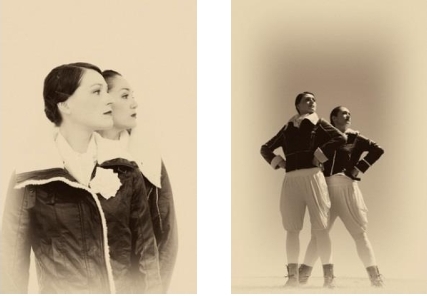
Alison Plevery and Liz Lea, 'InFlight'. Photos: Lorna Sim
Alison Plevey and Liz Lea in costume for InFlight. Photos: © Lorna Sim, 2012

There will be other snippets of news as well, and I hope to have time to look back on some of the dance events I have enjoyed in the previous month.

  • Elizabeth Dalman and Australian Dance Theatre

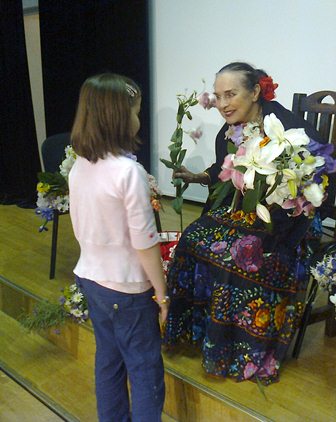
There was some lovely news earlier this month from Australian Dance Theatre—Elizabeth Dalman has been named patron of ADT for the company’s 50th anniversary year, 2015. Dalman, along with Leslie White (1936‒2009), founded ADT in 1965. White moved on to other things in 1967 and Dalman continued to direct the company until 1975. After a varied career overseas, both before and after the ten years she spent at ADT, Dalman returned to Australia in 1986 and in 1990 founded the Mirramu Creative Arts Centre at Lake George, near Canberra. She continues to direct the Centre and its associated Mirramu Dance Company. Fifty years of ADT will also mark fifteen of Mirramu.*
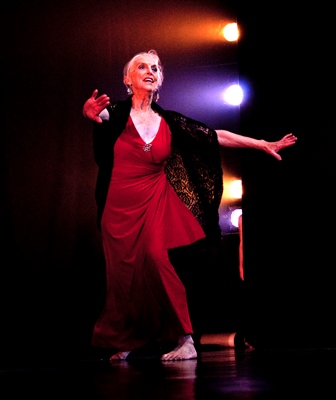
Elizabeth Dalman in 'From Sapling to Silver', 2011
 Elizabeth Dalman in Sapling to Silver, Mirramu Dance Company. Photo: © Barbie Robinson, 2011

I didn’t post my Canberra Times review of Sapling to Silver when it was performed in Canberra in 2011, so here is a link to the review. [UPDATE August 2020: Online link no longer available]. Here is a link to posts about Elizabeth Dalman.

  • The Fabric of Dance

In April I had the pleasure of presenting an illustrated talk, The fabric of dance, at the National Gallery of Victoria, Melbourne, in conjunction with the Gallery’s exhibition Ballet and Fashion.  In this talk I looked at how the tutu had developed over three centuries or so, and in particular at how its development had been influenced by changes in fashion and by new materials and fabrics that had become available. But, in putting the talk together, I found I was quite unexpectedly wanting to suggest a link between one of the costumes on show in the exhibition and Louis XIV in his famous role as Apollo in Les Ballets de la nuit of 1653, which I did. I am hoping to post the text of the talk, and the accompanying PowerPoint slides, on this site in due course.

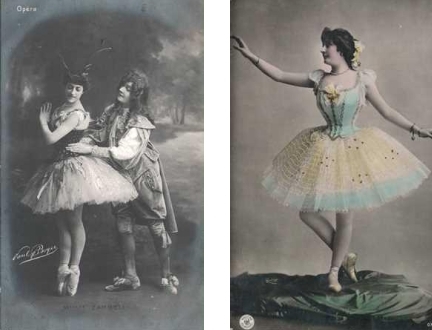
One of the images I showed during the talk was of Paris Opera Ballet dancer Carlotta Zambelli, which I was only able to show as a black and white scan from an article first published in the Australian dance journal Brolga in 2005. My postcard of Zambelli was in colour but it disappeared as a result of being lent when that issue of Brolga was being prepared for publication. I despaired of ever seeing it again but it was returned to me a week or so after the Melbourne talk. So for anyone who was at the talk, below on the right is the image in colour, alongside another (also returned to me at the same time in the same circumstances) of Zambelli with an unknown partner in La ronde des saisons in 1906.
  • The Rite of Spring: Stephen Malinowski’s animated graphical score

I found what I think is an excellent review of Stephen Malinowski’s animated graphical score of Stravinsky’s Rite of Spring. I mentioned this score in a previous post without making much comment myself although what the animated score did instantaneously for me was bring me to a realisation of why I disliked Raimund Hoghe’s Sacre so much. Hoghe completely ignored the fact that the music has so much colour, drive and rhythm. The colour, drive and rhythm of the music is perfectly obvious when listening to the music of course, but seeing the animated score absolutely drives it home and opens up a new view of the intensity of the music. Here is the link to the review.

Michelle Potter, 30 April 2013

* Dalman has always been a strong voice in the dance world and she argued against a name change to Meryl Tankard Australian Dance Theatre when Meryl Tankard became director of ADT in 1993. A brief account of that interlude appears in my recent publication Meryl Tankard: an original voice (2012). In a letter to Dance Australia Dalman argued that the company should not carry Tankard’s name as it was important to ‘maintain continuity and … respect for the historical background of the company’.
Dance diary. March 2013

  • Luke Ingham

In mid-March I had the pleasure of meeting up in San Francisco with Luke Ingham, former soloist with the Australian Ballet. Ingham and his wife, Danielle Rowe, left Houston Ballet in 2012 to take up other offers. Rowe went to join Netherlands Dance Theatre in The Hague and Ingham scored a soloist’s contract with San Francisco Ballet. Ingham has already had some great opportunities in San Francisco and my story on his activities is scheduled to appear in the June issue of Dance Australia in the magazine’s series Dancers without borders. Watch out for it.

  • Walter Gore’s The Crucifix

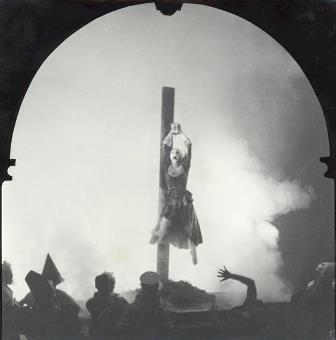
I have always been fascinated by a photograph taken by Walter Stringer of the final scene from Walter Gore’s ballet The Crucifix. Alan Brissenden, in his and Keith Glennon’s book Australia Dances, reproduces the photograph on page 53, and a print is part of the National Library’s Walter Stringer Collection. Brissenden gives a brief account of the storyline and the reception the ballet received when it was staged in Australia by the National Theatre Ballet in 1952.

Paula Hinton in Walter Gore's 'The Crucifix', 1952
Paul Hinton in the final scene of Walter Gore’s ballet The Crucifix, National Theatre Ballet, Melbourne 1952. Photo: Walter Stringer, National Library of Australia

I have just recently been making a summary of an oral history interview I recorded with Athol Willoughby in February and his recollections of performing in The Crucifix tell us a little more, especially about the final scene, and provide, furthermore, a wonderful example of the value of oral history. Willoughby played the role of one of the soldiers who accompanies the executioner, played by Walter Gore, to the scaffold. He says of the opening performance:

‘The scene changed to a huge [stake] with a lot of fake wood around it … Wally came in carrying Paula … Her hands were tied … and he lifted her onto the [stake]. Just as the symphony ended he picked up a torch—none of us had seen the end of the ballet, even at the dress rehearsal the end of the ballet hadn’t been choreographed and we didn’t know what was going to happen—he picked up a flaming torch and threw it at the pyre of wood. The minute he threw the torch at her the wood lit up, the symphony finished and Paula screamed … It was so powerful.’

  • The Rite of Spring: an animated graphical score

I  have just received the following note and link from composer Stephen Malinowski:
‘The last few months, I’ve been working on an animated graphical score of Stravinsky’s Rite of Spring. This week I completed the first part. Enjoy!

  • Pacific Northwest Ballet

In my review of Pacific Northwest Ballet’s recent program I mentioned that the show I saw was only the second time I had seen the company in performance. Well that is not quite true. I had the good fortune to see the company in 2007 in Seattle when the program consisted of George Balanchine’s La Sonambula, Christopher Wheeldon’s Polyphonia and Nacho Duato’s Rassemblement. Certainly a very interesting program.

Michelle Potter, 31 March 2013

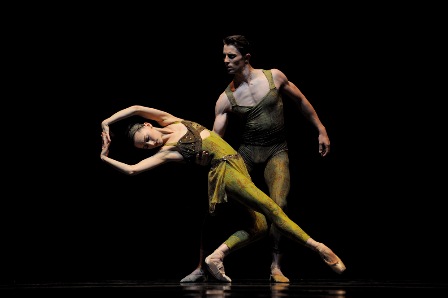
Featured image: Luke Ingham and Sarah van Patten in Christopher Wheeldon’s Within the Golden Hour. Photo: © Erik Tomasson, 2013. Courtesy San Francisco Ballet

Diary Note

Further details

Dance diary. February 2013

  • Hannah O’Neill

Admirers of Hannah O’Neill, and there are many if my web statistics are anything to go by, may be interested to read the following post on Laura Capelle’s website Bella Figura. In addition to what is written on the site, there is a link to an article written by Capelle for the American dance magazine Pointe. The article was published in the February/March issue of Pointe and Capelle has done a great job in getting O’Neill to open up about her experiences, including some of the difficulties she has faced in Paris.

UPDATE August 2020: The Bella figura website seems not to be available these days and I have removed the non-operational link. I did find, however, a Laura Capelle article about Hannah O’Neill at this link.

  • Bodenwieser update

A news story on the Bodenwieser project being led by Jochen Roller, which I mentioned in last month’s dance diary, was screened on SBS TV a few days ago. The SBS story is available below.

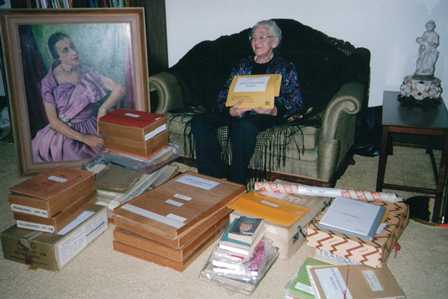
Below I have reproduced a photo of Marie Cuckson, who with Emmy Taussig assembled the Bodenwieser archival material and kept it in good order until she donated it to the National Library and the National Film and Sound Archive in 1998. The acquisition was part of the Keep Dancing! project, which was the forerunner to Australia Dancing. Marie Cuckson is seen in her home in Sydney in August 1998 with the material packaged and ready to be transported to Canberra.

Marie Cuckson with the Bodenwieser Archives, 1998

  • Oral history collections

As a result of the Athol Willoughby interview conducted recently I retrieved the listing of dance-related oral histories in the National Library and the National Film and Sound Archive that used to be part of Australia Dancing. I have updated that list (an old version is on the PANDORA Archive). Here is the link to the updated version. It is a remarkable list of resources going back to the 1960s with early recordings by pioneer oral historian Hazel de Berg and, in the case of the NFSA, to the 1950s with some radio interviews from that period. It includes, for example, interviews with every artistic director of the Australian Ballet—Peggy van Praagh, Robert Helpmann, Anne Woolliams, Marilyn Jones, Maina Gielgud, Ross Stretton and David McAllister—and with three of the company’s administrators/general managers—Geoffrey Ingram, Noël Pelly and Ian McRae. But it is not limited by any means to ballet and in fact covers most genres of dance and the ancillary arts as well.

That material held by the National Film and Sound Archive is included reflects the origins of the list, which was begun in the early days of the Australia Dancing project when the NFSA was a partner in the project (and in fact the major collecting partner in its initial stages). I have also posted the list on the Resources page of this website and will update it periodically as information about new interviews comes to light. It deserves to be more obvious than it is now—that is hidden in PANDORA in an outdated version—especially as it is not a static resource.

  • Site news

February saw a huge jump in visits from France due largely to the post on the Paris Opera Ballet’s production of Giselle, which was the most accessed post during February by a runaway margin. Critics in France were curious about the reaction of Australian audiences and critics.

Coming in at fourth spot was a much older post on the Paris Opera Ballet’s production of Jiří Kylián’s Kaguyahime, which was having a return season in Paris in February. Interest in these two posts saw Paris become the fourth most active city after Sydney, Melbourne and Canberra.

The second most accessed post in February was an even older one, my review of Meryl Tankard’s Oracle, originally posted in 2009. Tankard is currently touring this work in the United States. At third spot was a post on Pina Bausch’s Rite of Spring perhaps reflecting the wide interest in 2013 in the many dance activities associated with the 100th anniversary of the first performance of the Stravinsky/Roerich/Nijinsky Rite of Spring, of which the Tankard tour is one.

Michelle Potter, 28 February 2013

Dance diary. January 2013

  • The Upshaw album

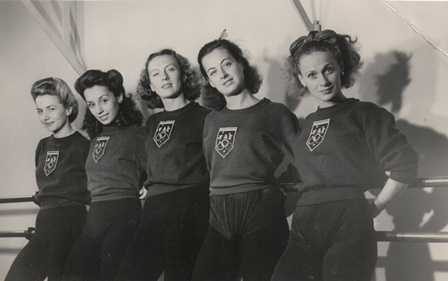
A recent meeting with Anna Volkova clarified one of the issues that went through my mind as I looked through the album assembled by James Upshaw, which was the subject of a recent post. I was interested in several photos that showed some of the dancers wearing sweatshirts with a logo for an organisation with the acronym F.A.E on them. F.A.E., it turns out, stands for an organisation in Rio de Janeiro called, in English, Student Assistance Foundation, and in Portuguese, Fundação de Assistêcia ao Estudante. Volkova explained that some of the dancers, including Volkova herelf, gave a performance for this Foundation while in Rio. She identified the dancers in the photos for me, with the exception of a Brazilian dancer who had only recently joined them and whose name she no longer recalled. At this stage I’m not entirely sure when the  performance took place.

Left to right: Lydia Kuprina, Leda Youky, Tamara Grigorieva, Anna Volkova, Tatiana Leskova, 1945. . Photo: © Kurt Paul Klagsbrunn

Update (1 February 2013): Tatiana Leskova has been kind enough to pass on some extra information about the photograph above and the concert in which the dancers performed. The Brazilian dancer was Leda Youky and the concert took place in Rio’s Teatro Municipal in, she believes, 1945. The dancers performed choreography by Vaslav Velchek—Anna Volkova danced to music by Mussorgsky (‘The Bumblebee’), Tamara Grigorieva and Tatiana Leskova to music by Rachmaninoff (Grigorieva to his ‘Prelude No. 2’, Leskova to his ‘Prelude No. 5’). Nini Theilade also performed, dancing her own choreography.

Grateful  thanks to the irrepressible Mme Leskova.

  • Vija Vetra

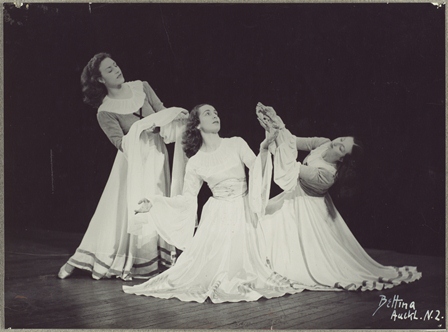
I was a little surprised, but of course pleased, to receive a message through this website’s contact box from Latvia. The message concerned Vija Vetra, a dancer born in Riga, Latvia, who had studied in Vienna with Rosalie Chladek, had come to Australia in 1948, had joined the company of Gertrud Bodenwieser shortly afterwards and had toured with the company to New Zealand and around Australia.  With Bodenwieser she performed in most of the repertoire from 1948 until the mid-1950s including as the Bride in The Wedding Procession (choreography Bodenwieser, costumes Evelyn Ippen, music Grieg), in which she is seen in the image below. She also danced one of the Aboriginal mothers in Beth Dean’s Corroboree during the Royal Gala season of 1954.

Left to right: Mardi Watchorn, Vija Vetra and Coralie Hinkley in The Wedding Procession, 1950. Photo:© Bettina, Auckland. Courtesy National Library of Australia, Papers of Gertrud Bodenwieser, MS 9263/67/204

Vetra moved to New York around 1964 and is still living there giving classes, lecture-demonstrations and workshops. She returns to her native Latvia frequently and is seen in the image below with a young student, Rasa Ozola, after a concert ‘Dejas sirdspuksti’ (Dance heartbeat) in Riga in June 2012.

Vija Vetra with Rasa Ozola, Riga, 2012. Photo:© Anita Smeltere

The 2010 publication Australia dances: creating Australian dance 1945–1965 by Alan Brissenden and Keith Glennon contains a brief summary of Vetra’s career in Australia (see page 224). An interview with Vetra recorded in New York in 2011 is at this link.

  • More Bodenwieser news

In January I was pleased to renew my contact with Barbara Cuckson, initially as a result of a request from the Dance Notation Bureau in New York relating to Gertrud Bodenwieser’s early work Demon Machine. Cuckson’s mother, Marie Cuckson, was responsible, with Bodenwieser dancer Emmy Taussig, for maintaining a collection of archival material relating to Bodenwieser’s life and career, which is now now housed in the National Library of Australia. Barbara Cuckson’s father, Eric Cuckson, filmed several of Bodenwieser’s works and this footage is now housed in the National Film and Sound Archive. Barbara Cuckson continues to promote the work of Bodenwieser in many ways.

The conversation turned to Errand into the Maze, which Bodenwieser made in Australia in 1954. German dancer/choreographer Jochen Roller is currently leading a project to investigate the ways in which Bodenwieser structured her ideas and themes, for which reconstructing Errand into the Maze is part. Cuckson provided me with the image below of a rehearsal conducted as part of the reconstruction process.

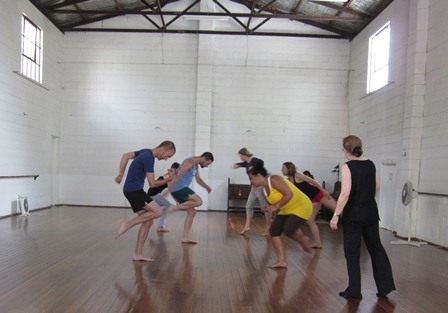
Barbara Cuckson and dancers in a rehearsal for Errand into the Maze, 2012. Photo:© Jan Poddebsky

Michelle Potter, 31 January 2013

Featured image: Lydia Kuprina, Leda Youky, Tamara Grigorieva, Anna Volkova, Tatiana Leskova, 1945. Photo: Kurt Paul Klagsbrunn

Dance diary. December 2012

  • Hannah O’Neill: news from Paris

Hannah O’Neill is now half way through her second year with the Paris Opera Ballet, having successfully negotiated another temporary contract at the annual examinations the company conducts each year.

In her second year with the company O’Neill has taken particular delight in performing in George Balanchine’s Serenade, part of a program of three Balanchine ballets that began the 2012‒2013 season. Sadly for her Australian admirers however, she is not coming to Sydney for the Paris Opera Ballet’s season of Giselle to be staged in January‒February. She says that, as she is still on a temporary contract, she wasn’t expecting to tour but that the bonus is that she will be performing in Paris in February in Jiří Kylián’s Kaguyahime. With a company of over 150 dancers, the Paris Opera Ballet has the luxury of being able to tour while maintaining a regular program in Paris at the same time. Kaguyahime, a spectacular piece of theatre, will be O’Neill’s first experience dancing a contemporary work since she has been in Paris.

  • Michelle Ryan: new artistic director at Restless Dance Theatre

Early in December Michelle Ryan was appointed artistic director of Restless Dance Theatre in Adelaide. Many will remember Ryan I am sure from her performance days with Meryl Tankard. She joined the Meryl Tankard Company in Canberra in 1992 and then moved to Adelaide in 1993 remaining with Meryl Tankard Australian Dance Theatre until it disbanded. More recently Ryan has been working as rehearsal director with Dance North.

For more about the history of Restless Dance, a contemporary company working with people with and without a disability, the National Library holds an extensive interview with Kat Worth, artistic director of Restless Dance 2001–2006.

  • Meryl Tankard: an original voice

Here are some shout-lines from some who have read Meryl Tankard: an original voice: ‘It has a sense of drama but also balance, and it brings Meryl and her work to life’; and ‘The best and most comprehensive study of Tankard I have read’.

  • Site news

I am always interested to see which tags are being accessed most frequently by visitors to this site. It usually changes slightly from month to month depending on what has been posted in any particular month. But it is perhaps more telling to look at which tags have been accessed over a full year. In 2012 the Australian Ballet topped the list. Here are the top ten:

  • The Australian Ballet
  • Hannah O’Neill
  • Ty King-Wall
  • Ballets Russes
  • Graeme Murphy
  • Meryl Tankard
  • Madeleine Eastoe
  • Olga Spessivtseva
  • Juliet Burnett
  • Lana Jones

Michelle Potter, 28 December 2012

Dance diary. November 2012

  • Meryl Tankard: an original voice

Following requests from a number of readers for a copy of Meryl Tankard: an original voice, which appeared in eight parts on this website between July and September, the book is now available in print form. [UPDATE: This book is no longer available]

Please note that this is a self-published initiative and has not had the benefit of professional design; nor does it include any illustrations. Both were beyond the scope of this venture. It does however include material not published online including a preface, introduction, bibliography, index and the full list of choreographic works, updated with the addition of Cinderella (2011) for Leipzig Ballet, which will be restaged early in 2013 in Leipzig, and The Book of Revelation, the film directed by Ana Kokkinos that Tankard choreographed in 2006.

  • Canberra news

The Canberra Critics’ Circle announced its annual awards during November. The dance panel gave two awards this year. One went to Adelina Larsson ‘for her initiative in facilitating the development and performance of contemporary dance in Canberra, in particular for her work as director of  short + sweet dance, and for her collaborations with independent artists from across Australia to bring a broad spectrum of contemporary dance to Canberra’. Another went to Jordan Kelly local dancer and choreographer in musical theatre ‘for his body of work as an outstanding dancer, and consistent achievements as a talented choreographer, as evidenced in a number of musicals throughout 2012’.

In November, the ACT Government also announced its nominations for the Australian of the Year awards. At this ceremony the ACT Local Hero Award was presented to dancer and mentor, Francis Owusu. There is an enormous amount of community dance currently being practised in the ACT and Francis Owusu founded Kulture Break, a not-for-profit charitable creative arts organisation with a community focus. It acts as an outlet for young people to build self-confidence through dance.

  • Reviews: The Canberra Times

Here are links to my reviews published during November by The Canberra Times—performances by Les Ballets Trockadero de Monte Carlo and short + sweet dance. [UPDATE: Links no longer available]

  • On this site

The five most visited posts in November were: Thoughts in Pina Bausch’s ‘Rite of Spring’; ‘Icons’: the Australian Ballet; Lana Jones and Kevin Jackson dance Balanchine; ‘Concord’: the Australian Ballet; and ‘Swan Lake’: the Australian Ballet.

Michelle Potter, 30 November 2012

Dance diary. October 2012

  • Dancing bronzes

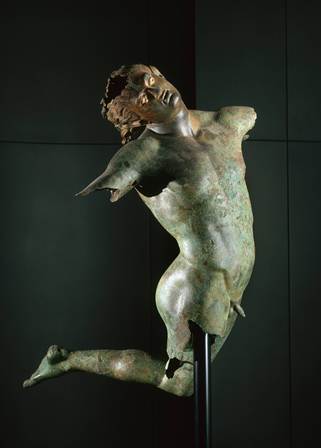
During October I was utterly transfixed by an exhibition called Bronze on show at the Royal Academy of Arts in London. I was sceptical when I read so many reviews all with glowing descriptions that seemed to border on hyperbole. But the exhbition was absolutely mind-blowing in its scope, in the intelligence of its presentation and in the power of the objects on display.

The centrepiece of the show is the ‘Dancing Satyr’, a slightly larger than life figure around 2,300 years old, which was dragged out of the sea by fishermen in 1998. It is the first object one encounters on entering the exhibition space and, although it is missing both arms and one leg, the sense of movement emanating from the figure is brilliant. No matter from which angle one looks at the figure it is dancing, wildly. Bathed in a soft, moody light this beautiful figure is the sole object in a quite large space. The impact is almost overpowering.

Dancing Satyr, Greek, Hellenistic period, Third–second centuries BCE; Bronze, with white alabaster for eyes, H. 200 cm; Museo del Satiro, Church of Sant’Egidio, Mazara del Vallo; Photo Sicily, Regione Siciliana—Assessorato Regionale dei Beni Culturali e dell’Identità Siciliana—Dipartimento dei Beni Culturali e dell’Identità Siciliana—Servizio Museo interdisciplinare Regionale “A. Pepoli” Trapani / © 2012. Photo Scala, Florence

The show contains other dancing items including a serene dancing Shiva.

Of course many of the bronzes have nothing to do at all with dance but they are astonishing as well and include some unexpected (to me) items from Africa. The show covers an exceptionally wide period of time from the ancient world to the present. On the non-dancing front I loved a spider, hovering high on a wall, by Louise Bourgeois, and a couple of beer cans in bronze from Jasper Johns.

Bronze is at the Royal Academy of Arts, London, 15 September 2012 to 9 December 2012. It’s a great show.

  • Bolshoi Ballet in Brisbane

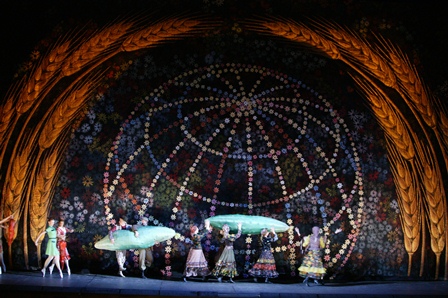
The Queensland Performing Arts Centre today announced its latest dance coup. Australian dance-goers will have the opportunity to see two programs by the Bolshoi Ballet in Brisbane in a season lasting from 30 May-9 June 2013. The Bolshoi is bringing two full-length works. The season opens with Le Corsaire based on the production created by Marius Petipa in the nineteenth century but in a revival by Alexei Ratmansky and Yuri Burlaka. The second program is another revival, this time of a 1935 work from the Soviet era, The bright stream, again with input from Alexei Ratmansky, who has given the work a fresh breath of life with new choreography.

Both works promise to be curiosities—The bright stream, for example, is set during a harvest festival on a collective farm in the Russian steppes where a Moscow dance troupe arrives to entertain the workers. The season is, however, an opportunity to consider Ratmansky’s work once more, especially in a year when his new Cinderella will be a feature of the Australian Ballet’s 2013 season.

Dancers of the Bolshoi Ballet in The bright stream
  • Yvonne Mounsey/Irina Zarova (1919–2012)

Late in September one of the few remaining dancers who performed in Australia with the Ballets Russes died in Los Angeles. Yvonne Mounsey, born Yvonne Leibbrandt in 1919 in Pretoria, South Africa, danced in Australia during the 1939‒1940 Original Ballet Russe tour under the name Irina Zarova. A quick scan of programs from that tour indicates that she danced in at least Pavane (see below), Scheherazade, Thamar, Le Coq d’or, Petrouchka, Francesca da Rimini, Coppélia and Etude. Mounsey then travelled with the de Basil company on to South America where she was involved in the infamous dancers’ strike.

Tamara Grigorieva and Irina Zarova in Serge Lifar’s Pavane, Original Ballet Russe, 1940. Photo: National Library of Australia

Mounsey’s major career was in the United States with New York City Ballet and she had a long career as a teacher in Los Angeles. Here is a link to Alastair Macaulay’s obituary in The New York Times, the only one I have seen so far that mentions the Australian part of her life.

Michelle Potter, 31 October 2012

Dance diary. September 2012

  • The Canberra Times

In September The Canberra Times published my preview articles on Intensely Soul, a program by Odissi dancers Nirmal Jena and Pratibha Jena Singh, and on Swan Lake, the Australian Ballet’s new production with choreography by Stephen Baynes and design by Hugh Colman. The Intensely Soul preview was also syndicated into The Sydney Morning Herald under the heading ‘Siblings dance father’s philosophy into being’.

  • Sydney Long: spirit of the land

On 6 September I gave a lunchtime talk in conjunction with the National Gallery of Australia’s exhibition Sydney Long: spirit of the land. The text for the talk is available at this link. Images used can be seen at this link. As a follow up, I appeared with the curator of the exhibition, Anne Grey, on Radio National’s program Books and Arts Daily hosted by Michael Cathcart.

  • The Australian Ballet in 2013

The Australian Ballet launched its program for 2013 this month. I mentioned Garry Stewart’s commission to create a new work, Monument, in a previous post. Of the other offerings for 2013 I am looking forward in particular to seeing what Alexei Ratmansky creates for his Cinderella, which will premiere in Melbourne in September. I have very divided thoughts at the moment on Ratmansky’s choreography but am hoping his Cinderella will be as thrilling, choreographically speaking, as his Seven Sonatas.

I am also looking forward to the triple bill program Vanguard opening in Sydney in April most especially to see Jiří Kylián’s luscious Bella Figura again. George Balanchine’s Four Temperaments and Wayne McGregor’s Dyad 1929, first seen in Australia in 2009, will provide startling contrasts to Bella and the program promises to be a challenging and exhilarating one for dancers and audiences alike.

Felicia Palanca & Sarah Peace in 'Bella Figura'. Photo: Jeff Busby

  • Helpmann awards

The 2012 Helpmann Award winners were announced at the end of September. Open this link to see all the awardees who in the dance category included Stephen Page, Paul White and DV8 Physical Theatre’s production, Can we talk about this? (UPDATE August 2020: Link no longer available)

I was especially pleased to see that Sydney Dance Company’s Charmene Yap was the winner of the best female dancer in a dance or physical theatre work for her performance in Rafael Bonachela’s 2 one another. Her performances have been consistently thrilling since she joined Sydney Dance Company. Here is Yap in an ‘artist snapshot’ in which she talks about auditioning for Sydney Dance Company, creating her solo Bonachela’s 6 Breaths and her duet in Jacopo Godani’s Raw Models.

Dance also featured in the category best original score (David Page and Steve Francis for Bangarra’s Belong program) and best costume design (Toni Maticevski and Richard Nylon for BalletLab’s Aviary: A Suite for the Bird).

  • Tag cloud: popular tags

The ten most popular tags for September were: Graeme Murphy, Hannah O’Neill, The Australian Ballet, Benedicte Bemet, Dance diary, Madeleine Eastoe, Ty King-Wall, Ballets Russes, Canberra dance and Adam Bull. Some could probably have been predicted in advance, others perhaps not.

Hannah O’Neill, Paris, May 2012. Photo: Michelle Potter

Michelle Potter, 29 September 2012

Dance diary. August 2012

  • America’s irreplaceable dance treasures

This month my essays in the series America’s irreplaceable dance treasures: the first 100 went online on the website of the Dance Heritage Coalition. I was commissioned to write on Merce Cunningham and Rudolf Nureyev. The Irreplaceable treasures site is something to be treasured in itself. It is a continuing source of regret to me that in Australia we no longer have something similar. See my previous post on the demise of Australia Dancing: the Australia Dancing site was admired and used not just in Australia but around the world. [Update: Well it seems that the Dance heritage coalition website has also been taken down! so I have removed the links]

  • Tammi Gissell

I continue to be impressed with dancer Tammi Gissell who earlier in August was the solo performer in Liz Lea’s work in progress ‘Seeking Biloela’. A follow up conversation with Gissell revealed her strong and much treasured connections to her indigenous heritage. It was also interesting to hear her thoughts about working with scientists at CSIRO. She said: ‘What is also exciting for me in working with Liz is the opportunity to work with the scientists at CSIRO and to see the absolute relationship between traditional knowledge and scientific knowledge and how they support each other. For example, the scientists confirm that the Black Cockatoo rides ahead of the rain currents, heralding fertility for the land and people’.

Tammi Gissell in rehearsal for Seeking Biloela, 2012. Photo: © Lorna Sim

Gissell has recently been commissioned to create two new works for the Perth-based Ochre Contemporary Dance Company for a forthcoming season. She will choreograph one herself and make the other in collaboration with Jacob Lehrer. She is also currently in discussions with Queensland Theatre Company to develop a new work in 2013.

  • Claudia Gitelman

I was sorry to hear, just a day or so after posting my review of On stage alone, edited by Claudia Gitelman and Barbara Palfy, that Claudia Gitelman had died. Gitelman was associate professor emerita at Rutgers University, the State University of New Jersey, and was well-known for her uncompromising scholarship. Her published writing includes a study of Hanya Holm. She also co-edited and contributed to a critical analysis of the work of Alwin Nikolais with whose company she performed.

  • Time in motion

The exhibition venue at the State Theatre in Melbourne is currently showing an exhibition celebrating the Australian Ballet’s 50th anniversary. Called Time in motion: 50 years of the Australian Ballet and curated by Margot Anderson, the Arts Centre Melbourne’s curator of dance and opera, the exhibition shows a diverse range of material including footage (some of which is archival), photographs, designs and memorabilia. It covers, if randomly, the company’s history from its first performance of Swan Lake in 1962 up to the triple bill, Infinity, staged in 2012.

Natasha Kusen of the Australian Ballet in Serenade, 2004. Choreography G Balanchine ©The George Balanchine Trust. Photo: © Justin Smith

I was especially taken by the works on paper from set and costumes designers working for the Australian Ballet across the decades. They ranged from highly detailed works, such as that by Kristian Fredrikson for Franz in the 1979 production of Coppélia, to others that were simply pencilled shapes, such as the designs by Moritz Junge for Wayne McGregor’s 2009 production, Dyad 1929. I especially liked the designs by Akira Isogawa for Graeme Murphy’s Romeo and Juliet (2011). They looked like they had been drawn in fine black pen on cloth rather than paper and were careful works of art with fabric swatches attached to become part of the art work rather pinned or stapled on in a less than careful manner. But probably my favourite was Michael Pearce’s design for the character played by Simone Goldsmith in Stephen Baynes’ At the edge of Night (1997). I loved how it was presented as a collage of sources with costume drawings complemented by historical images and a fabric swatch carefully placed to enhance the total effect.

My one gripe is that there were some issues with the display of archival footage. Some of the footage made the dancers look decidedly short and dumpy. While one can make excuses (perhaps) for the 1960s footage, there is no excuse for having Lisa Bolte and Robert Curran look short and dumpy in footage of Baynes’ beautiful pas de deux from Edge of night. I know they don’t look like that and suspect that something as simple as a change of monitor might have made a difference.

Time in motion finishes in Melbourne on 23 September 2012 and then goes to Sydney where it will be hung at the State Library of New South Wales, 12 November 2012–10 February 2013.

Michelle Potter, 31 August 2012

Dance diary. July 2012

  • Moya Beaver (1918‒2012)

I was saddened to learn that Moya Beaver, whose dance links go back to Louise Lightfoot and Mischa Burlakov and the First Australian Ballet in the 1930s, had died on 13 June 2012. Beaver performed in many of the Lightfoot/Burlakov productions and was partnered often by Gordon Hamilton. She later travelled to Europe where she studied in Paris with Lubov Egorova. Beaver then performed with Egorova’s Les Ballets de la jeunesse, touring with them to Denmark. On her return to Australia she danced in the J. C. Williamson musical Funny side up before settling into family life and a long career as a teacher in Sydney.

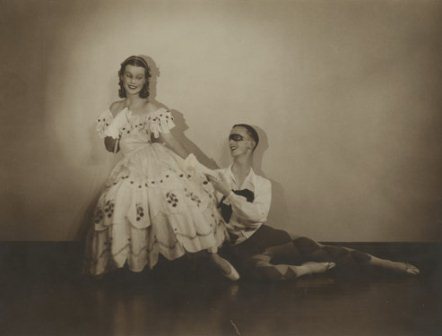
Moya Beaver and Gordon Hamilton in Le Carnaval, First Australian Ballet 1937. Photo Nikolai Ross. Courtesy National Library of Australia.

Listen to Moya Beaver’s oral history interview, recorded for the National Library in 1994.

  • International Auto/Biography Association (IABA)

In July I presented a paper, ‘The desire to conceal: two case studies’, at the 2012 IABA conference, Framing Lives.  In this paper I looked at the problems encountered in writing a biography when a subject expresses, either directly or indirectly, a desire to conceal certain aspects of his/her life and career.

  • Kathryn Bennetts

I also had the great pleasure in July of recording an oral history interview with Australian expatriate Kathryn Bennetts who recently resigned from a seven year term as artistic director of the Royal Ballet of Flanders in Antwerp. Bennetts was in Sydney briefly before returning to Europe to continue work as a much sought after teacher and as a stager of ballets, especially those of William Forsythe, for companies across the world.

  • The Oracle and Meryl Tankard

Also during July The Canberra Times published my article on Meryl Tankard’s 2009 work The Oracle, which I was inspired to write after hearing that negotiations were underway for The Oracle to tour in the United States

  • Ethan Stiefel

News came through this month too of Ethan Stiefel’s final performance on 7 July as a dancer with American Ballet Theatre. Here is a selection of online news:

Interview in TimeOut about his retirement
Article in The New York Times about his retirement
The New York Times review of the final show

I loved Roslyn Sulcas’ comments in the review: ‘His performance was daring, explosive. Pirouettes, jumps and whole phrases started at what seemed to be full power and then amazingly turned up a notch. Risk was palpable, and yet classical form was never distorted’.

After reading the reports I looked back to a letter I had written to a friend following Stiefel’s performance as Solor in La Bayadère with ABT in 2007 (with Diana Vishneva as Nikiya). I wrote: ‘Those double cabrioles in his Act I solo! So exciting to see, partly of course because he has such amazing legs in terms of strength and in terms of the long lean look they have. Then I was watching his manège of grands jetés in the same solo and was absolutely taken by the way he stretched out the front leg. You could see its trajectory carving or pushing a line in the space ahead of him.’

What a performance that was and, to my absolute surprise as I am not normally a fan of La Bayadère, I found myself sitting on the edge of my seat for the entire performance.

Steifel and his partner Gillian Murphy are now back in Wellington with the Royal New Zealand Ballet where a new production of Giselle by Stiefel, in collaboration with Johan Kobborg, is something to anticipate later this year.

Michelle Potter, 31 July 2012