Athol Willoughby (1932–2020)

Athol Willoughby, OAM, professional dancer, dance teacher, educator, examiner, adjudicator, board member and patron of Cecchetti Ballet Australia, has died in Melbourne at the age of 87.

Athol Willoughby was born and educated in Tasmania. His interest in dance began in Hobart when, with a friend, he would go to the movies every Friday night. It was the era of Hollywood musicals and he would watch outstanding male dancers, including Fred Astaire and Gene Kelly, both of whom he greatly admired. But it was not until the Borovansky Ballet toured to Hobart, when Willoughby was aged 14, that he was given an opportunity to take ballet classes with Hobart teacher, Beattie Jordan. He began formal ballet training in 1946.

An early dance portrait of Athol Willoughby, 1940s(?). Courtesy of Anne Butler
An early dance portrait of Athol Willoughby, 1950s (?). Courtesy of Anne Butler

Willoughby’s career began in earnest, however, when the Melbourne-based National Theatre Ballet visited Hobart. Willoughby took some classes with the company and, as a result, Leon Kellaway, the company ballet master, suggested he should move to Melbourne to take classes at the National Theatre Ballet School. In Melbourne, Willoughby was taught by esteemed Cecchetti teacher, Lucie Saronova, whose influence on his future was immense. Remembering Saronova’s classes Willoughby recalled:

I enjoyed Madam’s classes but they lasted exactly an hour and she packed a lot into a class. There was very little correction. It was doing the exercises that was supposed to get you there, not breaking the exercises down, as is the custom today. But a terrifying aspect of Madam’s classes was that she had been a fantastic turner. She always, at the end of every class, gave a series of diagonal turns. And it didn’t matter whether you were male or female you had to do these diagonal turns. Well I hadn’t been brought up to expect anything like this—perhaps a few chaînés, petits tours as Cechetti calls them, or posé turns—but not these complex diagonals. I used to hate it. I used to try to be the last one down the diagonal until I subsequently figured out that if you were first you had the least attention and you were out of the way and forgotten.

Later in the 1950s he gained his own qualifications as a Cecchetti teacher and began working across Melbourne, including for Dame Margaret Scott at her ballet school, which she set up in Toorak in 1955. But his performance career continued in Melbourne and he eventually joined the National Theatre Ballet and performed with them, dancing both the classics and the repertoire of two directors of the company, Walter Gore and Valrene Tweedie. Tweedie, also Cecchetti trained, remained a close colleague until her death in 2008.

Athol Willoughby and Valrene Tweedie in Tweedies’s production of Francesca da Rimini. National Theatre Ballet, 1955. Photo: Walter Stringer. Personal collection of Athol Willoughby

In 1958 Willoughby left for London where he took classes with Anna Northcote and Stanislas Idzikowski. He took on various theatrical and non-theatrical jobs before joining Peter Darrell’s Western Theatre Ballet. But an illness in the family necessitated a return to Australia in 1961. He danced in Tivoli shows during the 1960s, including in a pantomime production of Cinderella in which he played one of the Ugly Sisters. He also continued to teach, travelling across the city and into regional centres before buying the Essendon Academy of Ballet in 1962. He directed the Essendon Academy until 1997 and the students whose careers he nurtured over more than three decades have gone on to dance across the world. Some have become teachers and examiners. But all had their lives enriched by his continued service to dance, in particular to the Cecchetti approach to ballet. But his humility was such that he was able to say, ‘I was just there to try to teach them classical ballet correctly—I like to see it done correctly—and with discipline.’

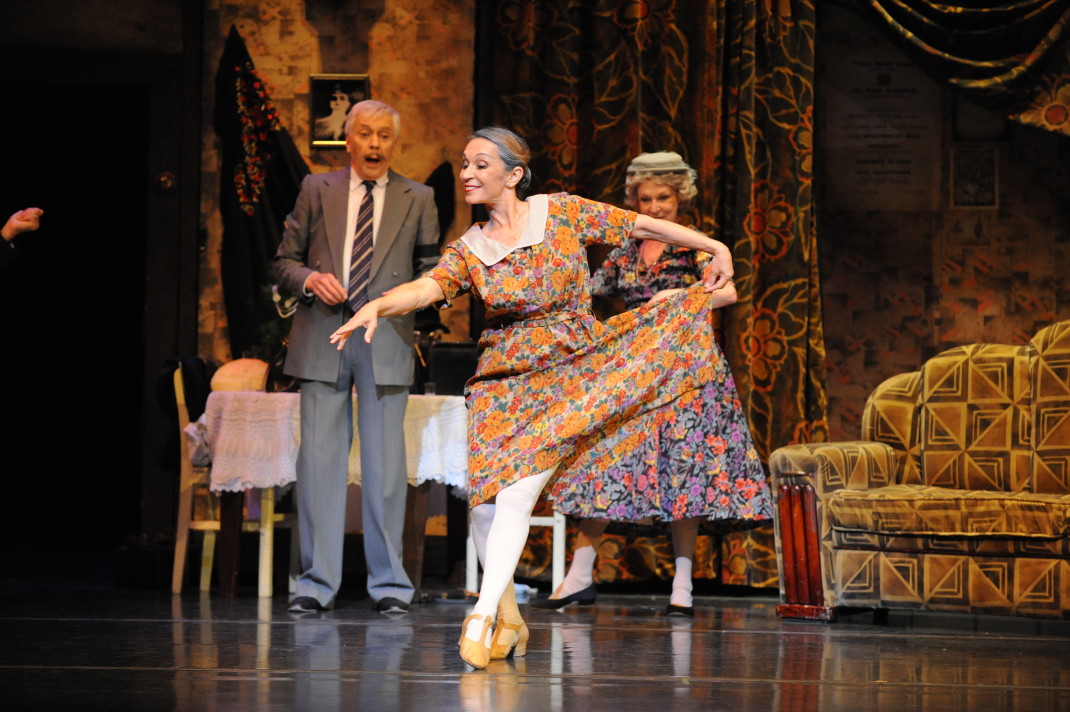
But before he retired from teaching he twice returned to the stage as a guest artist with the Australian Ballet: in Anne Woolliams’ 1990 revival of Swan Lake in which he took the role of the Hungarian Ambassador, and in Graeme Murphy’s Nutcracker. The Story of Clara in 1992 and 1994 where he played one of Clara the Elder’s émigré friends.

Willoughby once described himself as ‘a born collector of books and clothes and bits and pieces’. His home in Carlton North, which he shared with his partner James O’Donnell, was evidence of his collecting obsession, and of his interest in many forms of art. Both Willoughby and O’Donnell would often visit Canberra to take in the latest exhibition at the National Gallery, or National Library. I was fortunate enough to be able to have lunch with them on a number of those visits. Sharing a meal with them was always a very special occasion. Vale Athol.

Portrait of Athol Willoughby. Courtesy of Anne Butler

Athol Willoughby: born Campbell Town, Tasmania, 1 September 1932; died Melbourne, Victoria, 19 July 2020

Read more about Athol Willoughby at these links: Athol Willoughby. Lifetime Achievement Award 2018; Athol Willoughby. An oral history; Dance diary. March 2013 (on Walter Gore’s ballet The Crucifix—scroll down!).
Please note that Athol Willoughby’s oral history interview for the National Library is not at present available online. This reflects certain permissions that Willoughby placed on public use of the material. I hope the situation may be able to be changed. It is a wonderful interview, full of fascinating anecdotes as well as being a good outline of Willoughby’s career.

Michelle Potter, 21 July 2020

Featured image: Portrait of Athol Willoughby, 2018. Photo: © Michela Dent-Causon

Andrew Killian and Dimity Azoury in 'Aurum'. The Australian Ballet, 2019. Photo: © Daniel Boud

Dance diary. January 2020

Alice Topp’s Aurum

Aurum, choreographed by Alice Topp, a resident choreographer with the Australian Ballet, was first seen in Melbourne in 2018. It was followed by a 2019 season in Sydney, a scene from which is the featured image for this post. Also in 2019 it had a showing in New York at the Joyce Theater. In fact the Joyce was in part responsible for the creation of Aurum. Aurum was enabled with the support of a Rudolf Nureyev Prize for New Dance, awarded by the Joyce. Major funding came from the Rudolf Nureyev Dance Foundation. Aurum went on to win a Helpmann Award in 2019.

Now Topp will stage her work for Royal New Zealand Ballet as part of that company’s Venus Rising program opening in May 2020. She has recently been rehearsing the work in RNZB studios in Wellington.

Madeleine Graham and Allister Madin in rehearsal for Alice Topp's 'Aurum'. Royal New Zealand Ballet, 2020. Photo: © Jeremy Brick
Madeleine Graham and Allister Madin in rehearsal for Alice Topp’s Aurum. Royal New Zealand Ballet, 2020. Photo: © Jeremy Brick

I can still feel the excitement of seeing Aurum for the first time in 2018 when it was part of the Australian Ballet’s Verve program. My review from that season is at this link.

Dance Australia critics’ survey

Below are my choices in the annual Dance Australia critics’ survey. See the February/March 2020 issue of Dance Australia for the choices made by other critics across Australia. The survey is always interesting reading.

  • Highlight of the year
    West Side Story’s return to Australian stages looking as fabulous as it did back in the 1960s. A true dance musical in which choreographer Jerome Robbins tells the story brilliantly through dance and gesture.
  • Most significant dance event
    Sydney Dance Company’s 50th anniversary. Those who have led, and are leading the company—Suzanne Musitz, Jaap Flier, Graeme Murphy and Janet Vernon, and currently Rafael Bonachela—have given Australian audiences a varied contemporary repertoire with exposure to the work of some remarkable Australian choreographers and composers, as well as the work of some of the best contemporary artists from overseas.
  • Most interesting Australian independent group or artist
    Canberra’s Australian Dance Party, which has started to develop a strong presence and unique style and has given Canberra a much needed local, professional company. The 2019 production From the vault showed the company’s strong collaborative aesthetic with an exceptional live soundscape and lighting to add to the work’s appeal.
  • Most interesting Australian group or artist
    Bangarra Dance Theatre. Over thirty years the company has gone from strength to strength and can only be admired for the way in which Stephen Page and his associates tell Indigenous stories with such pride and passion.
Beau Dean Riley Smith (centre) as Bennelong, Bangarra Dance Theatre 2017. Photo: Vishal Pandey
Beau Dean Riley Smith (centre) as Bennelong in Bennelong, Bangarra Dance Theatre, 2017. Photo: © Vishal Pandey
  • Most outstanding choreography
    Melanie Lane’s thrilling but somewhat eccentric WOOF as restaged by Sydney Dance Company. It was relentless in its exploration of group behaviour and reminded me a little of a modern day Rite of Spring
Scene from Melanie Lane's 'WOOF'. Sydney Dance Company, 2019. Photo: © Pedro Greig
Scene from Melanie Lane’s WOOF. Sydney Dance Company, 2019. Photo: © Pedro Greig
  • Best new work
    Dangerous Liaisons by Liam Scarlett for Queensland Ballet. Scarlett has an innate ability to compress detail without losing the basic elements of the narrative and to capture mood and character through movement. It was beautifully performed by Queensland Ballet and demonstrated excellence in its collaborative elements.
  • Most outstanding dancer(s)
    Kohei Iwamato from Queensland Ballet especially for his dancing in Dangerous Liaisons as Azolan, valet to the Vicomte de Valmont. His dancing was light, fluid, and technically exact and he made every nuance of Scarlett’s choreography clearly visible

    Tyrel Dulvarie in Bangarra’s revival of Unaipon in which he danced the role of David Unaipon. His presence on stage was imposing throughout and his technical ability shone, especially in the section where he danced as Tolkami (the West Wind).
  • Dancer(s) to watch
    Ryan Stone, dancer with Alison Plevey’s Canberra-based Australian Dance Party (ADP). His performance in ADP’s From the vault was exceptional for its fluidity and use of space and gained him a Dance Award from the Canberra Critics’ Circle.

    Yuumi Yamada of the Australian Ballet whose dancing in Stephen Baynes Constant Variants and as the Daughter in Stanton Welch’s Sylvia showed her as an enticing dancer with much to offer as she develops further.
  • Boos!
    The Australian Government’s apparent disinterest in the arts and in the country’s collecting institutions. The removal of funding for Ausdance National, for example, resulted in the cancellation of the Australian Dance Awards, while the efficiency dividend placed on collecting institutions, which has been in place for years now, means that items that tell of our dance history lie unprocessed and uncatalogued, and hence are unusable by the public for years.
  • Standing ovation
    I’m standing up and cheering for the incredible variety of dance that goes on beyond our major ballet and contemporary companies. Youth dance, community dance, dance for well-being, dance for older people, and more. It is indicative of the power that dance has to develop creativity, health and welfare, and a whole range of social issues.
Scene from Eye to Eye in On course. QL2 Dance, 2019. Photo: © Andrew Sikorski/Art Atelier

New oral history recordings

In January I had the pleasure of recording two new oral history interviews for the National Library of Australia’s oral history program. The first was with Chrissa Keramidas, former dancer with the Australian Ballet, American Ballet Theatre and Sydney Dance Company. Keramidas recently returned as a guest artist in the Australian Ballet’s recent revival of Nutcracker. The story of Clara. The second was with Emeritus Professor Susan Street, AO, dance educator over many years including with Queensland University of Technology and the Hong Kong Academy of Performing Arts.

News from James Batchelor

James Batchelor’s Redshift, originally commissioned by Chunky Move in 2017, will have another showing in Paris in February as part of the Artdanthé Festival. Redshift is another work emerging from Batchelor’s research following his taking part in an expedition to Heard and McDonald Islands in the sub-Antarctic in 2016. Artdanthé takes place at the Théâtre de Vanves and Batchelor’s works have been shown there on previous occasions.

Study for Redshift. Photo: © Morgan Hickinbotham

Batchelor is also about to start work on a new piece, Cosmic Ballroom, which will premiere in December 2020 at another international festival, December Dance, in Bruges, Belgium. Below are some of Batchelor’s thoughts about this new work.

Set in a 19th Century Ballroom in Belgium, Cosmic Ballroom will playfully reimagine social dances and the aesthetic relationship they have to the space and time they exist within. We will work with movement as a plastic and expressive language that is formed through social encounters: the passing of thoughts, feelings and uncertainties from body to body. It will ponder the public and private and the personal and interpersonal as tonal zones that radiate and contaminate. How might movement be like a virus in this context? How might space-times be playfully spilling across and infecting one another from the baroque ballroom to the post-industrial club space?

Batchelor will collaborate with an team of Australian, Italian and UK artists on this work.

Liam Scarlett

Not such good news

Michelle Potter, 31 January 2020

Featured image: Andrew Killian and Dimity Azoury in Aurum. The Australian Ballet, 2019. Photo: © Daniel Boud

Andrew Killian and Dimity Azoury in 'Aurum'. The Australian Ballet, 2019. Photo: © Daniel Boud
Lucy Green as Cecile and Alexander Idaszak as Valmont in 'Dangerous Liaisons'. Queensland Ballet, 2019. Photo David Kelly

Dance diary. December 2019

  • The best of …

At this time of the year ‘the best of …’ is a common feature of many print and online sources. My thoughts on the dance highlights of the year will appear in the February/March issue of Dance Australia. But I can’t help commenting here on one or two particular highlights. For me, Liam Scarlett’s Dangerous Liaisons, created for Queensland Ballet, stands at the top of my list of best production for 2019.

What impresses me about Scarlett’s work in general is his ability to compress complex stories into clear narratives that never lose the major thread of the storyline, but are never so complicated that we get lost. This was especially noticeable in Dangerous Liaisons. It was a work in which quite a lot of subplots were evident, and in which there were many characters involved in many clandestine activities. Scarlett managed, however, to leave us in no doubt as to what was happening. He also seems to have a real knack of collaborating with the other creatives who have input into his work. Again, this was evident in Dangerous Liaisons, which had a great arrangement of music, stunning costumes and evocative lighting. Read (or reread) the review at this link.

My Dance Australia contribution also mentioned Yuumi Yamada but I had not seen her perform as Clara in Peter Wright’s Nutcracker until after my Dance Australia deadline had passed. So I need to document here that I thought she was a standout as Clara, as well as in other works throughout 2019.

Yuumi Yamada_and dancers of the Australian Ballet in 'The Nutcracker', 2019. Photo: © Daniel Boud
Yuumi Yamada and dancers of the Australian Ballet in The Nutcracker, 2019. Photo: © Daniel Boud

  • The Kristian Fredrikson project

As a very special end to 2019 (for me anyway), I signed a contract with Melbourne Books who will begin editing of my book on the life and career of Kristian Fredrikson in February with publication scheduled, at this stage, for August. Things Fredrikson have been occupying my life since 2011 and the book has been researched across Australia; in Wellington, New Zealand; in the United States, in New York and Houston; in London; and in La Mirande en Ardèche in the French Alps, where choreographer Gray Veredon lives. Below is one of the many striking images that will appear in the book.

Study for Captain Hook in Russell Kerr's 'Peter Pan', 1999. © 1998 Kristian Fredrikson
Study for Captain Hook in Russell Kerr’s Peter Pan. Royal New Zealand Ballet 1999. © 1998 Kristian Fredrikson. This version of Peter Pan was also staged by West Australian Ballet in 2013. There have been various revivals

  • John O’Brien (1933–2019)

After posting my obituary for Barry Kitcher last month, I was contacted by a reader who brought to my attention another death in the dance world—that of former Rambert dancer and much admired teacher, the Australian-born John O’Brien. Much of O’Brien’s life was spent in England and I never saw him dance. Apart from his many performing and teaching accomplishments, O’Brien founded the bookshop, which I knew as Dance Books, in Cecil Court in central London. How many hours did I spend ferreting around in its second hand department! And how sad that it had to close. But now I know that it was founded by O’Brien.

  • Happy New year 2020

All best wishes to all those who read my posts, and especially to those who contribute in one way or another. It also continues to thrill me that we in Australia (and elsewhere) benefit from dance news from New Zealand with some great posts from Jennifer Shennan. So my particular thanks to her for her contributions and the manner in which they expand our understanding of dance and its context.

And here’s to a great year of dance in 2020.

Michelle Potter, 31 December 2019

Featured image: Lucy Green as Cécile and Alexander Idaszak as Valmont in Dangerous Liaisons. Queensland Ballet, 2019. Photo: © David Kelly

Lucy Green as Cecile and Alexander Idaszak as Valmont in 'Dangerous Liaisons'. Queensland Ballet, 2019. Photo David Kelly
Ako Kondo and Chengwu Guo in 'The Nutcracker'. The Australian Ballet, 2019. Photo: © Daniel Boud

The Nutcracker. The Australian Ballet (2019)

14 December 2019 (matinee). Joan Sutherland Theatre, Sydney Opera House

This staging of Sir Peter Wright’s Nutcracker was a beautiful and magical end to the Australian Ballet’s 2019 season. I have written before about Sir Peter’s take on this much-loved Christmas ballet, in both its onstage and film productions, and the features I enjoyed on those other occasions—such as its moments of stage magic, and the inherent logic within the narrative structure—were apparent again. The experience was especially enjoyable on this occasion as I had the good fortune to see an outstanding cast of lead characters.

As Clara, Yuumi Yamada just took my breath away. From her very first entrance her delightful and youthful personality, so perfect for this role, were apparent. She acted and danced her way through the show in spectacular fashion— and there were few moments when she wasn’t onstage. Particular dancing highlights were her pas de deux with Marcus Morelli in the Christmas party scenes and another pas de deux with the Nutcracker-turned-Prince (François-Eloi Lavignac) just before the snow scene began.

Yuumi Yamada as Clara in The Nutcracker. The Australian Ballet, 2019. Photo: © Daniel Boud

It was particularly pleasing too to see Chengwu Guo back on stage after an absence due to injury. The Act II pas de deux between Guo as the Nutcracker Prince and Ako Kondo as the Sugar Plum Fairy demonstrated what we, the audience, had been missing. His elevation; his soft, controlled landings; his multiple pirouettes (including those grands pirouettes à la seconde; and his spectacular entrechats were nothing short of thrillling. And I am always impressed by the way in which, as an intrinsic part of his performance, he treats his partner with such respect. All I can say is welcome back! Kondo performed beautifully too. I admired her absolute control, to the extent that we could see every movement unfold. It was as if she were dancing in slow motion.

The very young boy, Gabriel Bennett, who danced as Fritz also deserves a mention. His presence onstage and his acting made his performance a winning one. In fact all the young student extras, male and female, who danced as friends of Clara held their own throughout the opening party scene.

Andrew Killian as Drosselmeyer made an important contribution to the success of the performance, and the soloists and corps de ballet danced well throughout. I especially enjoyed the dancing of the four men who danced as the Winds in the snow scene, and who returned again (with one replacement) as Consorts to the Rose Fairy in the Waltz of the Flowers section.

Dancers of the Australian Ballet in 'Nutcracker', 2019. Photo: © Daniel Boud
Dancers of the Australian Ballet in Nutcracker, 2019. Photo: © Daniel Boud

I am not a huge fan of John McFarlane’s designs for this Nutcracker. They often seem ‘loud’ to me and they simply don’t fit well on the Sydney Opera House stage. Nor does that frustratingly small stage lend itself well to the Christmas party that opens this Nutcracker. Too many people have to crowd onto it, which rather ruins the party. It’s an ongoing saga.

But nothing can really take away from the magical and enchanting performance that we were offered and accepted with loud applause.

Michelle Potter, 16 December 2019

Featured image: Ako Kondo and Chengwu Guo in The Nutcracker. The Australian Ballet, 2019. Photo: © Daniel Boud

Ako Kondo and Chengwu Guo in 'The Nutcracker'. The Australian Ballet, 2019. Photo: © Daniel Boud

Please consider supporting my Australian Cultural Fund project to help Melbourne Books publish Kristian Fredrikson. Designer in a high quality format. Donations are tax deductible. See this link to the project, which closes on 31 December 2019.

Dimity Azoury, 2019. Photo: © Georges Antoni

Dimity Azoury & Benedicte Bemet. The Australian Ballet

The Australian Ballet has just announced the promotion of Dimity Azoury and Benedicte Bemet to principal artists with the company.

Azoury has particular connections to Canberra and the surrounding region region having begun her training in Queanbeyan and then at the Kim Harvey School of Dance in Canberra. Her background is described in the Australian Ballet’s media release.

Dimity began dancing at the age of four in her home town of Queanbeyan, New South Wales. She studied at the Kim Harvey School of Dance in Canberra for 11 years before moving to The Australian Ballet School in 2005. Dimity joined The Australian Ballet in 2008 and has worked with acclaimed choreographers throughout her career, including Nicolo Fonte, Graeme Murphy, Tim Harbour, Stephen Page and Stephen Baynes. Dimity was promoted to soloist in 2015 following her debut as Baroness von Rothbart in Graeme Murphy’s Swan Lake, and to senior artist in 2017.

But Azoury was also the winner of the Telstra Ballet Dancer Award in 2014 and at that point I spoke to her about her career. Looking back at that interview I am moved by what she said, which you can read at this link. See also the tag Dimity Azoury. The featured image shows her in a study for the Australian Ballet’s 2020 season, while the image below shows her, looking rather different wearing a spectacular wig, in Graeme Murphy’s The Silver Rose part of the Australian Ballet’s 2018 program, Murphy.

Dimity Azoury and Ty-King Wall in Graeme Murphy's 'The Silver Rose'. The Australian Ballet. Photo: © Jeff Busby
Dimity Azoury and Ty-King Wall in Graeme Murphy’s The Silver Rose, 2018. The Australian Ballet. Photo: © Jeff Busby

Benedicte Bemet has been an outstanding member of the company ever since she joined in 2012. Her background is described in the Australian Ballet’s media release.

Mackay-born Benedicte started ballet at the age of three, eventually moving to the Gold Coast where she trained at the Ransley Ballet Centre. When she was 10 her family relocated to Hong Kong where she continued her ballet training at the Jean M. Wong School of Ballet; she was subsequently accepted into The Australian Ballet School at age 14. In 2012, Benedicte joined The Australian Ballet’s corps de ballet and one year later was promoted to coryphée. In 2016 she was promoted to soloist and became a senior artist in 2018.

I especially enjoyed her performance as the Fairy of Musicality in David McAllister’s production of The Sleeping Beauty when I think her very individualistic style perfectly captured the essence of that role. I wrote, Benedicte Bemet as the Fairy of Musicality gave a distinctive interpretation to this role and brought a gorgeously lively quality to her exceptional technical capacity. She also made an impression on me in Sir Peter Wright’s Nutcracker and appears as Clara in the DVD production of that ballet.

Benedicte Bemet and artists of the Australian Ballet in 'The Nutcracker', 2014. Photo Jeff Busby
Benedicte Bemet and artists of the Australian Ballet in The Nutcracker. The Australian Ballet, 2014. Photo: © Jeff Busby

Bemet was also the winner of the Telstra Ballet Dancer Award, which she received in 2015. For further comments from this website see the tag Benedicte Bemet.

Congratulations to them both.

Michelle Potter, 17 November 2019

Featured image: Dimity Azoury in a study for the Australian Ballet’s 2020 season. Photo: © 2019 Georges Antoni

Dimity Azoury, 2019. Photo: © Georges Antoni

Memorial for Dame Margaret Scott

15 March 2019. State Theatre, Victorian Arts Centre, Melbourne

Dame Margaret Scott was farewelled with style and grace, and more than a little bit of emotion, in a memorial event arranged by the Australian Ballet and the Australian Ballet School and presented in Melbourne on 15 March 2019.

It began with an initial surprise as we entered the auditorium of the State Theatre. I wondered why we were asked to enter through the door at the back of the auditoriun. Well, it was so that we would properly enjoy the guard of honour made by two rows of young dancers from the Australian Ballet School, the girls dressed in simple white tutus and the boys in black tights and white shirts. They were lined up on each side of the auditorium stretching pretty much from the last row of the stalls down to the stage. On the stage a giant screen had been lowered and we saw an image of a smiling Maggie, full of the joy of life. And standing in the middle of a row close to the front was Maggie’s husband, Professor Derek Denton, watching as we entered.

Following an introduction from Steven Heathcote and an opening tribute from Maggie’s younger son, Angus Denton, reminiscences were given by several of Maggie’s former students and colleagues including Colin Peasley, David McAllister, Graeme Murphy, Marilyn Rowe and Lisa Pavane. Those who auditioned for her as young and hopeful dancers all admitted to being in awe of Maggie at first, but all continued to say how much they had grown to love and respect her.

Interspersed among the spoken tributes were three short performances. The first was Embrace, created by Paulina Quinteros, which was accompanied on the printed program by the phrase ‘For Dick, Matthew and Angus’, to which was added the words ‘Lucky are those who have experienced the sweetness of loving’. It was danced by Chloe Reynolds and Daniel Savetta (with Steven Heathcote playing a small role). Embrace was followed by the Act II pas de deux from Nutcracker. The Story of Clara, danced by Benedicte Bemet and Jarryd Madden. Level 8 students of the Australian Ballet School gave the third performance, a movement from Stephen Baynes’ Ballo Barocco.

But the most moving moments were left till last when a series of images of Maggie, covering the gamut of her life and career, were flashed across the screen.

The end seemed to have been reached when Jim McFarlane’s iconic image from Nutcracker (above left) appeared and all went dark. But no, Earl Carter’s equally iconic Nutcracker image appeared of Maggie rejoicing in the pleasures she experienced in Act I of Nutcracker (above right). Then, from each side of the stage a procession of students, former dancers and others entered and, in single file, moved to the centre of the stage where each placed a single white rose on the floor in front of Maggie’s image before making a slow exit. A beautiful tribute to an exceptional woman.

A State Memorial for Dame Margaret will be held on 22 March at the National Gallery of Victoria International commencing at 10:00 am. My obituary for her is at this link.

Michelle Potter, 17 March 2019

Featured image: Maggie Scott in Gala Performance (detail with text added). From the Ballet Rambert souvenir program for its 1947–1949 Australian tour

Mao’s Last Dancer. The Exhibition

Immigration Museum, Melbourne, until 8 October 2018

The story of Li Cunxin, current artistic director of Queensland Ballet, and his journey from China to the West, is well-known from Li’s autobiography Mao’s Last Dancer, published in 2003. But the Immigration Museum’s exhibition, subtitled ‘A Portrait of Li Cunxin’ also seen last year in Brisbane, adds very nicely to that story. In one exhibition case, for example, there is a handwritten document that is a draft of Mao’s Last Dancer. The ‘devices’ we use these days for drafting material for publication clearly were not as ubiquitous then as they are now.

But there are some very personal items in this exhibition and many are quite moving. In particular, there is a short film, around 8 minutes of footage, in which Li’s parents are interviewed about their son. They give their side of the story (in their language but translated with subtitles) including their thoughts on seeing Li performing in Nutcracker with Houston Ballet when they were first permitted to visit him. ‘But didn’t you get dizzy?’ his mother says talking about Li’s astonishing capacity for performing multiple (and I mean multiple) pirouettes. Three tiny folding stools are another memento from Li’s days in China. They were made by Li’s father for his family of nine to use around the small table at which they ate. It conjured up some quite lovely images of a family that seemed so closely knit in its poverty

There are also some beautiful photos of Li and his fellow artists, mainly from his days at Houston Ballet where he was mentored by artistic director Ben Stevenson. And another filmed segment gives us an insight into Stevenson’s thoughts on Li’s story.

Mary McKendry and Li Cunxin in the pas de deux from La Esmeralda. Houston Ballet, 1980s. Photographer not identified

But perhaps the section I enjoyed most was a compilation of footage from Li’s performances, again largely from Houston. While most of the footage was showing its age and was grainy and cloudy at times, what emerged was Li’s beautifully articulated movement and the wide range of choreography he performed. My favourite was a tiny section—no more than a few seconds— from the solo from Le Corsaire. It made me realise how lucky we were in Australia to have had Li performing with the Australian Ballet in the 1990s. Those were also the days when writers like me were welcomed into the classroom (with undying thanks to Maina Gielgud) and I recall Li staying on after class was officially finished and practising manège after manège of spectacular movement.

Portrait of Li Cunxin in Brisbane. Photo: © Eduardo Vieira

Everyone who visits this show will have his or her favourite items. Do go and have a look. It’s well worth a visit.

Michelle Potter, 31 August 2018

Jocelyn Vollmar in the Borovansky production of 'Symphonie fantastique', 1955. Photo: Walter Stringer

Jocelyn Vollmar (1925–2018)

American ballerina Jocelyn Vollmar has died in San Francisco at the age of 92. Born in San Francisco, Vollmar began her dance training aged 12 at San Francisco Ballet School under William Christensen and Gisella Caccialanza. As a student she danced in the first American Coppélia and the first American full-length Swan Lake in 1940. She joined San Francisco Ballet in 1943 and her roles in the following years included the Snow Queen in Nutcracker in 1944, and Myrthe in Giselle in 1947 with guests Alicia Markova and Anton Dolin. In the late 1940s she danced as a principal with New York City Ballet and Ballet Theatre and studied further in Paris with Lubov Egorova and Olga Preobrajenska. She also danced with the Grand Ballet du Marquis de Cuevas in the early 1950s.

Vollmar was invited by Edouard Borovansky to come to Australia as ballerina with his Borovansky Ballet for his season beginning in 1954. Her first role with the Borovansky company was the Street Dancer in Le beau Danube where critics praised her ‘talent for mime’ and her ‘spirited dancing.’ Over the course of a two year term with the Borovansky Ballet, Vollmar  danced leading roles in all the company’s productions including the classics such as GiselleLes SylphidesNutcracker in a new production by David Lichine, and Swan Lake Act II, and in the Borovansky Ballet’s stagings of the Ballets Russes repertoire including PetrouchkaLes Presages: Fifth SymphonyLa Boutique fantasqueScheherazade and Le beau Danube. Her partners with the Borovansky Ballet included Vassilie Trunoff and Royes Fernandez and fellow principal dancer, Peggy Sager, spoke of the great versatility she brought to the company during her brief time with them.

Vollmar returned to San Francisco when the Borovansky Ballet went into recess in 1956 and, although invited to return to Australia for the next Borovansky season, she decided to stay in her home city. She danced with San Francisco Ballet until 1972. On retirement from performing Vollmar took up teaching and when Helgi Tomasson took over San Francisco Ballet in 1985 he invited her to teach in the company school, where she taught and coached upper division classes until 2005.

Jocelyn Vollmar. Born San Francisco 25 November 1925; died San Francisco 13 July 2018.

Michelle Potter, 8 August 2018

Featured image: Jocelyn Vollmar in the Borovansky production of Symphonie fantastique, 1955. Photo: Walter Stringer

Artists of Finnish National Ballet in 'Giselle', 1998. Photo: © Kari Hakli

Globalisation or culturalism. Is ballet at the crossroads?

In December 2002 I wrote an article, at the request of Bruce Marriott, for ballet.co magazine (now no longer available) to coincide, if I remember correctly, with a conference of artistic directors held in the United Kingdom somewhere (perhaps London?). I think the commission came because David McAllister, then quite new in the role of artistic director of the Australian Ballet, was attending. As with many of my other articles and reviews for ballet.co, I thought it had disappeared from my computer files and I had not made a print out. But just recently it appeared when I was searching with the term ‘Nutcracker’ for another thought-to-be lost file. So I am posting it here and welcome comments from a 2018 perspective.

As artistic directors of some of the world’s best-known ballet companies meet to discuss the issue of globalisation, I am reminded of a now well-known debate that emerged in Australia in the 1960s and the 1970s. It concerned the nature of the country’s cultural development. Two camps sprang up: one centred on the idea of the tyranny of distance, the other on the notion that from the deserts the prophets come. Those who spoke for the tyranny of distance believed that Australia was a cultural desert isolated from the great centres of civilisation, especially from the so-called mother country of Great Britain. Those on the other side believed that Australians did not need to rely on their colonists for what they required to nourish their souls—in the midst of their isolation they could have their own uniquely beautiful culture that could define them, equally uniquely, as Australian. This group took as a catch cry some lines from a poem written by renowned Australian poet A. D. Hope in 1960:

Hoping, if still from the deserts the prophets come
Such savage and scarlet as no green hills dare
Springs in that waste.

The debate is historically interesting, and the discussion generated two of the best-known period books on Australian culture and identity: Geoffrey Blainey’s The Tyranny of Distance and Geoffrey Serle’s From the Deserts the Prophets Come (later, in an attempt to popularise, or globalise perhaps, the Serle book was renamed The Creative Spirit in Australia).

Advances in technology of various kinds have, of course, made the idea of the tyranny of distance pretty much an obsolete concept. Globalisation, however, is clearly with us: it is  part of the fabric of our contemporary existence. It has permeated every aspect of the way we live and operate in the twenty-first century. And while many of the inhabitants of the northern hemisphere may still think of Australia as out of scope, few Australians (thankfully) now believe that distance hampers their ability to interact with the rest of the world. So where does this leave the individualism that we rightly prize so highly? What do we do with the savage and scarlet that has so flamboyantly grown? Or even with the green hills if we are on the other side of the world? Do we sit back and allow globalisation to turn what is unique about our individual dance cultures into something bland and universal? Or do we embrace culturalism, accepting that, while communications may have changed the way we operate in the world, our individual cultures cannot develop in a similar way? Do we sit in our theatres from London to Sydney, from New York to Melbourne, all seeing the same works: a Giselle respectfully produced, Manon, a couple of items from Balanchine, The Merry Widow and so on.  Or do we each go for something culturally specific (a Murphy Nutcracker, an Ashton work from the early repertoire), and for individualistic reworkings of the tried and true (a Guillem Giselle, a Murphy Swan Lake)? Is one way the only way? The right way? The wrong way?

Artists of the Australian Ballet in Graeme Murphy's 'Swan Lake'. Photo Jeff Busby
Artists of the Australian Ballet in Graeme Murphy’s Swan Lake. Photo: © Jeff Busby

Neither bowing to globalisation nor strictly adhering to culturalism is the answer. Culturalism smacks of attitudes of superiority and cultural elitism—my culture is better than yours. It closes the mind to innovation and change. It indulges in smugness and name calling (the vile expression ‘Eurotrash’, beloved by one particular British critic, springs immediately to mind). It is a stultifying attitude. On the other hand, globalisation removes what we value about ourselves as individuals in unique cultures, what our specific histories have created and asked us to cherish. But defiantly, ballet is perfectly able to accommodate itself within a global society without losing anything. Ballet isn’t dying. It isn’t even at the crossroads as it encounters globalisation. Ballet is like a sponge. It can soak up change: it has been doing so for centuries. It can absorb new vocabulary. It can keep renewing itself from what it absorbs. It has to be able to operate in this way because it is a living, breathing art form. Even the most superficial glance at photographs of acclaimed dancers in the same role taken over several decades, in Giselle for example, makes it very clear that while we may want Giselle to stay the same—the past is very comforting—it can’t and hasn’t and won’t. In fifty years time dancers won’t want to dance Giselle like Alina Cojocaru (hard as that idea may be to comprehend at the moment).

In the twenty-first century the ballet-going public is entitled to green hills sprinkled liberally with some savage and scarlet (and I mean this more widely, more figuratively, than simply British works sprinkled with Australian ones). Dancers are, for their growth as artists, entitled to experience the work of choreographers outside their immediate, culturally-specific environment. Choreographers are entitled to wonder (and experience) how their works might look when danced by dancers trained outside the choreographer’s home country: the great ones do (and have) and are open and generous about the experience, as any dancer from the Australian Ballet who has worked with Jiří Kylián on any work from the Australian Ballet’s Kylián repertoire will tell you. Critics need to open-minded enough to embrace change and innovation while caring about the past. And artistic directors need to understand it all! The artistic director of a truly great company needs courage, intelligence and drive. Courage not to be swayed from his or her vision. Intelligence to have a vision that looks both forward and in a lateral direction and, going hand-in-hand, intelligence to understand that looking in this manner and direction is not a denial of the past. Drive to put the vision into practice.

Globalisation is a much-maligned concept. It doesn’t have to exclude anything really. But to react to globalisation uncritically, and to allow it to dictate to us is the problem. To do this is to lack courage, intelligence and drive. That we can see new works and restagings of old ones from London to Sydney, New York to Melbourne is a gift of globalisation. If we wish to deny that gift by insisting on culturalism it is a measure of an inability to exist in a global culture, in today’s culture, and a pitifully conservative attitude. But one thing is certain, whatever the response of individual people ballet will keep moving forward. It will never fall victim to a narrow culturalism. Only people will do that. Let’s hope that the new breed of artistic directors understands.

Michelle Potter, December 2002, reposted 14 June 2018

Featured image: Artists of Finnish National Ballet in Sylvie Guillem’s Giselle, 1998. Photo: © Kari Hakli

Artists of Finnish National Ballet in 'Giselle', 1998. Photo: © Kari Hakli

More thoughts on Nutcracker: The Story of Clara

I have to admit to disliking intensely the dumbing down of Graeme Murphy’s Nutcracker: The story of Clara with the ridiculous description of it as ‘The Gum-Nutcracker.’ The work might have strong Australian resonances, but it is much more than a story about early developments in Australian ballet. The so-called ‘affectionate dubbing’ of it with reference to the fruit of the eucalyptus tree makes the work sound pathetic. Below are a few published comments that suggest that we should grow up and resist the temptation to trivialise.

Speaking of the slight nature of, and problematic issues surrounding the more traditional productions of Nutcracker (going right back to 1892), Professor Rodney Stenning Edgecombe writes:

‘When foundations are sandy, it’s better to re-lay them in concrete. And that is indeed what the brilliant Graeme Murphy has done in his version of the ballet, which, having subtitled The Story of Clara, he conceives it, as Bournonville did his ballets, as ‘frames around the biographical and travel pictures which constitute [an] actual theatre life’.

He then proceeds to analyse the ballet, its story, its choreography, its music, and its place within the history of ballet (not necessarily Australian ballet), in the most erudite terms, making reference to, and using quotations from some of the great names of world scholarship—August Bournonville, T. S. Eliot, E. M. Forster, Marcel Proust, William Shakespeare, Percy Bysshe Shelley, Patrick White, and others. Speaking about the Snowflakes scene, for example, he writes:

‘The snowflakes’ wild pirouettes with upflung arms … show how inventively Murphy can work within restrictive confines of the danse d’école. Indeed one can’t help thinking that the writing for this ensemble is deliberately transitional, Petipa Duncanised as it were. And because ‘Petipa Duncanised’ is all but a synonym for ‘Fokine’—at least the Fokine of Les Sylphides—this episode illustrates the transformation that the very art of ballet witnessed during Clara’s childhood.’

What thrills me is that Edgecombe treats the work as an artistic creation of the highest order, one that deserves to be interpreted within the widest cultural context, not as some Snugglepot and Cuddlepie story (with apologies to May Gibbs). In his final paragraph, after discussing some issues he has with Marius Petipa’s work, and a similar issue he sees relating to the way Murphy has used a section of the music, Edgecombe says:

‘And what one allows to Petipa, one must allow to Murphy, a choreographer, in my opinion, of entirely comparable genius.’1

Dame Margaret Scott, Vicki Attard and David McAllister in Graeme Murphy's 'Nutcracker'. The Australian Ballet 1994. Photographer not identified
Dame Margaret Scott, Vicki Attard and David McAllister in Graeme Murphy’s Nutcracker. The Australian Ballet 1994. Photographer not identified

I am aware that not everyone will relate to the way Edgecombe writes and analyses but, like Edgecombe, Dame Margaret Scott, who danced Clara the Elder in 1992, 1994 and 2000, also speaks of the slight nature of traditional productions and recognises the extent to which Murphy’s ballet recontextualises the traditional work into something with more narrative and choreographic depth. In an interview in 2000, in which she replies to a question about why some found the Murphy production hard to accept, Dame Margaret says:

‘In the crits in the 1892 production, there was one critic who said, ‘It’s a pity that [such] fine music is expended on nonsense unworthy of attention.’ And in the 1992 production here, one of the crits said: ‘One of the great achievements of this production is that Tchaikovsky’s music sounds as if it was written to a brief from Murphy.

And then it goes on about the ballet itself. In 1892 the crit said, ‘Ballet is sliding downhill having lost its footing and moving away towards some kind of fragile and sugary Nutcracker.’ And then in Australia, ‘With Nutcracker the Australian Ballet came of age.’ I juxtaposed those two because it is relevant to the production.

I think if it had been called from the beginning, The Story of Clara, they would have accepted it. But it’s difficult to change the traditionalists. They still want the tutu ballet. And I mean, people don’t realise that the history of Nutcracker itself is a very chequered one. It only came into this popularity when the pantomimes died and it took the place of pantomimes because of its Christmas story. It became the cash cow, the Christmas entertainment. So to say it is popular because of a great love [is wrong] because a lot of people find it very dissatisfying.’2

It is common knowledge that Murphy was at first hesitant to accept the commission from Maina Gielgud to create a new Nutcracker. In an interview in 1996 he says:

‘Maina Gielgud had asked me years ago to think about doing a Nutcracker and I’d rejected the idea on the basis that the story was silly, the piece was clichéd, and I’d never really seen one I liked.’

But, thankfully, he eventually did accept the commission. He explains:

‘The clinch for me was the music, which I adore. So Kristian [Fredrikson] came over and we played the tape and I think somewhere in the course of that listening I was going ‘I can’t do a Nutcracker set in a postcard snowland, white Christmases and all that stuff. It doesn’t really mean anything. Maybe if you could do a Nutcracker set in arid Melbourne suburbia …’ And that was really the beginning of it.’3

What we have with Murphy’s visionary production should be regarded, especially by those who write media notes, as a ballet of international reach. Save gumnuts for other less sophisticated things. But if some see a need to dumb down the work with a crazy name (in order to attract more people and bring in more money?) then perhaps they should rename the Australian Ballet the Ocker Ballet?

Michelle Potter, 17 June 2017

References

  1. All quotes from Professor Edgecombe are from Rodney Stenning Edgecombe, ‘Graeme Murphy’s Nutcracker.’ Brolga, 17 (December 2002), pp. 23–32.
  2. Lee Christofis, ‘Coming of age. Retrieving history with Dame Margaret Scott and Valrene Tweedie OAM.’ Brolga, 13 (December 2000), pp. 44–58.
  3. All quotes from Murphy are from ‘Graeme Murphy. Humanity revealed’ in Michelle Potter, A passion for dance (Canberra: National Library of Australia, 1997), pp. 61–77.

See also the text of a program article I wrote for the Australian Ballet’s 2009 season of Nutcracker. The story of Clara. As a concluding remark I wrote, ‘This is a Nutcracker to be loved and cherished. Its Australian connections are heart warming and a source of pride and pleasure. But the dramatic text is universal.‘ Here is the link.

Featured image: Chrissa Keramidas as Clara the Elder in Nutcracker: The story of Clara. The Australian Ballet, 2017. Photo: © Jeff Busby

Chrissa Keramidas as Clara the Elder in 'Nutcracker. The story of Clara.' The Australian Ballet, 2017. Photo: © Jeff Busby