It is always a pleasure speaking to Paul Knobloch about future directions in his career. As I mentioned in my December dance diary Paul has just moved to San Francisco to take up a contract with Alonzo King LINES Ballet. Recently The Canberra Times published a longer story about this latest move under the heading ‘Moving on’. Here is a link to the article.
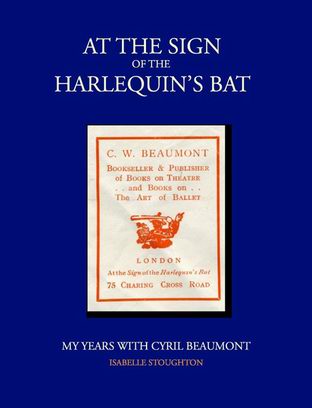
Last June I received a query about a particular photo of Olga Spessivtseva. An exchange of emails resulted and it transpired that the enquirer was the son of Isabelle Stoughton, whose recollections of working for publisher and writer Cyril Beaumont were published by Dance Books late in 2011 under the title At the Sign of the Harlequin’s Bat: My Years with Cyril Beaumont. I don’t think we really resolved the issue of the photo but the correspondence gave reading the book an added interest.
What is immediately attractive about this book is that it doesn’t pretend to be something that it’s not. It is simply a book of recollections randomly gathered together. It is written in quite a lively manner and it is easy to keep reading from beginning to end (and it’s not a long read), and easy to imagine or visualise the situations described. Having said that I have to add that it is a little uncritical, which is a bit annoying occasionally, but then that’s part of it not pretending to be something that it’s not. Isabelle Stoughton was fond of her employer and proud of his knowledge and expertise, and this comes through quite clearly.
Stoughton went to work for Cyril Beaumont in the 1950s and stayed until her marriage later that decade. It was a time when behaviour was more strictly codified than it is today. She says of her leaving to get married that in the 1950s married women only stayed on at work after marriage if either they were in financial need or had a profession. She was in neither category. There were conventions to be observed. There were also certain behaviours that were not mentioned except in enigmatic or ambiguous terms. So Beaumont’s friend (and Stoughton’s too), Montie Morris, was described by Stoughton’s mother as ‘Not a marrying man’. The book becomes to a certain extent a rather quaint reminder of 1950s rules of social behaviour.
But there are some interesting sections about the dance and dancers of the period as well. So many people with names that are iconic today passed through the doors of Beaumont’s bookstore at 75 Charing Cross Road, London. So many became close friends. I especially enjoyed the letter sent by Beaumont to Stoughton from Edinburgh in 1955 describing performances by the Royal Danish Ballet, including Ashton’s Romeo and Juliet, and the company’s excursion on Sunday ‘through wonderful Sylphide country’. And there is plenty of gossip and stories of ruffled feathers (or worse). The more things change …
But in the end what the book does is bring Beaumont to life. Most of us know him only from afar as the author of books that are still referred to today. He was at performances that have become legendary or saw first hand works that have long departed from today’s repertoire. He was able to analyse and recall brilliantly. In Stoughton’s book, which is definitely not a biography, the man behind the writing is there with all his idiosyncrasies, his habits, his working processes (highly unusual in most respects) and his eccentric pronunciations. And despite her uncritical approach I think Stoughton manages to show us a man that perhaps we all wish we could have met.
It’s a lovely holiday read.
Michelle Potter, 3 January 2012
Isabelle Stoughton, At the Sign of the Harlequin’s Bat: My Years with Cyril Beaumont (Alton: Dance Books, 2011) Paperback, 104 pp. ISBN 978-1-85273-150-2
During 2011 I have published many thoughts on a whole variety of dance subjects, but there is no doubt that most interest has been generated by posts and comments associated with the Australian Ballet’s production of Graeme Murphy’s Romeo and Juliet. Traffic across this website has risen by 50% since the opening of R & J in September. My two posts on this show were quickly picked up. The original post has been the top post in terms of visitor numbers since October and the ‘second look’ post quickly took up the second spot from November onwards.*
The main thrust of the comments on R & J has been, it seems to me, that the story lost its depth as a result of the wildly changing locations and eras in which this production of the ballet is set. In response to one such comment following the Sydney season I wrote: ‘ I keep wondering about our expectations of ballet, and this ballet in particular. Does the story lose its profundity if it covers different territory and does so in a way that is not expected?’ I think most people believe the story did lose rather than gain in this production, but I still wonder and look forward to further comments when the work goes to Brisbane early in 2012.
Infinity: the Australian Ballet’s 2012 triple bill
Graeme Murphy is in the throes of creating another work for the Australian Ballet. It will form part of a triple bill entitled Infinity, which will open in Melbourne in February and comprise works by Murphy, Gideon Obarzanek and Stephen Page. While I have no inkling as to what Murphy will give us this time, Bangarra Dance Theatre’s December newsletter gives us a hint of what we might expect from Page’s work, which will use dancers from both his own Bangarra Dance Theatre and the Australian Ballet—definitely something to look forward to.
Scholars and Artists in Residence (SAR) Fellowship
In December I began my research into designer Kristian Fredrikson’s film and television commissions at the National Film and Sound Archive under a SAR Fellowship and will resume work there after the holiday break. I was especially pleased finally to be able to see a film called Undercover, made in 1983 and produced by David Elfick with Kristian Fredrikson as costume designer and Anna French as his assistant designer. This film is set in the 1920s and charts the growth of the Berlei undergarment enterprise in Australia. Fredrikson’s designs, especially for the women and for the dance sequences (choreographed by former Australian Ballet dancer Leigh Chambers) towards the end of the film, are beautifully realised within the spirit of the fashions of the 1920s. I suspect Fredrikson reimagined some of his work for Undercover when he began work on Tivoli, which he designed in 2001 for Sydney Dance Company and the Australian Ballet. In any case, despite the reservations I had (before I had seen the film I have to admit) about the subject matter, Undercover is a fascinating film and I hope to arrange a screening of it at a later date.
As a result of a mention I made of the SAR Fellowship in my dance diary post for November I was surprised and delighted to be contacted by one of Fredrikson’s assistants who worked with him on a production of Oedipus Rex, produced in 1965 by Wal Cherry for his Emerald Hill Theatre in Melbourne. It was only recently that I discovered that Fredrikson had designed this show, one of his earliest Australian design commissions, and I hope to include reference to it in a Spotlight Talk I will be giving for the Performing Arts Centre, Melbourne, in April when I will also talk about Fredrikson’s other early designs in New Zealand and Australia.
Meryl Tankard
Meryl Tankard and Régis Lansac returned to Sydney in December following the opening of Tankard’s latest work, Cinderella, for Leipzig Ballet in November. As well as passing on news about Cinderella, Tankard also told me of the success that The Oracle had when it was shown in Lyon in November. Tankard made The Oracle in 2009 as a solo work for dancer Paul White and one clipping from a Lyon newspaper that Tankard sent me referred to Paul White as ‘a revelation to the French public’ and ‘a god of the stage’ and suggested that his solo had instantly attracted a cult following. Here is a link to another review (in French or, if you prefer, in English translation) from the Lyon Capitale that lauds, once again, White’s remarkable physicality and virtuosity and Tankard’s and Lansac’s extraordinary work. The Oracle was the recipient of two Australian Dance Awards in 2010.
Paul Knobloch
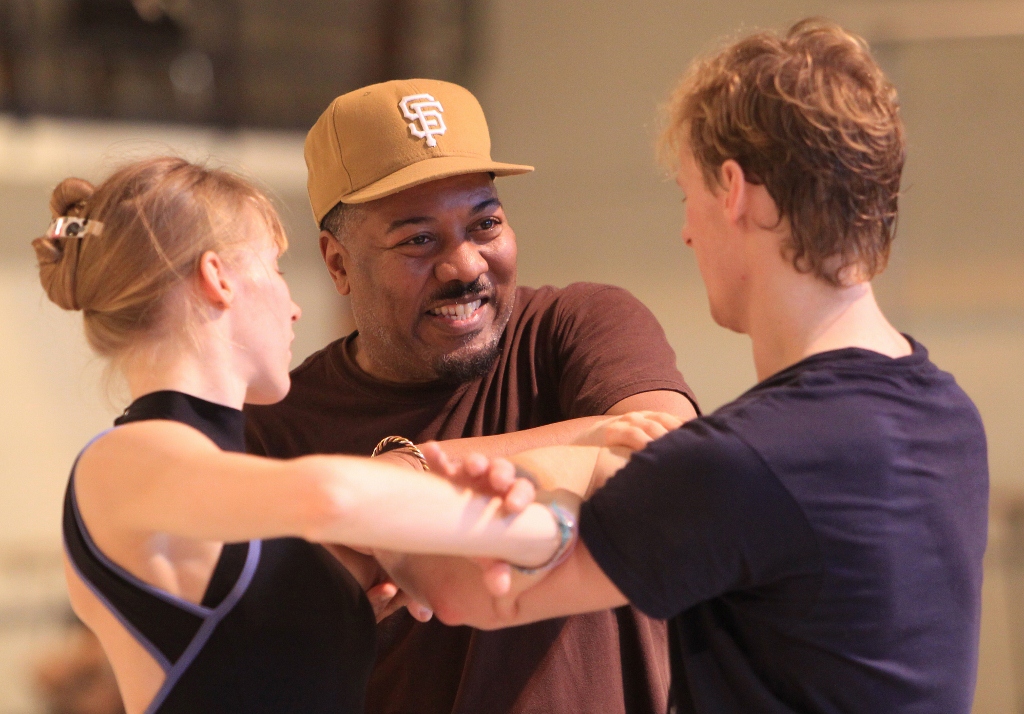
Alonzo King rehearsing Daria Ivanova and Paul Knobloch in Figures of thought, Lausanne, June 2011. Photo: Valerie Lacaze.
Australian dancer Paul Knobloch was in Canberra over the holiday season visiting family and friends. Knobloch is excited at the new direction his career is about to take. He will take up a contract in February with Alonzo King LINES Ballet based in San Francisco. King recently made a work called Figures of thought for Béjart Ballet Lausanne, where Knobloch has been working for the past few years. King offered Knobloch a contract after working with him in Lausanne.
The BBL website has a photo galleryfrom this work. It contains several images of Knobloch in rehearsal. [Update April 2019: link no longer available].
Luminous: Celebrating 50 years of the Australian Ballet
In December The Canberra Times published my review of the Australian Ballet’s most recent publication, Luminous: Celebrating 50 years of the Australian Ballet. Here is a link to the article.
New York does December in its own inimitable way and one annual and memorable event is a season of George Balanchine’s Nutcracker performed at Lincoln Center by New York City Ballet. This year, however, you didn’t have to be in New York to see the production. It was filmed live on 13 December and relayed in a high definition cinema broadcast across the United States. Just before Christmas it was screened in movie houses in Britain, Austria, Spain, Portugal and Australia.
While we all know that there’s nothing like being there, I loved the way this Nutcracker was so carefully filmed, especially Act I. I even liked the way the camera selected close-ups and never felt I was missing out on the action by having a close-up cut into the full stage view. I mostly liked the views shot from a side box too, especially in the Snowflakes scene where a high view accentuated the enclosed space of the snow-covered forest without taking anything away from the dancing. From a filmic point of view, Act II was probably less successful. But I suspect that this had something to do with Rouben Ter-Arutunian’s somewhat overwrought set of sweets and candies. Its visual complexities detract from the dancing at the best of times and, when seen on screen, the limitations of the two dimensionality of the medium are accentuated. However, I never once wished it had been shot in 3D!
One aspect of Balanchine’s version that I find especially enjoyable is the way in which children are incorporated into the production and the way the adult performers never treat them as anything but an integral part of the narrative. In Act I the children dance with the adults as well as with each other and have roles as soldiers, while in Act II they have their own roles as angels and as the children of Mother Ginger. In Act II they dance in the opening section and in the coda with all the panache of their adult counterparts. The coda in particular is quite fast but they are in there, totally unfazed and dancing beautifully.
The roles of Fritz and Marie, or Clara as we more commonly know her counterpart in Australia, are also children’s roles, rather than roles for smaller company members as often happens. The children from the School of American Ballet, who fill all the children’s roles, are professionals-in-training and it is hard to fault the way they conduct themselves on stage. In the role of Fritz, Maximilian Brooking Lendegger was captivatingly naughty and almost stole the show from the rather more placid and appropriately well-mannered Colby Clark as the princely child hero and nephew of Herr Drosselmeier. Marie was danced by a very composed Fiona Brennan. I was also mesmerised by a dark- haired child aged about eight, the youngest (or at least smallest in height) of the Polichinelles who emerge from Mother Ginger’s skirt in Act II. She grabbed my attention immediately with her innate understanding of how to use the space around her to achieve maximum effect from her movements.
Of the adult performers Megan Fairchild danced the role of the Sugar Plum Fairy and was partnered by Joaquin De Luz: lovely techniques both of them but on this occasion not much of the radiance that should accompany these roles. They are after all the roles of a prima ballerina and a premier danseur. The standout performers among the adults were Teresa Reichlen as a glamorously slinky Coffee, Tiler Peck as the leading Marzipan (in a tutu that I found clumsy and unattractive though) and Ashley Bouder as Dewdrop, the leading dancer in the Waltz of the Flowers. Bouder’s technical skills were electrifying. In Act I Adam Hendrickson gave a strong performance as Herr Drosselmeier. He captured every bit of the fantasy and mystery of this character.
The film was introduced by Kelly Ripa, who hosts a popular television series in the United States, and she also hosted several backstage interviews during the intermission. They included some interviews with excited child performers and a discussion of some of the technical tricks asociated with the production – the Christmas tree that grows during the transformation scene, for example. They were all interesting, even fascinating at times, but I could easily have done without some of Ripa’s comments. They were no doubt meant to appeal but often dumbed down what was happening.
Years ago now the American dance writer Edwin Denby remarked of Balanchine’s take on Nutcracker: ‘It’s Balanchine’s Oklahoma!’ This particular production, with sets by Ter-Arutunian and costumes by Karinska, dates back to 1964 and it is indeed a very American production, right down to its flying, reindeer-drawn sleigh that carries Marie and her Prince across the stage in the closing scene. At Christmas its glitz, even when it’s a little over the top and even when Ripa behaves a little too ingenuously, is irresistible.’
To all those who have visited this site over the past year, and especially to those who have contributed what I have referred to elsewhere as ‘refreshingly honest’ comments, I wish a very happy holiday season.
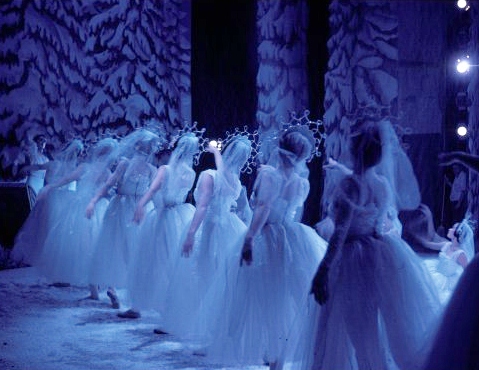
‘Snowflakes’ in the Borovansky Ballet’s production of The Nutcracker, ca. 1957. Photo: Walter Stringer. Courtesy of the National Library of Australia
A Christmas production of Nutcracker was always a much anticipated part of my childhood and recollections of Elaine Haxton’s designs for the old Borovansky production (reused in the early Australian Ballet production) surfaced a few years ago during a December drive through, of all places, the Kit Carson National Forest in New Mexico. I hope you enjoy the juxtaposition of images, despite the obvious differences in lighting and location!
I also recently came across aninterview with Elaine Haxtonrecorded by fellow artist James Gleeson in 1978 and held by the National Gallery of Australia. Her discussion of the work of the designer in the 1950s is worth reading I think.
I look forward to your visits and comments in 2012.
Michelle Potter, 18 December 2011
Featured image: High Road to Taos, Kit Carson Forest, New Mexico, 2007