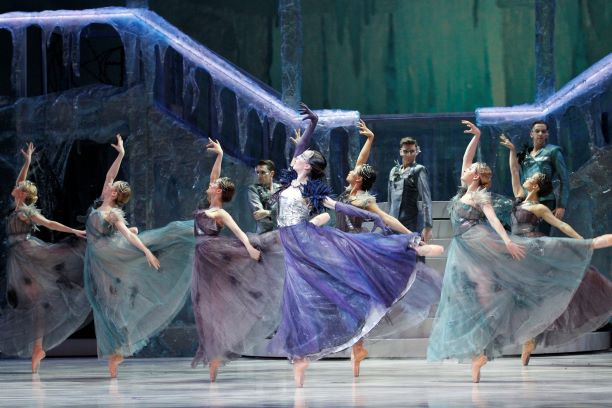
Romeo and Juliet (2011). A second look

10 December 2011, Opera Theatre, Sydney Opera House

Graeme Murphy’s Romeo and Juliet for the Australian Ballet continues to generate discussion and mixed reviews, and I recently took a second look at it at a Sydney mid-season matinee performance. It is impossible to ignore the dominance of the scenic elements and the challenges of the constantly changing times and locations, and why should we ignore them anyway as they are an intrinsic part of the collaboration and choreographic plan. So I still like to see this Romeo and Juliet as a postmodern work, despite all the problematic issues that the term ‘postmodern’ generates. Postmodernism, at least in areas of the visual arts, allows a collage of non-sequiturs and apparently frivolous allusions, which gives a pastiche we can either love or hate, but not ignore.

On this viewing, the sometimes overbearing scenic elements, and the episodic nature of the changes of time and location, did not startle to the same extent as they did that first time. On any second or subsequent viewing, whatever the work, one naturally notices different things. During the opening scene, set in what my ever-entertaining companion at these matiness thought looked like a scene from Dungeons and Dragons, it was Murphy’s attention to detail in his handling of the minor characters that attracted my attention. At the side of the main action and above it on the ‘bridge’, groups of bedraggled-looking townsfolk engaged in their own comments on the feuding being carried out centre stage. Murphy has always been a dab hand at this kind of background action—no standing round twiddling thumbs and admiring dresses. His works are choreographed down to the last detail.

The ball scene contains one of the best-known sections of the Prokofiev score, a section I will never be able to call anything other than ‘the cushion dance’. My approach to this scene will forever be coloured by my very first viewing of a ballet with the name Romeo and Juliet when, as a child, I saw a film of the Bolshoi Ballet with Galina Ulanova as Juliet. Well there were no cushions for the male guests to toss onto the floor in Murphy’s version of the magnificent ‘cushion dance’, but there was some startling and bold choreography. I especially admired the dramatic swirl of movement as the male guests held their partners, who leant back precariously as they were turned in a tight circle and who, with knees bent and feet together, jabbed the floor aggressively with their pointe shoes.

Akira Isogawa’s wedding dress for Juliet in the Japanese-inspired scene also caught my eye. Although it is pretty much impossible to learn much about the construction and detail of individual costumes from a seat in the auditorium, this dress seemed to be beautifully made from delicately patterned silk, or synthetic silken-look fabric. But it was the shoulder feature that surprised me. The straps that held the dress together over the shoulders were wide and crossed over just as they joined the bodice rather than in the middle of the of the upper back. It was a simple and almost unnoticeable touch, and perhaps not of major significance in the overall scheme of the ballet, but so elegant.

I was lucky enough to see Juliet Burnett in the leading role on this second viewing. She handled Murphy’s ever-changing and ever-challenging choreography as if she were born to dance his steps. She was bubbling with youth as she ran across the stage on pointe in the opening sequence. She soared through lifts in Murphy’s pas de deux and in those scenes in which the black-garbed holy men transported her across the stage. Her expressive arms gave a joyous quality to those moments where her young love for Romeo needed to be shown. But those arms also conjured up something entirely different, something leaden and full of fear when, for example, she reached out in an attempt to pick up the bottle of poison from her bed. It was this quality of being able to express emotion so well through the body, and not just through facial expression, that made her performance so exhilarating. But perhaps most of all it was a thrill to watch her portray the character of Juliet and to maintain that characterisation across the entire ballet, despite the changes of time and location. A stellar performance from Burnett who was partnered by Rudy Hawkes as Romeo.

Of the other cast members, Josef Brown made a welcome return to the ballet stage as Lord Capulet with Ingrid Gow as his Lady Capulet. Brown played Lord Capulet with a calm yet imposing presence. His handling of Juliet in the scenes with Paris rarely showed anger but rather some kind of fatherly determination. It allowed Murphy’s choreography, which in these scenes contains conflict within it, to shine through.

Michelle Potter, 11 December 2011

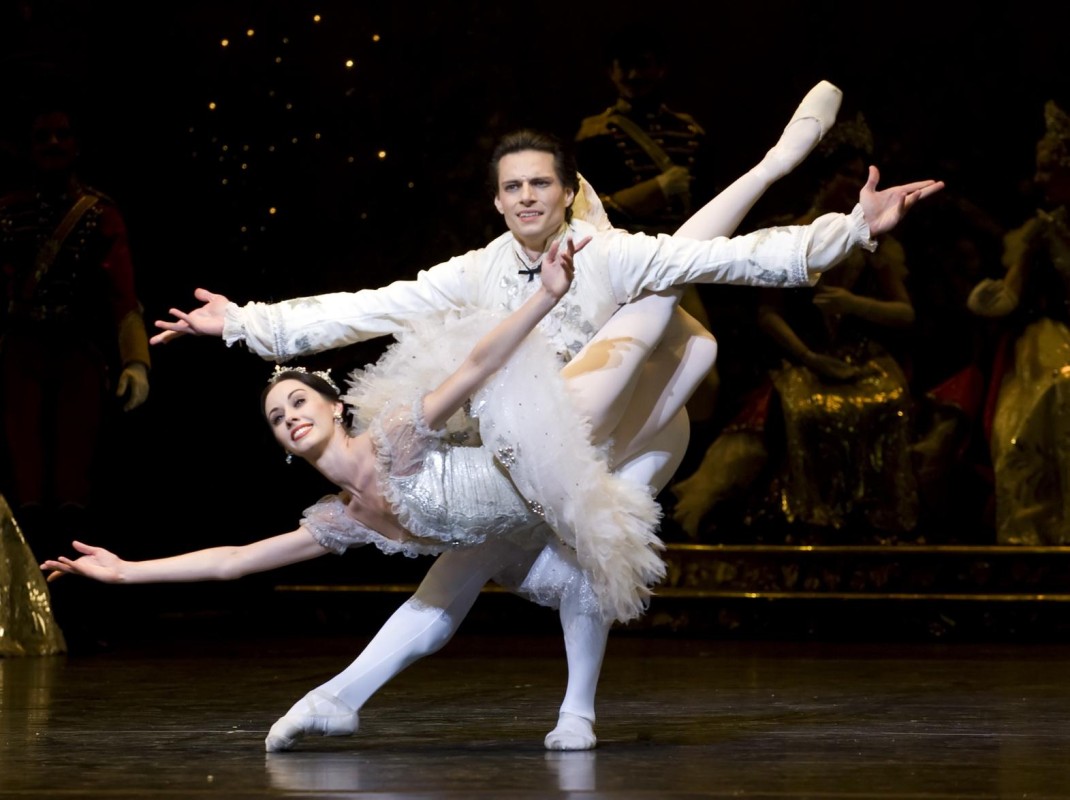
Featured image: Artists of the Australian Ballet in Romeo and Juliet, 2011. Photo: © Jeff Busby. Courtesy of the Australian Ballet
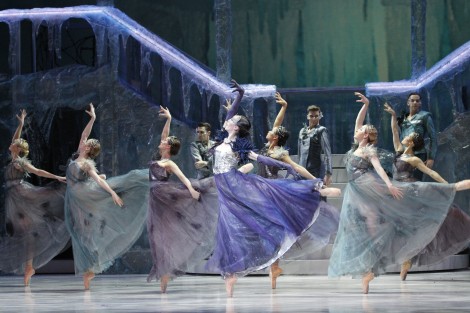
Artists of the Australian Ballet in 'Romeo and Juliet', 2011. Photo: Jeff Busby

Here is the link to my original post and comments on this production of Romeo and Juliet.

UPDATE, 12 December 2011: I have just reread more carefully the original post written after opening night in Melbourne in September. In it I wrote: ‘Manion’s strongest contribution [Gerard Manion was the set designer for this work] was a visually arresting painted front cloth comprising a huge bunch of gold, pink and blood red lilies from which the deepest colours drained to grey as the cloth rose at the beginning of the work’. Well this was not part of the Sydney production! Why not? I have no idea, but it was a sad omission in my opinion.
Cinderella by two: some thoughts

West Australian Ballet’s Cinderella, newly created this year, had a season in Canberra in November and its popularity was such that an extra show needed to be scheduled. I had certain expectations, having spoken previously to the artistic director of WAB, the choreographer and the designer before writing a preview piece for The Canberra Times. All spoke eloquently about the process of creation and their aspirations for the piece.

But when it came to the performance itself I have to say I was heartily disappointed. While I enjoyed the design by Allan Lees, which set the work in the 1930s, I thought the choreography, by Jayne Smeulders, was scant and quite simplistic. There were many moments when the stage (and I’m talking here about the much-maligned stage of the Canberra Theatre, which is reputed to be too small for the larger kind of ballet production) seemed positively empty of dancing. Not only that, or perhaps because of that, the dancers rarely looked as though they were full-scale professional dancers.

Wherever I have worked in my journalistic dance writing life to date there has always been a policy in place that the person who writes the preview does not write the review of the same piece. My experience with WAB’s Cinderella hammered home the sense behind that policy. But seeing this Cinderella made me wonder about another newly created Cinderella, that by Meryl Tankard for Leipzig Ballet. It opened in Leipzig on 5 November.

Unfortunately I have neither spoken to Tankard about the work nor seen it but the web at least allowed me to catch a glimpse of some images, a bit of footage and snatches of an interview with Tankard about the work. I was interested in Tankard’s answer to a question posed to her by Maeshelle West-Davies from the Leipzig Zeitgeist about why she chose Cinderella and what she thought she could bring to the work. Part of her reply said:

‘Since I am quite used to spending a lot of my time on long trips to and from Australia, I decided to use this experience in Cinderella. The story begins in an airport with Cinderella, and the very ‘glamorous!’ sisters, travelling to an exotic location for a huge party hosted by a wealthy prince. A lot of the scenes will be in ‘hotel rooms’ and the garden scene has been influenced by Sydney’s beautiful botanical gardens. I would like the audience to feel as if they have also been on big trip!’

As thought-provoking too was her reply to a question concerning her process, which seems somewhat different from her process with many of her works made in Australia:

‘I had to be very well organised for Cinderella. I didn’t get much time with the dancers, as they were rehearsing a lot for other productions. I also had to make a lot of decisions about editing the music very early on, so I had to have a clear structure before I began working with the dancers. Since Cinderella is a very well-known story, I had to come up with a new and original way to tell the tale. I approached it as if I were planning a film and storyboarded all the scenes before I arrived in Leipzig.’

A trailer available on YouTube gives a glimpse of the choreography and the design, including the kinds of projections we have come to recognise as signature Tankard/Lansac. Some of the lighting and projections reminded me of sections of Wild Swans, which is not a bad thing in my opinion. I often ponder how Wild Swans the ballet has pretty much slipped from view whereas Elena Kats-Chernin’s delicious score, or parts of it, are heard often. Such is dance I guess.

It seems unlikely that we will see Tankard’s Cinderella in Australia, at least not in the near future. It sounds and looks (at least from a brief glimpse) as though it might be an engrossing take on the fairy-tale. But am I falling into the same trap as I did with WAB’s Cinderella? Such are expectations.

Michelle Potter, 4 December 2011

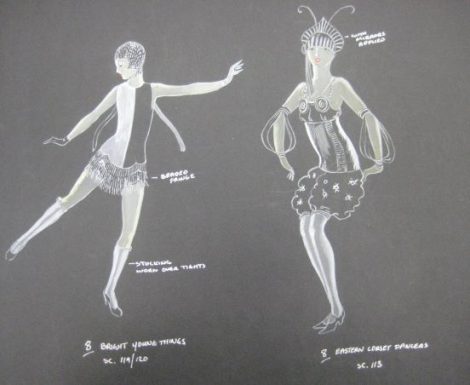
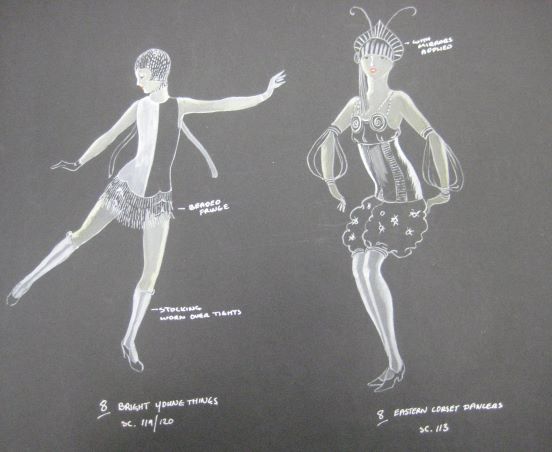
Kristian Fredrikson, designs for 'Undercover' (Bright Young Things and Eastern Corset Dancers). National Library of Australia

Dance diary. November 2011

  • SAR Fellowship: National Film and Sound Archive (NFSA)

In 2012 I will be taking up a SAR Fellowship, SAR being the acronym for Scholars and Artists in Residence, for two months at the National Film and Sound Archive. This Fellowship will enable me to investigate a lesser known aspect of the career of designer Kristian Fredrikson, namely his commissions for film and television. In addition to designing costumes for one or two televised ballets in the late 1960s, in the 1980s Fredrikson worked on at least three feature films, Undercover, Sky Pirates, and Short Changed, and three mini-series for television, The Shiralee, The Dirtwater Dynasty and Vietnam. I’m looking forward to delving into this aspect of Fredrikson’s multi-faceted career.

The SAR program aims to promote the NFSA as a centre for scholarly activity, to encourage and facilitate research relating to the NFSA collections and programs and to bring new ideas and expertise to the NFSA.

  • Houston Ballet

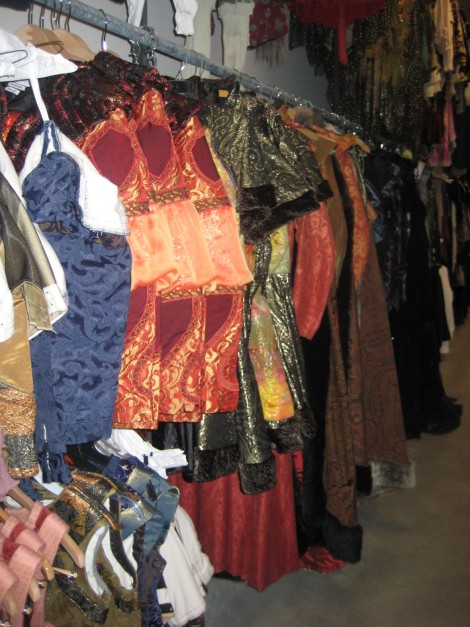
In addition to my meeting with Stanton Welch while in Houston recently, which was the subject of a recent post, I spent half a day with Laura Lynch, Houston Ballet’s wardrobe manager. Laura spoke to me at length about Kristian Fredrikson’s designs for ‘Pecos’, part of a Houston Ballet evening length program called Tales of Texas, and Fredrikson’s last work, a new version of Swan Lake. Both works had choreography by Stanton Welch and his Swan Lake, which premiered after Fredrikson’s death, was dedicated to Fredrikson. We also visited the HB warehouse, a little out of town, to have a look at the costumes themselves.

Rack of costumes for Houston Ballet's 'Swan Lake'
Rack of costumes for the Houston Ballet production of Swan Lake. Photo: © Michelle Potter
  • Miranda Coney Barker

Most readers of this site will remember Miranda Coney, a much-loved principal of the Australian Ballet during the 1990s. Miranda is now living in New York with her husband, conductor Charles Barker, and their two young sons. I caught up with her while in New York and was more than delighted to know that she has been giving class to young dancers in the current Broadway production of Billy Elliot—‘quite a challenge’ she says!

  • Canberra Critics’ Circle Awards: Dance 2011

In November the Canberra Critics’ Circle met to discuss nominations for its annual awards, which were presented on 29 November. Two dance awards were made. Liz Lea received an award for her creative use of archival material from Canberra collecting institutions in her solo production of 120 Birds. Lea showed 120 Birds as a work for a small company at the Edinburgh Fringe in 2010 but reworked it as a solo show for presentation in February 2011 as an event associated with the National Gallery of Australia’s Ballets Russes exhibition. She drew on material from the National Film and Sound Archive, the National Library of Australia and the National Gallery of Australia bringing it all together to pay homage to those intrepid artists who toured to and from Australia when communications were not the instant experience we know today.

Photos from Lea’s Gallery performance are at this link.

Elizabeth Cameron Dalman received an award for her poignant and moving show Sapling to Silver, which was the story of a vibrant life—her own life in dance. I recall in particular from that show a duet between Dalman and Albert David in which two cultural heritages were juxtaposed, as were two lives lived in different generations. The citation for Dalman’s award also mentioned the seamless way in which the various sections of the work were put together to deliver a beautifully produced whole.

  • ‘The fire and the rose’

The link to my tribute to Valrene Tweedie, an article originally published in Brolga. An Australian journal about dance in December 2008 and posted on this site in July 2009, is not currently available as it was previously via the Ausdance website. The National Library of Australia’s web archiving service, Pandora, came to the rescue however and the tribute is now available at this link.

Michelle Potter, 30 November 2011

Featured image: Kristian Fredrikson, designs for Undercover (Bright Young Things and Eastern Corset Dancers). National Library of Australia

Kristian Fredrikson, designs for 'Undercover' (Bright Young Things and Eastern Corset Dancers). National Library of Australia

Kristian Fredrikson. ‘What’s in a name?’

The work of Kristian Fredrikson is currently the subject of an exhibition called Bedazzled, which opened at the Dowse Art Museum, Lower Hutt, New Zealand, on 26 November 2011 and which runs there until 4 March 2012. After reading publicity for this exhibition, it is clear to me that there is a compelling need for a number of misconceptions about Fredrikson’s early life to be corrected.

The main issue concerns Fredrikson’s name. At the time of writing this post a number of online sources, including the website Australia Dancing to which a number of other sites have posted links, and from which others have harvested material or used information on it in some other way, maintain that Fredrikson was born Kristian Adrian Sams and that he later changed his name to Kristian Adrian Fredrikson. Some obituaries published in Australian newspapers and now available online for all to read do the same. It is simply not so. My recent research into the career of Fredrikson reveals otherwise.

Fredrikson was born Frederick John Sams and was at least the third generation in the Sams family to carry the first name of Frederick. His early reviews written for New Zealand newspapers were signed ‘F. J. S.’ and it was not until 1962 that he took on the name Kristian Adrian Fredrikson. One signed early drawing I have seen indicates that he was playing around with the spelling of Frederick, his given first name, while probably a teenager. But the name change to Kristian Fredrikson happened around the time he was designing his first theatrical work, A Night in Venice. That work premiered in 1962. There are also indications that at least one review he wrote shortly after the premiere of A Night in Venice was signed ‘K. F.’

The second ‘fact’ that is constantly and erroneously perpetuated is that Kristian Fredrikson was the son of a Danish merchant seaman. He wasn’t. His father, Frederick Spencer Sams (1910-1996), was not a Dane but a New Zealander. His grandmother, Ann Sams (nee Munro), was also a New Zealander and his grandfather, also named Frederick Sams, was Australian. As for the occupation of merchant seaman, in 1938 when he was 28 Frederick Spencer Sams’ occupation was mentioned in a New Zealand newspaper as ‘seaman’, although when he took up this occupation and how long it lasted is unclear at this stage of my investigations. It was probably not for an extended period of time and certainly wasn’t a long-term career. He married early in 1940 and in May of that year, before his first son was born, there is clear evidence that he was unemployed.

There is still much to learn about the early life of the man we have come to know as Kristian Fredrikson but he was not born Kristian Adrian Sams and he was not the son of a Danish merchant seaman. All sources, even the web and newspapers, and even Fredrikson’s own oral history interview, are not necessarily accurate. Kristian Fredrikson was intent on creating a persona for himself that did not entirely reflect the circumstances of his early family life.

© Michelle Potter, 30 November 2011

All rights reserved. Please acknowledge the source of this information if you use it elsewhere.

Stanton Welch. ‘An Aussie in Houston’

A recent visit to the United States saw me in Houston, Texas, where I was able to have a look at Houston Ballet’s new premises and enjoyed being shown around by Stanton Welch. And there is more than one Aussie at Houston Ballet these days. Below is the text of a story published on 26 November 2011 in The Canberra Times under the heading ‘An Aussie in Houston’.

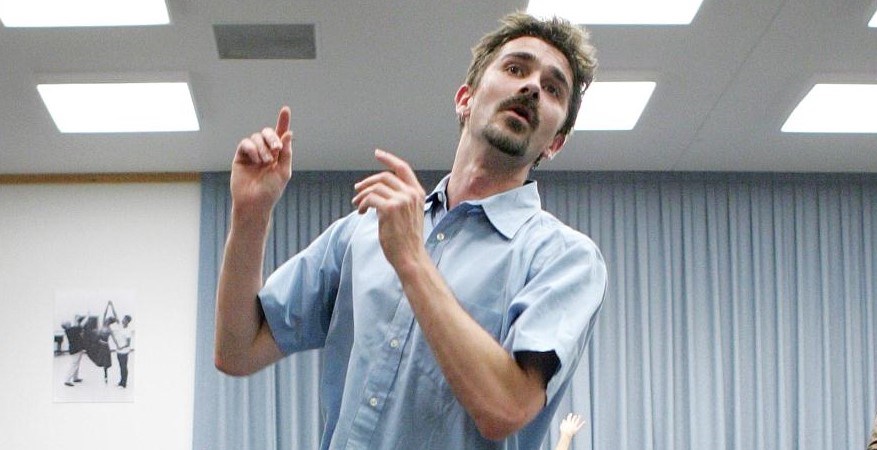
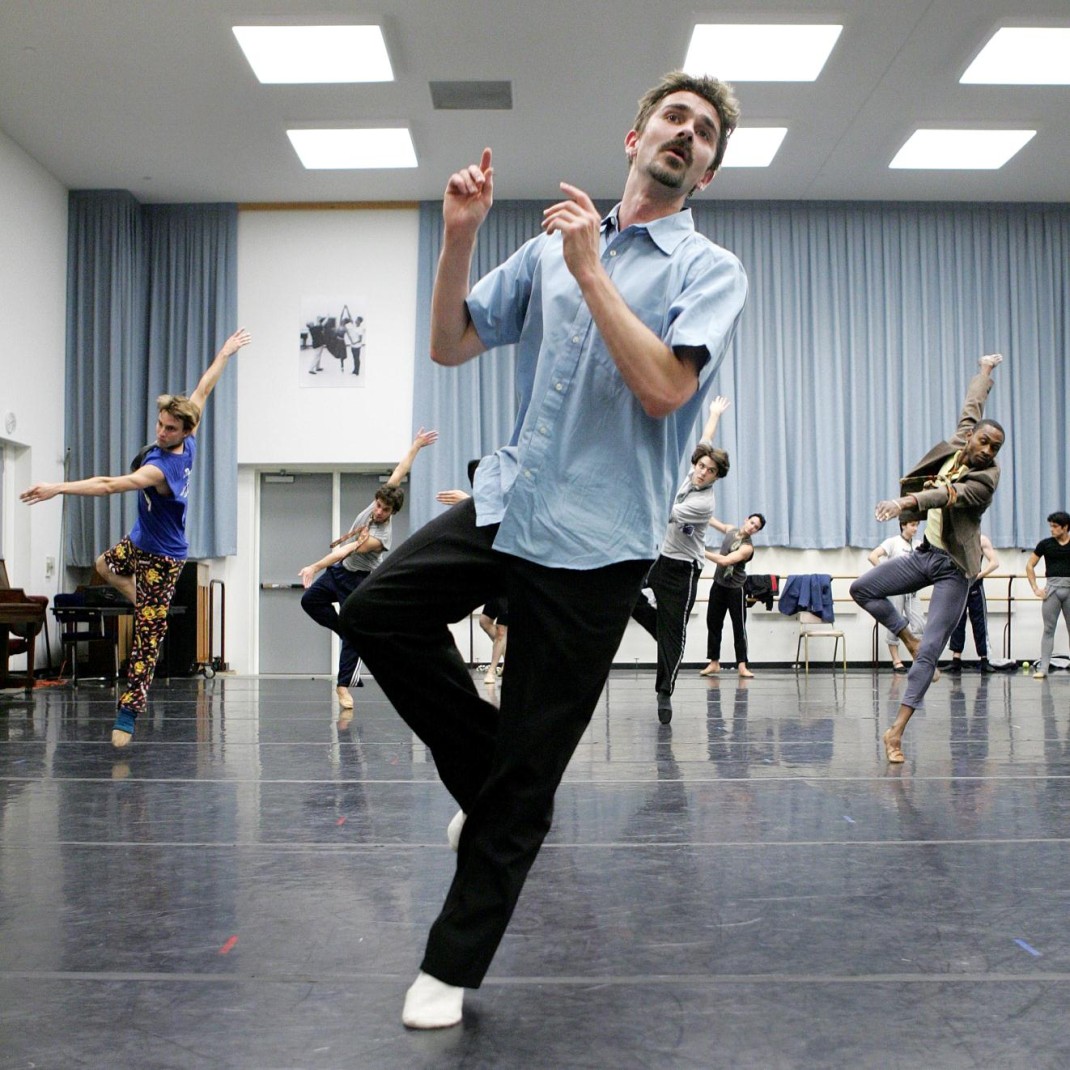
Stanton Welch in rehearsal. Photo: © Bruce Bennetts. Courtesy of Houston Ballet

— Stanton Welch is in a buoyant mood as he shows me around Houston Ballet’s stunning new home in downtown Houston, Texas. Melbourne-born Welch has been artistic director of Houston Ballet, the fourth largest ballet company in the United States, for eight years. The company moved into its six-storey headquarters in February of this year and the new studios—nine of them—are huge with high ceilings and lots of windows letting in the beautiful Texan light. In some, children are taking a ballet class. In others, company members are rehearsing for the forthcoming production of the Christmas classic The Nutcracker and for the annual gala, Jubilee of Dance. The building hums with activity.

Welch, a young-looking 42 year old, is the elder son of Marilyn Jones and Garth Welch, former principal dancers with both the Borovansky and the Australian Ballets. Both also worked with Sydney Dance Company and both are teachers of renown. Their second son, Damien, retired quite recently from his position as a principal dancer with the Australian Ballet. Together the four of them are familiarly called the “Royal Family of Australian Ballet” such is their collective status in the Australian dance world. Damien is also currently in Houston to stage his brother’s production of Cinderella for Houston Ballet next year. And indeed the month of November is something of a family time. Jones is also visiting. “Mum comes over a couple of times a year. I usually try to get her to do a bit of teaching while she’s here,” Welch says with a grin.

Welch was a late starter in the ballet world: he took his first lessons only when 16. But there was no looking back after that. He choreographed his first piece, Hades, during the first year of his dance training in 1986 and it won several eisteddfod prizes. By 1989 he had joined the Australian Ballet and in 1990 received his first choreographic commission, which resulted in A Time to Dance for the Dancers Company of the Australian Ballet. He went on to make his first major piece, Of Blessed Memory, for the main company in 1991. By 1995 he was a resident choreographer with the Australian Ballet and remains so, from a distance, to this day. The extent of his choreographic output by now is remarkable and includes works for major companies around the world. He was appointed artistic director of Houston Ballet in 2003 and for the moment he seems firmly entrenched in Houston, largest city in the state of Texas.

“What I love about working here”, he says “is that the dancers are so energised. There is absolutely no complacency. We are so lucky with audiences too. They are very adventurous and brave when it comes to new work, which is great for a choreographer. Our subscriptions continued to grow even during the recession.”

But as I look into the studios from the viewing windows I am struck by the fact that there are Australians in a number of the studios. Ballet master Steven Woodgate is busy rehearsing a large number of dancers for a group scene in Nutcracker. A Churchill Fellowship awardee for 2000, Woodgate retired from the Australian Ballet, where he was senior artist for several years, and took up the position of ballet master at Houston in 2004, the year after Welch’s arrival.

In another studio Luke Ingham, who grew up on a farm in Mount Gambier, South Australia, is rehearsing for his first princely role, that of the Prince in Nutcracker. Ingham has been with the company since July 2011 and has just toured to New York with Houston Ballet where he also took the opportunity to catch up with four of his former Australian Ballet colleagues. They were in New York to dance and promote the Australian Ballet’s New York visit in 2012.

Ingham will be dancing in Houston’s Nutcracker with his partner in life Danielle Rowe, a former Australian Ballet principal who joined Houston Ballet early in 2011. He is looking forward to the occasion. “It’s great to work with someone you love,” he says. “I love being out there on stage with Dani.”

In her relatively short time in Houston to date Rowe has already made a name for herself. A dazzling dancer and winner of a 2010 Helpmann Award as best female dancer in a dance or physical theatre production, Rowe has so far danced leading roles in Houston productions of two major classics, Sleeping Beauty and Giselle. In Giselle, a production staged by yet another Australian artist, dancer and coach Ai-Gul Gaisina, critics spoke glowingly of Rowe’s performance as “gossamer-spirited.” and noted that she moved like “a tissue in a breeze.”

There have been Australians in the Houston company for a while. Mary McKendry, who was brought up and learnt to dance in Rockhampton, Queensland, was a principal dancer with Houston Ballet in the 1980s when a young man from Mao’s China defected while on an exchange visit to Houston Ballet. His name was Li Cunxin and McKendry eventually married him. They moved to Australia where Li would go on to have a stellar career with the Australian Ballet, write his best selling autobiography Mao’s Last Dancer and eventually become a stockbroker in Melbourne. Li often returns to Houston and did so earlier this month to be honoured for his achievements by the Houston-based organisation Dance of Asian America.

Danielle Rowe and Simon Ball in Ben Stevenson’s Sleeping Beauty, 2011. Photo: © Ron McKinney. Courtesy of Houston Ballet

What is it that draws Australian dancers to Houston Ballet? Welch believes that it is the varied repertoire that the company offers. His dancers get the opportunity to perform in works that he creates himself, works by acclaimed American and European choreographers and both old and new takes on the classics. Danielle Rowe suggests the same. Along with a positive work ethic, it was what she was looking forward to most of all when she left the Australian Ballet for a new career in Houston. Ingham couldn’t resist the thought though that, with his farming background, there might be the added attraction of the Texan cowboy culture! But whatever it is, the vibes are good at Houston Ballet. Welch strides through his new domain laughing and joking and generously accommodating my every request.—

And in addition to those Australians mentioned above, former Australian Ballet dancer Andrew Murphy is an instructor at Houston Ballet’s academy. Murphy is married to Sabrina Lenzi, ballet mistress of Houston Ballet II, a company similar in outlook and mission to the Australian Ballet’s Dancers Company.

Michelle Potter, 26 November 2011

Featured image: Stanton Welch in rehearsal (detail). Photo: © Bruce Bennetts. Courtesy of Houston Ballet