As Jack Anderson says in a recently published article, balletgoers love Giselle. It has been some time since I have seen this classic of the Romantic repertoire performed live, which I regret. Still very clear in my mind is the Finnish National Ballet’s production of Sylvie Guillem’s staging, which while not the most recent I have seen—it goes back to the 1990s—for me is easily the most intelligent and most moving production I have had the good fortune to see. I still recall, however, Clement Crisp’s remark in a review in London’s Financial Times that this staging was ‘ultimately wilful as a view of an old text.’
Anderson’s article in New York Theatre Wire concerns a recent production of Giselle by Pacific Northwest Ballet under the direction of Peter Boal, and is also a comment on the recent meeting in Seattle of the Dance Critics’ Association. Although I will never be convinced that there is not also a place for those ‘wilful’ productions like that of Guillem, the Anderson article is a terrific piece of writing offering many insights into what is a remarkable ballet.
Those who have been following posts on this site relating to Nina Verchinina may be interested in an article published in the most recent edition of Brolga: an Australia journal about dance (issue 34, June 2011). This elegantly written article, rather lengthily entitled ‘Designing for Nina Verchinina’s choreographic vivacity: a new light on Loudon Sainthill’s art’, is by Andrew Montana. It sheds important light on Verchinina’s choreographic exploits in Australia and suggests that gender may have played a role in the fact that, in Montana’s opinion, Verchinina’s ballets were never really given adequate showings in Australia.
The gender issue is an interesting speculation and perhaps will never ultimately be more than that. But the idea does have a certain plausibility and is echoed by the difficulties faced by Hélène Kirsova as she tried to develop her own company, the Kirsova Ballet, in the early 1940s in the face of competition from Edouard Borovansky. See for example my recent post on Kirsova, my article ‘A strong personality and a gift for leadership: Hélène Kirsova in Australia’ (Dance Research, 13:2, Winter 1995, pp. 62-76) and a shorter article in National Library of Australia News published in August 2000.
Montana is perhaps at his most eloquent when describing the drawings and paintings of Verchinina executed by Sainthill. But his article also develops further than has been done so far the story of de Basil’s design competition of 1940 won by Donald Friend, along with a number of other matters relating to the Original Ballet Russe in Australia.
As something of a side issue, Montana also mentions the Sidney Nolan designed Icare and notes that there is nothing to indicate that Sainthill was approached to design this work. This appears to contradict Brian Adams’ contention in his biography of Nolan, Such is life, that Sainthill had ‘already been commissioned by Colonel de Basil’ (p. 46) to design this work. Adams gives no source reference for his statement but I believe it does warrant more investigation. Adams goes on to say that Sainthill had been ‘edged out by [Serge] Lifar and [Peter] Bellew’ (p. 46) so there is potentially source material elsewhere other than in Sainthill’s archival collection, which Montana has investigated.
One error in the text needs correction. Montana notes that the cast of Verchinina’s Etude included ‘Lydia Couprina (Valrene Tweedie)’ (p. 22). In fact Lydia Couprina was the stage name of Phyllida Cooper, an Australian from Melbourne who had joined de Basil in Paris where she had been studying with Olga Preobrajenska. Tweedie danced under the name Irina Lavrova. As a side issue, however, there is a connection beyond nationality between Cooper and Tweedie. When Tweedie returned to Australia from the United States in 1950s she eventually bought the school in Sydney jointly run by Cooper and her then husband, James Upshaw. Upshaw later became Tweedie’s second husband.
Unfortunately this most welcome article from Montana is not available online, but it is worth following up in hard copy in libraries where Brolga is held.
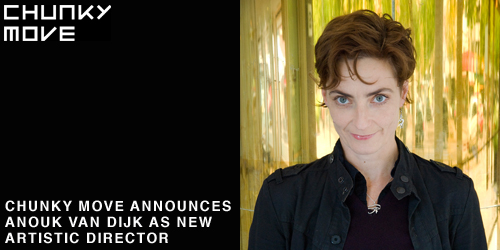
The Board of Chunky Move today announced that Anouk van Dijk will take over as Artistic Director following Gideon Obarzanek’s departure at the end of 2011.
Photo by Silvia Sztankovits
Anouk van Dijk is an internationally acclaimed choreographer, whose work has toured extensively throughout her home country of The Netherlands, and far beyond throughout Europe, North America, Asia and Australia. Her appointment builds on Chunky Move’s commitment to supporting the creation of dance that surprises and delights. Anouk’s work attracts broad audiences through an approach which is daring, innovative and unpredictable in both its form and context.
Anouk van Dijk began her career as a dancer, and for almost a decade was lead soloist with the Rotterdam Dance Group and Amanda Miller’s Pretty Ugly Dance Company. In 1998 she formed her own company, anoukvandijk dc creating work both distinctive and unpredictable which has toured the globe attracting broad audiences and critical acclaim. Her enthusiasm for collaboration with individual artists and companies has delivered vital and exciting co-productions – she is currently premiering the site specific, outdoor work MENSCH on the island of Terschelling (Netherlands), which then relocates (and reincarnates) to the sheds of the former Dutch Dock and Shipbuilding Company in Amsterdam. This follows the presentation of TRUST (a co-production between anoukvandijk dc and Schaubühne Berlin with regular creative collaborator, writer and director Falk Richter) which opened the 2011 Festival Transamerique in May after performing at the Perth International Festival of the Arts in February. Anouk’s work STAU performed in Australia at the Adelaide Festival of Arts and Sydney Opera House in 2006.
Anouk van Dijk will commence her hand-over part time from January 2012, relocating to Melbourne in June 2012 when she will assume the full time role of CEO and Artistic Director.
The following schedules and lists from the 1934–1935 tour by the Dandré-Levitoff Russian Ballet are taken from my article ‘The Dandré-Levitoff Russian Ballet 1934–1935: Australia and beyond’ published in Dance Research (Edinburgh University Press), 29:1 Summer 2011.
The information has been gathered from various sources including newspapers (advertisements and reviews) and programs. In particular the following newspapers provided useful information, The Argus (Melbourne), Cape Times (Cape Town), The Courier-Mail (Brisbane), De Locomotief (Semarang), The Star (Johannesburg), The Straits Times (Singapore), The Sydney Morning Herald, The Times of India (Bombay), and The West Australian (Perth). The letters and 1935 clipping books of Harcourt Algeranoff (MS 2376, National Library of Australia) also provided some useful material, particularly about Ceylon, India and Egypt, as did the personal archive of Anna Northcote (Severskaya).
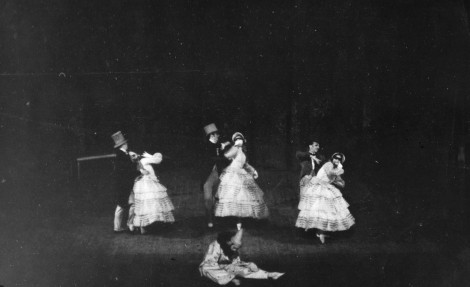
Dancers of the Dandré-Levitoff Russian Ballet in Carnaval, 1934 or 1935. Anna Northcote (centre), Travis Kemp as Pierrot. Personal archive of Anna Northcote (Severskaya). Private collection
I have standardised spellings of names of works in the repertoire using what I think is the most commonly used form today. The material contained in these appendices should not be considered as necessarily complete or definitive at this stage.
APPENDIX A: REPERTOIRE and PERFORMANCE SCHEDULE
SOUTH AFRICA [1934]
Cape Town: Cape Town Opera House
Program 1 (18-26 May)
La Fille mal gardée, Swan Lake (Act II), Polovtsian Dances, Divertissements
Program 2 (28 May-2 June)
Carnaval, Visions, Suite from Coppélia, Divertissements
Program 3 (4-9 June)
The Magic Flute, Les Sylphides, Promenade (Old Vienna), Divertissements
Durban: Theatre Royal
Program 1 (13-17 June)
La Fille mal gardée, Swan Lake (Act II), Polovtsian Dances, Divertissements
Program 2 (18-20 June)
Carnaval, Visions, Divertissements
Program 3 (21-23? June)
Unknown repertoire *
* A third program is mentioned in an undated newspaper clipping in the Anna Northcote archive although no specific details are given.
Pietermaritzburg 24-26 June; Pretoria 27-30 June
No evidence has yet emerged of performances in these two cities. That the company stayed for several days in each city suggests, however, that at least one program may have been scheduled in each city.
Johannesburg: His Majesty‘s Theatre
Program 1 (2-7 July)
La Fille mal gardée, Swan Lake (Act II), Polovtsian Dances, Divertissements
Program 2 (9-14 July)
Visions, Carnaval, Divertissements
Program 3 (16-21 July)
Les Sylphides, The Magic Flute, Divertissements
Program 4 (23-28 July)
Egyptian Ballet, Swan Lake (Act II), Divertissements
Lourenço Marques (Maputo) : Teatro Varieta
Program 1 (3 August)
La Fille mal gardée, Les Sylphides, Promenade (Old Vienna), Divertissements
SINGAPORE [1934]
Capitol Theatre
Program 1 (2-4 September)
Swan Lake (Act II), La Fille mal gardée, Divertissements
Program 2 (5-6 September)
Les Sylphides, The Magic Flute, Promenade (Old Vienna), Divertissements
INDONESIA [1934]
Batavia (Jakarta): theatre unknown
Batavia (Jakarta) (12-16 September)
La Fille mal gardée (complete repertoire unknown)
Bandoeng (Bandung): theatre unknown
Program 1 (18-19 September)
Carnaval, Suite from Coppélia (complete repertoire unknown)
Soerabaia (Surabaya): theatre unknown
Program 1: 22-23 September
La Fille mal gardée, Swan Lake (Act II), Divertissements
Program 2: 24-? September
Repertoire unknown
AUSTRALIA [1934–1935]
Brisbane: His Majesty‘s Theatre
Program 1 (10-12 October)
Swan Lake (Act II), La Fille mal gardée, Polovtsian Dances, Divertissements
Program 2 (13, 15-16 October)
Visions, Carnaval, Suite from Coppélia, Divertissements
Program 3 (17-19 October)
Les Sylphides, The Magic Flute, Divertissements
Program 4 (20 October) matinee and evening shows
Swan Lake (Act II), Egyptian Ballet, Promenade (Old Vienna), Divertissements
Program 5 (22-23 October)
Les Sylphides, Egyptian Ballet, Promenade (Old Vienna), Divertissements
Sydney: Theatre Royal
Program 1 (27 October-2 November)
Swan Lake (Act II), La Fille mal gardée, Polovtsian Dances, Divertissements
Program 2 (3- 9 November)
Les Sylphides, The Magic Flute, Promenade (Old Vienna), Divertissements
Program 3 (10-16 November)
Visions, Carnaval, Suite from Coppélia, Divertissements
Visions, Carnaval, Suite from Coppélia, Divertissements
Program 5 (29-31 December)
La Fille mal gardée, Swan Lake (Act II), Polovtsian Dances, Divertissements
Perth: His Majesty‘s Theatre
Program 1 (8-12 January)
The Magic Flute, Les Sylphides, Promenade (Old Vienna), Divertissements
Program 2 (14-16 January)
La Fille mal gardée, Swan Lake (Act II), Polovtsian Dances, Divertissements
Program 3 (17-19 January)
Visions, Carnaval, Suite from Coppélia, Divertissements
CEYLON [1935]
Colombo: Regal Theatre
Program 1 (31 January)
Les Sylphides, Promenade (Old Vienna), Divertissements
Program 2 (1 February)
Repertoire unknown
INDIA [1935]
Madras
May or may not have performed in Madras
Calcutta: Theatre unknown
9-23 February: Repertoire unknown
Delhi: Theatre unknown
Dates and repertoire unknown
Bombay: Excelsior Theatre
Program 1 (2-5 March)
La Fille mal gardée, Swan Lake (Act II), Polovtsian Dances, Divertissements
Pogram 2 (6-8 March)
Visions, Carnaval, Suite from Coppélia, Divertissements
Program 3 (9-12 March)
The Magic Flute, Les Sylphides, Promenade (Old Vienna), Divertissements
Program 4 (13-15 March)
Egyptian Ballet, Les Sylphides, Venusberg, Divertissements
EGYPT [1935]
Cairo: Alhambra Theatre
Program 1 (27-29 March)
La Fille mal gardée, Swan Lake (Act II), Polovtsian Dances, Divertissements
Program 2 (30 March-2 April)
The Magic Flute, Les Sylphides, Promenade (Old Vienna), Divertissements
Program 3 (3-5 April)
Visions, Carnaval, Suite from Coppélia, Divertissements
Program 4 (9-11 April)
Egyptian Ballet, Swan Lake (Act II), Venusberg, Divertissements
Alexandria: Alhambra Theatre
Program 1 (13 April?-?)
Repertoire unknown
Program 2 (16 April-?)
The Magic Flute, Les Sylphides, Promenade (Old Vienna), Divertissements
Port Said: Theatre unknown
24-25 April: Repertoire unknown
Two further appendices (B: Australian Divertissements and C: Dancers appearing in Australia) are contained in the full article but are not reproduced here. All textual material contained in these appendices and in the article is the intellectual property of The Society for Dance Research and should not be reproduced without permission. Full bibliographic details.
Michelle Potter, 22 June 2011
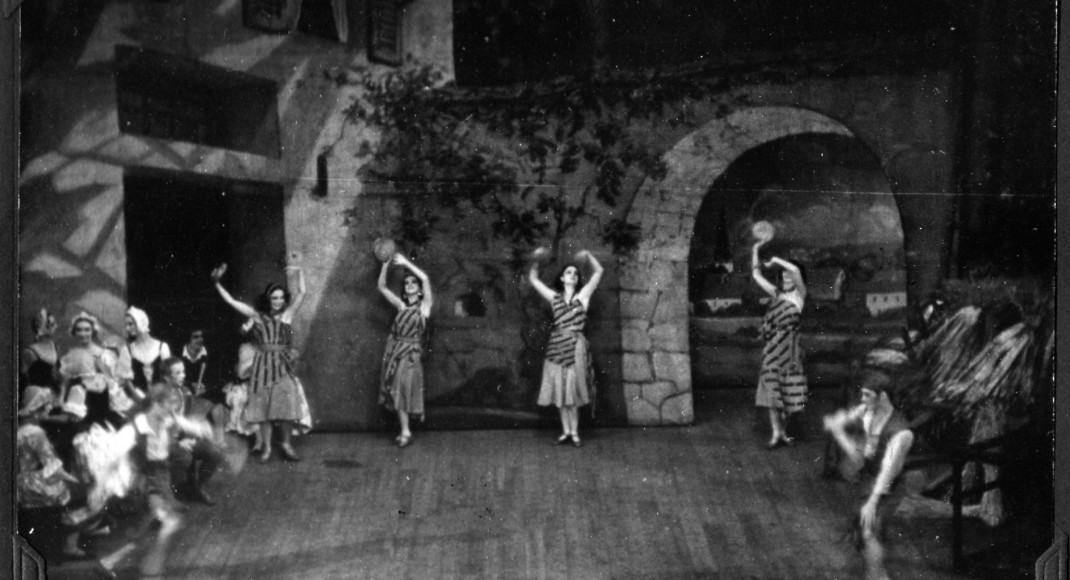
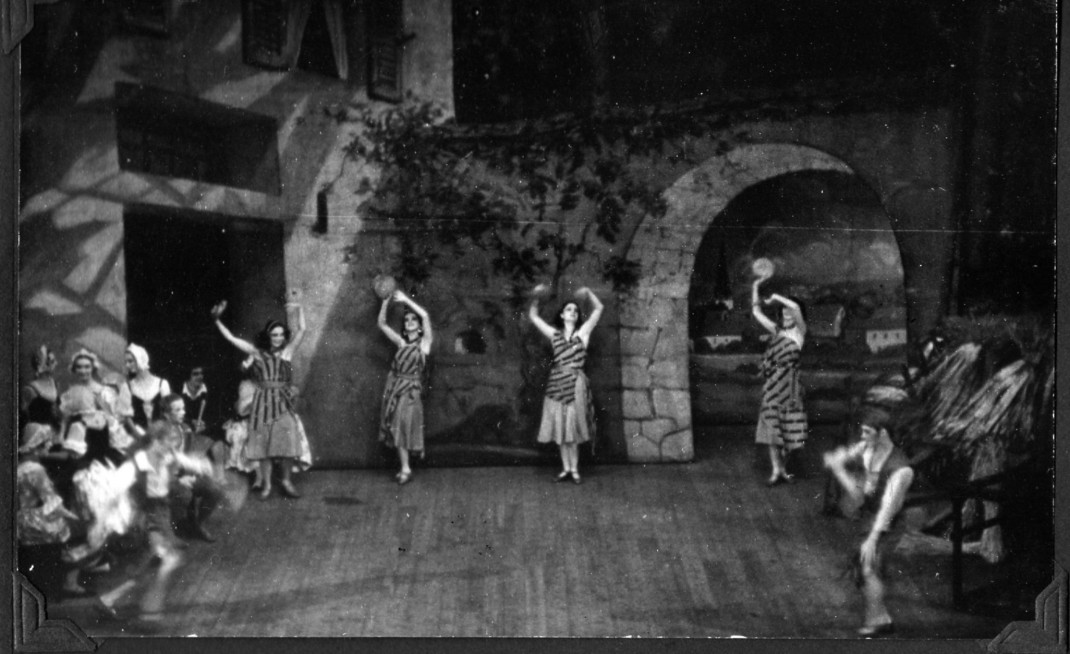
Featured image: Dancers of the Dandré-Levitoff Russian Ballet in La Fille mal gardée, 1934 or 1935. Tzigane group left to right: Vera Sevna, Eileen Keegan, Anna Northcote, Molly Lake. Personal archive of Anna Northcote (Severskaya). Private collection.
Most publicity related to the recent Paris Opera Ballet season of Anne Teresa de Keersmaeker’s Rain comments that the Belgian choreographer thought long and hard about having her work enter the repertoire of the Paris Opera Ballet. Would she or would she not agree to Brigitte Lefèvre’s request? Her vocabulary is just so different from that at the heart of the Paris Opera Ballet.
Reading these comments I thought about Merce Cunningham’s exquisite Summerspace entering the repertoire of New York City Ballet in 1966 and recalled that some Cunningham dancers say they sat in the theatre on opening night and cried as they watched it. I have never seen de Keersmaeker’s own company dancers perform Rain so I have no idea whether what I saw by the astonishing dancers of the Paris Opera Ballet would have induced tears in others. However, I know what reactions it elicited in me. Probably for the first time in my dance going career I felt that there was a real and palpable cross fertilisation between music and dance and that the design also contributed in its own way, all components advancing for me the simple idea of there being detail in detail.
Rain is danced to a score by Steve Reich, Music for eighteen musicians, pour ensemble avec voix, written in 1976, and the activity in the pit (and I had a seat close enough to have an excellent view of the musicians) was almost as good as what was happening on stage. The musicians of Ensemble Ictus and Synergy Vocals worked relentlessly to produce the sound just as the dancers worked relentlessly to put the choreography before us. Some, like the violinist, played pretty much constantly for the entire 70 minute piece, others occasionally changed positions in the pit or moved to play a different instrument. It looked as choreographed as the dance it accompanied.
From a dance point of view the work was full of the runs and falls, the off-centre leaning, the kicks of the legs, the pivots that we might expect of de Keersmaeker’s brand of dance. But the whole was beautifully arranged. Take the off-centre leans. They featured early in the piece but were picked up again towards the end of the work and repeated with arms lifted high rather than by the side. Devices of this kind featured throughout and gave the work a strong and logically organised internal structure within a seemingly random array of individualistic dance moves. The ten dancers, three men and seven women, demonstrated the innate ability that the Paris Opera Ballet dancers have to articulate movement in different parts of the body. Just as every note of music and every small change could be heard clearly, every minute change of movement had the essential clarity needed to make de Keersmaeker’s choreography detailed rather than seemingly repetitive
Danced within a large semi-circle of suspended ropes designed and lit by Jan Versweyveld, the work began and finished theatrically with the dancers appearing first and last to us as shadows behind the rope circle. At times throughout the piece they moved to the front of the stage and smiled out to us, inviting us to share what seemed to be a joyous experience.
Costumes by Dries van Noten were made of light fabric initially in honey shades. They moved freely and consisted of simple skirts and tops or shift-style dresses for the women and pants and shirts for then men. Like the music and the choreography they too underwent small changes. A light honey brown skirt was changed to a rose one; a pale T shirt became a fuschia coloured one; a light dress became magenta; until at the end all changes had changed again back to the honey shades of the beginning.
It was done without fuss and without excess. And it was simply beautiful.