Olga Spessivtseva. Her contract for Java and Australia

What treasures are still to be found in archival repositories around the world! Still on the trail of Olga Spessivtseva in Australia, I went through the process of gaining access to the archives of the museum and library of the Paris Opera, now part of the National Library of France. With formalities completed, I discovered, to my absolute delight, a folder of contracts for various of Spessivtseva’s engagements. Ít included a collection of documents relating to her engagement by Victor Dandré for the Javanese and Australian component of the 1934–1935 world tour by the Dandré-Levitoff Russian Ballet.

Several versions of the contract have been preserved, including some early versions heavily annotated in more than one hand. The earliest version indicates that Dandré began with the standard contract issued by Alexander Levitoff to other dancers in the company and altered that contract to suit Spessivtseva’s (and his own) requirements. Although no signed version exists in the collection, several copies of what appears to be the final version are intact. This version makes clear that the contract was a personal one between Dandré and Spessivtseva.

According to this final version, which is undated but from other contextual information in the Paris collection was probably written in June 1934, Spessivtseva was to leave Europe no later than 20 July 1934 to be in Batavia—present day Jakarta—before 15 August. Her contract was to begin on 15 August and was for a period of 20 weeks until 2 January 1935. It was to cover Java and Australia, or if required other countries (with the exception of Europe). The management reserved the right to extend the contract for a period of not more than 3 months, not including the return to Europe. This of course turned out to be a non-issue as Spessivtseva did not dance with the company after the Sydney season, which concluded on 28 November. She returned to Europe on the London-bound R. M. S. Orama, sailing from Sydney on 22 December.

Spessivtseva’s monthly payment under this contract was 15,000 francs (or the equivalent in foreign currency) payable fortnightly. While I have not yet been able adequately to compare this seemingly large figure with any average earnings in France in 1934, I found some evidence that in 1930 a French university professor was earning a monthly salary of around 4,000 francs. In addition, all Spessivtseva’s travel was to be in first class cabins, or sleeping compartments if travel was by train.

One has to imagine that Dandré cancelled Spessivtseva’s contract after Sydney, although there is as yet no evidence to support this. The Paris document stipulates, however, that the management reserved the right to terminate the contract if illness prevented the artist from taking part in performances for more than one week.

While much of the mystery of Spessivtseva’s Australian interlude still remains, this contract fills in a few more details of the puzzle.

© Michelle Potter, 8 June 2011

For related posts see the Spessivtseva and Dandré-Levitoff Russian Ballet tags. See also my extended article on the tour by the Dandré-Levitoff Russian Ballet published in Dance Research, Vol. 29, No 1, Summer 2011.
Ballo della regina, Live fire exercise, DGV. The Royal Ballet

10 May 2011, Royal Opera House, Covent Garden

Every time I visit London and am lucky enough to see a performance by the Royal Ballet I am bowled over. The recent mixed bill of Balanchine’s Ballo della regina, Wayne McGregor’s brand-new Live fire exercise and Christopher Wheeldon’s DGV (Danse à grande vitesse) simply reinforced my view that the Royal is at a high point in its career—so many dancers of star quality or star potential, a coaching team that appears to work on developing a clear understanding of what lies behind each work and great programming.

Balanchine’s Ballo della regina opened this program. On the night I went, leading roles were danced by Lauren Cuthbertson and Sergei Polunin. It was especially rewarding to see Cuthbertson take command of a role so closely associated with that great American ballerina Merrill Ashley, who created the leading female role in 1978. On stage Ashley always looked as American as apple pie, you might say, with her glowingly healthy face, her forthright (and fabulous) technique, and a kind of no holds barred, no nonsense approach. Cuthbertson, however, had a different approach. Ashley showed the steps, and how she showed them. Cuthbertson, with a lighter frame than Ashley, seemed to emphasis not so much individual moments but an overall fluidity. This is not to say that her dancing lacked highlights. Her ability to alter direction suddenly and to move with unexpected changes of speed was a real delight. And there was not a moment when she faltered. It was a great performance.

As for Polunin he had nothing to live up to as Robert Weiss, who partnered Ashley in 1978, never in my opinion really made the role his own. Polunin knocked me for six with his ability to cover space—the extension of the front leg in movements like grands jetés en avant was like an arrow speeding forward on a perfect course. And then there was the clarity of his beats and the perfection of his turns.

Four soloists—Melissa Hamilton stood out in particular—and a beautifully rehearsed corps de ballet made this Ballo a special treat.

Wayne McGregor’s Live fire exercise, made in collaboration with artist John Gerrard, on the surface could hardly have been more different. The starting point was a US army exercise in the Djibouti desert, a detonation designed to prepare troops for the physical effects of the mortar rounds or road side bombings they may encounter. A screen occupied a large part of the upstage area. On it was a projection of a desert scene and over time we saw the arrival of trucks and other machinery, a blast and the subsequent plume of fire and its smoky aftermath. In front of this video installation three men and three women performed McGregor’s demanding, highly physical choreography. In the background Michael Tippet’s Fantasia concertante on a theme of Corelli provided, almost as a juxtaposition, a kind of pastoral accompaniment.

McGregor’s choreography in Live fire exercise, showed his signature extensions with the dancers’ legs pushed high into positions that destroy the usual line of classical ballet, along with his approach to partnering with its emphasis on curved, twisted and folded bodies, and with his use of extreme falls. At one point Sarah Lamb performed a promenade in attitude on a bent supporting leg. She was supported in this by Eric Underwood who, once the circle of the promenade had been completed, swiftly lifted her and with a swirl threw her through the air. She travelled through the air, looking light as a feather with a perfectly held body, into the arms of another dancer. For me this moment put McGregor in a new light and his ability to use the classical vocabulary, and then to manipulate it became clear.

Overall, and almost unbelievably, the choreography seemed quite calm and considered. Throughout the piece single dancers occasionally stood quietly beside the video installation. They were lit so as to appear shadowy, isolated human beings figures against the plume of fire or smoke. They drew our attention from the choreography back to the footage and also served to remind us of the content of this footage and its underlying political message. Live fire exercise is the most personal of the works of McGregor that I have seen to date

In addition to Lamb and Underwood the cast comprised Cuthbertson, Polunin, Akane Takada, Federico Bonelli and Ricardo Cervera.

Closing the evening, Wheeldon’s DGV was something of a letdown. DGV is set to a score by Michael Nyman, MGV (Musique à grande vitesse), and draws inspiration from the idea of a journey with the French very fast train (TGV) the source of both Nyman’s and Wheeldon’s title. The work is essentially a series of four pas de deux with a corps to ballet of another eighteen dancers who often also work in pairs. It shows Wheeldon’s exceptional ability to create mesmerisng duets and his capacity to move large groups of people around the stage to create strong visual imagery. It was beautifully danced, especially by the corps and without a perfect corps the patterns falls apart, which they certainly didn’t on this occasion.

But I found the work a little repetitive and somewhat soporific. Maybe it was simply that it came after the McGregor with its underlying message of the politics of war? McGregor pushes his audience, Wheeldon doesn’t, or didn’t with DGV. Nevertheless DGV completed a wonderfully diverse and fabulously performed evening of dance.

Michelle Potter, 27 May 2011

Hélène Kirsova. Some problems with costumes

Back in 1995 I wrote an article on Hélène Kirsova for Dance Research. During the course of writing that article I came across a clipping in the Kirsova Archive held by the National Gallery of Australia, in which it was reported that Kirsova had had to postpone a Sydney season planned for September 1944 because she was unable to obtain the ration permit she needed to buy materials to make costumes. The article caused something of a stir and a rejoinder was published the following day from the deputy director of rationing, a Mr Hudson, who reported that Kirsova had in fact been given costume material far in excess of that given to any other similar company in Australia.

Recently a file held by the National Archives of Australia, Melbourne branch, in which the events are more fully spelled out became available and was brought to my attention. Perhaps the most interesting aspect of the correspondence contained in this file emerges from letters between Kirsova and the director of rationing, a Mr J. B. Cumming, written largely during August and September 1944. Cumming wrote to Kirsova early in August explaining that his advice was that the Kirsova Ballet was a non-commercial concern, similar in nature to the Borovansky Ballet and the National Theatre Ballet. Such companies, he noted, gave performances for charitable, educational or cultural purposes and as such had a maximum allowance of material imposed upon them. The correspondence pointed out that Kirsova donated the proceeds of her performances to a charity, as indeed she did. Kirsova had set up a charity to provide playgrounds for children in depressed inner city suburbs in Sydney.

Kirsova was, however, not impressed with the designation ‘non-commercial’ and she replied that the Kirsova Ballet ‘has been conducted on an entirely professional basis from its very inception and my dancers and all other artists are paid by me in accordance with existing Awards.’ She was at unhappy being classed with the Borovansky Ballet, which, she suggested, until the season sponsored by the J. C. Williamson organisation in 1944 had ‘never before toured or appeared outside Melbourne’ and had been conducted ‘on an entirely amateur basis, confining itself to an occasional presentation of a few performances and studio club concerts.’ Kirsova intimated that if she were unable to obtain the necessary permit her company would have to close down and in fact this is what happened. Although Kirsova was invited to submit a proposal for material required for the following year, in the end (after appeals to the Prime Minister on her behalf and further discussion about what constituted a professional company) the last performance by the Kirsova Ballet was the one that had taken place in Brisbane in May 1944.

There has always been speculation about why the Kirsova Ballet disbanded and this new correspondence adds fuel to the speculation that Kirsova was a determined woman and  not one to compromise. To be classed as an amateur company and to be put into the same category as the Borovansky Ballet was for her simply beyond the pale.

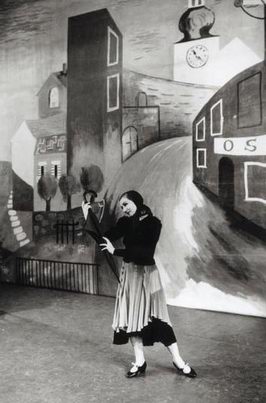
Hélène Kirsova in Revolution of the Umbrellas, 1944. Photograph by The Telegraph (Brisbane). National Library of Australia. Reproduced with permission

My original article, ‘A strong personality and a gift for leadership: Hélène Kirsova in Australia’, was published in Dance Research, Vol 13 (No. 2, Winter 1995), pp.  62–76.

See also ‘Permits for Kirsova Ballet Company’, National Archives of Australia, Series no. B5661.

© Michelle Potter, 19 May 2011.

British Liaisons. The Australian Ballet

14 May 2011, Opera Theatre, Sydney Opera House

This triple bill program, designed to highlight the strong links between British ballet and the growth of ballet in Australia, produced some moments that were absolute show stoppers.

None of those show stopping moments came, however, in Checkmate. Choreographed in 1937 by Dame Ninette de Valois as a battle between love and death played out on a chessboard, it opened the program. While for the most part it was adequately danced, it lacked any sustained suspense, which pretty much made a mockery of the whole thing. There is no doubt that Checkmate is an old fashioned work, highly stylised in its narrative and choreography. But some stronger characterisation, especially from Lucinda Dunn as the Black Queen, the seductress who ultimately brings about the downfall of the Red King, would have helped to make the work more enticing and anchored it in some kind of reality. Only Amy Harris as the Red Queen made anything of her role, a relatively minor one too, as she ushered in the Red King with kindness and concern. But without any strength of purpose from the other characters, Colin Peasley as the Red King had an uphill battle to make anything of his very important part.

But Christopher Wheeldon’s After the Rain, programmed as the middle piece, made up for the disappointments of Checkmate. The first section was strongly danced by Lana Jones, Amy Harris and Miwako Kubota partnered by Adam Bull, Andrew Killian and Brett Simon respectively. But it was the second section, the seductively beautiful pas de deux danced by Jones and Bull, that was the show stopper. Jones in particular captured the inner calm of this duet— ‘at the still point, there the dance is’ wrote T. S Eliot. Not only was Jones able capture the elusive quality of stillness and repose even as she moved or was moved by her partner, but with each lift one could only gasp at the curving line of her body as it cut through space until it reached the high point of the movement . There  it settled into its final, classically perfect shape. Bull partnered her with care and the tenderness that befits the emotional underpinning of the duet, but nothing could match the star quality of Jones.

Jones appeared again as the leading dancer in the first movement of Kenneth MacMillan’s Concerto, which closed the program. Here she showed another side of her technique, her clear, precise footwork and her ability to turn—especially her ability to turn as she executed a faultless series of chaîné turns across the stage from one downstage corner to the other. She also imbued her dancing in this movement with a beautifully pert quality bringing the audience into her ambit with smiling eyes and a sparkle to her every move. It made me long to see her dance the lead in Balanchine’s Rubies.

Concerto needed, however, a little more precision of technique from the corps de ballet to do justice to MacMillan’s spatial arrangements, which any straggly lines instantly destroy. And they were destroyed on more than one occasion. Juliet Burnett, however, made a strong impression with a beautifully controlled performance in the pas de deux that comprises the second movement. She was partnered by Andrew Killian who almost stole the limelight from her with his deliciously unexpected changes of expression and mood.

Company pianist Stuart Macklin deserves accolades too for his solo piano performances, first in Arvo Pärt’s Spiegel im Spiegel to which the pas de deux in After the Rain is performed, and then as soloist in the Shostakovich second piano concerto to which Concerto is danced.

At last, a few moments of excitement from an Australian Ballet performance. Oh that there could be more!

Michelle Potter, 16 May 2011

Bolero. Meryl Tankard & Régis Lansac

Bolero, by that remarkable duo Meryl Tankard and Régis Lansac, will have another European outing in April 2012. It will appear on a triple bill program by the Lyon Opera Ballet along with works by William Forsythe and Jiří Kylián. Is there any other Australian choreographer whose work can, over and over again, stand alongside those who are considered by most to be choreographic giants?

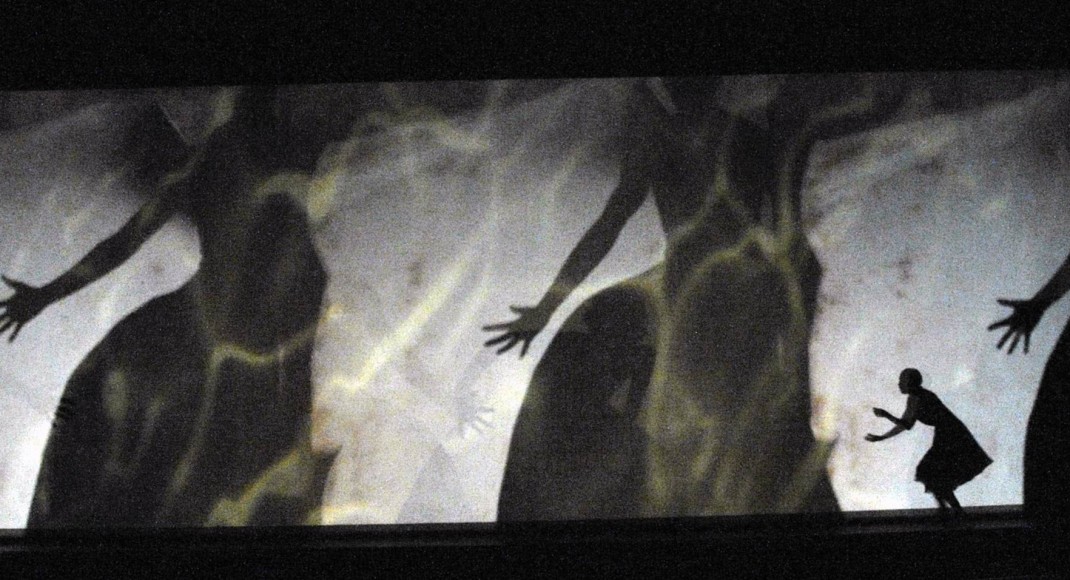
Bolero shows off Tankard’s capacity to create a vision of an ever-changing body in movement. It grows from earlier experiments with shadow play, which can be traced at least back to works made in Canberra—works such as Banshee and Nuti.

Bolero was first staged on commission from the Lyon Opera Ballet in 1998 shortly after Tankard had been dismissed as artistic director of Australian Dance Theatre. Its opening scene recalls a Javanese shadow play. Shadows in profile, delicately costumed in bell-shaped skirts with fretted designs are images of real dancers who are hidden behind a screen. As these dancers move across the stage space, they hold their arms in a way that casts two dimensional shapes onto the screen. They move jerkily through images of shadowy columns and disappear behind what appears to be the narrowest of slits between two architectural columns. They then re-emerge from this slim, vertical strip of light, and pursue their crossing of the space.

However, as the work proceeds—and it is performed entirely as a shadow play—the feeling of artificiality disappears. A feeling that this is a real world emerges, even though the audience is still involved in watching bodies behaving in mysterious ways. At one stage a man and a woman engage in a romantic interlude that changes emotional direction and ends with her being pushed to the ground. As she falls to the ground the floor swallows her up. The shadow of her body simply disappears from view. Further into the piece a Spanish dancer is joined by a headless woman and they dance alongside each other.

Set to the driving rhythms of Ravel’s Bolero, the dance gathers momentum along with the music. As both music and dance move to an inevitable climax, shadowy figures change size and shape and position. Some scurry across the space, some move with relentless slowness. There are multiple manifestations of the one figure. Frenzy and control. It is a technical tour de force for Lansac and a work in which the collaboration between Tankard and Lansac reaches a high point. The work was restaged in 2003 in Sweden by the GöteborgsOperans Balett but has never been seen in full in Australia.

© Michelle Potter, 25 April 2011

Featured image: a moment from Bolero. Photo: © Régis Lansac

.