The Oracle. Meryl Tankard

19 september 2009, The Playhouse, Sydney Opera House, Spring Dance

The Oracle, Meryl Tankard’s work set to Igor Stravinsky’s Rite of Spring, is a triumph. A solo work for Paul White, who dances with astonishing physicality and intensity, it is an example of how affecting a work can be when the creative team has a strongly shared vision and works single-mindedly to bring that vision into being. The Oracle was visually and choreographically focused and articulate. It moved from section to section as relentlessly as the music until it reached its dramatic conclusion.
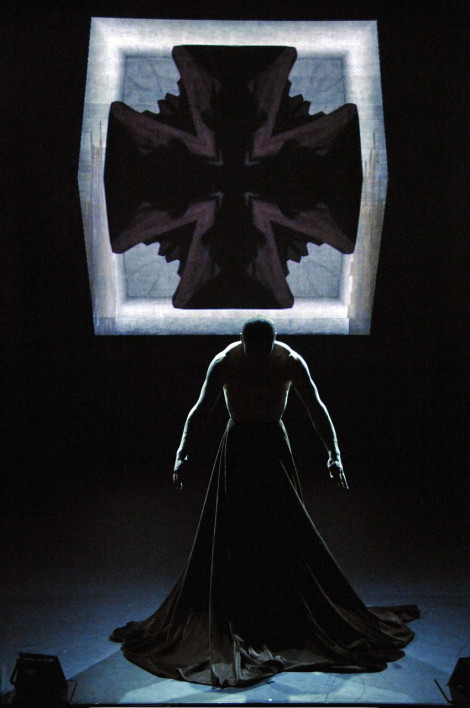
Paul White in The Oracle. Photo: © Régis Lansac, 2009

Tankard’s choreography, with shared credit to White on the program, moved between small and intricate movements of the hands and fingers and even of the tongue, which required sensitivity of the smallest body part, and movements that demanded that White fling himself through the air, while always maintaining absolute control of the whole body as it hurtled through space. Introverted movements, sometimes executed with the dancer’s back to the audience or with his head shrouded in a chocolate-coloured length of velvety cloth, contrasted with steps of exceptional virtuosity, exuberance and extroversion. Some sections were acrobatic—at one stage White walked on his hands—others had a strong classical feel. This choreography required an extraordinarily versatile performer and White’s performance was quite simply a tour de force.

Tankard assembled The Oracle following the structure of the Stravinsky score but, in her hallmark manner, it was built on multiple layers of meaning and allusion. There were emotive links to Nijinsky, who first gave choreographic expression to Stravinsky’s Rite of Spring in 1913. They were noticeable in some of the choreographic phrases, which seemed to refer back to Nijinsky’s movement phrases created for his own Rite of Spring. They were also noticeable in those moments when White seemed to be lost in a surreal world, which recalled Nijinsky’s descent into mental illness in the later years of his life. There were allusions to Martha Graham’s well known work, Letter to the World, in which she used her long skirt to give extra shape and form to her choreography. White used that long, chocolate-coloured swathe of velvet not this time to cover his head but as a skirt tied to his waist. He made it swirl through the air as he cart-wheeled and jumped and manipulated it across the floor as he slithered and twisted. The work drew on other sources of inspiration from the work of Norwegian artist Odd Nerdrum to Swedish film director Ingmar Bergman. But The Oracle is absolutely Tankard’s own. One of her great strengths as a choreographer is to make references while maintaining an individual integrity.

Regis Lansac, working again with Tankard as he has done over many years on set and video design, created an opening video sequence to a soundscape of whistling and other mechanical sounds and a recording of Magnificat by the Portuguese composer of the baroque period, João Rodrigues Esteves. This sequence picked up on aspects of the choreography and on images of White and manipulated both to explore a different view of the human body. It seemed also to set up a dance of its own that moved from the figurative to the abstract and back again melding and confusing the two ideas. At times throughout the piece Lansac’s projections and video sequences provided an evocative background. At other times they became essential to the unfolding of the dance, especially in those moments when White encountered his image on the backcloth and needed to contend with what he saw.

The Oracle was lit by Damien Cooper and Matt Cox. Highlights included the Rembrandt-esque lighting of White’s face, arms and legs in the opening moments; the expanding and contracting circle of light around whose circumference White made a slow and tentative progression; and the breathtaking closing moment as White, centre stage, jumped high into the air as a shaft of brilliant light closed down upon him.
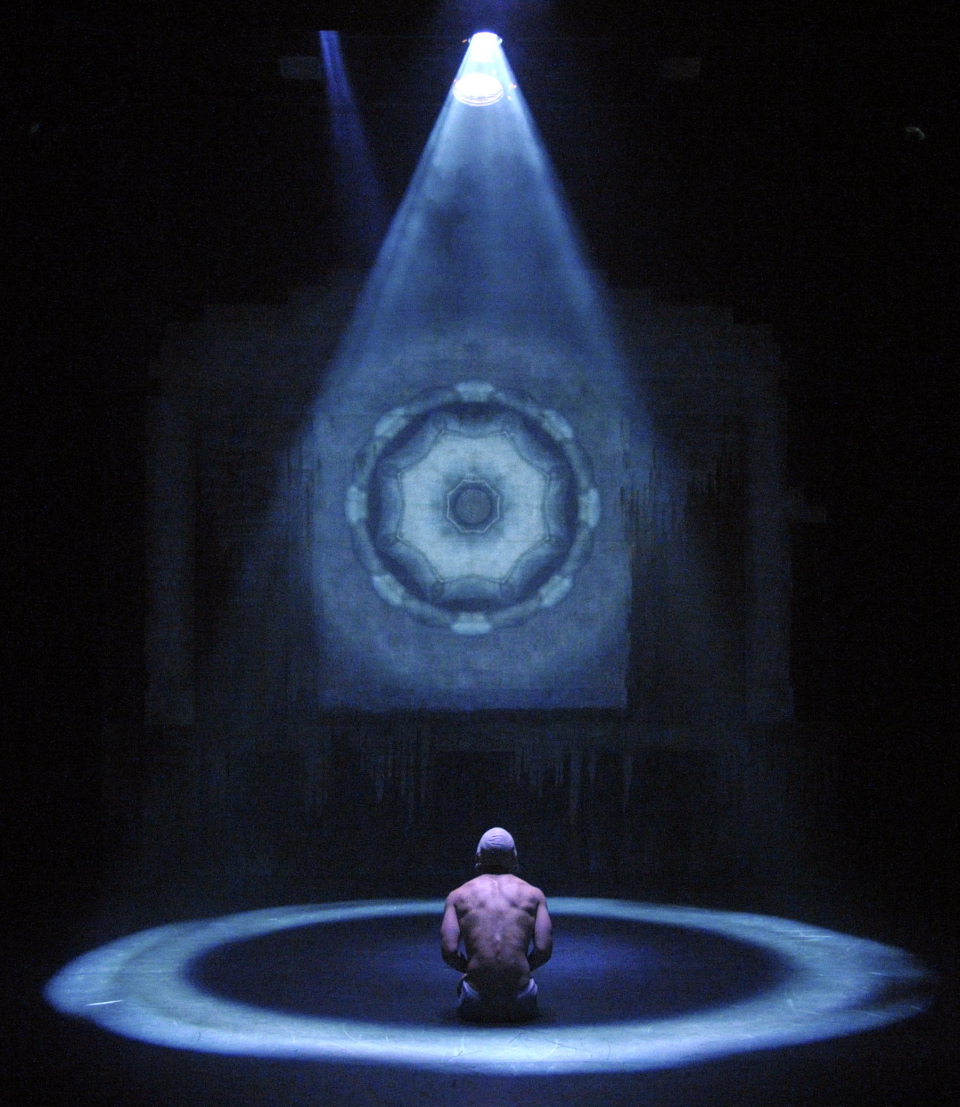
Paul White in The Oracle. Photo: © Régis Lansac, 2009

The Oracle shows the collaborative work of Tankard and Lansac at its best. It is an awesome piece of dance and theatre and was received with well deserved shouts of bravo and a standing ovation at both performances I attended.
Michelle Potter, 21 September 2009

Concord. The Australian Ballet

Por vos muero, Scuola di ballo & Dyad 1929, 21 August to 1 September 2009, State Theatre, Victorian Arts Centre, MelbourneJ

The Australian Ballet finally hit the jackpot! In the dying months of its four year long celebration of the Ballets Russes, Wayne McGregor arrived in Melbourne and created his Dyad 1929—a work that is truly in the adventurous spirit of the Diaghilev period.

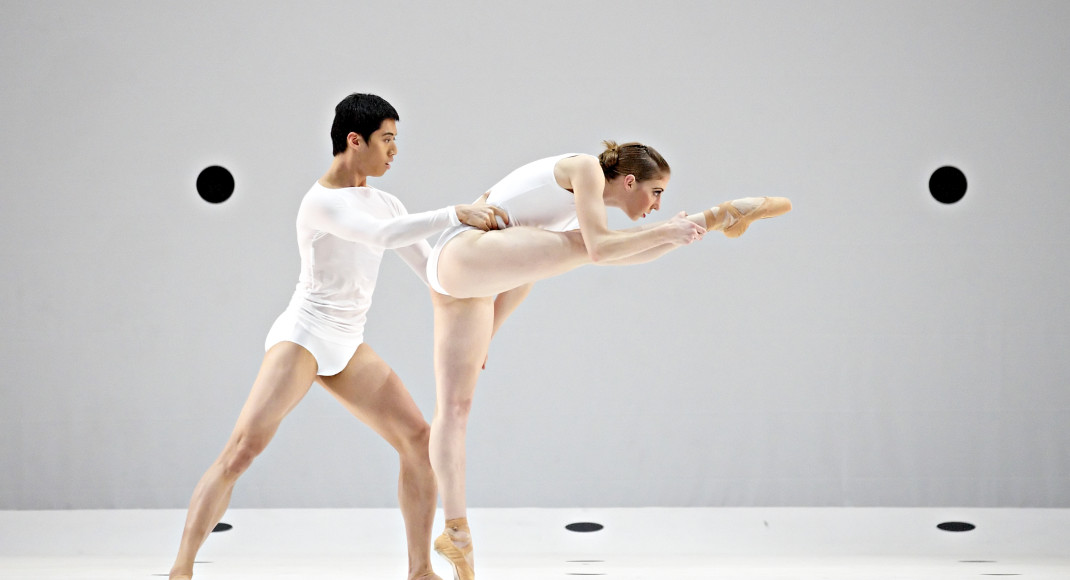
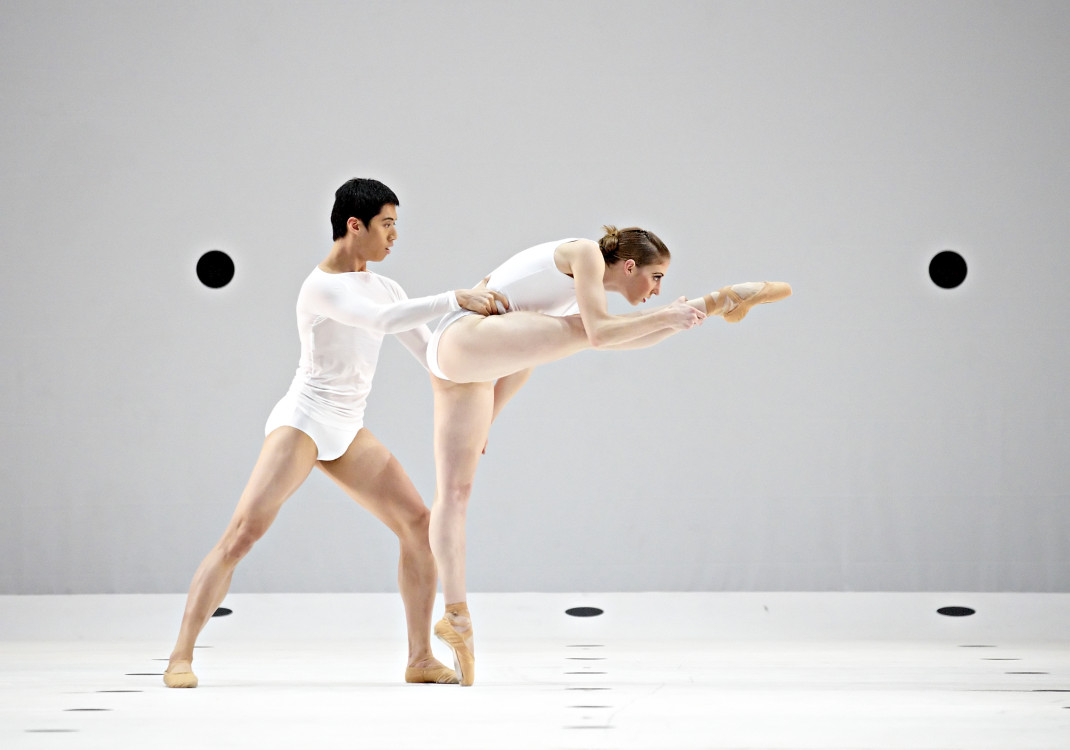
Dyad 1929 is made for a cast of twelve dancers, six women and six men. It is danced against a white backcloth, patterned all over with regular rows of black dots, which extends to a floorcloth. A thin horizontal bar of acid yellow light is raised and lowered in the extreme downstage area during the piece. Occasionally yellow light floods onto the backcloth. This ‘stage concept’ is by McGregor and the work’s lighting designer Lucy Carter. The dancers are costumed by Moritz Junge in close-fitting leotards, or all-overs, or trunks and tops in various combinations and patterns of white, black and fawn. The overall design concept is startling and exhilarating, as is the music—Double Sextet by Steve Reich.

But it is the choreography that lifts Dyad 1929 beyond the startling to the brave and the challenging. There is a matter-of-factness in the way the dancers enter and leave the stage. A la William Forsythe they walk, simply but decisively, on and off. Once on, however, their bodies become an experimental field. They are pushed, pulled and stretched. They crumple, bend and fold. Sometimes the movements look hard-edged. At other times they look more curvaceous. And what seems quite extraordinary is that often movements that are commonplace in a particular situation are put into completely new context. A stretching exercise commonly done at the barre becomes part of a duet, for example. And again extraordinarily, McGregor occasionally follows a twisted movement with a classical, centred one so that the eye can better discern what is central to each.

Standout dancers in two viewings were Lana Jones, cool and poised in a duet with Tzu-Chao Chou, and Danielle Rowe, more softly sinuous in a duet with Adam Bull—Jones a diamond, Rowe a pearl, both using their prodigious technical capacity to dance this audacious and demanding choreography. They dance purposefully, but also with what borders on ecstasy so intently and intensely do they articulate the choreography. This is what dancers crave: to be challenged to use their bodies to do the seemingly impossible, and thus to understand more about their art form.

This triple bill with the overarching name of ‘Concord’ opened with Nacho Duato’s sublime Por vos muero. Por vos remains a compelling work swinging between a stripped back look at human relationships, which we see in the three duets that open the work, to highly theatrical moments as in the scene in which six men in brocade cloaks swirl across the stage swinging censers that fill the air with incense. Daniel Gaudiello gave a particularly strong performance. It highlighted all the remarkable nuances of Duato’s choreography.

The third work on the program, also part of the Ballets Russes project, was a new production of Léonide Massine’s 1933 work, Scuola di ballo, in this case  choreographed by Alexei Ratmansky. Ratmansky adhered to the narrative and choreographic structure of Massine’s work but, in terms of movement, the work looked more like a homage to August Bournonville. Ratmansky emphasised beaten footwork for the men and his pas de deux contained very few lifts, especially big overhead lifts. In typical Bournonville style the man for the most part danced alongside his partner. This was especially noticeable in the pas de deux between the characters Rosina and Carlino, which was prettily danced by Leanne Stojmenov and Daniel Gaudiello in one cast and Danielle Rowe and Ty King-Wall in another.

Scuola‘s comic elements were a hit with the audience but I am not convinced that attempting to reproduce what was clearly not Massine’s best ballet was a worthwhile endeavour. What it did was remind me that not all ballets from the Ballets Russes era (whether from the Diaghilev period or from that of his followers) are worth recalling. Restaging or reproducing works as museum or celebratory pieces only works if the original was a piece of major importance in the first place. I don’t believe that Scuola di ballo was. Ballet has moved on. Thankfully.

And thankfully there are choreographers like Wayne McGregor to show that the way ahead can be as adventurous as it was under Diaghilev.

Michelle Potter, 23 August 2009

Featured  image: Tzu-Chao Chou & Lana Jones in Dyad 1929. Photo: © Jim McFarlane. Courtesy of the Australian Ballet

Footnote: Showing in Melbourne at the same time as ‘Concord’ is an exhibition documenting the career of Salvador Dali. Included in the show, which is at the National Gallery of Victoria, is film footage of Massine’s 1939 collaboration with Dali on the ballet Bacchanale for Sergei Denham’s Ballet Russe de Monte Carlo. It makes an interesting comparison with Scuola di ballo and comments on Bacchanale and its reception by Frederic Franklin, one of the original cast, are  easily found via any search engine and are eminently readable.

Select option. Quantum Leap

29 July 2009, Playhouse, Canberra Theatre Centre

The dancers of Quantum Leap, the pick-up company of QL2 Centre for Youth Dance in Canberra, are not professional although their enthusiasm for dance is palpable. But the choreographers with whom these young dancers work each year for their annual project are professional. So any review of Quantum Leap is really a review of whether the choreographers have the understanding and expertise to harness raw energy and a varying range of skills to produce a coherent piece of work that maximises what these young dancers have to offer. This year the theme of the project was choice and, although the results were, as ever, uneven, some moments were remarkably successful.

Liz Lea’s contribution, Select Red, was for me the undoubted stand out section. Lea chose to work only with female dancers and drew on the stylised movements and poses that have featured in her works about extraordinary female dancers—such as Ruth St Denis—of the early twentieth-century. The dancers needed to move in unison and yet look individualistic and even idiosyncratic and they responded beautifully. Lea’s choreography had a calmness and velvety smoothness to it and again the dancers responded. Not all the dancers, however, had the maturity and sophistication to carry off the move from this first part of the piece to the second, which showed the individual choices they had gone on to make about dress (always red), movement and general lifestyle. Nevertheless, the point was made.

The second act featured some exceptionally energetic dancing choreographed by Marko Panzic and Reed Luplau, although it was not always clear which choreographer had contributed what. Perhaps the most exhilarating section was a vignette featuring twelve male dancers, performing with what can only be described as total passion, and dancing to assorted Latin rhythms. Again the choreographer had chosen well as far as dancers were concerned. The the loose-limbed, fast and furious dancing, which largely happened in nothing more than a line across the front of the stage, was vibrant and rousing.

QL2 has a strong collaborative model at work with its annual shows. The two composers working with the company on this occasion, Nicholas Ng and Adam Ventoura, each produced an original score. Each was startlingly different from the other—a great experience for the dancers. Costumes were by Eline Martinsen and worked especially well in Select Red where small touches of red on the largely black outfits in the first section gave just a hint of what was to come later. Lighting designer Kaoru Alfonso also made an important contribution and again it was in Select Red that his designs were most effective. And for once the video footage that accompanied each piece was not intrusive but supported the works.

Michelle Potter, 2 August 2009

Featured image: Liz Lea’s Select Red. Photo: © Lorna Sim. Courtesy QL2 Centre for Youth Dance

A Feast of Wonders

A Feast of Wonders: Serge Diaghilev and the Ballets Russes
Edited by John E. Bowlt, Zelfira Tregulova and Nathalie Rosticher Giordano (Milan: Skira, 2009)

In this very handsome volume published in conjunction with the exhibition Étonne-moi: Serge Diaghilev et les Ballets Russes, which opened in Monaco on 9 July 2009, Alexander Schouvaloff has an essay entitled ‘The Diaghilev Legend’. In it he remarks on the ‘continued fascination’ with the Ballets Russes. He writes, ‘It is puzzling. Artifacts and records remain to obsess scholars.’ Well, the contents of this book make his use of the word ‘puzzling’ a puzzling one indeed.

The publication contains, in addition to the Schouvaloff piece, eleven other essays most of which develop their topics in contexts that have not previously been widely examined in the existing English writing on the Ballets Russes. For example, Nicoletta Misler’s ‘Dance, Memory! Tracing Ethnography in Nicholas Roerich’ draws on a wide range of Russian sources to examine Roerich’s use of shamanistic and similar imagery, particularly in his designs for Le Sacre du printemps. Then, Evgenia Iliukhina traces the roles of Mikhail Larionov and Natalia Goncharova in the Diaghilev enterprise. She notes Goncharova’s sources and the influence of other artists on designs for her major pieces, including those works, such as Liturgie, which were not realised but which nevertheless were significant developments. Iliukhina also looks at Larionov’s interest in choreography and the evolution of his attitude to the role of design in ballet. The article rightly positions Goncharova and Larionov as major artists in the post 1914 period of the Ballets Russes and as more than simply successors to Bakst and Benois.

These articles, and others of equal interest, suggest that the ‘continued fascination’ will last for decades yet, especially when there is still much primary source material awaiting the attention of scholars. Despite the fact that 2009 celebrates the centenary of Diaghilev’s first Ballets Russes season in Paris, it is clear that there is still much to be discovered and written about. And to return to Schouvaloff, if one follows his instructions regarding the ‘Find a grave’ website, which he gives at the end of his piece, it is clear too that Diaghilev’s charisma has not waned.

In addition to the essays, the book contains a list of operas and ballets for which Diaghilev was responsible. The list begins in 1908 with Boris Godounov and ends in 1929 with Le Bal. Its strength, or its particular interest, is the way in which the list is illustrated – not with a single image but usually with several from a variety of sources and of different media. So we have Le Coq d’or illustrated with set designs, set models, costumes, costume designs and photographs. The illustrations for Le Spectre de la rose include swatches of fabric, paintings, posters, costume designs, designs for stage props, photographs and sketches. The list is made all the richer as a result of this diverse illustrative material. In fact illustrations throughout the book are themselves a feast of wonders and go well beyond those that have become so familiar in the current literature.

The introductory pages contain a long list of lenders to the exhibition, which will move to Moscow in October 2009. The list of lenders, private as well as institutional, is interesting in its scope as well as for the one or two major collections that are not represented.

A Feast of Wonders is a beautifully and meticulously produced book and a delight both visually and intellectually—much more than an accompanying catalogue.

Michelle Potter, 26 July 2009

La Fille mal gardée. Paris Opera Ballet

14 July 2009. Palais Garnier, Paris

It was le quatorze juillet. The orchestra of the Opéra national de Paris began the evening with a remarkably stirring rendition of La Marseillaise. The audience applauded loudly and shouted Vive la France! It set the scene for an equally stirring performance of Frederick Ashton’s La Fille mal gardée.

Although Ashton’s version of Fille entered the repertoire of the Paris Opera Ballet only in 2007, the ballet has strong French roots that can be traced back to 1789 when a work called Le Ballet de la paille took the stage of the Grand-Théâtre of Bordeaux. Subsequently, a number of choreographers created their own versions before Ashton choreographed his production in 1960 for the Royal Ballet.

Ashton’s choreography gave the dancers of the Paris Opera Ballet every opportunity to show their technical capacity for fast and precise footwork and their glorious adherence to the classical way of moving. On show too was their ability to give an individualistic interpretation of a role. The Widow Simone who, in what no doubt was a one-off patriotic moment on the French National Day, waved a tiny French flag as she made her first appearance was a case in point. Stephane Phavorin was to a certain extent the flustered pantomime dame but absent (thankfully) was the high camp interpretation that one often sees. Similarly, Simon Valastro as Alain gave a thoughtful portrayal in which he managed to convince us that he was not so much an imbecile as simply someone incompetent of functioning in the society in which he found himself. The difference is perhaps subtle but this Alain was not entirely brainless.

As Lise, Dorothée Gilbert displayed the brilliant technical capacity and the clarity and expansiveness of movement that one has come to expect from étoiles with this remarkable company. Coupled with her beautifully expressive upper body and her sheer delight in dancing, she was everything one could hope for as Lise. Her mime scene in Act II where she imagines herself married to Colas was tenderly moving and the pas de deux in this act was danced with just the right dreamy quality to display Ashton’s choreography to perfection.

Gilbert was partnered by Mathias Heymann as Colas who like his colleagues showed himself every bit an étoile. This is a company of outstanding artists.

Michelle Potter, 16 July 2009

Swans and Firebirds

Swans and Firebirds (Schwäne und Feuervögel)
Austrian Theatre Museum, Palais Lobkowitz, Lobkowitz Platz 2, Vienna, 25 June to 27 September 2009

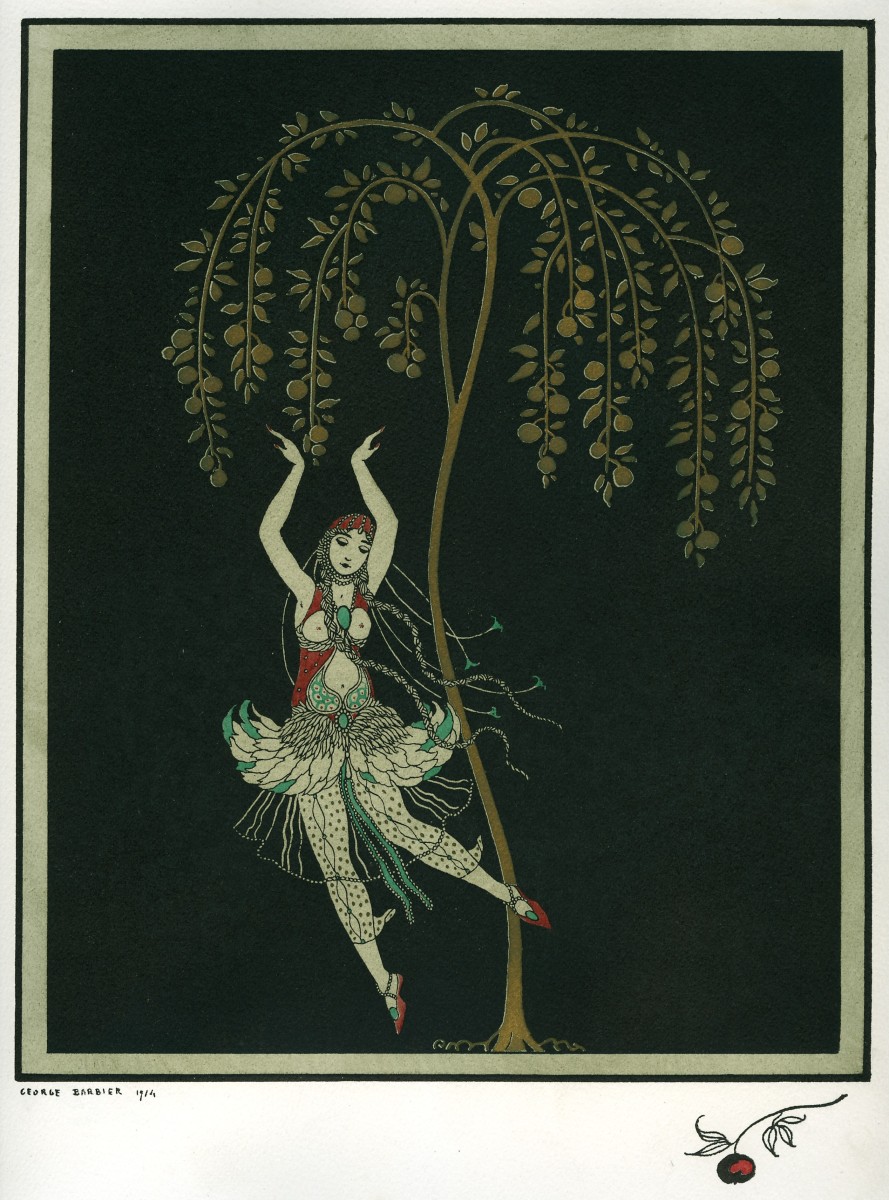
Georges Barbier, ‘Tamara Karsarvina in The Firebird‘, pochoir print from the series Homage to the Ballets Russes, after 1914. Collection: Derra de Moroda Dance Archives, Salzburg.

Like many other museums, galleries and libraries around the world, the Austrian Theatre Museum in Vienna is staging an exhibition to mark the centenary of the first Paris season of Diaghilev’s Ballets Russes. Although this exhibition carries a sub-title ‘Die Ballets Russes 1909-1929’ it uses the  term ‘russes’ in a wide sense as the exhibition includes material not strictly speaking from the Diaghilev enterprise as we have come to understand it. Jointly curated by Drs Claudia Jeschke and Nicole Haitzinger from the University of Salzburg, it draws for its material on the collections of a number of institutions, largely in Russia, Germany and Austria, and one major private collector, John Neumeier.

The exhibition suffers at the outset from being displayed very awkwardly in two rooms at the far end of the main entrance to the Palais Lobkowitz. The two rooms are on opposite sides of the entrance lobby and  thus are not obviously linked except perhaps in an architectural sense. Combined with pretty much non-existent signage, this physical arrangement makes for a disorienting experience for the exhibition viewer.

One finds oneself moving fairly logically, or snake-like, from the central space at the end of the lobby, which is devoted to material from Polovtsian Dances from Prince Igor, into the first room to the right. This first room focuses on the notion of ‘white’ and includes material from Les Sylphides and, mysteriously given the white tag, Diaghilev’s 1920s production of The Sleeping Princess. Other material relates to The Dying Swan and includes an interesting reconstruction of the swan tutu as worn by Pavlova in this celebrated solo. A video screening in this room—a dancer from the Bayerisches Staatsballett dancing the waltz from Les Sylphides—is a problematic inclusion. The amplified sound of the dancer landing after the many jumps in this solo is unpleasant, spoils the sound of the accompanying music and does little to evoke the poetic qualities of Les Sylphides. It does nothing for one’s perception of the dancer’s skills either.

Moving to the second room is not a logical progression from the first and initially the impression is that the exhibition finishes with the white material. Once one discovers the second room, on the left of the main lobby, the two other organising concepts—’unicolour’ (einfarbig) and ‘multicolour’—enter the equation. Designs for Petrouchka and Coq d’or are major items in the multicolour section and lead on to Natalia Goncharova’s beautiful drawings and extensive notes for the unrealised ballet Liturgie. Beyond Liturgie is material relating to Le Sacre du printemps and Les Noces, including a rare and valuable glimpse of the progression of Goncharova’s work for Les Noces from early designs in the Russian Primitivist mode to the final stripped-back designs. But the three colour codings—the organising concepts—are forced. The material to my mind is pushed to fit the concepts rather than emerging from them. Much of the material doesn’t seem to fit well anyway. This includes some quite fascinating notations (in facsimile) from 1910 by Fokine for Firebird from the St Petersburg State Theatrical Library.

But perhaps the most frustrating aspect of this second room is a loop video, which purports (according to the wall label) to show two recordings of George Balanchine’s Apollo each of around 30 mins in length. Sadly, however, all that is playing is about 3 minutes of a Radio Canada recording made in March 1960 with Jacques d’Amboise as Apollo and Diana Adams, Francia Russell and Jillana as the Muses. A great cast. But it got to where Apollo receives his lyre and holds it up to start playing only to return to the opening moments of Apollo’s birth from where it continued again to the receiving of the lyre. And nothing of the second recording.

Looking more positively, there are some wonderful items in the exhibition and many of them belong to John Neumeier. In fact, the strength and individuality of Neumeier’s collection is perhaps the outstanding aspect of this exhibition. In the pre-exhibition space—that is in the space between those two annoyingly unlinked rooms—there is a beautiful bronze sculpture of Adolphe Bolm in Polovtsian Dances. It stands about 25 cm high and is mounted on a small wooden plinth. It captures the passionate movement of Polovtsian Dances beautifully. Also from Neumeier’s collection is a hat by Léon Bakst for Tamara Karsarvina in Firebird—a pert little skull cap in green and tan with a white feather perched on top. Although designed by Bakst, it is in many respects one of those devotional items that so often grace dance exhibitions rather than an art historical piece. With the inclusion in the show of many photos of Karsarvina as well as designs for costumes she wore, this little cap seems to embody the spirit of its original wearer. Also of considerable interest are several photographs taken in Paris in 1910 by Auguste Bert, most again from the Neumeier collection. They include one of Vera Fokina as the Tsarina in Firebird. She stands with her body turned just slightly off-centre. Her head tilts softly to the left, her chest lifts and her hands gently lift her hair from her shoulders. This and other photographs by Bert have a soft, expressive quality and a sense of light movement to them. They are an absolute delight to examine and very revealing of this photographer’s approach to dance as an expression of the age.

There is a catalogue to this exhibition. Unfortunately there are a number of oversights in its production. Perhaps the most frustrating is that the images are not credited adequately – a final frustration in an exhibition that really needed to have been curated and produced more rigorously.

Michelle Potter, 1 July 2009

Newcomers to Graeme Murphy’s Nutcracker

Nutcracker: The Australian Ballet, Sydney and Melbourne, 2009

The 2009 season of Graeme Murphy’s Nutcracker: The story of Clara has all but convinced me that this work is the closest thing we have in Australia to a dance masterpiece. It is, like all great works of art, a very giving work. It continues to reveal new layers of meaning with each viewing, and it continues to reveal those layers at every level—dramaturgically and choreographically as well as in terms of its visual impact and historical underpinnings. Now we are also in the fortunate position of having had this ballet staged by the Australian Ballet in four separate seasons over seventeen years. Its inaugural season in 1992 was followed by restagings in 1994 and 2000. So, in 2009 there is an opportunity to reflect on how this ballet has grown and been interpreted over those seasons.

Two newcomers to the ballet stood out in this 2009 season.

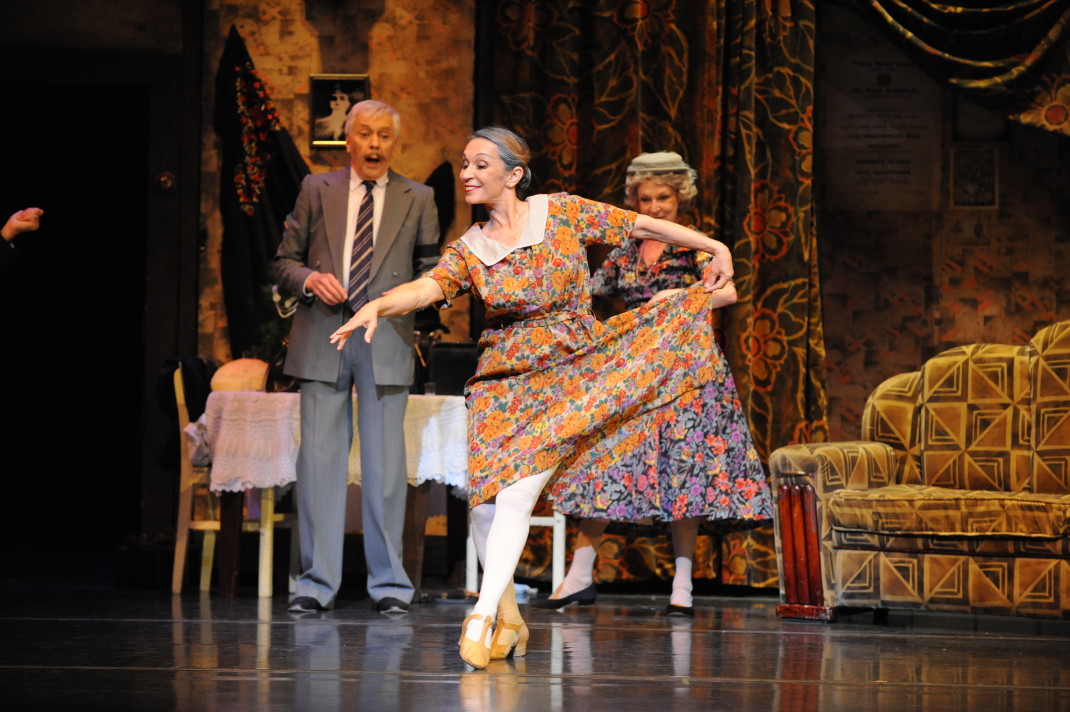
At the centre of the work is the character of Clara the Elder, a now-retired elderly woman who is still in her heart a dancer. It is her story we watch unfolding before us, her destiny and ultimately her death. In the 2009 season Marilyn Jones and Ai-Gul Gaisina, both now in their late sixties, were cast to alternate in this important role. For those of us who had watched the two original Elder Claras—Dame Margaret Scott and Valrene Tweedie—it was hard to imagine that anyone could bring such depth of characterisation to the role as these two did. But Gaisina, Russian-born and Russian-trained, seemed as though she was born to dance the role. She had all the elegance of a ballerina, which indeed she was when at the height of her career. There was also a certain flamboyance in the flick of a wrist or a tilt of the head that gave her dancing a particularly Russian flavour. This, combined with a special way of interacting with her fellow cast members so that eyes met eyes and looking meant seeing, made her performance a moving and utterly believable one. She also imbued the role with an edge of humour. It was quite understated and perhaps it was more a taking of pleasure in the role than anything else. But it was clearly there and very noticeable in Act I as she entertained her Russian émigré friends. It allowed us to sense that we were watching a real life story unfold before us.

Ai-Gul Gaisina as Clara the Elder in Nutcracker: The story of Clara Act 1. The Australian Ballet, 2009. Photo: © Branco Gaica

The other outstanding performance in the casts I saw came from Leanne Stojmenov as Clara the Ballerina. Stojmenov is now fulfilling the promise that marked her performances with West Australian Ballet as a new and very young member of the company in 1999 and 2000. She has such a strong and sure technique and handled the intricacies of Murphy’s choreography with aplomb and apparent ease. Her grand pas de deux with Marc Cassidy was thrilling and in the pas de deux between Clara and her Beloved Officer, although partnered very shakily by Yosvani Ramos, Stojmenov showed her growing ability to create dramatic tension through the use of the whole body. It augurs well for her future.

It is incredibly satisfying to have Murphy’s Nutcracker return to the stage. It is one of the great treasures of the Australian Ballet’s repertoire and a work that allows us the rare pleasure of being able to look back at an Australian work and compare and contrast.

Michelle Potter, 9 June 2009  

Body Torque 2.2. The Australian Ballet

27-30 May 2009, Sydney Theatre, Walsh Bay

Two works saved the Australian Ballet’s 2009 Body Torque season from drifting totally out of the memory the minute the curtain came down. They were Reed Luplau’s Bleecker and Remi Wortmeyer’s Fade Not. Both Luplau and Wortmeyer made very different works in every sense imaginable, but both were able to grab the audience’s attention from the opening moment and hold it throughout. Wortmeyer’s Fade Out was very short—probably no longer than three minutes; Luplau’s was a little longer. But both choreographers stood apart from the others in that neither tried to say too much in the amount of time they had given themselves. Both had thought through a basic premise and moved forward with a strongly focused approach.

Bleecker, named after a well known street in Greenwich Village, New York, showed the influence of Luplau’s work with Sydney Dance Company in its recent post-Murphy iteration, especially in terms of vocabulary. The dancers moved in a physically extreme manner, well away from the balanced, centred, refined look we are accustomed to seeing at the Australian Ballet. And what a gutsy performance from Dana Stephensen, the one female in the cast of four. Luplau’s choreography poured out of her body, making dance look like the kinaesthetic art that it is. She was more than ably accompanied by Andrew Killian, Rudy Hawkes and Andrew Wright.

Luplau says in his choreographic statement that Bleecker is ‘a journey of self discovery’, and he reflects that there is ‘a certain captivating moment you experience as you explore one of the world’s greatest cities’. Well Bleecker was a captivating moment in Luplau’s journey as a choreographer. We can only hope that the journey will be an ongoing one.

Wortmeyer’s Fade Not began with the piercing and unexpected sound of a human voice and the piece was a courageous experiment at linking dancer and singer, movement and voice. Wortmeyer used a librettist, Malcolm Rock, whose written words telling of a dying mother’s wish to see her newborn child flourish in life were sung onstage by Naomi Johns. Wortmeyer choreographed Johns into the work without it seeming unnatural or contrived and, while his choreography for the leading (and only) dancer—an able Gina Brescianini—was classically based and without any real sense of invention, the work generated an innate sense of clarity and harmony.

Three other works completed the program: Damien Welch’s Chemical Trigger, notable for the fact that Welch composed the music as well as the choreography, Robert Curran’s Veiled in Flesh, and Kevin Jackson’s Enter Closer.

Body Torque has been a feature of the Australian Ballet’s annual season for a number of years now and is the most recent development in a long line of similar Australian Ballet workshop activities dating back to the earliest days of the company under Peggy van Praagh. Choreographic workshops need strong direction however and only Bleecker and Fade Out looked as though they had been subjected to any sort of rigorous discussion with peers and elders before being put on the stage.

Michelle Potter, 1 June 2009